Most of us assume that our senses collect data, send it to the brain, and then we react. But a large body of research suggests that’s not how it works.
Your brain is a gambling addict that bets on reality. It doesn’t wait for information. It guesses what should happen and adjusts when surprised. Most bets win. But when they don’t, you run into walls.
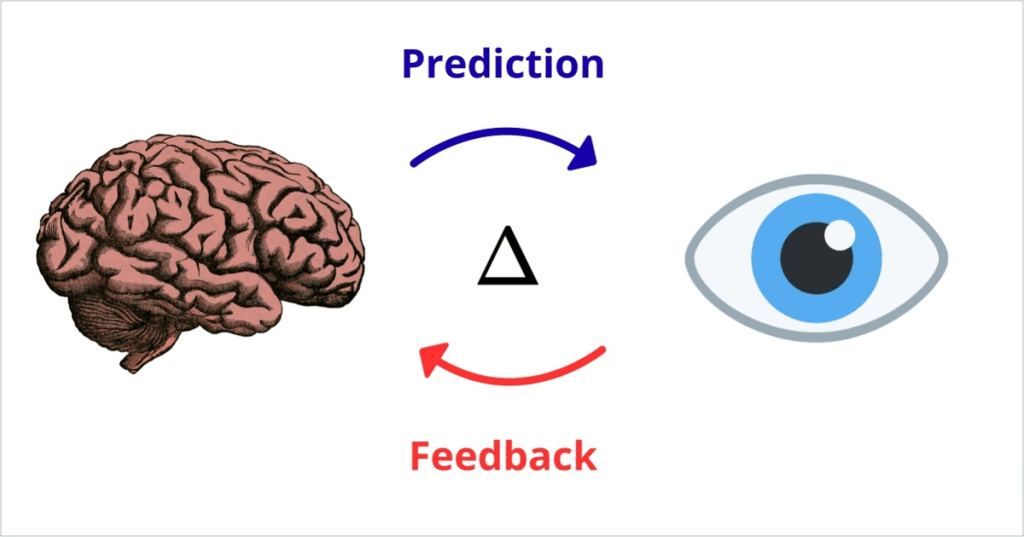
You start with a prediction, a top-down expectation of what your brain thinks it’s about to see. Then bottom-up incoming sensory data either confirms this prediction or updates it if things don’t fit. This is known as the predictive processing theory.
Higher-order areas of the brain were first making predictions about what they expected to see, and then sending them down the hierarchy. Only when something didn’t match the prediction, what they called a “prediction error,” did the lower levels sound the alarm and send information back up the hierarchy.
When the brain guesses correctly, there’s no need to notice anything. When it guesses wrong, like mistaking a wall for an aisle in a dark theater, the system lights up. It’s not that you didn’t see the wall with your eyes when you walked into it. It’s that your brain never expected it to be there in the first place.
This happens all the time with people when trying to solve problems, having conversations, and making decisions. The inner propagandist, the inner double agent, runs the show. The truth is whatever prediction doesn’t get proven wrong.
The brain deals with a world full of data and ambiguous messages. It makes the best possible predictions in moments of uncertainty. We don’t realize we’re making guesses, of course. The brain fills in the gaps using past experiences and context to figure out what should be there. You’re able to understand that sentence even though it’s painful to read:
Tahts wyh yuo cna uesndratnd tihs snetecne eevn thuogh teh wrods aer jbmlued pu. Oh, nda I klei yuro silme.
You don’t just see, then believe. You believe, then you see. Most of the time, it works great. But now and then, there’s a glitch.
Have you ever waved at someone who wasn’t there? Maybe you were walking down the street, and you saw a friend. So you smiled. Maybe you even raised your hand. And then you realized … it wasn’t them. This is an example of what feels like a positive hallucination, a moment when your brain sees something that isn’t there because it expects it to be. When you add to the scene around you.
There are also negative hallucinations, when you don’t see what is there. When your brain has removed things from in front of you. It’s asking your spouse where the keys are, when they’re sitting on the table right in front of you.
Our inner propagandists work 24/7, filling in blanks, removing things, and selling us the illusion that we are, in fact, seeing the world as it is. But we are, in fact, not.
____________________
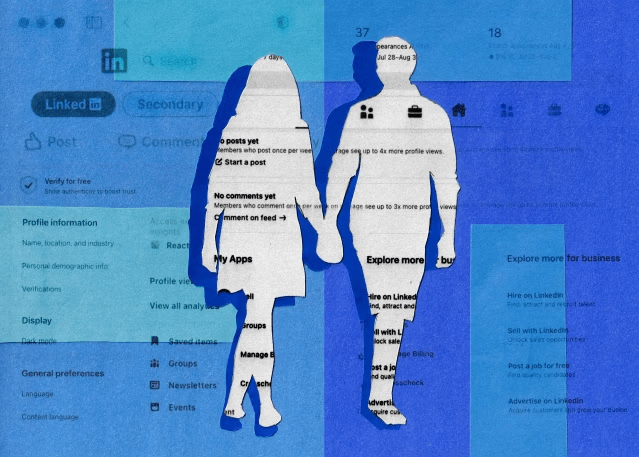
LinkedIn has accidentally become a dating site, despite its no-romance rules.
A deepening exhaustion with dating apps has pushed many to look beyond swiping. Singles are trying speed dating, connecting through shared real-world interests and even using spreadsheets to break their dating algorithm. It shouldn’t be a surprise that a public-facing platform with clear headshots and ample information about a person’s path in life, everything dating apps today seem to lack, has become a go-to tool in the modern search for love.
Just don’t expect to fly under the radar while you’re checking someone out. The site alerts users when someone has viewed their profile, which can either help or hurt your dating plans.
_______________________
In 2014, Bumble launched to solve a problem: an epidemic of aggressive men on the apps. If women were the only ones allowed to initiate conversation, they’d be in a position of power and agency; for once, they’d get to be the pursuers. And perhaps the Bumble man, knowing what he signed up for, would be an enlightened type, content waiting patiently to be chosen.
This was the dream of girlboss dating, and how lovely it was while it lasted. It died this past Tuesday, when Bumble announced that men will now be allowed to message women first.
When Bumble surveyed its female users, two-thirds said they would prefer not having to instigate each interaction. Younger women especially reported that having to go first added pressure. And many said they were fed up with men who seemed to put little effort into romance. In the game of online dating, an opening line is a delicate, high-stakes maneuver: Send something too basic (“Hey”) and you’ll fail to catch someone’s attention; send something too quirky or try-hard (“What’s your biggest fear?”) and you might scare them away. Bestowed with a very important responsibility, women wanted to toss the hot potato right back to the men.
In reporting on singlehood, you don’t tend to hear women complain about getting bombarded with messages or vigorously hit on. They say they do want to feel sought after. The women are constantly seeking, only to be met with a big, apathetic shrug.

_______________________
_______________________
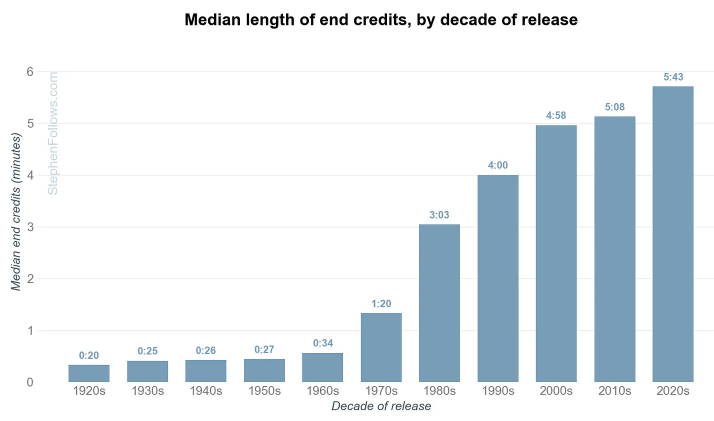
For most of cinema’s first seventy years, the end of a film was exactly that; it ended. A typical film of the 1930s, 40s or 50s ended with a cast reprise or a simple “The End” card. The median credits length didn’t shift much over forty years, going from 25 seconds in the 1930s to just 34 seconds by the 1960s.
Something weird happened to cinema in the 1970s. End credits changed dramatically, more than doubling in length within the decade, and then doubling again over the 1980s. By the 1990s, end credits were 4 minutes long, and they’ve kept climbing ever since, reaching 5:43 for films released in the 2020s. Current movie credits are almost thirteen times longer than those of the 1950s.
____________________________
_________________________
Why Walking Gets Tougher When You Age:
As we age, the body appears to sacrifice walking efficiency in exchange for stability. Older adults stiffen the ankle more with each step, which may help prevent falls but also forces the muscles to work harder while producing less forward motion. This leads to shorter strides, slower walking, and faster fatigue. Exercises targeting balance, coordination, and lower-leg strength could help preserve mobility.

_________________________
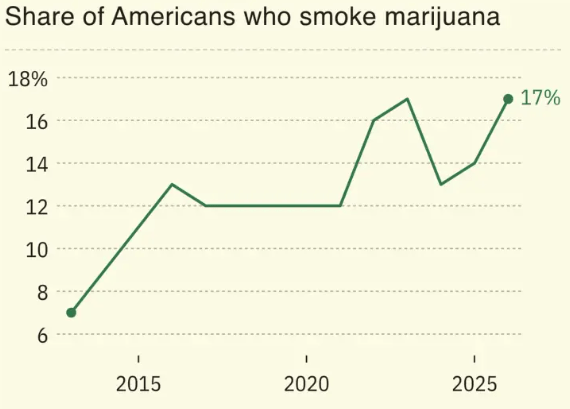
Seventeen percent of American adults say they smoke marijuana, tied with the high notched in 2023. That’s a big shift from 2013, the year Gallup started polling the question, when just 7% said they used pot. A record 15% of US adults also say they use edibles.
 Tuna Thoughts