Removing Burden, Parent Goals & Happiness

The British-born Zen master Houn Jiyu-Kennett said her teaching style wasn’t to lighten the burden of the student, but to make it so heavy that he or she would put it downI had a full-body reaction the first time I encountered that. To me, the phrase meant this: you can slog through life trying to ‘get on top of things’, trying to reach the point at which you feel like you know what you’re doing, trying to fix your flaws, or make yourself emotionally invulnerable… All of that is an attempt to ‘lighten the burden’, and there are a thousand self-help gurus on standby, promising to aid you in the effort.

But making the burden heavier? That means seeing that as a finite human you’ll never get on top of everything, never fully understand what makes others tick, never immunize yourself from distress. The burden of reaching that goal is an impossibly heavy one. And so you put it down. You let your shoulders drop and your muscles unclench. And then – crucially – you’re free to actually be here, actually do stuff, actually show up. You get to climb life’s mountains without lugging a huge rucksack full of steel ingots on your back the whole way, which is both easier and much more fun.

The spiritual writer Michael Singer points out: reality doesn’t need you to help operate it. It gets along just fine without your worrying.

Who knew? I don’t think of myself as an obscenely self-centered narcissist, yet I have to admit that when I heard those words, I suddenly perceived the subtle sense in which my thoughts and actions – and especially the background muscular tension I instinctively bring to them – were indeed somehow premised on the notion that reality itself would be badly affected were I to relax my guard.

I seem to imagine that my worrying is effective – that there’s something about the very act of fretting about the future that helps keep everything on track. This is, rather obviously, false. All I really need to do is to show up for what’s happening, appreciate the spectacle of it, and go with the flow.

Life is not a problem to be solved. Or else that life is nothing but a never-ending stream of problems to be solved, which in fact amounts to the same thing. Grasping this is both an enormous relief and tremendously energizing – because now you get to pour your finite time and energy into something infinitely more absorbing than trying to keep life under control, which is actually living it.

_____________________________

I had a conversation with a guy a few months ago whose immigrant parents came to America and worked tirelessly in low-wage jobs to make ends meet. Those kids are now adults, and this guy felt a sense of shame that as a college-educated white-collar worker he would not have to suffer the same way his parents did for him. His parents instilled in him the lessons of frugality and grit. Would his own children learn the same from him if they watched their father live a comparatively easy life?

He gave an example: when he was a kid, all books were borrowed from the library. Now his young daughter demands (and gets) to purchase $15 Taylor Swift books that pile up in her room.

My response was that if we talked to his immigrant parents, I would bet they would say: that was the goal. To put it differently: The goal of some parents is to work so hard that their kids and grandkids get to live a life that appears spoiled by the standards of previous generations.

What’s common to miss here is that when one generation’s life becomes comparatively easier than before, their life does not become objectively easy; they just move on to worrying about higher-order problems that were previously deemed not urgent enough to worry about.

I hope my kids and grandkids won’t have to worry about cancer in the ways we do. I hope they have incredible technology that makes their jobs easier than ours. I hope that everyday frictions we deal with today disappear. I hope their energy is so abundant they consider it unlimited.

Is that spoiled? I suppose, but when you frame it like that you might think of a different word – perhaps “lucky,” or, “fortunate.” Or perhaps, “beneficiaries of the accumulated hard work of those who came before them in a way that leaves them able to spend their days solving new problems.” Which is what you and I are today.

__________________

Mark Manson reviewed over 2,600 studies to rank 19 of the most common self-improvement techniques based on their effectiveness. He sorted them into four tiers: (1) legitimately works, (2) works sometimes, (3) probably not helping, and (4) straight up bullshit. Here were the results:

TIER 4: STRAIGHT UP BULLSHIT (AND MAY ACTUALLY HURT YOU):

19. Suppressing Negative Thoughts — The “ironic process” means trying not to think about something makes you think about it more. It can work for very smart people in very short-term, high-pressure moments, but the rebound effect makes things worse over time for everyone.

18. Microdosing Psychedelics — No consistent measurable benefit beyond mood improvement (i.e., you’re just getting a little high). Studies show a decline in cognitive function and executive reasoning, and long-term microdosing may carry adverse health effects from chronic exposure to psychoactive compounds.

17. Intuitive Decision-Making (“Trust Your Gut”) — Your gut doesn’t make better decisions; it just makes you feel better about your decisions. The exception is domain experts with decades of pattern-matching experience, but for most life choices, it’s self-serving and often detached from reality.

16. Catharsis / Venting Anger — Screaming into a pillow or punching a wall doesn’t release anger — it trains you to indulge it. The small effect sizes that exist are negative, meaning it makes you angrier more often.

TIER 3: PROBABLY NOT HELPING

15. Crystal Healing — Pure placebo effect. If you believe it works, you might get a small something, but there’s essentially zero evidence of any mechanism. Mostly it just harms your bank account.

14. Willpower / Ego Depletion — The concept of willpower as a finite tank you drain throughout the day is highly contested and probably not real. Believing you have limited willpower tends to make you underperform, and productivity problems are usually emotional problems in disguise.

13. Power Posing — Any mood boost is extremely transient, and the early hormonal claims (testosterone increases) have been debunked. It’s essentially a tiny placebo triggered by becoming momentarily aware of your posture.

12. Learning Styles (Visual/Auditory/Kinesthetic) — Over 90% of U.S. teachers still believe in this, but research consistently shows no real effect. The benefit people report is simply from having a choice in how they learn, not from matching a “style.”

11. Positive Affirmations — A “win more” strategy: people who already feel good get a small boost, but people with low self-esteem often feel worse because it highlights the gap between the affirmation and their actual beliefs.

10. Morning Routines — Extremely personality-dependent and mostly a placebo driven by a sense of control. Forcing a routine that mismatches your chronotype or becoming rigidly dependent on it can actually backfire.

TIER 2: WORKS SOMETIMES (MAYBE/DEPENDS):

9. Positive Visualization — Works well for physical/athletic performance and when paired with concrete planning. Without a plan, it’s just daydreaming — and pure outcome-based visualization actually decreases motivation.

8. Energy Healing — Surprisingly landed in the top half with a medium effect size (0.53), though only 56% of studies found any effect. The benefit likely comes from human touch, the ritual, and a strong placebo/expectancy effect rather than anything metaphysical.

7. Cold Water Immersion (for Mental Health) — Fairly consistent mood and stress benefits, likely driven by a big dopamine release. However, it’s a “win more” strategy — helpful if you’re already mentally healthy, potentially destabilizing if you’re fragile.

6. Speed Reading — You can realistically go from ~200 to 300–400 words per minute, which is meaningful, but the 1,000 wpm promises are nonsense. The trade-off is reduced retention, and much of reading speed turns out to be genetic.

TIER 1: LEGITIMATELY WORKS

5. Gratitude Interventions — The most consistent finding in the entire list: 98% of 166 studies showed a positive effect. The effect size is small, though, and compared to other positive interventions like acts of kindness, the unique “gratitude mechanism” mostly disappears.

4. Meditation — Consistently effective for stress and anxiety reduction, roughly equivalent to SSRIs for depression in some studies. The deeper benefit is knowing your own mind better, though compared to other active positive interventions, the unique advantage narrows.

3. Eat the Frog (Hardest Task First) — 95% of the benefit comes from the prioritization process itself, not the timing. Figuring out what matters most creates clarity and reduces anxiety, and ending the day on easier tasks boosts self-efficacy.

2. Bibliotherapy (Reading Self-Help Books) — 93% of 188 studies found positive effects, with a decent effect size approaching some therapy modalities. The key is the right book at the right time, and structured recommendations from a therapist boost the hit rate significantly.

1.Behavioral Activation (“Do Something”) — The most robust finding across all 19 techniques. Simply taking action, even small action, generates motivation rather than waiting for motivation to strike. It’s on par with CBT for depression and costs nothing.

Full Discussion Here: Self Help, Solved

_______________________________

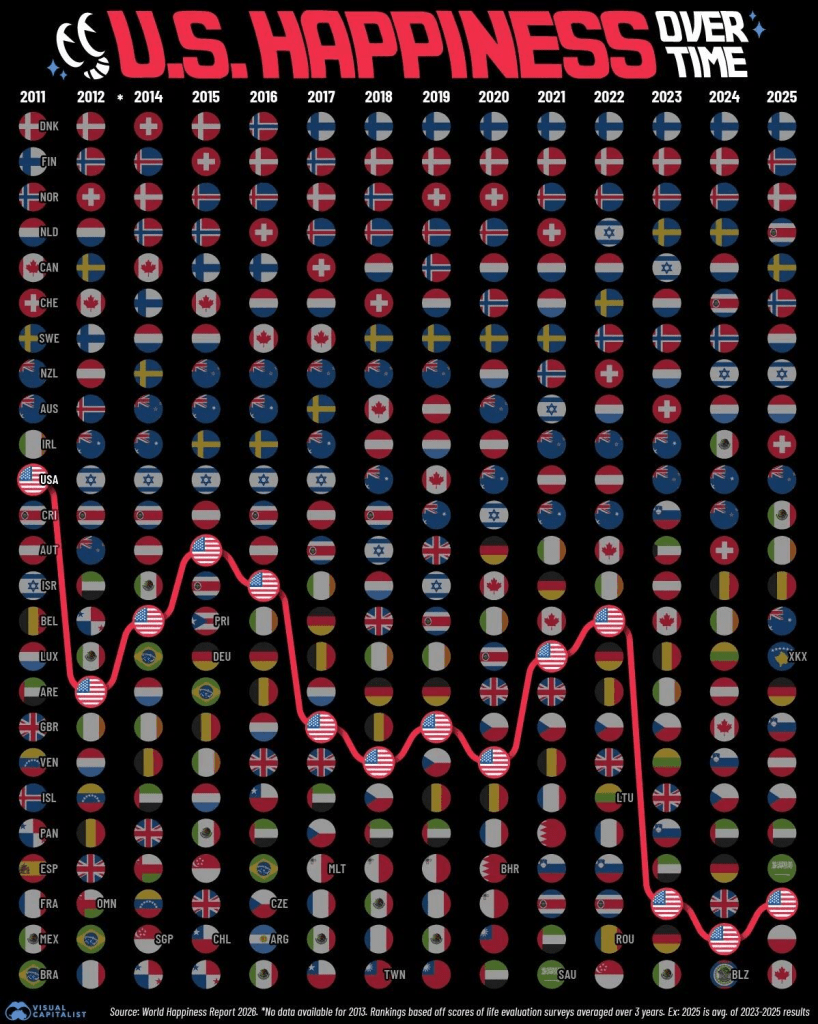
From the World Happiness Report (2026 was just released). The country rankings below are based on three-year averages, so the 2023 result captures responses from 2021, 2022 and 2023.

Brain Hemispheres, Meaning & The Placebo Effect

We are living at a time of profound unhappiness.

But here’s the really weird part: The ones suffering most are not just the down-and-out types—the addicts, the impoverished, the failsons. Those for whom there are obvious things gone wrong in their lives. On the contrary, it is also those who seem to have everything going right for them—in other words, our young and most successful strivers.

I’ve spent my life surrounded by that very group. As a longtime college professor, I have been privileged to teach hundreds of wonderful students—ambitious strivers just starting out on what promised to be terrific careers and lives. I have met countless young people who were so inspired by ideas, so purpose-driven, and so enthusiastic.

But in 2009, I left academia to run a nonprofit in Washington, D.C. And when I returned to campus a decade later, the atmosphere was dark. Larger and larger percentages of students were suffering from depression and anxiety. At some schools, more than half of students were receiving mental health treatment. My office hours were more like counseling sessions than tutoring. Hope and optimism had been replaced by anger and sadness.

Most of the younger generation is online a lot: scrolling social media, watching videos. To simulate a social life, they spend hours listening to podcasts of other people having interesting conversations. You could call it “social pornography.” Most of the time, there’s nothing better to do. They crave a big, meaningful project and immersing themselves in it. But they can’t come up with any ideas for what that project might be . . . so it’s back online.

They don’t fit the traditional résumé of unhappy people. They’re not addicted to drugs, nor struggling financially. In fact, their life looks enviable from the outside. But like so many young people I’ve spoken to over the years, they feel empty.

What these young strivers describe to me is something akin to waiting in an airport terminal for a delayed flight that never leaves. They try to stay occupied to keep themselves from going mad, always in the hope that boarding will finally be called and the flight will take off. And their distraction tactics—which invariably involve technology—keep them from thinking too much but make their sense of emptiness worse.

One of the young strivers I talked to was telling me about his virtual job, dating apps, social media friends, and video gaming. Then, out of the blue, he said something fundamental.

“I feel like I’m living in a simulation.”

Others said the same thing. Life felt unreal: full of false rewards, empty accomplishments, therapeutic talk, and fake experiences, all curated to pass the time as painlessly as possible.

Again and again, people said that life was busy but not meaningful. That experiences and relationships felt meaningless. Or that they didn’t know what they were meant to do in work and life. And it’s worse for the strivers than anyone else: The richer, more technologically advanced the country, the greater the percentage of the population that answers “no” to the question “Do you feel your life has an important purpose or meaning?”

Here’s why: Strivers are great at solving technical problems and answering specific, hard questions. They have been educated and trained to believe that, while the world is incredibly complicated, with enough knowledge and hard work, every problem can be solved.

The truth is, many big, complicated problems can be solved with sheer intellectual horsepower. But meaning is not one of them. “What is the meaning of my life?” is a question that cannot be answered like “How do I build an app for finding concert tickets?” or “How do I create an effective six-month weight-loss program?” Meaning is a question that must be lived, not solved with a Google search or simulated using artificial intelligence. It requires deep contemplation and a commitment to living a real life, full of unsolvable secrets, puzzling riddles, unexplainable bliss, and terrible suffering.

But in all their technical excellence, strivers trivialize their humanness by reducing life’s magnificent inscrutability to a series of complicated but solvable problems. They aren’t just living in a simulation; they are also creating the simulation they are living in.

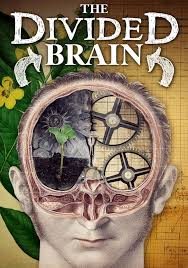
In his 2009 book, The Master and His Emissary: The Divided Brain and the Making of the Western World, Ian McGilchrist argued our brains have two hemispheres that deal with everything, but they do so in consistently different ways. The right side of the brain is the “master,” which asks big, transcendent questions such as “Why am I alive?” The left side—which he calls the “emissary”—addresses such practical questions as “How do I get food so I can keep being alive?”

In other words, in the right hemisphere we ask the lofty why questions about life. On the left side, we ask, earthbound, what to do now and how to do it.

Hemispheric lateralization explains the acute crisis of meaning today. In our increasingly complicated, technology-dominated, and endlessly distracting world, people are shoved to the left side of their brains. They are stuck in a complicated simulation where there is a lot going on, but which is bereft of mystery and meaning.

Older people remember the before times, when meeting a potential mate for the first time involved a real-life conversation, and a big question of life’s meaning couldn’t be reduced to a Google search. But most young adults today have never known any domain other than Left Brain Land. And this is especially true for the strivers. They know every complicated nook and cranny of that technical dystopia, but the mysterious realm of meaning seems mythical, like the lost kingdom of Atlantis.

Stuck outside the realm of the numinous right hemisphere, life becomes just an endless loop of complicated left-brain routines and habits—a simulation of a life that is deep, mysterious, and authentic. It’s frustrating and empty.

Worse: It’s boring. And humans absolutely despise boredom. 

Why are we so bored? Because life feels repetitive and meaningless, and even a minute here or there with nothing to do feels like an hour. So out comes the phone, every few minutes, all day long, changing our brain chemistry in dangerous ways.

And what side of our brains are we on as we do all this? The mundane left, of course, not the mysterious right. The remedy we’ve created to avoid the boredom of modern life—this app, that video—reinforces our inability to ponder the abstractions necessary to formulate any concept of our lives’ meaning.

This asymmetry explains why we’re bombarded with ingenious solutions to age-old problems but never seem to make progress toward greater happiness. In fact, it’s the reverse: We are losing our sense of life’s meaning faster and faster.

_____________________________

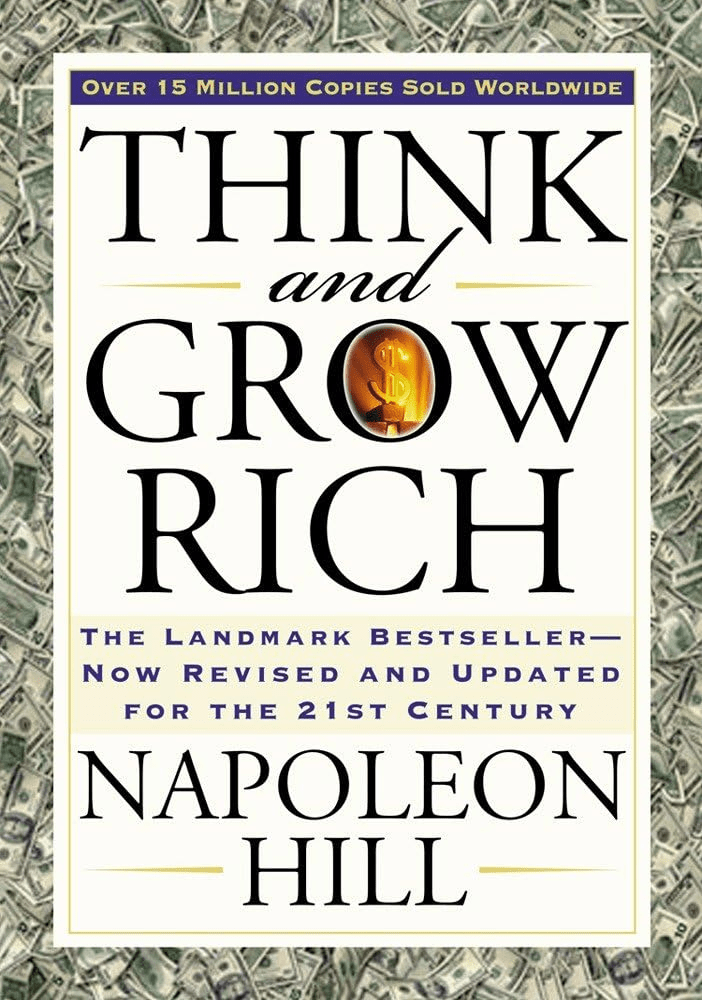
The famous origin story of Think and Grow Rich, by Napoleon Hill, is that Andrew Carnegie commissioned Hill in 1908 to interview 500 successful people over 20 years.

That origin story is fabrication.

In reality, in 1908 Hill was fleeing police in Alabama under a fake name after committing fraud, facing domestic violence accusations, and abandoning his family. The book’s real author was his wife. She took Hill’s rambling, failed manuscripts and refined them into Think and Grow Rich.

The book contains a mix of genuinely good advice:

  • Specific goal-setting with deadlines
  • Persistence and grit
  • The “mastermind” concept of surrounding yourself with sharp people
  • The value of specialized knowledge

It also contains psuedoscienctific nonsense like:

  • “Sex transmutation” or redirecting sexual energy toward business
  • The idea that brains communicate through vibrations
  • A “sixth sense” chapter about receiving messages from infinite intelligence

If Think & Grow Rich is a fabrication from a con man, how has it sold over 100 million copies and helped millions of people since it was published?

The answer lies in the placebo effect.

Most of the advice from self-help gurus works not because it’s scientifically accurate, but because believing in it changes people’s behavior, which then changes their outcomes. Believing they can accomplish something makes them more likely to try it and then more likely to try hard and persist.

Is his book Useful, Not True, Derek Sivers says most things are hard to know for certain, so you might as well believe whatever is most helpful for you and others. The criticism that self-help is pseudoscience misses the point. Due to the placebo effect, even if something is not scientifically true, it can be useful for many people.

____________________________

Key findings from chapter 3 of the 2026 World Happiness Report: Social media is harming adolescents at a scale large enough to cause changes at the population level:

Is social media use reasonably safe for children and adolescents? We call this the “product safety question”, and we present seven lines of evidence showing that the answer is no.

The evidence of harm is found in: 1) surveys of young people; 2) surveys of parents, teachers, and clinicians; 3) contents from corporate documents; 4) findings from cross-sectional studies; 5) findings from longitudinal studies; 6) findings from social media reduction experiments; and 7) findings from natural experiments.

We show there is now overwhelming evidence of severe and widespread direct harms (such as sextortion and cyberbullying), and compelling evidence of troubling indirect harms (such as depression and anxiety). Furthermore, we show that the harms and risks to individual users are so diverse and vast in scope that they justify the view that social media is causing harm at a population level.

We further argue that when these lines of evidence are considered alongside the timing, scope, and cross-national trends in adolescent wellbeing and mental health, they can help answer a second question: was the rapid adoption of always-available social media by adolescents in the early 2010s a substantial contributor to the population-level increases in mental illness that emerged by the mid 2010s in many Western nations? We call this the “historical trends question”. We draw on our findings about the vast scale of harm uncovered while answering the product safety question to argue that the answer to the historical trends question is “yes”.

__________________________

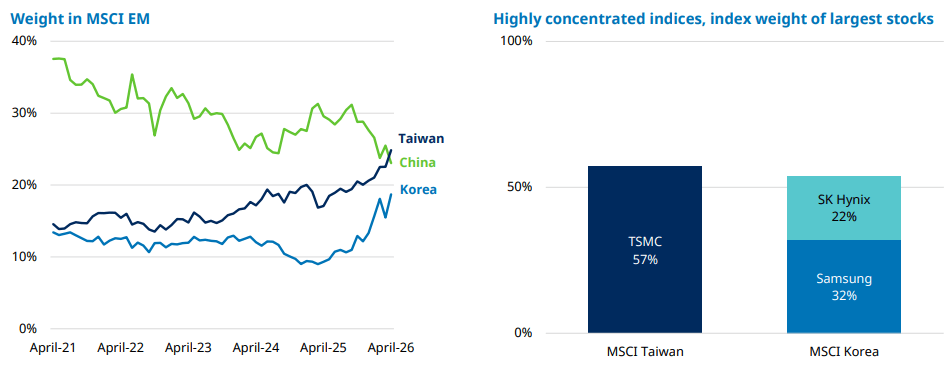
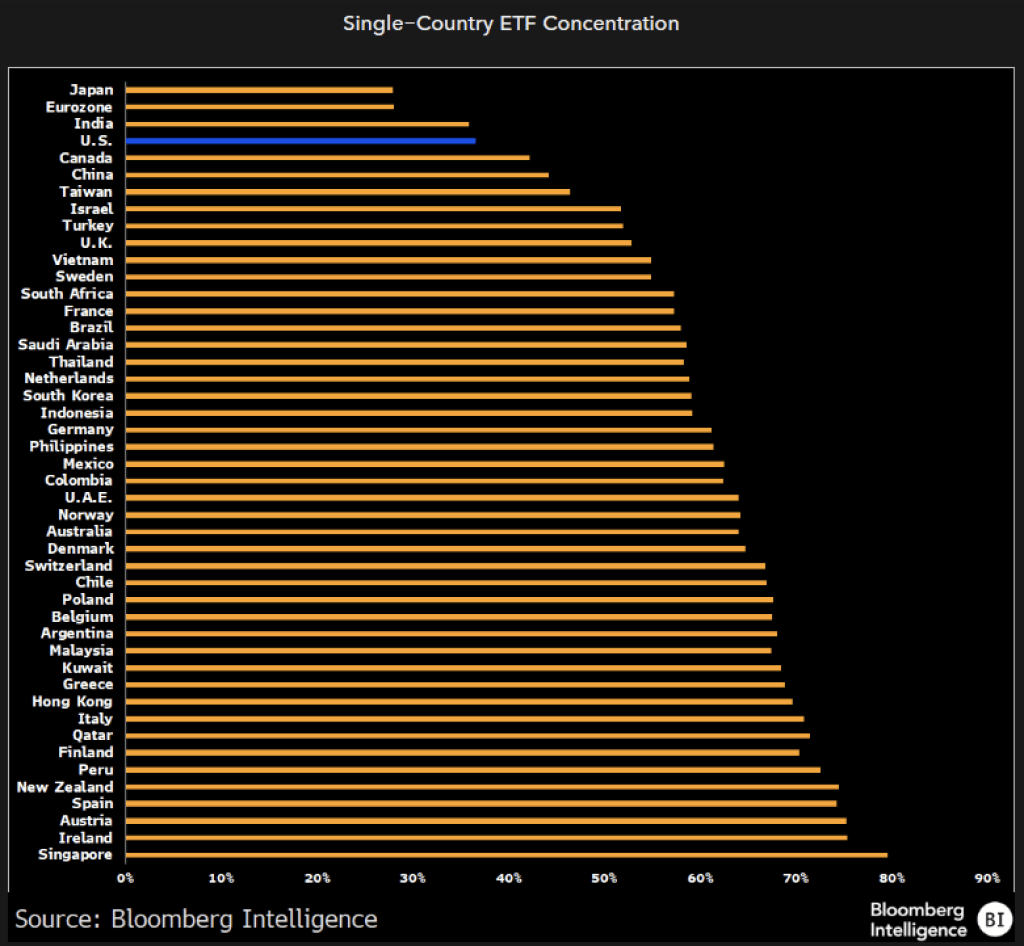
The graph below shows the percentage of each country’s total stock market cap made up by its top 10 largest stocks. While people worry about the concentration of the largest stocks in the U.S., it is a global phenomenon.

__________________________

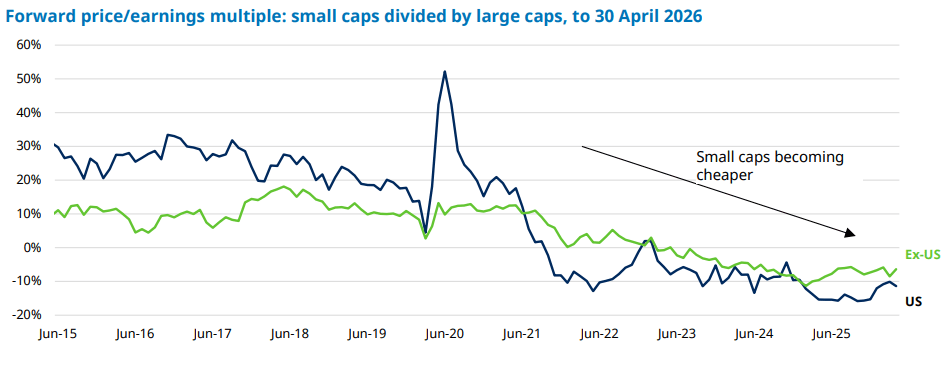
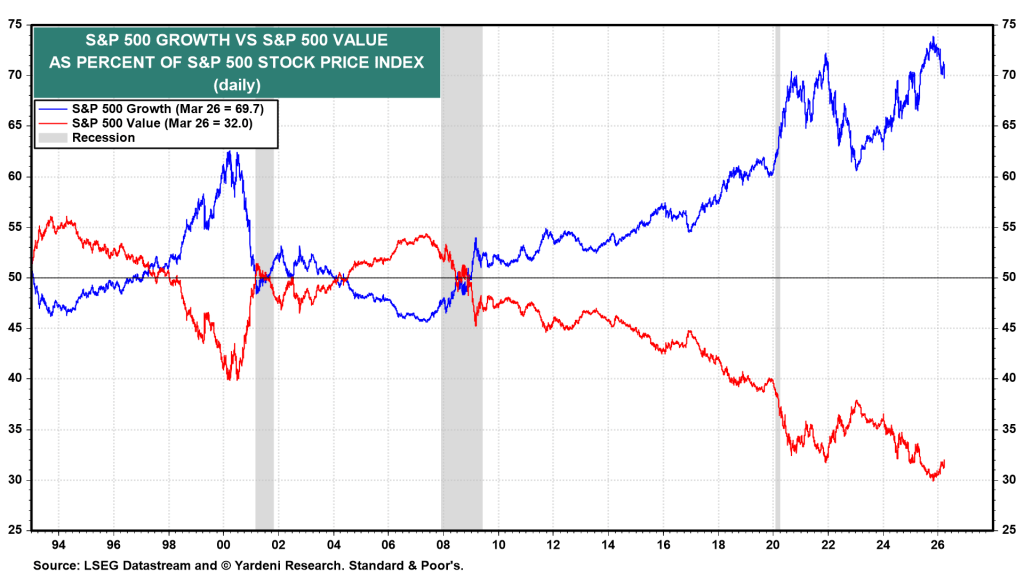
Is this finally the moment when the jaws begin to close and U.S. value stocks (red line) outperform growth (blue line)?

Death, Pessimism & Frontier Markets

Contemplating death is the New Year’s resolution to end all resolutions. Why? Because it sharpens our focus, allows us to clarify what truly matters—and to craft our goals and priorities around that—anchors us in the present moment, and deepens our appreciation for all that life has to offer, right here and now.

Remembering that we are going to die goes hand-in-hand with another key realization: we have no way of knowing how much time we have left. We might die in three years, or 38 years, or a few months from now. So, what should we do with the time we have—with our one wild and precious life?

Humans have long known of the power of this practice. We’ve been contemplating death for over 100,000 years, from the earliest archeological burial artifacts to Buddhist maraṇasati, from Stoic philosophy to ancient Egyptian funerary texts.

It’s only in the modern Western world that we began to see this practice as depressing or morbid. We lost our relationship with death, and somewhere along the way, we stopped living fully too.

Here are 11 science-backed benefits of taking the time to think about death:

  • Cut through your own bullshit – helps you overcome excuses and stop wasting time on what’s not serving you
  • Clarify your values – less bullshit = more clarity
  • Motivation to act – gives you permission to stop living on autopilot or within societal expectations and start living in alignment with what actually feels true
  • Find a deeper purpose – research shows that being reminded of our mortality triggers a psychological drive to seek or restore meaning in life.
  • Be more present – when you fully accept that everything, and I mean everything, will ultimately be taken from you, the present moment suddenly becomes sacred
  • Gratitude –  like anything else rare and precious, when we remember that life is fleeting, we value it more
  • Stronger relationships – when you remember that one day, everyone you love will die, and so will you, your relationships change
  • Empathy and compassion – death is the great equalizer
  • Unlocks creativity – gives rise to an intense drive to make your own little dent on the universe, to leave something behind to say that you were here. 
  • Keep your ego in check – it’s a reminder that you’re not the center of the universe, the desire to impress starts to dwindle, liberating you from feeling like you need to be the smartest, best, most admired person in the room – instead, you start to show up as a real person: flawed, fleeting, and free
  • Take more risks –  the only thing scarier than dying is never having really lived, so you’re more likely to pursue the life you’ve been dreaming of.

______________________________

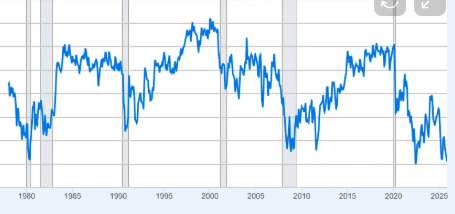
Interest rates have begun to come down. Inflation has mostly subsided, and the real economy is still doing decently well.  So why are American consumers more pessimistic than they were during the depths of the Great Recession or the inflation of the late 1970s?

It’s possible to spin all sorts of ad hoc hypotheses about why consumer sentiment has diverged from its traditional determinants. Perhaps Americans are upset about social issues and politics, and expressing this as dissatisfaction about the economy. Perhaps they’re mad that Trump seems to be trying to hurt the economy. Perhaps they’re scared that AI will take their jobs. And so on.

Here’s another hypothesis: Maybe Americans are down in the dumps because their perception of the “good life” is being warped by TikTok and Instagram.

I’ve been reading for many years about how social media would make Americans unhappier by prompting them to engage in more frequent social comparisons. In the 2010s, as happiness plummeted among young people, the standard story was that Facebook and Instagram were shoving our friends’ happiest moments in our faces — their smiling babies, their beautiful weddings, their exciting vacations — and instilling a sense of envy and inadequacy.

However, note that during the 2010s, consumer confidence was high. Even if people were comparing their babies and vacations and boyfriends, this was not yet causing them to seethe with dissatisfaction over their material lifestyles. But social media today is very different than social media in the 2010s. It’s a lot more like television — young people nowadays spend very little time viewing content posted by their friends. Instead, they’re watching an algorithmic feed of strangers.
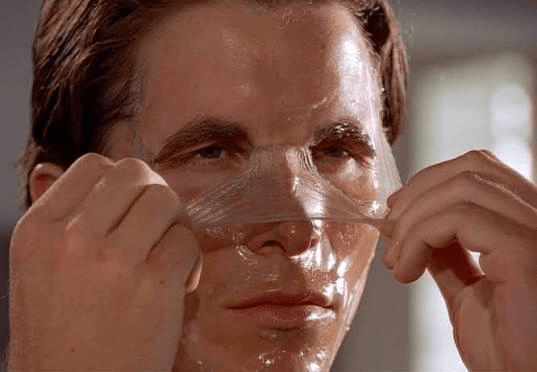
There were rich people like that in 1920, or 1960, or 1990. But you almost never saw them. Maybe you could read about them in People magazine or watch a TV show about them. But most people simply didn’t have contact with the super-rich. Now, thanks to social media, they do. 

But even more subtle might be the influencers who are merely upper class rather than spectacularly rich. These people aren’t living the lifestyle of a ultra-rich influencer, yet most of what you’re seeing in these photos and videos is economically out of reach for the average American. 

These are not obviously rich people — they’re more like the 5% or the 1% than the 0.01%. Their lifestyles are out of reach for most, but not obviously out of reach. Looking at any of their videos, you might unconsciously wonder “Why don’t I live like that?”.

Americans were always shown examples of aspirational lifestyles on TV shows. Yet on some level, Americans might have realized that that was fiction; when you see a lifestyle influencer on TikTok or Instagram, you feel like you’re seeing simple, bare-bones reality.

The rise of social media influencers has scrambled our social reference points. Humans have always compared ourselves to others, but before social media, we compared ourselves to the people around us — our coworkers, friends, family, and neighbors.

Those classic reference points tended to be people who were roughly similar to us in income — maybe a little higher, maybe a little lower, but usually not hugely different.

But perhaps even more importantly — we were able to explain the differences we saw. In 1995, if you knew a rich guy who owned a car dealership, you knew how he made his money. If you envied his big house and his nice car, you could tell yourself that he had those things because of hard work, natural ability, willingness to accept risk, and maybe luck. The “luck” part would rankle, but it was only one factor among many. And you knew that if you, too, opened a successful car dealership, you could have all of those same things.

But now consider looking at an upper-class social media influencer. It’s not immediately obvious what they do for work, or how they could afford all those nice things.

Not only can you not explain the wealth you’re seeing on social media, but you probably don’t even think about explaining it. It’s just floating there, delocalized, in front of you — something that other people have that you don’t. Perhaps you make it your reference point by default, unconsciously and automatically.

___________________________

Frontier markets represent the world’s least developed investable economies,
offering exposure to countries with young populations and high economic growth
potential, yet smaller, less liquid markets. Over time, the composition of the MSCI
Frontier Markets Index has shifted meaningfully, with Gulf countries like Kuwait and
Qatar having “graduated” to emerging status and Asian and European nations now
taking greater prominence. Frontier markets remain dominated by financial services,
with larger weights to real estate, energy, and materials, reflecting other structural
differences compared with emerging and developed markets.

The MSCI Frontier Markets index is one of the most widely used indices related to
frontier markets. It contains approximately 238 stocks spread across 28 countries.1
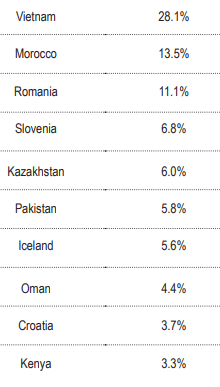
The top three countries in the benchmark were Vietnam, Morocco, and Romania,
which collectively accounted for just over 50% of the index.

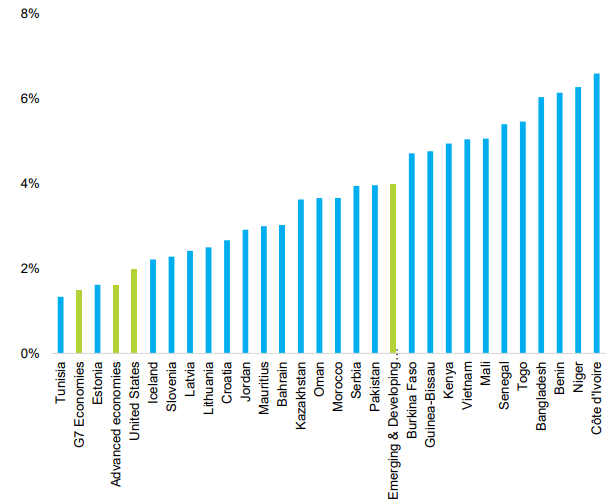
To better understand how growth expectations within frontier markets compare
with growth across the world, it is helpful to compare their GDP growth rate
expectations to developed and emerging markets.


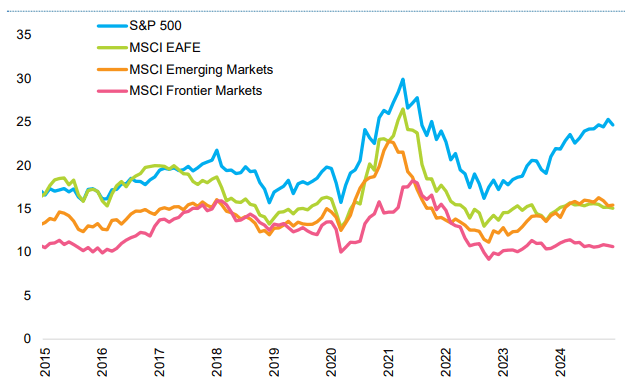
Despite their strong expected GDP growth rates, frontier markets have not translated
that economic momentum into equivalent corporate earnings performance. Earnings
per share growth has stagnated even as valuations have remained low relative to
developed and emerging markets. This combination presents both opportunities
and risks. Value-oriented investors may find attractive entry points, but persistent
structural inefficiencies and volatility underscore the need for careful analysis.

Frontier markets have historically traded at lower valuations compared to developed
markets and similar-to-lower valuations than emerging markets.

_______________________________

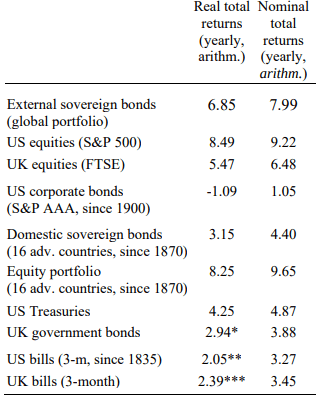
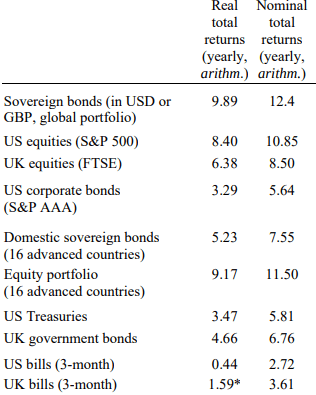
We compiled a new database of 266,000 monthly prices of foreign-currency government bonds traded in London and New York between 1815 and 2016, covering up to 91 countries. 
Our main insight is that, as in equity markets, the returns on external sovereign bonds have been sufficiently high to compensate for risk. Real ex-post returns average more than 6 percent annually across two centuries, including default episodes, major wars, and global crises. 
This represents an excess return of 3-4 percent above US or UK government bonds, which is comparable to stocks and outperforms corporate bonds. Central to this finding are the high average coupons offered on external sovereign bonds.
1815 – 2016:

1995 – 2016:

Ovarian Lottery, Money Nothingness & Sports Book Strategies

Money is a required pursuit for life, but a pointless pursuit upon death. If I were to illustrate what this tension looks like for your average person, it would look something like this:

That steep descent to zero is what I call The Nothingness of Money. It’s when the pointlessness of money is no longer theoretical; it’s truly understood. This delineation is important.

Everyone knows that your bank account doesn’t go with you upon death. But for most of life, that knowledge is theoretical, meaning that it’s not real enough to influence your day-to-day behavior. The mere awareness of your mortality isn’t enough to cease your pursuit of wealth.

It is only when the finiteness of life is glaringly obvious that things change. For most people, the Nothingness of Money strikes when the finish line is a few yards away. A terminal diagnosis is delivered. An appointment is made at a hospice center. A deathbed is prepared.

In this moment, a pursuit that once seemed all-consuming fades into the background. All that matters are the memories you have, the people you love, and the memories you can still make with them. The use of your finite time to squeeze out an extra dollar is laughable, as no one with a sound mind would expect that of you.

And finally, in this brief section of life, something profound happens. The Nothingness of Money is truly understood.

Wisdom is the co-existence of contradictory truths, and money is the clearest example of this. We must internalize its importance while also recognizing its pointlessness. We must operate within the story of money while also understanding that it’s a fairy tale. The problem is that we often fail to see the illusory nature of this story, and treat it as gospel until it’s too late. 

____________________________

Question To Warren Buffett: What would you do to live a happier life if you could live over again?

I have been extraordinarily lucky. I mean, I use this example and I will take a minute or
two because I think it is worth thinking about a little bit. Let’s just assume it was 24
hours before you were born and a genie came to you and he said, “Herb, you look very
promising and I have a big problem. I got to design the world in which you are going to
live in. I have decided it is too tough; you design it. So you have twenty-four hours, you
figure out what the social rules should be, the economic rules and the governmental rules
and you and your kids and their kids will live under those rules.


You say, “I can design anything? There must be a catch?” The genie says there is a
catch. You don’t know if you are going to be born black or white, rich or poor, male or
female, infirm or able-bodied, bright or retarded. All you know is you are going to take
one ball out of a barrel with 5.8 billion (balls). You are going to participate in the
ovarian lottery. And that is going to be the most important thing in your life, because
that is going to control whether you are born here or in Afghanistan or whether you are
born with an IQ of 130 or an IQ of 70. It is going to determine a whole lot. What type of
world are you going to design?


I think it is a good way to look at social questions, because not knowing which ball you
are going to get, you are going to want to design a system that is going to provide lots of
goods and services because you want people on balance to live well. And you want it to
produce more and more so your kids live better than you do and your grandchildren live
better than their parents. But you also want a system that does produce lots of goods and
services that does not leave behind a person who accidentally got the wrong ball and is
not well wired for this particular system. I am ideally wired for the system I fell into
here. I came out and got into something that enables me to allocate capital.

If all of us were stranded on a desert island somewhere and we
were never going to get off of it, the most valuable person there would be the one who
could raise the most rice over time. I can say, “I can allocate capital!” You wouldn’t be
very excited about that. So I have been born in the right place.


Bill Gates says that if I had been born three million years ago, I would have been some
animal’s lunch. He says, “You can’t run very fast, you can’t climb trees, you can’t do
anything.” You would just be chewed up the first day. You are lucky; you were born
today. And I am. The question getting back, here is this barrel with 6.5 billion balls,
everybody in the world, if you could put your ball back, and they took out at random a
100 balls and you had to pick one of those, would you put your ball back in?

Now those 100 balls you are going to get out, roughly 5 of them will be American, 95/5.
So if you want to be in this country, you will only have 5 balls, half of them will be
women and half men–I will let you decide how you will vote on that one. Half of them
will be below average in intelligence and half above average in intelligence. Do you want to
put your ball in there? Most of you will not want to put your ball back to get 100. So
what you are saying is: I am in the luckiest one percent of the world right now sitting in
this room–the top one percent of the world. Well, that is the way I feel. I am lucky to be
born where I was because it was 50 to 1 in the United States when I was born. I have
been lucky with parents, lucky with all kinds of things and lucky to be wired in a way
that in a market economy, pays off like crazy for me. It doesn’t pay off as well for
someone who is absolutely as good a citizen as I am (by) leading Boy Scout troops,
teaching Sunday School or whatever, raising fine families, but just doesn’t happen to be
wired in the same way that I am. So I have been extremely lucky so I would like to be
lucky again.


Then the way to do it is to play out the game and do something you enjoy all your life
and be associated with people you like. I only work with people I like. If I could make
$100 million dollars with a guy who causes my stomach to churn, I would say no because
in way that is very much like marrying for money which is probably not a very good idea
in any circumstances, but if you are already rich, it is crazy. I am not going to marry for
money. I would really do almost exactly what I have done except I wouldn’t have bought
the US Air.

_____________________________

Some highlights from The Economist’s article on sports betting:

Skilled players are “sharps” and given “stake restrictions” if they play too well (bets are capped). The rest of the players are called “squares.” As important as keeping out “sharps” is hooking “whales”, the deep-pocketed players that are willing to keep playing (and losing) large sums. Some “whales” are actually “sharps” in disguise, though. They’ll lose a bunch of bets to lull the sports book then put down a massive bet when they have an edge. While there is a risk of a “whale” being a “sharp”, the value of a real “whale” is so high that sports book will take the risk.

How sports books profile players:

  • Playing on Mobile is a good sign (where majority of people play)
  • Playing on PCs is a bad sign (it’s easier to compare odds and run models)
  • Women bettors are a red flag (most bettors are men and “sharps” often use women to place bets)
  • First wagers are a major tells (typical bettors go after top leagues — NFL, NBA, EPL — and do so near the start of the game).
  • Popular bets for “squares”: who will win, scoring margins and how star player will perform (also, they love multi-leg parlays).
  • “Sharps” go after less popular leagues and place bets as soon as odds are published, when they are most mispriced. They also go after less popular bets such as “pts in Q3” or stats from a random player (“Sharps” rarely do parlays and don’t withdrawal winnings often).
  • ”Sportsbooks look at a player’s ‘closing-line value’ — a measure that compares the odds at which he bets with those available right before a match begins. If it is consistently ahead of the market over his first ten wagers, he is highly likely to beat the book in the long run.”
  • E-wallets are a red flag (sports books prefer debit direct deposit that can attach a player to a single account; an e-wallet is more anonymous and players can move cash between sports books more quickly to shop for the best odds)

E-wallet users, women and bets over $100 are flagged. These suspicious bettors are given 30% of maximum bet (and proven sharps only allowed 1%).

By the time a customer places his first bet, [sports books] are 80-90% certain they know the lifetime value of the account. Sports book mathematically monitor players and creates a new risk score every 6-8 hours (risk score = estimate of probability that customers will wind up unprofitable).

High-skilled players will often get a “beard” to bet on their behalf. Most sports books ban this practice but it is widespread. Safest “beards” are close friends and relatives because you can mostly rely on them to pay out any winnings. The “beards” try to look like degens (playing at 3:00 am, bet non-stop and doing ridiculous parlays) before placing a winning bet.

The most effective strategy for “sharps” is “whale-flipping”. Find a losing gambler, then ask to put a (likely) large winning bet among their pool of guaranteed losers. Once “sharps” max out the people they can use as “beards”, they tap professional networks called “movers”. These “movers” employ a bunch of “mules” who can put down bets on the behalf of the network. Low-end movers charge 10-20% while high-end movers charge 50% of winnings.

___________________________________

Loneliness, Purpose & Cash Flow Forecasts

With 23,000 responses to survey questions distributed over more than 4,500 respondents, we found there is a youth loneliness crisis, not just a male loneliness crisis like many believe. Younger people — both male and female — are increasingly paralyzed by anxiety and fear, and they are finding it harder and harder to socialize.

In fact, when you look at the data, the “antisocial crisis” is actually most pronounced among young women, who experience the highest rates of social isolation.

It’s true that young men are facing a loneliness crisis, but it’s part of a broader loneliness crisis that young people are facing in general, and the numbers suggest that young women might actually be hit even harder, even though that story hasn’t gotten nearly as much attention.

Looking at the results from our study on the questions concerning emotional distress the gender split is striking, but it is age, rather than gender, which marks the determining axis once again.

For instance, young men (18 to 29) are more distressed than almost every other demographic, including women 45 to 64 and women over 65. But young women are hit even harder, and they actually have the worst scores among any age-based gender cohort in our entire dataset.

In another axis of our study, social disengagement, young people once again emerged as the age group most likely to feel lonely, isolated, or conversationally stunted with people they don’t know, and there is a striking gap between the “internet generations” (people under 45) and everyone else.

While both young men and young women suffer from a loneliness and socialization crisis, young women actually seem to be hit significantly harder by it. In particular, they seem to find it much harder to make new friends or converse with strangers, especially when it comes to the opposite gender — and they’re much more likely to be introverted and alienated.

The results of this study lined up quite well with the existing research on this topic. A study conducted by Public Opinion Strategies found that young women are the cohort of Americans most likely to feel lonely and left out. And it doesn’t seem to be limited to just America — a study done by the United Kingdom’s Campaign to End Loneliness found that women and young people were two of the cohorts most affected by loneliness.

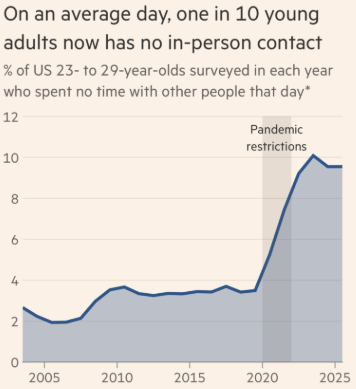
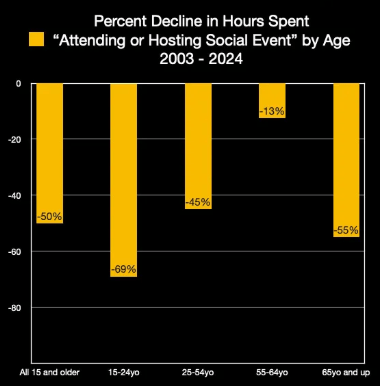
Young people are spending less and less time socializing with each other. The American Time Use Survey estimated a nearly 50% decline in face-to-face interactions among teenagers over the last two decades.

Time that used to be spent with friends is now spent online. When it comes to the “female loneliness crisis,” I’m not even convinced that most people know it exists. You can find column after column on the male loneliness epidemic. But when it comes to the female loneliness epidemic? Crickets.

_____________________________

Growing up, I spent every French school holiday in the U.S. with my dad — the more career-driven of my parents (which tracks, since my mom is Belgian and my dad is a pure-bred American from Michigan). So I grew up with both models: French and American.

I don’t think most French people think about purpose the way Americans do. What’s your purpose? What are you building? What are you here for?

They’re good questions. But in France, they’re not humming in the background of every conversation. Most people I know don’t define themselves by what they do for a living. And if they work in a corporate setting, there’s often this quiet trust that things will evolve over time. No need to panic about your life path. Just do your job — and enjoy your life. Work is one part of the equation. So is your social life, your hobbies, your weekends away.

In the U.S., the idea of having purpose is everywhere: in books, on podcasts, in LinkedIn bios, even in casual brunch conversations. There’s this constant pressure to align your job with your passion, your calendar with your goals, your time with your values.

But what if your purpose is simply to build a good life? To raise kind children. To cook a little better each year. To read a few excellent books. To notice the seasons. To build meaningful relationships. Isn’t that what people will remember anyway?

In France, there’s no guilt in doing a job because it pays the bills. Or because it gives you your evenings. You can be excellent at what you do and still have no desire to talk about it over dinner — which is very much the case with my French husband, who bans work talk at the table. At first it felt strange. Now I love it. We talk about where we want to go next weekend. What we’re reading. What to cook.

When I moved back to Paris as an adult, I was struck by how much people here were just… living. They weren’t building personal brands. They weren’t trying to optimize themselves into more perfect versions. They worked, they took real holidays, they cooked, they went to the theater. They had long conversations about everything and nothing. And they rarely used the word productive.

What they value instead is curiosity. Culture. Taste. The art of paying attention. Of being present, not just purposeful. That doesn’t mean people are passive. But the energy is different. Life is more about living well or profiter de la vie.

It took me time to unlearn the habit of measuring everything by what it might lead to. What goal it served. What version of myself it might create. I still have ambition, but I no longer believe every moment needs to be part of some upward trajectory. Some days, it’s enough to spend the weekend with my family — visiting an exhibition, taking the kids to a play.

I don’t know that I’ll ever stop caring about meaning. But I’ve stopped needing to declare it. What I want now is to live with intention, even when there’s no obvious reward. To build a life that’s full, not optimized.

____________________________

There’s a strange comfort in believing someone out there knows what the market will do next. Don’t fall for it. People who make predictions on the financial markets for a living are about as accurate as a 50/50 coin toss.

By early spring 2025, when President Trump’s tariff wars started, over half of the forecasters were calling for the market to decline.  The below graph shows the level of the S&P 500 at the beginning of the year (orange bar), the actual price level at year end (green bar) and the wide range of estimates published in April (blue bars).  If you’d been reading all their research reports, you might have started selling.

Maybe you’re thinking “Fine. Experts may be clueless, but vibes are easy to read.” You know all about employment numbers, and inflation, and the usual talking points from CNBC.

Well, here’s a great chart from JP Morgan Asset Management that begs to differIt looks at  S&P 500 performance after peaks and troughs in the University of Michigan’s consumer sentiment survey. Interestingly, the weakest moments in how people are feeling  tend to precede strong equity returns while peaks in sentiment do not see as much upside. Turns out that getting out of the market when things feel bad can be a poor investment strategy.

__________________________

The defining feature of every bubble is the same: a growing inconsistency between the long-term returns that investors expect in their heads – based on extrapolation of the past, and the long-term returns that properly relate prices to likely future cash flows – based on valuations.

Each speculative episode encourages a certain stubbornness – because humans are adaptive creatures, we base our expectations for the future on the experience of the recent past. We respond far less to those things that are painful but distant in our memory than to those things that are rewarding in real-time.

This feature of investor behavior – what Galbraith called “the extreme brevity of the financial memory” – is complicated by the crowd psychology that accompanies speculation. Independence of thought requires one “to resist two compelling forces: one, the powerful personal interest that develops in the euphoric belief, and the other, the seemingly superior financial opinion that is brought to bear on behalf of such belief. As long as they are in, they have a strong pecuniary commitment to the belief in the unique personal intelligence that tells them there will be yet more. Speculation buys up, in a very practical way, the intelligence of those involved.”

A related, and I think equally challenging complication is that, in the short run, market prices will be whatever the consensus of the crowd chooses them to be. Nothing that we can measure affects market prices – whether earnings, GDP, employment, interest rates, monetary policy, or any other factor – except through the expectations and risk-preferences in the heads of investors at any moment in time. As the Buddha said, “With our thoughts we create our world.”

A financial “security” is nothing more than a claim on some stream of cash flows that investors expect to be delivered into their hands in the future. For any stream of future cash flows, and some long-term rate of expected return, we can always calculate the “present value” of the cash flows expected at each point in the future. Likewise, once we have a reasonable estimate of likely future cash flows, then the moment we know the market price, it’s just arithmetic to calculate the expected long-term rate of return on the investment.

Over the short-run, however, nothing prevents investors from imagining whatever long-term rate of return they like, and paying whatever price they wish, even if the two are mathematically incompatible with likely future cash flows. Even then, we can make everything compatible by imagining whatever future cash flows we like. Only time imposes any discipline on those choices, and sometimes time is unforgiving.

Over the short run, all that matters is the return in people’s heads. It’s only over time that the cash flows arrive and reliably teach investors that valuations matter. That’s why Ben Graham wrote “In the short run, the market is a voting machine, but in the long run, it is a weighing machine.”

_________________________________

Will LLM models run out of data to train on? In its 2025 AI Index Report, Stanford concluded that this is unlikely before 2030. Common Crawl, an open repository of web crawl data frequently used in AI training, is estimated to contain a median of 130 trillion tokens. The indexed web holds approximately 510 trillion tokens, while the entire web contains around 3,100 trillion. Additionally, the total stock of images is estimated at 300 trillion tokens, and video at 1,350 trillion tokens.

Assume that 5 billion people end up using AI by the 2030’s (compared to 6 billion current internet users). Each user consumes about 1.6 mm tokens per day for search, coding assistance, other agents, background
assistants and creative purposes. That would be a LOT of demand vs current levels and assumes a paradigm
shift in how AI is used in daily life. Across all users, that would be 8 quadrillion tokens per day

How much capacity would be needed to handle 8 quadrillion tokens per day? 23 – 92 Gigawatts of active
inference capacity. While there are 125 Gigawatts of data centers around the world, only about 20 Gigawatts are currently estimated to be capable of handling AI workloads.

What is the constraint to grow toward the Gigawatts needed? Energy.

The Longevity Hack, Exceptional Adults & DNA

My father didn’t meditate, didn’t track his steps or explicitly “exercise,” and never once uttered the word “mindfulness.” Yet he lived to 92, dying at home after a very short bout with brain cancer, having been visited by his children and 11 grandchildren in the 10 days between diagnosis and death. And my mom is still going strong at 92. She still has her sense of humor and her political engagement but no “diseases that will kill her,” as she puts it.

I have spent my professional life studying what makes people live healthier and longer. I have analyzed data sets on longevity the world over and reviewed hundreds of clinical studies. I have heard numerous new claims about supplements, diets and tech devices that are supposed to extend life. But nothing I have read in the scientific literature explains longevity better than the lives of my incorrigibly social parents, Benjamin and Marsha Emanuel.

My father was a pediatrician who spoke five languages and was comfortable talking to anyone and everyone. He routinely talked to strangers, offering suggestions based on his well-honed diagnostic skills.

Whenever we stopped in a restaurant he would start chatting with the people at the next table within five minutes—asking about their jobs, their families, where they were from and what they liked about the place they lived. If no one was at a nearby table, he would strike up a conversation with the waitress.

To a modern eye, this might seem overzealous. But people responded to him. They felt seen, not interrogated. There was no agenda—just my father’s insatiable curiosity about people. One time, a casual chat with another father in a park ended with an invitation for our whole family to dinner at their home.

My mom was also incurably social. Our house was constantly filled with the people she collected. She was great at making our teenage friends feel understood, with warmth and empathy. When her kids went off to college, she finished her training as a therapist and went into practice.

For years, I did not fully appreciate what I was witnessing. To me as a kid, my father’s endless chatter was an embarrassing quirk of his personality. And my mother’s welcoming of strangers into our home just seemed, well, normal. Only after decades as a physician and policymaker did I understand that my father and mother had unintentionally but eagerly adopted one of the most powerful health interventions ever discovered: human connection.

Study after study now confirms what my father and mother intuited long before science caught up. Social relationships, both the deep ones and the fleeting exchanges, reduce stress hormones, lower blood pressure, reduce inflammation, strengthen immune function and make you happier. They may even slow cellular aging.

An analysis by the Health and Retirement Study, which enrolled over 20,000 Americans older than 50, found that over the next eight years, people with the most close friends (an average of 7.8) had a 17% lower risk of depression and a 24% lower risk of dying compared with people who had fewer close friends (an average of 1.6).

Similarly, Harvard University’s Study of Adult Development, which followed people for over 80 years, found that “the people who were happiest, stayed healthiest as they grew old, and who lived the longest were the people who had the warmest connections with other people.” By contrast, social isolation is as dangerous to longevity and cognitive decline as being obese. My father didn’t need PubMed to know that being interested in people kept him not just alive but vibrant and energetic.

Years later, I came to see that impulse—to notice, to care, to connect and help—as the very definition of wellness. My father’s memorial service overflowed with friends, former patients and neighbors, each one with a story about how he’d helped them, laughed with them or simply made them feel less alone. Every Thursday, meanwhile, my mom still has lunch at the deli with “the boys”—friends she has collected over the years.

It has taken me many years to grasp that wellness is inherent in the community we inhabit. My father’s conversations with strangers weren’t just good for him but for the people he engaged with. My mother’s weekly lunch is both good for her and for all her friends. Sharing time with others is beneficial for all involved.

If there is a “longevity hack,” that is it. Forget the cold plunges, red lights and fad-driven supplements. Call a friend. Chat with your neighbor. Ask the Uber driver or grocery checkout clerk how their day is going or how their holidays were. When I think of my father and mother now, I realize that health isn’t something you achieve in isolation. It is something we all create together.

_____________________________

From athletes like Simone Biles and Michael Phelps to scientists like Marie Curie and Albert Einstein, identifying exceptional talent is essential in the science of innovation. But how does talent originate? Did the most talented athletes, scientists, and musicians reach peak performance relatively early or late in their career? Did they forgo mastering multiple sports, academic subjects, and musical instruments to reach world-class performance in only one?

An analytical review looked at published research in science, music, chess, and sports and found two patterns: Exceptional young performers reached their peak quickly but narrowly mastered only one interest (e.g., one sport). By contrast, exceptional adults reached peak performance gradually with broader, multidisciplinary practice.

______________________________

Nearly two decades of studies from multiple independent labs suggest that a father’s gametes shuttle more than DNA: Within a sperm’s minuscule head are stowaway molecules, which enter the egg and convey information about the father’s fitness, such as diet, exercise habits and stress levels, to his offspring. These non-DNA transfers may influence genomic activity that boots up during and after fertilization, exerting some control over the embryo’s development and influencing the adult they will become.

The findings could end up changing the way we think about heredity. They suggest that what we do in this life affects the next generation. What a father eats, drinks, inhales, is stressed by or otherwise experiences in the weeks and months before he conceives a child might be encoded in molecules, packaged into his sperm cells and transmitted to his future kid.

___________________________

The average team valuation by league (in billions):

The top 10 most valuable pro sports teams in the U.S.:

North American sports assets (RASFI) returns vs. other asset classes, and why private credit wants to get more involved in the industry.

Loneliness, Doctors & Notes From Books

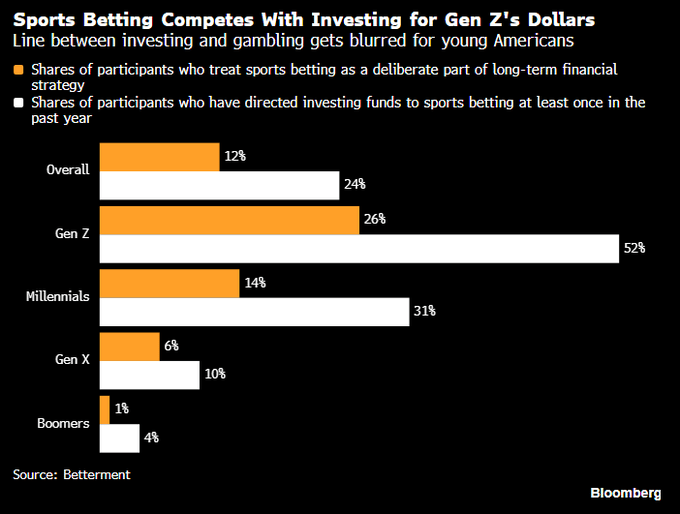
What afflicts America’s young today can’t be properly called a loneliness crisis. It seems more to me like an absence-of-loneliness crisis. It is a being-constantly-alone-and-not-even-thinking-that’s-a-problem crisis. Americans—and young men, especially—are choosing to spend historic gobs of time by themselves without feeling the internal cue to go be with other people, because it has simply gotten too pleasurable to exist without them. The problem is not loneliness. The problem is that we’ve forgotten how to feel lonely in the first place.

Since the 1970s, America has over-regulated the physical world and under-regulated the digital space. To open a daycare, build an apartment, or start a factory requires lawyers, permits, and years of compliance. To open a casino app or launch a speculative token requires a credit card and a few clicks. We made it hard to build physical-world communities and easy to build online casinos. The state that once poured concrete for public parks now licenses gambling platforms. The country that regulates a lemonade stand will let an 18-year-old day-trade options on his phone.

In short: The first half of the twentieth century was about mastering the physical world, the first half of the twenty-first has been about escaping it.

_____________________________

As part of a larger project, an author read 102 books over the past twelve-and-a-half months. Here were some of the insights he took away:

  • Exercising regularly is probably the single best thing you can do for your health. (Outside of quitting smoking.)
  • Happiness, not stress, leads to productivity.
  • Despite our preconceptions, we may be happier at work than at home. People experience more flow at work than in leisure.
  • Energy, not time, is the limited resource in our ability to be productive.
  • You can’t beat the market. Nearly everyone is better off simply buying a diversified low-cost index fund. Neither can any fund you invest in. The percentage of funds that beat the market after fees is so low that you can round it to zero.
  • You can’t time the market. Frequent trades expose you to taxes and whittle away your capital on fees. Buy and hold is better.
  • If you need an advisor, find someone who charges hourly. Paying a percentage of your assets seems cheaper, but the cost is enormous in the long-run.
  • We’re overweight because we eat too much. The increase in calories consumed is enough to entirely explain the change in body mass. Successful weight loss requires you to stick to a dietary pattern forever. The weight will always come back the moment you stop.
  • Loneliness is as bad for your health as smoking cigarettes. The stress of loneliness weakens our immune system.
  • There are numerous explanations for the increase in time alone, but a simple one is just better entertainment options available. 
  • Sleep serves many important functions. It flushes the brain of metabolic byproducts, consolidates memories, reinforces the immune system and recalibrates synaptic connections.
  • If you have insomnia, don’t worry, you probably are sleeping enough. If you’re sleep deprived you will fall asleep, so despite feeling cranky and low energy, most insomniacs are not actually sleep deprived.
  • Asking yourself “what went well?” at the end of the day can give you a big boost to your happiness.
  • ADHD is about as heritable as height, is not caused by parenting style, doesn’t go away as you age and, despite popular disbelief, medication works pretty well.

102 Lessons From Reading 102 Books

___________________________

Why do doctors now seem so rushed and dismissive? You wait 45 minutes in the exam room when the doctor finally walks in. They seem rushed. A few questions, a quick exam, a glance at the clock and then a rapid-fire plan with little time for discussion – and you leave feeling unheard, hurried and frustrated.

Increasingly, health care organizations and physician groups face intense financial pressures. Many doctors can no longer sustain their private practice due to declining reimbursements, rising costs and increasing administrative burdens; instead, they’ve become employees of larger health care systems. In some cases, their practices have been acquired by private equity groups.

With this shift, doctors have less control over their workloads and the time they get with their patients. More and more, payment models fail to cover the true cost of care. The default solution is often for doctors to see more patients with less time for each, and to squeeze in additional work after hours.

That negative, impolite tone you may have experienced might be because the doctor has many patients waiting and a full evening ahead just to catch up on writing visit notes, reviewing medical records and completing other required documentation. During the work day, they’re often fielding over 100 messages and alerts daily, including referrals and coordinating care, all while trying to focus on the patient in front of them.

________________________________

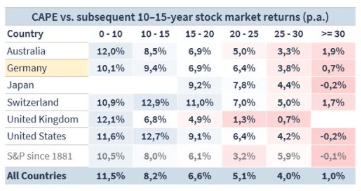
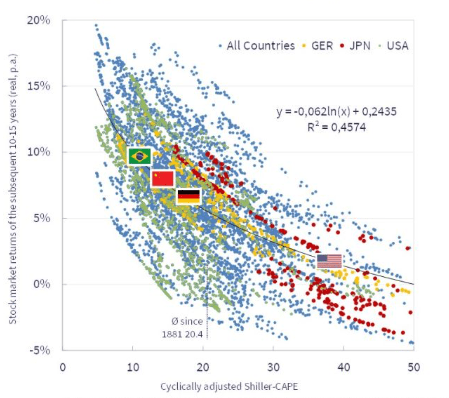
200 years of data across 56 countries, showing 25-year and 5-year returns from different starting P/E ratios (the price of a stock dividend by its earnings). The takeaway? Even over relatively short periods like five years, valuations matter a lot. If you buy when stocks are expensive they tend to do worse than when you buy them cheap.

Here are the forecasts for different categories of stocks over the coming decade based on their current valuations:

Chatfishing & Poorly Defined Problems

Why Aren’t Smart People Happier?

A good name for problems on tests that determine someone’s level of intelligence is “well-defined.” Well-defined problems can be very difficult, but they aren’t mystical. You can write down instructions for solving them. And you can put them on a test. In fact, standardized tests items must be well-defined problems, because they require indisputable answers. Matching a word to its synonym, finding the area of a trapezoid, putting pictures in the correct order—all common tasks on IQ tests—are well-defined problems.

People differ in their ability to solve well-defined problems, they’re not the only kind of problems. “Why can’t I find someone to spend my life with?” “Should I be a dentist or a dancer?” and “How do I get my child to stop crying?” are all important but “poorly defined” problems. Getting better at rotating shapes or remembering state capitals is not going to help you solve them.

One way to spot people who are good at solving poorly defined problems is to look for people who feel good about their lives; “how do I live a life I like” is a humdinger of a poorly defined problem. The rules aren’t stable: what makes you happy may make me miserable. The boundaries aren’t clear: literally anything I do could make me more happy or less happy. The problems are not repeatable: what made me happy when I was 21 may not make me happy when I’m 31.

This is why the people who score well on intelligence tests and win lots of chess games are no happier than the people who flunk the tests and lose at chess: well-defined and poorly defined problems require completely different problem-solving skills. Nobody agrees on the rules, the pieces do whatever they want, and the board covers the whole globe, as well as the inside of your head and possibly several metaphysical planes as well.

Over the last generation, we have solved tons of well-defined problems. We eradicated smallpox and polio. We landed on the moon. We built better cars, refrigerators, and televisions. We even got ~15 IQ points smarter. How much did our happiness improve? None.

We haven’t yet defined the problem of “living a happy life”. We know that if you’re starving, lonely, or in pain, you’ll probably get happier if you get food, friends, and relief. After that, the returns diminish very quickly. You could read all the positive psychology you want, take the online version of The Science of Wellbeing, read posts on hacking the hedonic treadmill, meditate, exercise, and keep a gratitude journal—and after all that, maybe you’ll be a smidge happier. Whatever else you think will put a big, permanent smile on your face, you’re probably wrong.

We fawn over people who are good at solving well-defined problems. They get to be called “professor” and “doctor.” We pay them lots of money to teach us stuff. They get to join exclusive clubs like Mensa and the Prometheus Society. 

People who are good at solving poorly defined problems don’t get the same kind of kudos. They don’t get any special titles or clubs. There is no test they can take that will spit out a big, honking number that will make everybody respect them.

And that’s a shame. My grandma does not know how to use the “input” button on her TV’s remote control, but she does know how to raise a family full of good people who love each other, how to carry on through a tragedy, and how to make the perfect pumpkin pie.

If you don’t value the ability to solve poorly defined problems, you’ll never get more of it. You won’t seek out people who have that ability and try to learn from them, nor will you listen to them when they have something important to say. You’ll spend your whole life trying to solve problems with cleverness when what you really need is wisdom. And you’ll wonder why it never really seems to work. All of your optimizing, your straining to achieve and advance, your ruthless crusade to eliminate all of the well-defined problems from your life—it doesn’t actually seem make your life any better.

_________________________

‘I realized I’d been ChatGPT-ed into bed’: how ‘Chatfishing’ made finding love on dating apps even weirder.

Standing outside the pub, 36-year-old business owner Rachel took a final tug on her vape and steeled herself to meet the man she’d spent the last three weeks opening up to. They’d matched on the dating app Hinge and built a rapport that quickly became something deeper. “From the beginning he was asking very open-ended questions, and that felt refreshing,” says Rachel.

One early message from her match read: “I’ve been reading a bit about attachment styles lately, it’s helped me to understand myself better – and the type of partner I should be looking for. Have you ever looked at yours? Do you know your attachment style?” “It was like he was genuinely trying to get to know me on a deeper level. The questions felt a lot more thoughtful than the usual, ‘How’s your day going?’” she says.

Soon, Rachel and her match were speaking daily, their conversations running the gamut from the ridiculous (favourite memes, ketchup v mayonnaise) to the sublime (expectations in love, childhood traumas). Often they’d have late-night exchanges that left her staring at her phone long after she should have been asleep. “They were like things that you read in self-help books – really personal conversations about who we are and what we want for our lives,” she says.

Which is why the man who greeted her inside the pub – polite, pleasant but oddly flat – felt like a stranger. Gone was the quickfire wit and playful rhythm she’d come to expect from their exchanges. Over pints he stumbled through small talk, checked his phone a little too often, and seemed to wilt under the pressure of her questions. “I felt like I was sitting opposite someone I’d never even spoken to,” she says. “I tried to have the same sort of conversation as we’d been having online, but it was like, ‘Knock, knock, is anyone home?’ – like he knew basically nothing about me. That’s when I suspected he’d been using AI.”

Rachel gave her date the benefit of the doubt. “I thought maybe he was nervous,” she says. But she’d been “Chatfished” before, so when the gap between his real and digital selves failed to close on their second date, she called it off. “I’d already been ChatGPT-ed into bed at least once. I didn’t want it to happen again.”

In a landscape where text-based communication plays an outsized role in the search for love, it’s perhaps understandable that some of us reach for AI’s helping hand – not everyone gives good text. Some Chatfishers, though, go to greater extremes, outsourcing entire conversations to ChatGPT, leaving their match in a dystopian hall of mirrors: believing they’re building a genuine connection with another human being when in reality they’re opening up to an algorithm trained to reflect their desires back to them.

_______________________________

Youtube is eating everything:

Consciousness, Being Present & The Fragile Gift Of Life

The night before my brain surgery, my wife and I sat across from each other in wordless stillness. Hours before surgery, with death still in the room, I didn’t feel fear. I felt something quieter. Stranger. I felt connected. To my wife’s eyes. To my breath. To the weight of my feet against the floor. To the wind brushing the window. Even to our cat, oblivious, licking her paws in perfect peace.

Upstairs, in a crib painted white, our 18-month-old daughter lay sleeping. I imagined her face at 5, at 15, at 40. I hoped she would know how deeply I loved her. And in that moment — that unbearable, radiant moment — I was, for perhaps the first time ever, conscious.

Not in the neurological sense. Not in the academic or philosophical sense. But in the raw, elemental sense of being awake to the miracle and the absurdity of existence. Alive to the texture of being. 

Leading up to surgery the world had never looked so alive. Every detail sharpened, sacred. Time no longer moved. It hovered. Held. The future dissolved. The past let go. All that remained was one long, luminous moment. And in that moment, I was tethered — to my wife’s hand, to the stars, to everything. I was, finally, conscious.

I considered the paradox of being most awake at the edge of unconsciousness. The strange intimacy of being stripped down to nothing: no ego, no schedule, no ambition.  Just breath. Presence. And the knowledge that everything is about to change—or end. 

At that moment, I was not thinking about business plans or unread emails. I was not anxious about the past. I was not hungry for the future. I was only there, suspended, waiting. And in that waiting, I was more myself than I’d ever been.

I laughed to myself in the hours before the anesthesia took hold: This is what it means to be fully human. This is what it means to be conscious.

I lived, and in the weeks following surgery, I experienced what doctors call “survivor’s euphoria.” A clinical term, woefully inadequate. It wasn’t just euphoria. It was revelation. It was a reawakening. It was a second birth.

The world opened itself to me like a wound and a gift. I smelled color. I tasted air. I watched dust motes floating in the light and felt tears rise. My daughter’s laugh shattered something inside me, and I let it. I held my wife in the dark, listening to her breath, feeling the hum of her life, and I cried because I could.

I no longer chase productivity the way I once did. I no longer confuse urgency with meaning. I try, imperfectly, to pay attention. To listen more than I speak. To feel what I feel, even when it hurts.

There is a kind of consciousness that lives not in thought but in presence. It asks nothing of us but awareness. It demands no degree, no ideology, no spiritual badge. Only that we pay attention. Only that we look — at our children, our lovers, our trees, our coffee, our clocks — and see them as if for the first time.

Schopenhauer, Colleges & Pickleball

Schopenhauer believed that all of human experience runs along a pendulum that swings from two poles: one of desire, and the other of satisfaction. We strive when we have desire, so the only way to alleviate this is to experience the pleasure that comes with satisfaction. But once you’re satisfied, boredom ensues, and desire inevitably arises yet again. Hence the pendulum.

The pace in which the pendulum swings between desire and satisfaction is what matters most. If it swings rapidly between the two, you get happiness. If it swings slowly between them, you get suffering.

To Schopenhauer, one could only be happy if desire is quickly offset by satisfaction, and this satisfaction could then be quickly offset by another desire. If it’s in our nature to restlessly strive for something, the only way to be happy is to feed that nature what it wants. Suppressing the existence of a desire only prolongs the suffering, which is why he didn’t believe that an ascetic life was the answer.

I think this does a good job explaining the phenomenon of busyness, and its existential utility for people. Ultimately, being busy is you continually swinging between desire and satisfaction. Anytime you create an item on a To Do list and proceed to check it off, that’s you making one round on this continuum. Multiply this by however many times you do it over the course of a week, and you get the feeling of busyness.

 If your mind always has something to check off, then there’s no room to ask yourself if you’re deriving meaning or purpose in what you’re doing. You just move from one cycle of desire / satisfaction to the next, and that in itself is where you dedicate your attention to.

This is where Schopenhauer’s take breaks down. Simply going from one pole to the next in a rapid manner is not happiness. Oftentimes, it’s just distraction. And when the pace of the pendulum slows in a manner where your desire takes a long time to satisfy, then you’ll see through the illusion that your busyness has created. Anytime there’s a lull or silence in your day-to-day life, this void may be filled with the angst that what you’re doing isn’t the answer, and that’s when an existential crisis takes hold.

This is why true happiness cannot be contingent upon any notion of satisfaction. Because to be satisfied is to imply an endpoint. A goal. And as the hedonic treadmill illustrates, once there is a goal, the logical conclusion is to create another chase to distract you. This distraction may keep you amused and busy, but once you’re faced with silence, you will be afraid of what you may feel.

The answer here is that happiness cannot be pursued, nor can it ever be achieved. Because the moment you’re aware that you’re happy, then paradoxically, you no longer are because you’ve called it out. Once you name a positive feeling, you become attached to it, and you long to feel it again.

The moment you pursue happiness, it is nullified. Paradoxically, understanding this is the only way one can truly be happy.

_______________________________

America is about to tumble off the edge of a massive demographic cliff. The timing is no coincidence. The US birth rate peaked in 2007, with just over 4.3 million babies born that year. That number has dropped almost every year since, reaching a 30-year low of 3.8 million births in 2017. Last year, the rate was down to 3.6 million.

Now, those 2007 babies are turning 18 (ugh, I know). As they prepare to start college and enter the workforce, their transition to adulthood signals a new reality for universities, employers, and the whole of America’s economy. Every year from here on out — at least for the foreseeable future — colleges will face a smaller and smaller pool of prospective students.

___________________________

To give you some context for pickleball’s pre-pandemic popularity, think about badminton. And now think about something half as popular as badminton. That was pickleball in 2019. Total pickleball players in the U.S. were outnumbered by participants in archery, bow hunting, fly fishing, indoor climbing, snorkeling, and sledding. Now it’s more popular than all of those pastimes … and America’s pastime. Yes, more Americans played pickleball last year than baseball.

___________________________

I’ve taught the same course to a class of undergraduate, M.B.A., medical and nursing students every year for over a decade. While I didn’t change my lectures or teaching style, somehow the students’ evaluations of last year’s class were better than ever before.

What changed? I banned all cellphones and computer-based note taking in the classroom.

To help sell this policy, I presented in the first lecture of the course a study showing that students who were required to take class notes by hand retained significantly more information than students who used computers. The reason is that with computers, students can type as fast as I speak and strive for verbatim transcripts, but there is almost no mental processing of the class’s content.

Handwritten notes require simultaneous mental processing to determine the important points that need recording. This processing encodes the material in the brain differently and facilitates longer-term retention.

Repeated studies show students perform worst on tests when phones are on desks, next worse when they’re placed in bags or pockets, and best when they’re stored in another room. The presence of smartphones also undermines the quality of in-person social interactions.

___________________________

A recently published paper looked at twin studies to see if heavy social media users have innate tendencies toward lower social well-being. After looking at info on the amount of use, the number of posts, the number of social media accounts, etc., they found only a modest correlation between social media use and well-being (including anxious-depressive symptoms).

What they did find, which many studies have found in the past, is that those symptoms correlated heavily to genetic influences.

___________________________

Today, I’m going after a sacred modern virtue. Tell me if you’ve heard this one before: “Freedom is the highest form of wealth.” After 2 years of freedom, I’d like to disagree. I don’t have issue with freedom as a form of wealth. Or that it’s a better form of wealth than money (it is). I only take issue with the “highest” or “greatest” part of this argument.

I now believe that meaning is the highest form of wealth. The ability to continually have and make meaning, every day. To feel a deep sense of fulfillment and purpose in our actions; emphasizing what we do more than who we are. The good news is you don’t need money for meaning (though it can help). There’s plenty who never find freedom, but still find purpose. So wait, does that make them free? And having freedom without meaning is its own kind of prison.

___________________________

Howard Marks’ newsletter this month provides an in depth analysis that lays out where investment value comes from and how they should be assessed. The TDLR jumping to his conclusion at the end on where we are with U.S. stocks today:

“Fundamentals appear to me to be less good overall than they were seven months ago, but at the same time, asset prices are high relative to earnings, higher than they were at the end of 2024, and at high valuations relative to history.”

Instead of DEFCONs like the Pentagon uses for war scenarios, he laid out levels of INVESTCONs investors can move through to protect investments in the face of above average market valuations and optimistic investor behavior:

6. Stop buying
5. Reduce aggressive holdings and increase defensive holdings
4. Sell off the remaining aggressive holdings
3. Trim defensive holdings as well
2. Eliminate all holdings
1. Go short

From Marks: “In my view, it’s essentially impossible to reasonably reach the degree of certainty needed to implement INVESTCON 3, 2, or 1. Because “overvaluation” is never synonymous with “sure to go down soon,” it’s rarely wise to go to those extremes. I know I never have. But I have no problem thinking right now it’s time for INVESTCON 5.