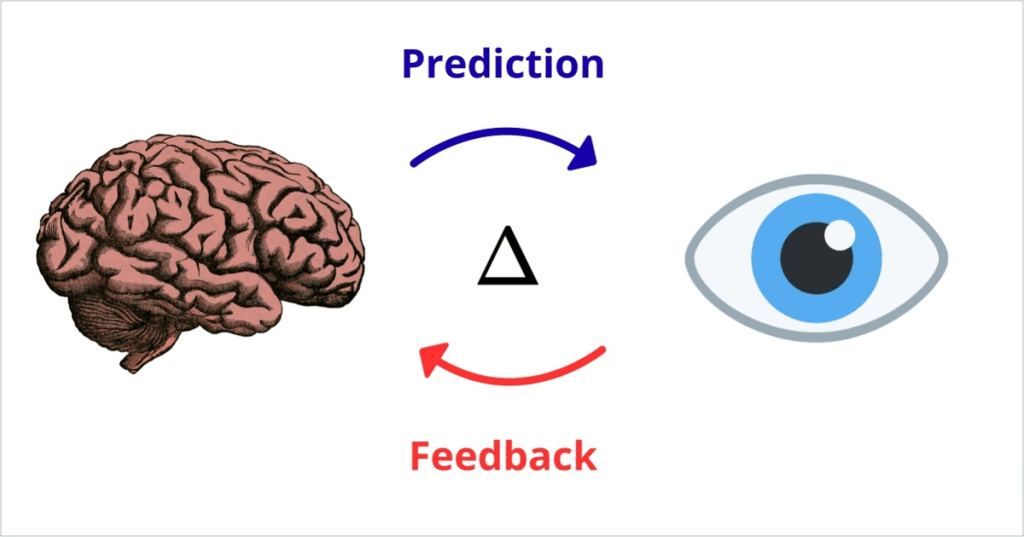
Your hippocampus doesn’t encode days that feel identical. If this Tuesday looks like last Tuesday, your brain files them as a single compressed memory. The second day never gets its own folder.
This is why decades feel like they disappeared. The hippocampus uses novelty as its filter for “worth storing.” Repetitive routines trigger temporal compression. Same commute, same desk, same dinner, same bedtime: the brain deduplicates the whole sequence into one entry. You lived 365 days. You filed 40.
As people move through continuous experience, the hippocampus and medial prefrontal cortex fire in discrete bursts at moments the brain flags as “something changed.” Each burst becomes a retrievable memory later. In stretches with no boundaries, the bursts flatten. Participants with more boundaries in a given period remembered more of it afterward. Segmentation literally builds memory.
Sleep is the second mechanism. During slow-wave sleep, the hippocampus replays the day’s episodes and transfers them to the neocortex for long-term storage. This is when memory actually gets filed. Cut sleep short and encoding efficiency drops. Chronic sleep debt means experiences you had never complete the transfer. The memory existed. It just never made it to disk.
The third mechanism is where dopamine meets attention. Novel stimuli trigger the ventral tegmental area to release dopamine into the hippocampus, which gates what gets encoded. Mind-wandering does the opposite. When your default mode network takes over (phone scrolling, rumination, email during dinner), the hippocampus stops tagging the present. You were at the wedding. Your hippocampus was in your inbox.
The fix comes straight out of the mechanism. New locations, new food, new people, new routes home. The brain needs boundaries to build memories. Go to bed earlier so replay actually runs. Put the phone down when something is happening so the dopamine signal can fire.
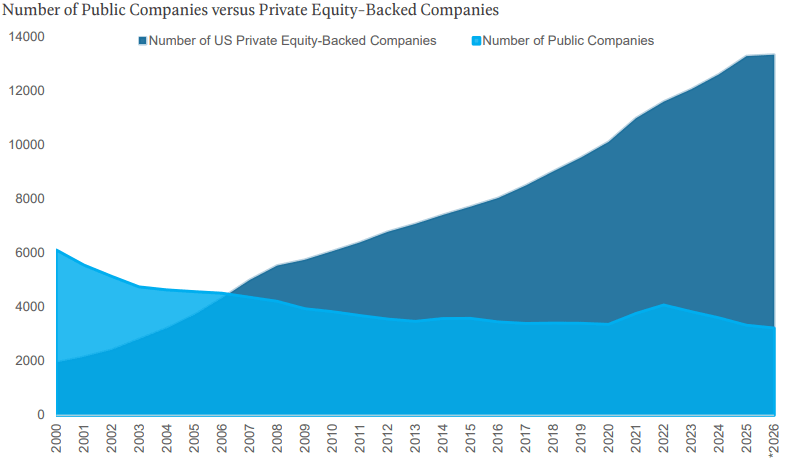
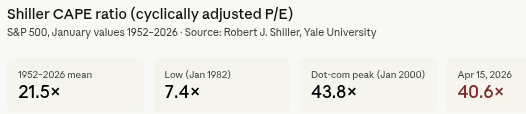
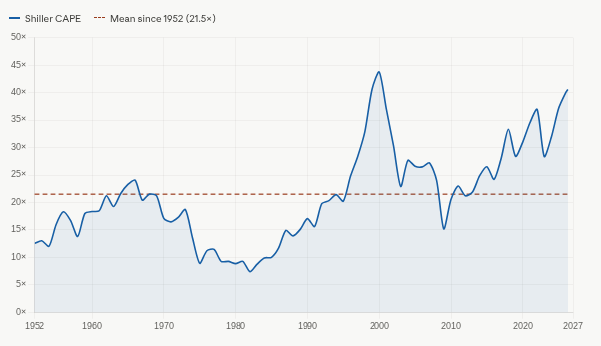
Traditional valuation metrics like the Shiller CAPE (price-to-earnings) ratio have been screaming “overvalued” for most of this century, but there has been almost no mean reversion since 2008 for U.S. stocks:
Why?
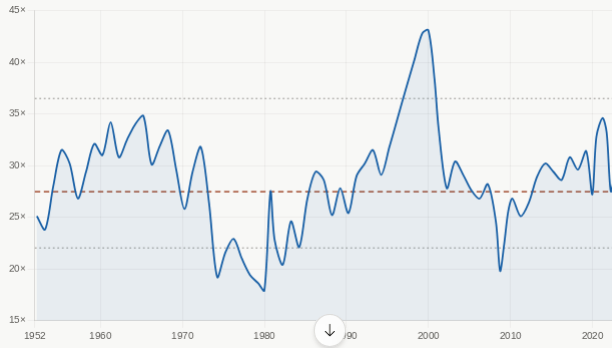
When you swap earnings for free cash flow (sales minus input costs, labor, taxes, and capex — basically what’s actually available to pay owners), the picture changes dramatically. Until recently, the price-to-free-cash-flow ratio bounced around but had no long-term upward drift:
Two structural shifts explain the divergence:
Labor share has declined ~8 percentage points of GDP since 1980. Less of the pie goes to workers, more goes to firm owners. This boosted earnings.
Capex has been relatively weak as a share of firm value. Firms (especially big tech) generated massive earnings without heavy reinvestment, so cash flow grew even faster than earnings.
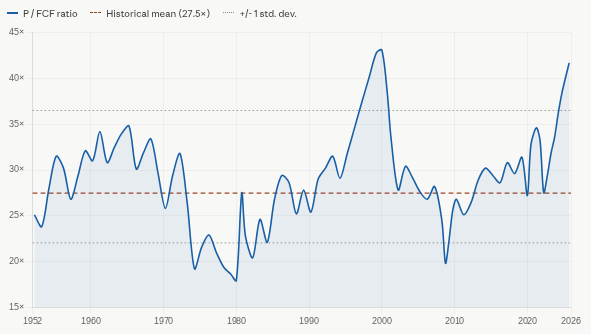
However, that clean free-cash-flow story is under pressure right now. Some of these companies have gone from huge positive FCF to zero or negative FCF, taking on debt to fund it. Big tech has flipped from cash-generating machines to massive spenders on AI data centers, chips, and energy infrastructure.
The chart below is the same as above, but extends the data adding the last few years:
Bullish case: This is 1-2 years of heavy investment that will produce a new plateau of even higher cash flows, and AI further reduces labor share.
Bearish case: AI isn’t “free money” — even adopter firms (not just the hyperscalers) will need serious capex to implement it, and the payoff is uncertain.
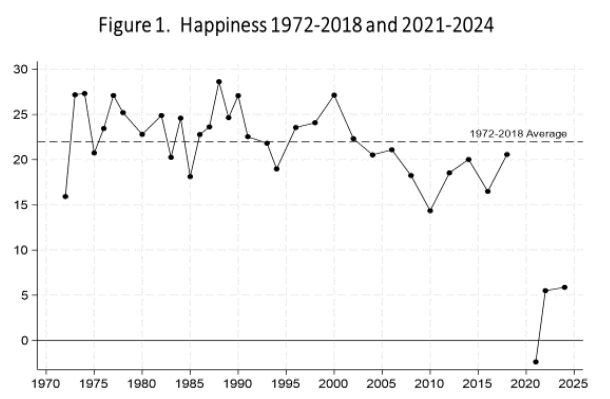
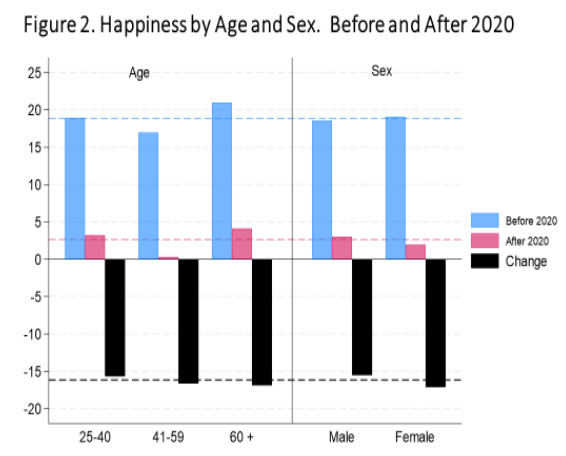
There was a sudden, sharp and historically unprecedented decline in self-reported happiness in the US population. It occurred during 2020, the year of the Covid pandemic, and mainly persists through 2024.
This happiness crash spread across nearly all typical demographics and geographies. The happiest groups pre-Covid (e.g., whites, high income, well-educated and politically/ideologically right-leaning) tend to show the largest happiness reductions.
Your brain is running status calculations all the time — looking for who is capitulating to whom, who commands attention, who has the nicest stuff, who seems confident, who people want to be around, etc, etc. This is un-installable software in your brain.
Every time you feel a pang of envy scrolling through someone’s engagement photos, every time you adjust how you describe your job depending on who’s asking, every time you feel a flush of pride when someone important remembers your name — that’s the program running. You can intellectually reject status games all you want — your brain is unconsciously still playing them.
The important thing is that status is completely relative. It’s not calculated against some universal benchmark. It’s calculated against whoever else is in the room. A surgeon has high status in a hospital but not necessarily at a skate park. Which is why status is so deeply entangled with money. Money is the most legible, most portable status signal we have. Every financial decision you make is shaped, consciously or not, by where you think you stand relative to the people around you.
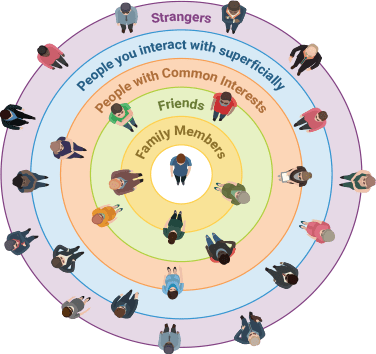
There are two fundamentally different kinds of status. The first is the respect and admiration you get from people who actually know you — your friends, your coworkers, your community. Your standing on the local ladder. It’s earned through relationships, rooted in a specific place and a specific group of people. And it’s the kind that actually predicts whether you’re happy. When your local standing goes up, your well-being goes up. When it drops, it drops. The effect is stronger than income, education, or job. Having money only really feels good insofar as it makes the people around you respect you more.
The second is what most people mean when they say “status” — wealth, income, job title, clothes, etc. The stuff people can more readily see (and quantify). It’s much easier to compare your salary to someone else than it is to determine if you’re a better partner/friend/daughter.
This kind of status barely moves the needle when it comes to happiness. People adapt to new income levels almost immediately (hello, hedonic adaptation). You get the raise, you feel good for a month, your reference group shifts, and you need more.
The pursuit of status has less to do with material comfort than with love — that what we’re really chasing when we chase rank is the assurance that we matter to someone. That we won’t be abandoned. That we’re worthy of attention and care. Which makes the whole status economy feel even crueler, because the version of status our current system sells — the one made of metrics and money and things that scale digitally — is the one least likely to deliver the thing we actually want.
The whole system runs on a kind of collective amnesia about what actually matters. We build the metrics. We optimize for the metrics. We forget why we built the metrics. We assume the metrics are the thing instead of a proxy for the thing. And then we wonder why we feel empty.
________________________________
There’s one piece of advice I’m confident applies to basically everyone: you should make sure your psychological center of gravity your real and immediate world – the world of your family and friends and neighborhood, your work and your creative projects, as opposed to the world of presidencies and governments, social forces and global emergencies.
This will make you happier. It will make you more meaningfully productive.
Keeping your center of gravity immediate and local means treating the world of national and international events as a place that you visit – to campaign or persuade, donate or volunteer, to do whatever you feel is demanded of you – and that you then return from, in order to gain perspective, and to spend time doing some of the other things a meaningful life is about.
One very good way to tell that your center of gravity is out of whack is when it feels like you spend a lot of time inside the minds of far-off strangers. To follow the news isn’t merely to follow the activities of Elon Musk, but to feel overly familiar with his twitchy and emotionally reactive inner life as well. This isn’t healthy.
We need a certain psychological distance, some cognitive privacy. There’s some appropriate level of such privacy between me and my wife, for goodness’s sake, so you’d better believe there’s one between me and Musk.
Returning your center of gravity to your immediate world means remembering that “the way you want the world to be” is something you can live, here and now, not just something for which you advocate or argue. Your immediate world isn’t only somewhere you come to recharge, before heading back to the arena. It isthe arena.
Choose something you’ve been putting off and commit to doing it for exactly two minutes. Set a timer: When it goes off, you can stop – no guilt, no pushing through. You’re not changing your life overnight – you’re just proving that beginning doesn’t have to be overwhelming.
The limits of our willpower and the importance of structuring our environment to help us accomplish what we want. To change our behavior, we need to change out surroundings. Instead of saying “I’m going to refrain from eating Fig Newtons today,” it’s better to put the Fig Newtons on the top shelf behind a box of rice crackers.
__________________________
The men who can afford it are shelling out up to $20,000 to get hair transplants, which have become harder to detect and ever more precise.
Men with more modest means can find packages that fly them to Turkey and deliver the same procedure for around $3,000 — or they can start with the cheapest option of all, which is going on finasteride. Prescriptions for the drug in the United States tripled between 2017 and 2024, a time when telehealth companies were taking off, just as men started spending hours a day staring at their hairlines on Zoom.
Feeding that anxiety is a mass-marketing campaign teaching men the same brutal self-scrutiny that women have long been trained to perform. A typical male in his 20s or 30s is likely to receive a flood of ads and shout-outs on Instagram, TikTok, YouTube and the livestreaming platform Twitch for hair-growth products that appeal to men their age.
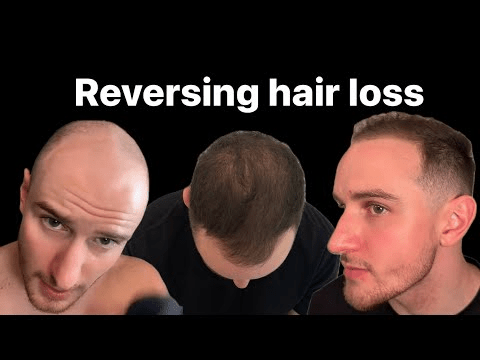
Young men who have come of age in the time of the manosphere are prime audiences for endless reels from influencers — some of them exceptionally buff, some of them funny, some of them with millions of followers, who are trying various treatments in the hope of regaining a full head of hair. The hair-loss influencer Zeph Sanders has over one million TikTok followers tracking his “hair journey.” The ubiquity of this kind of content makes losing one’s hair no longer seem inevitable; going bald can now feel like a choice — a conscious decision.
The advertising and those influencers are conveying the message to young men that they should start taking finasteride young; in their early 20s. The approach fits into the broader “prejuvenation” trend, in which young men and women are using lasers, fillers and products like Botox to fend off signs of aging before they start, rather than doing damage control when degradation is already well underway.
Here’s a number that should change how you think about retirement: 12.
That’s how long the average healthy 60-year-old has before their mobility, energy, and independence start to significantly decline. Not before they die… before life gets noticeably harder. You have more time than you have energy. More years than you have vitality. And if you don’t understand that distinction, you’ll waste the good years preparing for the declining ones.
The cruel irony is that most people spend the first decade of retirement living as they did in the last decade of work—carefully. You saved for 40 years. You delayed gratification. You were prudent, responsible, cautious. And that got you here. It built the nest egg. It secured your future. But if you keep living that way, you’ll waste the very years you saved for.
Your 60s are not a rehearsal for your 80s. They’re the main event. And if you don’t spend (not recklessly, but intentionally) during the years when you can still fully enjoy it, you’ll reach 78 with a big bank balance and a long list of regrets.
If you’re reading this in your 60s, you’re in the window. You still have your good years ahead of you. You haven’t missed it. But the window is finite, and it’s closing.
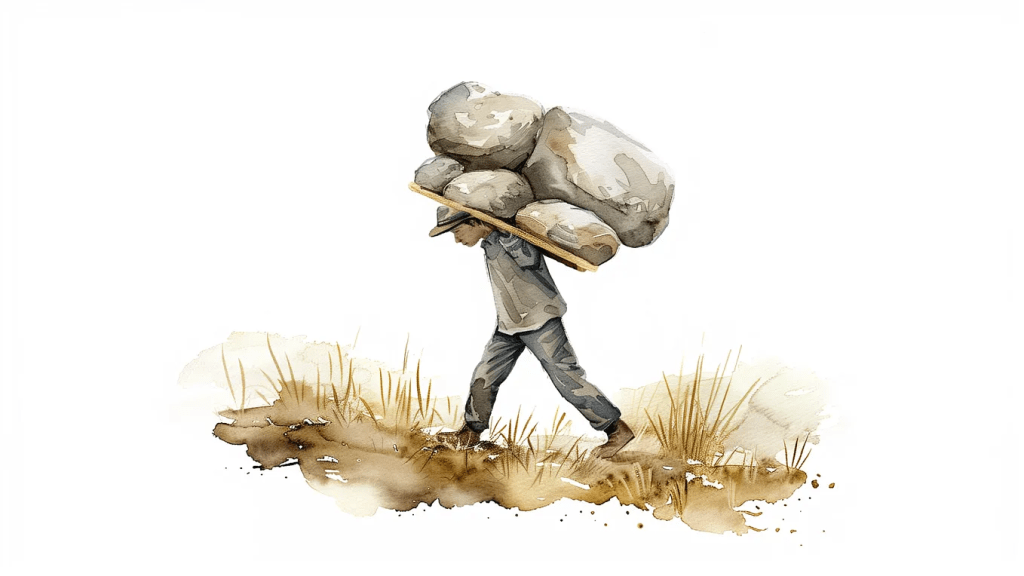
The British-born Zen master Houn Jiyu-Kennett said her teaching style wasn’t to lighten the burden of the student, but to make it so heavy that he or she would put it down. I had a full-body reaction the first time I encountered that. To me, the phrase meant this: you can slog through life trying to ‘get on top of things’, trying to reach the point at which you feel like you know what you’re doing, trying to fix your flaws, or make yourself emotionally invulnerable… All of that is an attempt to ‘lighten the burden’, and there are a thousand self-help gurus on standby, promising to aid you in the effort.
But making the burden heavier? That means seeing that as a finite human you’ll never get on top of everything, never fully understand what makes others tick, never immunize yourself from distress. The burden of reaching that goal is an impossibly heavy one. And so you put it down. You let your shoulders drop and your muscles unclench. And then – crucially – you’re free to actually be here, actually do stuff, actually show up. You get to climb life’s mountains without lugging a huge rucksack full of steel ingots on your back the whole way, which is both easier and much more fun.
The spiritual writer Michael Singer points out: reality doesn’t need you to help operate it. It gets along just fine without your worrying.
Who knew? I don’t think of myself as an obscenely self-centered narcissist, yet I have to admit that when I heard those words, I suddenly perceived the subtle sense in which my thoughts and actions – and especially the background muscular tension I instinctively bring to them – were indeed somehow premised on the notion that reality itself would be badly affected were I to relax my guard.
I seem to imagine that my worrying is effective – that there’s something about the very act of fretting about the future that helps keep everything on track. This is, rather obviously, false. All I really need to do is to show up for what’s happening, appreciate the spectacle of it, and go with the flow.
I had a conversation with a guy a few months ago whose immigrant parents came to America and worked tirelessly in low-wage jobs to make ends meet. Those kids are now adults, and this guy felt a sense of shame that as a college-educated white-collar worker he would not have to suffer the same way his parents did for him. His parents instilled in him the lessons of frugality and grit. Would his own children learn the same from him if they watched their father live a comparatively easy life?
He gave an example: when he was a kid, all books were borrowed from the library. Now his young daughter demands (and gets) to purchase $15 Taylor Swift books that pile up in her room.
My response was that if we talked to his immigrant parents, I would bet they would say: that was the goal. To put it differently: The goal of some parents is to work so hard that their kids and grandkids get to live a life that appears spoiled by the standards of previous generations.
What’s common to miss here is that when one generation’s life becomes comparatively easier than before, their life does not become objectively easy; they just move on to worrying about higher-order problems that were previously deemed not urgent enough to worry about.
I hope my kids and grandkids won’t have to worry about cancer in the ways we do. I hope they have incredible technology that makes their jobs easier than ours. I hope that everyday frictions we deal with today disappear. I hope their energy is so abundant they consider it unlimited.
Is that spoiled? I suppose, but when you frame it like that you might think of a different word – perhaps “lucky,” or, “fortunate.” Or perhaps, “beneficiaries of the accumulated hard work of those who came before them in a way that leaves them able to spend their days solving new problems.” Which is what you and I are today.
__________________
Mark Manson reviewed over 2,600 studies to rank 19 of the most common self-improvement techniques based on their effectiveness. He sorted them into four tiers: (1) legitimately works, (2) works sometimes, (3) probably not helping, and (4) straight up bullshit. Here were the results:
TIER 4: STRAIGHT UP BULLSHIT (AND MAY ACTUALLY HURT YOU):
19. Suppressing Negative Thoughts — The “ironic process” means trying not to think about something makes you think about it more. It can work for very smart people in very short-term, high-pressure moments, but the rebound effect makes things worse over time for everyone.
18. Microdosing Psychedelics — No consistent measurable benefit beyond mood improvement (i.e., you’re just getting a little high). Studies show a decline in cognitive function and executive reasoning, and long-term microdosing may carry adverse health effects from chronic exposure to psychoactive compounds.
17. Intuitive Decision-Making (“Trust Your Gut”) — Your gut doesn’t make better decisions; it just makes you feel better about your decisions. The exception is domain experts with decades of pattern-matching experience, but for most life choices, it’s self-serving and often detached from reality.
16. Catharsis / Venting Anger — Screaming into a pillow or punching a wall doesn’t release anger — it trains you to indulge it. The small effect sizes that exist are negative, meaning it makes you angrier more often.
TIER 3: PROBABLY NOT HELPING
15. Crystal Healing — Pure placebo effect. If you believe it works, you might get a small something, but there’s essentially zero evidence of any mechanism. Mostly it just harms your bank account.
14. Willpower / Ego Depletion — The concept of willpower as a finite tank you drain throughout the day is highly contested and probably not real. Believing you have limited willpower tends to make you underperform, and productivity problems are usually emotional problems in disguise.
13. Power Posing — Any mood boost is extremely transient, and the early hormonal claims (testosterone increases) have been debunked. It’s essentially a tiny placebo triggered by becoming momentarily aware of your posture.
12. Learning Styles (Visual/Auditory/Kinesthetic) — Over 90% of U.S. teachers still believe in this, but research consistently shows no real effect. The benefit people report is simply from having a choice in how they learn, not from matching a “style.”
11. Positive Affirmations — A “win more” strategy: people who already feel good get a small boost, but people with low self-esteem often feel worse because it highlights the gap between the affirmation and their actual beliefs.
10. Morning Routines — Extremely personality-dependent and mostly a placebo driven by a sense of control. Forcing a routine that mismatches your chronotype or becoming rigidly dependent on it can actually backfire.
TIER 2: WORKS SOMETIMES (MAYBE/DEPENDS):
9. Positive Visualization — Works well for physical/athletic performance and when paired with concrete planning. Without a plan, it’s just daydreaming — and pure outcome-based visualization actually decreases motivation.
8. Energy Healing — Surprisingly landed in the top half with a medium effect size (0.53), though only 56% of studies found any effect. The benefit likely comes from human touch, the ritual, and a strong placebo/expectancy effect rather than anything metaphysical.
7. Cold Water Immersion (for Mental Health) — Fairly consistent mood and stress benefits, likely driven by a big dopamine release. However, it’s a “win more” strategy — helpful if you’re already mentally healthy, potentially destabilizing if you’re fragile.
6. Speed Reading — You can realistically go from ~200 to 300–400 words per minute, which is meaningful, but the 1,000 wpm promises are nonsense. The trade-off is reduced retention, and much of reading speed turns out to be genetic.
TIER 1: LEGITIMATELY WORKS
5. Gratitude Interventions — The most consistent finding in the entire list: 98% of 166 studies showed a positive effect. The effect size is small, though, and compared to other positive interventions like acts of kindness, the unique “gratitude mechanism” mostly disappears.
4. Meditation — Consistently effective for stress and anxiety reduction, roughly equivalent to SSRIs for depression in some studies. The deeper benefit is knowing your own mind better, though compared to other active positive interventions, the unique advantage narrows.
3. Eat the Frog (Hardest Task First) — 95% of the benefit comes from the prioritization process itself, not the timing. Figuring out what matters most creates clarity and reduces anxiety, and ending the day on easier tasks boosts self-efficacy.
2. Bibliotherapy (Reading Self-Help Books) — 93% of 188 studies found positive effects, with a decent effect size approaching some therapy modalities. The key is the right book at the right time, and structured recommendations from a therapist boost the hit rate significantly.
1.Behavioral Activation (“Do Something”) — The most robust finding across all 19 techniques. Simply taking action, even small action, generates motivation rather than waiting for motivation to strike. It’s on par with CBT for depression and costs nothing.
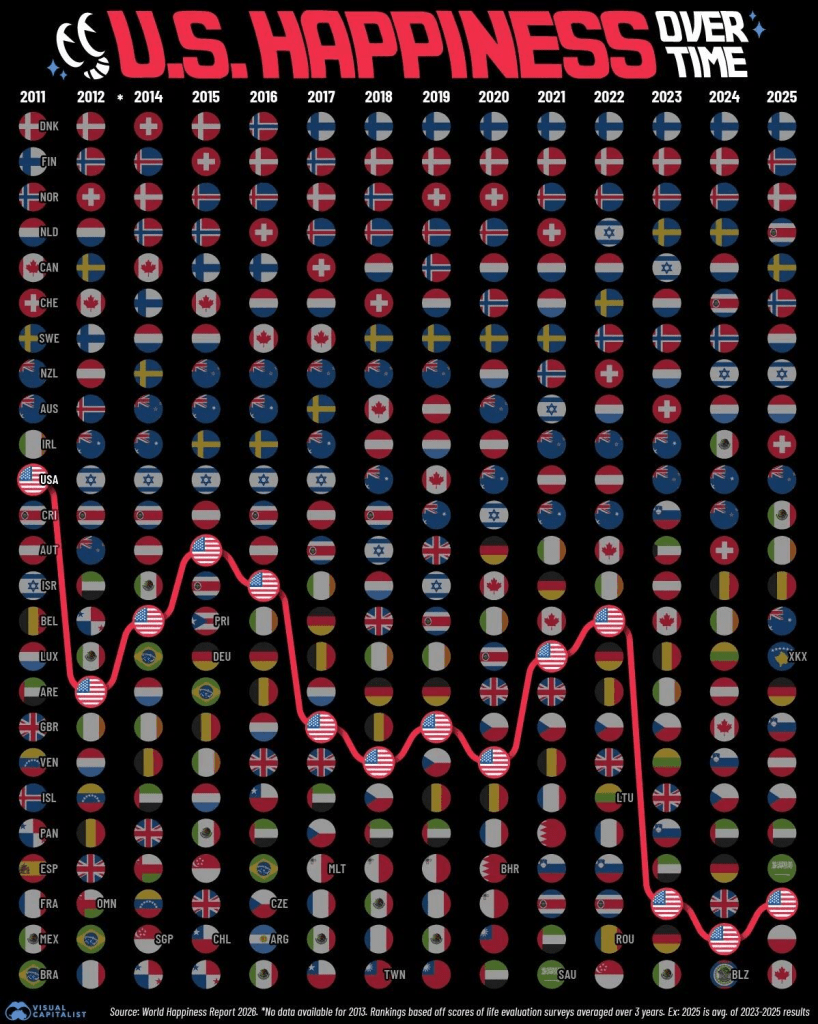
From the World Happiness Report (2026 was just released). The country rankings below are based on three-year averages, so the 2023 result captures responses from 2021, 2022 and 2023.
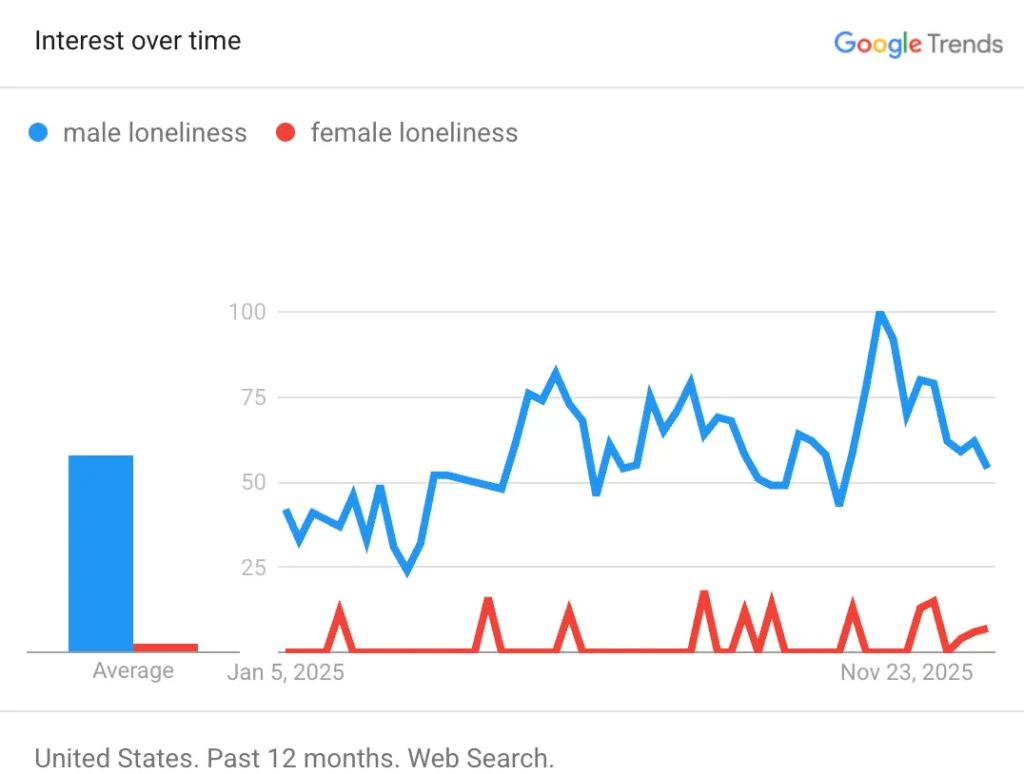
With 23,000 responses to survey questions distributed over more than 4,500 respondents, we found there is a youth loneliness crisis, not just a male loneliness crisis like many believe. Younger people — both male and female — are increasingly paralyzed by anxiety and fear, and they are finding it harder and harder to socialize.
In fact, when you look at the data, the “antisocial crisis” is actually most pronounced among young women, who experience the highest rates of social isolation.
It’s true that young men are facing a loneliness crisis, but it’s part of a broader loneliness crisis that young people are facing in general, and the numbers suggest that young women might actually be hit even harder, even though that story hasn’t gotten nearly as much attention.
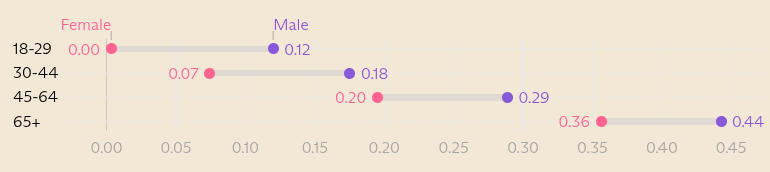
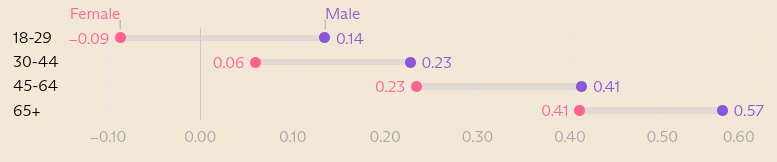
Looking at the results from our study on the questions concerning emotional distress the gender split is striking, but it is age, rather than gender, which marks the determining axis once again.
For instance, young men (18 to 29) are more distressed than almost every other demographic, including women 45 to 64 and women over 65. But young women are hit even harder, and they actually have the worst scores among any age-based gender cohort in our entire dataset.
In another axis of our study, social disengagement, young people once again emerged as the age group most likely to feel lonely, isolated, or conversationally stunted with people they don’t know, and there is a striking gap between the “internet generations” (people under 45) and everyone else.
While both young men and young women suffer from a loneliness and socialization crisis, young women actually seem to be hit significantly harder by it. In particular, they seem to find it much harder to make new friends or converse with strangers, especially when it comes to the opposite gender — and they’re much more likely to be introverted and alienated.
The results of this study lined up quite well with the existing research on this topic. A study conducted by Public Opinion Strategies found that young women are the cohort of Americans most likely to feel lonely and left out. And it doesn’t seem to be limited to just America — a study done by the United Kingdom’s Campaign to End Loneliness found that women and young people were two of the cohorts most affected by loneliness.
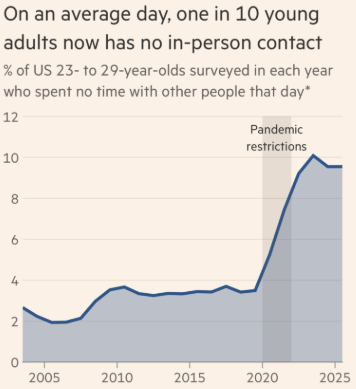
Young people are spending less and less time socializing with each other. The American Time Use Survey estimated a nearly 50% decline in face-to-face interactions among teenagers over the last two decades.
Growing up, I spent every French school holiday in the U.S. with my dad — the more career-driven of my parents (which tracks, since my mom is Belgian and my dad is a pure-bred American from Michigan). So I grew up with both models: French and American.
I don’t think most French people think about purpose the way Americans do. What’s your purpose? What are you building? What are you here for?
They’re good questions. But in France, they’re not humming in the background of every conversation. Most people I know don’t define themselves by what they do for a living. And if they work in a corporate setting, there’s often this quiet trust that things will evolve over time. No need to panic about your life path. Just do your job — and enjoy your life. Work is one part of the equation. So is your social life, your hobbies, your weekends away.
In the U.S., the idea of having purpose is everywhere: in books, on podcasts, in LinkedIn bios, even in casual brunch conversations. There’s this constant pressure to align your job with your passion, your calendar with your goals, your time with your values.
But what if your purpose is simply to build a good life? To raise kind children. To cook a little better each year. To read a few excellent books. To notice the seasons. To build meaningful relationships. Isn’t that what people will remember anyway?
In France, there’s no guilt in doing a job because it pays the bills. Or because it gives you your evenings. You can be excellent at what you do and still have no desire to talk about it over dinner — which is very much the case with my French husband, who bans work talk at the table. At first it felt strange. Now I love it. We talk about where we want to go next weekend. What we’re reading. What to cook.
When I moved back to Paris as an adult, I was struck by how much people here were just… living. They weren’t building personal brands. They weren’t trying to optimize themselves into more perfect versions. They worked, they took real holidays, they cooked, they went to the theater. They had long conversations about everything and nothing. And they rarely used the word productive.
What they value instead is curiosity. Culture. Taste. The art of paying attention. Of being present, not just purposeful. That doesn’t mean people are passive. But the energy is different. Life is more about living well or profiter de la vie.
It took me time to unlearn the habit of measuring everything by what it might lead to. What goal it served. What version of myself it might create. I still have ambition, but I no longer believe every moment needs to be part of some upward trajectory. Some days, it’s enough to spend the weekend with my family — visiting an exhibition, taking the kids to a play.
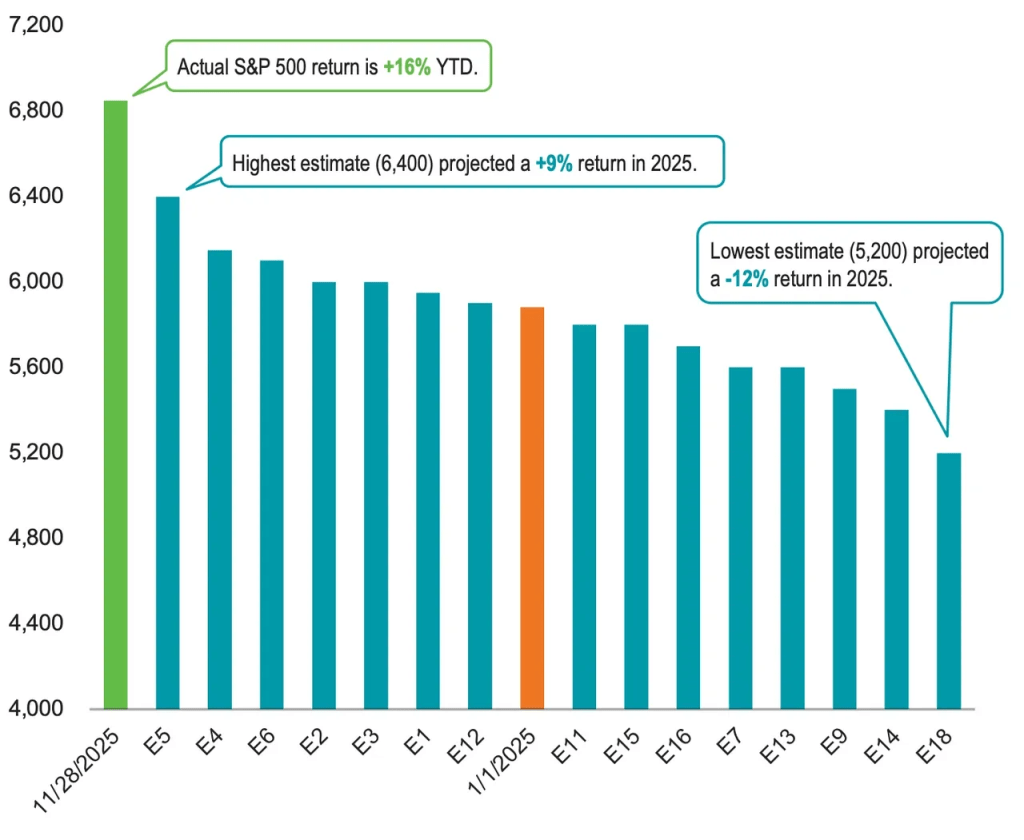
There’s a strange comfort in believing someone out there knows what the market will do next. Don’t fall for it. People who make predictions on the financial markets for a living are about as accurate as a 50/50 coin toss.
By early spring 2025, when President Trump’s tariff wars started, over half of the forecasters were calling for the market to decline. The below graph shows the level of the S&P 500 at the beginning of the year (orange bar), the actual price level at year end (green bar) and the wide range of estimates published in April (blue bars). If you’d been reading all their research reports, you might have started selling.
Maybe you’re thinking “Fine. Experts may be clueless, but vibes are easy to read.” You know all about employment numbers, and inflation, and the usual talking points from CNBC.
Well, here’s a great chart from JP Morgan Asset Management that begs to differ. It looks at S&P 500 performance after peaks and troughs in the University of Michigan’s consumer sentiment survey. Interestingly, the weakest moments in how people are feeling tend to precede strong equity returns while peaks in sentiment do not see as much upside. Turns out that getting out of the market when things feel bad can be a poor investment strategy.
__________________________
The defining feature of every bubble is the same: a growing inconsistency between the long-term returns that investors expect in their heads – based on extrapolation of the past, and the long-term returns that properly relate prices to likely future cash flows – based on valuations.
Each speculative episode encourages a certain stubbornness – because humans are adaptive creatures, we base our expectations for the future on the experience of the recent past. We respond far less to those things that are painful but distant in our memory than to those things that are rewarding in real-time.
This feature of investor behavior – what Galbraith called “the extreme brevity of the financial memory” – is complicated by the crowd psychology that accompanies speculation. Independence of thought requires one “to resist two compelling forces: one, the powerful personal interest that develops in the euphoric belief, and the other, the seemingly superior financial opinion that is brought to bear on behalf of such belief. As long as they are in, they have a strong pecuniary commitment to the belief in the unique personal intelligence that tells them there will be yet more. Speculation buys up, in a very practical way, the intelligence of those involved.”
A related, and I think equally challenging complication is that, in the short run, market prices will be whatever the consensus of the crowd chooses them to be. Nothing that we can measure affects market prices – whether earnings, GDP, employment, interest rates, monetary policy, or any other factor – except through the expectations and risk-preferences in the heads of investors at any moment in time. As the Buddha said, “With our thoughts we create our world.”
A financial “security” is nothing more than a claim on some stream of cash flows that investors expect to be delivered into their hands in the future. For any stream of future cash flows, and some long-term rate of expected return, we can always calculate the “present value” of the cash flows expected at each point in the future. Likewise, once we have a reasonable estimate of likely future cash flows, then the moment we know the market price, it’s just arithmetic to calculate the expected long-term rate of return on the investment.
Over the short-run, however, nothing prevents investors from imagining whatever long-term rate of return they like, and paying whatever price they wish, even if the two are mathematically incompatible with likely future cash flows. Even then, we can make everything compatible by imagining whatever future cash flows we like. Only time imposes any discipline on those choices, and sometimes time is unforgiving.
Will LLM models run out of data to train on? In its 2025 AI Index Report, Stanford concluded that this is unlikely before 2030. Common Crawl, an open repository of web crawl data frequently used in AI training, is estimated to contain a median of 130 trillion tokens. The indexed web holds approximately 510 trillion tokens, while the entire web contains around 3,100 trillion. Additionally, the total stock of images is estimated at 300 trillion tokens, and video at 1,350 trillion tokens.
Assume that 5 billion people end up using AI by the 2030’s (compared to 6 billion current internet users). Each user consumes about 1.6 mm tokens per day for search, coding assistance, other agents, background assistants and creative purposes. That would be a LOT of demand vs current levels and assumes a paradigm shift in how AI is used in daily life. Across all users, that would be 8 quadrillion tokens per day
How much capacity would be needed to handle 8 quadrillion tokens per day? 23 – 92 Gigawatts of active inference capacity. While there are 125 Gigawatts of data centers around the world, only about 20 Gigawatts are currently estimated to be capable of handling AI workloads.
There’s a new theory from an amateur code-breaker, Alex Barber, that links two of America’s most infamous unsolved cases: the 1947 mutilation murder of Elizabeth Short (known as the Black Dahlia) and the late-1960s killings by the Zodiac Killer.
Baber, a 50-year-old self-taught investigator from West Virginia with autism and no formal education beyond high school, claims both crimes were committed by the same person: Marvin Margolis (who later used the alias Marvin Merrill until his death in 1993). Baber says he cracked the Zodiac’s unsolved 13-symbol cipher (Z13) using AI-assisted methods, revealing the name “Marvin Merrill.” He connects this to the Black Dahlia case through circumstantial links, including:
Margolis’s brief living arrangement with Short shortly before her murder.
His Navy medical training explaining the surgical precision in her dismemberment.
A 1992 sketch by Margolis titled “Elizabeth” depicting a mutilated woman with the word “ZODIAC” hidden in the shading.
The possible murder site near a Compton motel called the Zodiac Motel, which Baber suggests inspired the killer’s later moniker.
The 2018 US semiconductor embargo against China changed the world. The age of cooperation and globalization was over.
With the 2018 embargo, the US essentially punched China on the nose. At the time, China had little choice but to take the punch. Take the punch and prepare its own economy for a future in which it would be less vulnerable to further US embargoes.
For seven long years China went on a diet, and went to the CrossFit gym. And as all of China’s savings were captured—through tighter capital controls, the suspension of IPOs, and the concentration of bank lending—and redirected towards China’s industrial supply chains, returns for investors were dreadful.
When Donald Trump came back to power in 2025, China, which had spent the past seven years getting toned, showed up and essentially said: “Gloves off. If you want a fight, let’s go. You tariff me, then I will tariff you. You embargo me, then I will embargo you.
China’s response was to de-Westernize its supply chain, at great cost to its investor base, to economic growth, to domestic consumption and even to its birth rate.
Meanwhile, over the same period, the US did absolutely nothing to de-Sinify its own supply chain. While China hit the gym, the US partied. And partied hard: US budget deficits expanded, but pretty much just funded expansions in social benefits—social security, Medicare and Medicaid. Between 2018 and 2025, US government debt increased from $21 trillion to $38 trillion. However, none of the US $17 trillion in debt went into building new Hoover dams, new Tennessee Valley Authorities, new interstate highways or new railroads.
The frustrating truth is that we don’t really know for sure what the digital empire of short-form video is doing to our minds. But a systematic review of 71 studies with 98,000 participants published in 2025 reached an alarming finding. Across the dozens of studies, heavy short-form video users showed moderate deficits in attention, inhibitory control, and memory.
The probability of men getting married increases with their income.
________________________________
The share of people between 20 and 24 who are not in a job, or seeking work, or in school, or raising a child has nearly doubled in the last quarter-century in both the UK and the U.S.
Walk 15+ miles a week, even if you do other exercise.
Eat real food. Not too much.
Stop drinking alcohol, even in moderation.
Explore minimalism (it’s not what you think it is).
Get 8 hours of quality sleep each night.
Invest in experiences, not things.
Stay lean. Men in particular are obsessed with muscle mass these days, but bulk doesn’t age well. The goal is to be strong but lean. The fittest guys in their 50s and beyond aren’t meatheads, they’re lean guys who are serious about a sport.
Stop drinking sodas and sugary energy drinks.
Show up on time, every time. Poor time management limits success more than most people realize.
Find a hobby and pursue mastery. You can’t have a happy life without a passionate pursuit that isn’t your vocation. Your work—even if you enjoy it—isn’t enough.
Try psychedelics. It’s one of those things everyone should do at least once, and it might be the breakthrough you’ve been looking for.
Be a lifelong learner. Your brain is just like a muscle—if you don’t feed and flex it regularly, it will atrophy.
Find your purpose. People with a strong sense of purpose are happier and live longer. Lack of purpose sucks energy and magnifies depression.
Only take advice from people who embody the traits you want to have. Talk is cheap—emulate those who have done it.
The goal is not to retire and do nothing, it’s to build a great day-to-day life that you don’t need to escape. A life of leisure is a slow death.
Have fun! Do frivolous and silly things that make you smile.
Accumulate assets—things that grow in value over time. It’s the #1 habit of rich people, and it can be done in tiny chunks. It becomes addictive (in a good way).
Make your own decisions. We live in an era where most of what society tells us is wrong. Don’t be afraid to break from societal norms.
Go all in on family. Get married, stay married, have kids. Burn the boats. In the end, family is all that matters.
Be ruthless with your time. Money comes and goes. Time only goes. Audit your calendar ruthlessly—cut the trivial, double down on the meaningful, and spend your hours like your life depends on it.
_____________________________
________________________________
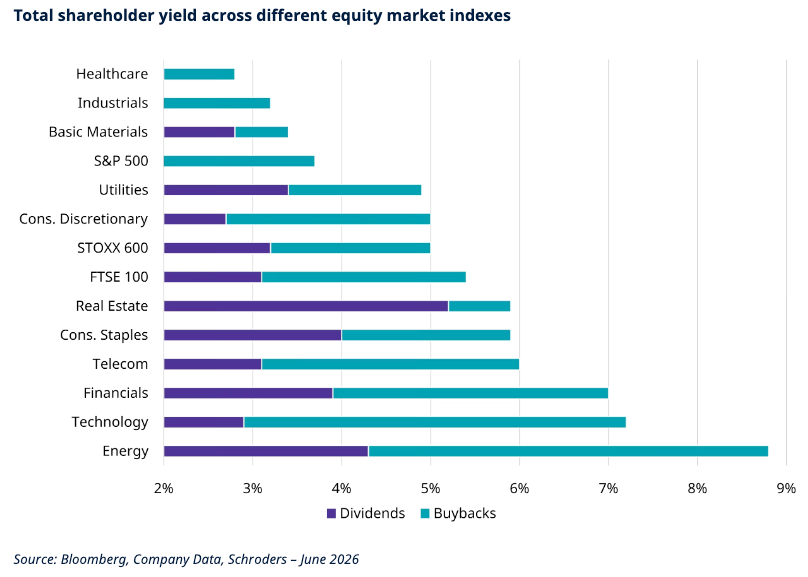
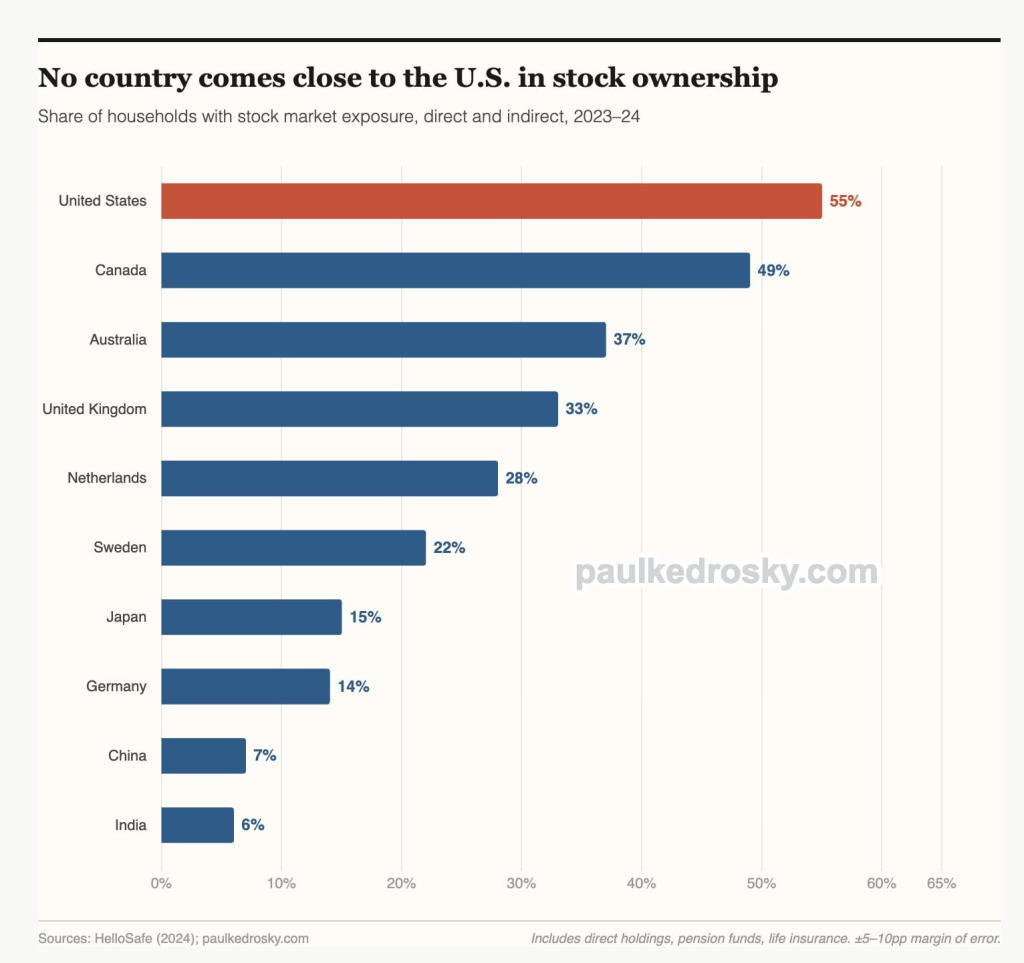
Stocks are still the most expensive in the United States, by far, but the rest of the world also became more expensive this year after an enormous rise in global stock prices almost everywhere.
What afflicts America’s young today can’t be properly called a loneliness crisis. It seems more to me like an absence-of-loneliness crisis. It is a being-constantly-alone-and-not-even-thinking-that’s-a-problem crisis. Americans—and young men, especially—are choosing to spend historic gobs of time by themselves without feeling the internal cue to go be with other people, because it has simply gotten too pleasurable to exist without them. The problem is not loneliness. The problem is that we’ve forgotten how to feel lonely in the first place.
Since the 1970s, America has over-regulated the physical world and under-regulated the digital space. To open a daycare, build an apartment, or start a factory requires lawyers, permits, and years of compliance. To open a casino app or launch a speculative token requires a credit card and a few clicks. We made it hard to build physical-world communities and easy to build online casinos. The state that once poured concrete for public parks now licenses gambling platforms. The country that regulates a lemonade stand will let an 18-year-old day-trade options on his phone.
As part of a larger project, an author read 102 books over the past twelve-and-a-half months. Here were some of the insights he took away:
Exercising regularly is probably the single best thing you can do for your health. (Outside of quitting smoking.)
Happiness, not stress, leads to productivity.
Despite our preconceptions, we may be happier at work than at home. People experience more flow at work than in leisure.
Energy, not time, is the limited resource in our ability to be productive.
You can’t beat the market. Nearly everyone is better off simply buying a diversified low-cost index fund. Neither can any fund you invest in. The percentage of funds that beat the market after fees is so low that you can round it to zero.
You can’t time the market. Frequent trades expose you to taxes and whittle away your capital on fees. Buy and hold is better.
If you need an advisor, find someone who charges hourly. Paying a percentage of your assets seems cheaper, but the cost is enormous in the long-run.
We’re overweight because we eat too much. The increase in calories consumed is enough to entirely explain the change in body mass. Successful weight loss requires you to stick to a dietary pattern forever. The weight will always come back the moment you stop.
Loneliness is as bad for your health as smoking cigarettes. The stress of loneliness weakens our immune system.
There are numerous explanations for the increase in time alone, but a simple one is just better entertainment options available.
Sleep serves many important functions. It flushes the brain of metabolic byproducts, consolidates memories, reinforces the immune system and recalibrates synaptic connections.
If you have insomnia, don’t worry, you probably are sleeping enough. If you’re sleep deprived you will fall asleep, so despite feeling cranky and low energy, most insomniacs are not actually sleep deprived.
Asking yourself “what went well?” at the end of the day can give you a big boost to your happiness.
ADHD is about as heritable as height, is not caused by parenting style, doesn’t go away as you age and, despite popular disbelief, medication works pretty well.
Why do doctors now seem so rushed and dismissive? You wait 45 minutes in the exam room when the doctor finally walks in. They seem rushed. A few questions, a quick exam, a glance at the clock and then a rapid-fire plan with little time for discussion – and you leave feeling unheard, hurried and frustrated.
Increasingly, health care organizations and physician groups face intense financial pressures. Many doctors can no longer sustain their private practice due to declining reimbursements, rising costs and increasing administrative burdens; instead, they’ve become employees of larger health care systems. In some cases, their practices have been acquired by private equity groups.
With this shift, doctors have less control over their workloads and the time they get with their patients. More and more, payment models fail to cover the true cost of care. The default solution is often for doctors to see more patients with less time for each, and to squeeze in additional work after hours.
200 years of data across 56 countries, showing 25-year and 5-year returns from different starting P/E ratios (the price of a stock dividend by its earnings). The takeaway? Even over relatively short periods like five years, valuations matter a lot. If you buy when stocks are expensive they tend to do worse than when you buy them cheap.
Here are the forecasts for different categories of stocks over the coming decade based on their current valuations:
The Pill That Women Are Taking for Everything From Speeches to First Dates: Propranolol has become the go-to pill for dealing with all sorts of stressful situations. Prescriptions are on the rise, up 28 percent from 2020. By slowing down heart rate and lowering blood pressure, the drug can reduce the physical symptoms of anxiety.
Where other beta blockers focus on specific parts of the body, propranolol affects beta receptors in the heart and everywhere else in the body, including the brain. The effects on the brain are the effects that cause the decrease of anxiety.
Compared to Xanax or Valium, propranolol is considered nonaddictive and is among the mildest variety of anti-anxiety medication, but it is not without risk. Because propranolol works to reduce blood pressure and heart rate, if you reduce it too much, the person could faint.
Szeder, founder of the AI gambling startup MonsterBet, says his tools give customers an edge. “We have some people who are probably hitting around 56 to 60 percent of the time, myself included,” he claims. He created an assistant called MonsterGPT to select bets on professional sports in the US. It uses projection models he designed combined with information scraped from across the internet.
MonsterGPT accesses web scrapers through retrieval-augmented generation (RAG), a process that allows AI tools to incorporate new data from external sources on top of their training materials. He charges $77 a month for access to MonsterGPT and other tools.
More than 16 million people aged 65 and older in the U.S. live alone. That represents 28% of that age group, almost triple the share in 1950. Among the reasons: increased longevity, higher divorce rates among older adults and children more scattered than previous generations. Many are women who outlived their spouses, and at least one-fourth of older adults with dementia live alone.
_________________________
A stock or a bond is a tangible claim on some future revenue stream; real estate and commodities are physical things that you can use even if their price drops. Crypto coins, or tokens, or however it pleases you to visualize these bits of ephemeral code, are pure speculative baubles, endowed with value only to the extent that you can convince another person to pay you more for them than you paid. They are a claim on nothing. They are the grandest embodiment of Greater Fool Theory ever invented by mankind.
Major banks have now decided to allow crypto to be used as collateral for loans. This sets the stage for a rapid collapse in crypto prices to spread its harm much more broadly throughout the financial system.
There is an ongoing phenomenon of companies that are not doing well simply buying a bunch of Bitcoin and rebranding themselves as crypto holding companies and then seeing their stock price shoot up. Because we are still in the frothy phase of the bubble, it turns out that investors will actually pay more for crypto held by a company like this than they could just buy the crypto for themselves on the open market. So a, you know, declining ball bearings manufacturer can go out and buy $1 billion of Bitcoin and announce that in a press release and then see their stock value increase by $2 billion.
The night before my brain surgery, my wife and I sat across from each other in wordless stillness. Hours before surgery, with death still in the room, I didn’t feel fear. I felt something quieter. Stranger. I felt connected. To my wife’s eyes. To my breath. To the weight of my feet against the floor. To the wind brushing the window. Even to our cat, oblivious, licking her paws in perfect peace.
Upstairs, in a crib painted white, our 18-month-old daughter lay sleeping. I imagined her face at 5, at 15, at 40. I hoped she would know how deeply I loved her. And in that moment — that unbearable, radiant moment — I was, for perhaps the first time ever, conscious.
Not in the neurological sense. Not in the academic or philosophical sense. But in the raw, elemental sense of being awake to the miracle and the absurdity of existence. Alive to the texture of being.
Leading up to surgery the world had never looked so alive. Every detail sharpened, sacred. Time no longer moved. It hovered. Held. The future dissolved. The past let go. All that remained was one long, luminous moment. And in that moment, I was tethered — to my wife’s hand, to the stars, to everything. I was, finally, conscious.
I considered the paradox of being most awake at the edge of unconsciousness. The strange intimacy of being stripped down to nothing: no ego, no schedule, no ambition. Just breath. Presence. And the knowledge that everything is about to change—or end.
At that moment, I was not thinking about business plans or unread emails. I was not anxious about the past. I was not hungry for the future. I was only there, suspended, waiting. And in that waiting, I was more myself than I’d ever been.
I laughed to myself in the hours before the anesthesia took hold: This is what it means to be fully human. This is what it means to be conscious.
I lived, and in the weeks following surgery, I experienced what doctors call “survivor’s euphoria.” A clinical term, woefully inadequate. It wasn’t just euphoria. It was revelation. It was a reawakening. It was a second birth.
The world opened itself to me like a wound and a gift. I smelled color. I tasted air. I watched dust motes floating in the light and felt tears rise. My daughter’s laugh shattered something inside me, and I let it. I held my wife in the dark, listening to her breath, feeling the hum of her life, and I cried because I could.
I no longer chase productivity the way I once did. I no longer confuse urgency with meaning. I try, imperfectly, to pay attention. To listen more than I speak. To feel what I feel, even when it hurts.
A boy once asked Charlie Munger, “What advice do you have for someone like me to succeed in life?” Munger replied: “Don’t do cocaine. Don’t race trains to the track. And avoid all AIDS situations.” It’s often hard to know what will bring joy but easy to spot what will bring misery. When trying to get ahead it can be helpful to flip things around, focusing on how to not fall back. Here are a few pieces of very bad advice:
Allow your expectations to grow faster than your income
Envy others’ success without having a full picture of their lives.
Mimic the strategy of people who want something different than you do.
Automatically associate wealth with wisdom.
Assume a new dopamine hit is a good indication of long-term joy.
Assume people care where you went to school after age 25.
Assume that what people can communicate is 100% of what they know or believe.
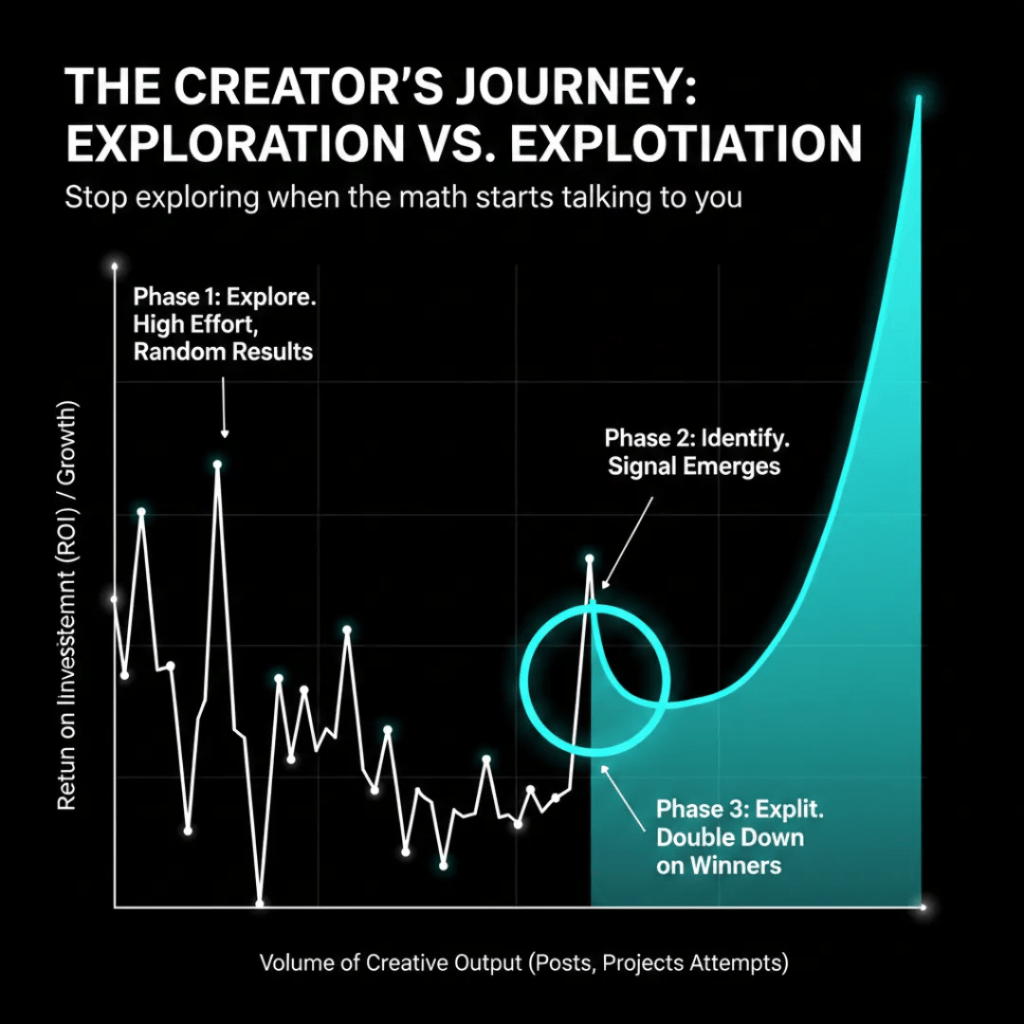
But real learning doesn’t usually follow that path. Instead, we often hit long plateaus, followed by sudden breakthroughs.
If we’re expecting constant progress, those plateaus can feel like failure. But they’re not failure. They’re part of the process.
This is where a lot of people give up. When you’ve been practicing, trying, doing the work, and it feels like nothing’s happening, it’s tempting to walk away.
But you may be much closer to a breakthrough than you think. Sometimes, just around the corner, something clicks—and you’re suddenly at the next level.
It’s not always a flat line before a breakthrough. Sometimes you make slow, steady gains. Sometimes it feels like you’re backsliding. Sometimes it gets messier before it gets clearer. But underneath the surface, your brain is making connections. Your understanding is deepening. The dots are starting to line up. Eventually, that invisible progress becomes visible.
__________________________
There is a reason why people find the financial markets endlessly fascinating. They haven’t been solved. The complexity of markets is dizzying, and in complex situations even the iron laws of physics can produce surprising, unstable results (think of airplane turbulence). More important still, finance is ultimately driven by people, not particles, and they do not always respond to similar stimuli in similar ways. They look at what happened last time, try to do better, anticipate what other traders will do and seek to outfox them. The absence of fundamental laws in markets is frustrating, disorientating—and what makes them so interesting.
There is certainly plenty to learn about the markets. But there is a case for learning as much as you can about finance and the markets and then easing back. There’s this weird dynamic in personal finance where you have to go deep at first. You need to learn enough to protect yourself. To build a plan. To avoid getting fleeced. But once that plan is in place, ideally you should be able to step back.
One of the main reasons people make behavioral mistakes when investing: the power of stories.Humans interpret the world through stories, and financial markets are narrative generating machines. When we make poor investment decisions, they are inevitably deeply intwined with a story we are using to interpret a complex and chaotic environment. It is easy to look at historic financial market events with equanimity because we know how these stories unfolded; it is an entirely different proposition when we are in the midst of an event – because we don’t know how the story will end. So, we make up our own ending and invest accordingly.
__________________________
Modern neuroscience distinguishes between two mental states: one of striving, where a surge of dopamine keeps us laser-focused on external goals like winning, perfection or achievement – and another of serene presence, where we hover in the moment, simply being. In this latter state, our neural chemistry shifts; endogenous opioids and endocannabinoids fill the brain, bringing feelings of deep satisfaction, fulfillment and joy in the now.
Motivation psychologists distinguish these two states as extrinsic and intrinsic motivation for what we’re doing. The former takes hard work and discipline to keep us going. The latter propels us forward, as by magic: flow.
Repetition: the repeated movements of our craft – the physical routines we practice over and over – follow us everywhere. Whether we call it practice or technique, these repeated actions shape our brains in powerful ways, often without us even realizing it.
They form unique connections in the brain – linking movement, memory and emotion. These connections stretch across the parts of the brain that control movement, wrap around the areas responsible for memory, and reach deep into the emotional core of the brain – the limbic system. That includes the insula, a region that helps manage both our physical health and our inner sense of self.
‘Muscle memory’ doesn’t live in our hands or legs.The real control centre is in the brain. This is where movement begins, guided by systems that plan and initiate what we do. From there, messages travel through long chains of nerve cells – from the brain down the spine and out to the rest of the body. Millions of tiny electrical signals, known as action potentials, move back and forth, telling our muscles, organs and even the tips of our fingers what to do next.
The idea is to ‘program’ the right moves in our brain so they become so automatic we can use them to, yes, feel, and to find flow. The prefrontal cortex part of our brain matures last in our individual development, with restructuring continuing well into our 20s. These parts of the brain are very ‘plastic’, meaning that they are easily shaped by experience and learning. So they are also key to the development of technique in our craft – be that in science, the arts or other fields – because they are suited to rule-based learning.
Neuroplasticity is our brain’s capacity to learn; to forge new connections between neural systems, as we practice something with our body. Professional singers and actors do daily vocal exercises, dancers do daily barre exercises – the same moves over and again – and musicians are known for their never-ending scales practice that drives neighbors up the wall. What may seem a strange, repetitive, even boring activity that artists, scientists and other creatives engage in daily is in fact doing magic to their brains.
Repeating something consciously – in this context meaning exercising those prefrontal systems of the brain – is quite effortful, and it needs a lot of energy and attentional resources. Therefore, our brain starts to forge connections that let the movements we’re practicing pass from explicit, effortful memory systems into implicit, almost automatic memory systems.
This works a bit like learning a new language. First, we learn the words, the basic grammar, and we make many mistakes. It is effortful and we have to think before uttering any sentence at all. But as we repeat the words, practice verbal tenses and vocabulary over and over, our brain realizes the repetition and transports the skill of that new language from explicit to implicit memory systems.
That’s why the advice to ‘just let go’, ‘be in the present’ and ‘feel it’ are unhelpful to find flow. When flow happens to you, it may well feel magical, it might feel like you’re ‘letting go’. You feel a strange fusion of your movements and your awareness, and you’re somehow entirely entrapped in the present. It’s still early days to say exactly how this works, but it has to do with those low-level, implicit memory systems that encode movements that we internalize with technique practice. Then, the prefrontal systems deactivate while we let the implicit motor memory systems do their job. That’s when you use that skill to express and find flow.
But this is a neural process that happens outside of your conscious awareness, you can’t do this at will. Repetitive movement practices have a wonderful side-effect if used well: they remove uncertainty from our brain. Uncertainty is part of all our lives to a larger or lesser extent; and it is among the chief killers of our calm. Being in flow makes us escape from the unpredictability of life.
Life is unpredictable, and our senses can’t always find something recognizable to cling to. When our ability to predict is weakened and our brain is put on alert, this mind-absorbing state can make us feel miserable. We can regain our footing by controlling our surroundings or other people, but if flow is what we seek, we’ll fail. What we need instead are routines in our day to create habits of well-being in our mind, because our brain will, during those periods of routine, know exactly what’s going to happen next.
While anti-smoking policy has been the single biggest lifesaver, other interventions have helped reduce people’s cancer risk. One of the biggest successes is the HPV vaccine. Cervical cancer deaths in US women under 25 fell about 62 percent, a decline researchers attribute largely to the HPV vaccine.
The next revolution is better and earlier screening. It’s generally true that the earlier cancer is caught, the better the chances of survival.
Most exciting of all are frontier developments in treating cancer. From drugs like lenalidomide and bortezomib in the 2000s, which helped double median myeloma survival, to the spread of monoclonal antibodies, real breakthroughs in treatments have meaningfully extended people’s lives — not just by months, but years. Perhaps the most promising development is CAR-T therapy, a form of immunotherapy. Rather than attempting to kill the cancer directly, immunotherapies turn a patient’s own T-cells into guided missiles.
__________________________
There is so much we don’t know about the deep ocean, but what we do know is astonishing. The ocean’s deepest point extends approximately 36,000 feet below the surface. Beyond 600 feet, light no longer penetrates, making photosynthesis impossible, yet 98% of marine life resides on or near the sea floor. Life at these depths depends almost entirely on “marine snow”—organic matter drifting down from the ocean’s upper layers.
When a whale dies, its massive body sinks to the seabed and sets off an extraordinary chain of events. A single whale fall can blanket an area of 50 square meters, roughly 538 square feet, on the ocean floor. In that single moment, it delivers a bounty of food equivalent to what small particles would provide over 200 to 2,000 years. It’s an enormous input of organic matter that sticks around for centuries.
________________________
The math and odds are against you to be able to make enough money to survive as a professional tennis player. Employing a bottom-up analysis of the top 100 junior players from 2008, research examines their career trajectories, rankings, and financial outcomes. The findings reveal that you need to be ranked in the top 150 in the world in order to break-even financially. It’s even tougher for females because male players tend to sustain longer careers, potentially due to higher earnings in the ATP circuit outside Grand Slam events.
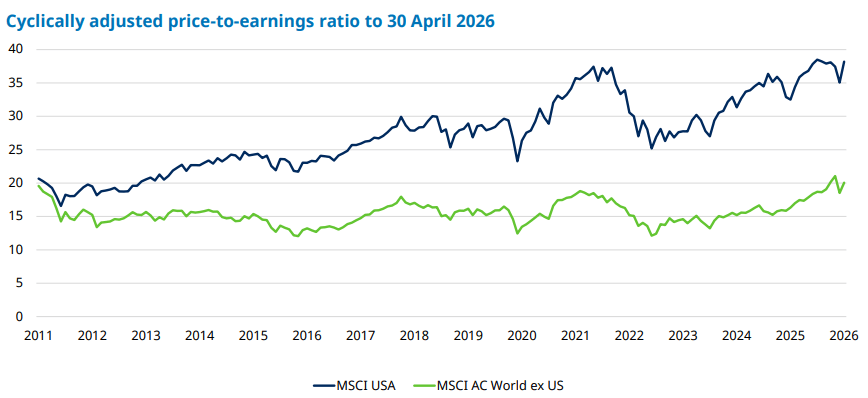
The U.S. as a whole remains much more expensive than all foreign markets:
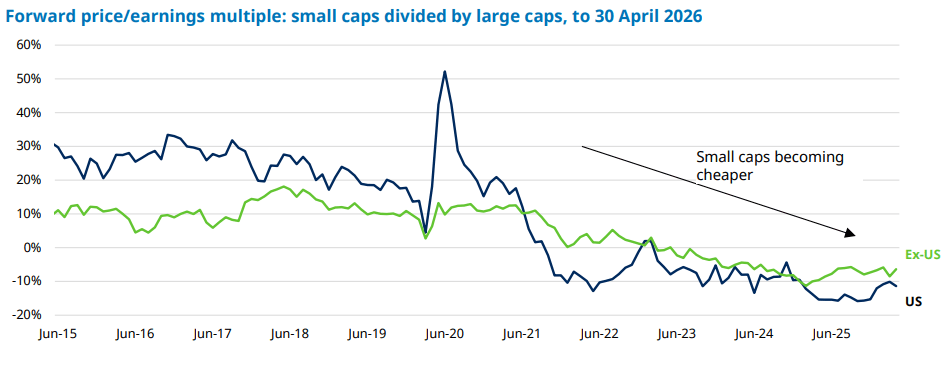
The gap in price to earnings from the U.S. vs. the rest of the world has narrowed slightly in 2025 but remains enormous:
_______________________________
Only a third of five-to-10-year-old kids frequently read for fun, compared to over half in 2012. This could be in part because their parents are less likely to read to them before they turn five: 41% of parents of all ages reported doing so, a steep drop from the 64% in 2012.
_______________________
Barry Ritholtz and Paul Krugman interview: On Art as an investment: If you go back to the old masters in the 15, 1600s and buy one of their paintings for $100 and it sells centuries later for tens of millions, it’s about a 3% return rate. It’s just the magic of compounding over centuries that are just outside our comprehension.
_____________________
__________________________
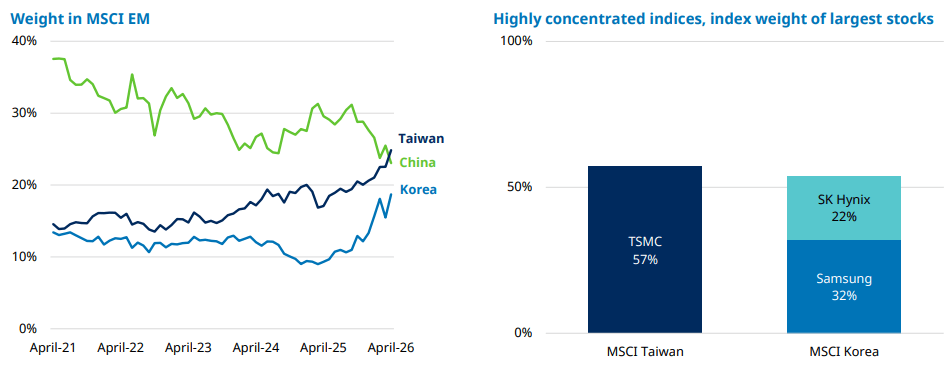
The largest stocks dominate market caps in most countries, not just the U.S. (with the Mag 7):
Imagine reading a story titled “The Relentless Pursuit of Booze.” You would likely expect a depressing story about a person in a downward alcoholic spiral. Now imagine instead reading a story titled “The Relentless Pursuit of Success.” That would be an inspiring story, wouldn’t it? Maybe—but maybe not. It might well be the story of someone whose never-ending quest for more and more success leaves them perpetually unsatisfied and incapable of happiness.
Though it isn’t a conventional medical addiction, for many people success has addictive properties. To a certain extent, I mean that literally—praise stimulates the neurotransmitter dopamine, which is implicated in all addictive behaviors. success also resembles addiction in its effect on human relationships. People sacrifice their links with others for their true love, success. They travel for business on anniversaries; they miss Little League games and recitals while working long hours. Some forgo marriage for their careers.
People willingly sacrifice their own well-being through overwork to keep getting hits of success. I know a thing or two about this: As I once found myself confessing to a close friend, “I would prefer to be special than happy.” He asked why. “Anyone can do the things it takes to be happy; going on vacation with family, relaxing with friends … but not everyone can accomplish great things.” My friend scoffed at this, but I started asking other people in my circles and found that I wasn’t unusual. Many of them had made the success addict’s choice of specialness over happiness. They (and sometimes I) would put off ordinary delights of relaxation and time with loved ones until after this project, or that promotion, when finally, it would be time to rest. But, of course, that day never seemed to arrive.
We are not only gregarious animals, liking to be in sight of our fellows, but we have an innate propensity to get ourselves noticed, and noticed favorably, by our kind. And success makes us attractive to others (that is, until we ruin our marriages).
Unfortunately, success is Sisyphean (to mix my Greek myths). The goal can’t be satisfied; most people never feel “successful enough.” The high only lasts a day or two, and then it’s on to the next goal. Psychologists call this the hedonic treadmill, in which satisfaction wears off almost immediately and we must run on to the next reward to avoid the feeling of falling behind. This is why so many studies show that successful people are almost invariably jealous of people who are more successful.
They should get off the treadmill. But quitting isn’t easy for addicts. For people hooked on substances, withdrawal can be an agonizing experience, both physically and psychologically. Anxiety and depression are very common after one quits alcoholic drinking. Success addicts giving up their habit experience a kind of withdrawal as well. Research finds that depression and anxiety are common among elite athletes after their careers end.
American culture valorizes overwork, which makes it easy to slip into a mindset that can breed success addiction. What can you do to retrain yourself to chase happiness instead of success, no matter where you are in your life’s journey?
Admit that as successful as you are, were, or hope to be in your life and work, you are not going to find true happiness on the hedonic treadmill of your professional life. You’ll find it in things that are deeply ordinary: enjoying a walk or a conversation with a loved one, instead of working that extra hour. This is extremely difficult for many people. It feels almost like an admission of defeat for those who have spent their lives worshipping hard work and striving to outperform others. Social comparison is a big part of how people measure worldly success, but the research is clear that it strips us of life satisfaction.
Start showing up and being present for relationships you’ve compromised in the pursuit of success.
Find the right metrics of success. If you only measure yourself by the worldly rewards of money, power, and prestige, you’ll spend your life running on the hedonic treadmill and comparing yourself to others. Better metrics include faith, family, and friendship. I also include work—but not work for the sake of outward achievement. Rather, it should be work that serves others and gives you a sense of personal meaning.
I stopped buying active investments (individual stocks, etc.) a few years ago. I’ve gone through different justifications for why too. Originally, I stopped buying active investments because of the performance argument. If 85% of active stock managers can’t beat the market over 10 years, what makes you think you can? It’s also too hard to know if you’re actually good. Because there is so much luck involved (especially over shorter time periods), you are better off not wasting your time trying to figure it out.
But there’s an even better argument: I don’t make active investments now because you can’t put a price on mental freedom. What I’ve realized about myself (and many others I’ve spoken to) is that when you buy an active investment like an individual stock, that investment consumes a lot of your attention.
1. 1960-2000: Robert Putnam sees associations and club membership plummeting, writes “Bowling Alone”
2. 2000 – 2020s: Face to face socializing falls another 25%, as coupling rates plunge
3. Now this…
_____________________________
Forbes surveyed more than 217,000 employees working at companies within the U.S. that employ more than 1,000 people. The organizations were stratified so that companies with 1,000 to 5,000 employees were deemed midsize, while companies with more than 5,000 employees were considered large employers.
Survey respondents (who remained anonymous so they could answer freely) were asked if they would recommend their employer to others and to rate it based on a range of criteria, including salary, work environment, training programs and opportunities to advance. Participants were also asked if they would recommend their previous employers (within the past two years) and the employers they knew through their industry experience or through friends or family who worked there.