There’s a new theory from an amateur code-breaker, Alex Barber, that links two of America’s most infamous unsolved cases: the 1947 mutilation murder of Elizabeth Short (known as the Black Dahlia) and the late-1960s killings by the Zodiac Killer.
Baber, a 50-year-old self-taught investigator from West Virginia with autism and no formal education beyond high school, claims both crimes were committed by the same person: Marvin Margolis (who later used the alias Marvin Merrill until his death in 1993). Baber says he cracked the Zodiac’s unsolved 13-symbol cipher (Z13) using AI-assisted methods, revealing the name “Marvin Merrill.” He connects this to the Black Dahlia case through circumstantial links, including:
Margolis’s brief living arrangement with Short shortly before her murder.
His Navy medical training explaining the surgical precision in her dismemberment.
A 1992 sketch by Margolis titled “Elizabeth” depicting a mutilated woman with the word “ZODIAC” hidden in the shading.
The possible murder site near a Compton motel called the Zodiac Motel, which Baber suggests inspired the killer’s later moniker.
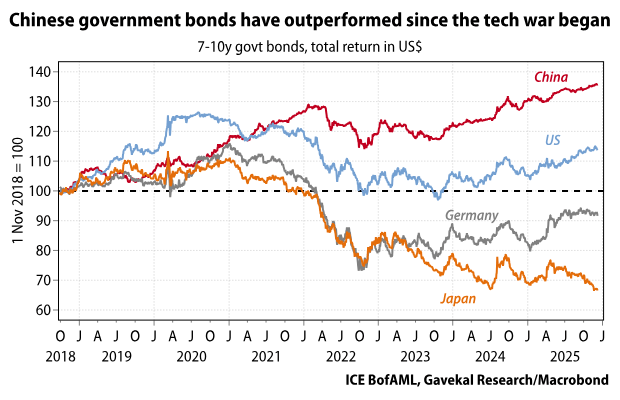
The 2018 US semiconductor embargo against China changed the world. The age of cooperation and globalization was over.
With the 2018 embargo, the US essentially punched China on the nose. At the time, China had little choice but to take the punch. Take the punch and prepare its own economy for a future in which it would be less vulnerable to further US embargoes.
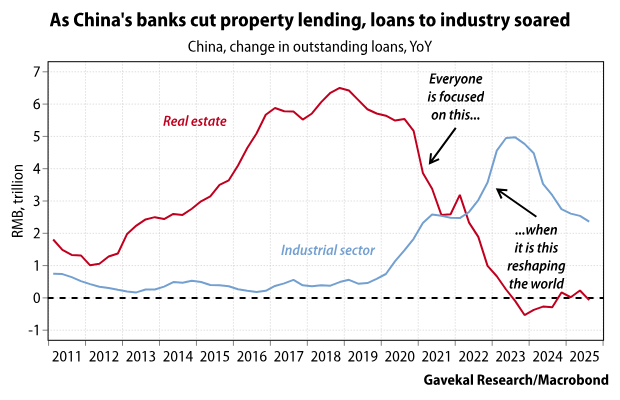
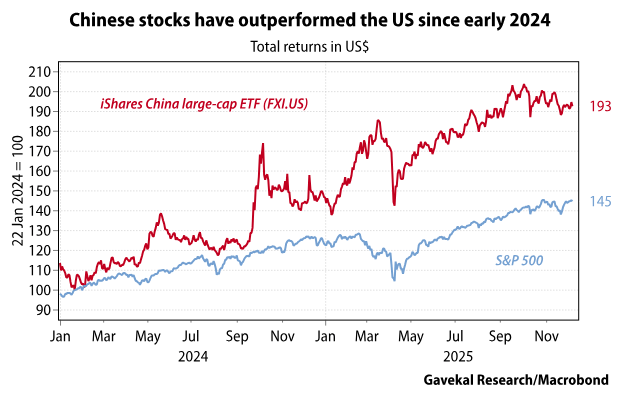
For seven long years China went on a diet, and went to the CrossFit gym. And as all of China’s savings were captured—through tighter capital controls, the suspension of IPOs, and the concentration of bank lending—and redirected towards China’s industrial supply chains, returns for investors were dreadful.
When Donald Trump came back to power in 2025, China, which had spent the past seven years getting toned, showed up and essentially said: “Gloves off. If you want a fight, let’s go. You tariff me, then I will tariff you. You embargo me, then I will embargo you.
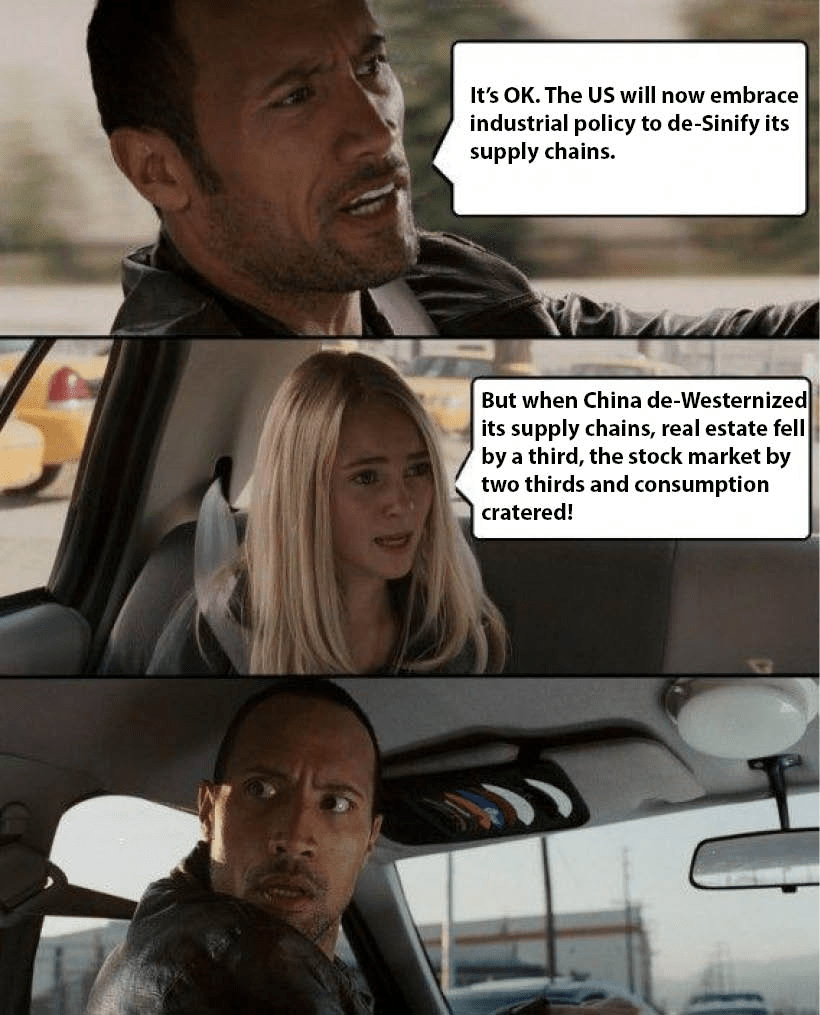
China’s response was to de-Westernize its supply chain, at great cost to its investor base, to economic growth, to domestic consumption and even to its birth rate.
Meanwhile, over the same period, the US did absolutely nothing to de-Sinify its own supply chain. While China hit the gym, the US partied. And partied hard: US budget deficits expanded, but pretty much just funded expansions in social benefits—social security, Medicare and Medicaid. Between 2018 and 2025, US government debt increased from $21 trillion to $38 trillion. However, none of the US $17 trillion in debt went into building new Hoover dams, new Tennessee Valley Authorities, new interstate highways or new railroads.
The frustrating truth is that we don’t really know for sure what the digital empire of short-form video is doing to our minds. But a systematic review of 71 studies with 98,000 participants published in 2025 reached an alarming finding. Across the dozens of studies, heavy short-form video users showed moderate deficits in attention, inhibitory control, and memory.
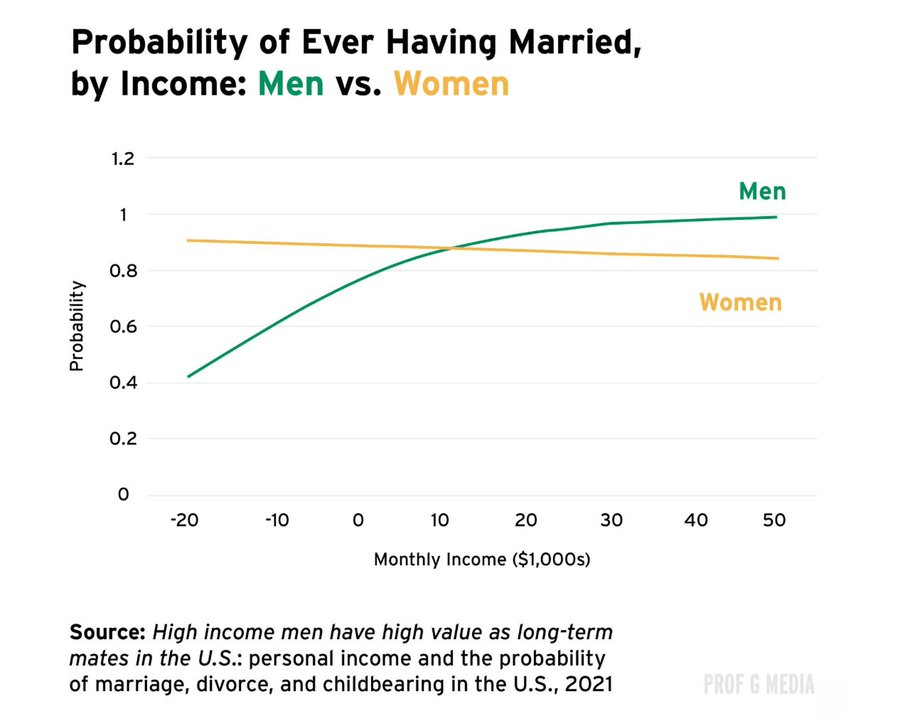
The probability of men getting married increases with their income.
________________________________
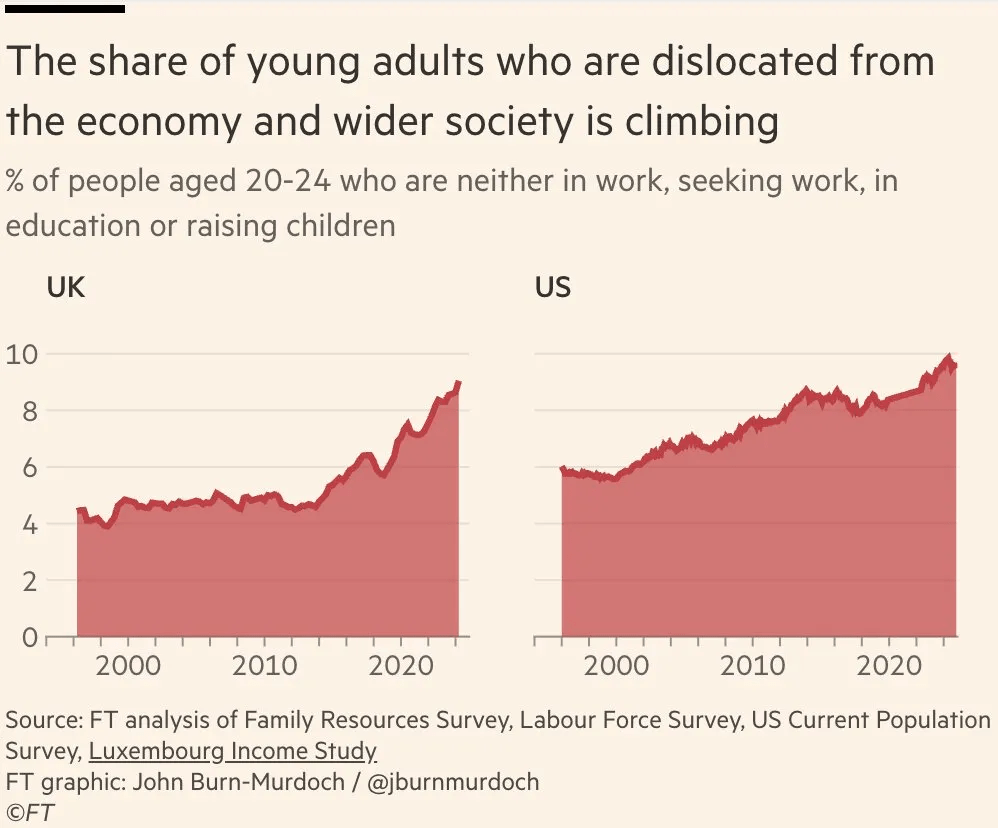
The share of people between 20 and 24 who are not in a job, or seeking work, or in school, or raising a child has nearly doubled in the last quarter-century in both the UK and the U.S.
Walk 15+ miles a week, even if you do other exercise.
Eat real food. Not too much.
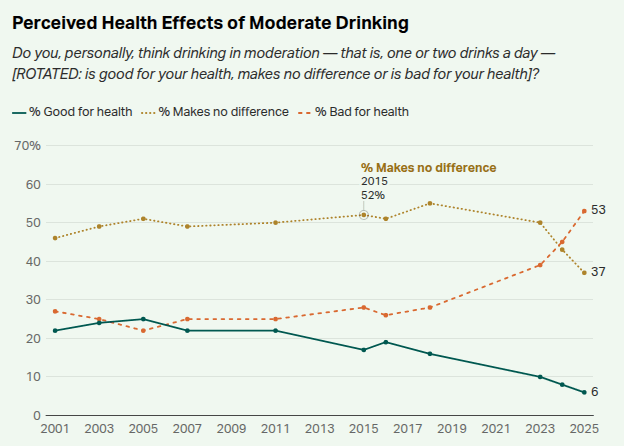
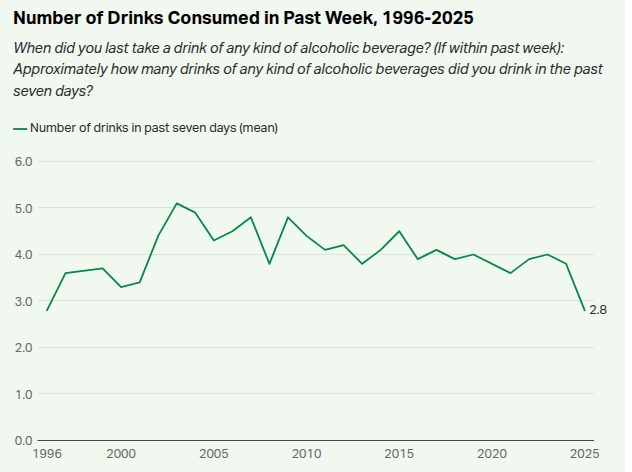
Stop drinking alcohol, even in moderation.
Explore minimalism (it’s not what you think it is).
Get 8 hours of quality sleep each night.
Invest in experiences, not things.
Stay lean. Men in particular are obsessed with muscle mass these days, but bulk doesn’t age well. The goal is to be strong but lean. The fittest guys in their 50s and beyond aren’t meatheads, they’re lean guys who are serious about a sport.
Stop drinking sodas and sugary energy drinks.
Show up on time, every time. Poor time management limits success more than most people realize.
Find a hobby and pursue mastery. You can’t have a happy life without a passionate pursuit that isn’t your vocation. Your work—even if you enjoy it—isn’t enough.
Try psychedelics. It’s one of those things everyone should do at least once, and it might be the breakthrough you’ve been looking for.
Be a lifelong learner. Your brain is just like a muscle—if you don’t feed and flex it regularly, it will atrophy.
Find your purpose. People with a strong sense of purpose are happier and live longer. Lack of purpose sucks energy and magnifies depression.
Only take advice from people who embody the traits you want to have. Talk is cheap—emulate those who have done it.
The goal is not to retire and do nothing, it’s to build a great day-to-day life that you don’t need to escape. A life of leisure is a slow death.
Have fun! Do frivolous and silly things that make you smile.
Accumulate assets—things that grow in value over time. It’s the #1 habit of rich people, and it can be done in tiny chunks. It becomes addictive (in a good way).
Make your own decisions. We live in an era where most of what society tells us is wrong. Don’t be afraid to break from societal norms.
Go all in on family. Get married, stay married, have kids. Burn the boats. In the end, family is all that matters.
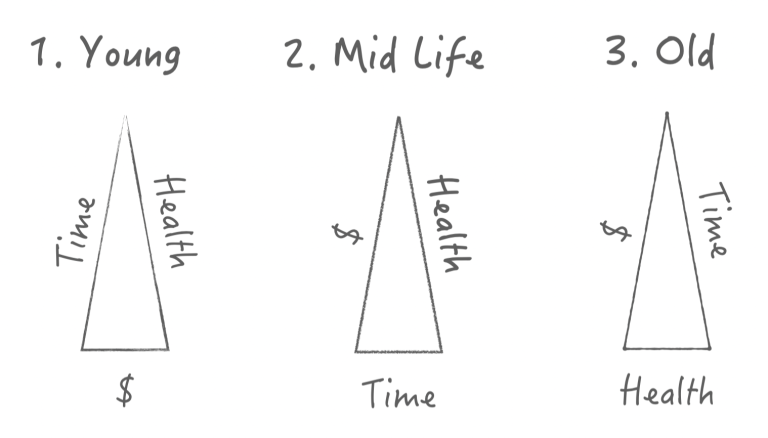
Be ruthless with your time. Money comes and goes. Time only goes. Audit your calendar ruthlessly—cut the trivial, double down on the meaningful, and spend your hours like your life depends on it.
_____________________________
________________________________
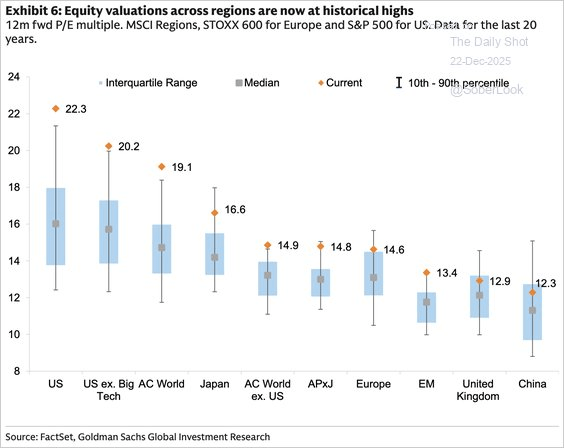
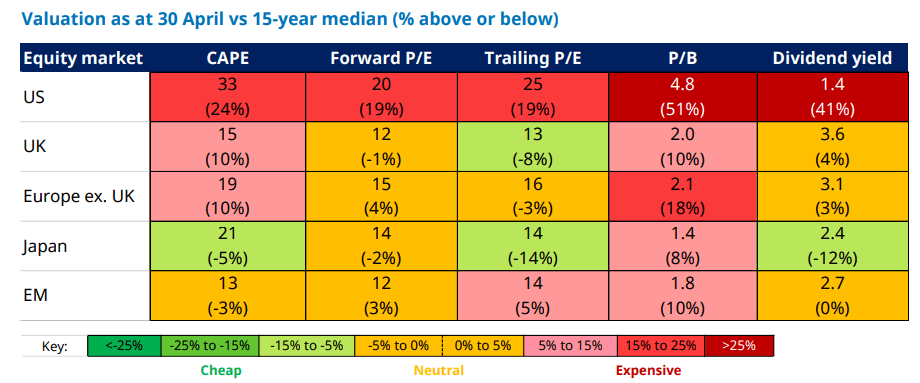
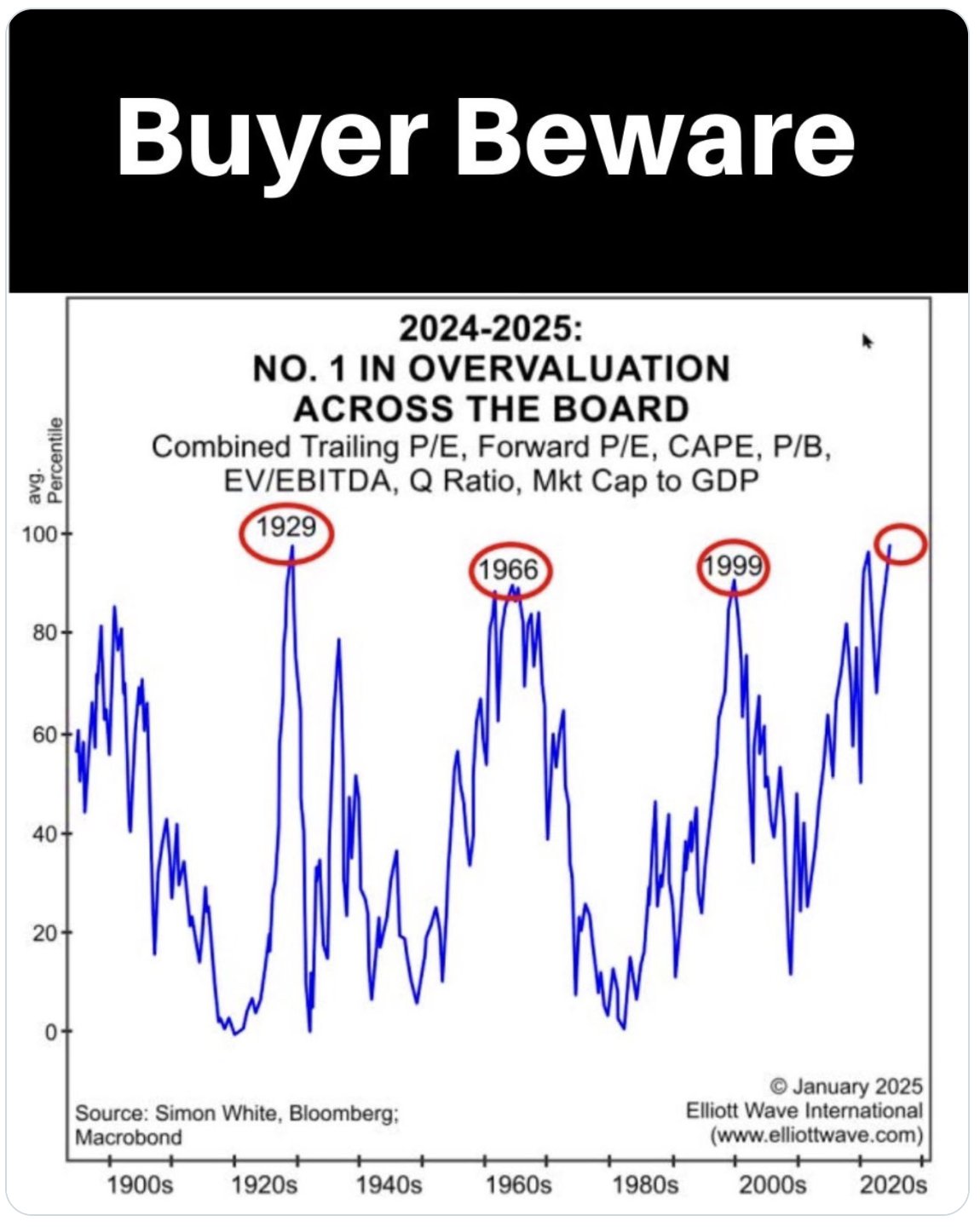
Stocks are still the most expensive in the United States, by far, but the rest of the world also became more expensive this year after an enormous rise in global stock prices almost everywhere.
What afflicts America’s young today can’t be properly called a loneliness crisis. It seems more to me like an absence-of-loneliness crisis. It is a being-constantly-alone-and-not-even-thinking-that’s-a-problem crisis. Americans—and young men, especially—are choosing to spend historic gobs of time by themselves without feeling the internal cue to go be with other people, because it has simply gotten too pleasurable to exist without them. The problem is not loneliness. The problem is that we’ve forgotten how to feel lonely in the first place.
Since the 1970s, America has over-regulated the physical world and under-regulated the digital space. To open a daycare, build an apartment, or start a factory requires lawyers, permits, and years of compliance. To open a casino app or launch a speculative token requires a credit card and a few clicks. We made it hard to build physical-world communities and easy to build online casinos. The state that once poured concrete for public parks now licenses gambling platforms. The country that regulates a lemonade stand will let an 18-year-old day-trade options on his phone.
As part of a larger project, an author read 102 books over the past twelve-and-a-half months. Here were some of the insights he took away:
Exercising regularly is probably the single best thing you can do for your health. (Outside of quitting smoking.)
Happiness, not stress, leads to productivity.
Despite our preconceptions, we may be happier at work than at home. People experience more flow at work than in leisure.
Energy, not time, is the limited resource in our ability to be productive.
You can’t beat the market. Nearly everyone is better off simply buying a diversified low-cost index fund. Neither can any fund you invest in. The percentage of funds that beat the market after fees is so low that you can round it to zero.
You can’t time the market. Frequent trades expose you to taxes and whittle away your capital on fees. Buy and hold is better.
If you need an advisor, find someone who charges hourly. Paying a percentage of your assets seems cheaper, but the cost is enormous in the long-run.
We’re overweight because we eat too much. The increase in calories consumed is enough to entirely explain the change in body mass. Successful weight loss requires you to stick to a dietary pattern forever. The weight will always come back the moment you stop.
Loneliness is as bad for your health as smoking cigarettes. The stress of loneliness weakens our immune system.
There are numerous explanations for the increase in time alone, but a simple one is just better entertainment options available.
Sleep serves many important functions. It flushes the brain of metabolic byproducts, consolidates memories, reinforces the immune system and recalibrates synaptic connections.
If you have insomnia, don’t worry, you probably are sleeping enough. If you’re sleep deprived you will fall asleep, so despite feeling cranky and low energy, most insomniacs are not actually sleep deprived.
Asking yourself “what went well?” at the end of the day can give you a big boost to your happiness.
ADHD is about as heritable as height, is not caused by parenting style, doesn’t go away as you age and, despite popular disbelief, medication works pretty well.
Why do doctors now seem so rushed and dismissive? You wait 45 minutes in the exam room when the doctor finally walks in. They seem rushed. A few questions, a quick exam, a glance at the clock and then a rapid-fire plan with little time for discussion – and you leave feeling unheard, hurried and frustrated.
Increasingly, health care organizations and physician groups face intense financial pressures. Many doctors can no longer sustain their private practice due to declining reimbursements, rising costs and increasing administrative burdens; instead, they’ve become employees of larger health care systems. In some cases, their practices have been acquired by private equity groups.
With this shift, doctors have less control over their workloads and the time they get with their patients. More and more, payment models fail to cover the true cost of care. The default solution is often for doctors to see more patients with less time for each, and to squeeze in additional work after hours.
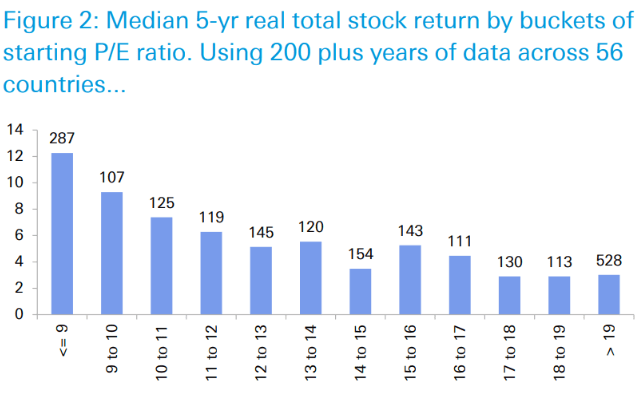
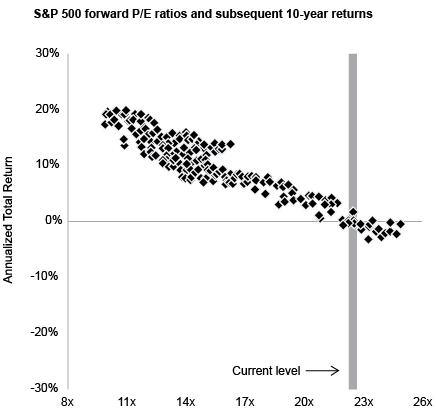
200 years of data across 56 countries, showing 25-year and 5-year returns from different starting P/E ratios (the price of a stock dividend by its earnings). The takeaway? Even over relatively short periods like five years, valuations matter a lot. If you buy when stocks are expensive they tend to do worse than when you buy them cheap.
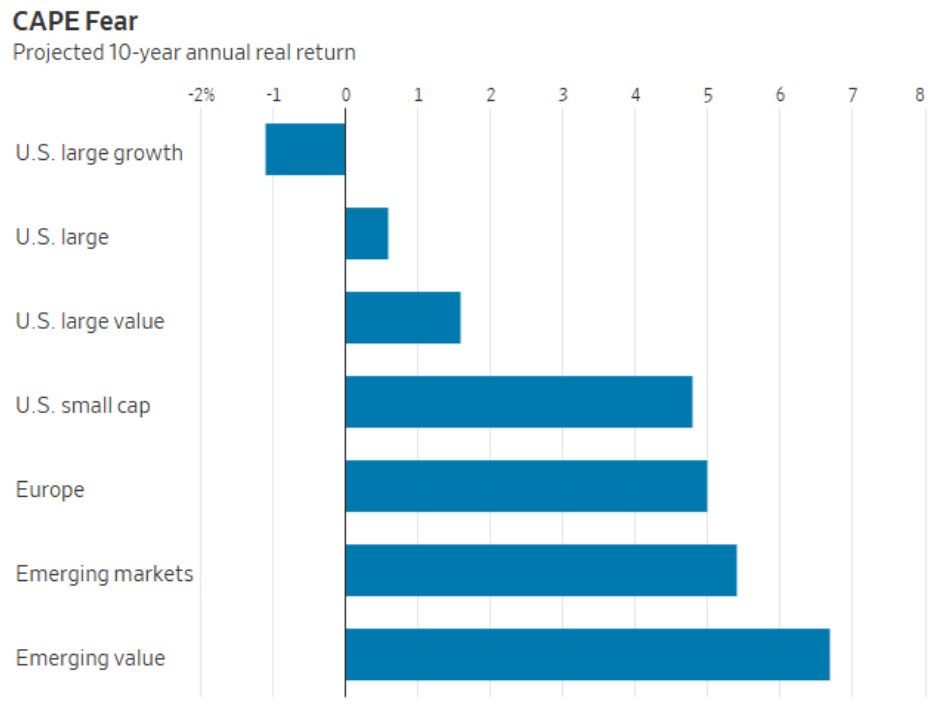
Here are the forecasts for different categories of stocks over the coming decade based on their current valuations:
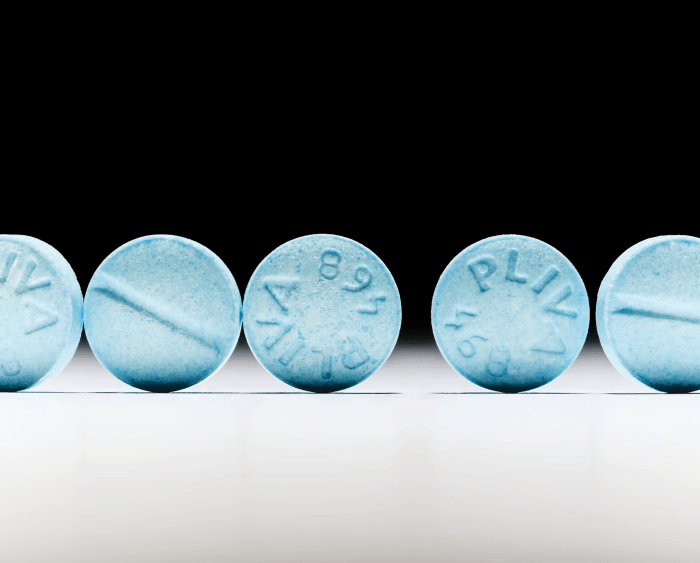
The Pill That Women Are Taking for Everything From Speeches to First Dates: Propranolol has become the go-to pill for dealing with all sorts of stressful situations. Prescriptions are on the rise, up 28 percent from 2020. By slowing down heart rate and lowering blood pressure, the drug can reduce the physical symptoms of anxiety.
Where other beta blockers focus on specific parts of the body, propranolol affects beta receptors in the heart and everywhere else in the body, including the brain. The effects on the brain are the effects that cause the decrease of anxiety.
Compared to Xanax or Valium, propranolol is considered nonaddictive and is among the mildest variety of anti-anxiety medication, but it is not without risk. Because propranolol works to reduce blood pressure and heart rate, if you reduce it too much, the person could faint.
Szeder, founder of the AI gambling startup MonsterBet, says his tools give customers an edge. “We have some people who are probably hitting around 56 to 60 percent of the time, myself included,” he claims. He created an assistant called MonsterGPT to select bets on professional sports in the US. It uses projection models he designed combined with information scraped from across the internet.
MonsterGPT accesses web scrapers through retrieval-augmented generation (RAG), a process that allows AI tools to incorporate new data from external sources on top of their training materials. He charges $77 a month for access to MonsterGPT and other tools.
More than 16 million people aged 65 and older in the U.S. live alone. That represents 28% of that age group, almost triple the share in 1950. Among the reasons: increased longevity, higher divorce rates among older adults and children more scattered than previous generations. Many are women who outlived their spouses, and at least one-fourth of older adults with dementia live alone.
_________________________
A stock or a bond is a tangible claim on some future revenue stream; real estate and commodities are physical things that you can use even if their price drops. Crypto coins, or tokens, or however it pleases you to visualize these bits of ephemeral code, are pure speculative baubles, endowed with value only to the extent that you can convince another person to pay you more for them than you paid. They are a claim on nothing. They are the grandest embodiment of Greater Fool Theory ever invented by mankind.
Major banks have now decided to allow crypto to be used as collateral for loans. This sets the stage for a rapid collapse in crypto prices to spread its harm much more broadly throughout the financial system.
There is an ongoing phenomenon of companies that are not doing well simply buying a bunch of Bitcoin and rebranding themselves as crypto holding companies and then seeing their stock price shoot up. Because we are still in the frothy phase of the bubble, it turns out that investors will actually pay more for crypto held by a company like this than they could just buy the crypto for themselves on the open market. So a, you know, declining ball bearings manufacturer can go out and buy $1 billion of Bitcoin and announce that in a press release and then see their stock value increase by $2 billion.
The night before my brain surgery, my wife and I sat across from each other in wordless stillness. Hours before surgery, with death still in the room, I didn’t feel fear. I felt something quieter. Stranger. I felt connected. To my wife’s eyes. To my breath. To the weight of my feet against the floor. To the wind brushing the window. Even to our cat, oblivious, licking her paws in perfect peace.
Upstairs, in a crib painted white, our 18-month-old daughter lay sleeping. I imagined her face at 5, at 15, at 40. I hoped she would know how deeply I loved her. And in that moment — that unbearable, radiant moment — I was, for perhaps the first time ever, conscious.
Not in the neurological sense. Not in the academic or philosophical sense. But in the raw, elemental sense of being awake to the miracle and the absurdity of existence. Alive to the texture of being.
Leading up to surgery the world had never looked so alive. Every detail sharpened, sacred. Time no longer moved. It hovered. Held. The future dissolved. The past let go. All that remained was one long, luminous moment. And in that moment, I was tethered — to my wife’s hand, to the stars, to everything. I was, finally, conscious.
I considered the paradox of being most awake at the edge of unconsciousness. The strange intimacy of being stripped down to nothing: no ego, no schedule, no ambition. Just breath. Presence. And the knowledge that everything is about to change—or end.
At that moment, I was not thinking about business plans or unread emails. I was not anxious about the past. I was not hungry for the future. I was only there, suspended, waiting. And in that waiting, I was more myself than I’d ever been.
I laughed to myself in the hours before the anesthesia took hold: This is what it means to be fully human. This is what it means to be conscious.
I lived, and in the weeks following surgery, I experienced what doctors call “survivor’s euphoria.” A clinical term, woefully inadequate. It wasn’t just euphoria. It was revelation. It was a reawakening. It was a second birth.
The world opened itself to me like a wound and a gift. I smelled color. I tasted air. I watched dust motes floating in the light and felt tears rise. My daughter’s laugh shattered something inside me, and I let it. I held my wife in the dark, listening to her breath, feeling the hum of her life, and I cried because I could.
I no longer chase productivity the way I once did. I no longer confuse urgency with meaning. I try, imperfectly, to pay attention. To listen more than I speak. To feel what I feel, even when it hurts.
A boy once asked Charlie Munger, “What advice do you have for someone like me to succeed in life?” Munger replied: “Don’t do cocaine. Don’t race trains to the track. And avoid all AIDS situations.” It’s often hard to know what will bring joy but easy to spot what will bring misery. When trying to get ahead it can be helpful to flip things around, focusing on how to not fall back. Here are a few pieces of very bad advice:
Allow your expectations to grow faster than your income
Envy others’ success without having a full picture of their lives.
Mimic the strategy of people who want something different than you do.
Automatically associate wealth with wisdom.
Assume a new dopamine hit is a good indication of long-term joy.
Assume people care where you went to school after age 25.
Assume that what people can communicate is 100% of what they know or believe.
But real learning doesn’t usually follow that path. Instead, we often hit long plateaus, followed by sudden breakthroughs.
If we’re expecting constant progress, those plateaus can feel like failure. But they’re not failure. They’re part of the process.
This is where a lot of people give up. When you’ve been practicing, trying, doing the work, and it feels like nothing’s happening, it’s tempting to walk away.
But you may be much closer to a breakthrough than you think. Sometimes, just around the corner, something clicks—and you’re suddenly at the next level.
It’s not always a flat line before a breakthrough. Sometimes you make slow, steady gains. Sometimes it feels like you’re backsliding. Sometimes it gets messier before it gets clearer. But underneath the surface, your brain is making connections. Your understanding is deepening. The dots are starting to line up. Eventually, that invisible progress becomes visible.
__________________________
There is a reason why people find the financial markets endlessly fascinating. They haven’t been solved. The complexity of markets is dizzying, and in complex situations even the iron laws of physics can produce surprising, unstable results (think of airplane turbulence). More important still, finance is ultimately driven by people, not particles, and they do not always respond to similar stimuli in similar ways. They look at what happened last time, try to do better, anticipate what other traders will do and seek to outfox them. The absence of fundamental laws in markets is frustrating, disorientating—and what makes them so interesting.
There is certainly plenty to learn about the markets. But there is a case for learning as much as you can about finance and the markets and then easing back. There’s this weird dynamic in personal finance where you have to go deep at first. You need to learn enough to protect yourself. To build a plan. To avoid getting fleeced. But once that plan is in place, ideally you should be able to step back.
One of the main reasons people make behavioral mistakes when investing: the power of stories.Humans interpret the world through stories, and financial markets are narrative generating machines. When we make poor investment decisions, they are inevitably deeply intwined with a story we are using to interpret a complex and chaotic environment. It is easy to look at historic financial market events with equanimity because we know how these stories unfolded; it is an entirely different proposition when we are in the midst of an event – because we don’t know how the story will end. So, we make up our own ending and invest accordingly.
__________________________
Modern neuroscience distinguishes between two mental states: one of striving, where a surge of dopamine keeps us laser-focused on external goals like winning, perfection or achievement – and another of serene presence, where we hover in the moment, simply being. In this latter state, our neural chemistry shifts; endogenous opioids and endocannabinoids fill the brain, bringing feelings of deep satisfaction, fulfillment and joy in the now.
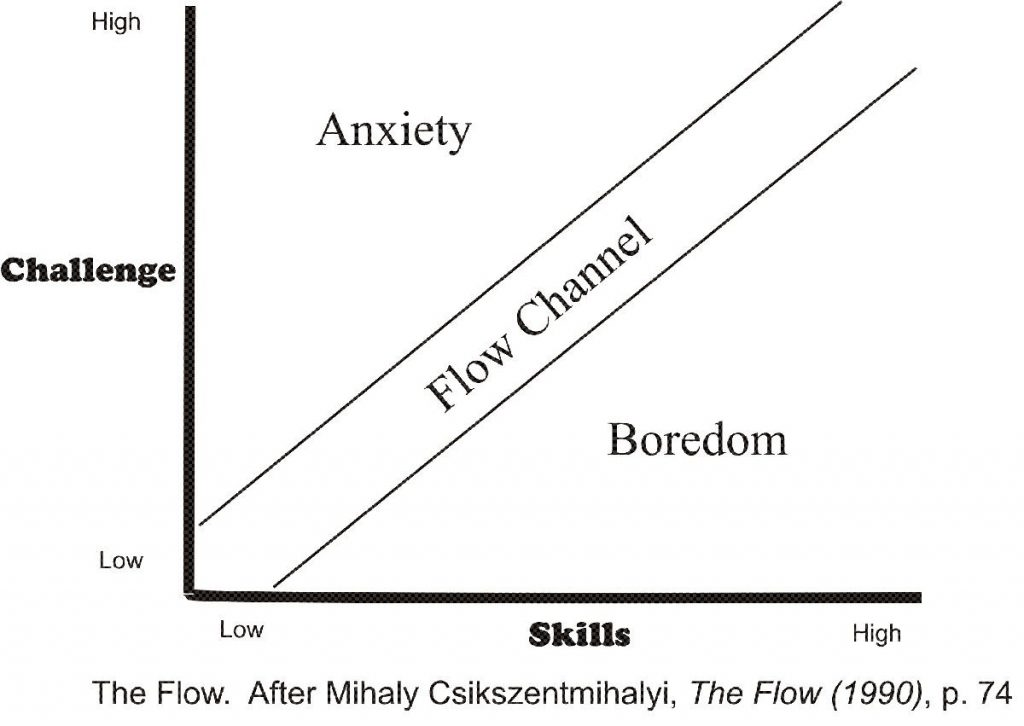
Motivation psychologists distinguish these two states as extrinsic and intrinsic motivation for what we’re doing. The former takes hard work and discipline to keep us going. The latter propels us forward, as by magic: flow.
Repetition: the repeated movements of our craft – the physical routines we practice over and over – follow us everywhere. Whether we call it practice or technique, these repeated actions shape our brains in powerful ways, often without us even realizing it.
They form unique connections in the brain – linking movement, memory and emotion. These connections stretch across the parts of the brain that control movement, wrap around the areas responsible for memory, and reach deep into the emotional core of the brain – the limbic system. That includes the insula, a region that helps manage both our physical health and our inner sense of self.
‘Muscle memory’ doesn’t live in our hands or legs.The real control centre is in the brain. This is where movement begins, guided by systems that plan and initiate what we do. From there, messages travel through long chains of nerve cells – from the brain down the spine and out to the rest of the body. Millions of tiny electrical signals, known as action potentials, move back and forth, telling our muscles, organs and even the tips of our fingers what to do next.
The idea is to ‘program’ the right moves in our brain so they become so automatic we can use them to, yes, feel, and to find flow. The prefrontal cortex part of our brain matures last in our individual development, with restructuring continuing well into our 20s. These parts of the brain are very ‘plastic’, meaning that they are easily shaped by experience and learning. So they are also key to the development of technique in our craft – be that in science, the arts or other fields – because they are suited to rule-based learning.
Neuroplasticity is our brain’s capacity to learn; to forge new connections between neural systems, as we practice something with our body. Professional singers and actors do daily vocal exercises, dancers do daily barre exercises – the same moves over and again – and musicians are known for their never-ending scales practice that drives neighbors up the wall. What may seem a strange, repetitive, even boring activity that artists, scientists and other creatives engage in daily is in fact doing magic to their brains.
Repeating something consciously – in this context meaning exercising those prefrontal systems of the brain – is quite effortful, and it needs a lot of energy and attentional resources. Therefore, our brain starts to forge connections that let the movements we’re practicing pass from explicit, effortful memory systems into implicit, almost automatic memory systems.
This works a bit like learning a new language. First, we learn the words, the basic grammar, and we make many mistakes. It is effortful and we have to think before uttering any sentence at all. But as we repeat the words, practice verbal tenses and vocabulary over and over, our brain realizes the repetition and transports the skill of that new language from explicit to implicit memory systems.
That’s why the advice to ‘just let go’, ‘be in the present’ and ‘feel it’ are unhelpful to find flow. When flow happens to you, it may well feel magical, it might feel like you’re ‘letting go’. You feel a strange fusion of your movements and your awareness, and you’re somehow entirely entrapped in the present. It’s still early days to say exactly how this works, but it has to do with those low-level, implicit memory systems that encode movements that we internalize with technique practice. Then, the prefrontal systems deactivate while we let the implicit motor memory systems do their job. That’s when you use that skill to express and find flow.
But this is a neural process that happens outside of your conscious awareness, you can’t do this at will. Repetitive movement practices have a wonderful side-effect if used well: they remove uncertainty from our brain. Uncertainty is part of all our lives to a larger or lesser extent; and it is among the chief killers of our calm. Being in flow makes us escape from the unpredictability of life.
Life is unpredictable, and our senses can’t always find something recognizable to cling to. When our ability to predict is weakened and our brain is put on alert, this mind-absorbing state can make us feel miserable. We can regain our footing by controlling our surroundings or other people, but if flow is what we seek, we’ll fail. What we need instead are routines in our day to create habits of well-being in our mind, because our brain will, during those periods of routine, know exactly what’s going to happen next.
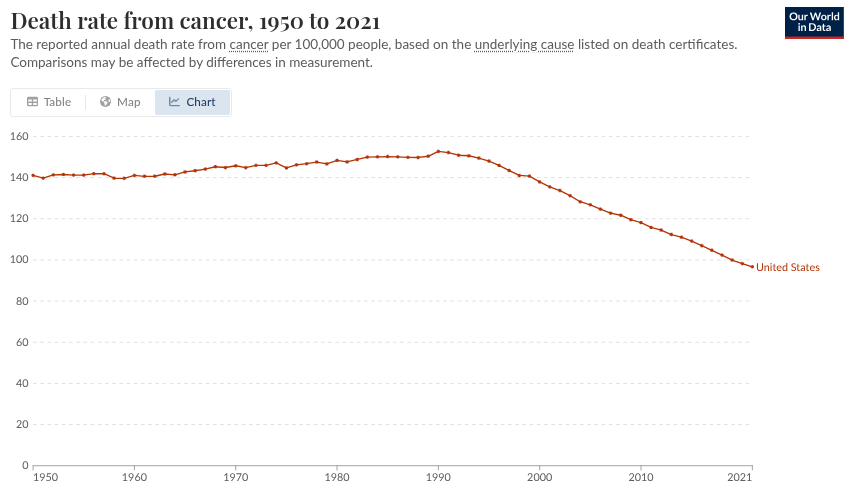
While anti-smoking policy has been the single biggest lifesaver, other interventions have helped reduce people’s cancer risk. One of the biggest successes is the HPV vaccine. Cervical cancer deaths in US women under 25 fell about 62 percent, a decline researchers attribute largely to the HPV vaccine.
The next revolution is better and earlier screening. It’s generally true that the earlier cancer is caught, the better the chances of survival.
Most exciting of all are frontier developments in treating cancer. From drugs like lenalidomide and bortezomib in the 2000s, which helped double median myeloma survival, to the spread of monoclonal antibodies, real breakthroughs in treatments have meaningfully extended people’s lives — not just by months, but years. Perhaps the most promising development is CAR-T therapy, a form of immunotherapy. Rather than attempting to kill the cancer directly, immunotherapies turn a patient’s own T-cells into guided missiles.
__________________________
There is so much we don’t know about the deep ocean, but what we do know is astonishing. The ocean’s deepest point extends approximately 36,000 feet below the surface. Beyond 600 feet, light no longer penetrates, making photosynthesis impossible, yet 98% of marine life resides on or near the sea floor. Life at these depths depends almost entirely on “marine snow”—organic matter drifting down from the ocean’s upper layers.
When a whale dies, its massive body sinks to the seabed and sets off an extraordinary chain of events. A single whale fall can blanket an area of 50 square meters, roughly 538 square feet, on the ocean floor. In that single moment, it delivers a bounty of food equivalent to what small particles would provide over 200 to 2,000 years. It’s an enormous input of organic matter that sticks around for centuries.
________________________
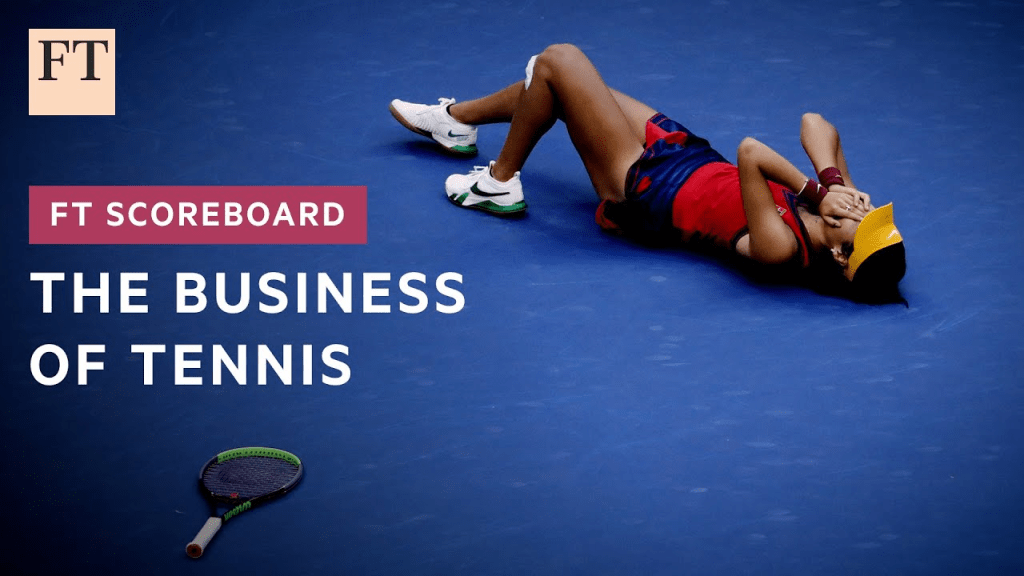
The math and odds are against you to be able to make enough money to survive as a professional tennis player. Employing a bottom-up analysis of the top 100 junior players from 2008, research examines their career trajectories, rankings, and financial outcomes. The findings reveal that you need to be ranked in the top 150 in the world in order to break-even financially. It’s even tougher for females because male players tend to sustain longer careers, potentially due to higher earnings in the ATP circuit outside Grand Slam events.
The U.S. as a whole remains much more expensive than all foreign markets:
The gap in price to earnings from the U.S. vs. the rest of the world has narrowed slightly in 2025 but remains enormous:
_______________________________
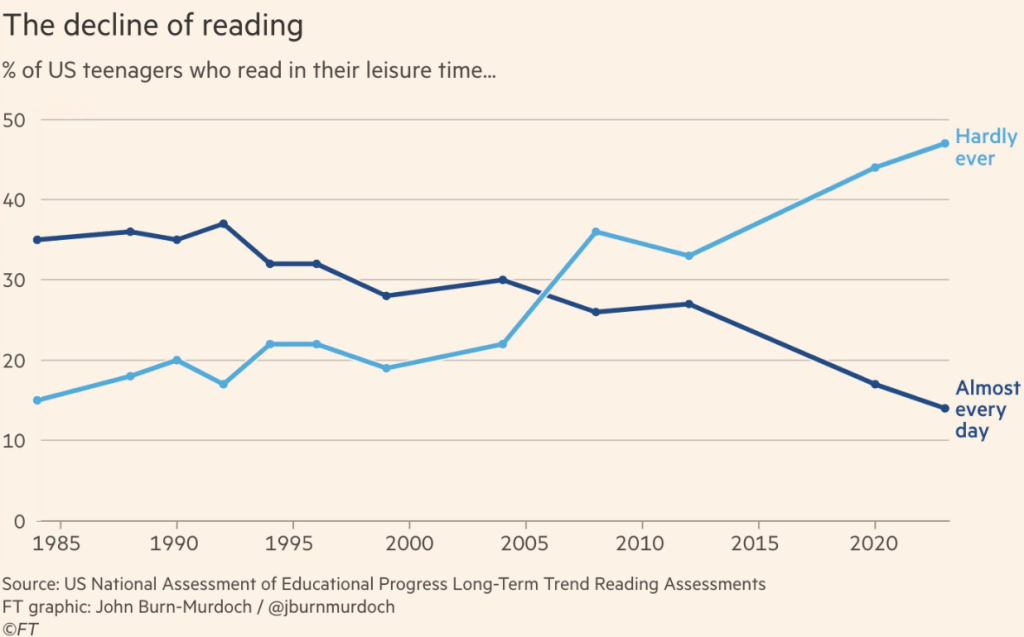
Only a third of five-to-10-year-old kids frequently read for fun, compared to over half in 2012. This could be in part because their parents are less likely to read to them before they turn five: 41% of parents of all ages reported doing so, a steep drop from the 64% in 2012.
_______________________
Barry Ritholtz and Paul Krugman interview: On Art as an investment: If you go back to the old masters in the 15, 1600s and buy one of their paintings for $100 and it sells centuries later for tens of millions, it’s about a 3% return rate. It’s just the magic of compounding over centuries that are just outside our comprehension.
_____________________
__________________________
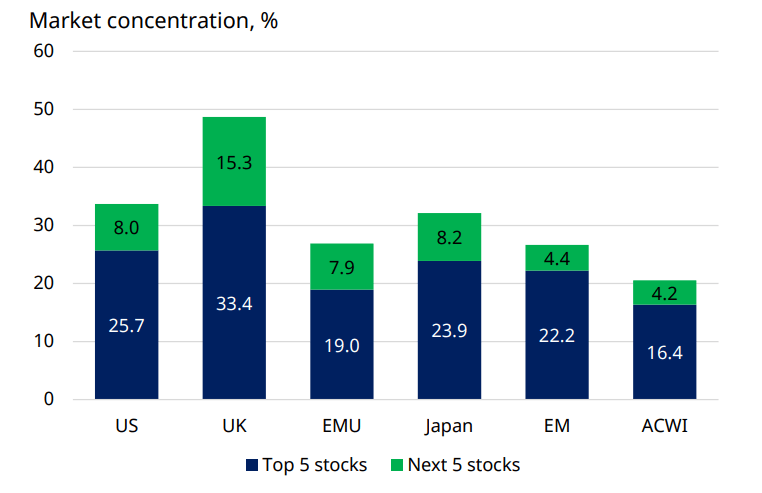
The largest stocks dominate market caps in most countries, not just the U.S. (with the Mag 7):
Imagine reading a story titled “The Relentless Pursuit of Booze.” You would likely expect a depressing story about a person in a downward alcoholic spiral. Now imagine instead reading a story titled “The Relentless Pursuit of Success.” That would be an inspiring story, wouldn’t it? Maybe—but maybe not. It might well be the story of someone whose never-ending quest for more and more success leaves them perpetually unsatisfied and incapable of happiness.
Though it isn’t a conventional medical addiction, for many people success has addictive properties. To a certain extent, I mean that literally—praise stimulates the neurotransmitter dopamine, which is implicated in all addictive behaviors. success also resembles addiction in its effect on human relationships. People sacrifice their links with others for their true love, success. They travel for business on anniversaries; they miss Little League games and recitals while working long hours. Some forgo marriage for their careers.
People willingly sacrifice their own well-being through overwork to keep getting hits of success. I know a thing or two about this: As I once found myself confessing to a close friend, “I would prefer to be special than happy.” He asked why. “Anyone can do the things it takes to be happy; going on vacation with family, relaxing with friends … but not everyone can accomplish great things.” My friend scoffed at this, but I started asking other people in my circles and found that I wasn’t unusual. Many of them had made the success addict’s choice of specialness over happiness. They (and sometimes I) would put off ordinary delights of relaxation and time with loved ones until after this project, or that promotion, when finally, it would be time to rest. But, of course, that day never seemed to arrive.
We are not only gregarious animals, liking to be in sight of our fellows, but we have an innate propensity to get ourselves noticed, and noticed favorably, by our kind. And success makes us attractive to others (that is, until we ruin our marriages).
Unfortunately, success is Sisyphean (to mix my Greek myths). The goal can’t be satisfied; most people never feel “successful enough.” The high only lasts a day or two, and then it’s on to the next goal. Psychologists call this the hedonic treadmill, in which satisfaction wears off almost immediately and we must run on to the next reward to avoid the feeling of falling behind. This is why so many studies show that successful people are almost invariably jealous of people who are more successful.
They should get off the treadmill. But quitting isn’t easy for addicts. For people hooked on substances, withdrawal can be an agonizing experience, both physically and psychologically. Anxiety and depression are very common after one quits alcoholic drinking. Success addicts giving up their habit experience a kind of withdrawal as well. Research finds that depression and anxiety are common among elite athletes after their careers end.
American culture valorizes overwork, which makes it easy to slip into a mindset that can breed success addiction. What can you do to retrain yourself to chase happiness instead of success, no matter where you are in your life’s journey?
Admit that as successful as you are, were, or hope to be in your life and work, you are not going to find true happiness on the hedonic treadmill of your professional life. You’ll find it in things that are deeply ordinary: enjoying a walk or a conversation with a loved one, instead of working that extra hour. This is extremely difficult for many people. It feels almost like an admission of defeat for those who have spent their lives worshipping hard work and striving to outperform others. Social comparison is a big part of how people measure worldly success, but the research is clear that it strips us of life satisfaction.
Start showing up and being present for relationships you’ve compromised in the pursuit of success.
Find the right metrics of success. If you only measure yourself by the worldly rewards of money, power, and prestige, you’ll spend your life running on the hedonic treadmill and comparing yourself to others. Better metrics include faith, family, and friendship. I also include work—but not work for the sake of outward achievement. Rather, it should be work that serves others and gives you a sense of personal meaning.
I stopped buying active investments (individual stocks, etc.) a few years ago. I’ve gone through different justifications for why too. Originally, I stopped buying active investments because of the performance argument. If 85% of active stock managers can’t beat the market over 10 years, what makes you think you can? It’s also too hard to know if you’re actually good. Because there is so much luck involved (especially over shorter time periods), you are better off not wasting your time trying to figure it out.
But there’s an even better argument: I don’t make active investments now because you can’t put a price on mental freedom. What I’ve realized about myself (and many others I’ve spoken to) is that when you buy an active investment like an individual stock, that investment consumes a lot of your attention.
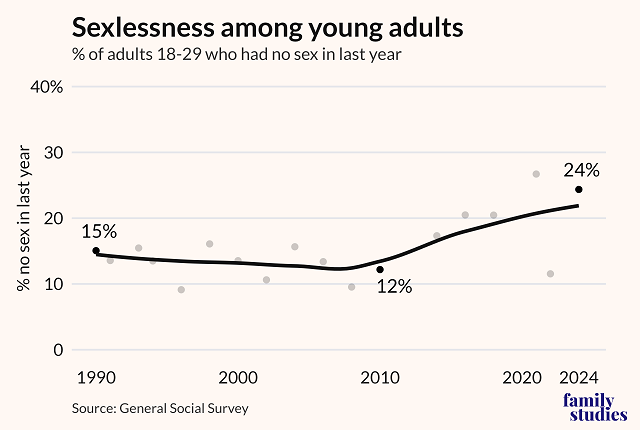
1. 1960-2000: Robert Putnam sees associations and club membership plummeting, writes “Bowling Alone”
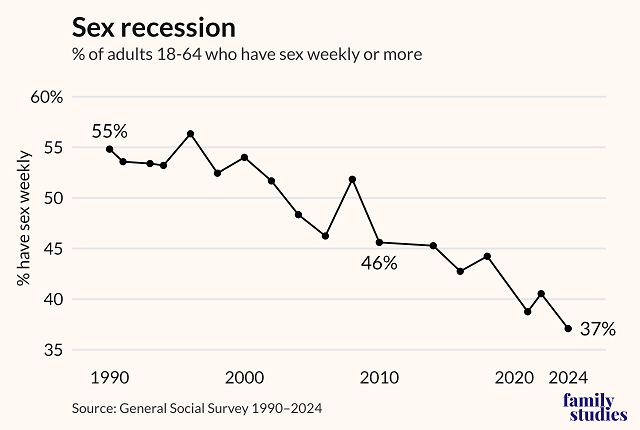
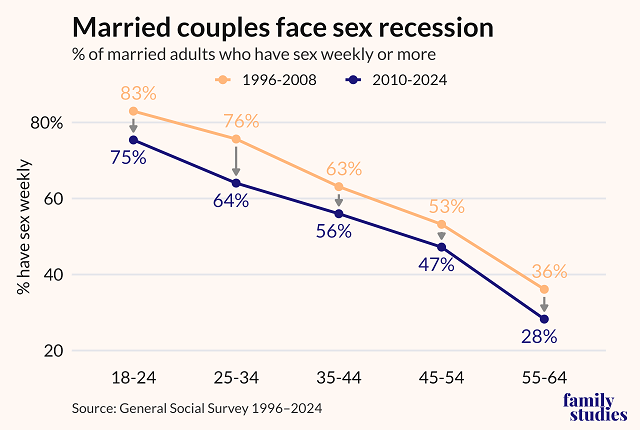
2. 2000 – 2020s: Face to face socializing falls another 25%, as coupling rates plunge
3. Now this…
_____________________________
Forbes surveyed more than 217,000 employees working at companies within the U.S. that employ more than 1,000 people. The organizations were stratified so that companies with 1,000 to 5,000 employees were deemed midsize, while companies with more than 5,000 employees were considered large employers.
Survey respondents (who remained anonymous so they could answer freely) were asked if they would recommend their employer to others and to rate it based on a range of criteria, including salary, work environment, training programs and opportunities to advance. Participants were also asked if they would recommend their previous employers (within the past two years) and the employers they knew through their industry experience or through friends or family who worked there.
“You need 8 hours of sleep every night” (7 hours is ideal)
“We sleep to rest our bodies” (Sleep restores your brain much more than your body)
“Waking up in the middle of the night is bad”
“Light and sound will ruin your sleep”
“Sleeping pills will help you”
“You need to time your sleep cycles to leverage REM”
There are two ways sleep helps the brain:
(1) Sleep helps us learn and remember important things. When we’re awake, our memories seem to go into a sort of short-term bank. Then, when we’re in certain stages of sleep, our brain culls through these memories. It puts the most important memories in long-term storage and deletes the useless ones.
(2) Sleep “cleans” our brain. The brain is like an engine that does a lot of work during the day. Engines emit smog—in the case of the brain, this smog is called “metabolites.” But because our brain is tightly sealed off, it can’t seem to get rid of these metabolites as it’s up and running while we’re awake.
Picture this as a car running idle in a garage. But pretend the car’s engine can’t run with the garage door open. So across the day, the engine runs in the closed garage, and smog builds and builds in the brain. Run the engine too long with the garage door closed, and you get a dangerous smog buildup. As we sleep, it’s like the engine turns down and the garage door opens. During certain sleep phases, some areas of our brain expand by 60 percent, which allows the previous day’s metabolites to clear. This also lets in enzymes that repair and rejuvenate receptors in the brain. Sort of like having a mechanic come in to tune the engine while the garage is open and the engine is “off.”
_________________________
When Do People Want Their Inheritance (And When Do They Get It)? When you ask people whether they would prefer $250,000 at age 30, $500,000 at age 40, or $1 million at age 50, people overwhelmingly wanted the lower amount earlier in life. 70% of respondents who answered this question chose $250,000 at age 30.
The average age at which someone receives an inheritance has been increasing over time. In 1989, the average age of inheritance was 41 and today it’s around 51.
You can provide up to $19,000 per year to each of your children tax-free (as of 2025). While the IRS allows you to gift $19,000 per child per year tax-free, technically you can gift far more than this without paying federal taxes. The catch is that any gift above $19,000 counts against your lifetime gift limit, which is $13.99 million (as of 2025). In other words, you can give away $13.99 million across your lifetime without having to pay the federal gift tax.
_________________________
Why Macro Forecasting Is Impossible. Think about global trade — large, complex interrelated economies, driven by everything from policy to consumer sentiment, geography, innovation, employment, inflation, natural resources, etc. Besides all of those massive complexities, everything affects everything else. You have initial acts, second-order effects, 3rd, 4th, 5th order effects, reflexivity, and dynamic interactions. It quickly scales up to billions of incalculable odds.
This is why forecasting market prices or macroeconomic data is so challenging: There are simply too many variables, each dependent on and reflecting even more variables, to pretend we truly know what will happen next.
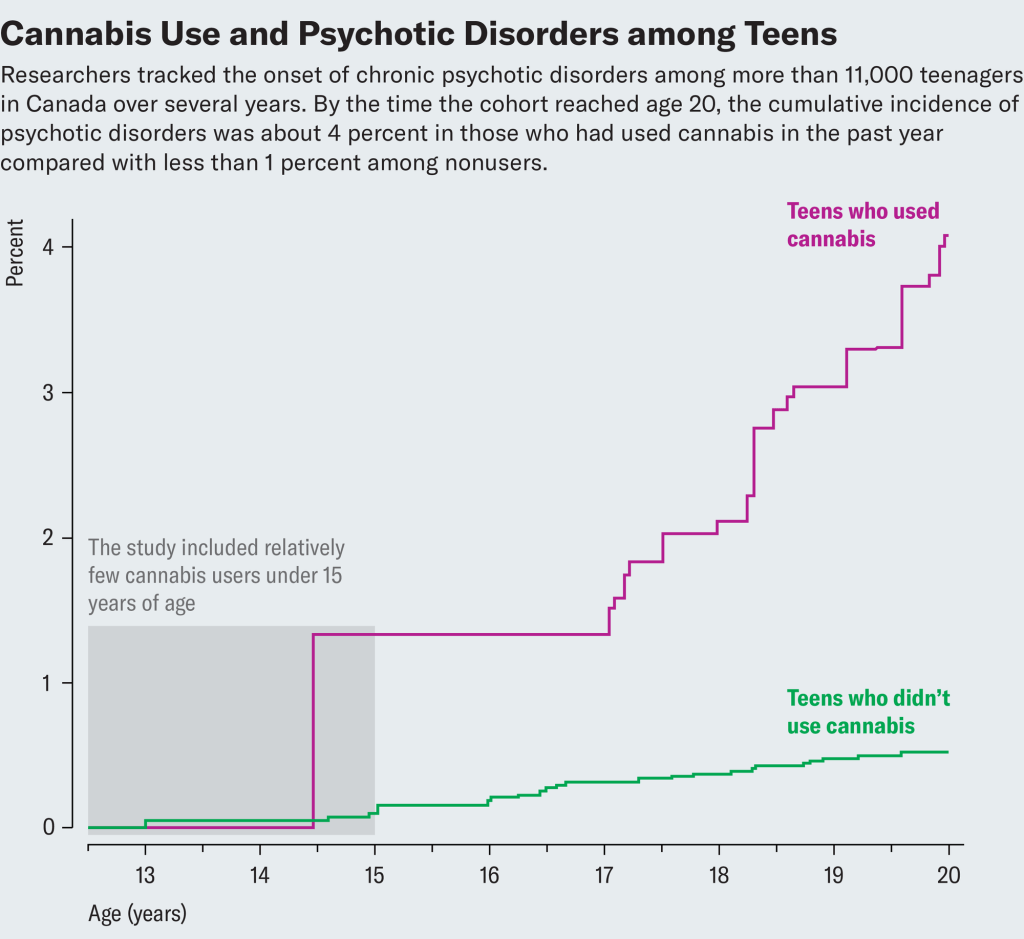
All cannabis products contain a mix of delta-9-tetrahydrocannabinol (THC), the intoxicating component of the cannabis plant, and cannabidiol (CBD), which may have anxiety-reducing properties. In the 1990s the marijuana in a typical joint contained about 5 percent THC.
But genetic modification has drastically increased THC potency; from 1995 to 2022 its content in the average cannabis plant increased by 307 percent. And it’s not just joints or pot brownies; with the expanding legalization and commercialization of cannabis, there are few limits on the levels of THC in products such as fast-acting vape pens and edibles. What teens can buy today is nothing like what their parents used in college.
Higher-potency THC, marijuana use starting at a young age and more frequent use all increase the risk of psychosis.
When you’re independent you feel less desire to impress strangers, which can be an enormous financial and psychological cost. Speaking of hidden forms of debts: How much of what takes place in our modern economy is done purely for signaling reasons? It’s impossible to quantify, but you know it when you see it. And taking an action to impress other people is a direct form of dependence.
___________________________
After shuffling the cards in a standard 52-card deck, Alex Mullen, a three-time world memory champion, can memorize their order in under 20 seconds. As he flips though the cards, he takes a mental walk through a house. At each point in his journey — the mailbox, front door, staircase and so on — he attaches a card. To recall the cards, he relives the trip. This technique, called “method of loci” or “memory palace,” is effective because it mirrors the way the brain naturally constructs narrative memories: Mullen’s memory for the card order is built on the scaffold of a familiar journey.
Analyses have generated a new understanding of how the human brain constructs narrative memories. Nearly the entire brain is involved, contradicting earlier ideas that placed memory in specific brain regions. And memories are built in temporal pieces, each of which ranges from a second to a minute in length. The brain places those pieces onto the scaffolds of event scripts. It’s all a construction. It’s not like you have this video camera of exactly what happened, exactly as it happened. You have to reconstruct, based on pieces of the experience, what you think happened.
The brain doesn’t simply record what it perceives. Instead, much if not most of the brain’s reaction to an event or story originates in memories of how that type of event usually plays out. In other words, we process the present through the past.
There are two critical steps to constructing memories. As we go about our day, we record the new experiences in pieces of varying size and complexity, from simple perceptions to stunning plot twists. Meanwhile, our brains access templates for these new events based on knowledge of similar ones, and place the pieces of the evolving memory in that context. Memories, it turns out, are more like paint-by-number than rendered from scratch on a blank canvas. The way we experience and remember events arises largely from our mental state, as opposed to properties of the events themselves.
_____________________________
We report eleven studies that show declines in life satisfaction and happiness among young adults in the last decade or so, with less uniform trends among older adults. In the U. S. life satisfaction rises with age. This is broadly confirmed in several other datasets including four from the European Commission across five other English-speaking countries: Australia, Canada, Ireland New Zealand and the UK. There is broad evidence across all of these English-speaking countries that happiness and life satisfaction since 2020 rise with age. In several of these surveys we also find that ill-being declines in age. The U-shape in well-being by age that used to exist in these countries is now gone, replaced by a crisis in well-being among the young.
_____________________________
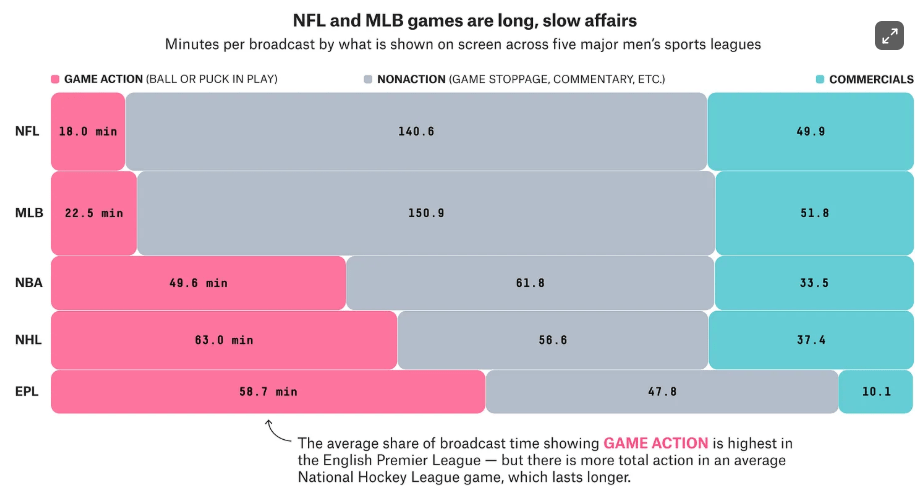
Which Sports Provide the Best Return on Your Time Investment? Football has the greatest amount of “false advertising” in terms of how much time the game actually takes versus how long it lasts on the clock. Hockey, by contrast, is the most honest American sport — with a ratio of 2.5 “real” minutes per minute on the scoreboard — with NBA games checking in right behind at 2.8 “real” minutes per clock minute.
_________________________________
The U.S. has become much less Christian, driven in large part by Gen Z and younger Millennials, according to a new Pew study. “We’ve had rising shares of people who don’t identify with any religion — so-called ‘nones’ — and declining shares who identify as Christian, in all parts of the country, in all parts of the population, by ethnicity and race, among both men and women, and among people at all levels of the educational spectrum,” he says about the survey findings. A significant portion of U.S. adults (35%) have switched from the religion of their childhood.
________________________________
Lessons From This Year’s Berkshire Hathaway Letter. Sixty years ago, Warren Buffett bought control of Berkshire Hathaway. He’s highlighted that mistake on and off ever since. He did so once again in this year’s annual letter, which came out over the weekend.
_______________________________
India is best thought of as a country of 1.4 billion people of whom about 300 million are leading a relatively comfortable life in major cities like Bombay and New Delhi while 1.1 billion are in rural or urban poverty. India is poor but 300 million middle-class citizens is a population almost the size of the United States. Again, that’s the point. A U.S.-sized middle-class population already exists in India with 1.1 billion more people waiting to join the ranks. The growth potential is almost beyond comprehension.
___________________________
My quest for cheap stocks has led me to South America. Specifically, Brazil. The largest Brazil ETF, EWZ, currently trades at around 8x earnings with an 8% dividend yield. An entire country ETF offering an 8% yield. Meanwhile, the dividend yield on the S&P 500 is 1.27%. EWZ trades at 1.5x book value, while the S&P 500 currently sits at 5.01x (a higher multiple means stocks are more expensive). The chart combines seven metrics to show just how expensive the U.S. stock market has become.
___________________________
The U.S. stock market as a whole is the most expensive in the world, but when you pull out just the technology stocks, they are on another planet in terms of how they’re priced relative to their earnings.
How about the capital being employed? There better be something new. I mean, we’re talking now for the just a top handful of companies doing $300 to $500 billion in capex [capital expenditures] annually. I mean, AI isn’t like the internet, which made things more capital efficient and raised returns on capital. So far, AI is doing the opposite. It is a massively capital-intensive business. Someone joked that the top tech companies are now looking like the oil frackers did in 2014, 2015, where more and more capital is chasing arguably a variable return.
Fracking technology has revived the U.S. oil and gas industries, and along with renewables, has made America energy-independent for the first time in generations. But the fracking companies themselves turned out to be far less profitable than they led investors to believe.
The face of cancer in the U.S. is getting younger—and more feminine. Cancer rates for women in the U.S. have risen over the past half-century, particularly among women under age 65 diagnosed with breast cancer. For decades, the cancer burden in the U.S. was higher for men, who started smoking en masse in the 20th century. Their rates of lung-cancer cases and deaths soared. Lung cancer remains the biggest cancer killer for men in the U.S., but case and death rates have dropped, after smoking rates declined.
Women started smoking heavily later than men and have been slower to quit, so their lung-cancer decline started later and hasn’t been as steep. That has had a significant impact: Lung cancer incidence among women under 65 was greater than among men for the first time in 2021. Women are also more likely to get diagnosed with lung cancer as nonsmokers.
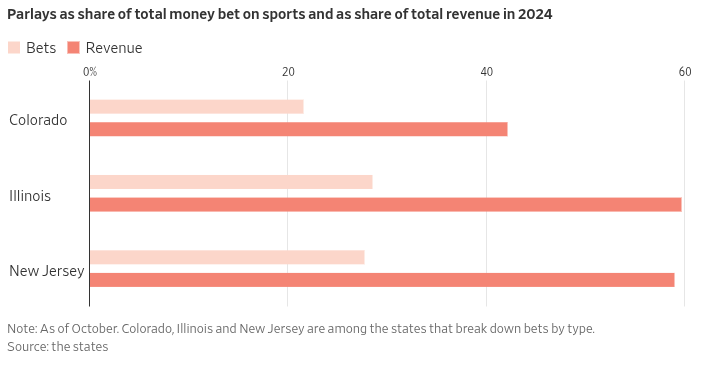
Parlays accounted for about 27% of the money wagered on all sports bets last year through October in Illinois, New Jersey and Colorado, states in which gambling regulators report data by bet type. That’s up from 22% of all sports bets in 2021. The multi-leg bets delivered about 56% of sports-betting revenue after payouts for companies in the three states during that period, up from 50% in the same stretch of 2021.
Multi-leg bets are so lucrative that FanDuel parent company Flutter Entertainment recently increased its expectation for total online gambling revenues in the U.S. to $63 billion by 2030, up from its estimate of $40 billion two years ago, driven in part by parlays, the company said.
Men who watch television now spend 7 hours in front of the TV for every 1 hour they spend hanging out with somebody outside their home.
The typical female pet owner spends more time actively engaged with her pet than she spends in face-to-face contact with friends of her own species.
From the late 1970s to the late 1990s, the frequency of hosting friends for parties, games, dinners, and so on declined by 45%, then it got worse. Between the early 2000s and the latest data, the average amount of time that Americans spent hosting or attending social events declined another 32%.
A 5-percentage-point increase in alone time is associated with about the same decline in life satisfaction as was a 10% lower household income.
From 1965 to 1995, the typical adult gained 6 weekly hours in leisure time. They funneled almost all of it into one activity: watching TV.
In 1970, just 6 percent of sixth graders had a TV set in their bedroom; in 1999, that proportion had grown to 77 percent.
The share of boys and girls who say they meet up with friends almost daily outside school hours has declined by nearly 50 percent since the early 1990s.
Today’s adults spend an additional 99 minutes inside their homes on any given day, compared with 2003.
The share of U.S. adults having dinner or drinks with friends outside the home on any given night has declined by more than 30% in the past 20 years.
Restaurants used to be the ultimate “social” business. But today, just one-quarter of restaurant traffic is “on-premises”—that is, sitting, ordering, talking with people at a table. With the rise and rise of delivery 74% of all restaurant traffic now comes from “off premises” customers—takeout and delivery. And solo dining has increased by 29% in just the past two years. The top reason given? The need for more “me time.”
_____________________________
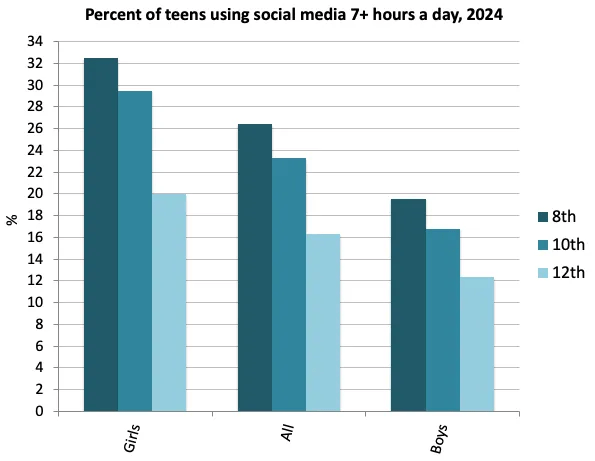
Gen Z spends an average of 109 days per year looking at a screen. Eighty percent of our waking hours are spent consuming information, up from 40% in 1980.
In the past, I might have tuned out a very online trend like looksmaxxing, but I regret to inform you that we can’t skip this one. Because looksmaxxing might be the key to understanding Gen Z and Gen Alpha behavior, knowing where they’re headed, and, frankly, answering a larger question you’ve definitely thought about: Are young men okay?
Someone unexpected has emerged as an unlikely Gen Alpha role model: American Psycho’s Patrick Bateman, the yoked killer from the 1991 Bret Easton Ellis novel, memorably played by Christian Bale (and his cheekbones) in the film. In forums on Reddit , looksmaxxers have coalesced around Bateman, whose well-moisturized face has become an extremely popular profile pic for self-described “sigmas,” a Gen Alpha term for independent men who prioritize power, class, and self-control, known to attract beautiful women aroused by their bank accounts.
As Bateman says in the film: “You can always be thinner…look better.” For many, that starts with “mewing,” a non-medical technique that involves pressing your tongue to the roof of your mouth to reshape your jawline. Men now receive ads for Jawliner gum, part of a new category of fitness chewing gums, which is 10 times harder to chew than a standard piece and is designed to tone the masseter muscles in their face. Terms like brotox have made their way into professional conversations, and more men have been seeking jawline-enhancing procedures.
In bubbles, investors treat the leading companies—and pay for their stocks—as though the firms are sure to remain leaders for decades. Some do and some don’t, but change seems to be more the rule than persistence.
My early brush with a genuine bubble caused me to formulate some guiding principles that carried me through the next 50-odd years:
It’s not what you buy, it’s what you pay that counts.
Good investing doesn’t come from buying good things, but from buying things well.
There’s no asset so good that it can’t become overpriced and thus dangerous, and there are few assets so bad that they can’t get cheap enough to be a bargain.
Researchers analyzed 33 studies examining the movements of nearly 100,000 adults using smartphones, pedometers and other fitness trackers. Those who clocked more daily steps were less likely to report depressive symptoms or be diagnosed with the condition than those who walked less.
Participants ranged in age from 18 to 91 years old and lived in 13 different countries. Those who logged at least 5,000 or more daily steps were less likely to experience depressive symptoms, with the greatest effect coming for those who logged more than 7,500 steps a day — they were 42% less likely to suffer depressive symptoms.
A subset of studies included in the meta-analysis found that for every 1,000 daily step increase, adults reduced their risk of developing depression by 9%.
The message is very consistent: more is better, and some is better than none.
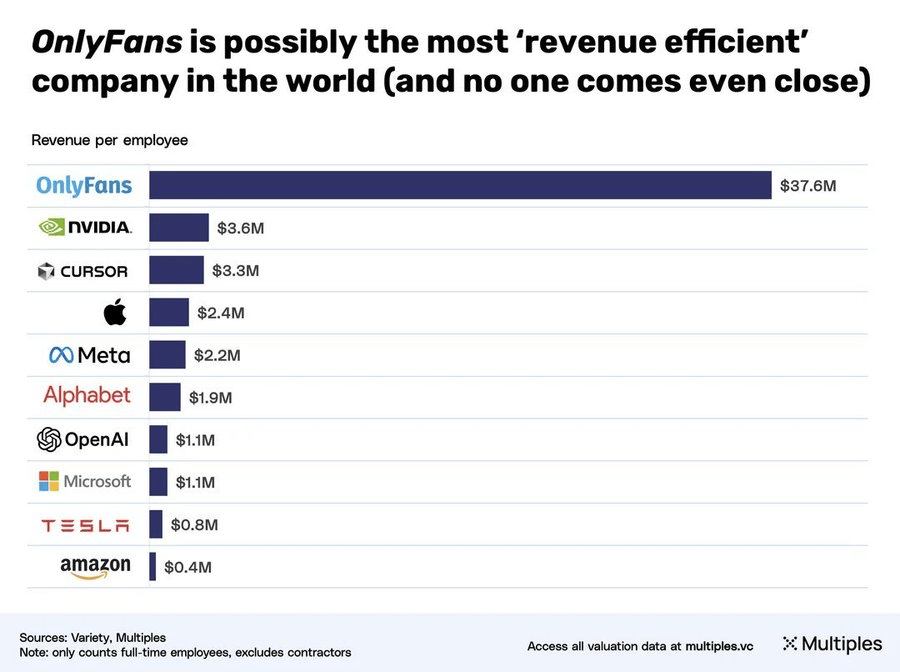
Created in 2016, OnlyFans has paid out over $20 billion to its creators, who now number 4.1 million. The company takes a 20% cut of creators’ revenue.
In 2023 alone, content creators generated $6.6 billion on the platform that has over 300 million users
Its dividend payout of $472 million to the owner was more than Ralph Lauren earned from the fashion company he founded, and Nike co-founder Phil Knight earned from the sportswear giant – combined.
_______________________________
While no one is ever going to feel bad for someone that co-founded a company and sold it for $975 million, Vinay Hiremath wrote a blog post this week titled: “I Am Rich & Have No Idea What To Do With Myself.” After selling the company he found himself lost, depressed and breaking up with what sounds like an amazing girlfriend that loved him. He just booked a ticket to Hawaii to do some soul searching (again, no one is going to feel bad for him), and is asking himself:
Why couldn’t I just leave Loom and say “I don’t know what I want to do next”?
Why do I feel the need to only be on a journey if it’s grand?
What is wrong with being insignificant?
It’s an introspective look into someone’s open, honest mind providing another example that money solves a lot of problems, but it can’t solve all of them. Most of the time people seem to end up less happy at the destination than they were along the journey to get there.