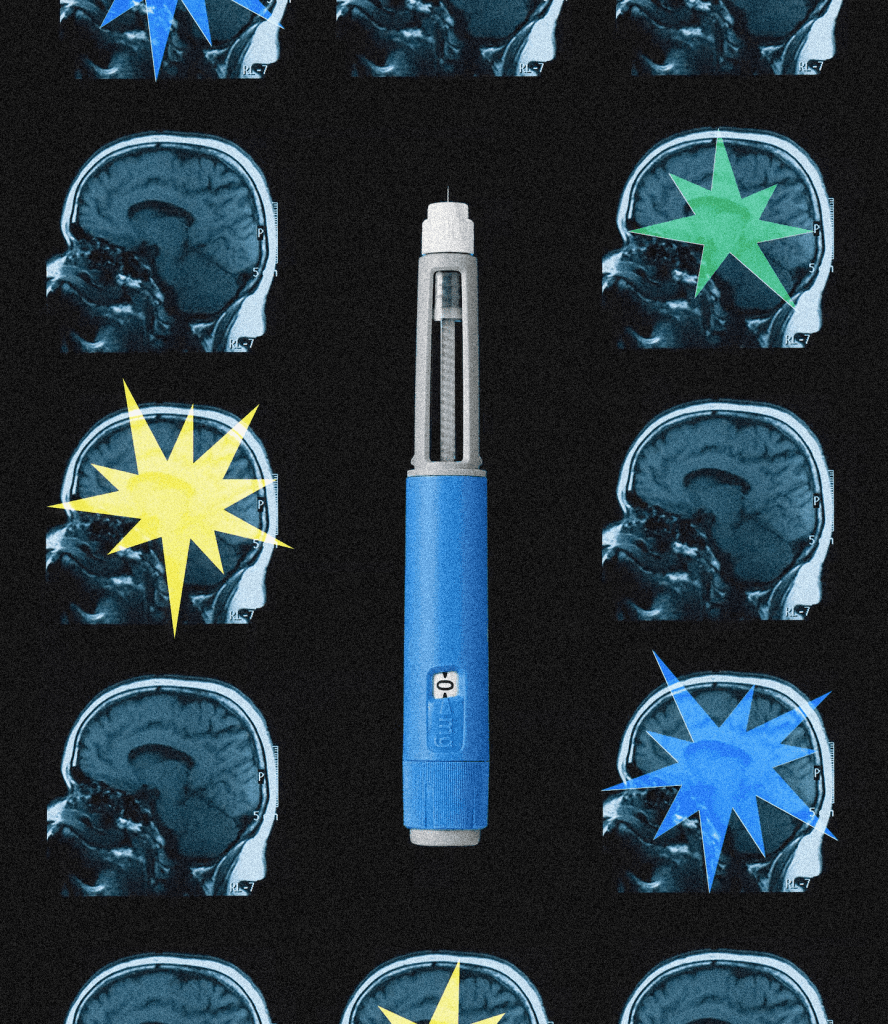
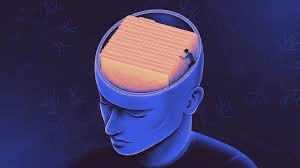
Your hippocampus doesn’t encode days that feel identical. If this Tuesday looks like last Tuesday, your brain files them as a single compressed memory. The second day never gets its own folder.
This is why decades feel like they disappeared. The hippocampus uses novelty as its filter for “worth storing.” Repetitive routines trigger temporal compression. Same commute, same desk, same dinner, same bedtime: the brain deduplicates the whole sequence into one entry. You lived 365 days. You filed 40.
As people move through continuous experience, the hippocampus and medial prefrontal cortex fire in discrete bursts at moments the brain flags as “something changed.” Each burst becomes a retrievable memory later. In stretches with no boundaries, the bursts flatten. Participants with more boundaries in a given period remembered more of it afterward. Segmentation literally builds memory.
Sleep is the second mechanism. During slow-wave sleep, the hippocampus replays the day’s episodes and transfers them to the neocortex for long-term storage. This is when memory actually gets filed. Cut sleep short and encoding efficiency drops. Chronic sleep debt means experiences you had never complete the transfer. The memory existed. It just never made it to disk.
The third mechanism is where dopamine meets attention. Novel stimuli trigger the ventral tegmental area to release dopamine into the hippocampus, which gates what gets encoded. Mind-wandering does the opposite. When your default mode network takes over (phone scrolling, rumination, email during dinner), the hippocampus stops tagging the present. You were at the wedding. Your hippocampus was in your inbox.
The fix comes straight out of the mechanism. New locations, new food, new people, new routes home. The brain needs boundaries to build memories. Go to bed earlier so replay actually runs. Put the phone down when something is happening so the dopamine signal can fire.
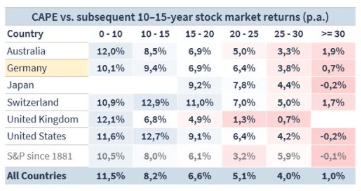
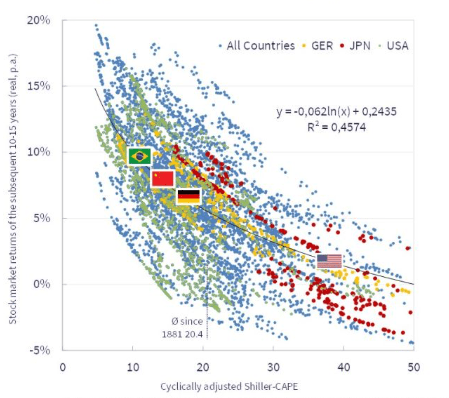
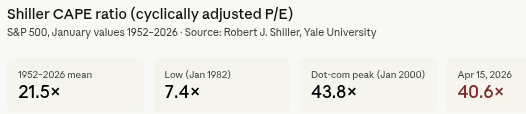
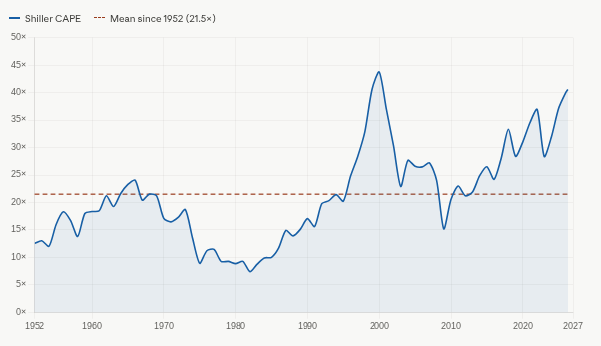
Traditional valuation metrics like the Shiller CAPE (price-to-earnings) ratio have been screaming “overvalued” for most of this century, but there has been almost no mean reversion since 2008 for U.S. stocks:
Why?
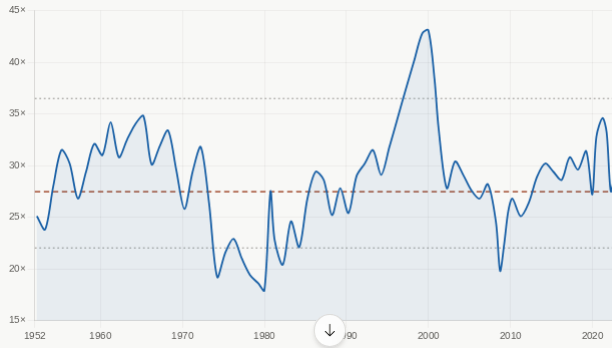
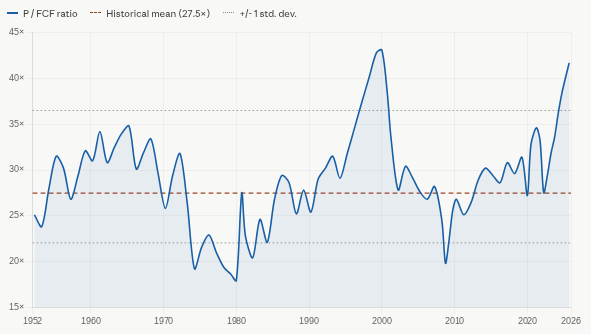
When you swap earnings for free cash flow (sales minus input costs, labor, taxes, and capex — basically what’s actually available to pay owners), the picture changes dramatically. Until recently, the price-to-free-cash-flow ratio bounced around but had no long-term upward drift:
Two structural shifts explain the divergence:
Labor share has declined ~8 percentage points of GDP since 1980. Less of the pie goes to workers, more goes to firm owners. This boosted earnings.
Capex has been relatively weak as a share of firm value. Firms (especially big tech) generated massive earnings without heavy reinvestment, so cash flow grew even faster than earnings.
However, that clean free-cash-flow story is under pressure right now. Some of these companies have gone from huge positive FCF to zero or negative FCF, taking on debt to fund it. Big tech has flipped from cash-generating machines to massive spenders on AI data centers, chips, and energy infrastructure.
The chart below is the same as above, but extends the data adding the last few years:
Bullish case: This is 1-2 years of heavy investment that will produce a new plateau of even higher cash flows, and AI further reduces labor share.
Bearish case: AI isn’t “free money” — even adopter firms (not just the hyperscalers) will need serious capex to implement it, and the payoff is uncertain.
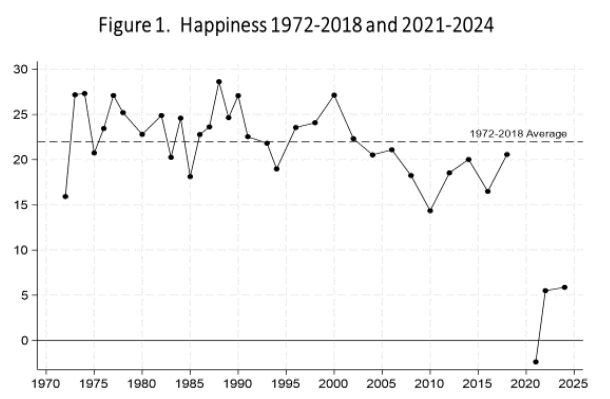
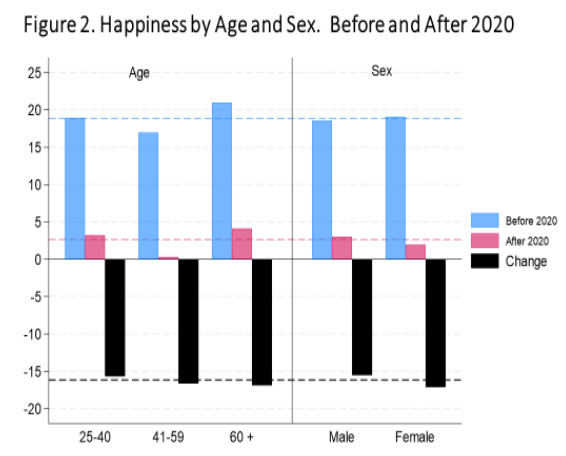
There was a sudden, sharp and historically unprecedented decline in self-reported happiness in the US population. It occurred during 2020, the year of the Covid pandemic, and mainly persists through 2024.
This happiness crash spread across nearly all typical demographics and geographies. The happiest groups pre-Covid (e.g., whites, high income, well-educated and politically/ideologically right-leaning) tend to show the largest happiness reductions.
Your brain is running status calculations all the time — looking for who is capitulating to whom, who commands attention, who has the nicest stuff, who seems confident, who people want to be around, etc, etc. This is un-installable software in your brain.
Every time you feel a pang of envy scrolling through someone’s engagement photos, every time you adjust how you describe your job depending on who’s asking, every time you feel a flush of pride when someone important remembers your name — that’s the program running. You can intellectually reject status games all you want — your brain is unconsciously still playing them.
The important thing is that status is completely relative. It’s not calculated against some universal benchmark. It’s calculated against whoever else is in the room. A surgeon has high status in a hospital but not necessarily at a skate park. Which is why status is so deeply entangled with money. Money is the most legible, most portable status signal we have. Every financial decision you make is shaped, consciously or not, by where you think you stand relative to the people around you.
There are two fundamentally different kinds of status. The first is the respect and admiration you get from people who actually know you — your friends, your coworkers, your community. Your standing on the local ladder. It’s earned through relationships, rooted in a specific place and a specific group of people. And it’s the kind that actually predicts whether you’re happy. When your local standing goes up, your well-being goes up. When it drops, it drops. The effect is stronger than income, education, or job. Having money only really feels good insofar as it makes the people around you respect you more.
The second is what most people mean when they say “status” — wealth, income, job title, clothes, etc. The stuff people can more readily see (and quantify). It’s much easier to compare your salary to someone else than it is to determine if you’re a better partner/friend/daughter.
This kind of status barely moves the needle when it comes to happiness. People adapt to new income levels almost immediately (hello, hedonic adaptation). You get the raise, you feel good for a month, your reference group shifts, and you need more.
The pursuit of status has less to do with material comfort than with love — that what we’re really chasing when we chase rank is the assurance that we matter to someone. That we won’t be abandoned. That we’re worthy of attention and care. Which makes the whole status economy feel even crueler, because the version of status our current system sells — the one made of metrics and money and things that scale digitally — is the one least likely to deliver the thing we actually want.
The whole system runs on a kind of collective amnesia about what actually matters. We build the metrics. We optimize for the metrics. We forget why we built the metrics. We assume the metrics are the thing instead of a proxy for the thing. And then we wonder why we feel empty.
________________________________
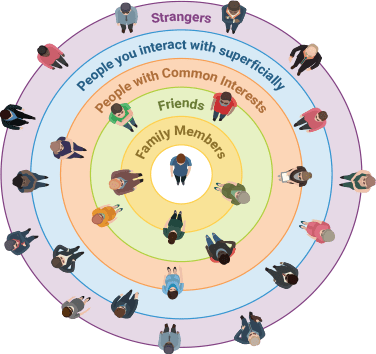
There’s one piece of advice I’m confident applies to basically everyone: you should make sure your psychological center of gravity your real and immediate world – the world of your family and friends and neighborhood, your work and your creative projects, as opposed to the world of presidencies and governments, social forces and global emergencies.
This will make you happier. It will make you more meaningfully productive.
Keeping your center of gravity immediate and local means treating the world of national and international events as a place that you visit – to campaign or persuade, donate or volunteer, to do whatever you feel is demanded of you – and that you then return from, in order to gain perspective, and to spend time doing some of the other things a meaningful life is about.
One very good way to tell that your center of gravity is out of whack is when it feels like you spend a lot of time inside the minds of far-off strangers. To follow the news isn’t merely to follow the activities of Elon Musk, but to feel overly familiar with his twitchy and emotionally reactive inner life as well. This isn’t healthy.
We need a certain psychological distance, some cognitive privacy. There’s some appropriate level of such privacy between me and my wife, for goodness’s sake, so you’d better believe there’s one between me and Musk.
Returning your center of gravity to your immediate world means remembering that “the way you want the world to be” is something you can live, here and now, not just something for which you advocate or argue. Your immediate world isn’t only somewhere you come to recharge, before heading back to the arena. It isthe arena.
Choose something you’ve been putting off and commit to doing it for exactly two minutes. Set a timer: When it goes off, you can stop – no guilt, no pushing through. You’re not changing your life overnight – you’re just proving that beginning doesn’t have to be overwhelming.
The limits of our willpower and the importance of structuring our environment to help us accomplish what we want. To change our behavior, we need to change out surroundings. Instead of saying “I’m going to refrain from eating Fig Newtons today,” it’s better to put the Fig Newtons on the top shelf behind a box of rice crackers.
__________________________
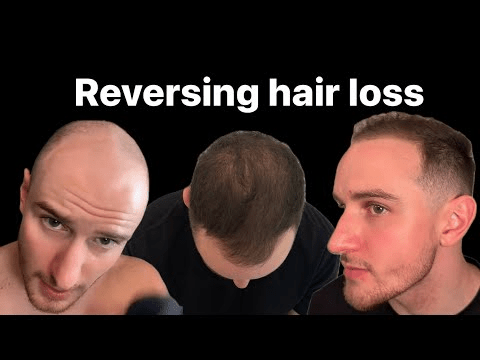
The men who can afford it are shelling out up to $20,000 to get hair transplants, which have become harder to detect and ever more precise.
Men with more modest means can find packages that fly them to Turkey and deliver the same procedure for around $3,000 — or they can start with the cheapest option of all, which is going on finasteride. Prescriptions for the drug in the United States tripled between 2017 and 2024, a time when telehealth companies were taking off, just as men started spending hours a day staring at their hairlines on Zoom.
Feeding that anxiety is a mass-marketing campaign teaching men the same brutal self-scrutiny that women have long been trained to perform. A typical male in his 20s or 30s is likely to receive a flood of ads and shout-outs on Instagram, TikTok, YouTube and the livestreaming platform Twitch for hair-growth products that appeal to men their age.
Young men who have come of age in the time of the manosphere are prime audiences for endless reels from influencers — some of them exceptionally buff, some of them funny, some of them with millions of followers, who are trying various treatments in the hope of regaining a full head of hair. The hair-loss influencer Zeph Sanders has over one million TikTok followers tracking his “hair journey.” The ubiquity of this kind of content makes losing one’s hair no longer seem inevitable; going bald can now feel like a choice — a conscious decision.
The advertising and those influencers are conveying the message to young men that they should start taking finasteride young; in their early 20s. The approach fits into the broader “prejuvenation” trend, in which young men and women are using lasers, fillers and products like Botox to fend off signs of aging before they start, rather than doing damage control when degradation is already well underway.
Here’s a number that should change how you think about retirement: 12.
That’s how long the average healthy 60-year-old has before their mobility, energy, and independence start to significantly decline. Not before they die… before life gets noticeably harder. You have more time than you have energy. More years than you have vitality. And if you don’t understand that distinction, you’ll waste the good years preparing for the declining ones.
The cruel irony is that most people spend the first decade of retirement living as they did in the last decade of work—carefully. You saved for 40 years. You delayed gratification. You were prudent, responsible, cautious. And that got you here. It built the nest egg. It secured your future. But if you keep living that way, you’ll waste the very years you saved for.
Your 60s are not a rehearsal for your 80s. They’re the main event. And if you don’t spend (not recklessly, but intentionally) during the years when you can still fully enjoy it, you’ll reach 78 with a big bank balance and a long list of regrets.
If you’re reading this in your 60s, you’re in the window. You still have your good years ahead of you. You haven’t missed it. But the window is finite, and it’s closing.
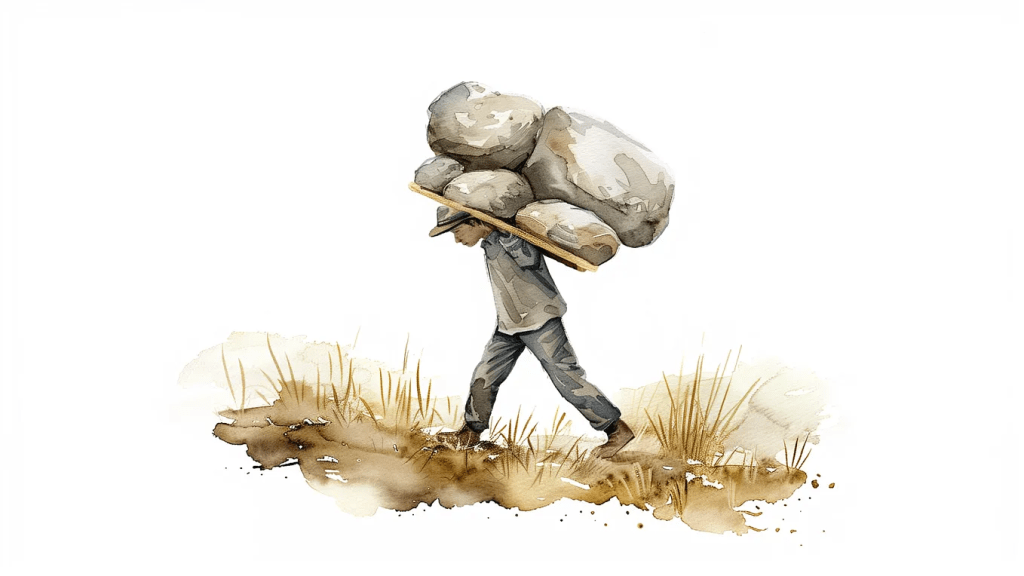
The British-born Zen master Houn Jiyu-Kennett said her teaching style wasn’t to lighten the burden of the student, but to make it so heavy that he or she would put it down. I had a full-body reaction the first time I encountered that. To me, the phrase meant this: you can slog through life trying to ‘get on top of things’, trying to reach the point at which you feel like you know what you’re doing, trying to fix your flaws, or make yourself emotionally invulnerable… All of that is an attempt to ‘lighten the burden’, and there are a thousand self-help gurus on standby, promising to aid you in the effort.
But making the burden heavier? That means seeing that as a finite human you’ll never get on top of everything, never fully understand what makes others tick, never immunize yourself from distress. The burden of reaching that goal is an impossibly heavy one. And so you put it down. You let your shoulders drop and your muscles unclench. And then – crucially – you’re free to actually be here, actually do stuff, actually show up. You get to climb life’s mountains without lugging a huge rucksack full of steel ingots on your back the whole way, which is both easier and much more fun.
The spiritual writer Michael Singer points out: reality doesn’t need you to help operate it. It gets along just fine without your worrying.
Who knew? I don’t think of myself as an obscenely self-centered narcissist, yet I have to admit that when I heard those words, I suddenly perceived the subtle sense in which my thoughts and actions – and especially the background muscular tension I instinctively bring to them – were indeed somehow premised on the notion that reality itself would be badly affected were I to relax my guard.
I seem to imagine that my worrying is effective – that there’s something about the very act of fretting about the future that helps keep everything on track. This is, rather obviously, false. All I really need to do is to show up for what’s happening, appreciate the spectacle of it, and go with the flow.
I had a conversation with a guy a few months ago whose immigrant parents came to America and worked tirelessly in low-wage jobs to make ends meet. Those kids are now adults, and this guy felt a sense of shame that as a college-educated white-collar worker he would not have to suffer the same way his parents did for him. His parents instilled in him the lessons of frugality and grit. Would his own children learn the same from him if they watched their father live a comparatively easy life?
He gave an example: when he was a kid, all books were borrowed from the library. Now his young daughter demands (and gets) to purchase $15 Taylor Swift books that pile up in her room.
My response was that if we talked to his immigrant parents, I would bet they would say: that was the goal. To put it differently: The goal of some parents is to work so hard that their kids and grandkids get to live a life that appears spoiled by the standards of previous generations.
What’s common to miss here is that when one generation’s life becomes comparatively easier than before, their life does not become objectively easy; they just move on to worrying about higher-order problems that were previously deemed not urgent enough to worry about.
I hope my kids and grandkids won’t have to worry about cancer in the ways we do. I hope they have incredible technology that makes their jobs easier than ours. I hope that everyday frictions we deal with today disappear. I hope their energy is so abundant they consider it unlimited.
Is that spoiled? I suppose, but when you frame it like that you might think of a different word – perhaps “lucky,” or, “fortunate.” Or perhaps, “beneficiaries of the accumulated hard work of those who came before them in a way that leaves them able to spend their days solving new problems.” Which is what you and I are today.
__________________
Mark Manson reviewed over 2,600 studies to rank 19 of the most common self-improvement techniques based on their effectiveness. He sorted them into four tiers: (1) legitimately works, (2) works sometimes, (3) probably not helping, and (4) straight up bullshit. Here were the results:
TIER 4: STRAIGHT UP BULLSHIT (AND MAY ACTUALLY HURT YOU):
19. Suppressing Negative Thoughts — The “ironic process” means trying not to think about something makes you think about it more. It can work for very smart people in very short-term, high-pressure moments, but the rebound effect makes things worse over time for everyone.
18. Microdosing Psychedelics — No consistent measurable benefit beyond mood improvement (i.e., you’re just getting a little high). Studies show a decline in cognitive function and executive reasoning, and long-term microdosing may carry adverse health effects from chronic exposure to psychoactive compounds.
17. Intuitive Decision-Making (“Trust Your Gut”) — Your gut doesn’t make better decisions; it just makes you feel better about your decisions. The exception is domain experts with decades of pattern-matching experience, but for most life choices, it’s self-serving and often detached from reality.
16. Catharsis / Venting Anger — Screaming into a pillow or punching a wall doesn’t release anger — it trains you to indulge it. The small effect sizes that exist are negative, meaning it makes you angrier more often.
TIER 3: PROBABLY NOT HELPING
15. Crystal Healing — Pure placebo effect. If you believe it works, you might get a small something, but there’s essentially zero evidence of any mechanism. Mostly it just harms your bank account.
14. Willpower / Ego Depletion — The concept of willpower as a finite tank you drain throughout the day is highly contested and probably not real. Believing you have limited willpower tends to make you underperform, and productivity problems are usually emotional problems in disguise.
13. Power Posing — Any mood boost is extremely transient, and the early hormonal claims (testosterone increases) have been debunked. It’s essentially a tiny placebo triggered by becoming momentarily aware of your posture.
12. Learning Styles (Visual/Auditory/Kinesthetic) — Over 90% of U.S. teachers still believe in this, but research consistently shows no real effect. The benefit people report is simply from having a choice in how they learn, not from matching a “style.”
11. Positive Affirmations — A “win more” strategy: people who already feel good get a small boost, but people with low self-esteem often feel worse because it highlights the gap between the affirmation and their actual beliefs.
10. Morning Routines — Extremely personality-dependent and mostly a placebo driven by a sense of control. Forcing a routine that mismatches your chronotype or becoming rigidly dependent on it can actually backfire.
TIER 2: WORKS SOMETIMES (MAYBE/DEPENDS):
9. Positive Visualization — Works well for physical/athletic performance and when paired with concrete planning. Without a plan, it’s just daydreaming — and pure outcome-based visualization actually decreases motivation.
8. Energy Healing — Surprisingly landed in the top half with a medium effect size (0.53), though only 56% of studies found any effect. The benefit likely comes from human touch, the ritual, and a strong placebo/expectancy effect rather than anything metaphysical.
7. Cold Water Immersion (for Mental Health) — Fairly consistent mood and stress benefits, likely driven by a big dopamine release. However, it’s a “win more” strategy — helpful if you’re already mentally healthy, potentially destabilizing if you’re fragile.
6. Speed Reading — You can realistically go from ~200 to 300–400 words per minute, which is meaningful, but the 1,000 wpm promises are nonsense. The trade-off is reduced retention, and much of reading speed turns out to be genetic.
TIER 1: LEGITIMATELY WORKS
5. Gratitude Interventions — The most consistent finding in the entire list: 98% of 166 studies showed a positive effect. The effect size is small, though, and compared to other positive interventions like acts of kindness, the unique “gratitude mechanism” mostly disappears.
4. Meditation — Consistently effective for stress and anxiety reduction, roughly equivalent to SSRIs for depression in some studies. The deeper benefit is knowing your own mind better, though compared to other active positive interventions, the unique advantage narrows.
3. Eat the Frog (Hardest Task First) — 95% of the benefit comes from the prioritization process itself, not the timing. Figuring out what matters most creates clarity and reduces anxiety, and ending the day on easier tasks boosts self-efficacy.
2. Bibliotherapy (Reading Self-Help Books) — 93% of 188 studies found positive effects, with a decent effect size approaching some therapy modalities. The key is the right book at the right time, and structured recommendations from a therapist boost the hit rate significantly.
1.Behavioral Activation (“Do Something”) — The most robust finding across all 19 techniques. Simply taking action, even small action, generates motivation rather than waiting for motivation to strike. It’s on par with CBT for depression and costs nothing.
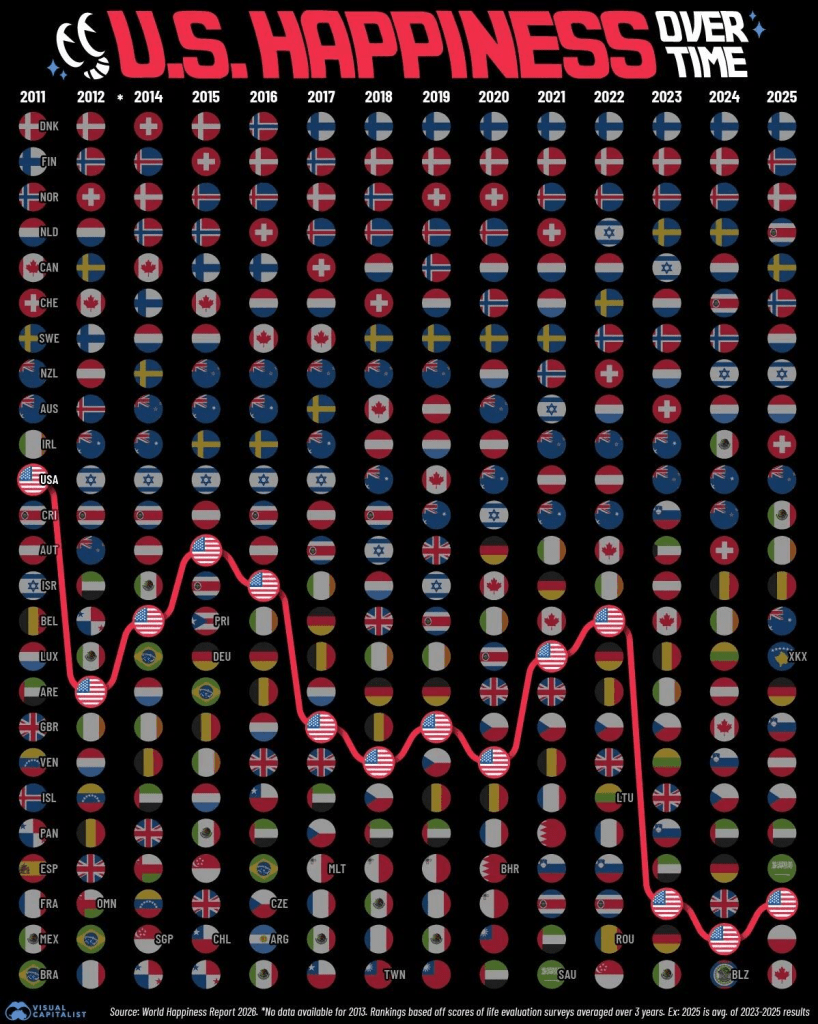
From the World Happiness Report (2026 was just released). The country rankings below are based on three-year averages, so the 2023 result captures responses from 2021, 2022 and 2023.
But here’s the really weird part: The ones suffering most are not just the down-and-out types—the addicts, the impoverished, the failsons. Those for whom there are obvious things gone wrong in their lives. On the contrary, it is also those who seem to have everything going right for them—in other words, our young and most successful strivers.
I’ve spent my life surrounded by that very group. As a longtime college professor, I have been privileged to teach hundreds of wonderful students—ambitious strivers just starting out on what promised to be terrific careers and lives. I have met countless young people who were so inspired by ideas, so purpose-driven, and so enthusiastic.
But in 2009, I left academia to run a nonprofit in Washington, D.C. And when I returned to campus a decade later, the atmosphere was dark. Larger and larger percentages of students were suffering from depression and anxiety. At some schools, more than half of students were receiving mental health treatment. My office hours were more like counseling sessions than tutoring. Hope and optimism had been replaced by anger and sadness.
Most of the younger generation is online a lot: scrolling social media, watching videos. To simulate a social life, they spend hours listening to podcasts of other people having interesting conversations. You could call it “social pornography.” Most of the time, there’s nothing better to do. They crave a big, meaningful project and immersing themselves in it. But they can’t come up with any ideas for what that project might be . . . so it’s back online.
They don’t fit the traditional résumé of unhappy people. They’re not addicted to drugs, nor struggling financially. In fact, their life looks enviable from the outside. But like so many young people I’ve spoken to over the years, they feel empty.
What these young strivers describe to me is something akin to waiting in an airport terminal for a delayed flight that never leaves. They try to stay occupied to keep themselves from going mad, always in the hope that boarding will finally be called and the flight will take off. And their distraction tactics—which invariably involve technology—keep them from thinking too much but make their sense of emptiness worse.
One of the young strivers I talked to was telling me about his virtual job, dating apps, social media friends, and video gaming. Then, out of the blue, he said something fundamental.
“I feel like I’m living in a simulation.”
Others said the same thing. Life felt unreal: full of false rewards, empty accomplishments, therapeutic talk, and fake experiences, all curated to pass the time as painlessly as possible.
Again and again, people said that life was busy but not meaningful. That experiences and relationships felt meaningless. Or that they didn’t know what they were meant to do in work and life. And it’s worse for the strivers than anyone else: The richer, more technologically advanced the country, the greater the percentage of the population that answers “no” to the question “Do you feel your life has an important purpose or meaning?”
Here’s why: Strivers are great at solving technical problems and answering specific, hard questions. They have been educated and trained to believe that, while the world is incredibly complicated, with enough knowledge and hard work, every problem can be solved.
The truth is, many big, complicated problems can be solved with sheer intellectual horsepower. But meaning is not one of them. “What is the meaning of my life?” is a question that cannot be answered like “How do I build an app for finding concert tickets?” or “How do I create an effective six-month weight-loss program?” Meaning is a question that must be lived, not solved with a Google search or simulated using artificial intelligence. It requires deep contemplation and a commitment to living a real life, full of unsolvable secrets, puzzling riddles, unexplainable bliss, and terrible suffering.
But in all their technical excellence, strivers trivialize their humanness by reducing life’s magnificent inscrutability to a series of complicated but solvable problems. They aren’t just living in a simulation; they are also creating the simulation they are living in.
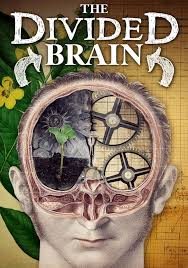
In his 2009 book, The Master and His Emissary: The Divided Brain and the Making of the Western World, Ian McGilchrist argued our brains have two hemispheres that deal with everything, but they do so in consistently different ways. The right side of the brain is the “master,” which asks big, transcendent questions such as “Why am I alive?” The left side—which he calls the “emissary”—addresses such practical questions as “How do I get food so I can keep being alive?”
In other words, in the right hemisphere we ask the lofty why questions about life. On the left side, we ask, earthbound, what to do now and how to do it.
Hemispheric lateralization explains the acute crisis of meaning today. In our increasingly complicated, technology-dominated, and endlessly distracting world, people are shoved to the left side of their brains. They are stuck in a complicated simulation where there is a lot going on, but which is bereft of mystery and meaning.
Older people remember the before times, when meeting a potential mate for the first time involved a real-life conversation, and a big question of life’s meaning couldn’t be reduced to a Google search. But most young adults today have never known any domain other than Left Brain Land. And this is especially true for the strivers. They know every complicated nook and cranny of that technical dystopia, but the mysterious realm of meaning seems mythical, like the lost kingdom of Atlantis.
Stuck outside the realm of the numinous right hemisphere, life becomes just an endless loop of complicated left-brain routines and habits—a simulation of a life that is deep, mysterious, and authentic. It’s frustrating and empty.
Worse: It’s boring. And humans absolutely despise boredom.
Why are we so bored? Because life feels repetitive and meaningless, and even a minute here or there with nothing to do feels like an hour. So out comes the phone, every few minutes, all day long, changing our brain chemistry in dangerous ways.
And what side of our brains are we on as we do all this? The mundane left, of course, not the mysterious right. The remedy we’ve created to avoid the boredom of modern life—this app, that video—reinforces our inability to ponder the abstractions necessary to formulate any concept of our lives’ meaning.
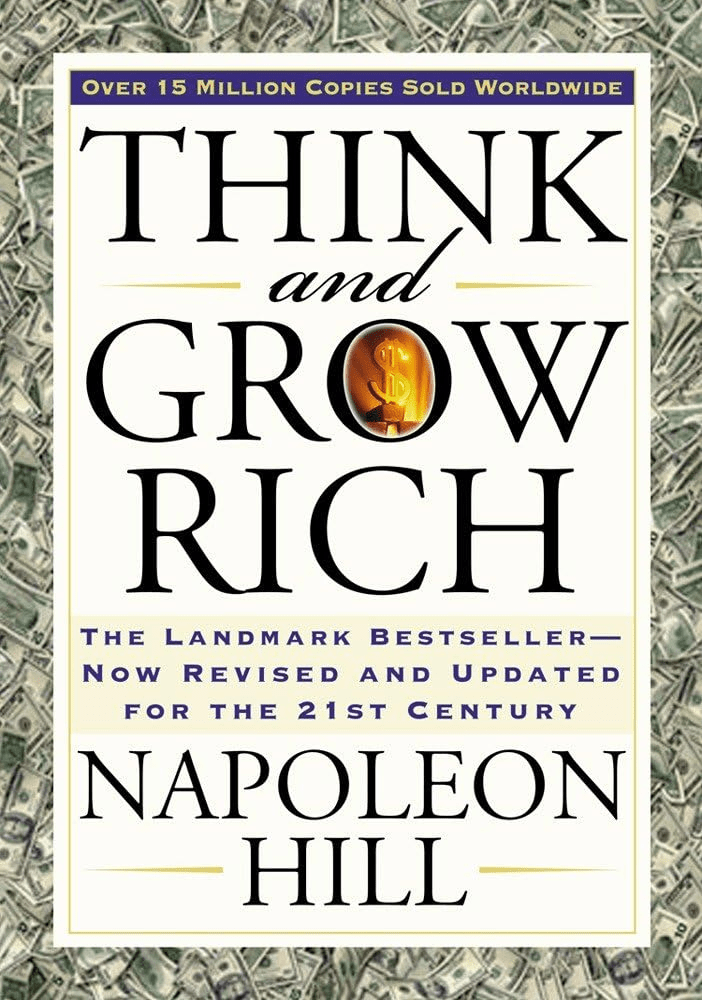
The famous origin story of Think and Grow Rich, by Napoleon Hill, is that Andrew Carnegie commissioned Hill in 1908 to interview 500 successful people over 20 years.
That origin story is fabrication.
In reality, in 1908 Hill was fleeing police in Alabama under a fake name after committing fraud, facing domestic violence accusations, and abandoning his family. The book’s real author was his wife. She took Hill’s rambling, failed manuscripts and refined them into Think and Grow Rich.
The book contains a mix of genuinely good advice:
Specific goal-setting with deadlines
Persistence and grit
The “mastermind” concept of surrounding yourself with sharp people
The value of specialized knowledge
It also contains psuedoscienctific nonsense like:
“Sex transmutation” or redirecting sexual energy toward business
The idea that brains communicate through vibrations
A “sixth sense” chapter about receiving messages from infinite intelligence
If Think & Grow Rich is a fabrication from a con man, how has it sold over 100 million copies and helped millions of people since it was published?
The answer lies in the placebo effect.
Most of the advice from self-help gurus works not because it’s scientifically accurate, but because believing in it changes people’s behavior, which then changes their outcomes. Believing they can accomplish something makes them more likely to try it and then more likely to try hard and persist.
Is social media use reasonably safe for children and adolescents? We call this the “product safety question”, and we present seven lines of evidence showing that the answer is no.
The evidence of harm is found in: 1) surveys of young people; 2) surveys of parents, teachers, and clinicians; 3) contents from corporate documents; 4) findings from cross-sectional studies; 5) findings from longitudinal studies; 6) findings from social media reduction experiments; and 7) findings from natural experiments.
We show there is now overwhelming evidence of severe and widespread direct harms (such as sextortion and cyberbullying), and compelling evidence of troubling indirect harms (such as depression and anxiety). Furthermore, we show that the harms and risks to individual users are so diverse and vast in scope that they justify the view that social media is causing harm at a population level.
We further argue that when these lines of evidence are considered alongside the timing, scope, and cross-national trends in adolescent wellbeing and mental health, they can help answer a second question: was the rapid adoption of always-available social media by adolescents in the early 2010s a substantial contributor to the population-level increases in mental illness that emerged by the mid 2010s in many Western nations? We call this the “historical trends question”. We draw on our findings about the vast scale of harm uncovered while answering the product safety question to argue that the answer to the historical trends question is “yes”.
__________________________
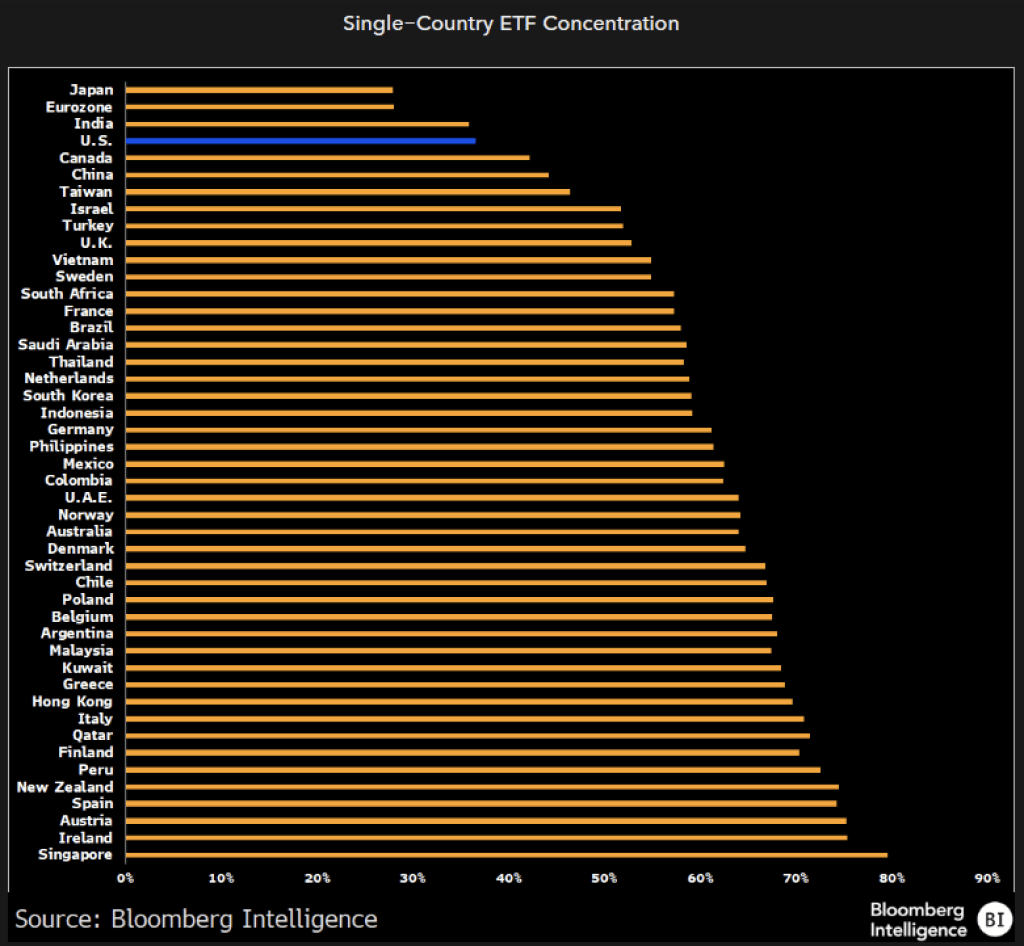
The graph below shows the percentage of each country’s total stock market cap made up by its top 10 largest stocks. While people worry about the concentration of the largest stocks in the U.S., it is a global phenomenon.

__________________________
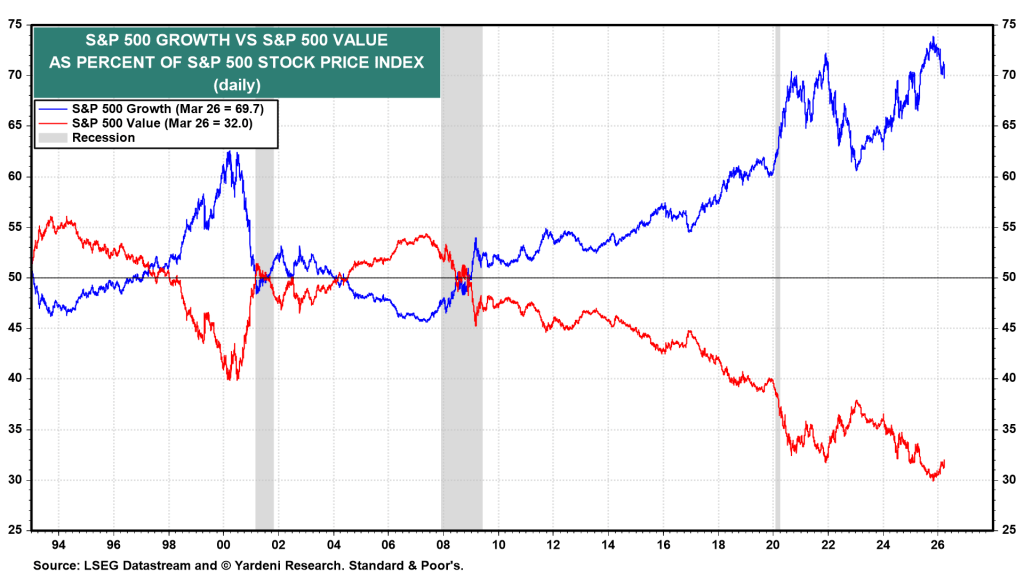
Is this finally the moment when the jaws begin to close and U.S. value stocks (red line) outperform growth (blue line)?
Bio-fabrication technologies advance rapidly enabling human organs to be printed on demand. A new industry of “body mechanics” emerges and utilizes AI-driven prediction models to pre-emptively replace joints, bones, and organs before they fail. The expected lifespan of a child born in 2030 rises to 151 years.
Advancements in quantum computing lead to a geopolitical crisis as all formerly- secure communications become instantaneously vulnerable. Each breakthrough leads to a bump in gold prices as investors fear the possibility of quantum-enabled theft of cryptocurrency. Cybersecurity re-emerges as an area of top concern for corporate boardrooms, nation states, and individuals.
Deepfake technologies become indistinguishable from real life, leading to mass human confusion and cognitive dissonance. Reality Defender emerges as the world’s hottest company as it secures elections by providing voters assurance of authentic messaging from candidates, thereby saving democracy from being hijacked by technologically-savvy foreign actors.
A boom in next generation nuclear technologies combines with improved hydrocarbon extraction efficiency to keep energy prices contained in the face of exploding demand from technology applications and data centers. As copper emerges as the world’s most strategic resource, the Great Powers shift their focus from the Middle East to the Andean region.
The insatiable consumer appetite for protein continues indefinitely. Restaurants start disclosing the protein content of menu items, and Coke introduces a high-protein soda. Public health deteriorates as Americans’ religious focus on protein leads to elevated consumption of sugars and artificial sweeteners.
The global use of GLP-1 drugs skyrockets as an oral pill becomes readily available and is covered by most health insurance plans or government health offices.
Artificial intelligence generates deflation, leading to structurally rising unemployment and elevated debt levels.
___________________________________
We are drowning in information and data. So much so that we’re obese in the mind. The same way the human body was not prepared for a world of abundant food, and we thus transformed our cities into feeding zones full of fat people, the human mind is not prepared for a world with infinite content and information. Less than two decades into social media and the world is already full of morbidly obese minds that cannot think or focus, let alone produce anything novel anymore.
Even the best of us are mentally overweight! There are few, if any, original ideas anywhere. Everyone, everywhere is in a constant, social-media induced mimetic trance, mistaking repetition for thought while parroting the same words as those in our little echo chamber.
The only solution is to shut it all out. I’ve come to the realization that selective ignorance on the other hand; I’m talking actual willful, intentional ignorance, is not only blissful, but is a holy virtue.
It’s the kind of ignorance that is deliberately oblivious to what is going on in the world because none of it matters an iota in the grand scheme of one’s life. It’s the kind of noble, savage and ruthless ignorance that doesn’t even waste energy saying: “I don’t care.” It’s just blissfully above to the noise, present only with what matters, here and now.
As the pace of things accelerates and the never ending cycle of hysteria continues, it’s dawned on me that none of it really matters. Sure, individual events may matter to some people, but because of how we’re wired and how the internet and social media have connected us all, the number of events that can (a) happen and also (b) be brought to our attention is infinite.
Which in short means that everything matters all the time. But when everything matters all of the time, then the only reaction for the mind and body is to become numb. In other words, nothing means anything or matters any more. This is not a way to live.
Attention, at the end of the day, is all we really have. It’s finite. It’s super super super finite. We have so little time. We have only so much energy. It’s hard to focus at the best of times, and here we are, on a daily basis, being either:
Distracted by things inside of a phone-size shopfront that most of us will either never have (picture-perfect women, hotels, cars, etc), or
Inflamed by things on that same stupid screen which we have no relationship to or influence over, happening in other parts of the world, thousands of miles away.
The end result of all this stupidity (for 99.9999% of people) is just a LOSS of attention. I’m sure some of you have found inspiration or motivation from these screens (this can happen), but if we’re all being TRULY honest with ourselves here, we can admit the truth: we can be just as inspired by a walk on the beach or a conversation with a loved one too.
When I’m on my deathbed, I won’t remember wtf I saw on Twitter or Instagram from all those endless hours of looking at the screen. But I will remember the time I spent with the people who I truly loved. To find a solution, one must first understand the problem, and the problem is twofold:
Nobody is entirely immune to the siren call of dopamine. These platforms hack your biology in such a way that they hook you. Thus you are not fighting the platform, but your own biology – and this consumes energy. Energy that could be much better spent elsewhere.
Our cups are already full. Those of use who are strong learners have already had our fill, especially if you’ve been online for the last 5 – 10 years. We’re well past the point of diminishing returns. We have all the information we could possibly need to live and lead meaningful lives. Stuffing our minds with more stuff won’t improve anything, and at this point is just a distraction from living in the real world and implementing the things we’ve already learned or know.
The beautiful thing about value is that it always migrates to the zone of greatest scarcity. As a zone attracts more attention (and thus value), it begins to lose scarcity, until it gets saturated, and then one day, the value migrates away to a zone where scarcity prevails. People are starting to realize that being online is quickly becoming uncouth and that they need to run away. But where?
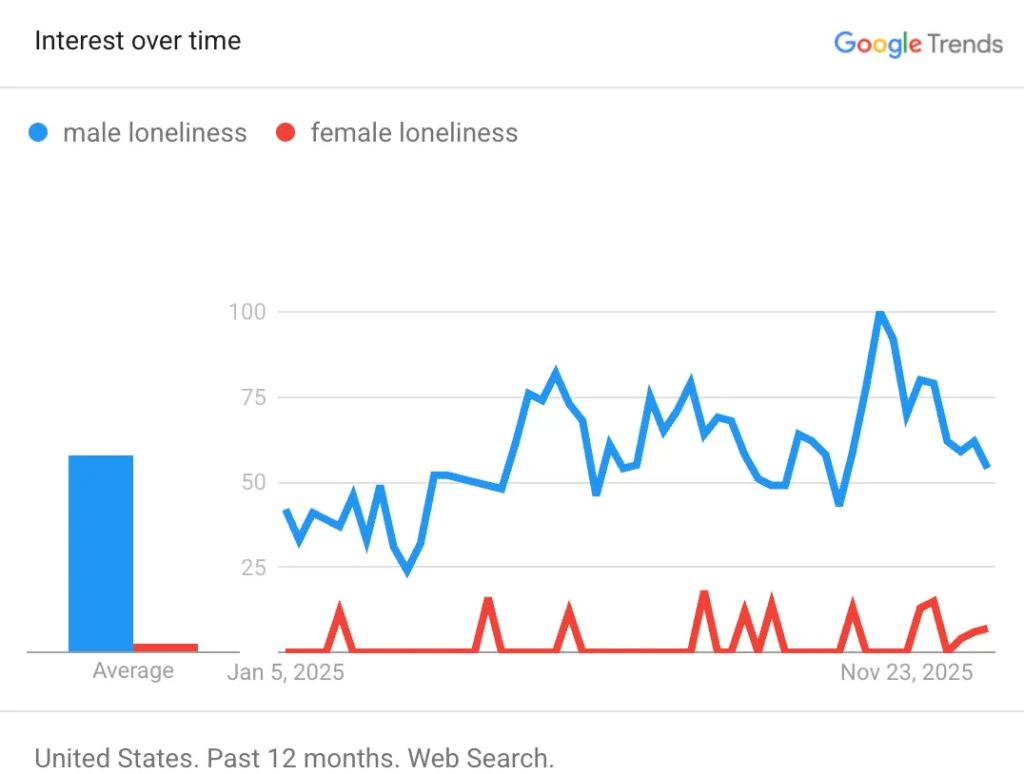
With 23,000 responses to survey questions distributed over more than 4,500 respondents, we found there is a youth loneliness crisis, not just a male loneliness crisis like many believe. Younger people — both male and female — are increasingly paralyzed by anxiety and fear, and they are finding it harder and harder to socialize.
In fact, when you look at the data, the “antisocial crisis” is actually most pronounced among young women, who experience the highest rates of social isolation.
It’s true that young men are facing a loneliness crisis, but it’s part of a broader loneliness crisis that young people are facing in general, and the numbers suggest that young women might actually be hit even harder, even though that story hasn’t gotten nearly as much attention.
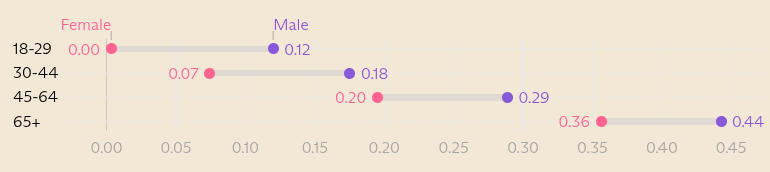
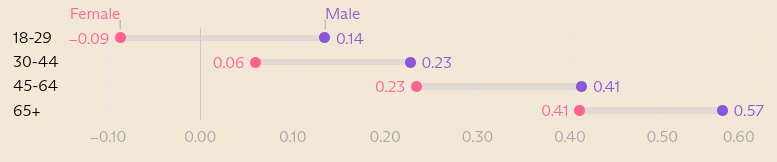
Looking at the results from our study on the questions concerning emotional distress the gender split is striking, but it is age, rather than gender, which marks the determining axis once again.
For instance, young men (18 to 29) are more distressed than almost every other demographic, including women 45 to 64 and women over 65. But young women are hit even harder, and they actually have the worst scores among any age-based gender cohort in our entire dataset.
In another axis of our study, social disengagement, young people once again emerged as the age group most likely to feel lonely, isolated, or conversationally stunted with people they don’t know, and there is a striking gap between the “internet generations” (people under 45) and everyone else.
While both young men and young women suffer from a loneliness and socialization crisis, young women actually seem to be hit significantly harder by it. In particular, they seem to find it much harder to make new friends or converse with strangers, especially when it comes to the opposite gender — and they’re much more likely to be introverted and alienated.
The results of this study lined up quite well with the existing research on this topic. A study conducted by Public Opinion Strategies found that young women are the cohort of Americans most likely to feel lonely and left out. And it doesn’t seem to be limited to just America — a study done by the United Kingdom’s Campaign to End Loneliness found that women and young people were two of the cohorts most affected by loneliness.
Young people are spending less and less time socializing with each other. The American Time Use Survey estimated a nearly 50% decline in face-to-face interactions among teenagers over the last two decades.
Growing up, I spent every French school holiday in the U.S. with my dad — the more career-driven of my parents (which tracks, since my mom is Belgian and my dad is a pure-bred American from Michigan). So I grew up with both models: French and American.
I don’t think most French people think about purpose the way Americans do. What’s your purpose? What are you building? What are you here for?
They’re good questions. But in France, they’re not humming in the background of every conversation. Most people I know don’t define themselves by what they do for a living. And if they work in a corporate setting, there’s often this quiet trust that things will evolve over time. No need to panic about your life path. Just do your job — and enjoy your life. Work is one part of the equation. So is your social life, your hobbies, your weekends away.
In the U.S., the idea of having purpose is everywhere: in books, on podcasts, in LinkedIn bios, even in casual brunch conversations. There’s this constant pressure to align your job with your passion, your calendar with your goals, your time with your values.
But what if your purpose is simply to build a good life? To raise kind children. To cook a little better each year. To read a few excellent books. To notice the seasons. To build meaningful relationships. Isn’t that what people will remember anyway?
In France, there’s no guilt in doing a job because it pays the bills. Or because it gives you your evenings. You can be excellent at what you do and still have no desire to talk about it over dinner — which is very much the case with my French husband, who bans work talk at the table. At first it felt strange. Now I love it. We talk about where we want to go next weekend. What we’re reading. What to cook.
When I moved back to Paris as an adult, I was struck by how much people here were just… living. They weren’t building personal brands. They weren’t trying to optimize themselves into more perfect versions. They worked, they took real holidays, they cooked, they went to the theater. They had long conversations about everything and nothing. And they rarely used the word productive.
What they value instead is curiosity. Culture. Taste. The art of paying attention. Of being present, not just purposeful. That doesn’t mean people are passive. But the energy is different. Life is more about living well or profiter de la vie.
It took me time to unlearn the habit of measuring everything by what it might lead to. What goal it served. What version of myself it might create. I still have ambition, but I no longer believe every moment needs to be part of some upward trajectory. Some days, it’s enough to spend the weekend with my family — visiting an exhibition, taking the kids to a play.
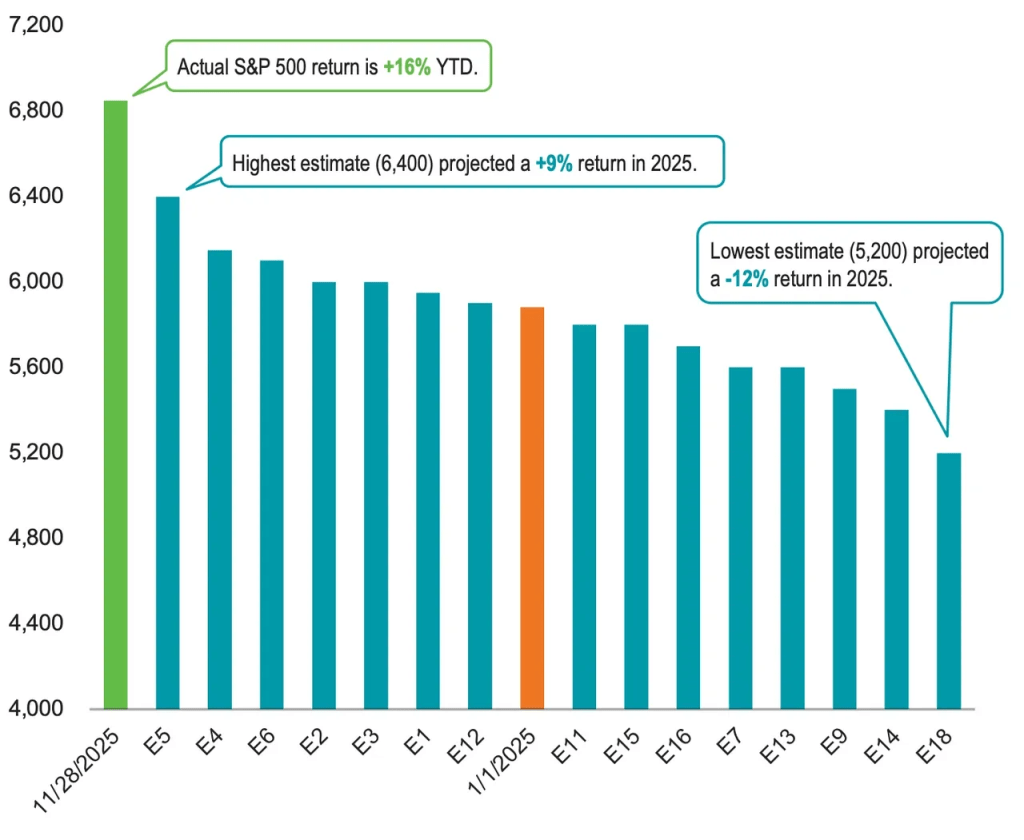
There’s a strange comfort in believing someone out there knows what the market will do next. Don’t fall for it. People who make predictions on the financial markets for a living are about as accurate as a 50/50 coin toss.
By early spring 2025, when President Trump’s tariff wars started, over half of the forecasters were calling for the market to decline. The below graph shows the level of the S&P 500 at the beginning of the year (orange bar), the actual price level at year end (green bar) and the wide range of estimates published in April (blue bars). If you’d been reading all their research reports, you might have started selling.
Maybe you’re thinking “Fine. Experts may be clueless, but vibes are easy to read.” You know all about employment numbers, and inflation, and the usual talking points from CNBC.
Well, here’s a great chart from JP Morgan Asset Management that begs to differ. It looks at S&P 500 performance after peaks and troughs in the University of Michigan’s consumer sentiment survey. Interestingly, the weakest moments in how people are feeling tend to precede strong equity returns while peaks in sentiment do not see as much upside. Turns out that getting out of the market when things feel bad can be a poor investment strategy.
__________________________
The defining feature of every bubble is the same: a growing inconsistency between the long-term returns that investors expect in their heads – based on extrapolation of the past, and the long-term returns that properly relate prices to likely future cash flows – based on valuations.
Each speculative episode encourages a certain stubbornness – because humans are adaptive creatures, we base our expectations for the future on the experience of the recent past. We respond far less to those things that are painful but distant in our memory than to those things that are rewarding in real-time.
This feature of investor behavior – what Galbraith called “the extreme brevity of the financial memory” – is complicated by the crowd psychology that accompanies speculation. Independence of thought requires one “to resist two compelling forces: one, the powerful personal interest that develops in the euphoric belief, and the other, the seemingly superior financial opinion that is brought to bear on behalf of such belief. As long as they are in, they have a strong pecuniary commitment to the belief in the unique personal intelligence that tells them there will be yet more. Speculation buys up, in a very practical way, the intelligence of those involved.”
A related, and I think equally challenging complication is that, in the short run, market prices will be whatever the consensus of the crowd chooses them to be. Nothing that we can measure affects market prices – whether earnings, GDP, employment, interest rates, monetary policy, or any other factor – except through the expectations and risk-preferences in the heads of investors at any moment in time. As the Buddha said, “With our thoughts we create our world.”
A financial “security” is nothing more than a claim on some stream of cash flows that investors expect to be delivered into their hands in the future. For any stream of future cash flows, and some long-term rate of expected return, we can always calculate the “present value” of the cash flows expected at each point in the future. Likewise, once we have a reasonable estimate of likely future cash flows, then the moment we know the market price, it’s just arithmetic to calculate the expected long-term rate of return on the investment.
Over the short-run, however, nothing prevents investors from imagining whatever long-term rate of return they like, and paying whatever price they wish, even if the two are mathematically incompatible with likely future cash flows. Even then, we can make everything compatible by imagining whatever future cash flows we like. Only time imposes any discipline on those choices, and sometimes time is unforgiving.
Will LLM models run out of data to train on? In its 2025 AI Index Report, Stanford concluded that this is unlikely before 2030. Common Crawl, an open repository of web crawl data frequently used in AI training, is estimated to contain a median of 130 trillion tokens. The indexed web holds approximately 510 trillion tokens, while the entire web contains around 3,100 trillion. Additionally, the total stock of images is estimated at 300 trillion tokens, and video at 1,350 trillion tokens.
Assume that 5 billion people end up using AI by the 2030’s (compared to 6 billion current internet users). Each user consumes about 1.6 mm tokens per day for search, coding assistance, other agents, background assistants and creative purposes. That would be a LOT of demand vs current levels and assumes a paradigm shift in how AI is used in daily life. Across all users, that would be 8 quadrillion tokens per day
How much capacity would be needed to handle 8 quadrillion tokens per day? 23 – 92 Gigawatts of active inference capacity. While there are 125 Gigawatts of data centers around the world, only about 20 Gigawatts are currently estimated to be capable of handling AI workloads.
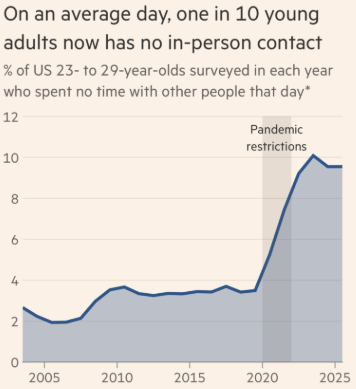
What afflicts America’s young today can’t be properly called a loneliness crisis. It seems more to me like an absence-of-loneliness crisis. It is a being-constantly-alone-and-not-even-thinking-that’s-a-problem crisis. Americans—and young men, especially—are choosing to spend historic gobs of time by themselves without feeling the internal cue to go be with other people, because it has simply gotten too pleasurable to exist without them. The problem is not loneliness. The problem is that we’ve forgotten how to feel lonely in the first place.
Since the 1970s, America has over-regulated the physical world and under-regulated the digital space. To open a daycare, build an apartment, or start a factory requires lawyers, permits, and years of compliance. To open a casino app or launch a speculative token requires a credit card and a few clicks. We made it hard to build physical-world communities and easy to build online casinos. The state that once poured concrete for public parks now licenses gambling platforms. The country that regulates a lemonade stand will let an 18-year-old day-trade options on his phone.
As part of a larger project, an author read 102 books over the past twelve-and-a-half months. Here were some of the insights he took away:
Exercising regularly is probably the single best thing you can do for your health. (Outside of quitting smoking.)
Happiness, not stress, leads to productivity.
Despite our preconceptions, we may be happier at work than at home. People experience more flow at work than in leisure.
Energy, not time, is the limited resource in our ability to be productive.
You can’t beat the market. Nearly everyone is better off simply buying a diversified low-cost index fund. Neither can any fund you invest in. The percentage of funds that beat the market after fees is so low that you can round it to zero.
You can’t time the market. Frequent trades expose you to taxes and whittle away your capital on fees. Buy and hold is better.
If you need an advisor, find someone who charges hourly. Paying a percentage of your assets seems cheaper, but the cost is enormous in the long-run.
We’re overweight because we eat too much. The increase in calories consumed is enough to entirely explain the change in body mass. Successful weight loss requires you to stick to a dietary pattern forever. The weight will always come back the moment you stop.
Loneliness is as bad for your health as smoking cigarettes. The stress of loneliness weakens our immune system.
There are numerous explanations for the increase in time alone, but a simple one is just better entertainment options available.
Sleep serves many important functions. It flushes the brain of metabolic byproducts, consolidates memories, reinforces the immune system and recalibrates synaptic connections.
If you have insomnia, don’t worry, you probably are sleeping enough. If you’re sleep deprived you will fall asleep, so despite feeling cranky and low energy, most insomniacs are not actually sleep deprived.
Asking yourself “what went well?” at the end of the day can give you a big boost to your happiness.
ADHD is about as heritable as height, is not caused by parenting style, doesn’t go away as you age and, despite popular disbelief, medication works pretty well.
Why do doctors now seem so rushed and dismissive? You wait 45 minutes in the exam room when the doctor finally walks in. They seem rushed. A few questions, a quick exam, a glance at the clock and then a rapid-fire plan with little time for discussion – and you leave feeling unheard, hurried and frustrated.
Increasingly, health care organizations and physician groups face intense financial pressures. Many doctors can no longer sustain their private practice due to declining reimbursements, rising costs and increasing administrative burdens; instead, they’ve become employees of larger health care systems. In some cases, their practices have been acquired by private equity groups.
With this shift, doctors have less control over their workloads and the time they get with their patients. More and more, payment models fail to cover the true cost of care. The default solution is often for doctors to see more patients with less time for each, and to squeeze in additional work after hours.
200 years of data across 56 countries, showing 25-year and 5-year returns from different starting P/E ratios (the price of a stock dividend by its earnings). The takeaway? Even over relatively short periods like five years, valuations matter a lot. If you buy when stocks are expensive they tend to do worse than when you buy them cheap.
Here are the forecasts for different categories of stocks over the coming decade based on their current valuations:
The night before my brain surgery, my wife and I sat across from each other in wordless stillness. Hours before surgery, with death still in the room, I didn’t feel fear. I felt something quieter. Stranger. I felt connected. To my wife’s eyes. To my breath. To the weight of my feet against the floor. To the wind brushing the window. Even to our cat, oblivious, licking her paws in perfect peace.
Upstairs, in a crib painted white, our 18-month-old daughter lay sleeping. I imagined her face at 5, at 15, at 40. I hoped she would know how deeply I loved her. And in that moment — that unbearable, radiant moment — I was, for perhaps the first time ever, conscious.
Not in the neurological sense. Not in the academic or philosophical sense. But in the raw, elemental sense of being awake to the miracle and the absurdity of existence. Alive to the texture of being.
Leading up to surgery the world had never looked so alive. Every detail sharpened, sacred. Time no longer moved. It hovered. Held. The future dissolved. The past let go. All that remained was one long, luminous moment. And in that moment, I was tethered — to my wife’s hand, to the stars, to everything. I was, finally, conscious.
I considered the paradox of being most awake at the edge of unconsciousness. The strange intimacy of being stripped down to nothing: no ego, no schedule, no ambition. Just breath. Presence. And the knowledge that everything is about to change—or end.
At that moment, I was not thinking about business plans or unread emails. I was not anxious about the past. I was not hungry for the future. I was only there, suspended, waiting. And in that waiting, I was more myself than I’d ever been.
I laughed to myself in the hours before the anesthesia took hold: This is what it means to be fully human. This is what it means to be conscious.
I lived, and in the weeks following surgery, I experienced what doctors call “survivor’s euphoria.” A clinical term, woefully inadequate. It wasn’t just euphoria. It was revelation. It was a reawakening. It was a second birth.
The world opened itself to me like a wound and a gift. I smelled color. I tasted air. I watched dust motes floating in the light and felt tears rise. My daughter’s laugh shattered something inside me, and I let it. I held my wife in the dark, listening to her breath, feeling the hum of her life, and I cried because I could.
I no longer chase productivity the way I once did. I no longer confuse urgency with meaning. I try, imperfectly, to pay attention. To listen more than I speak. To feel what I feel, even when it hurts.
Schopenhauer believed that all of human experience runs along a pendulum that swings from two poles: one of desire, and the other of satisfaction. We strive when we have desire, so the only way to alleviate this is to experience the pleasure that comes with satisfaction. But once you’re satisfied, boredom ensues, and desire inevitably arises yet again. Hence the pendulum.
The pace in which the pendulum swings between desire and satisfaction is what matters most. If it swings rapidly between the two, you get happiness. If it swings slowly between them, you get suffering.
To Schopenhauer, one could only be happy if desire is quickly offset by satisfaction, and this satisfaction could then be quickly offset by another desire. If it’s in our nature to restlessly strive for something, the only way to be happy is to feed that nature what it wants. Suppressing the existence of a desire only prolongs the suffering, which is why he didn’t believe that an ascetic life was the answer.
I think this does a good job explaining the phenomenon of busyness, and its existential utility for people. Ultimately, being busy is you continually swinging between desire and satisfaction. Anytime you create an item on a To Do list and proceed to check it off, that’s you making one round on this continuum. Multiply this by however many times you do it over the course of a week, and you get the feeling of busyness.
If your mind always has something to check off, then there’s no room to ask yourself if you’re deriving meaning or purpose in what you’re doing. You just move from one cycle of desire / satisfaction to the next, and that in itself is where you dedicate your attention to.
This is where Schopenhauer’s take breaks down. Simply going from one pole to the next in a rapid manner is not happiness. Oftentimes, it’s just distraction. And when the pace of the pendulum slows in a manner where your desire takes a long time to satisfy, then you’ll see through the illusion that your busyness has created. Anytime there’s a lull or silence in your day-to-day life, this void may be filled with the angst that what you’re doing isn’t the answer, and that’s when an existential crisis takes hold.
This is why true happiness cannot be contingent upon any notion of satisfaction. Because to be satisfied is to imply an endpoint. A goal. And as the hedonic treadmill illustrates, once there is a goal, the logical conclusion is to create another chase to distract you. This distraction may keep you amused and busy, but once you’re faced with silence, you will be afraid of what you may feel.
The answer here is that happiness cannot be pursued, nor can it ever be achieved. Because the moment you’re aware that you’re happy, then paradoxically, you no longer are because you’ve called it out. Once you name a positive feeling, you become attached to it, and you long to feel it again.
America is about to tumble off the edge of a massive demographic cliff. The timing is no coincidence. The US birth rate peaked in 2007, with just over 4.3 million babies born that year. That number has dropped almost every year since, reaching a 30-year low of 3.8 million births in 2017. Last year, the rate was down to 3.6 million.
To give you some context for pickleball’s pre-pandemic popularity, think about badminton. And now think about something half as popular as badminton. That was pickleball in 2019. Total pickleball players in the U.S. were outnumbered by participants in archery, bow hunting, fly fishing, indoor climbing, snorkeling, and sledding. Now it’s more popular than all of those pastimes … and America’s pastime. Yes, more Americans played pickleball last year than baseball.
___________________________
I’ve taught the same course to a class of undergraduate, M.B.A., medical and nursing students every year for over a decade. While I didn’t change my lectures or teaching style, somehowthe students’ evaluations of last year’s class were better than ever before.
What changed? I banned all cellphones and computer-based note taking in the classroom.
To help sell this policy, I presented in the first lecture of the course a study showing that students who were required to take class notes by hand retained significantly more information than students who used computers. The reason is that with computers, students can type as fast as I speak and strive for verbatim transcripts, but there is almost no mental processing of the class’s content.
Handwritten notes require simultaneous mental processing to determine the important points that need recording. This processing encodes the material in the brain differently and facilitates longer-term retention.
A recently published paper looked at twin studies to see if heavy social media users have innate tendencies toward lower social well-being. After looking at info on the amount of use, the number of posts, the number of social media accounts, etc., they found only a modest correlation between social media use and well-being (including anxious-depressive symptoms).
Today, I’m going after a sacred modern virtue. Tell me if you’ve heard this one before: “Freedom is the highest form of wealth.” After 2 years of freedom, I’d like to disagree. I don’t have issue with freedom as a form of wealth. Or that it’s a better form of wealth than money (it is). I only take issue with the “highest” or “greatest” part of this argument.
I now believe that meaning is the highest form of wealth. The ability to continually have and make meaning, every day. To feel a deep sense of fulfillment and purpose in our actions; emphasizing what we do more than who we are. The good news is you don’t need money for meaning (though it can help). There’s plenty who never find freedom, but still find purpose. So wait, does that make them free? And having freedom without meaning is its own kind of prison.
___________________________
Howard Marks’ newsletter this month provides an in depth analysis that lays out where investment value comes from and how they should be assessed. The TDLR jumping to his conclusion at the end on where we are with U.S. stocks today:
“Fundamentals appear to me to be less good overall than they were seven months ago, but at the same time, asset prices are high relative to earnings, higher than they were at the end of 2024, and at high valuations relative to history.”
Instead of DEFCONs like the Pentagon uses for war scenarios, he laid out levels of INVESTCONs investors can move through to protect investments in the face of above average market valuations and optimistic investor behavior:
6. Stop buying 5. Reduce aggressive holdings and increase defensive holdings 4. Sell off the remaining aggressive holdings 3. Trim defensive holdings as well 2. Eliminate all holdings 1. Go short
From Marks: “In my view, it’s essentially impossible to reasonably reach the degree of certainty needed to implement INVESTCON 3, 2, or 1. Because “overvaluation” is never synonymous with “sure to go down soon,” it’s rarely wise to go to those extremes. I know I never have. But I have no problem thinking right now it’s time for INVESTCON 5.
Here’s a surprising truth it took me ages to grasp: by far the best way to spend more of your life doing meaningful, rewarding and difference-making things is to really feel the deep sense in which youdon’t need to do any of that stuff at all.
At public events, people sometimes ask what advice I’d give my fourteen, sixteen or eighteen-year-old self – which is a ticklish question, partly since I’m sure my teenage self would have scoffed at being lectured at by the late-forties version. And he might have been right to do so; I think you probably have to just go through a certain amount of experience, in order to learn about life, instead of having wisdom dispensed by your elders.
Still, the honest answer is that I’d say something like this: “You do realise you don’t absolutely have to do any of this, right – the good grades, the praiseworthy accomplishments, ‘fulfilling your potential’ and all the rest? It’s all great, and it matters, but do you understand that it doesn’t matter matter? That the sky won’t fall in if you chill out a bit, and that people who don’t always ‘do their best’ or ‘fulfill their potential’ are allowed to enjoy life, too?”
The spiritual teacher Michael Singer says somewhere that the basic stance most of us take toward the world is that we try to use life to make ourselves feel OK. And this is certainly true of the type psychologists label ‘insecure overachievers’, who often accomplish plenty of impressive things, but who do so, deep down, because we don’t believe we’d have earned the right to feel good about ourselves, or to relax into life, if we didn’t.
It’s a soul-crushing way to live, not least because it turns each success into a new source of oppression, since now that’s the minimum standard you feel obliged to meet next time. A hugely successful author once told me he knew something was amiss when the experience of reaching the upper echelons of the bestseller list, previously a cause of excited disbelief, instead brought only relief that he hadn’t failed to replicate his prior achievement.
Most productivity advice, I think, caters to people mired in this mindset. It promises ways to help you take so much action, so efficiently, that you might one day get to feel good about yourself at last. Which isn’t going to work – because the real problem isn’t that you haven’t yet done enough things, or got good enough at doing them. The real problem is the fact that for whatever combination of reasons in your childhood, culture or genes, your sense of self-worth and psychological safety got tethered to your productivity or accomplishments in the first place.
But there exists another, very different sort of productive action: the kind you take not because you feel you have to, in order to feel OK, but precisely because you understand that you don’t have to – because you already feel basically OK about yourself, so now of course you want to take action, because action is how you express your enjoyment in being alive, being good at a few things, and being able to use your talents to make some kind of difference in the world, alongside other people.
One of the most important consequences of all this, for me, has been the realisation that when you begin to outgrow action-from-insecurity, you don’t have to give up on being ambitious. On the contrary: you get to be much more effectively and enjoyably ambitious, if that’s the way you’re inclined.
I’ve long been allergic to the notion, prevalent in self-help circles, that if you truly managed to liberate yourself from your issues, you’d ideally spend your days just sort of passively floating around, smiling at everyone, maybe attending the occasional yoga retreat, but not much more. “The more I heal, the less ambitious I become” is a phrase I’ve encountered multiple times online in recent months. And yes, sure, if your ambition was only ever a function of anxiety, becoming less ambitious would be an excellent development. Then again, the desire to create remarkable outcomes in your creative work, relationships or community – or even just in your bank balance – might just be an authentic part of who you are, once the clouds of insecurity begin to clear.
So you don’t need to choose between peace of mind and the thrill of pursuing ambitious goals. You just need to understand those goals less as vehicles to get you to a future place of sanity and good feeling, and more as things that unfold from an existing place of sanity and good feeling. (Besides, I’ve got to believe that ambition pursued in this spirit is far likelier to make a positive difference in the world.)
Obviously, if you’re deeply stuck on insecure-overachiever mode, merely reading about the alternative in a newsletter isn’t going to solve everything. Nor do I mean to suggest that every task becomes an undiluted joy when you re-frame action in this way – or that there aren’t plenty of things you “need to do” for reasons other than feeling OK about yourself, such as keeping food on the table.
But it can be strikingly liberating just to begin, however gingerly, to experiment with the idea that, actually, you could just do the minimum. You really could. You could not try to impress, or be extraordinary, or do your best, or fulfill your potential (whatever that even means). And you would still be fully entitled to a relaxed and enjoyable life.
I went into my conversations with college career executives expecting to hear about AI replacing work. What I heard instead is that AI is transforming everything around work. The transition from college to the workforce is fully drenched in artificial intelligence. AI is automating homework, obliterating the meaning of much testing, disrupting the labor-market signal of college achievement and grades, distorting the job hunt by normalizing 500+ annual applications per person, turning first-round interviews into creepy surveillance experiences or straight-up conversations with robots, and, oh, after all that, maybe kinda beginning to saw off the bottom of the corporate ladder by automating some entry-level jobs during a period of economic uncertainty. This really is a hard time to be a young person.
___________________________
Even if Trump’s tactics improbably succeed in changing Jerome Powell’s mind, they would change only one vote out of 12 on the Federal Open Market Committee. The FOMC’s decision at its June 18 meeting to leave the Fed funds rate unchanged was unanimous. Furthermore, seven of the 19 officials who are eligible for the 12 voting positions predicted there will be no rate cuts for the remainder of 2025, up from four in March.