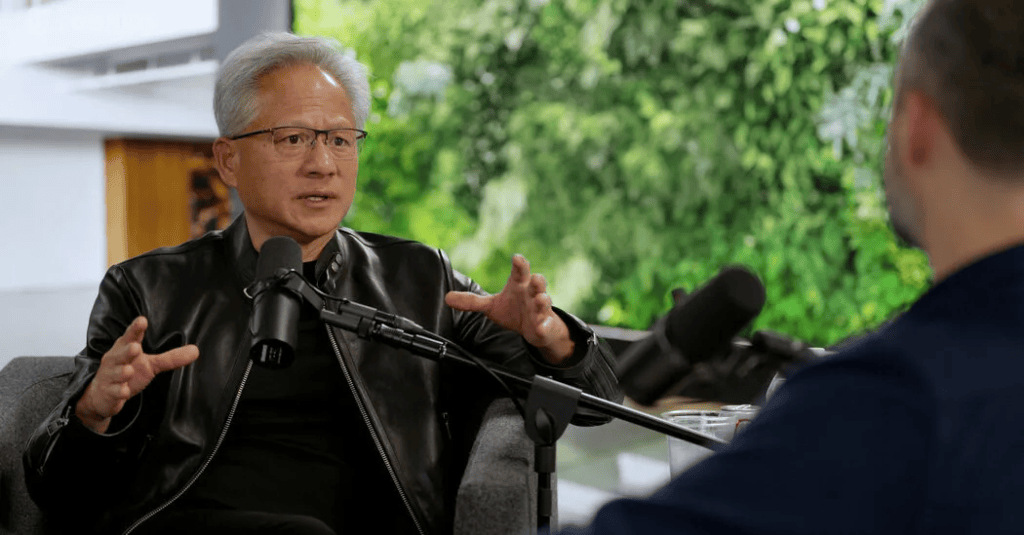
The excerpt below is from an interview on the Acquired podcast with Jensen Huang (Nvidia’s CEO) in October 2023. For most of its history, Nvidia was a small, little-known company whose split-adjusted stock traded for pennies. At the time of this interview, it was just beginning its ascent toward becoming the most valuable company in the world, reaching a $5.8 trillion valuation. Decades of work had paid off, which makes Jensen’s answer to this question fascinating:
Question To Jensen:
“It’s 2023, 30 years anniversary of the founding of Nvidia. If you were magically 30 years old again today in 2023, and you were going to Denny’s with your two best friends who are the two smartest people you know, and you’re talking about starting a company, what are you talking about starting?”
Jensen’s Response:
“I wouldn’t do it. The reason why I wouldn’t do it, and it goes back to why it’s so hard, is building a company and building Nvidia turned out to have been a million times harder than I expected it to be, any of us expected it to be.
At that time, if we realized the pain and suffering, just how vulnerable you’re going to feel, and the challenges that you’re going to endure, the embarrassment and the shame, and the list of all the things that go wrong, I don’t think anybody would start a company. Nobody in their right mind would do it.
That’s really the trick of an entrepreneur. You have to get yourself to believe that it’s not that hard, because it’s way harder than you think. If I go taking all of my knowledge now and I go back, and I said, I’m going to endure that whole journey again, I think it’s too much. It is just too much.”
________________________
Some thoughts from Oliver Burkeman in an interview on the AOM podcast:
The Efficiency Trap:
If you work on making yourself better and better and better at getting through more and more and more things in a given period of time, which is what efficiency essentially is, if that incoming supply of things is essentially infinite, whether it’s a supply of emails or demands or family obligations or ambitions and places you want to travel and all the rest of it, if the supply is effectively infinite, getting through it faster isn’t going to help.
It’s just going to cause you to have more on your plate and to be diluting your attention between more things. It’s also going to stop you making the tough decisions you need to make about which things are really worth your time.
If you’ve ever experienced, like, really deciding to get on top of your email and you really do it and you really succeed, all that happens is that you immediately get much more email because you’re replying to more people more quickly and they’re replying to you and you have to reply to them and it has the exact reverse effect. It doesn’t get you to that place of that kind of plateau of effortless calm where you’re finally on top of everything. It has the reverse effect.
Productivity Debt:
This is the notion that I think many of us have that we wake up in the morning feeling like we’re in a moral debt that we’ve got to pay off, we’ve got to do a certain amount of stuff, get a certain amount of stuff done by the end of the day, be productive to a certain level. Otherwise, we haven’t quite earned our right to exist on the planet. We’re not quite succeeding minimally as human beings. And the best you can hope for in that situation is that by the time it’s the end of the day and you’re finished, you might be back at a zero balance. If you’re lucky, you might have just earned your way back to feeling okay about yourself.
And this is where I stop and say, in a sense, if you’re in a salaried profession or something like that, or in any job really, you are in productivity debt of a kind. You do owe your employer output in return for your pay, but that’s not the same as this existential burden that many of us carry, that we have to earn our right to exist through productivity.
There are ways of encouraging yourself to start the day at a zero balance. Not start the day in debt, but start the day at zero thinking like, “Okay. I’m fine. I’m enough.” Now anything that I do during the day is extra, and that’s because I want to create some cool things in the world, not because I absolutely have to do it just to plug this void. I think that’s a really important switch for any of us who fall into this category that psychologists call insecure overachievers, which is probably a good chunk of people.
Drowning In Information:
When you really see how impossibly big the potential supply of things to read is or potential supply of things to listen to or watch, it’s just so much bigger than any human could manage. Even just the good stuff, the stuff that’s relevant to you, the stuff that is high quality, even that, whatever criteria you apply, it’s still going to be effectively infinite.
If you can shift your perspective to seeing that and being like, “Oh, okay. Getting on top of this is impossible.” That’s really helpful. Because now the challenge is not to try to get on top of it but just to engage with it in the most enjoyable and meaningful way.
The metaphor I use is to try and see your “to-read” backlog, or whatever it is, as a river. Not a bucket that contains a whole lot of stuff and your job is to empty the bucket, but just something that is flowing past you as you’re standing in the middle of it.
And all you need to do, all you ever could do is pick a few items as they pass by that seem like the most worthwhile to pick and not feel guilty about the ones passing by. We don’t feel guilty, most of us, about not getting through all the books in the Library of Congress. It’s only when we sort of draw the boundary a little bit closer to home and say, all the articles in our Reader app, and all the podcasts in our queue, and all the books on the list we’ve been keeping, only then do these lists become tormenting. But in fact, they’re all effectively impossible, and that’s actually very liberating.
Your Future Self
There’s a huge focus in personal development at the moment especially it seems to me on thinking carefully about making choices now for the benefit of your future self. And obviously it has wisdom to it. But I think that the kind of people who are attracted to that kind of advice in the first place are much more likely to be too good at deferring gratification than not good enough.
I think we need to remember that you can go too far. You can make it so that you are constantly doing everything for the benefit of a future self that in some sense will never exist. Because when you get to that future there’ll still be another future self to focus on until one day there isn’t. And so, it’s actually important to be able to claim, to cash in some of your preparation as well, to be able to say on a given day, like, actually I’m gonna do something that is fun today because I have created the life in which I’m able to do that instead of always postponing that into the future.
___________________
The phrase ‘mid-life crisis’ is still relatively new. It was coined by Canadian Elliot Jacques (in his mid 40s) in an article called “Death and the Mid-life Crisis” back in 1965:
“The individual has stopped growing up, and has begun to grow old. A new set of external circumstances has to be met. The first phase of adult life has been lived. Family and occupation have become established; parents have grown old, and children are at the threshold of adulthood.”
Happiness starts out higher when you’re young, dips in middle age and then goes back up in your older years. The thing about the happiness curve is you overestimate your future life satisfaction when you’re young and underestimate your future happiness when you’re in middle age.
Both feelings are probably wrong but impossible to ignore. A mid-life crisis doesn’t necessarily mean there’s anything wrong with you. It’s almost a natural state of affairs to go through this.
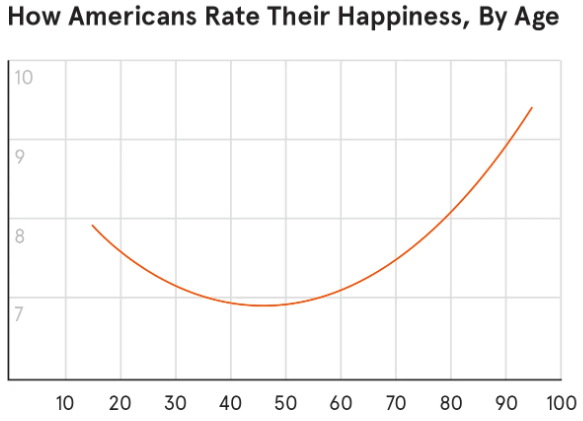
This happiness smile makes sense if you have regrets about life or don’t have the success you wished for in your younger days. But these results hold even for people who have done well at work, have a happy marriage, or make a lot of money.
It’s not necessarily circumstances that cause this situation but expectations. If you’re not as successful as you once desired that’s a huge disappointment. But even successful people can feel unfulfilled. Reaching your goals can often be a letdown because even getting everything you thought you wanted doesn’t always make you feel any better.
You could also make the case that it’s never been harder to avoid the feelings of a mid-life crisis. It’s never been easier to compare yourself to people who are more successful than you. Social media is constantly showing you how rich people are, the fabulous trips they take, the toys they spend money on, the outsized returns they earn on their investments, etc.
Money was a taboo subject when I was growing up. In the 1990s, selling out was the worst thing you could do. Today, selling out is seen as the obvious choice. People love bragging about their successes, whether real or imagined.
If comparison is the thief of joy, robberies are at an all-time high in today’s society.
___________________
___________________________
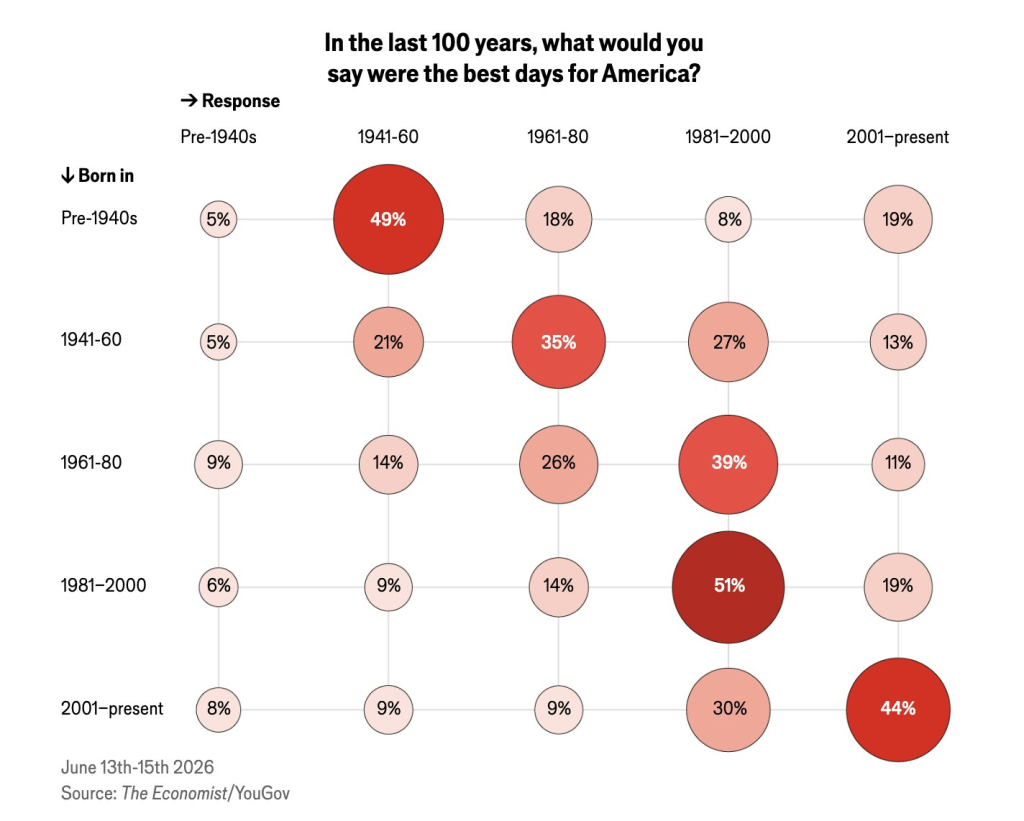
Every generation thinks America was best when they were kids.
______________________
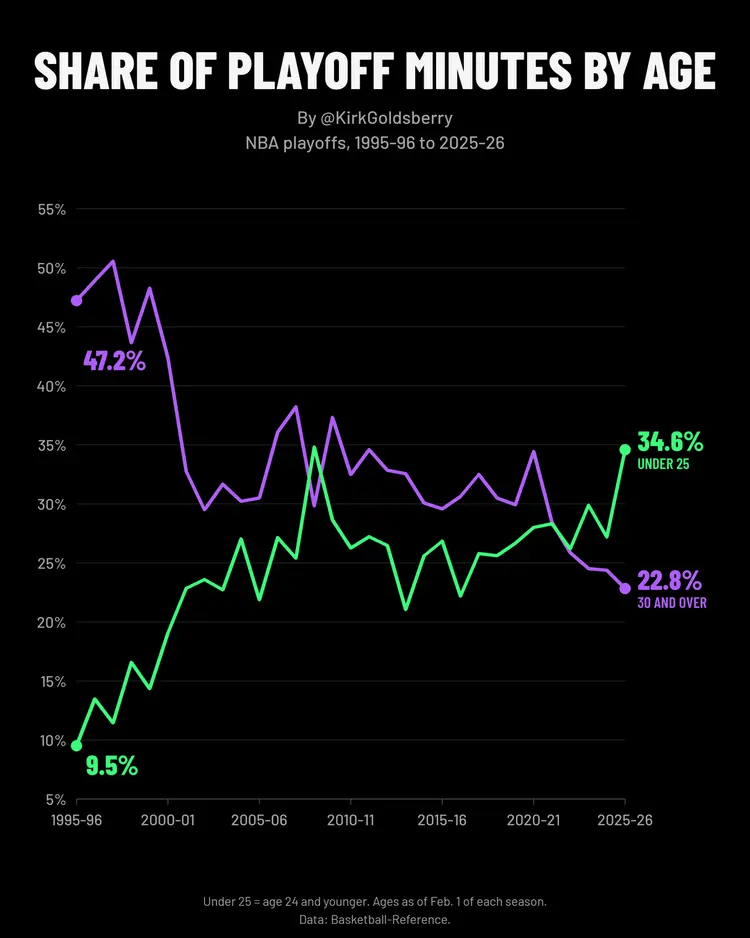
The NBA has become a young man’s game. In the 1998 playoffs, dudes 30 and older accounted for half of all postseason playing time. In 2026, that share was down to just 22.8 percent, the lowest on record.
During the 2025-26 regular season, players 30 and older made up just 17.5 percent of the NBA. That’s the lowest share in at least 30 years. Meanwhile, for the seventh straight season, more than half the league (54.6 percent) was 25 or younger. In 1997-98, that number was just 36 percent.
Last season, for the first time in modern history, players 30 and older accounted for less than 20 percent of NBA minutes (19.8 percent).
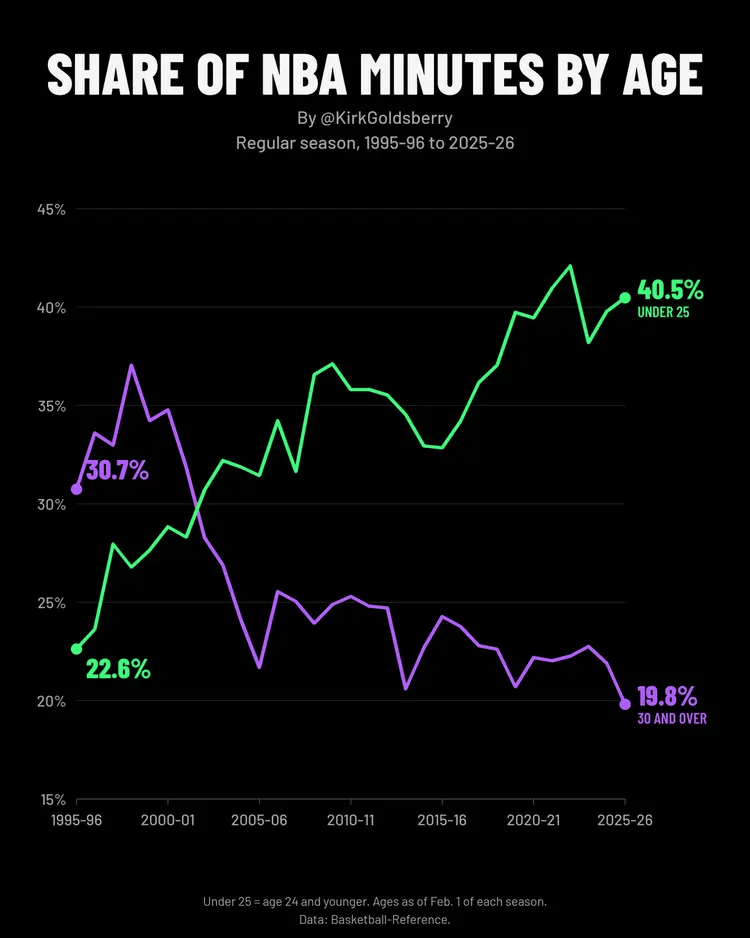
Players under 25 logged 34.6 percent of playoff minutes, and players 30 and older logged just 22.8 percent, the lowest share in at least 30 years.
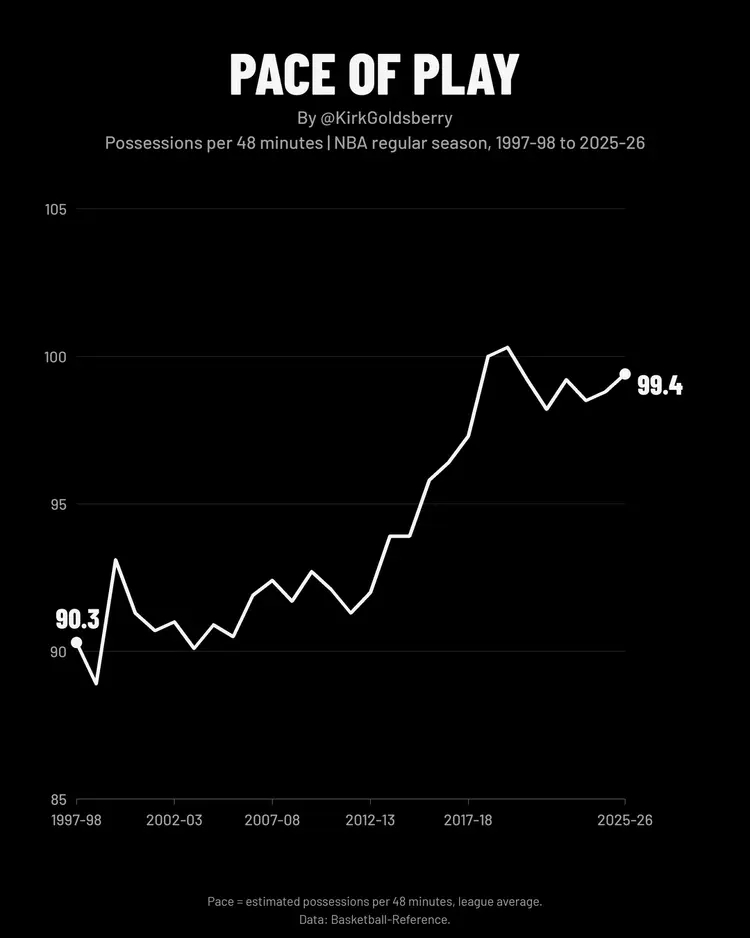
The style of play in the modern game is more conducive to young legs. The on-court trends of the day are pace, space, and crashing the boards. Older dudes don’t want to do that.
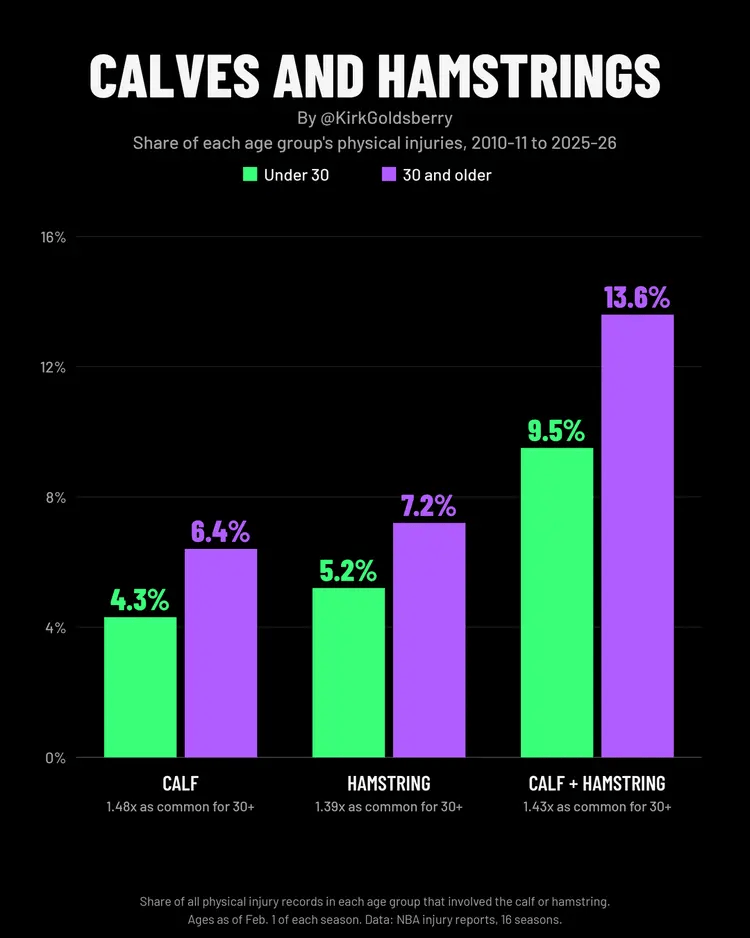
What happens when older men chase around younger fellas for six months? They break. The NBA is experiencing massive upticks in leg injuries, a depressing trend that unfortunately has carried over into this season. And once the battle scars start to appear, a vicious cycle can set in. The no. 1 predictor of a calf strain is a previous calf strain.
_____________________________
Annual births in the U.S. have fallen off since peaking in 2007. Today’s kindergarten enrollment declines reflect the “missing” births of five to six years earlier. Enrollment at K-12 public schools totaled 48.8 million students in the 2025-26 school year, down 3.7% from 2017-18.

______________________________
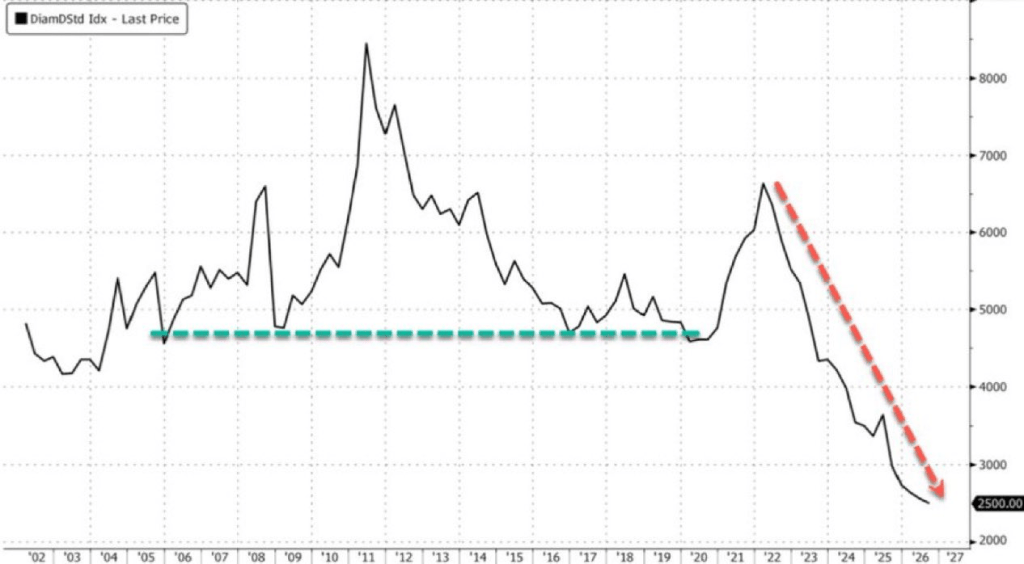
Diamonds have plunged to their lowest prices this century after crashing 70% from their 2011 all-time high.