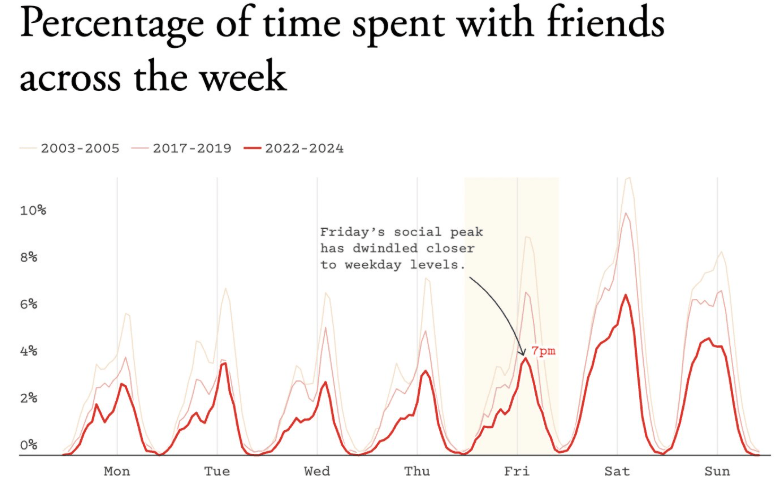
What does “appreciate the present” mean?
A good thought experiment for thinking about this comes from the book Replay by Ken Grimwood. It’s about a 43-year-old guy in 1988 who has a heart attack and suddenly wakes up as an 18-year-old in his college dorm room in 1963. Suddenly, he gets to live 1963–1988 all over again. He relives this period multiple times, trying all sorts of different paths. His first attempt mostly involves trying to make vast amounts of money with his knowledge of the future. Then he tries other stuff.
What would I do if I woke up and I was 25 years younger?
- I’d want to see my grandparents who have passed away.
- There are friends who have since left my life whom I’d love to reconnect with.
- I’d enjoy going to college parties and having fun with my friends all over again, in ways I haven’t been able to experience since. I’d have a hell of a lot more appreciation for a simple college house party.
- I’d love to go on one of those random car rides with my friends when we were 18, doing nothing in particular, just laughing, listening to music, and telling jokes.
In other words, I’d live a lot more in the present.
I can’t actually do any of this, of course. But what I can do is imagine my 69-year-old self waking up in my body today as a 44-year old. I suspect he’d do something very similar.
- Spend more time with the people in my life who are getting older and might not be around when I’m 69.
- Make more time to do fun things that I might not be able to do when I’m 69.
- I sure as hell wouldn’t slave away more at work. I doubt very much that the things I’m doing for work today will matter all that much when I’m 69. I don’t think many 69-year-olds wish they worked more.
- I don’t think it makes sense to grind away at work just so I can afford a better car, a bigger house, or something like that. If anything, if I were doing that now, I suspect my 69-year-old self would advise against it. All that time spent working for material possessions likely comes at the expense of relationships and experiences I’d have to ignore to make that extra money.
- I’d probably be a lot better to the people who love me. Be more present for them.
I wouldn’t try to live in either extreme: extreme deprivation so I can save more money, or extreme achievement so I can make more money. I would try to involve a lot of little things that help me more deeply appreciate a time in my life I’ll never get back.

____________________________
Young Americans are dating less, coupling less, marrying less, and having fewer children? Why?
Surveillance Anxiety
Gen Z is drinking less, going to church less, dating less, working fewer teenage jobs, and hanging out less. Young adults are entering adulthood with a social deficit. As a result, their understanding of the world is shaped less by lived experiences and more by what they see online. And social media not only offers a warped view of human behavior, but it also excels at feeding our anxiety and fears.
One inevitable result of this has been rising discomfort with friction and prioritizing the avoidance of embarrassment. It’s not a coincidence that concepts like “the ick” and “cringe” were introduced into our lexicon by a generation with less appetite for social risk and tolerance for awkwardness. This is tragic.
Over the last few years, DJs have started noticing that dance floors are empty; almost everyone stands around the periphery holding their phones. It’s undeniable the impact that phones are having on young people’s willingness to take risks. Nobody dances anymore for fear that they will look stupid, and that their joyful gyrations will be documented and disseminated online.
This anxiety about being surveilled is constant and unavoidable. It’s sort of like walking around in the Matrix where anyone you meet could potentially document and share an embarrassing moment, social misstep, or inartful comment. It’s made young people hypervigilant, less understanding, and less forgiving.
The Experience Deficit
There is an “experience deficit.” Boys and girls spend less time together, so they know less about one another; then the internet fills the vacuum with caricatures. We’re literally talking to each other less. We’re speaking on average 300 fewer words a day.
Young adults spend less time out in the world with peers and friends and more time at home, where their connection to the outside world occurs through a smartphone. Social media algorithms are extremely efficient at social segregation. One study of TikTok users found that gender was the strongest predictor of what appears in your social media feed. Young men and women can be sitting in the same lunchroom and be immersed in entirely different realities. Algorithms efficiently deliver uncharitable characterizations of the opposite sex, and outrage entrepreneurs specialize in promoting this type of content.
The majority of the posting is done by a very small minority. One-quarter of TikTok users produce 98 percent of all the videos posted on the platform. These people are not representative of their social group, their interests, or their views about sex and relationships. More of what users see on social media is professionally produced content from strangers.
The other issue is that social media algorithms prey on our insecurities and anxieties. If you’re concerned about not being tall enough, you’ll be fed content about extreme methods you can use to gain a few centimeters or videos of attractive women deriding “short kings.” It’s not meant to reflect reality, but without a countervailing experience to draw on, this content becomes formative.
Self-Optimization
There’s a cultural dimension to all of this, as well. It’s not entirely that young people have fewer social opportunities, but that they are encouraged to prioritize their own personal experiences and expression. On social media, self-optimization culture teaches young people that the most coveted rewards in life are secured through individual effort and ambition alone. There is a fear that our relational obligations can work against these goals by restricting our autonomy. It explains why more young people worry about what marriage and parenthood will require of them, rather than the benefits they offer.
Dating Apps
Men and women have somewhat different experiences on dating apps on average, but the immiseration has the same basic mechanism. By providing so many more potential romantic options, dating apps reduce our willingness to invest in any one person or date. Why would I go to all this trouble when I can swap it out for another person on another day? More singles rely on superficial evaluations or develop lists of excessive qualifications. It can make the process feel unforgiving—one misstep, and you’re done.
It’s a volume problem. It’s like trying to find something to watch on Netflix; instead of making a quick selection, you spend your time endlessly scrolling through all the available options and not watching anything at all. The paradox of choice is applicable to dating. Studies have shown that the perception that we have abundant romantic alternatives reduces how satisfied we feel about the choices we eventually make.
“Marriageable” Men
No group appears to be struggling more on the dating market than young men without college degrees. Even after decades of rising female economic power, women in the dating market still value men’s economic potential more than height, politics, religion, or education, and low-income men without college degrees are often less affluent than the women in their neighborhoods and social circles.
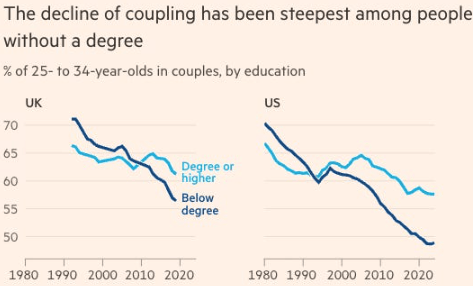
Women still want to feel that their male partner can provide a sense of security or protection. One of the paradoxes of modern life is that, even as women have attained greater economic power, status, and influence, it has not lessened concerns about personal safety. In some ways, young women today feel even more vulnerable. For women interested in starting families, this is even more important because early parenthood has negative economic repercussions for women and places them in a uniquely precarious position. What’s notable is how stable this view is across lines of age, racial and ethnic identity, and class—surveys show that women consistently prioritize financial security in prospective partners.
The decline of marriage cannot be reduced to any one thing, but it cannot be fully explained without considering the decline of “marriageable men.”
Social Circles
One of the most striking features of the gender divide in romantic outcomes is the way strong social networks matter for men, but not for women. Men with larger social circles tend to have much more romantic success than those with fewer friends. But that’s only true for men! The number of close friends a woman has seems to have little bearing on her ability to go on dates or attract a partner.
One possible explanation is that a broader social circle provides more opportunities for men to meet prospective romantic partners. Surveys have shown that women have a strong preference for meeting partners through their existing social networks. Or perhaps very sociable men have other qualities, such as self-confidence, a sense of humor, or emotional maturity, that are appealing to women. Whatever the reason, social and romantic outcomes are closely intertwined. The fact that so many noncollege men struggle to develop and maintain strong ties of any kind puts them at a considerable disadvantage on the dating market.
Attention Infidelity
Smartphones and smartwatches equipped with social media are not simply distractions; they reduce our capacity to connect with another person by fracturing our attention. Even if we are physically present, the omnipresent draw to be somewhere else ensures that we are never entirely engaged. A single message, reminder, or notification can yank us away at any moment. This represents such a profound loss, and it has largely gone unnoticed.

____________________________
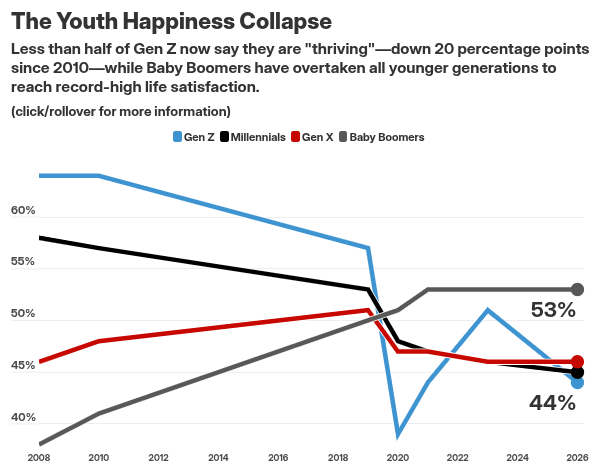
Gen Z has seen their life satisfaction plummet compared to their Millennial predecessors a generation ago, with less than half now describing their lives as “thriving,” down from nearly half of young people in 2008.
More than a quarter (27%) of adults aged 18 to 29 also reported that they are being treated for depression, up by 11 points since 2019, according to the new Life Evaluation Index poll from Gallup. Many young adults described themselves as drifting away from friends and partners and experiencing less joy.
____________________________
26 New Rules of Digital Etiquite:
- Don’t play videos, music, podcasts, or games out loud in public.
- Don’t take phone calls/Zooms/FaceTimes in shared spaces.
- Don’t phub (scrolling your phone while someone is talking to you).
- Don’t let filming your workout get in the way of other people using the gym.
- Keep video at events to a minimum.
- Don’t expect immediate responses to texts.
- Don’t wait too long to respond to texts, either.
- Don’t text “Hey” and then wait for a reply before stating what you want.
- Don’t bombard friends with so many reels and memes that keeping up with you becomes homework.
- Don’t add people to group chats without asking.
- Don’t add all your contacts to your newsletter without asking.
- Don’t try to have a text exchange over what should be a phone call or an in-person conversation.
- No smartphones out in locker rooms or bathrooms or anywhere else people get undressed.
- If someone gets hurt, for the love of God, help before you film.
- Unless someone’s a danger to the people around him, or you need a record of what happened (a hit-and-run, say), don’t film people at their worst.
- Don’t participate in internet pile-ons.
- Don’t share screenshots of private texts, emails, DMs, or Slack messages with a wider audience without a compelling reason.
- Don’t use strangers as involuntary characters in prank videos or “social experiments.”
- Don’t swipe through someone’s camera roll.
- Don’t complain about your spouse online.
- Don’t turn every personal dispute into a referendum in the court of public opinion.
- Don’t post about someone else’s pregnancy, engagement, breakup, diagnosis, job loss, or death before he or she does.
- Don’t post embarrassing photos or stories about your children that will follow them into adulthood.
- Don’t post pics of other people’s kids, either.
- Don’t create realistic AI images or video (or audio) of real people without their permission.
- Don’t outsource every human gesture to AI.
___________________________