Being Present, Surveillance Anxiety & Experience Deficit

What does “appreciate the present” mean?

A good thought experiment for thinking about this comes from the book Replay by Ken Grimwood. It’s about a 43-year-old guy in 1988 who has a heart attack and suddenly wakes up as an 18-year-old in his college dorm room in 1963. Suddenly, he gets to live 1963–1988 all over again. He relives this period multiple times, trying all sorts of different paths. His first attempt mostly involves trying to make vast amounts of money with his knowledge of the future. Then he tries other stuff.

What would I do if I woke up and I was 25 years younger?

  • I’d want to see my grandparents who have passed away.
  • There are friends who have since left my life whom I’d love to reconnect with.
  • I’d enjoy going to college parties and having fun with my friends all over again, in ways I haven’t been able to experience since. I’d have a hell of a lot more appreciation for a simple college house party.
  • I’d love to go on one of those random car rides with my friends when we were 18, doing nothing in particular, just laughing, listening to music, and telling jokes.

In other words, I’d live a lot more in the present.

I can’t actually do any of this, of course. But what I can do is imagine my 69-year-old self waking up in my body today as a 44-year old. I suspect he’d do something very similar.

  • Spend more time with the people in my life who are getting older and might not be around when I’m 69.
  • Make more time to do fun things that I might not be able to do when I’m 69.
  • I sure as hell wouldn’t slave away more at work. I doubt very much that the things I’m doing for work today will matter all that much when I’m 69. I don’t think many 69-year-olds wish they worked more.
  • I don’t think it makes sense to grind away at work just so I can afford a better car, a bigger house, or something like that. If anything, if I were doing that now, I suspect my 69-year-old self would advise against it. All that time spent working for material possessions likely comes at the expense of relationships and experiences I’d have to ignore to make that extra money.
  • I’d probably be a lot better to the people who love me. Be more present for them.

I wouldn’t try to live in either extreme: extreme deprivation so I can save more money, or extreme achievement so I can make more money. I would try to involve a lot of little things that help me more deeply appreciate a time in my life I’ll never get back.

____________________________

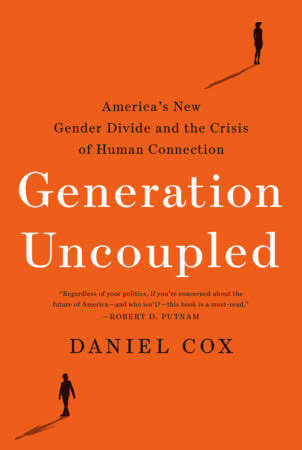
Young Americans are dating less, coupling less, marrying less, and having fewer children? Why?

Surveillance Anxiety

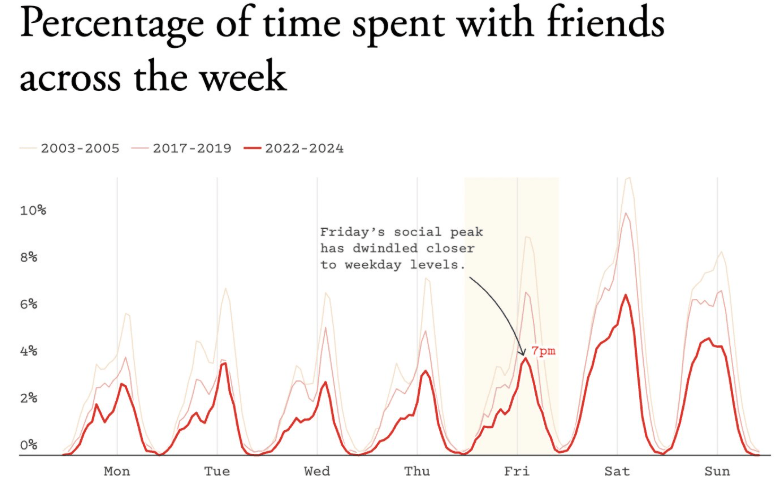
Gen Z is drinking less, going to church less, dating less, working fewer teenage jobs, and hanging out less. Young adults are entering adulthood with a social deficit. As a result, their understanding of the world is shaped less by lived experiences and more by what they see online. And social media not only offers a warped view of human behavior, but it also excels at feeding our anxiety and fears.

One inevitable result of this has been rising discomfort with friction and prioritizing the avoidance of embarrassment. It’s not a coincidence that concepts like “the ick” and “cringe” were introduced into our lexicon by a generation with less appetite for social risk and tolerance for awkwardness. This is tragic.

Over the last few years, DJs have started noticing that dance floors are empty; almost everyone stands around the periphery holding their phones. It’s undeniable the impact that phones are having on young people’s willingness to take risks. Nobody dances anymore for fear that they will look stupid, and that their joyful gyrations will be documented and disseminated online.

This anxiety about being surveilled is constant and unavoidable. It’s sort of like walking around in the Matrix where anyone you meet could potentially document and share an embarrassing moment, social misstep, or inartful comment. It’s made young people hypervigilant, less understanding, and less forgiving.

The Experience Deficit

There is an “experience deficit.” Boys and girls spend less time together, so they know less about one another; then the internet fills the vacuum with caricatures. We’re literally talking to each other less. We’re speaking on average 300 fewer words a day.

Young adults spend less time out in the world with peers and friends and more time at home, where their connection to the outside world occurs through a smartphone. Social media algorithms are extremely efficient at social segregation. One study of TikTok users found that gender was the strongest predictor of what appears in your social media feed. Young men and women can be sitting in the same lunchroom and be immersed in entirely different realities. Algorithms efficiently deliver uncharitable characterizations of the opposite sex, and outrage entrepreneurs specialize in promoting this type of content.

The majority of the posting is done by a very small minority. One-quarter of TikTok users produce 98 percent of all the videos posted on the platform. These people are not representative of their social group, their interests, or their views about sex and relationships. More of what users see on social media is professionally produced content from strangers.

The other issue is that social media algorithms prey on our insecurities and anxieties. If you’re concerned about not being tall enough, you’ll be fed content about extreme methods you can use to gain a few centimeters or videos of attractive women deriding “short kings.” It’s not meant to reflect reality, but without a countervailing experience to draw on, this content becomes formative.

Self-Optimization

There’s a cultural dimension to all of this, as well. It’s not entirely that young people have fewer social opportunities, but that they are encouraged to prioritize their own personal experiences and expression. On social media, self-optimization culture teaches young people that the most coveted rewards in life are secured through individual effort and ambition alone. There is a fear that our relational obligations can work against these goals by restricting our autonomy. It explains why more young people worry about what marriage and parenthood will require of them, rather than the benefits they offer.

Dating Apps

Men and women have somewhat different experiences on dating apps on average, but the immiseration has the same basic mechanism. By providing so many more potential romantic options, dating apps reduce our willingness to invest in any one person or date. Why would I go to all this trouble when I can swap it out for another person on another day? More singles rely on superficial evaluations or develop lists of excessive qualifications. It can make the process feel unforgiving—one misstep, and you’re done.

It’s a volume problem. It’s like trying to find something to watch on Netflix; instead of making a quick selection, you spend your time endlessly scrolling through all the available options and not watching anything at all. The paradox of choice is applicable to dating. Studies have shown that the perception that we have abundant romantic alternatives reduces how satisfied we feel about the choices we eventually make.

“Marriageable” Men

No group appears to be struggling more on the dating market than young men without college degrees. Even after decades of rising female economic power, women in the dating market still value men’s economic potential more than height, politics, religion, or education, and low-income men without college degrees are often less affluent than the women in their neighborhoods and social circles.
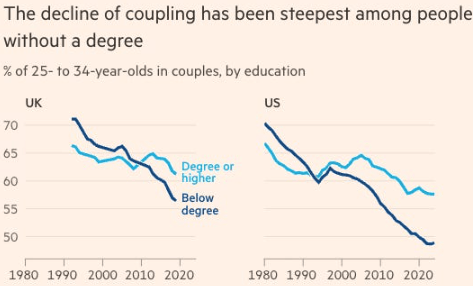
Women still want to feel that their male partner can provide a sense of security or protection. One of the paradoxes of modern life is that, even as women have attained greater economic power, status, and influence, it has not lessened concerns about personal safety. In some ways, young women today feel even more vulnerable. For women interested in starting families, this is even more important because early parenthood has negative economic repercussions for women and places them in a uniquely precarious position. What’s notable is how stable this view is across lines of age, racial and ethnic identity, and class—surveys show that women consistently prioritize financial security in prospective partners.

The decline of marriage cannot be reduced to any one thing, but it cannot be fully explained without considering the decline of “marriageable men.”

Social Circles

One of the most striking features of the gender divide in romantic outcomes is the way strong social networks matter for men, but not for women. Men with larger social circles tend to have much more romantic success than those with fewer friends. But that’s only true for men! The number of close friends a woman has seems to have little bearing on her ability to go on dates or attract a partner.

One possible explanation is that a broader social circle provides more opportunities for men to meet prospective romantic partners. Surveys have shown that women have a strong preference for meeting partners through their existing social networks. Or perhaps very sociable men have other qualities, such as self-confidence, a sense of humor, or emotional maturity, that are appealing to women. Whatever the reason, social and romantic outcomes are closely intertwined. The fact that so many noncollege men struggle to develop and maintain strong ties of any kind puts them at a considerable disadvantage on the dating market.

Attention Infidelity

Smartphones and smartwatches equipped with social media are not simply distractions; they reduce our capacity to connect with another person by fracturing our attention. Even if we are physically present, the omnipresent draw to be somewhere else ensures that we are never entirely engaged. A single message, reminder, or notification can yank us away at any moment. This represents such a profound loss, and it has largely gone unnoticed.
____________________________

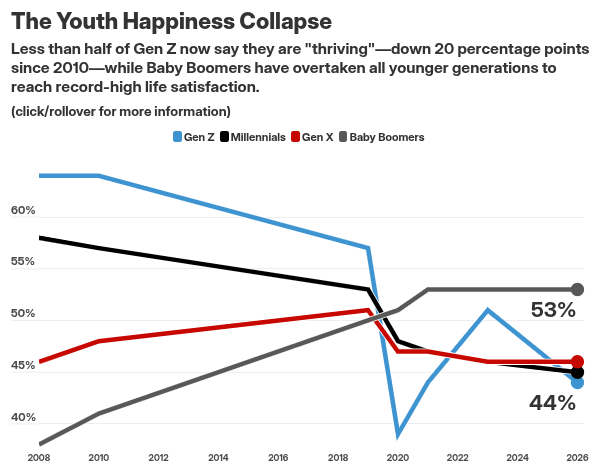
Gen Z has seen their life satisfaction plummet compared to their Millennial predecessors a generation ago, with less than half now describing their lives as “thriving,” down from nearly half of young people in 2008.

More than a quarter (27%) of adults aged 18 to 29 also reported that they are being treated for depression, up by 11 points since 2019, according to the new Life Evaluation Index poll from Gallup. Many young adults described themselves as drifting away from friends and partners and experiencing less joy.
____________________________

26 New Rules of Digital Etiquite:

  1. Don’t play videos, music, podcasts, or games out loud in public.
  2. Don’t take phone calls/Zooms/FaceTimes in shared spaces.
  3. Don’t phub (scrolling your phone while someone is talking to you).
  4. Don’t let filming your workout get in the way of other people using the gym.
  5. Keep video at events to a minimum.
  6. Don’t expect immediate responses to texts.
  7. Don’t wait too long to respond to texts, either.
  8. Don’t text “Hey” and then wait for a reply before stating what you want.
  9. Don’t bombard friends with so many reels and memes that keeping up with you becomes homework.
  10. Don’t add people to group chats without asking.
  11. Don’t add all your contacts to your newsletter without asking.
  12. Don’t try to have a text exchange over what should be a phone call or an in-person conversation.
  13. No smartphones out in locker rooms or bathrooms or anywhere else people get undressed.
  14. If someone gets hurt, for the love of God, help before you film.
  15. Unless someone’s a danger to the people around him, or you need a record of what happened (a hit-and-run, say), don’t film people at their worst.
  16. Don’t participate in internet pile-ons.
  17. Don’t share screenshots of private texts, emails, DMs, or Slack messages with a wider audience without a compelling reason.
  18. Don’t use strangers as involuntary characters in prank videos or “social experiments.”
  19. Don’t swipe through someone’s camera roll.
  20. Don’t complain about your spouse online.
  21. Don’t turn every personal dispute into a referendum in the court of public opinion.
  22. Don’t post about someone else’s pregnancy, engagement, breakup, diagnosis, job loss, or death before he or she does.
  23. Don’t post embarrassing photos or stories about your children that will follow them into adulthood.
  24. Don’t post pics of other people’s kids, either.
  25. Don’t create realistic AI images or video (or audio) of real people without their permission.
  26. Don’t outsource every human gesture to AI.

___________________________
Happiness, Single Women & Perspective Before Dying

Raising Vikings: Danish Secrets To Raising Happy Children. After 12 years of living in Denmark, ranked as the second happiest country on earth, a mother wrote about what she learned living there:

  • Denmark’s social rule of janteloven – the idea that “you’re no better than anyone else” – keeps everyone grounded. Its education system is rooted in equality, with children calling teachers by their first names and collaboration prioritised over competition. There’s a flat hierarchical structure and high taxes help redistribute wealth – not a terrible plan since more equal societies are happier and healthier.
  • Danes trust their neighbours, institutions and even strangers, with 74% believing “most people can be trusted”. So, babies are left to nap outside in their prams, children roam freely and people sell secondhand clothes from “trust stands” outside their homes.
  • The Danes are masters of the work-life balance, with a 37-hour work week as standard and OECD figures showing that the average Dane puts in only 33 hours a week.  The result? Lower stress and higher productivity. 
  • Friluftsliv, or “open-air life”, is deeply ingrained in ­Nordic culture and spending time in nature has been shown to reduce stress. 
  • One of the greatest gifts from our Danish years is the habit of eating together. This is non-­negotiable – TV off, phones away and everyone at the table for a home-cooked meal, proven to improve mental and physical health as well as our relationships. Thanks to a short working week, a daily family dinner is entirely possible in Denmark and tends to be eaten early, something our metabolism and gut health apparently thank us for.
  • Nearly half of Danes volunteer, contributing to their communities through clubs, events and schools.  If Denmark taught me anything, it’s that small acts of service build stronger communities.
  • The Danish art of cosines meant slowing down, switching off and sharing quality time in relaxed surroundings (accepting that the best evenings don’t involve wifi). Danes priorities daily moments of joy.
  • Vikings are allowed to take risks, learn from mistakes and develop independence early on. From two-year-olds dressing themselves to eight-year-olds cycling to school alone, there’s a collective confidence in giving children freedom in Denmark, which helps them flourish. A phrase beloved by my children’s teachers was that adults should “sit on their hands” – ie do nothing and let ­children work things out for themselves.
  • Danish minimalism goes beyond design; it’s a way of life. From clothes to home decor, the approach taught me the beauty of having fewer things, of higher ­quality.

_____________________________

But a good question to ask is, What Exactly Do Country Happiness Rankings Measure? For the eighth year in a row, Finland tops the “happiness” league tables — but that doesn’t mean its citizens are feeling the joy.

The country ranking itself stems from the the “life evaluation” metric: “Please imagine a ladder with steps numbered from 0 at the bottom to 10 at the top. The top of the ladder represents the best possible life for you and the bottom of the ladder represents the worst possible life for you. On which step of the ladder would you say you personally feel you stand at this time?”

Considering this, the most prominent factor that determines whether citizens are “happy” might have more to do with how satisfied they are with their immediate surroundings, rather than how they’re feeling.

While the World Happiness Report takes into account life satisfaction, it lacks one crucial joy-determining factor: emotions. The 2024 Gallup Global Emotions Report focused on respondents’ positive and negative emotion; including how often people laugh, smile, or learn something new, as well as how often they feel pain, stress, or anger (the “Positive Emotions Ranking” column below):

Finland ranked in 25th place overall for feeling positive emotions specifically, and until recently, had one of the highest suicide rates in the world. What the happiness ranking could speak to, then, is the Finnish custom of “sisu,” or inner strength, which means people rarely complain about their problems… or, for that matter, place themselves low on the life ladder.

Another factor contributing to life satisfaction that the report highlighted was meal sharing. The growing number of people eating alone in the United States — in 2023, about 1 in 4 Americans reported eating all their meals alone the day before, up 53% from two decades prior — was said to have contributed to a decline in national well-being, as the US ranked 24th overall in the report, the lowest position it’s ever held.

_____________________________

American women have never been this resigned to staying single and they’re giving up on marriage. They are responding to major demographic shifts, including huge and growing gender gaps in economic and educational attainment, political affiliation and beliefs about what a family should look like. More women than men are attending college, buying houses and focusing on their friendships and careers over dating and marriage. 

Women throughout history rarely questioned whether finding and securing a romantic partner should be a primary goal of adulthood. This seems to be changing. Over half of single women say they believe they are happier than their married counterparts. A rise in earning power and a decline in the social stigma for being single has allowed more women to be choosy. They would rather be alone than with a man who holds them back. The focus has shifted toward self-improvement, friendship and the ability to find happiness on their own. 

48% of women say that being married is not too or not at all important for a fulfilling life, up from 31% in 2019. Marriage rates for both men and women are in decline, in part owing to less pressure to pair off and higher expectations for a would-be match. Dating apps make people feel like there might always be a better option. They view looking for a marriage partner the same way that you view looking for a job candidate.

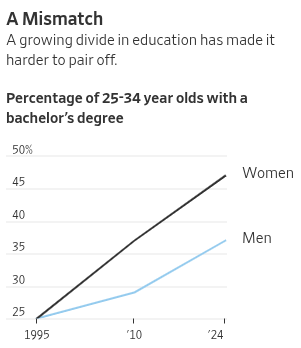
The challenges of finding a romantic partner have been made more complicated by a growing divide in education and career prospects between men and women. 47% of American women ages 25-34 have a bachelor’s degree, compared with 37% of men. A bachelor’s degree increases net lifetime earnings by an estimated $1 million. Women are doing comparatively well when it comes to education and their early years in the labor force, and men are doing comparatively badly. That creates a mismatch, because people prefer to date in terms of comparable education or income.

Men’s economic struggles seem to be having the biggest effect on women without a college degree, whose marriage rates by age 45 have plummeted from 79% to 52% for those born between 1930 and 1980. Young men without a degree are struggling so much as a group that there simply aren’t enough with steady jobs and earnings for non-college women to date.

_____________________________

Nine months ago, Jonathan Clements shared with readers that he’d been diagnosed with an incurable form of cancer. It was devastating news, especially for longtime readers, many of whom regard Jonathan not only as a journalist but also a friend. I count myself among them, so I was grateful that Jonathan agreed to sit for an interview to share more about his background, his early years and his current thinking. 

What were some of your most popular articles at the Journal? “Anything with a list, anything that mentioned my kids, and anything on the topic of money and happiness. “

What’s changed since those days? “Go back to the late 1980s and through the 1990s, all the focus was on investing, how to build a portfolio, what’s the expected return, yada yada yada. Since then, people have realized that there’s a limit to how much we can optimize a portfolio. Instead, there’s a lot of focus on other issues, like helping people buy the right-size home, making sure they have all their estate-planning documents, making sure they have the right insurance policies, making sure they claim Social Security at the right age, and so on. There has been more focus on the  psychological aspects of managing money. And finally, there’s now a focus on helping people figure out what money means to them.”

Do you remember your final article at the Journal? “When I left in 2008, I wrote a piece about three ways that money can help happiness.  One, money can give you a sense of financial security. Two, it can allow you to spend your days doing what you love. And three, it can allow you to have special times with friends and family. I believe that those are the three ingredients for not only a happy financial life, but also a happy life—period. It’s certainly the three things that I’m focused on.”

Has your thinking changed about anything since your diagnosis? “In the last couple of years, I’ve become better about giving money to my kids and funding my grandchildren’s 529 plans. In retrospect, I think I should have started earlier and could have been more generous, because it’s clear to me that I’d never have been able to spend all this money I’ve accumulated, even if I did live to a ripe old age. If you’re pretty sure that your kids have good financial habits, and you’re not going to undermine their ambitions or send them on some wayward path, by all means give them money now. Why have them live with unnecessary financial anxiety? Why not make them feel a little more financially secure? I really believe that’s one of the greatest gifts that we can give to family members, this sense of financial security.”

In your writing, you’ve shared that you aren’t feeling negative emotions about your diagnosis. In fact, you wrote that your first reaction was, “I’m okay with this.” Can you say more about that? “I feel like I’ve been very fortunate. It’s not that bad things haven’t happened in my life. They have. But I’ve been able to spend my life doing what I love. I have a close-knit family, and I’ve largely been free of financial worry.  All in all, I feel like I’ve managed to get a whole lot out of my life.”

________________________________

Michael Easter (author of The Comfort Crisis and Scarcity Brain) interviewed Brett McKay who has an extremely popular podcast called the “Art Of Manliness” that I’ve been listening to for many years. Brett is one of the best at interviewing authors about their new books, helping me decide if I want to read them. It was strange to hear someone asking Brett the questions. Some random thoughts from their conversation.

What’s the dumbest health trend you’ve noticed recently? Blue-light-blocking glasses. They’re useless—the research doesn’t support significant circadian disruption from blue light.

You’ve experimented extensively with health trends. What’s something you’ve changed your mind about? Low-carb diets. I got into low-carb in early days. And then I learned, wait, there’s nothing magic about low carb. You just eat fewer calories typically when you’re on low carb. But you can do that with any diet.

You’ve talked to a ton of parenting experts on podcasts. What’s your best parenting advice? Parent like a video game. In video games, if you mess up you just start from the beginning—it’s not a big deal. So if your kid makes a mistake, treat it like restarting a game—tell them not to do that again and move on. No big deal. Also, something I appreciate more and more is that kids are their own people. You can guide them, create a supportive environment, but you can’t control their personalities or outcomes. You see families where all the kids are parented the same way, but they all end up different. Why’s that? Because people are different. So do your best, love them, and let them be themselves.

______________________________

Married men are more than three times as likely to be obese as unmarried men. Though women experience weight gain in wedlock, it is on par with unmarried women.

______________________________

The U.S. is making progress against one of its most devastating public-health threats: drug overdoses.The decline is at least in part due to a drop in opioid use. A 2022 report found that opioid-use disorder increased from 2010 to 2014, then stabilized and slightly declined each year thereafter. Another reason is because the most vulnerable people have died and others have adapted. Many fentanyl users are now smoking the drug instead of injecting it, and some research shows that smoking fentanyl could come with lower risk of overdose, infections and other complications. 

_________________________________

Market timing is hard because, even if you get out at an opportune time, you have to nail the landing and get back in. Few people can do both. In fact, getting the first leg of the parlay right often makes it even harder to get back in because you become so attached to the loving arms of cash. The psychology of market timing becomes even more challenging when you add politics to the mix.

______________________________

A popular investment strategy being sold to investors today is the idea of getting limited upside annually on your stocks in exchange for limiting the downside. AQR discussed these in their recent article: Rebuffed: A Closer Look At Options-Based Strategies.

At the heart of the strategies examined are put options.  The way puts work is straightforward: the investor pays some amount (the option premium) to protect themselves from a specific decline in a specific asset’s price over a specific period. There’s one wrinkle though: when it comes to buying puts, the price of admission is generally higher than the benefit.

let’s say an investor is less concerned with long-term returns, and more concerned with shorter-term drawdowns. Surely options-based strategies should at least help there, since a put option is literally tailor-made for this task. 

Nope.

Puts are designed for very specific outcomes – they protect against a specific price level for a specific length of time. If the duration of the draw-down doesn’t align with the maturity of the option, the hoped-for protection won’t be there.  This is why a strategy that buys 5% out-of-the-money puts every month can have a drawdown that’s worse than 5% – markets might fall by 4% in one month, and by another 4% the next so the options you paid for never pay you.  And this is a reason 81% of the funds in Exhibit 3 weren’t able to deliver on the seemingly easy goal of downside protection (again, compared to an applicable mix of equities plus T-bills).

Marriage, Scammers & Losing It On Live TV

Losing It on Live TV. Lorne Michaels reportedly dislikes when “Saturday Night Live” cast members break character. But over 50 seasons, it’s become one of the show’s signature moves — one that usually delights the audience.

__________________________________

A common narrative is that less people are getting married, and the number of births is declining because more college educated women are choosing their jobs over starting a family. In reality, the graph below shows it’s the opposite. The married rates for college educated women have held steady, while the number of non-college educated married women has plummeted.

The reason: Men without degrees have seen their economic prospects decline over the past few decades. These financial troubles have led to lower marriage rates for men — and for women without four-year degrees (even as these women have seen their incomes rise). In other words: a “good” man has become harder to find, at least for women with less than a four-year degree. So, they’re getting married less.

_________________________________

Scammers are seen as faceless, evil people who make Aussie lives a living hell. We decided to track down a scammer, and this is how and why he does it. He worked alongside hundreds of others aiming to steal money in a ‘pig butchering’ romance scam in a sophisticated operation designed to part unsuspecting victims from their cash. This type of scam devastates thousands of Aussies a year.

Seen below, scammers will queue up “the model” to speak to the victims on video calls.

_________________________________

The Endowment Effect is sneaky. It whispers, “Hold on. This is yours. It’s special.” But the truth is, nothing is special just because you own it. A bad stock doesn’t become good because it’s in your portfolio. A house isn’t worth more because you have memories in it. How do we fight the Endowment Effect?

  1. Ask: If I didn’t own this, would I buy it today? If the answer is no, it might be time to let go.
  2. Detach from the purchase price. The stock doesn’t know what price you bought it at.
  3. Think like an outsider. What advice would you give a friend in your position?
  4. Set clear exit rules. Have a plan for when to exit an investment before you even enter.
  5. Seek a devil’s advocate. Have someone play devil’s advocate to convince you out of your decision to hold.

________________________________________

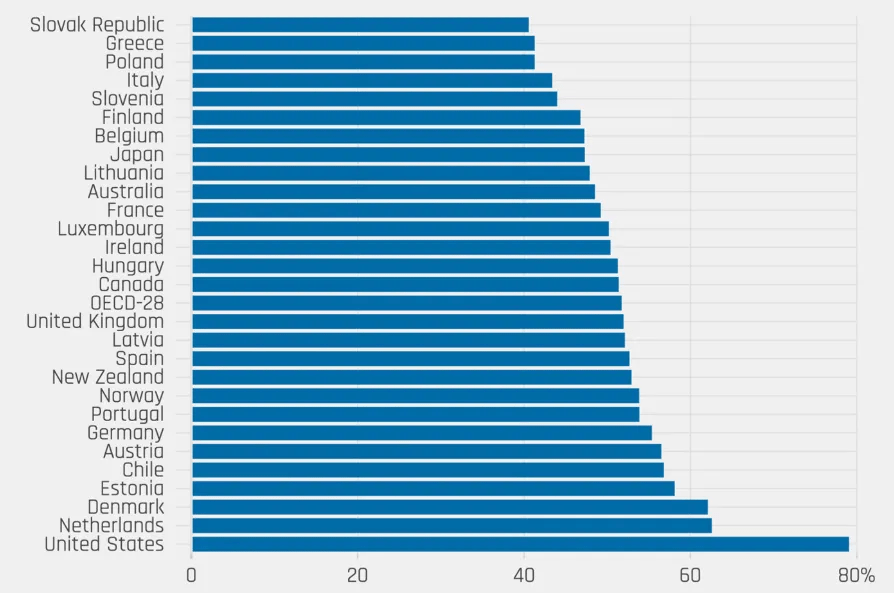
The graph below shows wealth concentration/inequality among top the 10% in the OECD member countries. The United States is unlike anywhere else in the world:

__________________________

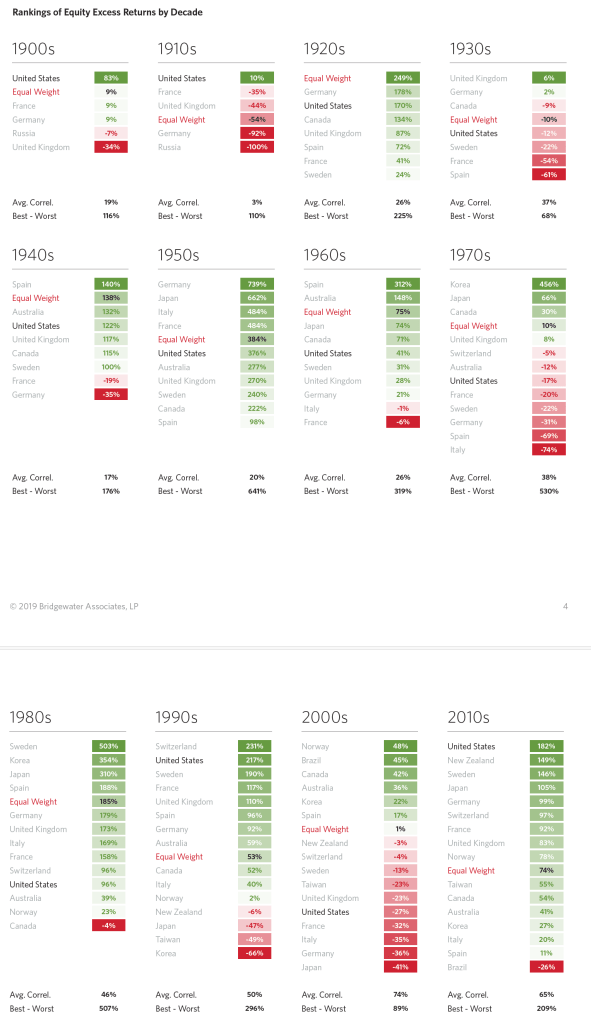
How many decades since 1900 has the United States stock market outperformed the rest of the world? Only 3:

  • 1900’s
  • 1910’s
  • 2010’s

___________________________

America dominates the rest of the world in venture capital (VC) investments:

_____________________________

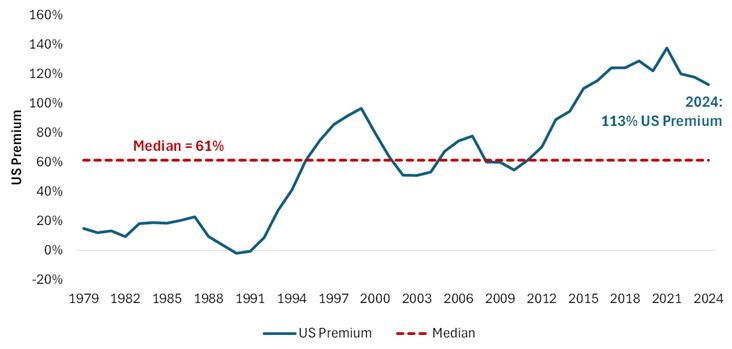
Perhaps the single greatest divergence in equity markets has been the continued outperformance of US versus international equities—and thus the widening of the valuation gap between the US and the rest of the world. To try and determine why, we regressed value against the other common risk factors for the top 1,000 stocks globally. By far the most significant difference, explaining about half the valuation gap, is the domicile of listing. US-listed stocks are substantially more expensive than internationally listed stocks for no reason other than the place of listing.

Were a larger percentage of the valuation gap explained by fundamentals; we’d expect such a gap to persist. But given that the valuation gap is primarily explained simply by the location of listing, we think there’s a strong reason to expect a convergence—and therefore to favor international over US-listed stocks, despite their terrible relative performance over the past decade.

Figure 1: Premium of US vs. International Equity Valuations (5-Year Average, P/B)