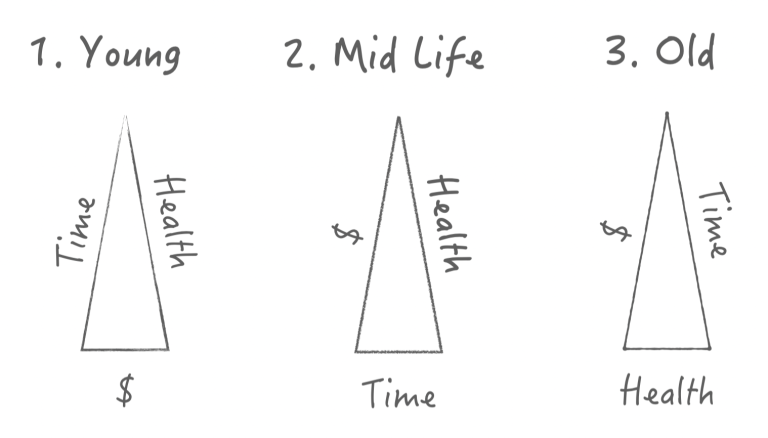
Life can be divided into three stages:
- Stage 1: Youth – You have time and health, but not much money (unless you have a trust fund).
- Stage 2: Mid-Life – You have money and health, but little time, career/family consume most of it.
- Stage 3: Old Age – You have time and money (hopefully), but your health begins to deteriorate.
But there’s a magical stage between Stage 2 and Stage 3 where you have all three: time, health, and money. Some people extend Stage 2 for too long, chasing promotions, accumulating wealth, and missing this precious window to live fully and intentionally.
_________________________
- “You need 8 hours of sleep every night” (7 hours is ideal)
- “We sleep to rest our bodies” (Sleep restores your brain much more than your body)
- “Waking up in the middle of the night is bad”
- “Light and sound will ruin your sleep”
- “Sleeping pills will help you”
- “You need to time your sleep cycles to leverage REM”
There are two ways sleep helps the brain:
(1) Sleep helps us learn and remember important things. When we’re awake, our memories seem to go into a sort of short-term bank. Then, when we’re in certain stages of sleep, our brain culls through these memories. It puts the most important memories in long-term storage and deletes the useless ones.
(2) Sleep “cleans” our brain. The brain is like an engine that does a lot of work during the day. Engines emit smog—in the case of the brain, this smog is called “metabolites.” But because our brain is tightly sealed off, it can’t seem to get rid of these metabolites as it’s up and running while we’re awake.
Picture this as a car running idle in a garage. But pretend the car’s engine can’t run with the garage door open. So across the day, the engine runs in the closed garage, and smog builds and builds in the brain. Run the engine too long with the garage door closed, and you get a dangerous smog buildup. As we sleep, it’s like the engine turns down and the garage door opens. During certain sleep phases, some areas of our brain expand by 60 percent, which allows the previous day’s metabolites to clear. This also lets in enzymes that repair and rejuvenate receptors in the brain. Sort of like having a mechanic come in to tune the engine while the garage is open and the engine is “off.”
_________________________
When Do People Want Their Inheritance (And When Do They Get It)? When you ask people whether they would prefer $250,000 at age 30, $500,000 at age 40, or $1 million at age 50, people overwhelmingly wanted the lower amount earlier in life. 70% of respondents who answered this question chose $250,000 at age 30.
The average age at which someone receives an inheritance has been increasing over time. In 1989, the average age of inheritance was 41 and today it’s around 51.
You can provide up to $19,000 per year to each of your children tax-free (as of 2025). While the IRS allows you to gift $19,000 per child per year tax-free, technically you can gift far more than this without paying federal taxes. The catch is that any gift above $19,000 counts against your lifetime gift limit, which is $13.99 million (as of 2025). In other words, you can give away $13.99 million across your lifetime without having to pay the federal gift tax.
_________________________
Why Macro Forecasting Is Impossible. Think about global trade — large, complex interrelated economies, driven by everything from policy to consumer sentiment, geography, innovation, employment, inflation, natural resources, etc. Besides all of those massive complexities, everything affects everything else. You have initial acts, second-order effects, 3rd, 4th, 5th order effects, reflexivity, and dynamic interactions. It quickly scales up to billions of incalculable odds.
This is why forecasting market prices or macroeconomic data is so challenging: There are simply too many variables, each dependent on and reflecting even more variables, to pretend we truly know what will happen next.

_________________________
Modern-day cannabis is simply not the same as the plant used in the 1960s through the 1980s or even as recently as 10 years ago. New strains of cannabis are highly potent, making them more addictive and potentially more dangerous, and we are still trying to understand what the drug does to developing adolescent brains.
All cannabis products contain a mix of delta-9-tetrahydrocannabinol (THC), the intoxicating component of the cannabis plant, and cannabidiol (CBD), which may have anxiety-reducing properties. In the 1990s the marijuana in a typical joint contained about 5 percent THC.
But genetic modification has drastically increased THC potency; from 1995 to 2022 its content in the average cannabis plant increased by 307 percent. And it’s not just joints or pot brownies; with the expanding legalization and commercialization of cannabis, there are few limits on the levels of THC in products such as fast-acting vape pens and edibles. What teens can buy today is nothing like what their parents used in college.

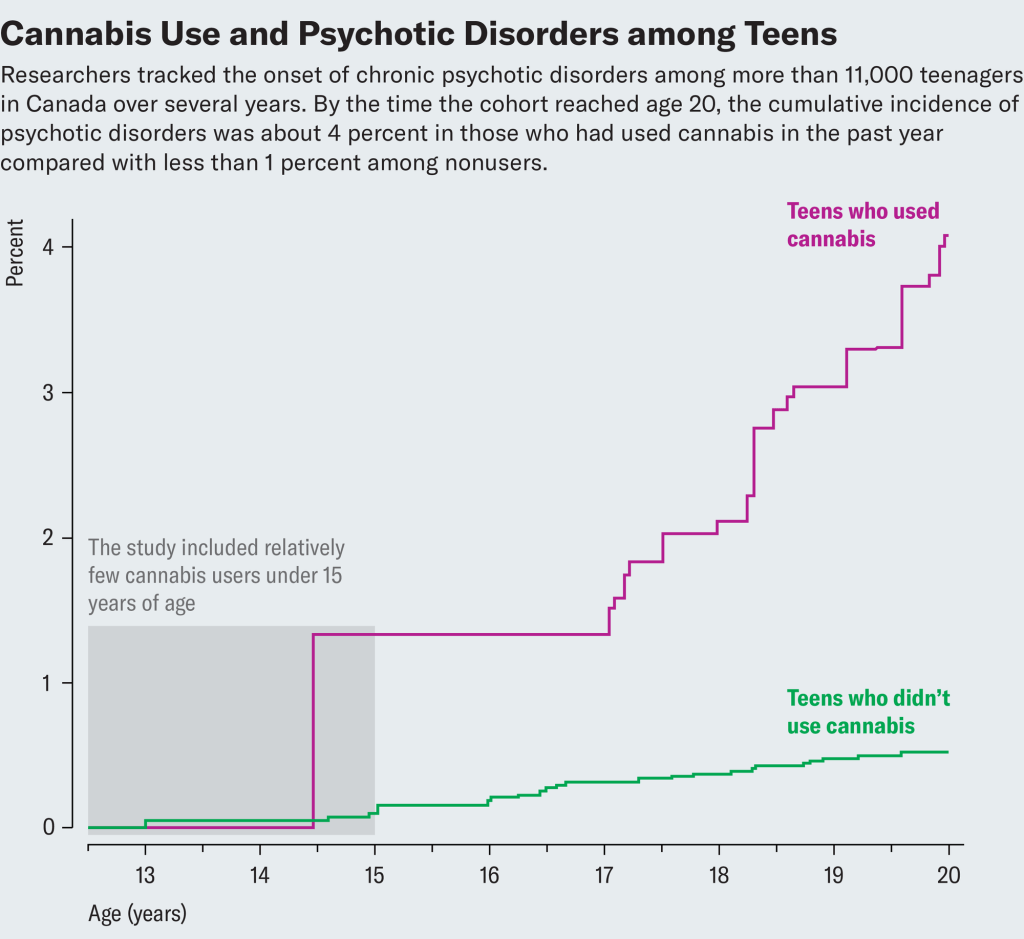
Higher-potency THC, marijuana use starting at a young age and more frequent use all increase the risk of psychosis.
 Tuna Thoughts