Memories, Cash Flow & The Happiness Crash

Your hippocampus doesn’t encode days that feel identical. If this Tuesday looks like last Tuesday, your brain files them as a single compressed memory. The second day never gets its own folder.

This is why decades feel like they disappeared. The hippocampus uses novelty as its filter for “worth storing.” Repetitive routines trigger temporal compression. Same commute, same desk, same dinner, same bedtime: the brain deduplicates the whole sequence into one entry. You lived 365 days. You filed 40.

As people move through continuous experience, the hippocampus and medial prefrontal cortex fire in discrete bursts at moments the brain flags as “something changed.” Each burst becomes a retrievable memory later. In stretches with no boundaries, the bursts flatten. Participants with more boundaries in a given period remembered more of it afterward. Segmentation literally builds memory.

Sleep is the second mechanism. During slow-wave sleep, the hippocampus replays the day’s episodes and transfers them to the neocortex for long-term storage. This is when memory actually gets filed. Cut sleep short and encoding efficiency drops. Chronic sleep debt means experiences you had never complete the transfer. The memory existed. It just never made it to disk.

The third mechanism is where dopamine meets attention. Novel stimuli trigger the ventral tegmental area to release dopamine into the hippocampus, which gates what gets encoded. Mind-wandering does the opposite. When your default mode network takes over (phone scrolling, rumination, email during dinner), the hippocampus stops tagging the present. You were at the wedding. Your hippocampus was in your inbox.

The fix comes straight out of the mechanism. New locations, new food, new people, new routes home. The brain needs boundaries to build memories. Go to bed earlier so replay actually runs. Put the phone down when something is happening so the dopamine signal can fire.

The more forgettable the day, the shorter the decade.

__________________________

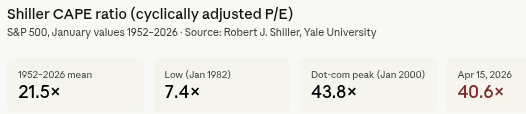
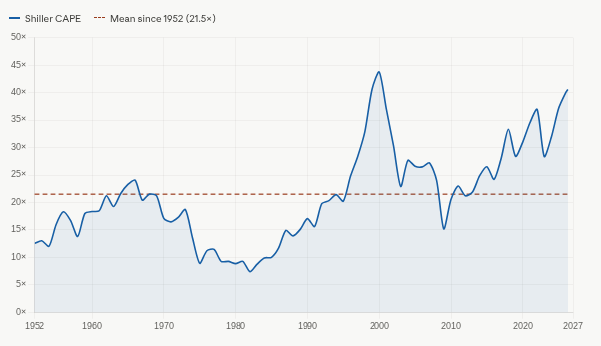
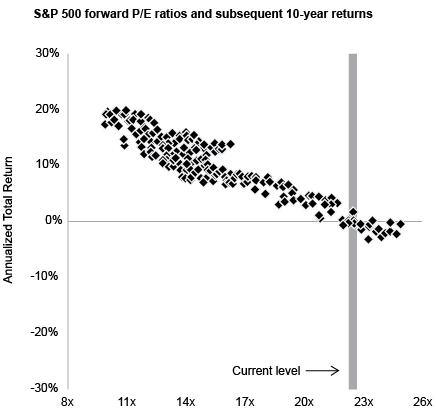
Traditional valuation metrics like the Shiller CAPE (price-to-earnings) ratio have been screaming “overvalued” for most of this century, but there has been almost no mean reversion since 2008 for U.S. stocks:

Why?

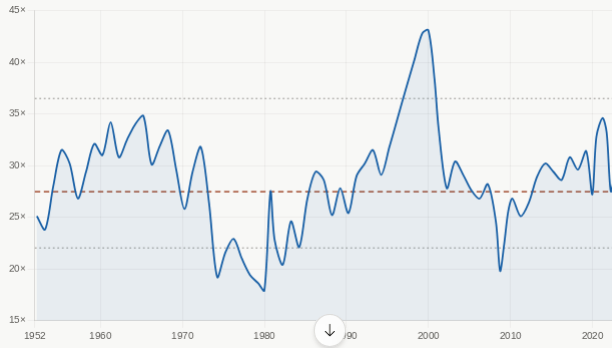
When you swap earnings for free cash flow (sales minus input costs, labor, taxes, and capex — basically what’s actually available to pay owners), the picture changes dramatically. Until recently, the price-to-free-cash-flow ratio bounced around but had no long-term upward drift:

Two structural shifts explain the divergence:

  1. Labor share has declined ~8 percentage points of GDP since 1980. Less of the pie goes to workers, more goes to firm owners. This boosted earnings.
  2. Capex has been relatively weak as a share of firm value. Firms (especially big tech) generated massive earnings without heavy reinvestment, so cash flow grew even faster than earnings.

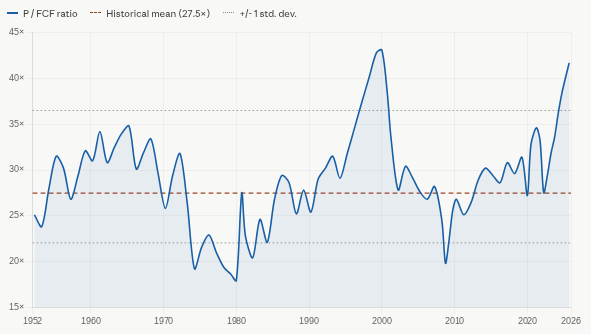
However, that clean free-cash-flow story is under pressure right now. Some of these companies have gone from huge positive FCF to zero or negative FCF, taking on debt to fund it. Big tech has flipped from cash-generating machines to massive spenders on AI data centers, chips, and energy infrastructure.

The chart below is the same as above, but extends the data adding the last few years:

Bullish case: This is 1-2 years of heavy investment that will produce a new plateau of even higher cash flows, and AI further reduces labor share.

Bearish case: AI isn’t “free money” — even adopter firms (not just the hyperscalers) will need serious capex to implement it, and the payoff is uncertain.

Full podcast discussion on this topic on an episode of Odd Lots this week.

__________________________

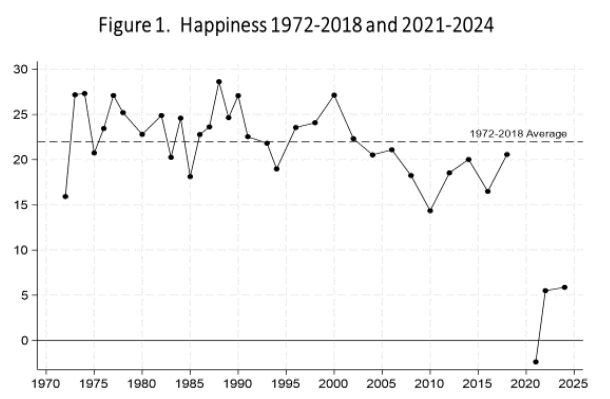
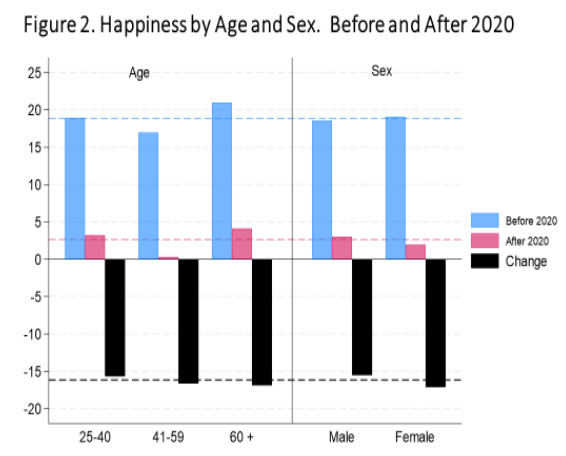
There was a sudden, sharp and historically unprecedented decline in self-reported happiness in the US population. It occurred during 2020, the year of the Covid pandemic, and mainly persists through 2024. 

This happiness crash spread across nearly all typical demographics and geographies. The happiest groups pre-Covid (e.g., whites, high income, well-educated and politically/ideologically right-leaning) tend to show the largest happiness reductions. 

The glaring exception is marital status, which has consistently been an important marker for happiness. The already wide happiness premium for marriage has, if anything, become slightly wider. With both married and unmarried reporting large declines in happiness the country has become segregated: slightly over half-the married adults-remain happy on balance; the unmarried, nearly half, are now distinctly unhappy.

Sleep, Forecasting & Life Stages

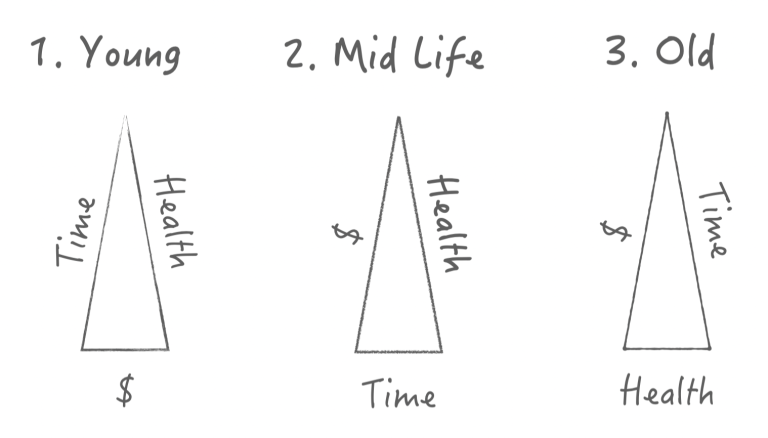
Life can be divided into three stages:

  • Stage 1: Youth – You have time and health, but not much money (unless you have a trust fund).
  • Stage 2: Mid-Life – You have money and health, but little time, career/family consume most of it.
  • Stage 3: Old Age – You have time and money (hopefully), but your health begins to deteriorate.

But there’s a magical stage between Stage 2 and Stage 3 where you have all three: time, health, and money. Some people extend Stage 2 for too long, chasing promotions, accumulating wealth, and missing this precious window to live fully and intentionally.

_________________________

Six common sleep myths:

  • “You need 8 hours of sleep every night” (7 hours is ideal)
  • “We sleep to rest our bodies” (Sleep restores your brain much more than your body)
  • “Waking up in the middle of the night is bad”
  • “Light and sound will ruin your sleep”
  • “Sleeping pills will help you”
  • “You need to time your sleep cycles to leverage REM”

There are two ways sleep helps the brain:

(1) Sleep helps us learn and remember important things. When we’re awake, our memories seem to go into a sort of short-term bank. Then, when we’re in certain stages of sleep, our brain culls through these memories. It puts the most important memories in long-term storage and deletes the useless ones.

(2) Sleep “cleans” our brain. The brain is like an engine that does a lot of work during the day. Engines emit smog—in the case of the brain, this smog is called “metabolites.” But because our brain is tightly sealed off, it can’t seem to get rid of these metabolites as it’s up and running while we’re awake.

Picture this as a car running idle in a garage. But pretend the car’s engine can’t run with the garage door open. So across the day, the engine runs in the closed garage, and smog builds and builds in the brain. Run the engine too long with the garage door closed, and you get a dangerous smog buildup. As we sleep, it’s like the engine turns down and the garage door opens. During certain sleep phases, some areas of our brain expand by 60 percent, which allows the previous day’s metabolites to clear. This also lets in enzymes that repair and rejuvenate receptors in the brain. Sort of like having a mechanic come in to tune the engine while the garage is open and the engine is “off.”

_________________________

When Do People Want Their Inheritance (And When Do They Get It)? When you ask people whether they would prefer $250,000 at age 30, $500,000 at age 40, or $1 million at age 50, people overwhelmingly wanted the lower amount earlier in life. 70% of respondents who answered this question chose $250,000 at age 30.

The average age at which someone receives an inheritance has been increasing over time. In 1989, the average age of inheritance was 41 and today it’s around 51.

You can provide up to $19,000 per year to each of your children tax-free (as of 2025). While the IRS allows you to gift $19,000 per child per year tax-free, technically you can gift far more than this without paying federal taxes. The catch is that any gift above $19,000 counts against your lifetime gift limit, which is $13.99 million (as of 2025). In other words, you can give away $13.99 million across your lifetime without having to pay the federal gift tax.

_________________________

Why Macro Forecasting Is Impossible. Think about global trade — large, complex interrelated economies, driven by everything from policy to consumer sentiment, geography, innovation, employment, inflation, natural resources, etc. Besides all of those massive complexities, everything affects everything else. You have initial acts, second-order effects, 3rd, 4th, 5th order effects, reflexivity, and dynamic interactions. It quickly scales up to billions of incalculable odds.

This is why forecasting market prices or macroeconomic data is so challenging: There are simply too many variables, each dependent on and reflecting even more variables, to pretend we truly know what will happen next.

_________________________

Modern-day cannabis is simply not the same as the plant used in the 1960s through the 1980s or even as recently as 10 years ago. New strains of cannabis are highly potent, making them more addictive and potentially more dangerous, and we are still trying to understand what the drug does to developing adolescent brains.

All cannabis products contain a mix of delta-9-tetrahydrocannabinol (THC), the intoxicating component of the cannabis plant, and cannabidiol (CBD), which may have anxiety-reducing properties. In the 1990s the marijuana in a typical joint contained about 5 percent THC.

But genetic modification has drastically increased THC potency; from 1995 to 2022 its content in the average cannabis plant increased by 307 percent. And it’s not just joints or pot brownies; with the expanding legalization and commercialization of cannabis, there are few limits on the levels of THC in products such as fast-acting vape pens and edibles. What teens can buy today is nothing like what their parents used in college.

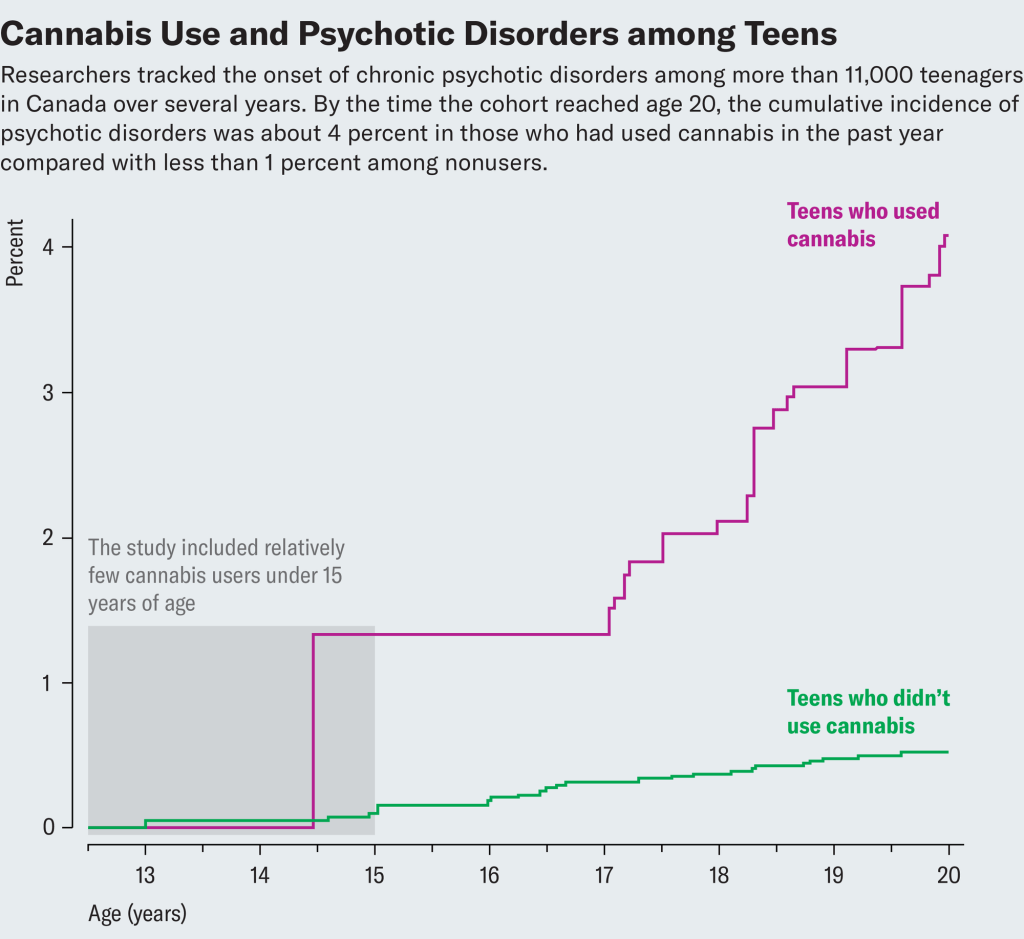
Higher-potency THC, marijuana use starting at a young age and more frequent use all increase the risk of psychosis.

College, Cancer & Wages

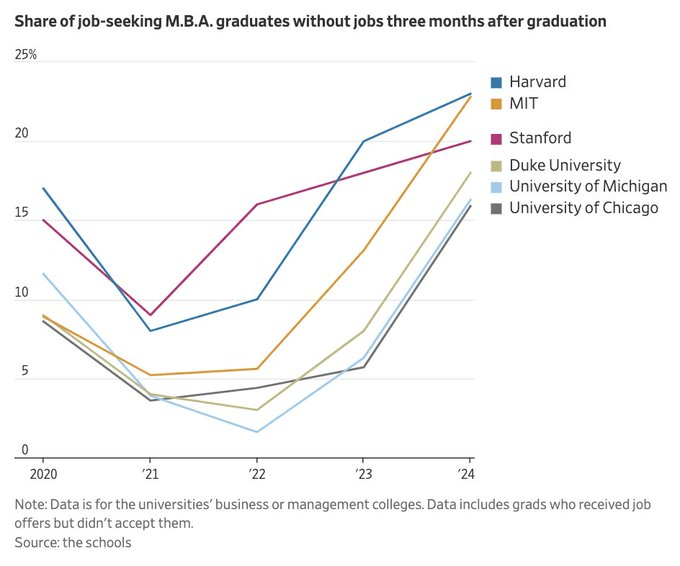
The share of elite MBA grads still looking for work 3+ months after graduation is up sharply at practically every high-ranking school. The traditional elite-MBA absorption process—1) Get degree; 2) Glide path to Big Tech/Consulting—seems disrupted.

_________________________________________

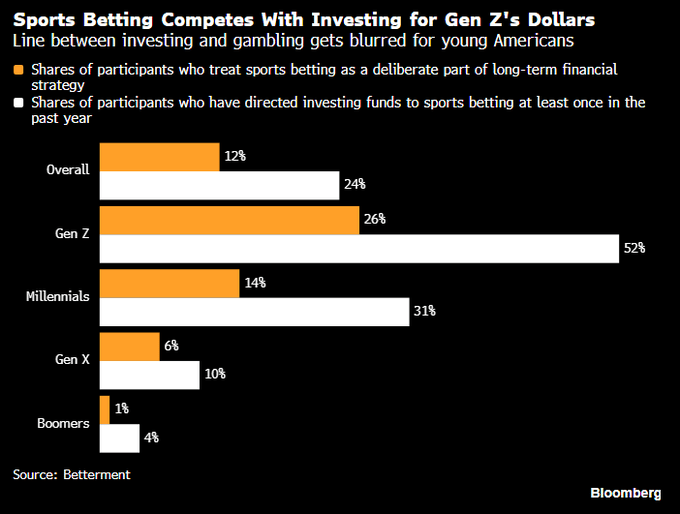
Gen Z is the most money-centric generation we’ve seen yet.

________________________________________

The face of cancer in the U.S. is getting younger—and more feminine. Cancer rates for women in the U.S. have risen over the past half-century, particularly among women under age 65 diagnosed with breast cancer. For decades, the cancer burden in the U.S. was higher for men, who started smoking en masse in the 20th century. Their rates of lung-cancer cases and deaths soared. Lung cancer remains the biggest cancer killer for men in the U.S., but case and death rates have dropped, after smoking rates declined. 

Women started smoking heavily later than men and have been slower to quit, so their lung-cancer decline started later and hasn’t been as steep. That has had a significant impact: Lung cancer incidence among women under 65 was greater than among men for the first time in 2021. Women are also more likely to get diagnosed with lung cancer as nonsmokers. 

_________________________________

We rank nine major U.S. airlines on seven equally weighted operations metrics: on-time arrivals, flight cancellations, delays of 45 minutes or more, baggage handling, tarmac delays, involuntary bumping and what the Transportation Department calls passenger submissions (which are mostly complaints).

_______________________________________

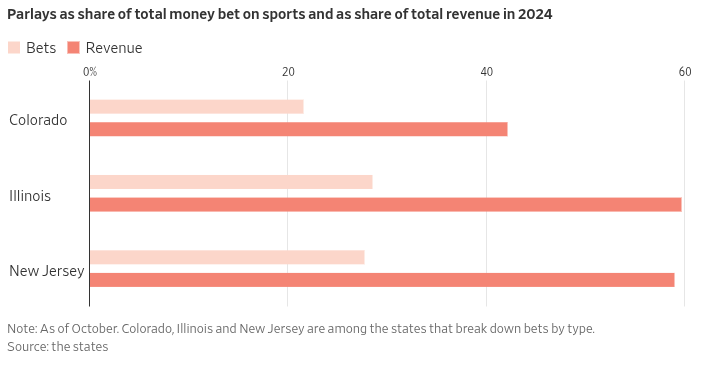
Parlays, the tough-to-win multipart wagers with tantalizing payouts, are bringing in casual and newbie gamblers, and betting companies are making a killing. FanDuel said 90% of its same-game parlays, or bets on multiple developments within one event, have a wager of $30 or less, while 60% are $5 or less. About 20% of all money spent by DraftKings on national TV advertising last year hyped parlays, compared with 11% in 2022.

Parlays accounted for about 27% of the money wagered on all sports bets last year through October in Illinois, New Jersey and Colorado, states in which gambling regulators report data by bet type. That’s up from 22% of all sports bets in 2021. The multi-leg bets delivered about 56% of sports-betting revenue after payouts for companies in the three states during that period, up from 50% in the same stretch of 2021. 

Multi-leg bets are so lucrative that FanDuel parent company Flutter Entertainment recently increased its expectation for total online gambling revenues in the U.S. to $63 billion by 2030, up from its estimate of $40 billion two years ago, driven in part by parlays, the company said.

___________________________________

People are usually surprised when they see how Japan has grown its dividends at a 6.9% annual clip over the last 20 years, outpacing the 6.7% growth pace of the S&P 500. Japan trades for 13.5x forward earnings, or a 37% discount to the S&P’s P/E of 21.3.

______________________________

A massive wage arbitrage has opened between the US and its competitors. The overwhelming majority of people in the US have no idea just how much more money they make than the Japanese, French, British, etc.

______________________________

Of the stock market’s 10 largest companies, there are more that trade for a P/E > 30 than there were on Dec. 31, 1999. With the exception of maybe AT&T, every single one of 1999’s top dogs were considered unstoppable, dominant, kings, never to be unseated. Until they were.

___________________________________

US stocks are expensive relative to the rest of the world, even if you excludes big tech:

___________________________________

Anti-Social, Bubbles & Walking

Derek Thompson wrote a great article this week called The Anti-Social Century: Americans are now spending more time alone than ever. It’s changing our personalities, our politics, and even our relationship to reality. He also released a podcast episode discussing the article.

  • Men who watch television now spend 7 hours in front of the TV for every 1 hour they spend hanging out with somebody outside their home.
  • The typical female pet owner spends more time actively engaged with her pet than she spends in face-to-face contact with friends of her own species.
  • From the late 1970s to the late 1990s, the frequency of hosting friends for parties, games, dinners, and so on declined by 45%, then it got worse. Between the early 2000s and the latest data, the average amount of time that Americans spent hosting or attending social events declined another 32%.
  • A 5-percentage-point increase in alone time is associated with about the same decline in life satisfaction as was a 10% lower household income.
  • From 1965 to 1995, the typical adult gained 6 weekly hours in leisure time. They funneled almost all of it into one activity: watching TV.
  • In 1970, just 6 percent of sixth graders had a TV set in their bedroom; in 1999, that proportion had grown to 77 percent.
  • The share of boys and girls who say they meet up with friends almost daily outside school hours has declined by nearly 50 percent since the early 1990s.
  • Today’s adults spend an additional 99 minutes inside their homes on any given day, compared with 2003.
  • The share of U.S. adults having dinner or drinks with friends outside the home on any given night has declined by more than 30% in the past 20 years.
  • Restaurants used to be the ultimate “social” business. But today, just one-quarter of restaurant traffic is “on-premises”—that is, sitting, ordering, talking with people at a table. With the rise and rise of delivery 74% of all restaurant traffic now comes from “off premises” customers—takeout and delivery. And solo dining has increased by 29% in just the past two years. The top reason given? The need for more “me time.”

_____________________________

Gen Z spends an average of 109 days per year looking at a screen. Eighty percent of our waking hours are spent consuming information, up from 40% in 1980.

_____________________________

Do You Even Maxx Bro? Chewing-gum workouts for sharper jawlines. Specialty products for feathered bangs. So. Much. Cologne. Exploring the extreme self-care trends shaping a generation of young men.

In the past, I might have tuned out a very online trend like looksmaxxing, but I regret to inform you that we can’t skip this one. Because looksmaxxing might be the key to understanding Gen Z and Gen Alpha behavior, knowing where they’re headed, and, frankly, answering a larger question you’ve definitely thought about: Are young men okay?

Someone unexpected has emerged as an unlikely Gen Alpha role model: American Psycho’s Patrick Bateman, the yoked killer from the 1991 Bret Easton Ellis novel, memorably played by Christian Bale (and his cheekbones) in the film. In forums on Reddit , looksmaxxers have coalesced around Bateman, whose well-moisturized face has become an extremely popular profile pic for self-described “sigmas,” a Gen Alpha term for independent men who prioritize power, class, and self-control, known to attract beautiful women aroused by their bank accounts.

As Bateman says in the film: “You can always be thinner…look better.” For many, that starts with “mewing,” a non-medical technique that involves pressing your tongue to the roof of your mouth to reshape your jawline. Men now receive ads for Jawliner gum, part of a new category of fitness chewing gums, which is 10 times harder to chew than a standard piece and is designed to tone the masseter muscles in their face. Terms like brotox have made their way into professional conversations, and more men have been seeking jawline-enhancing procedures.

____________________________

Great newsletter from Howard Markets this month discussing bubbles and valuations in the market using historical examples from his decades of experience in the financial industry (started in 1969). Some highlights:

  • In bubbles, investors treat the leading companies—and pay for their stocks—as though the firms are sure to remain leaders for decades. Some do and some don’t, but change seems to be more the rule than persistence.

My early brush with a genuine bubble caused me to formulate some guiding principles that carried me through the next 50-odd years:

  • It’s not what you buy, it’s what you pay that counts.
  • Good investing doesn’t come from buying good things, but from buying things well.
  • There’s no asset so good that it can’t become overpriced and thus dangerous, and there are few assets so bad that they can’t get cheap enough to be a bargain.

________________________________

Studies continue to show that any type of movement (even just taking a simple walk) can be extremely beneficial for mental health.

  • Researchers analyzed 33 studies examining the movements of nearly 100,000 adults using smartphones, pedometers and other fitness trackers. Those who clocked more daily steps were less likely to report depressive symptoms or be diagnosed with the condition than those who walked less.
  • Participants ranged in age from 18 to 91 years old and lived in 13 different countries. Those who logged at least 5,000 or more daily steps were less likely to experience depressive symptoms, with the greatest effect coming for those who logged more than 7,500 steps a day — they were 42% less likely to suffer depressive symptoms.
  • A subset of studies included in the meta-analysis found that for every 1,000 daily step increase, adults reduced their risk of developing depression by 9%.
  • The message is very consistent: more is better, and some is better than none.

______________________________

An in-depth report from Reuters on the origins of OnlyFans and how it turned into one of the most profitable businesses in the world.

  • Created in 2016, OnlyFans has paid out over $20 billion to its creators, who now number 4.1 million. The company takes a 20% cut of creators’ revenue.
  • In 2023 alone, content creators generated $6.6 billion on the platform that has over 300 million users
  • Its dividend payout of $472 million to the owner was more than Ralph Lauren earned from the fashion company he founded, and Nike co-founder Phil Knight earned from the sportswear giant – combined.

_______________________________

While no one is ever going to feel bad for someone that co-founded a company and sold it for $975 million, Vinay Hiremath wrote a blog post this week titled: “I Am Rich & Have No Idea What To Do With Myself.” After selling the company he found himself lost, depressed and breaking up with what sounds like an amazing girlfriend that loved him. He just booked a ticket to Hawaii to do some soul searching (again, no one is going to feel bad for him), and is asking himself:

  • Why couldn’t I just leave Loom and say “I don’t know what I want to do next”?
  • Why do I feel the need to only be on a journey if it’s grand?
  • What is wrong with being insignificant?

It’s an introspective look into someone’s open, honest mind providing another example that money solves a lot of problems, but it can’t solve all of them. Most of the time people seem to end up less happy at the destination than they were along the journey to get there.

_________________________________