Attention, Airlines & Mobile Games

Everyone knows it’s hard to get college students to do the reading—remember books? But the attention-span crisis is not limited to the written word. Professors are now finding that they can’t even get film students—film students—to sit through movies.

I heard similar observations from 20 film-studies professors around the country. They told me that over the past decade, and particularly since the pandemic, students have struggled to pay attention to feature-length films.

A professor at the University of Southern California, home to perhaps the top film program in the country, said that his students remind him of nicotine addicts going through withdrawal during screenings: The longer they go without checking their phone, the more they fidget. Eventually, they give in.

He recently screened the 1974 Francis Ford Coppola classic The Conversation. At the outset, he told students that even if they ignored parts of the film, they needed to watch the famously essential and prophetic final scene. Even that request proved too much for some of the class. When the scene played, the professor noticed several students were staring at their phones.

Professors at Universities can track whether students watched films on the campus internal streaming platform. Fewer than 50 percent would even start the movies, he said, and only about 20 percent made it to the end. (Recall that these are students who chose to take a film class.)

After watching movies distractedly, if they watch them at all, students unsurprisingly can’t answer basic questions about what they saw. When a film professor at UW Madison asks what happens at the end of a film, more than half of the class picks one of the wrong options.
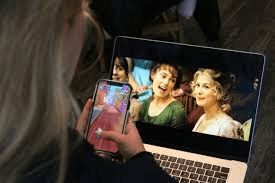
The professors I spoke with didn’t blame students for their shortcomings; they focused instead on how media diets have changed. From 1997 to 2014, screen time for children under age 2 doubled. And the screen in question, once a television, is now more likely to be a tablet or a smartphone. Students arriving in college today have no memory of a world before the infinite scroll. As teenagers, they spent nearly five hours a day on social media, with much of that time used for flicking from one short-form video to the next. An analysis of people’s attention while working on a computer found that they now switch between tabs or apps every 47 seconds.

A film and media-studies professor at Johns Hopkins, usually begins his course with an icebreaker: “What’s a movie you watched recently?” In the past few years, some students have struggled to name any film.  A performing- and media-arts professor at Cornell University, has noticed a similar trend. Some of her students arrive having seen only Disney movies. 

Of course, young people haven’t given up on movies altogether. But the feature films that they do watch now tend to be engineered to cater to their attentional deficit. In a recent appearance on The Joe Rogan Experience, Matt Damon, the star of many movies that college students may not have seen, said that Netflix has started encouraging filmmakers to put action sequences in the first five minutes of a film to get viewers hooked. And just because young people are streaming movies, it doesn’t mean they’re paying attention. When they sit down to watch, many are browsing social media on a second screen. Netflix has accordingly advised directors to have characters repeat the plot three or four times so that multitasking audiences can keep up with what’s happening.

___________________________
___________________________

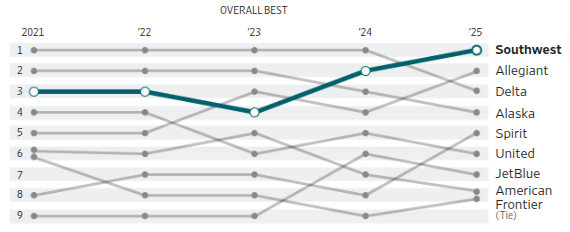
We rank nine major U.S. airlines on seven equally weighted operations metrics:

  • on-time arrivals
  • flight cancellations
  • delays of 45 minutes or more
  • baggage handling
  • tarmac delays
  • involuntary bumping
  • passenger submissions (which are mostly complaints)
____________________________

To keep people splurging in mobile games on your phone like the Custom Street Racing, FarmVille and Words With Friends franchises, their publisher, Zynga, uses a secretive V.I.P. program that treats players like royalty. It is a tactic borrowed from casinos, which may offer a free meal or show tickets when they notice a player is losing more than usual on a slot machine.

Retaining big spenders is essential in the competitive world of mobile gaming, where roughly 90 percent of revenue can come from less than 5 percent of the player base.

The typical V.I.P. gamer is a retired or semiretired professional drawn in by the chance to meet new people online. The continuous stream of updates and seasonal features in mobile games can also create a feeling of purpose and productivity. They can choose to spend their surplus income on golf memberships or they can play FarmVille with their newfound friends in Australia for the weekend.

Players who pour hundreds or thousands of dollars into a game are known as whales, a term borrowed from the gambling world that many people in the industry avoid.

Preventing burnout was a key goal when casinos introduced V.I.P. programs. Harrah’s influential program, which began in 1997, used a digital tracking tool to detect when someone was losing more often than a slot machine’s predetermined odds. To stop players from forming a negative memory that might dissuade them from coming back, an alert would instruct a casino floor attendant to approach them with a reward.

Similar programs are becoming widespread in the video game industry as companies invest in free-to-play and live service games.

____________________________

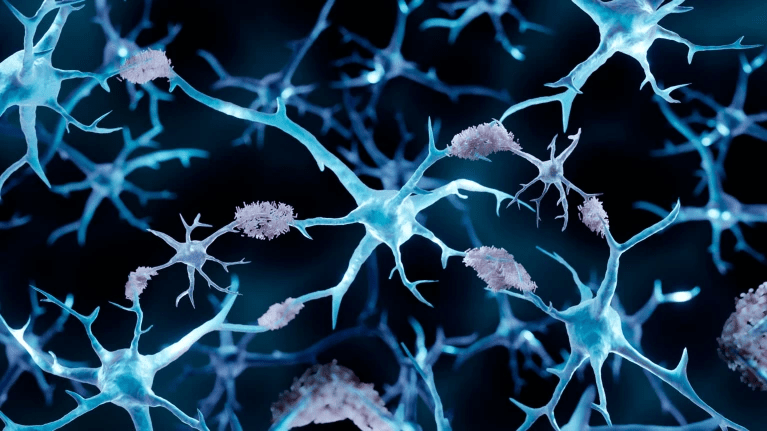
For decades, researchers have noted that cancer and Alzheimer’s disease are rarely found in the same person, fuelling speculation that one condition might offer some degree of protection from the other.

Now, a study in mice provides a possible molecular solution to the medical mystery: a protein produced by cancer cells seems to infiltrate the brain, where it helps to break apart clumps of misfolded proteins that are often associated with Alzheimer’s disease. The study was 15 years in the making and could help researchers to design drugs to treat Alzheimer’s disease.
____________________________________

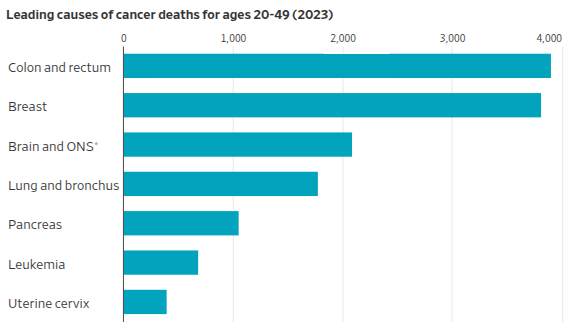
Colon cancer is now the leading cause of cancer death in the U.S. for those under 50. Medical groups have lowered the recommended age for colonoscopies that can detect the disease while there are good odds for effective treatment.
_____________________________________
Death, Pessimism & Frontier Markets

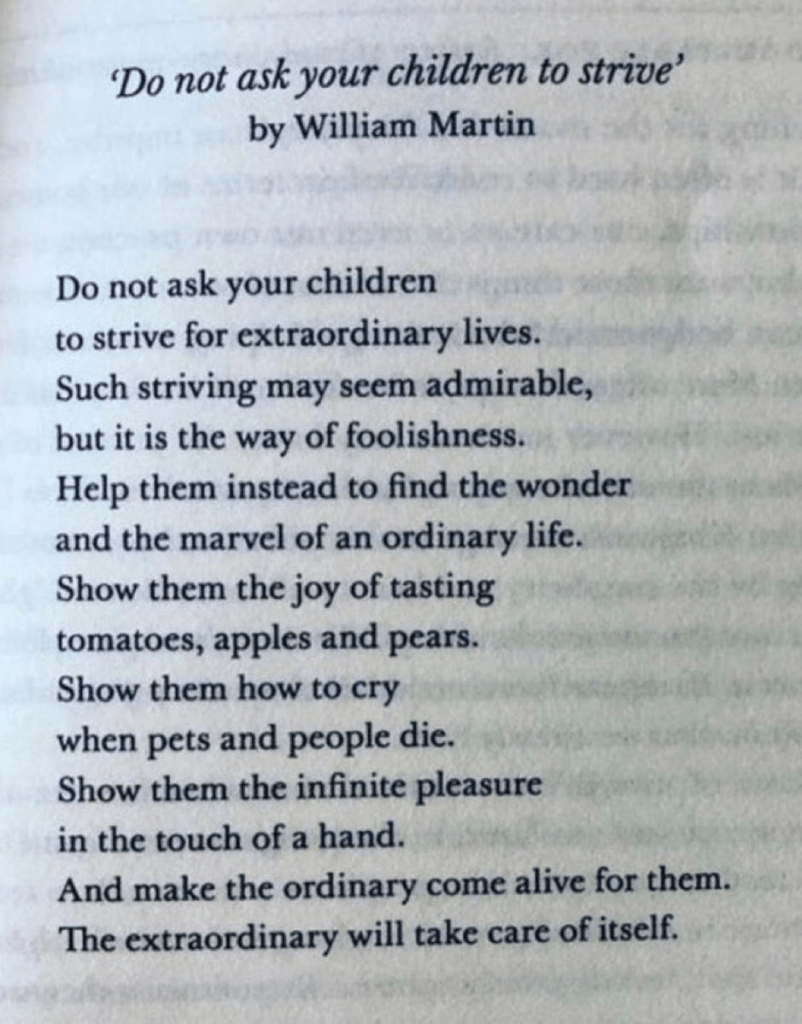
Contemplating death is the New Year’s resolution to end all resolutions. Why? Because it sharpens our focus, allows us to clarify what truly matters—and to craft our goals and priorities around that—anchors us in the present moment, and deepens our appreciation for all that life has to offer, right here and now.

Remembering that we are going to die goes hand-in-hand with another key realization: we have no way of knowing how much time we have left. We might die in three years, or 38 years, or a few months from now. So, what should we do with the time we have—with our one wild and precious life?

Humans have long known of the power of this practice. We’ve been contemplating death for over 100,000 years, from the earliest archeological burial artifacts to Buddhist maraṇasati, from Stoic philosophy to ancient Egyptian funerary texts.

It’s only in the modern Western world that we began to see this practice as depressing or morbid. We lost our relationship with death, and somewhere along the way, we stopped living fully too.

Here are 11 science-backed benefits of taking the time to think about death:

  • Cut through your own bullshit – helps you overcome excuses and stop wasting time on what’s not serving you
  • Clarify your values – less bullshit = more clarity
  • Motivation to act – gives you permission to stop living on autopilot or within societal expectations and start living in alignment with what actually feels true
  • Find a deeper purpose – research shows that being reminded of our mortality triggers a psychological drive to seek or restore meaning in life.
  • Be more present – when you fully accept that everything, and I mean everything, will ultimately be taken from you, the present moment suddenly becomes sacred
  • Gratitude –  like anything else rare and precious, when we remember that life is fleeting, we value it more
  • Stronger relationships – when you remember that one day, everyone you love will die, and so will you, your relationships change
  • Empathy and compassion – death is the great equalizer
  • Unlocks creativity – gives rise to an intense drive to make your own little dent on the universe, to leave something behind to say that you were here. 
  • Keep your ego in check – it’s a reminder that you’re not the center of the universe, the desire to impress starts to dwindle, liberating you from feeling like you need to be the smartest, best, most admired person in the room – instead, you start to show up as a real person: flawed, fleeting, and free
  • Take more risks –  the only thing scarier than dying is never having really lived, so you’re more likely to pursue the life you’ve been dreaming of.

______________________________

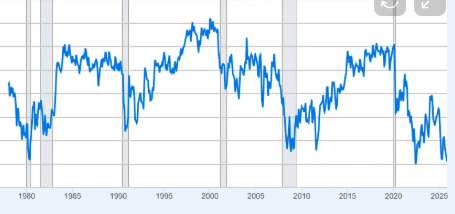
Interest rates have begun to come down. Inflation has mostly subsided, and the real economy is still doing decently well.  So why are American consumers more pessimistic than they were during the depths of the Great Recession or the inflation of the late 1970s?

It’s possible to spin all sorts of ad hoc hypotheses about why consumer sentiment has diverged from its traditional determinants. Perhaps Americans are upset about social issues and politics, and expressing this as dissatisfaction about the economy. Perhaps they’re mad that Trump seems to be trying to hurt the economy. Perhaps they’re scared that AI will take their jobs. And so on.

Here’s another hypothesis: Maybe Americans are down in the dumps because their perception of the “good life” is being warped by TikTok and Instagram.

I’ve been reading for many years about how social media would make Americans unhappier by prompting them to engage in more frequent social comparisons. In the 2010s, as happiness plummeted among young people, the standard story was that Facebook and Instagram were shoving our friends’ happiest moments in our faces — their smiling babies, their beautiful weddings, their exciting vacations — and instilling a sense of envy and inadequacy.

However, note that during the 2010s, consumer confidence was high. Even if people were comparing their babies and vacations and boyfriends, this was not yet causing them to seethe with dissatisfaction over their material lifestyles. But social media today is very different than social media in the 2010s. It’s a lot more like television — young people nowadays spend very little time viewing content posted by their friends. Instead, they’re watching an algorithmic feed of strangers.

There were rich people like that in 1920, or 1960, or 1990. But you almost never saw them. Maybe you could read about them in People magazine or watch a TV show about them. But most people simply didn’t have contact with the super-rich. Now, thanks to social media, they do. 

But even more subtle might be the influencers who are merely upper class rather than spectacularly rich. These people aren’t living the lifestyle of a ultra-rich influencer, yet most of what you’re seeing in these photos and videos is economically out of reach for the average American. 

These are not obviously rich people — they’re more like the 5% or the 1% than the 0.01%. Their lifestyles are out of reach for most, but not obviously out of reach. Looking at any of their videos, you might unconsciously wonder “Why don’t I live like that?”.

Americans were always shown examples of aspirational lifestyles on TV shows. Yet on some level, Americans might have realized that that was fiction; when you see a lifestyle influencer on TikTok or Instagram, you feel like you’re seeing simple, bare-bones reality.

The rise of social media influencers has scrambled our social reference points. Humans have always compared ourselves to others, but before social media, we compared ourselves to the people around us — our coworkers, friends, family, and neighbors.

Those classic reference points tended to be people who were roughly similar to us in income — maybe a little higher, maybe a little lower, but usually not hugely different.

But perhaps even more importantly — we were able to explain the differences we saw. In 1995, if you knew a rich guy who owned a car dealership, you knew how he made his money. If you envied his big house and his nice car, you could tell yourself that he had those things because of hard work, natural ability, willingness to accept risk, and maybe luck. The “luck” part would rankle, but it was only one factor among many. And you knew that if you, too, opened a successful car dealership, you could have all of those same things.

But now consider looking at an upper-class social media influencer. It’s not immediately obvious what they do for work, or how they could afford all those nice things.

Not only can you not explain the wealth you’re seeing on social media, but you probably don’t even think about explaining it. It’s just floating there, delocalized, in front of you — something that other people have that you don’t. Perhaps you make it your reference point by default, unconsciously and automatically.

___________________________

Frontier markets represent the world’s least developed investable economies,
offering exposure to countries with young populations and high economic growth
potential, yet smaller, less liquid markets. Over time, the composition of the MSCI
Frontier Markets Index has shifted meaningfully, with Gulf countries like Kuwait and
Qatar having “graduated” to emerging status and Asian and European nations now
taking greater prominence. Frontier markets remain dominated by financial services,
with larger weights to real estate, energy, and materials, reflecting other structural
differences compared with emerging and developed markets.

The MSCI Frontier Markets index is one of the most widely used indices related to
frontier markets. It contains approximately 238 stocks spread across 28 countries.1
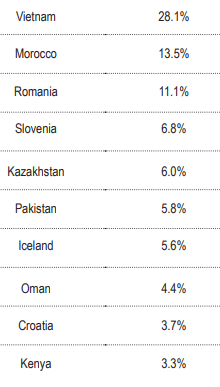
The top three countries in the benchmark were Vietnam, Morocco, and Romania,
which collectively accounted for just over 50% of the index.

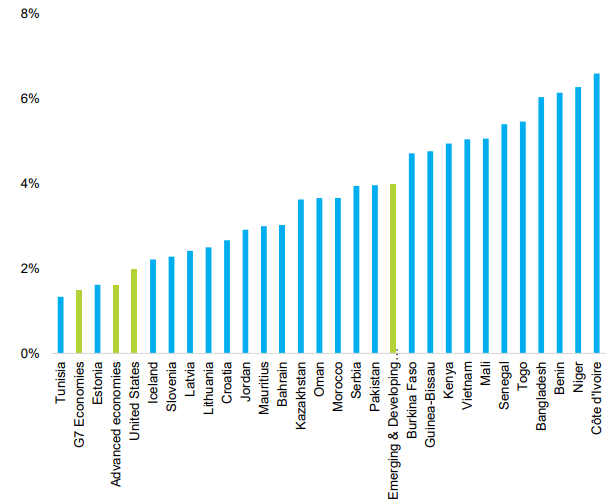
To better understand how growth expectations within frontier markets compare
with growth across the world, it is helpful to compare their GDP growth rate
expectations to developed and emerging markets.


Despite their strong expected GDP growth rates, frontier markets have not translated
that economic momentum into equivalent corporate earnings performance. Earnings
per share growth has stagnated even as valuations have remained low relative to
developed and emerging markets. This combination presents both opportunities
and risks. Value-oriented investors may find attractive entry points, but persistent
structural inefficiencies and volatility underscore the need for careful analysis.

Frontier markets have historically traded at lower valuations compared to developed
markets and similar-to-lower valuations than emerging markets.

_______________________________

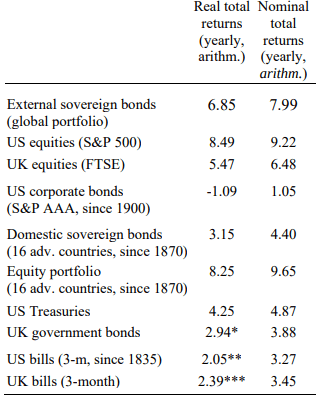
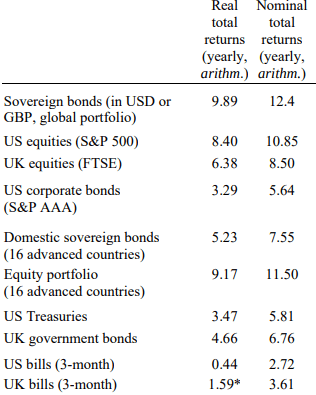
We compiled a new database of 266,000 monthly prices of foreign-currency government bonds traded in London and New York between 1815 and 2016, covering up to 91 countries. 

Our main insight is that, as in equity markets, the returns on external sovereign bonds have been sufficiently high to compensate for risk. Real ex-post returns average more than 6 percent annually across two centuries, including default episodes, major wars, and global crises. 

This represents an excess return of 3-4 percent above US or UK government bonds, which is comparable to stocks and outperforms corporate bonds. Central to this finding are the high average coupons offered on external sovereign bonds.

1815 – 2016:

1995 – 2016:

The Longevity Hack, Exceptional Adults & DNA

My father didn’t meditate, didn’t track his steps or explicitly “exercise,” and never once uttered the word “mindfulness.” Yet he lived to 92, dying at home after a very short bout with brain cancer, having been visited by his children and 11 grandchildren in the 10 days between diagnosis and death. And my mom is still going strong at 92. She still has her sense of humor and her political engagement but no “diseases that will kill her,” as she puts it.

I have spent my professional life studying what makes people live healthier and longer. I have analyzed data sets on longevity the world over and reviewed hundreds of clinical studies. I have heard numerous new claims about supplements, diets and tech devices that are supposed to extend life. But nothing I have read in the scientific literature explains longevity better than the lives of my incorrigibly social parents, Benjamin and Marsha Emanuel.

My father was a pediatrician who spoke five languages and was comfortable talking to anyone and everyone. He routinely talked to strangers, offering suggestions based on his well-honed diagnostic skills.

Whenever we stopped in a restaurant he would start chatting with the people at the next table within five minutes—asking about their jobs, their families, where they were from and what they liked about the place they lived. If no one was at a nearby table, he would strike up a conversation with the waitress.

To a modern eye, this might seem overzealous. But people responded to him. They felt seen, not interrogated. There was no agenda—just my father’s insatiable curiosity about people. One time, a casual chat with another father in a park ended with an invitation for our whole family to dinner at their home.

My mom was also incurably social. Our house was constantly filled with the people she collected. She was great at making our teenage friends feel understood, with warmth and empathy. When her kids went off to college, she finished her training as a therapist and went into practice.

For years, I did not fully appreciate what I was witnessing. To me as a kid, my father’s endless chatter was an embarrassing quirk of his personality. And my mother’s welcoming of strangers into our home just seemed, well, normal. Only after decades as a physician and policymaker did I understand that my father and mother had unintentionally but eagerly adopted one of the most powerful health interventions ever discovered: human connection.

Study after study now confirms what my father and mother intuited long before science caught up. Social relationships, both the deep ones and the fleeting exchanges, reduce stress hormones, lower blood pressure, reduce inflammation, strengthen immune function and make you happier. They may even slow cellular aging.

An analysis by the Health and Retirement Study, which enrolled over 20,000 Americans older than 50, found that over the next eight years, people with the most close friends (an average of 7.8) had a 17% lower risk of depression and a 24% lower risk of dying compared with people who had fewer close friends (an average of 1.6).

Similarly, Harvard University’s Study of Adult Development, which followed people for over 80 years, found that “the people who were happiest, stayed healthiest as they grew old, and who lived the longest were the people who had the warmest connections with other people.” By contrast, social isolation is as dangerous to longevity and cognitive decline as being obese. My father didn’t need PubMed to know that being interested in people kept him not just alive but vibrant and energetic.

Years later, I came to see that impulse—to notice, to care, to connect and help—as the very definition of wellness. My father’s memorial service overflowed with friends, former patients and neighbors, each one with a story about how he’d helped them, laughed with them or simply made them feel less alone. Every Thursday, meanwhile, my mom still has lunch at the deli with “the boys”—friends she has collected over the years.

It has taken me many years to grasp that wellness is inherent in the community we inhabit. My father’s conversations with strangers weren’t just good for him but for the people he engaged with. My mother’s weekly lunch is both good for her and for all her friends. Sharing time with others is beneficial for all involved.

If there is a “longevity hack,” that is it. Forget the cold plunges, red lights and fad-driven supplements. Call a friend. Chat with your neighbor. Ask the Uber driver or grocery checkout clerk how their day is going or how their holidays were. When I think of my father and mother now, I realize that health isn’t something you achieve in isolation. It is something we all create together.

_____________________________

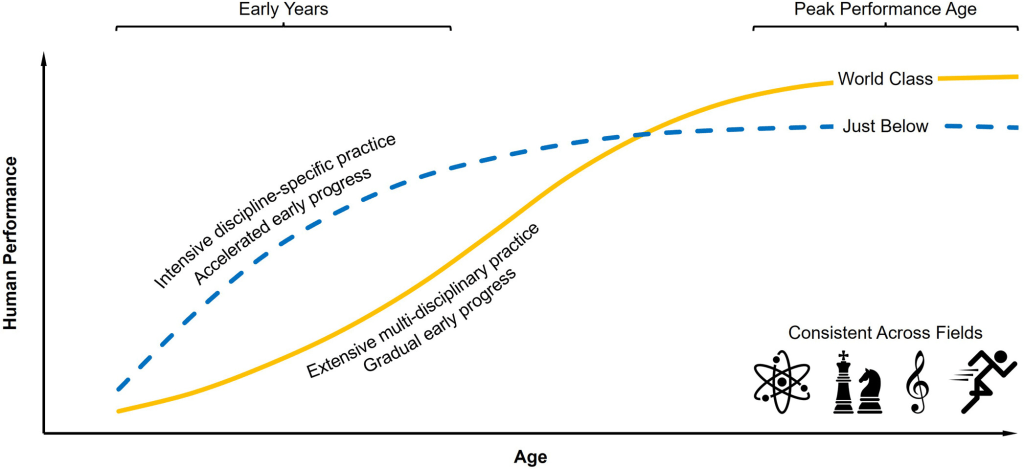
From athletes like Simone Biles and Michael Phelps to scientists like Marie Curie and Albert Einstein, identifying exceptional talent is essential in the science of innovation. But how does talent originate? Did the most talented athletes, scientists, and musicians reach peak performance relatively early or late in their career? Did they forgo mastering multiple sports, academic subjects, and musical instruments to reach world-class performance in only one?

An analytical review looked at published research in science, music, chess, and sports and found two patterns: Exceptional young performers reached their peak quickly but narrowly mastered only one interest (e.g., one sport). By contrast, exceptional adults reached peak performance gradually with broader, multidisciplinary practice.

______________________________

Nearly two decades of studies from multiple independent labs suggest that a father’s gametes shuttle more than DNA: Within a sperm’s minuscule head are stowaway molecules, which enter the egg and convey information about the father’s fitness, such as diet, exercise habits and stress levels, to his offspring. These non-DNA transfers may influence genomic activity that boots up during and after fertilization, exerting some control over the embryo’s development and influencing the adult they will become.

The findings could end up changing the way we think about heredity. They suggest that what we do in this life affects the next generation. What a father eats, drinks, inhales, is stressed by or otherwise experiences in the weeks and months before he conceives a child might be encoded in molecules, packaged into his sperm cells and transmitted to his future kid.

___________________________

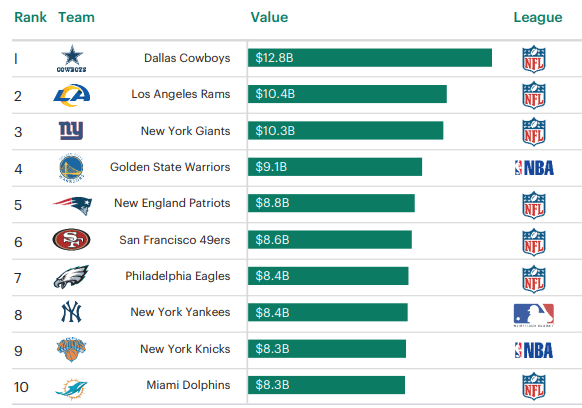
The average team valuation by league (in billions):

The top 10 most valuable pro sports teams in the U.S.:

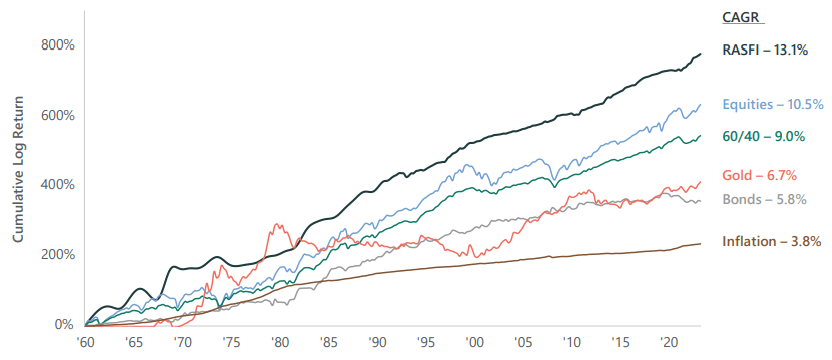
North American sports assets (RASFI) returns vs. other asset classes, and why private credit wants to get more involved in the industry.

Chatfishing & Poorly Defined Problems

Why Aren’t Smart People Happier?

A good name for problems on tests that determine someone’s level of intelligence is “well-defined.” Well-defined problems can be very difficult, but they aren’t mystical. You can write down instructions for solving them. And you can put them on a test. In fact, standardized tests items must be well-defined problems, because they require indisputable answers. Matching a word to its synonym, finding the area of a trapezoid, putting pictures in the correct order—all common tasks on IQ tests—are well-defined problems.

People differ in their ability to solve well-defined problems, they’re not the only kind of problems. “Why can’t I find someone to spend my life with?” “Should I be a dentist or a dancer?” and “How do I get my child to stop crying?” are all important but “poorly defined” problems. Getting better at rotating shapes or remembering state capitals is not going to help you solve them.

One way to spot people who are good at solving poorly defined problems is to look for people who feel good about their lives; “how do I live a life I like” is a humdinger of a poorly defined problem. The rules aren’t stable: what makes you happy may make me miserable. The boundaries aren’t clear: literally anything I do could make me more happy or less happy. The problems are not repeatable: what made me happy when I was 21 may not make me happy when I’m 31.

This is why the people who score well on intelligence tests and win lots of chess games are no happier than the people who flunk the tests and lose at chess: well-defined and poorly defined problems require completely different problem-solving skills. Nobody agrees on the rules, the pieces do whatever they want, and the board covers the whole globe, as well as the inside of your head and possibly several metaphysical planes as well.

Over the last generation, we have solved tons of well-defined problems. We eradicated smallpox and polio. We landed on the moon. We built better cars, refrigerators, and televisions. We even got ~15 IQ points smarter. How much did our happiness improve? None.

We haven’t yet defined the problem of “living a happy life”. We know that if you’re starving, lonely, or in pain, you’ll probably get happier if you get food, friends, and relief. After that, the returns diminish very quickly. You could read all the positive psychology you want, take the online version of The Science of Wellbeing, read posts on hacking the hedonic treadmill, meditate, exercise, and keep a gratitude journal—and after all that, maybe you’ll be a smidge happier. Whatever else you think will put a big, permanent smile on your face, you’re probably wrong.

We fawn over people who are good at solving well-defined problems. They get to be called “professor” and “doctor.” We pay them lots of money to teach us stuff. They get to join exclusive clubs like Mensa and the Prometheus Society. 

People who are good at solving poorly defined problems don’t get the same kind of kudos. They don’t get any special titles or clubs. There is no test they can take that will spit out a big, honking number that will make everybody respect them.

And that’s a shame. My grandma does not know how to use the “input” button on her TV’s remote control, but she does know how to raise a family full of good people who love each other, how to carry on through a tragedy, and how to make the perfect pumpkin pie.

If you don’t value the ability to solve poorly defined problems, you’ll never get more of it. You won’t seek out people who have that ability and try to learn from them, nor will you listen to them when they have something important to say. You’ll spend your whole life trying to solve problems with cleverness when what you really need is wisdom. And you’ll wonder why it never really seems to work. All of your optimizing, your straining to achieve and advance, your ruthless crusade to eliminate all of the well-defined problems from your life—it doesn’t actually seem make your life any better.

_________________________

‘I realized I’d been ChatGPT-ed into bed’: how ‘Chatfishing’ made finding love on dating apps even weirder.

Standing outside the pub, 36-year-old business owner Rachel took a final tug on her vape and steeled herself to meet the man she’d spent the last three weeks opening up to. They’d matched on the dating app Hinge and built a rapport that quickly became something deeper. “From the beginning he was asking very open-ended questions, and that felt refreshing,” says Rachel.

One early message from her match read: “I’ve been reading a bit about attachment styles lately, it’s helped me to understand myself better – and the type of partner I should be looking for. Have you ever looked at yours? Do you know your attachment style?” “It was like he was genuinely trying to get to know me on a deeper level. The questions felt a lot more thoughtful than the usual, ‘How’s your day going?’” she says.

Soon, Rachel and her match were speaking daily, their conversations running the gamut from the ridiculous (favourite memes, ketchup v mayonnaise) to the sublime (expectations in love, childhood traumas). Often they’d have late-night exchanges that left her staring at her phone long after she should have been asleep. “They were like things that you read in self-help books – really personal conversations about who we are and what we want for our lives,” she says.

Which is why the man who greeted her inside the pub – polite, pleasant but oddly flat – felt like a stranger. Gone was the quickfire wit and playful rhythm she’d come to expect from their exchanges. Over pints he stumbled through small talk, checked his phone a little too often, and seemed to wilt under the pressure of her questions. “I felt like I was sitting opposite someone I’d never even spoken to,” she says. “I tried to have the same sort of conversation as we’d been having online, but it was like, ‘Knock, knock, is anyone home?’ – like he knew basically nothing about me. That’s when I suspected he’d been using AI.”

Rachel gave her date the benefit of the doubt. “I thought maybe he was nervous,” she says. But she’d been “Chatfished” before, so when the gap between his real and digital selves failed to close on their second date, she called it off. “I’d already been ChatGPT-ed into bed at least once. I didn’t want it to happen again.”

In a landscape where text-based communication plays an outsized role in the search for love, it’s perhaps understandable that some of us reach for AI’s helping hand – not everyone gives good text. Some Chatfishers, though, go to greater extremes, outsourcing entire conversations to ChatGPT, leaving their match in a dystopian hall of mirrors: believing they’re building a genuine connection with another human being when in reality they’re opening up to an algorithm trained to reflect their desires back to them.

_______________________________

Youtube is eating everything:

Offshoring Automation & Meaningful Ordinary Things

Inside a multistory office building in Manila’s financial district, around 60 young men and women monitored and controlled artificial intelligence robots restocking convenience store shelves in distant Japan. Occasionally, when a bot dropped a can, someone would don a virtual-reality headset and use joysticks to help recover it. 

The AI robots are designed by Tokyo-based startup Telexistence, and run on Nvidia and Microsoft platforms. Since 2022, the company has deployed the machines in the back rooms of over 300 FamilyMart and Lawson stores in Tokyo. It is also planning to use them soon in 7-Elevens.

The bots are remotely monitored 24/7 in Manila by the employees of Astro Robotics, a robot-workforce startup. Japan faces a worker shortage as its population ages, and the country has been cautious about expanding immigration. Telexistence’s bots offer a workaround, allowing physical labor to be offshored. This lowers costs for companies and increases their scale of operations, he said. 

It’s hard to find workers to do stacking in Japan. If you get one who’s willing to do it, it’s going to be very expensive. The minimum wage is quite expensive. It’s easy to get young, tech-savvy Filipinos to operate the robots. Each tele-operator, called a “pilot,” monitors around 50 robots at a time.

The bots are usually autonomous, but occasionally — about 4% of the time — they mess up. Perhaps they drop a bottle, which rolls away. Getting the AI bot to recover it by mimicking the human grip perfectly — the friction, the feel of metal in the hand — is one of the more challenging problems in robotics. That’s when a pilot steps in. 

Astro Robotics’ tele-operators are benefiting from an AI- and automation-related boom in IT-service work and tech jobs in the Philippines, even as layoffs hit similar workers in richer countries. Filipino tech workers maneuver industrial robots, drive autonomous vehicles, collaborate with AI on various tasks, or help build “AI agents,” which are computer programs that enable autonomous action. 

________________________

Diane has been a death doula for two decades now, meaning she is a companion for people at the end of life. She has sat beside people with no time left to waste and nothing left to prove, continually learning from the profound insights they leave behind. An insight she has gleaned:

What does it really mean to live like you are dying? Go skydiving? Ride a bull? Those may sound fun, but insights from people who are actually dying are often simpler and much deeper.

One client told me, “I just want to sit in my own kitchen one more time, with the people I love and a bowl of warm, fresh pasta with parmesan cheese melting on top.” That was his dream. Not a trip to Bali. Not bungee jumping. Just warm pasta, family, and home.

I used to expect that people would reminisce about big events like weddings, awards, or epic vacations. But over and over, what they actually longed for were the simplest pleasures.

My client Bernice had lived an extravagant life. Her walls were covered with perfectly posed photographs of big events from her life. But in her final months, she said, “I wish I had different pictures on the wall—messy ones. Pajama parties with friends, Sunday night movies with my kids, and neighborhood barbeques.” Those were the memories that stirred her soul.

We spend so much of life chasing big moments, but the dying often remind me that it’s not the grand gestures that matter most in the end. It’s the small, ordinary things. A meaningful life is built in everyday moments. Not in the highlight reel, but in the quiet, ordinary spaces in-between.

The dying know something we seem to have forgotten: Life is happening right now. In the warm pasta. During the neighborhood barbecue. In the sound of your favorite voice calling your name. Big events are wonderful, but in the end, the ordinary is everything.

____________________________________

The decline of local news has all kinds of implications. One that doesn’t get much attention is that the wider the news becomes, the more likely it is to be pessimistic. Two things make that so:

  • Bad news gets more attention than good news because pessimism is seductive and feels more urgent than optimism.
  • The odds of a bad news story—a fraud, a corruption, a disaster—occurring in your local town at any given moment is low. When you expand your attention nationally, the odds increase. When they expand globally, the odds of something terrible happening in any given moment are 100 percent.

______________________________________
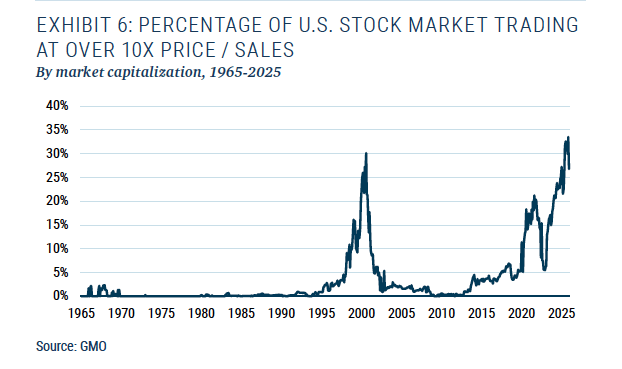
The top 10 stocks in the S&P 500 account for 40% of the index’s market cap. Since ChatGPT launched in November 2022, AI-related stocks have registered 75% of S&P 500 returns, 80% of earnings growth, and 90% of capital spending growth. Meanwhile, AI investments accounted for nearly 92% of the U.S. GDP growth this year. Without those AI investments growth would be flat. America is now one big bet on AI, and this concentration creates fragility.

Valuations for the Mag 10 — the original group of seven leading tech stocks, plus AMD, Broadcom, and Palantir — are high, but not yet at historic peaks. The 24-month forward P/E ratio of the Mag 10 is 35x. In 2000, at the height of the dot-com bubble, the top 10 stocks traded at 52x forward earnings. Implicit in these valuations, however, is an assumption that AI will help these companies cut costs, or grow revenues by $1 trillion in the next two years. I believe we’re either going to see a massive destruction in valuations, infecting all U.S. stocks and global markets. Or we’re going to see a massive destruction in employment across industries with the highest concentrations of white-collar workers. Both scenarios are ugly.

_____________________________

Cellphone bans in schools have become a popular policy in recent years in the United States, yet very little is known about their effects on student outcomes. In this study, we try to fill this gap by examining the causal effects of bans using detailed student-level data from Florida and a quasi-experimental research strategy relying upon differences in pre-ban cellphone use by students. Several important findings emerge.

  • The enforcement of cellphone bans in schools led to a significant increase in student suspensions in the short-term, but disciplinary actions began to dissipate after the first year, potentially suggesting a new steady state after an initial adjustment period.
  • We find significant improvements in student test scores in the second year of the ban after that initial adjustment period.
  • The findings suggest that cellphone bans in schools significantly reduce student unexcused absences, an effect that may explain a large fraction of the test score gains.

Time, Work, Beer & A.I.

Does Time Seem To Be Flying By? There Are Ways To Slow It Down. Exposure to variety in your life creates memories, which in turn makes time seem to pass slower because there is more to look back on. For children, fresh experiences and “firsts” are a natural part of everyday life — losing that first tooth, first day of school, first bicycle. This constant stream of new occurrences stretches the passage of time in a young mind.

Older adults, on the other hand, often slip into predictable patterns where days differ only by the calendar date. With scant new memories being formed between existing time markers like birthdays and holidays, Christmas seems to roll around quicker each year. 

So as simple as it sounds, if you want time to slow down, the key is to intentionally introduce more novel experiences into your daily routine. Researchers divide these into two categories:

Distinct novelty. Taking a trip to somewhere you have never been fires a whole different system in your mind that preserves all the details like a high-resolution photo, creating vivid memories you recall for years to come. Your brain’s reaction is, “This looks important. I’d better save all of this!”

Common novelty. You decide to try a different restaurant in your neighborhood instead of the ones you normally frequent. It’s new but related to something you already know, so the impression is not particularly powerful.

__________________________

Typically, what you find in highly successful people is that an addiction to work is, in fact, based on an inchoate belief that love from others—including spouses, parents, and friends—can be earned only through constant toil and exceptional merit.

Why might someone fall prey to such an erroneous belief? It could be the way you were raised. Workaholic parents tend to have workaholic kids. If you grow up seeing adulthood modeled by people who work all hours and are rarely home, you can be forgiven for regarding this as appropriate behavior for a responsible spouse and parent. This is at least partly the same mechanism behind the fact that you are much likelier to become an alcoholic if you were raised by one.

Researchers have also shown that when parents express love for a child in a conditional way based on the child’s behavior, that person is likely to grow up feeling that they deserve love only through good conduct and hard work. This might sound as though I’m describing terrible parents, but I don’t mean to do so at all; well-intentioned parental encouragement can be heard by a child as a message about their worthiness.

In the workaholic’s case, it might look like this: Your parents wanted you to succeed in school and in life, so they gave you the most love and attention when you got good report cards, won at sports, or earned the top spot in the orchestra. You were a bright kid, and put two and two together: I am extra lovable when I earn accolades. In my experience, this describes the childhood of a lot of people who strove to be special to gain their parents’ attention, and who carry this behavior into adulthood by trying to earn the love of others through compulsive work.

__________________________

Michelob Ultra has become king of the hill among beer brands. By topping the sales by volume charts for 2025, it has ousted Modelo Especial as America’s best-selling beer.

While its lower caloric content certainly appealed to many people, some of Michelob Ultra’s success can also be credited to aggressive marketing campaigns, which helped the brand gain notoriety at major sporting events like the FIFA Club World Cup, NBA games, and the PGA tour. That falls in line with Michelob Ultra’s focus on folks with active lifestyles. 

More people are seeing Michelob Ultra on tap. The new top dog surpassed its sister brand, Bud Light, in bar and restaurant presence in December 2024. Michelob Ultra’s upsurge in popularity happened at a relatively quick pace; the brand has flourished by 15% since 2020. That equates to a 2% hold over the entire beer market in that time frame.

___________________________

A.I. investors shouldn’t swim upstream, but fish downstream: companies whose products rely on achieving high-quality results from somewhat ambiguous information will see increased productivity and higher profits. These sectors include professional services, healthcare, education, financial services, and creative services, which together account for between a third and a half of global GDP and have not seen much increased productivity from automation. AI can help lower costs, but how individual businesses incorporate lower costs into their strategies—and what they decide to do with the savings—will determine success. To put it bluntly, using cost savings to increase profits rather than grow revenue is a loser’s game. The companies that will benefit most rapidly are those whose strategies are already conditional on lowering costs.

With A.I., knowledge-intensive services will get cheaper, allowing consumers to buy more of them, while services that require person-to-person interaction will get more expensive, taking up a greater percentage of household spending. This points to obvious opportunities in both. But the big news is that most of the new value created by AI will be captured by consumers, who should see a wider variety of knowledge-intensive goods at reasonable prices, and wider and more affordable access to services like medical care, education, and advice.

There is nothing better than the beginning of a new wave, when the opportunities to envision, invent, and build world-changing companies leads to money, fame, and glory. But there is nothing more dangerous for investors and entrepreneurs than wishful thinking. The lessons learned from investing in tech over the last 50 years are not the right ones to apply now. The way to invest in AI is to think through the implications of knowledge workers becoming more efficient, to imagine what markets this efficiency unlocks, and to invest in those. For decades, the way to make money was to bet on what the new thing was. Now, you have to bet on the opportunities it opens up.

_________________________

There is a consistent doom-and-gloom forecast that within 18 months A.I. software will make human capabilities worthless. The far more significant crisis is precisely the opposite. Young people are already degrading their cognitive capabilities by outsourcing their minds to machines long before software is ready to steal their jobs.

Many recent articles have loudly proclaimed what most people were already thinking: Everybody is using AI to cheat their way through school. By allowing high school and college students to summon into existence any essay on any topic, large language models have created an existential crisis for teachers trying to evaluate their students’ ability to actually write, as opposed to their ability to prompt an LLM to do all their homework. Massive numbers of students are going to emerge from university with degrees, and into the workforce, who are essentially illiterate.

The demise of writing matters, because writing is not a second thing that happens after thinking. The act of writing is an act of thinking. Students, scientists, and anyone else who lets AI do the writing for them will find their screens full of words and their minds emptied of thought.

As writing skills have declined, reading has declined even more. Most of our students are functionally illiterate. Achievement scores in literacy and numeracy are declining across the West for the first time in decades.

Americans are reading words all the time: email, texts, social media newsfeeds, subtitles on Netflix shows. But these words live in fragments that hardly require any kind of sustained focus; and, indeed, Americans in the digital age don’t seem interested in, or capable of, sitting with anything linguistically weightier than a tweet. The share of Americans overall who say they read books for leisure has declined by nearly 50 percent since the 2000s.

Even America’s smartest teenagers have essentially stopped reading anything longer than a paragraph. Students are matriculating into America’s most elite colleges without having ever read a full book. High schools have chunkified books to prepare students for the reading-comprehension sections of standardized exams.

Thinking benefits from a principle of “time under tension.” It is the ability to sit patiently with a group of barely connected or disconnected ideas that allows a thinker to braid them together into something that is combinatorially new. 

__________________________

A.I. related stocks have accounted for 75% of S&P 500 returns, 80% of earnings growth and 90% of capital spending growth since ChatGPT launched in November 2022. Data centers are eclipsing office construction spending and are coming under increased scrutiny for their impact on power grids and rising electricity prices.

The biggest medium-term risk I can think of for top heavy US equity markets: China’s Huawei and SMIC pierce the $6.3 trillion NVIDIA-TSMC-ASML moat by creating their own supernode computing clusters and deep-ultraviolet lithography machines of comparable quality.

Oracle’s stock jumped by 25% after being promised $60 billion a year from OpenAI, an amount of money OpenAI doesn’t earn yet, to provide cloud computing facilities that Oracle hasn’t built yet, and which will require 4.5 GW of power (the equivalent of 2.25 Hoover Dams or four nuclear plants), as well as increased borrowing by Oracle whose debt to equity ratio is already 500%. In other words, the tech capital cycle may be about to change.

__________________________

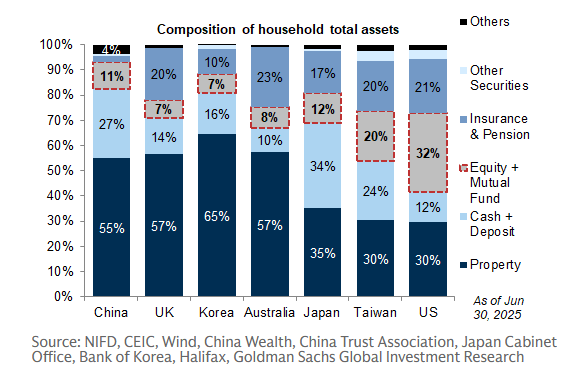
This is a fascinating look at how foreign households invest. I had no idea U.K. residents had such a low percentage of their personal investments in stocks, and the amount Japanese citizens hold in cash (which has provided no interest/return for decades) is incredible.

_____________________________

____________________________________
Africa is enormous. These countries would all fit within Africa’s border:

Dropped Calls, Polymarket & Passwords

That Dropped Call With Customer Service? It Was on Purpose. Endless wait times and excessive procedural fuss—it’s all part of a tactic called “sludge.”

In the 2008 best seller Nudge, the legal scholar Cass R. Sunstein and the economist Richard H. Thaler marshaled behavioral-science research to show how small tweaks could help us make better choices. An updated version of the book includes a section on what they called “sludge”—tortuous administrative demands, endless wait times, and excessive procedural fuss that impede us in our lives.

Sludge is often intentional,” said a professional that works in the customer service call center industry. “Of course. The goal is to put as much friction between you and whatever the expensive thing is. So the frontline person is given as limited information and authority as possible. And it’s punitive if they connect you to someone who could actually help.”

Helpfulness aside, I mentioned that I frequently felt like I was talking with someone alarmingly indifferent to my plight.

“That’s called good training,” Tenumah said. “What you’re hearing is a human successfully smoothed into a corporate algorithm, conditioned to prioritize policy over people. If you leave humans in their natural state, they start to care about people and listen to nuance, and are less likely to follow the policy.”

For some people, that humanity gets trained out of them. For others, the threat of punishment suppresses it. To keep bosses happy, Tenumah explained, agents develop tricks. If your average handle time is creeping up, hanging up on someone can bring it back down. If you’ve escalated too many times that day, you might “accidentally” transfer a caller back into the queue. Choices higher up the chain also add helpful friction, Tenumah said: Not hiring enough agents leads to longer wait times, which in turn weeds out a percentage of callers. Choosing cheaper telecom carriers leads to poor connection with offshore contact centers; many of the calls disconnect on their own.

“No one says, ‘Let’s do bad service,’” Tenumah told me. “Instead they talk about things like credit percentages”—the number of refunds, rebates, or payouts extended to customers. “My boss would say, ‘We spent a million dollars in credits last month. That needs to come down to 750.’ That number becomes an edict, makes its way down to the agents answering the phones. You just start thinking about what levers you have.”

“Does anyone tell them to pull those levers?” I asked.

“The brilliance of the system is that they don’t have to say it out loud,” Tenumah said. “It’s built into the incentive structure.”

That structure, he said, can be traced to a shift in how companies operate. There was a time when the happiness of existing customers was a sacred metric. CEOs saw the long arc of loyalty as essential to a company’s success. That arc has snapped. Everyone still claims to value customer service, but as the average CEO tenure has shortened, executives have become more focused on delivering quick returns to shareholders and investors. This means prioritizing growth over the satisfaction of customers already on board.

Customers are part of the problem too, Tenumah added. “We’ve gotten collectively worse at punishing companies we do business with,” he said. He pointed to a deeply unpopular airline whose most dissatisfied customers return only slightly less often than their most satisfied customers. “We as customers have gotten lazy. I joke that all the people who hate shopping at Walmart are usually complaining from inside Walmart.”

In other words, he said, companies feel emboldened to treat us however they want. “It’s like an abusive relationship. All it takes is a 20 percent–off coupon and you’ll come back.” Supervisors don’t tell customer service workers to deceive or thwart customers. But having them get frustrated and give up is the best way to meet numbers.

Sometimes they intentionally drop a call or feign technical trouble: “‘I’m sorry, the call … I can’t … I’m having a hard time hearing y—.’ It’s sad. Sometimes they drag out the call enough that customers get agitated, or say things that get them agitated, and they hang up.”

Even if an agent wanted to treat callers more humanely, much of the friction was structural, a longtime contact-center worker named Amayea Maat told me. For one, the different corners of a business were seldom connected, which forced callers to re-explain their problem over and over: more incentive to give up.

“And often they make the IVR”—interactive voice response, the automated phone systems we curse at—“really difficult to get through, so you get frustrated and go online.” Employees described working with one government agency that programmed its IVR to simply hang up on people who’d been on hold for a certain amount of time.

________________________

On June 12th, an anonymous trader opened a new account on Polymarket, an anonymous internet betting site that uses cryptocurrency to obscure the source of money. The new trader was interested in betting on one topic: whether the Israeli military would strike Iran within the next 24 hours, by Friday, June 13th.

As the 13th approached, most people thought it was unlikely, but this new account seemed convinced that airstrikes were imminent. The trades started during a one-hour period around 12pm; $1,728 of bets in the first one, then another $311, $280, $560. Then, between 10pm and midnight, with time running out, they accelerated their betting, showing their confidence by ramping up the bets, putting about $20,000 in total at risk.

Three and a half hours later, Israel struck Iran in a surprise attack—and the Polymarket trader cashed out. They had made a total of $134,000 in profits. After taking their winnings, they closed the account, never trading again. This was probably a case of geopolitical insider trading. Someone who knew that the strike was imminent decided to use that knowledge to make a lot of money anonymously through online betting markets.

This is pretty dystopian: individuals, state actors, even terrorist groups can decide to bet on their own behavior, even their own uses of violence. There’s nothing stopping someone who’s a high-profile political actor—or the people around them—from betting on an outcome, then making comments or posting something on, say, Truth Social or X, that inevitably affects public perceptions about a likely course of action. They can drive the price up or down at will, knowing full well that they can ultimately decide whether the value of a “share” goes to $0.00 or to $1.00. And then, they can anonymously cash out, with nobody the wiser. It’s the Wild West of insider trading.

____________________________

Nearly half of U.S. grandchildren (47%) live within 10 miles of a grandparent. Of those, significant numbers live even closer: 21% live between 1 and 5 miles, and 13% live within a walkable distance of 1 mile.

______________________________

The blue horizontal bars in the picture below are parallel to each other:

_______________________________

Ranked: The World’s Most Common Passwords. The data comes from NordPass, which analyzed the most frequently used passwords based on a 2.5 terabyte database of credentials exposed by data breaches. All of the passwords below would take a hacker less than 1 second to crack.

According to NordPass, your password should be at least 20 characters long and include uppercase and lowercase letters, numbers, and special symbols. They suggest that you never reuse passwords. If one account were to be compromised, other accounts that share the same password could also be at risk.

_______________________________

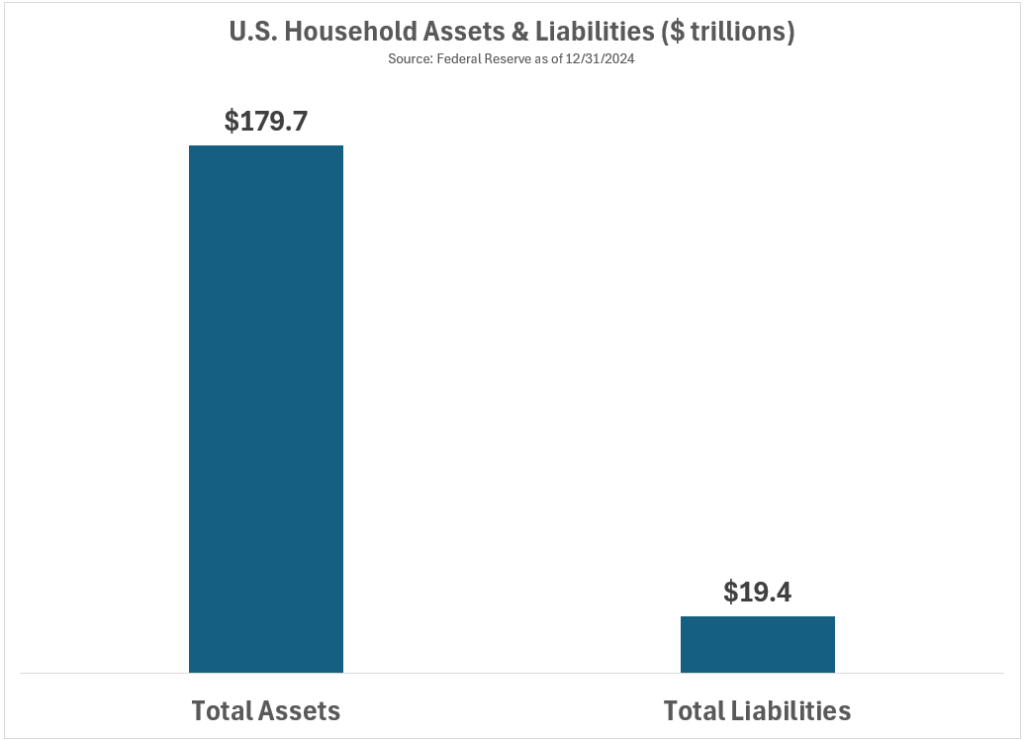
American household leverage is the lowest in 50 years. The leverage ratio is liabilities (mortgage, auto, credit, student loans) divided by the price of assets they own (stocks, bonds, real estate,).

Stock price gains help the top 10% wealthiest families disproportionately, but the biggest improvement in the leverage ratio above for most American families comes from home prices:

Productivity, Jobs, Rates & Zyn Pouches

Here’s a surprising truth it took me ages to grasp: by far the best way to spend more of your life doing meaningful, rewarding and difference-making things is to really feel the deep sense in which you don’t need to do any of that stuff at all.

At public events, people sometimes ask what advice I’d give my fourteen, sixteen or eighteen-year-old self – which is a ticklish question, partly since I’m sure my teenage self would have scoffed at being lectured at by the late-forties version. And he might have been right to do so; I think you probably have to just go through a certain amount of experience, in order to learn about life, instead of having wisdom dispensed by your elders.

Still, the honest answer is that I’d say something like this: “You do realise you don’t absolutely have to do any of this, right – the good grades, the praiseworthy accomplishments, ‘fulfilling your potential’ and all the rest? It’s all great, and it matters, but do you understand that it doesn’t matter matter? That the sky won’t fall in if you chill out a bit, and that people who don’t always ‘do their best’ or ‘fulfill their potential’ are allowed to enjoy life, too?”

The spiritual teacher Michael Singer says somewhere that the basic stance most of us take toward the world is that we try to use life to make ourselves feel OK. And this is certainly true of the type psychologists label ‘insecure overachievers’, who often accomplish plenty of impressive things, but who do so, deep down, because we don’t believe we’d have earned the right to feel good about ourselves, or to relax into life, if we didn’t.

It’s a soul-crushing way to live, not least because it turns each success into a new source of oppression, since now that’s the minimum standard you feel obliged to meet next time. A hugely successful author once told me he knew something was amiss when the experience of reaching the upper echelons of the bestseller list, previously a cause of excited disbelief, instead brought only relief that he hadn’t failed to replicate his prior achievement.

Most productivity advice, I think, caters to people mired in this mindset. It promises ways to help you take so much action, so efficiently, that you might one day get to feel good about yourself at last. Which isn’t going to work – because the real problem isn’t that you haven’t yet done enough things, or got good enough at doing them. The real problem is the fact that for whatever combination of reasons in your childhood, culture or genes, your sense of self-worth and psychological safety got tethered to your productivity or accomplishments in the first place.

But there exists another, very different sort of productive action: the kind you take not because you feel you have to, in order to feel OK, but precisely because you understand that you don’t have to – because you already feel basically OK about yourself, so now of course you want to take action, because action is how you express your enjoyment in being alive, being good at a few things, and being able to use your talents to make some kind of difference in the world, alongside other people.

One of the most important consequences of all this, for me, has been the realisation that when you begin to outgrow action-from-insecurity, you don’t have to give up on being ambitious. On the contrary: you get to be much more effectively and enjoyably ambitious, if that’s the way you’re inclined.

I’ve long been allergic to the notion, prevalent in self-help circles, that if you truly managed to liberate yourself from your issues, you’d ideally spend your days just sort of passively floating around, smiling at everyone, maybe attending the occasional yoga retreat, but not much more. “The more I heal, the less ambitious I become” is a phrase I’ve encountered multiple times online in recent months. And yes, sure, if your ambition was only ever a function of anxiety, becoming less ambitious would be an excellent development. Then again, the desire to create remarkable outcomes in your creative work, relationships or community – or even just in your bank balance – might just be an authentic part of who you are, once the clouds of insecurity begin to clear.

So you don’t need to choose between peace of mind and the thrill of pursuing ambitious goals. You just need to understand those goals less as vehicles to get you to a future place of sanity and good feeling, and more as things that unfold from an existing place of sanity and good feeling. (Besides, I’ve got to believe that ambition pursued in this spirit is far likelier to make a positive difference in the world.)

Obviously, if you’re deeply stuck on insecure-overachiever mode, merely reading about the alternative in a newsletter isn’t going to solve everything. Nor do I mean to suggest that every task becomes an undiluted joy when you re-frame action in this way – or that there aren’t plenty of things you “need to do” for reasons other than feeling OK about yourself, such as keeping food on the table.

But it can be strikingly liberating just to begin, however gingerly, to experiment with the idea that, actually, you could just do the minimum. You really could. You could not try to impress, or be extraordinary, or do your best, or fulfill your potential (whatever that even means). And you would still be fully entitled to a relaxed and enjoyable life.

And then you might begin to feel, in that newly peaceful state of mind, the stirrings of a different kind of action: one that’s no less energetic or productive or effective; far more alive; and much, much easier to enjoy.

___________________________

I went into my conversations with college career executives expecting to hear about AI replacing work. What I heard instead is that AI is transforming everything around work. The transition from college to the workforce is fully drenched in artificial intelligence. AI is automating homework, obliterating the meaning of much testing, disrupting the labor-market signal of college achievement and grades, distorting the job hunt by normalizing 500+ annual applications per person, turning first-round interviews into creepy surveillance experiences or straight-up conversations with robots, and, oh, after all that, maybe kinda beginning to saw off the bottom of the corporate ladder by automating some entry-level jobs during a period of economic uncertainty. This really is a hard time to be a young person.

___________________________

Even if Trump’s tactics improbably succeed in changing Jerome Powell’s mind, they would change only one vote out of 12 on the Federal Open Market Committee. The FOMC’s decision at its June 18 meeting to leave the Fed funds rate unchanged was unanimous. Furthermore, seven of the 19 officials who are eligible for the 12 voting positions predicted there will be no rate cuts for the remainder of 2025, up from four in March.

Surely, you might say, the FOMC would never go against its chair if he altered his position on rates? If that were to happen it would not be unprecedented. In June 1978, Miller was in the minority as the full FOMC voted to raise rates.

________________________

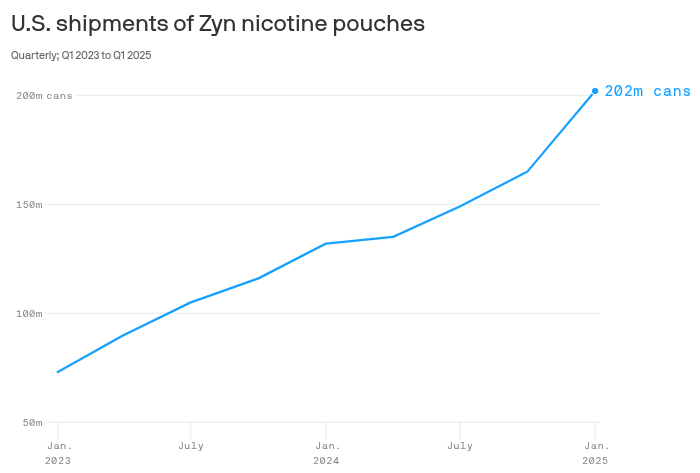
U.S. shipments of Zyn pouches rose 177% from the first quarter of 2023 to the first quarter of 2025.

Being Present, Unsubscribing & Gummy Clusters

These days I’m pretty good at avoiding the trap that’s been called “onedayism” – the tendency to live as if the really important part of life won’t truly begin until you’ve reached some far-off milestone, like finding a long-term partner, or achieving financial security, or until you’ve fixed your problem with procrastination, or once world events don’t seem so apocalyptic. (You have to find meaning, accomplishment and joy in the midst of all that, not solely once it’s all been “sorted out”.)

Yet as I’ve relaxed my grip on that sort of unconscious postponement, I’ve found it’s still easy to make the same error, just on a much shorter timescale: to proceed through the day as if my generally sane and interesting and enjoyable life can resume just as soon as I’ve got this task out of the way, cleared this batch of email, or made it through to this evening. But of course you can miss your whole life in this manner, ceaselessly focused on a point a few hours in the future, no less surely than with the longer-timescale version.

The answer definitely isn’t to beat yourself up for not yet having perfectly mastered the art of being present. (That, you might notice, is just another version of the same mistake.) But you can remind yourself to unclench a bit, to soften, to fall back into what’s really going on, here and now, and to see there’s no reason why you can’t find this very experience juicy and alive. I like how the entrepreneur Shane Melaugh puts it: “Your life plays out over your entire lifetime.” Which always includes now.

None of this is about attaining some kind of pristine, static, passive state of Presence In The Moment, as it sometimes gets presented in spiritual circles. You still get to pursue goals and ambitions and exciting future states; you can still look forward to the end of the day. It’s just that you get to experience all that as something that’s unfolding now, in a present moment that gets to count just as much as any moment that might coming in future.

__________________________

Different Kinds Of Smart:

Humility: Given how little of the world we’ve experienced, in most situations we are likely wrong, especially in knowing how other people think and make decisions.

Self-Discipline: Everyone knows the famous marshmallow test, where kids who could delay eating one marshmallow in exchange for two later on ended up better off in life. But the most important part of the test is often overlooked. The kids exercising patience often didn’t do it through sheer will. Most kids will take the first marshmallow if they sit there and stare at it. The patient ones delayed gratification by distracting themselves. They hid under a desk. Or sang a song. Or played with their shoes. Delayed gratification isn’t about surrounding yourself with temptations and hoping to say no to them. No one is good at that. The smart way to handle long-term thinking is enjoying what you’re doing day to day enough that the terminal rewards don’t constantly cross your mind.

Influence: A good storyteller with a decent idea will always have more influence than someone with a great idea who hopes the facts will speak for themselves. People often wonder why so many unthoughtful people end up in government. The answer is easy: Politicians do not win elections to make policies; they make policies to win elections. What’s most persuasive to voters isn’t whether an idea is right, but whether it narrates a story that confirms what they see and believe in the world. It’s hard to overstate this: The main use of facts is their ability to give stories credibility. But the stories are always what persuade.

Balance: Someone with B+ intelligence in several fields likely has a better grasp of how the world works than someone with A+ intelligence in one field. The best thing to do is to quickly learn and accept that your field is no more important or influential to other people’s decisions than dozens of other fields, which pushes you to spend your time connecting the dots between your expertise and other disciplines. Being an expert in economics would help you understand the world if the world were governed purely by economics. But it’s not. It’s governed by economics, psychology, sociology, biology, physics, politics, physiology, ecology, and on and on.

____________________________

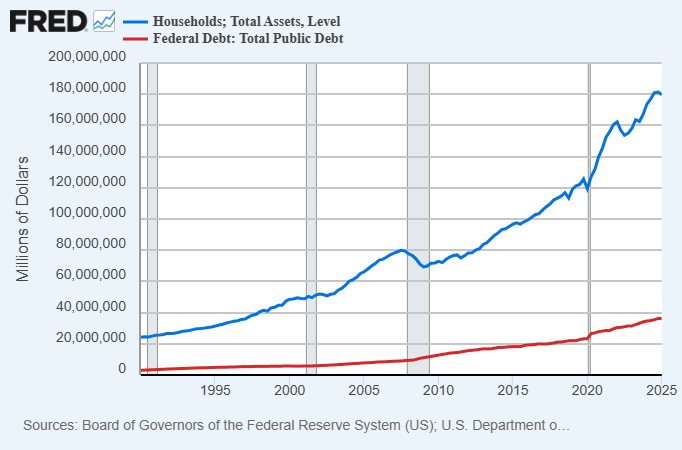
The federal government has a bit over $36 trillion in debt. To put that in context, US households collectively have $180 trillion in assets, or $160 trillion in net worth after liabilities (mostly mortgages) are subtracted.

The US monetary base is about $6 trillion. There is over $120 trillion worth of dollar-denominated loans and bonds outstanding in total (public and private, domestic and international, excluding derivatives). In the foreign sector alone, there is about $18 trillion worth of dollar-denominated debt. What this means is that there is an incredibly large amount of inflexible demand for dollars domestically and throughout the world. Everyone who owes dollars, needs dollars.

When a country like Turkey or Argentina hyper-inflates or nearly-so, it’s in a context where practically nobody outside of their country needs their lira or pesos. There’s no entrenched demand for their currency. And so, if their currency becomes undesirable for any reason (usually due to rapid money supply growth), it’s very easy to just repudiate it and send its value to Hades.

Countless specific entities around the world contractually owe countless other specific entities around the world a certain number of dollars by a certain date in time, and thus need to constantly try to get their hands on dollars. The fact that they collectively owe more dollars than there are base dollars in existence is important. That’s why the monetary base can double, triple, or more, and not be outright hyper-inflationary. It’s still a small increase relative to how much contractual demand there is for dollars. When outstanding debt greatly exceeds the number of base units, it takes a ton of printing of base units to render that base unit worthless.

Suppose that bond yields break out to the point of rendering banks insolvent or the Treasury market acutely illiquid. The Fed can step in with QE or yield suppression. Yes, that comes with the cost of potential price inflation and has implications for asset prices, but no, it’s not hyper-inflationary in this context.

____________________________

Think Twice Before You Click Unsubscribe On An Email:

  • Clicking “unsubscribe” in emails can lead to malicious websites testing if your email is active.
  • Criminals can build a files on users who click unsubscribe links, hoping to eventually extort money through scams.
  • Use list-unsubscribe headers, mark emails as spam or use disposable email addresses for online sign-ups.

____________________________

Cannabis use among seniors surged 46% in the last two years; 7% of adults 65 and older now report recent use. This rise isn’t just in numbers but also in diversity older users today are more likely to be women, college-educated, and higher-income. Researchers suggest legalization and growing social acceptance are contributing factors, especially in states with medical marijuana laws. The trend is especially notable among those with chronic illnesses, raising both opportunities and concerns for medical professionals trying to balance symptom relief with the complexities of aging.

_____________________________

College Baseball Has a Power Problem: Players Keep Hitting the Ball Too Hard: In the big leagues, only superstars like Aaron Judge can routinely crush the ball at speeds in excess of 115 mph. In college baseball these days, everybody’s doing it.

  • College baseball is seeing unprecedented exit velocities, rivaling and sometimes exceeding those in Major League Baseball.
  • College players are 42% more likely to hit balls at 115 mph or harder than MLB players.
  • The reasons for the surge in exit velocity aren’t entirely clear, but it’s creating safety concerns for pitchers, infielders or with fans sitting in the stands

___________________________

Nerds is on track to hit more than $900 million in sales this year, a more than 1,700% increase from the $50 million in sales in 2018. The unprecedented surge is directly attributed to the widely popular Nerds Gummy Clusters, which represented the first meaningful innovation for the once-sleepy brand in years. Nerds Gummy Clusters are now the top sugar confection on the market, overtaking skittles.

_____________________________

Older people will remember the time when there was – for a while – a discussion about how the US stock market had significantly higher returns overnight when the market was closed vs. the actual trading day. Those were the innocent days of an era long gone, aka 2018, when we were all naïve and enthralled by a bull market that couldn’t be derailed by anything. The graph below shows the “overnight effect” through January 2018:

This effect was so promising that it even led to the launch of an ETF in June 2022 that focused on this trade. A product that was so successful that it was liquidated in August 2023. 

A new study shows that the effect disappeared after the pandemic. What makes the study interesting, though, is that they seem to find why the effect existed in the US (and not other countries) in the first place: Hype.

They noticed that stocks with large trading volume just after markets opened were the main driver of the overnight effect. For the uninitiated, trading volumes are heavily concentrated during the last hour of the day. Institutional investors typically want to trade when liquidity is highest which means they tend to wait until the end of a trading day to execute their orders. This becomes a self-fulfilling prophecy. Because big institutions focus their trading on the last hour of the day, this is where volume is highest and this is when other institutions want to trade in the future as well.

________________________

The number of paying Tinder users has dwindled to just 9.1 million in its most recent quarter — down 18% from a peak of 11.1 million in late 2022. While Tinder remains Match Group’s biggest brand, Hinge, another dating app under the Match umbrella, saw paying users grow 19% year over year in Q1 2025.

Double Date, a feature that allows pairs of users to match with other pairs, is now available on Tinder in the US, with a global rollout planned for July. So far, the results seem hopeful: after first trialing the feature in a handful of European countries, Tinder reported that women were 3x more likely to “like” a pair than an individual profile, and that nearly 90% of Double Date profiles came from users under 29.

Ferguson’s Law & The Peak-End Rule

Daniel Kahneman spent his life studying behavioral economics, cognitive biases and learning why people make irrational decisions. He won the Nobel prize for his research and wrote the most influential book ever on the topic titled “Thinking, Fast & Slow.” At age 90, his closest friends and family were shocked and upset when they received an email from him saying that he would be ending his life through assisted suicide, even though he was still in relatively good health. From his email:

I am still active, enjoying many things in life (except the daily news) and will die a happy man. But my kidneys are on their last legs, the frequency of mental lapses is increasing, and I am ninety years old. It is time to go. 

Not surprisingly, some of those who love me would have preferred for me to wait until it is obvious that my life is not worth extending. But I made my decision precisely because I wanted to avoid that state, so it had to appear premature. I am grateful to the few with whom I shared early, who all reluctantly came round to support me.

I discovered after making the decision that I am not afraid of not existing, and that I think of death as going to sleep and not waking up. The last period has truly not been hard, except for witnessing the pain I caused others. So if you were inclined to be sorry for me, don’t be.

Kahneman knew the psychological importance of happy endings. In repeated experiments, he had demonstrated what he called the peak-end rule: Whether we remember an experience as pleasurable or painful doesn’t depend on how long it felt good or bad, but rather on the peak and ending intensity of those emotions. It is the case that in following this carefully thought-out plan, Danny was able to create a happy ending to a 90-year life, in keeping with his peak-end rule. He could not have achieved this if he had let nature take its course.

_____________________________

One reason why the younger generation doesn’t like to drink is because every moment of their lives is either being filmed or only seconds away from the next picture that will be shared online. “I think that a lot of times we’re so consumed with how other people are looking at us that we don’t even want to risk being considered messy,” said Sofie Ruiz, a sophomore at Texas Christian University. This fear of being perceived as “messy” is fueled by the popularity of the “clean girl” aesthetic. A “clean girl” is often associated with healthy habits like yoga, pilates, green smoothies, and journaling—definitely not heavy drinking. The epitome of the popular girl is now one who projects an image of a balanced, healthy, and often sober lifestyle. This ideal is heavily promoted on social media, influencing what is seen as desirable and aspirational. College campuses also have school-specific social media apps, such as Yik Yak, where a drunken night out can get posted by peers with lasting and embarrassing consequencessaid Ruiz. With social media comes permanent and wide-reaching evidence, and students are choosing not to be seen in a certain way in perpetuity.

The reputation repercussions can run deep. Ruiz has a friend who attends a university with its own dedicated Instagram account. Students can send in anything, and it will likely be posted. A female student was kicked out of her sorority for being drunkenly featured on the page. “We grew up a lot hearing the concerns of a digital footprint. People don’t want to risk their future on stuff like that,” said Ruiz. “Guys don’t have as much to be scared about, I think. Because even if they do something embarrassing and it gets posted, they, by history, most likely will not get the same repercussions as a girl might. As a girl, you don’t want to be hungover, you don’t want to feel sick, which also goes into the clean girl aesthetic thing.” “I think that if social media wasn’t a component, it would definitely be a lot different,” she said. The opposite is true with marijuana. Ruiz said that cannabis’s popularity may stem from its perceived social acceptability: “You’re kind of at less of a risk to embarrass yourself because if you’re high, you’re normally just going to chill out. Whereas when you’re drunk, you don’t really have control over your actions.”

_________________________________

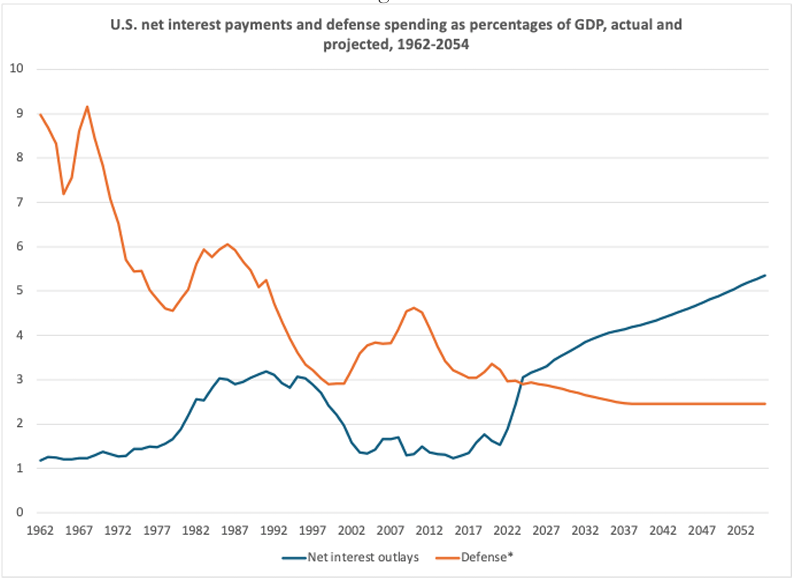
Are there financial determinants of great-power decline and fall? “Ferguson’s Law,” which states that any great power that spends more on debt servicing than on defense risks ceasing to be a great power. The paper identifies the “Ferguson limit,” or the point at which interest payments exceed defense spending, as the tipping point after
which the centripetal forces of the aggregate debt burden tend to pull apart the geopolitical grip of a great power.

This is because the debt burden draws scarce resources towards itself, reducing the amount available for national security, and leaving the power increasingly vulnerable to military challenge. Looking at historical case studies that are analogous to the situation of the modern United States as the dominant global power, it is very rare but not unprecedented for a great power to return to the right side of the Ferguson limit. The United States began violating Ferguson’s Law for the first time in nearly a century in 2024.

________________________________

Don’t let your kids get on motorcycles, if possible.

_____________________________________
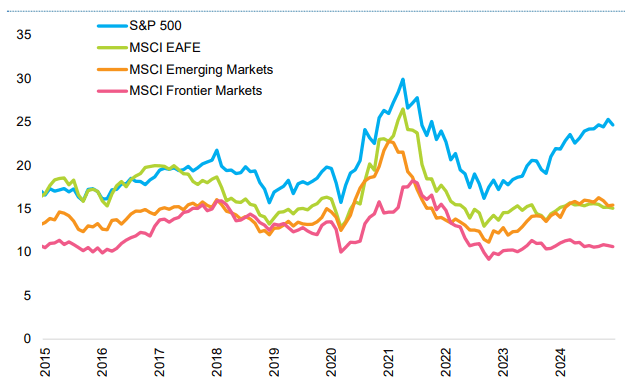
Atlanta-based Chick-fil-A is on the vanguard of fast-food drive-through science, regularly dispatching specialist teams to its more than 3,000 restaurants to study the minutiae of parking-lot traffic patterns and how employees hand off orders. In years past, some Chick-fil-A operators would climb onto restaurant roofs to study traffic flows. These days, the chain sends out traffic-analysis teams that use drones to capture aerial footage, which team members splice with video from kitchens and drive-through windows to create roughly hourlong videos for store owners. The insights are reshaping Chick-fil-A’s restaurants. One opened outside Atlanta last August with no dining room but four drive-throughs that can serve some 700 cars an hour. A second-floor kitchen prepares food that is delivered to the cars below via a system akin to a dumbwaiter. 

_____________________________
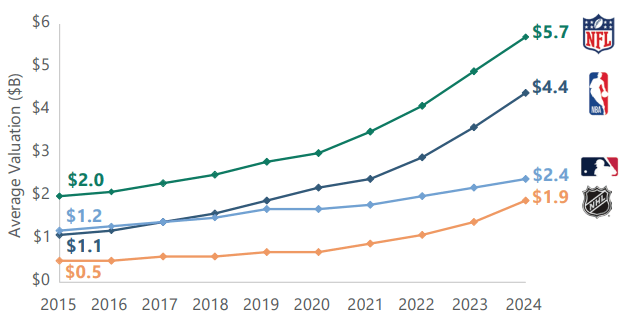
Turning-Tides in Emerging Markets. A quick history of emerging market cycles, and the case for investing in India, Indonesia and Brazil.