Time, Work, Beer & A.I.

Does Time Seem To Be Flying By? There Are Ways To Slow It Down. Exposure to variety in your life creates memories, which in turn makes time seem to pass slower because there is more to look back on. For children, fresh experiences and “firsts” are a natural part of everyday life — losing that first tooth, first day of school, first bicycle. This constant stream of new occurrences stretches the passage of time in a young mind.

Older adults, on the other hand, often slip into predictable patterns where days differ only by the calendar date. With scant new memories being formed between existing time markers like birthdays and holidays, Christmas seems to roll around quicker each year. 

So as simple as it sounds, if you want time to slow down, the key is to intentionally introduce more novel experiences into your daily routine. Researchers divide these into two categories:

Distinct novelty. Taking a trip to somewhere you have never been fires a whole different system in your mind that preserves all the details like a high-resolution photo, creating vivid memories you recall for years to come. Your brain’s reaction is, “This looks important. I’d better save all of this!”

Common novelty. You decide to try a different restaurant in your neighborhood instead of the ones you normally frequent. It’s new but related to something you already know, so the impression is not particularly powerful.

__________________________

Typically, what you find in highly successful people is that an addiction to work is, in fact, based on an inchoate belief that love from others—including spouses, parents, and friends—can be earned only through constant toil and exceptional merit.

Why might someone fall prey to such an erroneous belief? It could be the way you were raised. Workaholic parents tend to have workaholic kids. If you grow up seeing adulthood modeled by people who work all hours and are rarely home, you can be forgiven for regarding this as appropriate behavior for a responsible spouse and parent. This is at least partly the same mechanism behind the fact that you are much likelier to become an alcoholic if you were raised by one.

Researchers have also shown that when parents express love for a child in a conditional way based on the child’s behavior, that person is likely to grow up feeling that they deserve love only through good conduct and hard work. This might sound as though I’m describing terrible parents, but I don’t mean to do so at all; well-intentioned parental encouragement can be heard by a child as a message about their worthiness.

In the workaholic’s case, it might look like this: Your parents wanted you to succeed in school and in life, so they gave you the most love and attention when you got good report cards, won at sports, or earned the top spot in the orchestra. You were a bright kid, and put two and two together: I am extra lovable when I earn accolades. In my experience, this describes the childhood of a lot of people who strove to be special to gain their parents’ attention, and who carry this behavior into adulthood by trying to earn the love of others through compulsive work.

__________________________

Michelob Ultra has become king of the hill among beer brands. By topping the sales by volume charts for 2025, it has ousted Modelo Especial as America’s best-selling beer.

While its lower caloric content certainly appealed to many people, some of Michelob Ultra’s success can also be credited to aggressive marketing campaigns, which helped the brand gain notoriety at major sporting events like the FIFA Club World Cup, NBA games, and the PGA tour. That falls in line with Michelob Ultra’s focus on folks with active lifestyles. 

More people are seeing Michelob Ultra on tap. The new top dog surpassed its sister brand, Bud Light, in bar and restaurant presence in December 2024. Michelob Ultra’s upsurge in popularity happened at a relatively quick pace; the brand has flourished by 15% since 2020. That equates to a 2% hold over the entire beer market in that time frame.

___________________________

A.I. investors shouldn’t swim upstream, but fish downstream: companies whose products rely on achieving high-quality results from somewhat ambiguous information will see increased productivity and higher profits. These sectors include professional services, healthcare, education, financial services, and creative services, which together account for between a third and a half of global GDP and have not seen much increased productivity from automation. AI can help lower costs, but how individual businesses incorporate lower costs into their strategies—and what they decide to do with the savings—will determine success. To put it bluntly, using cost savings to increase profits rather than grow revenue is a loser’s game. The companies that will benefit most rapidly are those whose strategies are already conditional on lowering costs.

With A.I., knowledge-intensive services will get cheaper, allowing consumers to buy more of them, while services that require person-to-person interaction will get more expensive, taking up a greater percentage of household spending. This points to obvious opportunities in both. But the big news is that most of the new value created by AI will be captured by consumers, who should see a wider variety of knowledge-intensive goods at reasonable prices, and wider and more affordable access to services like medical care, education, and advice.

There is nothing better than the beginning of a new wave, when the opportunities to envision, invent, and build world-changing companies leads to money, fame, and glory. But there is nothing more dangerous for investors and entrepreneurs than wishful thinking. The lessons learned from investing in tech over the last 50 years are not the right ones to apply now. The way to invest in AI is to think through the implications of knowledge workers becoming more efficient, to imagine what markets this efficiency unlocks, and to invest in those. For decades, the way to make money was to bet on what the new thing was. Now, you have to bet on the opportunities it opens up.

_________________________

There is a consistent doom-and-gloom forecast that within 18 months A.I. software will make human capabilities worthless. The far more significant crisis is precisely the opposite. Young people are already degrading their cognitive capabilities by outsourcing their minds to machines long before software is ready to steal their jobs.

Many recent articles have loudly proclaimed what most people were already thinking: Everybody is using AI to cheat their way through school. By allowing high school and college students to summon into existence any essay on any topic, large language models have created an existential crisis for teachers trying to evaluate their students’ ability to actually write, as opposed to their ability to prompt an LLM to do all their homework. Massive numbers of students are going to emerge from university with degrees, and into the workforce, who are essentially illiterate.

The demise of writing matters, because writing is not a second thing that happens after thinking. The act of writing is an act of thinking. Students, scientists, and anyone else who lets AI do the writing for them will find their screens full of words and their minds emptied of thought.

As writing skills have declined, reading has declined even more. Most of our students are functionally illiterate. Achievement scores in literacy and numeracy are declining across the West for the first time in decades.

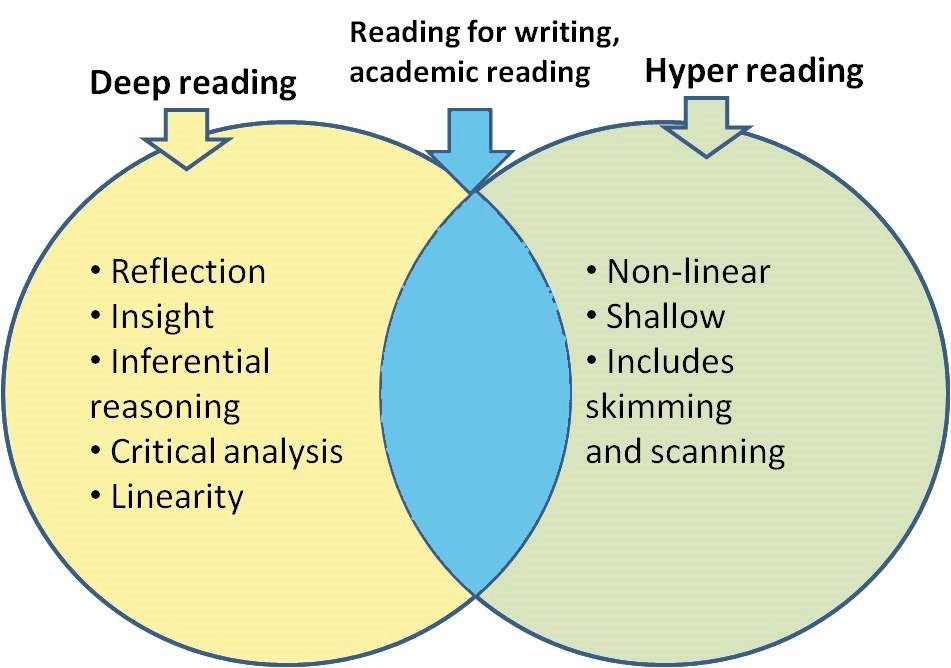
Americans are reading words all the time: email, texts, social media newsfeeds, subtitles on Netflix shows. But these words live in fragments that hardly require any kind of sustained focus; and, indeed, Americans in the digital age don’t seem interested in, or capable of, sitting with anything linguistically weightier than a tweet. The share of Americans overall who say they read books for leisure has declined by nearly 50 percent since the 2000s.

Even America’s smartest teenagers have essentially stopped reading anything longer than a paragraph. Students are matriculating into America’s most elite colleges without having ever read a full book. High schools have chunkified books to prepare students for the reading-comprehension sections of standardized exams.

Thinking benefits from a principle of “time under tension.” It is the ability to sit patiently with a group of barely connected or disconnected ideas that allows a thinker to braid them together into something that is combinatorially new. 
__________________________

A.I. related stocks have accounted for 75% of S&P 500 returns, 80% of earnings growth and 90% of capital spending growth since ChatGPT launched in November 2022. Data centers are eclipsing office construction spending and are coming under increased scrutiny for their impact on power grids and rising electricity prices.

The biggest medium-term risk I can think of for top heavy US equity markets: China’s Huawei and SMIC pierce the $6.3 trillion NVIDIA-TSMC-ASML moat by creating their own supernode computing clusters and deep-ultraviolet lithography machines of comparable quality.

Oracle’s stock jumped by 25% after being promised $60 billion a year from OpenAI, an amount of money OpenAI doesn’t earn yet, to provide cloud computing facilities that Oracle hasn’t built yet, and which will require 4.5 GW of power (the equivalent of 2.25 Hoover Dams or four nuclear plants), as well as increased borrowing by Oracle whose debt to equity ratio is already 500%. In other words, the tech capital cycle may be about to change.

__________________________

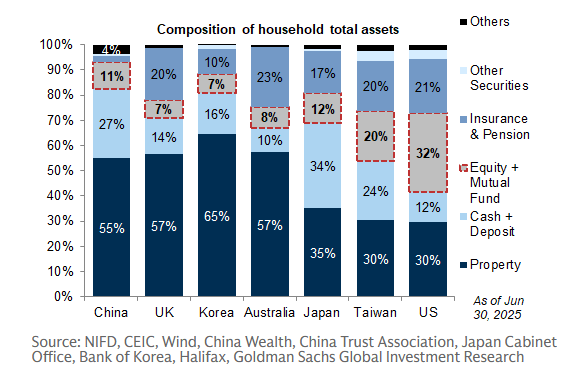
This is a fascinating look at how foreign households invest. I had no idea U.K. residents had such a low percentage of their personal investments in stocks, and the amount Japanese citizens hold in cash (which has provided no interest/return for decades) is incredible.
_____________________________
____________________________________

Africa is enormous. These countries would all fit within Africa’s border:

Dropped Calls, Polymarket & Passwords

That Dropped Call With Customer Service? It Was on Purpose. Endless wait times and excessive procedural fuss—it’s all part of a tactic called “sludge.”

In the 2008 best seller Nudge, the legal scholar Cass R. Sunstein and the economist Richard H. Thaler marshaled behavioral-science research to show how small tweaks could help us make better choices. An updated version of the book includes a section on what they called “sludge”—tortuous administrative demands, endless wait times, and excessive procedural fuss that impede us in our lives.

Sludge is often intentional,” said a professional that works in the customer service call center industry. “Of course. The goal is to put as much friction between you and whatever the expensive thing is. So the frontline person is given as limited information and authority as possible. And it’s punitive if they connect you to someone who could actually help.”

Helpfulness aside, I mentioned that I frequently felt like I was talking with someone alarmingly indifferent to my plight.

“That’s called good training,” Tenumah said. “What you’re hearing is a human successfully smoothed into a corporate algorithm, conditioned to prioritize policy over people. If you leave humans in their natural state, they start to care about people and listen to nuance, and are less likely to follow the policy.”

For some people, that humanity gets trained out of them. For others, the threat of punishment suppresses it. To keep bosses happy, Tenumah explained, agents develop tricks. If your average handle time is creeping up, hanging up on someone can bring it back down. If you’ve escalated too many times that day, you might “accidentally” transfer a caller back into the queue. Choices higher up the chain also add helpful friction, Tenumah said: Not hiring enough agents leads to longer wait times, which in turn weeds out a percentage of callers. Choosing cheaper telecom carriers leads to poor connection with offshore contact centers; many of the calls disconnect on their own.

“No one says, ‘Let’s do bad service,’” Tenumah told me. “Instead they talk about things like credit percentages”—the number of refunds, rebates, or payouts extended to customers. “My boss would say, ‘We spent a million dollars in credits last month. That needs to come down to 750.’ That number becomes an edict, makes its way down to the agents answering the phones. You just start thinking about what levers you have.”

“Does anyone tell them to pull those levers?” I asked.

“The brilliance of the system is that they don’t have to say it out loud,” Tenumah said. “It’s built into the incentive structure.”

That structure, he said, can be traced to a shift in how companies operate. There was a time when the happiness of existing customers was a sacred metric. CEOs saw the long arc of loyalty as essential to a company’s success. That arc has snapped. Everyone still claims to value customer service, but as the average CEO tenure has shortened, executives have become more focused on delivering quick returns to shareholders and investors. This means prioritizing growth over the satisfaction of customers already on board.

Customers are part of the problem too, Tenumah added. “We’ve gotten collectively worse at punishing companies we do business with,” he said. He pointed to a deeply unpopular airline whose most dissatisfied customers return only slightly less often than their most satisfied customers. “We as customers have gotten lazy. I joke that all the people who hate shopping at Walmart are usually complaining from inside Walmart.”

In other words, he said, companies feel emboldened to treat us however they want. “It’s like an abusive relationship. All it takes is a 20 percent–off coupon and you’ll come back.” Supervisors don’t tell customer service workers to deceive or thwart customers. But having them get frustrated and give up is the best way to meet numbers.

Sometimes they intentionally drop a call or feign technical trouble: “‘I’m sorry, the call … I can’t … I’m having a hard time hearing y—.’ It’s sad. Sometimes they drag out the call enough that customers get agitated, or say things that get them agitated, and they hang up.”

Even if an agent wanted to treat callers more humanely, much of the friction was structural, a longtime contact-center worker named Amayea Maat told me. For one, the different corners of a business were seldom connected, which forced callers to re-explain their problem over and over: more incentive to give up.

“And often they make the IVR”—interactive voice response, the automated phone systems we curse at—“really difficult to get through, so you get frustrated and go online.” Employees described working with one government agency that programmed its IVR to simply hang up on people who’d been on hold for a certain amount of time.

________________________

On June 12th, an anonymous trader opened a new account on Polymarket, an anonymous internet betting site that uses cryptocurrency to obscure the source of money. The new trader was interested in betting on one topic: whether the Israeli military would strike Iran within the next 24 hours, by Friday, June 13th.

As the 13th approached, most people thought it was unlikely, but this new account seemed convinced that airstrikes were imminent. The trades started during a one-hour period around 12pm; $1,728 of bets in the first one, then another $311, $280, $560. Then, between 10pm and midnight, with time running out, they accelerated their betting, showing their confidence by ramping up the bets, putting about $20,000 in total at risk.

Three and a half hours later, Israel struck Iran in a surprise attack—and the Polymarket trader cashed out. They had made a total of $134,000 in profits. After taking their winnings, they closed the account, never trading again. This was probably a case of geopolitical insider trading. Someone who knew that the strike was imminent decided to use that knowledge to make a lot of money anonymously through online betting markets.

This is pretty dystopian: individuals, state actors, even terrorist groups can decide to bet on their own behavior, even their own uses of violence. There’s nothing stopping someone who’s a high-profile political actor—or the people around them—from betting on an outcome, then making comments or posting something on, say, Truth Social or X, that inevitably affects public perceptions about a likely course of action. They can drive the price up or down at will, knowing full well that they can ultimately decide whether the value of a “share” goes to $0.00 or to $1.00. And then, they can anonymously cash out, with nobody the wiser. It’s the Wild West of insider trading.

____________________________

Nearly half of U.S. grandchildren (47%) live within 10 miles of a grandparent. Of those, significant numbers live even closer: 21% live between 1 and 5 miles, and 13% live within a walkable distance of 1 mile.

______________________________

The blue horizontal bars in the picture below are parallel to each other:

_______________________________

Ranked: The World’s Most Common Passwords. The data comes from NordPass, which analyzed the most frequently used passwords based on a 2.5 terabyte database of credentials exposed by data breaches. All of the passwords below would take a hacker less than 1 second to crack.

According to NordPass, your password should be at least 20 characters long and include uppercase and lowercase letters, numbers, and special symbols. They suggest that you never reuse passwords. If one account were to be compromised, other accounts that share the same password could also be at risk.

_______________________________

American household leverage is the lowest in 50 years. The leverage ratio is liabilities (mortgage, auto, credit, student loans) divided by the price of assets they own (stocks, bonds, real estate,).

Stock price gains help the top 10% wealthiest families disproportionately, but the biggest improvement in the leverage ratio above for most American families comes from home prices:

Money, Happiness & Cancer

William Vanderbilt was the son of the great Cornelius Vanderbilt. When his father died, Cornelius was the richest person on the planet. Billy took his father’s wealth and almost immediately doubled it with some shrewd business maneuvers (in today’s terms, imagine Elon Musk’s son inheriting $500 billion when he dies and then investing it and quickly doubling it to $1 trillion). Being the richest rich person didn’t make William Vanderbilt any happier:

“The sheer magnitude of his fortune, he told Chauncey Depew, gave him no advantages over men of moderate wealth. “I have my house, my pictures and my horses, and so do they. I can have a steam yacht if I want to, but it would give me no pleasure, and I don’t care for it.” On another occasion he spoke of a neighbor saying, “He isn’t worth a hundredth part as much as I am, but he has more of the real pleasures of life than I have. His house is as comfortable as mine, even if it didn’t cost so much; his team is about as good as mine; his opera box is next to mine; his health is better than mine, and he will probably outlive me. And he can trust his friends.”

Being the richest person in the world brought him, he said, nothing but anxiety.

The founder of MVMT recently sold his company for $100 million at age 29. He recently posted on Reddit how two years after selling his company he’s lonelier than ever and deeply depressed. Money dramatically improves everyone’s lives up until the point they can relax and be content. After that, assuming they are in moderately good health, almost all happiness comes internally.

________________________________

The largest medical A.I. randomized controlled trial yet performed, enrolling >100,000 women undergoing mammography screening, was published today. The use of A.I. led to 29% higher detection of cancer, no increase of false positives, and reduced workload compared with radiologists without A.I.

________________________________

The Drug Industry Is Having Its Own DeepSeek Moment. It isn’t just artificial intelligence—Chinese biotechs are now developing drugs faster and cheaper than their U.S. counterparts. Many top scientists trained in the U.S. have returned to China over the past decade, fueling the emergence of biotech hubs around Shanghai. And just as DeepSeek built a formidable chatbot—allegedly on a lean budget with limited access to semiconductors—Chinese biotech companies are also scrappier, capitalizing on a highly skilled, lower-cost workforce that can move faster. Additionally, companies can conduct clinical trials at a fraction of what they would cost in the U.S., while recent changes in the Chinese regulatory system have streamlined and accelerated the approval process to get a study started.

_____________________________

A new study by Stanford University researchers finds that the average online sportsbook customer expects a gain of 0.3 cent for every dollar wagered. In reality, sports bettors lose an average of 7.5 cents per dollar wagered, reflecting widespread overoptimism about financial returns. We found that people more or less understood the amount of money they had lost in the past, but they just thought the future would be better. Parlay bettors do so much worse than single-outcome bettors and are so much more overconfident in their chances that they likely account for most of the excessive optimism in the overall sample.

_______________________________

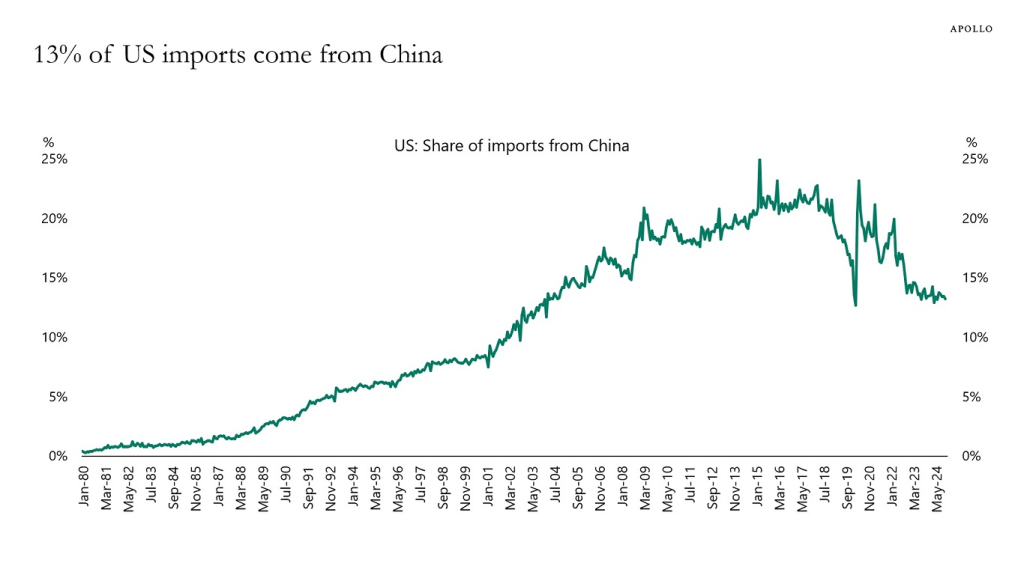
Only 13% of U.S. imports come from China:

_____________________________

European stocks have under-performed U.S. stocks in 12 of the last 15 years. However, the pedestrian pace of the European economy and markets could be a virtue for investors in the years ahead. Europe suffers from none of the over-building excesses that haunt the Chinese economy. European equity markets have none of the bubbly valuations that pose a threat to U.S. stocks. A starting point of a weak euro and monetary easing, combined with a high savings rate and fiscal capacity has the potential to boost both economic growth and dollar-denominated returns on European equities. Attractive dividend yields can allow European equities play a respectable role in generating income. Moreover, political pressure from within Europe, along with the threat of tariffs from the United States, could motivate bolder action from European policymakers in both deregulation and fiscal stimulus, triggering greater economic momentum. The strongest case for European equities is simply a value case. At the end of January, the MSCI Europe ex-UK had a forward P/E of 14.7 times compared to 21.8 times for the S&P500, a discount that is more than two standard deviations greater than its average over the past 20 years. It also sported a dividend yield of 3.3% compared to 1.3% for the S&P500.

_______________________________

The silver market is heading into a perfect storm. Even in our most conservative case, holding everything but solar demand constant, we’re looking at potential deficits of 100-200 million ounces annually for the next decade. Solar panels now consume one in four ounces of silver mined globally. Even at current solar installation rates – before factoring in any AI-driven surge in energy demand – we’re looking at a supply-demand gap as large as the entire elastic (price-sensitive) portion of silver supply. Solar demand is structurally inelastic – panel manufacturers will buy silver at almost any price because it represents a tiny fraction of total costs but is essential to functionality. The sheer scale of the energy transition dwarfs anything in silver’s industrial history – we’re talking about rebuilding the entire global energy infrastructure.