Luck, 529s, GLP1s & Wealth

Warren Buffett on Luck:

“When (Charlie Munger and I) were born the odds were over 30-to-1 against being born in the United States. Just winning that portion of the lottery, enormous plus. We wouldn’t be worth a damn in Afghanistan.  We won it partially in the era in which we were born by being born male. We won it in another way by being wired in a certain way, which we had nothing to do with, that happens to enable us to be good at valuing businesses. And you know, is that the greatest talent in the world? No. It just happens to be something that pays off like crazy in this system.”

If you had invested from 1960 to 1980 and beaten the market (the S&P 500) by 5% each year, you would have made less money than if you had invested from 1980-2000 and under-performed the market by 5% every year. When you start investing can be more important than anything else.

_______________________________________

For years, 529 accounts were synonymous with college savings plans. But recent updates have given the accounts a makeover. They’ve become education savings accounts, not just college savings accounts. The latest change allows the accounts to be used to help pay for a broader range of post-high school credentials, like certification in specialties like auto mechanics or food safety, and related expenses.

Money saved in the accounts can be used to pay for tuition and supplies for work force training, including certification and licensing programs, often offered at trade or technical schools; to pay for preparation and testing required to “obtain or maintain” a credential; and to pay fees for required continuing education. Some shorter-term credentialing programs were already eligible for tax-free 529 withdrawals, but only if they were offered at community colleges. Now, the range of options is wider. 

________________________________________

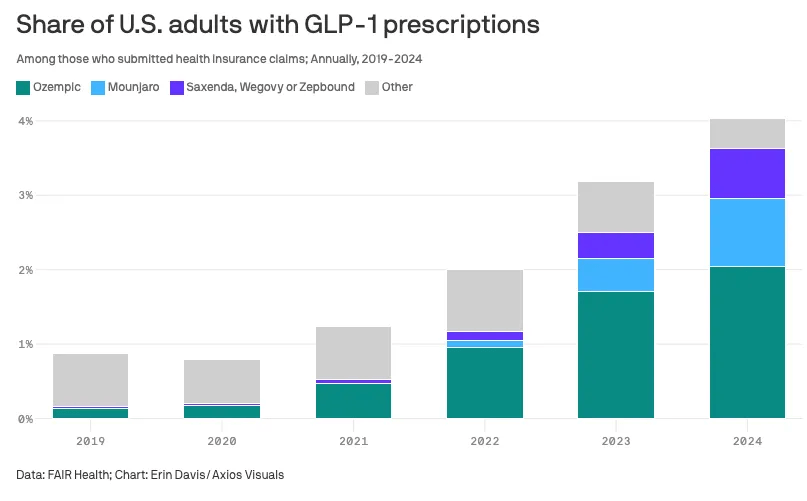
GLP-1s are a medication used for weight loss and diabetes management. In just 6 years after launch, more than 2% of Americans are taking this drug. To put the growth in context: GLP-1 drugs are set to generate nearly double the U.S. revenue of the iPhone’s first 10 years.
_______________________________________

Population ageing and decline is one of the most powerful forces in the world, shaping everything from economics to politics and the environment. It it implies the goal is the same today as it was in the past: finding ways to encourage couples to have more children. A closer look at the data suggests a whole new challenge.

Take the US as an example. Between 1960 and 1980, the average number of children born to a woman halved from almost four to two, even as the share of women in married couples edged only modestly lower. There were still plenty of couples in happy, stable relationships. They were just electing to have smaller families.

But in recent years most of the fall is coming not from the decisions made by couples, but from a marked fall in the number of couples. Had US rates of marriage and cohabitation remained constant over the past decade, America’s total fertility rate would be higher today than it was then. The central demographic story of modern times is not just declining rates of childbearing but rising rates of singledom: a much more fundamental shift in the nature of modern societies.

______________________________

When you ask people, “What builds wealth?” you get a wide variety of answers. Some will tell you it’s mindset. Some will say work ethic. Some will say it’s spending. And a host of other explanations. If you could have just one piece of information on somebody to predict their future wealth, what would it be? Would you ask for their IQ? Whether they went to college? How about their parents’ education level?

The answer is the most obvious and straightforward: For someone of working age, their income is the best leading indicator of wealth. What leads to higher income? Hard work, connections, and luck are important, but high earners tend to follow one of four distinct paths. These paths won’t guarantee success, but they are where high incomes tend to cluster:

  • Sales and Persuasion
  • Technical/Analytical Skills
  • Advanced Degrees/Credentials
  • Entrepreneurship and Business Building

______________________________

Some investing skills have to be mastered before any other skills matter at all. There is a hierarchy of needs.

At the foundation of this hierarchy are the boring but essential behaviors: living below your means, having an emergency fund, staying invested during downturns, and picking a reasonable asset allocation. These things aren’t exciting. They won’t get you likes. But they will carry you through decades of compounding.

Higher up the hierarchy are things like choosing the right stocks or funds and minimizing fees. These are useful, but only after the foundation is strong. Otherwise, you’re just rearranging furniture in a house with shaky walls.

Now, here’s the irony: the things that matter most often feel the least urgent. And the things that are least important often feel the most urgent. This is especially when social media and peer pressure amplify them. We chase what others are talking about, not what we truly need. If you get the big stuff right, the foundational skills, then the small stuff actually becomes less important.

A.I. In College, Sea Floors & Batting Stances

  • “College is just how well I can use ChatGPT at this point.”
  • “I think we are years — or months, probably — away from a world where nobody thinks using AI for homework is considered cheating.”
  • “It isn’t as if cheating is new. But now, as one student put it, ‘the ceiling has been blown off.’ Who could resist a tool that makes every assignment easier with seemingly no consequences?”
  • “Massive numbers of students are going to emerge from university with degrees, and into the workforce, who are essentially illiterate.”
  • “The humanities, and writing in particular, are quickly becoming an anachronistic art elective like basket-weaving.”
  • “Many teachers now seem to be in a state of despair.”
  • “Every time I talk to a colleague about this, the same thing comes up: retirement. When can I retire? When can I get out of this? That’s what we’re all thinking now.”

______________________________

______________________________

The High-School Juniors With $70,000-a-Year Job Offers. Companies with shortages of skilled workers are looking to high school shop classes to recruit future hires.

  • Employers are increasingly recruiting high-schoolers in skilled trades due to worker shortages as baby boomers retire.
  • High schools are revitalizing shop classes and teaming up with businesses that offer students opportunities for part-time work and academic credit.
  • Welding students are getting job offers paying $50,000 and above, with no college debt.
  • More businesses are teaming up with high schools to enable students to work part-time, earning money as well as academic credit.
  • Employers say that as the skilled trades become more tech-infused, they anticipate doing even more recruitment at an early age, because they need workers who are comfortable programming and running computer diagnostics. 

_____________________________

“The hardest thing to teach a student—and the hardest thing to believe consistently—is that there is nothing ‘out there’ to go and get. There is no part, no career, no opportunity for which you should be searching and scrounging and coveting. All of the preparation is within, and you keep yourself mentally and physically fit; you remain generous with yourself and others; you stay deeply in study about your craft. Whatever is yours will then arrive.” — ​Marian Seldes

_____________________________

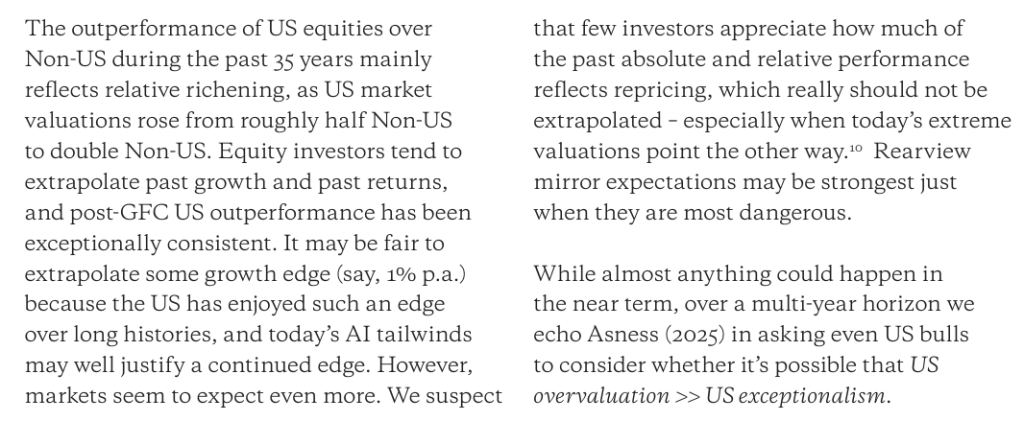
AQR released an excellent paper this week discussing U.S. vs. foreign stock markets.

_____________________________

Finland, the happiest country on earth, has things going for it that have been widely discussed in the past:

  • Universal healthcare and education
  • 320 days of paid parental leave, split equally between mothers and fathers
  • Freedom of the press, trust in institutions, and a culture of low corruption
  • Prioritization of community engagement, including frequently dining in groups, participating in civic life, and trusting the government to mostly take care of its people.
  • And a national character trait they call sisu—roughly translating to grit, resilience, or quiet inner strength

But it also has two others that are less widely discussed:

  1. There are 3.3 million saunas in Finland—roughly one for every 1.67 people. Finns drop by the sauna after work to relax, catch up with friends, or just sit in silence and sweat out the stress of modern life. There are even rules to encourage peaceful conversations – like no discussions about politics.
  2. Finland also scores high on the “lost wallet test.” This is a study from 2019 in which Stanford researchers dropped almost 19000 wallets in 355 cities/40 countries, to get a measure for whether people are generally honest. Scandinavia scored at the top of the lost wallet test: the Finns, for example, returned 90% of the wallets. And that’s not even the number that’s important. The report suggests that a strong predictor of the happiness of a country is whether the majority of people believe others would return their wallet. Finns trust their fellow Finns to do the right thing.

What can we learn from them to be happier?

  • Find people to break bread with
  • Go outside. 
  • Aim for “satisfied,” not euphoric. 
  • Cultivate a belief that most people are basically kind and trustworthy.

________________________________

Humans still haven’t seen 99.999% of the deep sea floor. Bizarre creatures like vampire squid and blobfish make their home in the dark, cold, depths of the deep sea, but most of this watery realm remains a complete mystery. Maps created with tools like sonar can show the shape of the seafloor, but it’s much harder to send cameras down beyond 200 meters, or more than 656 feet, where sunlight begins to fade rapidly and the waters turn cold and dark. This is the region of the ocean that’s considered “deep.”

______________________________

The 18 Degrees That Turned Aaron Judge Into the Next Babe Ruth. On May 5 of last season, Judge was mired in one of the worst slumps of his career. So when he stepped to the plate for the first time, he decided to try something different. Up to that point, Judge had always used an open batting stance, which angled his left foot toward the third baseman. Against Detroit Tigers ace Tarik Skubal that afternoon, Judge moved the placement of his front leg ever so slightly back toward the pitcher. He promptly blasted a home run into the right-center field bleachers, followed by a booming double a few innings later. The change to Judge’s setup was almost imperceptible at first, but it had an unimaginable impact: In the year since, he has put together one of the greatest stretches of hitting that baseball has ever seen.

Marriage, Scammers & Losing It On Live TV

Losing It on Live TV. Lorne Michaels reportedly dislikes when “Saturday Night Live” cast members break character. But over 50 seasons, it’s become one of the show’s signature moves — one that usually delights the audience.

__________________________________

A common narrative is that less people are getting married, and the number of births is declining because more college educated women are choosing their jobs over starting a family. In reality, the graph below shows it’s the opposite. The married rates for college educated women have held steady, while the number of non-college educated married women has plummeted.

The reason: Men without degrees have seen their economic prospects decline over the past few decades. These financial troubles have led to lower marriage rates for men — and for women without four-year degrees (even as these women have seen their incomes rise). In other words: a “good” man has become harder to find, at least for women with less than a four-year degree. So, they’re getting married less.

_________________________________

Scammers are seen as faceless, evil people who make Aussie lives a living hell. We decided to track down a scammer, and this is how and why he does it. He worked alongside hundreds of others aiming to steal money in a ‘pig butchering’ romance scam in a sophisticated operation designed to part unsuspecting victims from their cash. This type of scam devastates thousands of Aussies a year.

Seen below, scammers will queue up “the model” to speak to the victims on video calls.

_________________________________

The Endowment Effect is sneaky. It whispers, “Hold on. This is yours. It’s special.” But the truth is, nothing is special just because you own it. A bad stock doesn’t become good because it’s in your portfolio. A house isn’t worth more because you have memories in it. How do we fight the Endowment Effect?

  1. Ask: If I didn’t own this, would I buy it today? If the answer is no, it might be time to let go.
  2. Detach from the purchase price. The stock doesn’t know what price you bought it at.
  3. Think like an outsider. What advice would you give a friend in your position?
  4. Set clear exit rules. Have a plan for when to exit an investment before you even enter.
  5. Seek a devil’s advocate. Have someone play devil’s advocate to convince you out of your decision to hold.

________________________________________

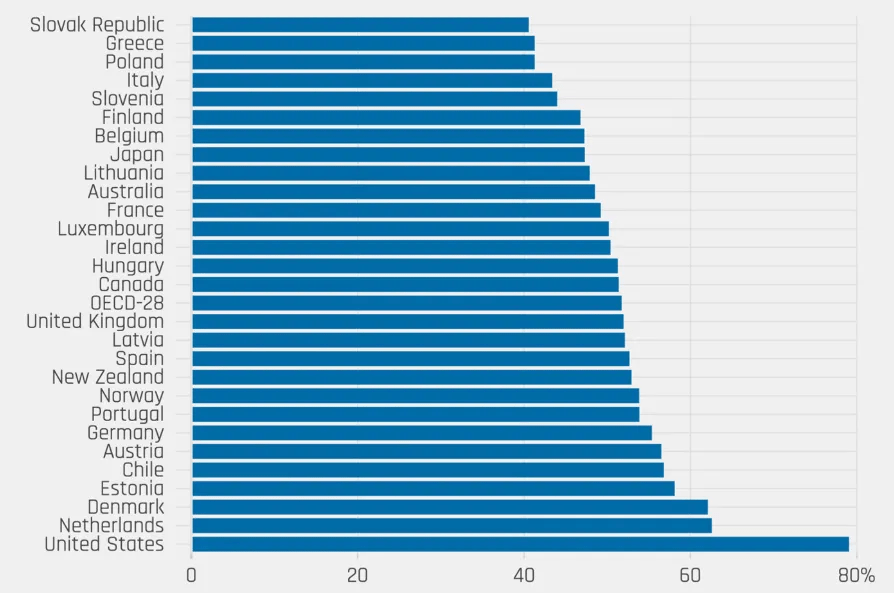
The graph below shows wealth concentration/inequality among top the 10% in the OECD member countries. The United States is unlike anywhere else in the world:

__________________________

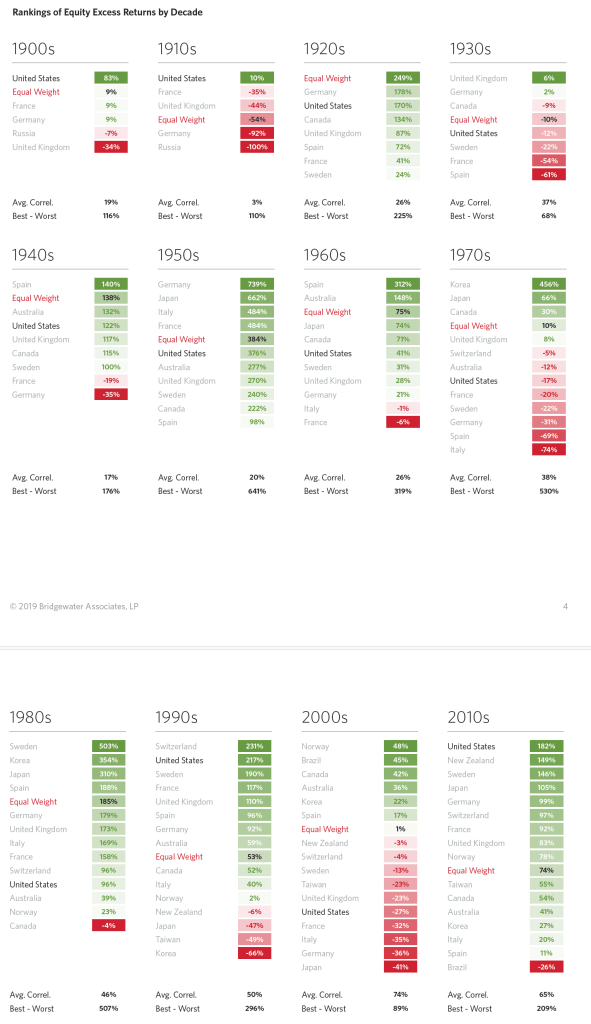
How many decades since 1900 has the United States stock market outperformed the rest of the world? Only 3:

  • 1900’s
  • 1910’s
  • 2010’s

___________________________

America dominates the rest of the world in venture capital (VC) investments:

_____________________________

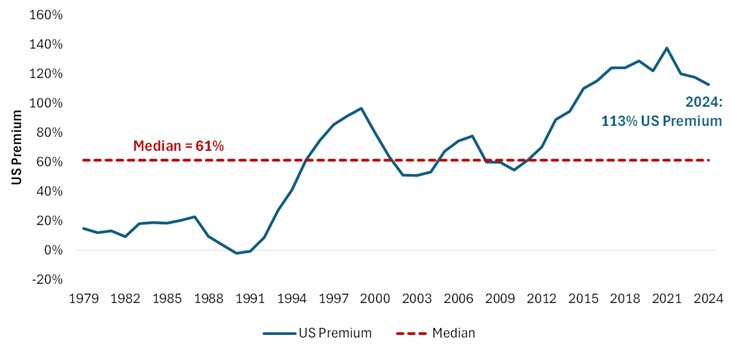
Perhaps the single greatest divergence in equity markets has been the continued outperformance of US versus international equities—and thus the widening of the valuation gap between the US and the rest of the world. To try and determine why, we regressed value against the other common risk factors for the top 1,000 stocks globally. By far the most significant difference, explaining about half the valuation gap, is the domicile of listing. US-listed stocks are substantially more expensive than internationally listed stocks for no reason other than the place of listing.

Were a larger percentage of the valuation gap explained by fundamentals; we’d expect such a gap to persist. But given that the valuation gap is primarily explained simply by the location of listing, we think there’s a strong reason to expect a convergence—and therefore to favor international over US-listed stocks, despite their terrible relative performance over the past decade.

Figure 1: Premium of US vs. International Equity Valuations (5-Year Average, P/B)