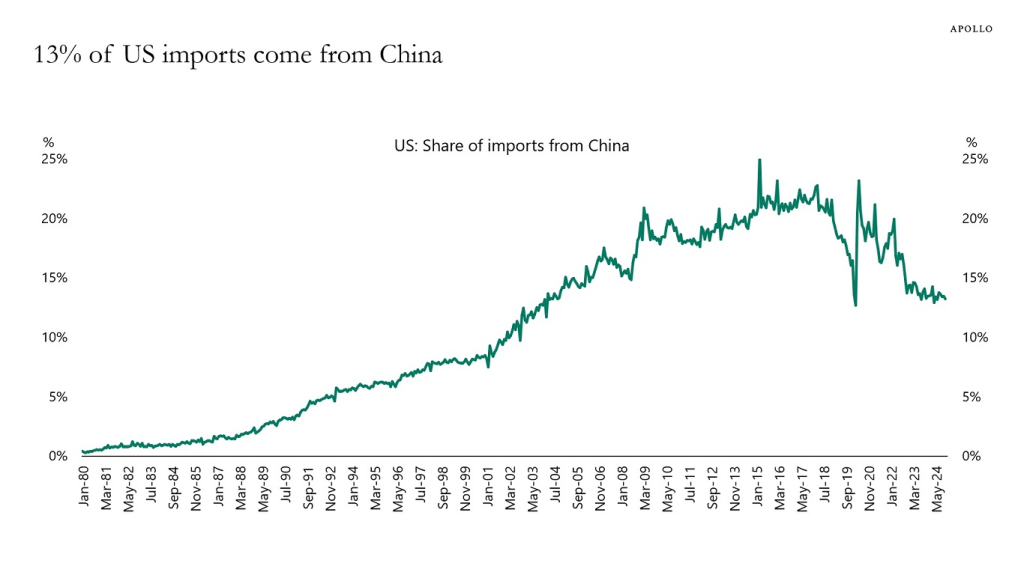
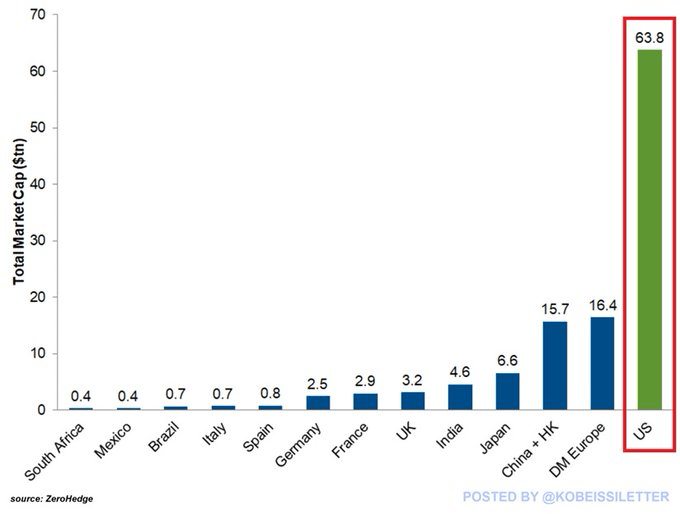
Great article from Louis-Vincent Gave discussing why most investors don’t realize how far ahead China has moved ahead of the rest of the world in many industries.
___________________________
Young people are not watching sports (live). The average age for broadcast prime-time NFL viewers is 62.5. Younger people have shorter attention spans. And we know for a fact they have infinite choices in terms of how to spend their time. So there’s tons of things vying for their time. And there are ways they can engage with a sport without spending three hours watching a live event. They can follow it on social platforms. They can get highlights as they happen. They can play fantasy. They can engage with individual athletes and immerse themselves in their fashion taste or musician tastes. They can read trade rumors or draft rumors
___________________________
Marijuana use among teens is dropping. Biennial data from the Youth Risk Behavior Survey from 2011 to 2021 included 88,183 adolescents in grades 9th through 12th showed that the percentage of adolescents who reported current marijuana use dropped significantly from 23.1% in 2011 to 15.8% in 2021. Although current marijuana use declined significantly for both girls and boys over time, in 2021 girls were more likely (17.8%) to currently use marijuana than boys (13.6%). In 2011, the opposite was true, with boys (25.9%) being more likely to use marijuana than girls (20.1%).
Do we need to throw out our black plastic spatulas? Cooking with any plastic is a dubious enterprise, because heat encourages potentially harmful plastic compounds to migrate out of the polymers and potentially into the food, black plastic is particularly crucial to avoid.
___________________________
The crypto industry accounted for almost half the money contributed by corporations to political action committees in the first half of 2024.
Forget trying to decide what your life’s destiny is. That’s too grand. Instead, just figure out what you should do in the next 2 years.
Interview your parents while they are still alive. Keep asking questions while you record. You’ll learn amazing things. Or hire someone to make their story into an oral history, or documentary, or book. This will be a tremendous gift to them and to your family.
Asking “what-if?” about your past is a waste of time; asking “what-if?” about your future is tremendously productive.
When you are stuck or overwhelmed, focus on the smallest possible thing that moves your project forward.
Discover people whom you love doing “nothing” with, and do nothing with them on a regular basis. The longer you can maintain those relationships, the longer you will live.
Write your own obituary, the one you’d like to have, and then everyday work towards making it true.
The highest form of wealth is deciding you have enough.
Very small things accumulate until they define your larger life. Carefully choose your everyday things.
Humility is mostly about being very honest about how much you owe to luck.
________________________________
I’m reminded of the scandal at Ford Motor—when they knew that the fuel tank in the Pinto could erupt into flames after a collision. They could fix it at a cost of ten dollars per car. But they did nothing. Ford calculated that 180 drivers would burn to death, and each would result in a $200,000 payout. It was cheaper just paying that money to victims’ families than recalling all eleven million Pintos and installing a safer fuel tank.
This is the same kind of math they’re doing at the big web platforms right now. The money they make from addiction more than offsets their cost from dead teens and ruined lives. In 1995, teens were alone 3.5 hours per day. But nowadays teens spend up to nine hours daily staring into screens.
Spotify is paying hundreds of millions on an annualized basis to audiobook publishers, according to internal figures obtained by Axios. The company has also doubled the number of titles available to premium members in the past few months from 150,000 to 300,000. The figures, confirmed by a Spotify spokesperson, suggest Spotify’s entry into the audiobook market is helping to significantly grow the pie for audiobook publishers at large. Without Spotify, the audiobook industry in the U.S. grew 14% in unit sales between Q4 2022 and Q4 2023, according to Bookstat. With Spotify, it grew 28%.
________________________________
Research suggests that unearned income is at best inferior as a happiness multiplier and at worst a Faustian bargain. People constantly ask me what they should help their adult kids pay for, if they themselves have been lucky enough to do well in life. The dilemma they have is that they’re proud of having earned their way and feel that their self-reliance, not a handout, is the gift they want to pass on; yet they also feel that it’s stingy to hold out on their nearest and dearest, rather than share their good fortune. Here’s a rule of thumb to help resolve that dilemma: If you can afford to help your adult kids, pay for investment, not consumption. In practice, that means: Education? Absolutely. Vacation? No way. Staking a business? Yes, if it seems a viable proposition (as opposed to mere whim or lifestyle choice). Wine cellar? Don’t be ridiculous. A down payment on a house? Judgment call. In this way, you are giving generously—to help them earn their own success.
________________________________
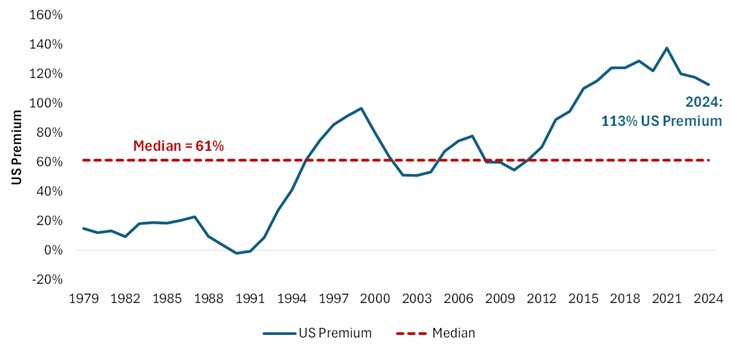
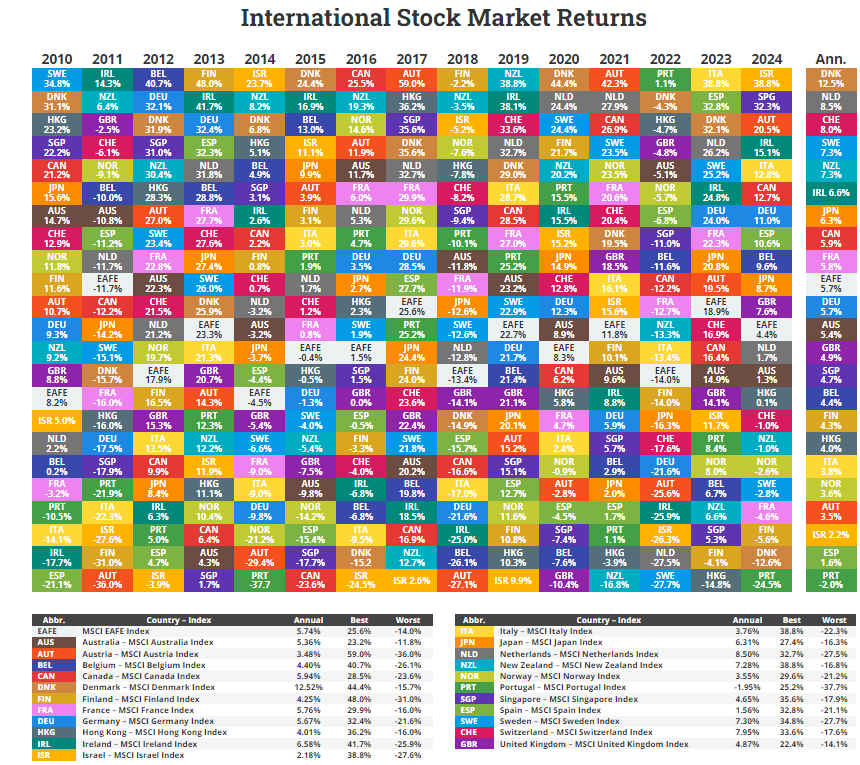
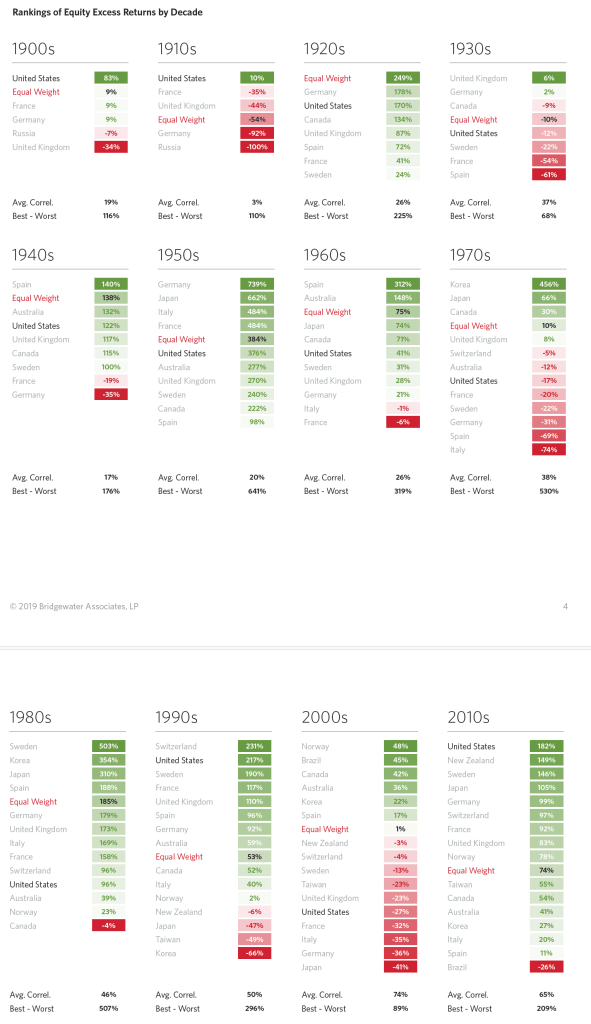
If it feels like the S&P 500 has always outperformed everything else in the world (and always will), you only need to go back to the 2000 – 2009 decade to see that cycles always change:
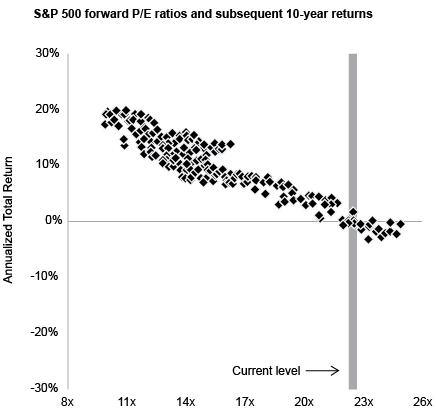
How expensive stocks are when you buy them (price to earnings ratio) has a direct correlation to the future returns.
It’s so common for people’s memories about a time to become disconnected from how they actually felt at the time. When thinking about our own lives, we don’t remember how we actually felt in the past; We remember how we think we should have felt, given what we know today. “You should have been happy and calm, given where things ended up,” you say to your past self. But your past self had no idea where things would end up. Uncertainty dictates nearly everything in the current moment, but looking back we pretend it never existed. Understanding why economic nostalgia is so powerful – why it’s almost impossible to remember how uncertain things were in the past when you know how the story ends – helps explain what I think is the most important lesson in economic history, that’s true for most people most of the time: “The past wasn’t as good as you remember. The present isn’t as bad as you think. The future will be better than you anticipate.”
_____________________________
Success has become overplaybooked. math competitions take naturally very smart kids and focus them entirely on training for specific math tests. The game selects for people who are smart enough and can train the most and learn the best. In the process, it kills polymaths. The problem isn’t that kids are competing or studying hard, but that they’re narrowing. One of the reasons kids can’t (or won’t) read full books any more might be that books contain a lot of superfluous information that won’t be on the test. There’s no testing skill that can be related to … Can you sit down and read Tolstoy?, so teachers don’t make kids sit down and read Tolstoy. Or anything long and challenging. The problem isn’t that they don’t know Tolstoy, specifically, but that they might be missing out on the one book that ignites something in them that makes them want to learn.
___________________________________

College students now seem bewildered by the thought of finishing multiple books a semester. Teachers have noticed this problem everywhere. Many students no longer arrive at college—even at highly selective, elite colleges—prepared to read books. Lit Hum often requires students to read a book, sometimes a very long and dense one, in just a week or two. Students tell their college professors that, at their public high school, they have never been required to read an entire book. They have been assigned excerpts, poetry, and news articles, but not a single book cover to cover. The anecdote helped explain the change teachers were seeing in their students: It’s not that they don’t want to do the reading. It’s that they don’t know how.
The percentage of Americans with obesity fell for the first time in 45 years. The Ozempic effect is here:
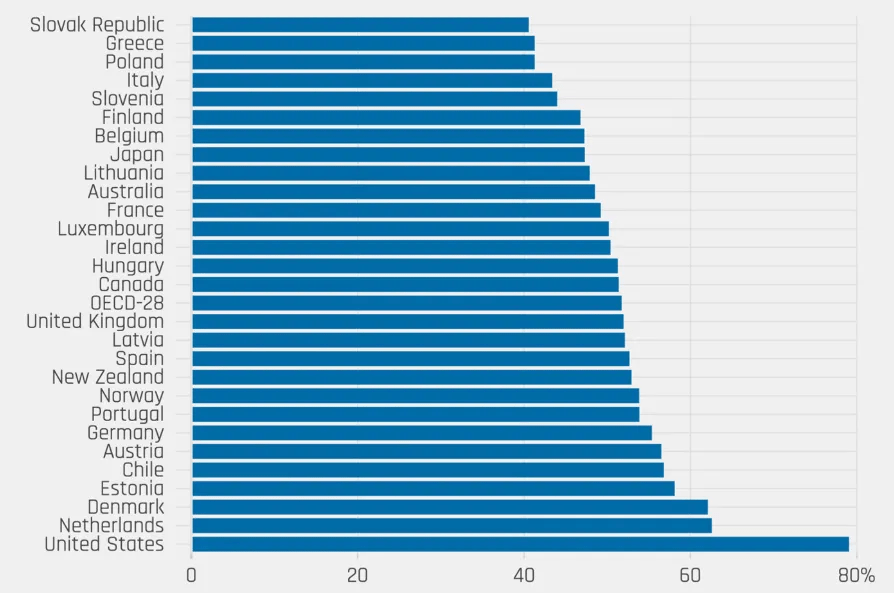
A higher price to earnings ratio means a country’s stock market is more expensive. A lower number is less expensive. It’s the price you are paying for the earnings of the companies.
Average of Foreign Developed Stock Markets: 20 Average of Foreign Emerging Stock Markets: 19
Status leads people to assume something about us that we might otherwise have had to prove. It’s a pattern-matching mechanism that allows us to quickly filter and process information in a world defined by incomplete knowledge. We live in a time-constrained world where don’t have the capacity to evaluate everyone on merit alone, and status is our way of expediting that evaluation process. And let’s not kid ourselves, most of us care a lot about status, to the point that we’ll sacrifice money for it. In a survey of 1,500 office workers, seven out of 10 said they would forego a raise for a higher status job title.
Buy this, not that: Buy term life insurance, not whole life insurance. Buy retirement accounts, not annuities. Buy individual disability insurance, not group disability insurance. Buy experiences, not stuff.
The speedometer below shows how many minutes it takes to arrive somewhere based on your speed. You can see that at the beginning, the value of going faster is enormous. As you hit about 65 miles per hour, the value falls off a cliff while the danger of increasing your speed rises exponentially.
____________________________
In the digital thunderdome of LinkedIn hustlers, Twitter thread bros, and Instagram “success stories,” there’s a piece of advice I continue to see shared, repackaged in various forms but always carrying the same core message: surround yourself with the most ambitious and successful people you can find.
This poll reads like a group of people that have been on drugs for a long time, know they’re awful, but cannot stop using them:
_______________________________
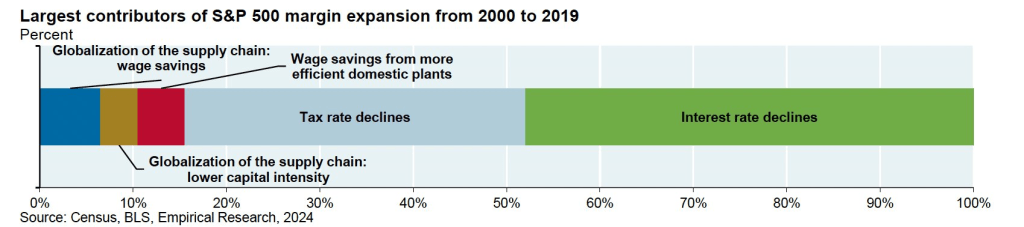
People are biased towards solving problems through addition rather than subtraction.The reason? Because adding something makes you feel like you are advancing, while taking something away makes you feel like you are retreating. We see this dynamic across all parts of the economy, and society at large. the case can be made that we live in an era of too much. Too much information, too much stuff, too many choices, and too many distractions. As a result, there is a good chance that the path to happier lives and investment portfolios performance, might start by taking things away.
_______________________________
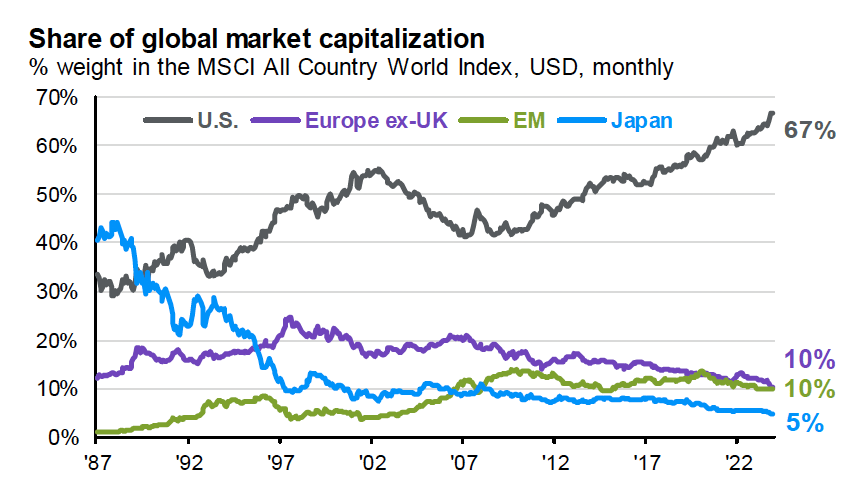
Should Europeans put 72% of their portfolios into 1 foreign country? Obviously, the same question should be asked of Americans, even though they live in that country. As of September 2024, the U.S. represents 72% of the MSCI World Index. Many passive investors simply buy into this widely adopted benchmark, but is that a prudent approach?
The primary reason we’re seeing all this disruption in the job market is because we’ve been part of a mass delusion about the very nature of work.
We told ourselves that millions of corporate workforce jobs—that pay good salaries, have good benefits, and allow you to save for retirement—were somehow a natural feature of the universe.
In fact, that entire paradigm was just a temporary feature of our civilization, caused by builders and creators not being able to do the work required by themselves. And that’s going away.
But it’s ok.
Most of the jobs sucked anyway, and they took up most of the daily waking hours we were supposed to be spending with family and friends.
Plus even if this transition happens really fast, it still won’t be overnight. Big things take a while.
And most importantly—what waits for us on the other side is a better way to live. A more human way to live—where we identify as individuals rather than corporate workers and exchange value and meaning as part of a new human-centered economy.
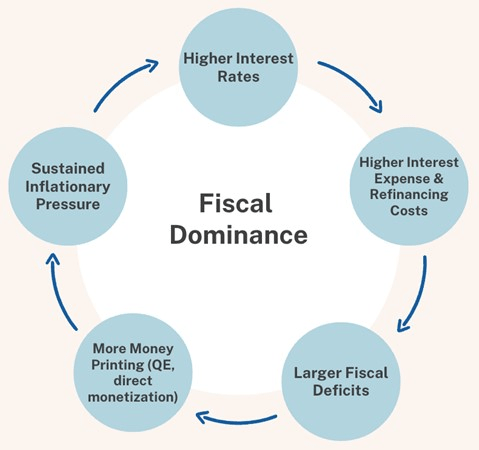
Great newsletter from Lyn Alden walking through the reasons why we will continue to have enormous structural government deficits moving forward and the implications on the global economy and financial assets.
Nobody knows whether stocks will be up or down tomorrow. Occasionally some newsworthy development is the clear driver of stock market movement, but usually daily market watchers are studying randomness, putting themselves at risk of missing the forest through the trees. Price movement always comes before the narrative. Reality is much more complex.
____________________________
OnlyFans now generates $6.3 billion in annual gross revenues, up from $300 million five years earlier. A reason for OnlyFans success is its high revenue share rate (with its content creators) – 80% – which far exceeds that which a creator might get as a performer working for a production company or other agency. OnlyFans creators collected $5.3 billion in 2023, a 19% increase year-over-year. Many OnlyFans creators now treat sites such as Reddit, Imgur, Instagram, TikTok, and Twitter as “front doors” for OnlyFans customer acquisition. OnlyFans has paid its two owners $1.1 billion in dividends since 2019, with $472 million paid in 2023 alone.
Teen vaping has hit a 10-year low. In an annual survey conducted from January through May in schools across the nation, fewer than 8 percent of high school students reported using e-cigarettes in the past month, the lowest level in a decade. That’s far lower than the apex, in 2019, when more than 27 percent of high school students who took the survey reported that they vaped.
___________________________
The dating apps are under a lot of pressure. Falling revenues, people not wanting to pay, and Gen Z seemingly uninterested have led to collapsing stocks and circling activist investors. Their only path forward is monetization – but what does that mean for the demographic crisis?
American homes have been going up in price since early 2012. That’s part of the reason why it’s been American’s favorite investment for 12 year running. The other reason is leverage. If you put down 20% (or less) and the home price goes up 20%, you’ve made 100% on your investment. Of course, most American’s have done much better than that since 2020.
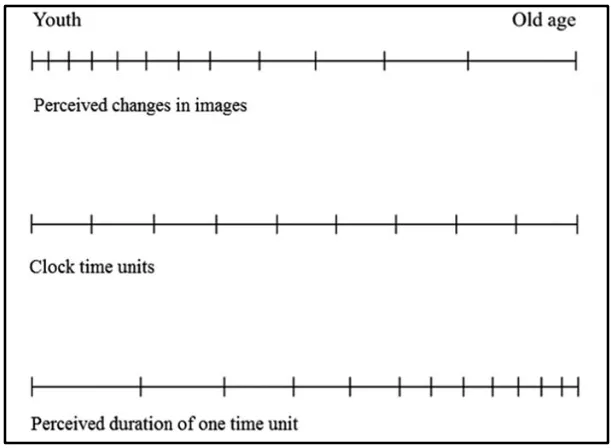
Based on the way we are wired as humans; our memories are constantly changing over time. Remembering is dominated by the perspective we have in the current moment. We have an ‘experiencing self’ and a ‘remembering self.’ Your experiences of things are continuous in real time and associated with all sorts of feelings and thoughts and sensations. And then in the cold light of reason you have this remembering self in a completely different context, trying to make sense of yourself, a person with a very narrow window of experience.
A look at why young adults are the ones most in crisis with mental health. A recent study found that 36 percent of participants ages 18 to 25 reported experiencing anxiety and 29 percent reported experiencing depression—about double the proportion of 14-to-17-year-olds on each measure. Older adults, often depicted in popular culture and news commentary as isolated and unhappy report the lowest levels of anxiety and depression.
The following graphs show the dividend yields for the S&P 500, MSCI World (all developed stock markets including the U.S.), MSCI EM (emerging markets) and MSCI EAFE (developed markets excluding the U.S.).
Here is the MSCI EAFE forward P/E ratio (stock prices relative to their projected earnings over the next 12 months). The higher the number, the more expensive the market. The S&P 500 is currently at 23. It would be close to being off the chart it is so expensive relative to the rest of the developed world.
They identified 8,577 who were in the study from the early 1990s until 2017 and who met a variety of other criteria for inclusion. This gave them 25 years of follow up, long enough to ask the question: how does participation in sports affect life expectancy? The results? Playing tennis was the clear winner: extending one’s life expectancy by 9.7 years. The other sports all provided benefits too:
Tennis: 9.7 years gain in life expectancy
Badminton: 6.2 years
Soccer: 4.7 years
Cycling: 3.7 years
Swimming: 3.4 years
Jogging: 3.2 years
Calisthenics: 3.1 years
Health club activities: 1.5 years
One possible reason for tennis, badminton, and soccer doing so well is that out of the 8 sports studied, these are the ones that require 2 or more people and involve social interaction. As the authors explain, “Belonging to a group that meets regularly promotes a sense of support, trust, and commonality, which has been shown to contribute to a sense of well-being and improved long-term health.”
Or it might be that the type of exercise you get in tennis – short bursts of activity rather than slow, steady plodding exercise – might be better for you. The authors noted that “short repeated intervals of higher intensity exercise appear to be superior to continuous moderate intensity physical activity for improving health outcomes.”
Constantly being presented with the idea that their friendships should mirror the deep, intimate, dyadic friendships of women alters men’s expectations in a potentially unhelpful way. Guys see memes about how it’s dysfunctional to spend hours with their buddies without discussing personal issues, or read a reddit post about how sad it is that men don’t have friends they can completely open up to, or listen to a podcast about how they need to be vulnerable with other men if they want to be happy and healthy, and start wondering if their social life is subpar and they’re missing out. “Man, maybe I don’t have good friends after all.”
Irving Fisher has one of the most famous quotes in financial history (for being very wrong at the worst possible time), but his full story is even more tragic. Another great lesson on the danger of leverage and overconfidence.
__________________________
Why you don’t need to separate your clothes anymore. There’s no actual threat to your clothes or machines by washing everything together—the life of your clothes may be shortened slightly, but that’s all. Since most of the clothes we wear are now a byproduct of fast fashion, there’s less investment into each piece, and they’re not really built for the long haul the way clothes once were, anyways. Also, the natural fibers and dyes that used to be mainstream have been long replaced by synthetic fibers and better dye processes, which result in much more colorfast garments. These garments also generally stand up to wash processes better. Advancements in detergents also focused on using less of it, stopping colors from fading, keeping whites bright, and washing everything in cold water to save on energy. As a result, laundry in general is a much gentler on clothes.