We are living at a time of profound unhappiness.
But here’s the really weird part: The ones suffering most are not just the down-and-out types—the addicts, the impoverished, the failsons. Those for whom there are obvious things gone wrong in their lives. On the contrary, it is also those who seem to have everything going right for them—in other words, our young and most successful strivers.
I’ve spent my life surrounded by that very group. As a longtime college professor, I have been privileged to teach hundreds of wonderful students—ambitious strivers just starting out on what promised to be terrific careers and lives. I have met countless young people who were so inspired by ideas, so purpose-driven, and so enthusiastic.
But in 2009, I left academia to run a nonprofit in Washington, D.C. And when I returned to campus a decade later, the atmosphere was dark. Larger and larger percentages of students were suffering from depression and anxiety. At some schools, more than half of students were receiving mental health treatment. My office hours were more like counseling sessions than tutoring. Hope and optimism had been replaced by anger and sadness.

Most of the younger generation is online a lot: scrolling social media, watching videos. To simulate a social life, they spend hours listening to podcasts of other people having interesting conversations. You could call it “social pornography.” Most of the time, there’s nothing better to do. They crave a big, meaningful project and immersing themselves in it. But they can’t come up with any ideas for what that project might be . . . so it’s back online.
They don’t fit the traditional résumé of unhappy people. They’re not addicted to drugs, nor struggling financially. In fact, their life looks enviable from the outside. But like so many young people I’ve spoken to over the years, they feel empty.
What these young strivers describe to me is something akin to waiting in an airport terminal for a delayed flight that never leaves. They try to stay occupied to keep themselves from going mad, always in the hope that boarding will finally be called and the flight will take off. And their distraction tactics—which invariably involve technology—keep them from thinking too much but make their sense of emptiness worse.
One of the young strivers I talked to was telling me about his virtual job, dating apps, social media friends, and video gaming. Then, out of the blue, he said something fundamental.
“I feel like I’m living in a simulation.”
Others said the same thing. Life felt unreal: full of false rewards, empty accomplishments, therapeutic talk, and fake experiences, all curated to pass the time as painlessly as possible.
Again and again, people said that life was busy but not meaningful. That experiences and relationships felt meaningless. Or that they didn’t know what they were meant to do in work and life. And it’s worse for the strivers than anyone else: The richer, more technologically advanced the country, the greater the percentage of the population that answers “no” to the question “Do you feel your life has an important purpose or meaning?”
Here’s why: Strivers are great at solving technical problems and answering specific, hard questions. They have been educated and trained to believe that, while the world is incredibly complicated, with enough knowledge and hard work, every problem can be solved.
The truth is, many big, complicated problems can be solved with sheer intellectual horsepower. But meaning is not one of them. “What is the meaning of my life?” is a question that cannot be answered like “How do I build an app for finding concert tickets?” or “How do I create an effective six-month weight-loss program?” Meaning is a question that must be lived, not solved with a Google search or simulated using artificial intelligence. It requires deep contemplation and a commitment to living a real life, full of unsolvable secrets, puzzling riddles, unexplainable bliss, and terrible suffering.
But in all their technical excellence, strivers trivialize their humanness by reducing life’s magnificent inscrutability to a series of complicated but solvable problems. They aren’t just living in a simulation; they are also creating the simulation they are living in.
In his 2009 book, The Master and His Emissary: The Divided Brain and the Making of the Western World, Ian McGilchrist argued our brains have two hemispheres that deal with everything, but they do so in consistently different ways. The right side of the brain is the “master,” which asks big, transcendent questions such as “Why am I alive?” The left side—which he calls the “emissary”—addresses such practical questions as “How do I get food so I can keep being alive?”
In other words, in the right hemisphere we ask the lofty why questions about life. On the left side, we ask, earthbound, what to do now and how to do it.
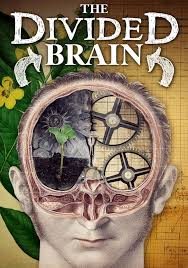
Hemispheric lateralization explains the acute crisis of meaning today. In our increasingly complicated, technology-dominated, and endlessly distracting world, people are shoved to the left side of their brains. They are stuck in a complicated simulation where there is a lot going on, but which is bereft of mystery and meaning.
Older people remember the before times, when meeting a potential mate for the first time involved a real-life conversation, and a big question of life’s meaning couldn’t be reduced to a Google search. But most young adults today have never known any domain other than Left Brain Land. And this is especially true for the strivers. They know every complicated nook and cranny of that technical dystopia, but the mysterious realm of meaning seems mythical, like the lost kingdom of Atlantis.
Stuck outside the realm of the numinous right hemisphere, life becomes just an endless loop of complicated left-brain routines and habits—a simulation of a life that is deep, mysterious, and authentic. It’s frustrating and empty.
Worse: It’s boring. And humans absolutely despise boredom.
Why are we so bored? Because life feels repetitive and meaningless, and even a minute here or there with nothing to do feels like an hour. So out comes the phone, every few minutes, all day long, changing our brain chemistry in dangerous ways.
And what side of our brains are we on as we do all this? The mundane left, of course, not the mysterious right. The remedy we’ve created to avoid the boredom of modern life—this app, that video—reinforces our inability to ponder the abstractions necessary to formulate any concept of our lives’ meaning.
This asymmetry explains why we’re bombarded with ingenious solutions to age-old problems but never seem to make progress toward greater happiness. In fact, it’s the reverse: We are losing our sense of life’s meaning faster and faster.

_____________________________
The famous origin story of Think and Grow Rich, by Napoleon Hill, is that Andrew Carnegie commissioned Hill in 1908 to interview 500 successful people over 20 years.
That origin story is fabrication.
In reality, in 1908 Hill was fleeing police in Alabama under a fake name after committing fraud, facing domestic violence accusations, and abandoning his family. The book’s real author was his wife. She took Hill’s rambling, failed manuscripts and refined them into Think and Grow Rich.
The book contains a mix of genuinely good advice:
- Specific goal-setting with deadlines
- Persistence and grit
- The “mastermind” concept of surrounding yourself with sharp people
- The value of specialized knowledge
It also contains psuedoscienctific nonsense like:
- “Sex transmutation” or redirecting sexual energy toward business
- The idea that brains communicate through vibrations
- A “sixth sense” chapter about receiving messages from infinite intelligence
If Think & Grow Rich is a fabrication from a con man, how has it sold over 100 million copies and helped millions of people since it was published?
The answer lies in the placebo effect.
Most of the advice from self-help gurus works not because it’s scientifically accurate, but because believing in it changes people’s behavior, which then changes their outcomes. Believing they can accomplish something makes them more likely to try it and then more likely to try hard and persist.
Is his book Useful, Not True, Derek Sivers says most things are hard to know for certain, so you might as well believe whatever is most helpful for you and others. The criticism that self-help is pseudoscience misses the point. Due to the placebo effect, even if something is not scientifically true, it can be useful for many people.
____________________________
Key findings from chapter 3 of the 2026 World Happiness Report: Social media is harming adolescents at a scale large enough to cause changes at the population level:
Is social media use reasonably safe for children and adolescents? We call this the “product safety question”, and we present seven lines of evidence showing that the answer is no.
The evidence of harm is found in: 1) surveys of young people; 2) surveys of parents, teachers, and clinicians; 3) contents from corporate documents; 4) findings from cross-sectional studies; 5) findings from longitudinal studies; 6) findings from social media reduction experiments; and 7) findings from natural experiments.
We show there is now overwhelming evidence of severe and widespread direct harms (such as sextortion and cyberbullying), and compelling evidence of troubling indirect harms (such as depression and anxiety). Furthermore, we show that the harms and risks to individual users are so diverse and vast in scope that they justify the view that social media is causing harm at a population level.
We further argue that when these lines of evidence are considered alongside the timing, scope, and cross-national trends in adolescent wellbeing and mental health, they can help answer a second question: was the rapid adoption of always-available social media by adolescents in the early 2010s a substantial contributor to the population-level increases in mental illness that emerged by the mid 2010s in many Western nations? We call this the “historical trends question”. We draw on our findings about the vast scale of harm uncovered while answering the product safety question to argue that the answer to the historical trends question is “yes”.

__________________________
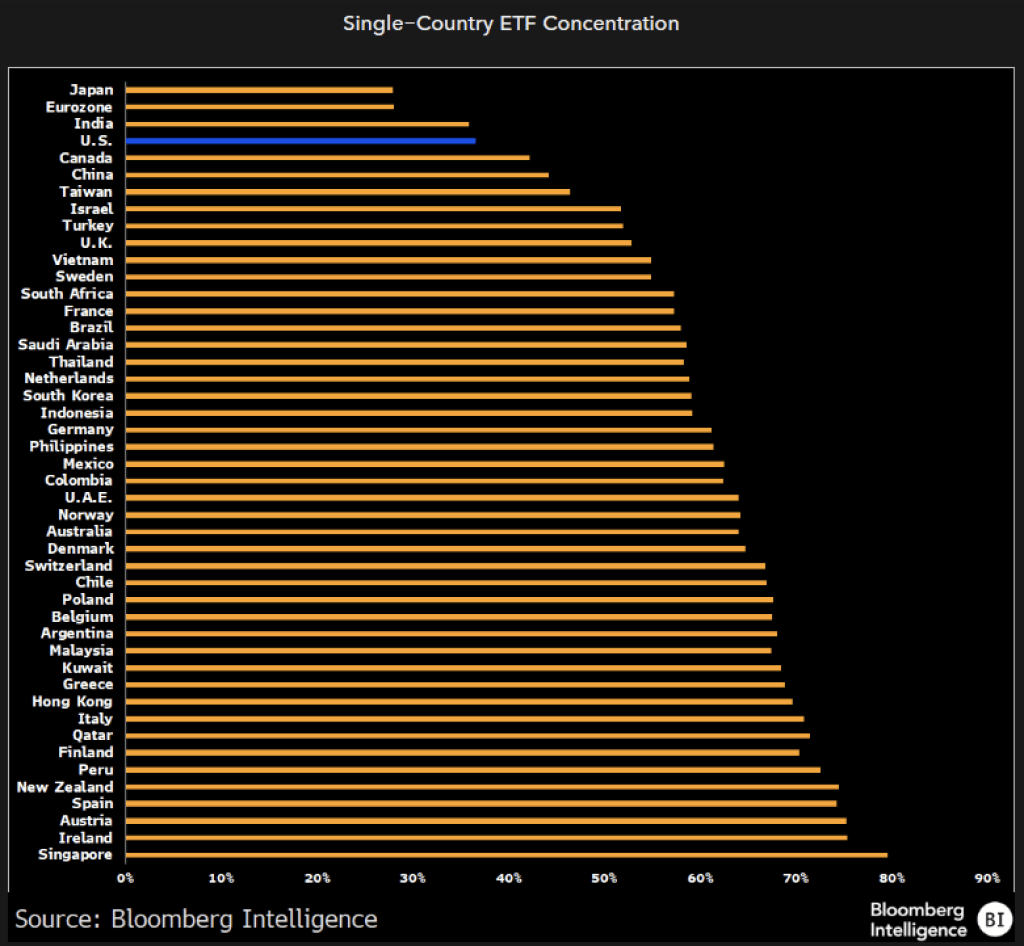
The graph below shows the percentage of each country’s total stock market cap made up by its top 10 largest stocks. While people worry about the concentration of the largest stocks in the U.S., it is a global phenomenon.
__________________________
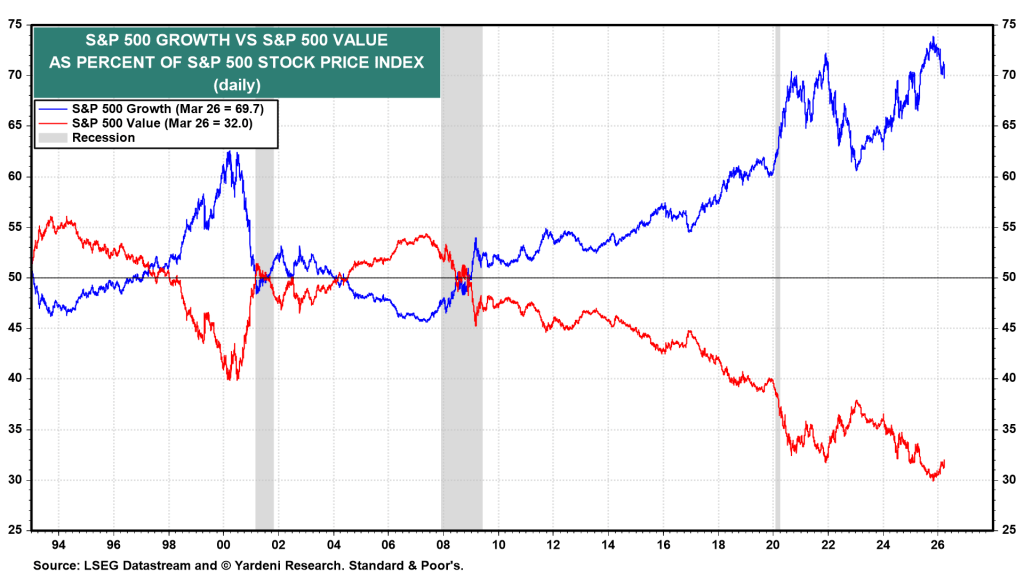
Is this finally the moment when the jaws begin to close and U.S. value stocks (red line) outperform growth (blue line)?


 Tuna Thoughts