The British-born Zen master Houn Jiyu-Kennett said her teaching style wasn’t to lighten the burden of the student, but to make it so heavy that he or she would put it down. I had a full-body reaction the first time I encountered that. To me, the phrase meant this: you can slog through life trying to ‘get on top of things’, trying to reach the point at which you feel like you know what you’re doing, trying to fix your flaws, or make yourself emotionally invulnerable… All of that is an attempt to ‘lighten the burden’, and there are a thousand self-help gurus on standby, promising to aid you in the effort.
But making the burden heavier? That means seeing that as a finite human you’ll never get on top of everything, never fully understand what makes others tick, never immunize yourself from distress. The burden of reaching that goal is an impossibly heavy one. And so you put it down. You let your shoulders drop and your muscles unclench. And then – crucially – you’re free to actually be here, actually do stuff, actually show up. You get to climb life’s mountains without lugging a huge rucksack full of steel ingots on your back the whole way, which is both easier and much more fun.
The spiritual writer Michael Singer points out: reality doesn’t need you to help operate it. It gets along just fine without your worrying.
Who knew? I don’t think of myself as an obscenely self-centered narcissist, yet I have to admit that when I heard those words, I suddenly perceived the subtle sense in which my thoughts and actions – and especially the background muscular tension I instinctively bring to them – were indeed somehow premised on the notion that reality itself would be badly affected were I to relax my guard.
I seem to imagine that my worrying is effective – that there’s something about the very act of fretting about the future that helps keep everything on track. This is, rather obviously, false. All I really need to do is to show up for what’s happening, appreciate the spectacle of it, and go with the flow.
Life is not a problem to be solved. Or else that life is nothing but a never-ending stream of problems to be solved, which in fact amounts to the same thing. Grasping this is both an enormous relief and tremendously energizing – because now you get to pour your finite time and energy into something infinitely more absorbing than trying to keep life under control, which is actually living it.

_____________________________
I had a conversation with a guy a few months ago whose immigrant parents came to America and worked tirelessly in low-wage jobs to make ends meet. Those kids are now adults, and this guy felt a sense of shame that as a college-educated white-collar worker he would not have to suffer the same way his parents did for him. His parents instilled in him the lessons of frugality and grit. Would his own children learn the same from him if they watched their father live a comparatively easy life?
He gave an example: when he was a kid, all books were borrowed from the library. Now his young daughter demands (and gets) to purchase $15 Taylor Swift books that pile up in her room.
My response was that if we talked to his immigrant parents, I would bet they would say: that was the goal. To put it differently: The goal of some parents is to work so hard that their kids and grandkids get to live a life that appears spoiled by the standards of previous generations.
What’s common to miss here is that when one generation’s life becomes comparatively easier than before, their life does not become objectively easy; they just move on to worrying about higher-order problems that were previously deemed not urgent enough to worry about.
I hope my kids and grandkids won’t have to worry about cancer in the ways we do. I hope they have incredible technology that makes their jobs easier than ours. I hope that everyday frictions we deal with today disappear. I hope their energy is so abundant they consider it unlimited.
Is that spoiled? I suppose, but when you frame it like that you might think of a different word – perhaps “lucky,” or, “fortunate.” Or perhaps, “beneficiaries of the accumulated hard work of those who came before them in a way that leaves them able to spend their days solving new problems.” Which is what you and I are today.

__________________
Mark Manson reviewed over 2,600 studies to rank 19 of the most common self-improvement techniques based on their effectiveness. He sorted them into four tiers: (1) legitimately works, (2) works sometimes, (3) probably not helping, and (4) straight up bullshit. Here were the results:
TIER 4: STRAIGHT UP BULLSHIT (AND MAY ACTUALLY HURT YOU):
19. Suppressing Negative Thoughts — The “ironic process” means trying not to think about something makes you think about it more. It can work for very smart people in very short-term, high-pressure moments, but the rebound effect makes things worse over time for everyone.
18. Microdosing Psychedelics — No consistent measurable benefit beyond mood improvement (i.e., you’re just getting a little high). Studies show a decline in cognitive function and executive reasoning, and long-term microdosing may carry adverse health effects from chronic exposure to psychoactive compounds.
17. Intuitive Decision-Making (“Trust Your Gut”) — Your gut doesn’t make better decisions; it just makes you feel better about your decisions. The exception is domain experts with decades of pattern-matching experience, but for most life choices, it’s self-serving and often detached from reality.
16. Catharsis / Venting Anger — Screaming into a pillow or punching a wall doesn’t release anger — it trains you to indulge it. The small effect sizes that exist are negative, meaning it makes you angrier more often.
TIER 3: PROBABLY NOT HELPING
15. Crystal Healing — Pure placebo effect. If you believe it works, you might get a small something, but there’s essentially zero evidence of any mechanism. Mostly it just harms your bank account.
14. Willpower / Ego Depletion — The concept of willpower as a finite tank you drain throughout the day is highly contested and probably not real. Believing you have limited willpower tends to make you underperform, and productivity problems are usually emotional problems in disguise.
13. Power Posing — Any mood boost is extremely transient, and the early hormonal claims (testosterone increases) have been debunked. It’s essentially a tiny placebo triggered by becoming momentarily aware of your posture.
12. Learning Styles (Visual/Auditory/Kinesthetic) — Over 90% of U.S. teachers still believe in this, but research consistently shows no real effect. The benefit people report is simply from having a choice in how they learn, not from matching a “style.”
11. Positive Affirmations — A “win more” strategy: people who already feel good get a small boost, but people with low self-esteem often feel worse because it highlights the gap between the affirmation and their actual beliefs.
10. Morning Routines — Extremely personality-dependent and mostly a placebo driven by a sense of control. Forcing a routine that mismatches your chronotype or becoming rigidly dependent on it can actually backfire.
TIER 2: WORKS SOMETIMES (MAYBE/DEPENDS):
9. Positive Visualization — Works well for physical/athletic performance and when paired with concrete planning. Without a plan, it’s just daydreaming — and pure outcome-based visualization actually decreases motivation.
8. Energy Healing — Surprisingly landed in the top half with a medium effect size (0.53), though only 56% of studies found any effect. The benefit likely comes from human touch, the ritual, and a strong placebo/expectancy effect rather than anything metaphysical.
7. Cold Water Immersion (for Mental Health) — Fairly consistent mood and stress benefits, likely driven by a big dopamine release. However, it’s a “win more” strategy — helpful if you’re already mentally healthy, potentially destabilizing if you’re fragile.
6. Speed Reading — You can realistically go from ~200 to 300–400 words per minute, which is meaningful, but the 1,000 wpm promises are nonsense. The trade-off is reduced retention, and much of reading speed turns out to be genetic.
TIER 1: LEGITIMATELY WORKS
5. Gratitude Interventions — The most consistent finding in the entire list: 98% of 166 studies showed a positive effect. The effect size is small, though, and compared to other positive interventions like acts of kindness, the unique “gratitude mechanism” mostly disappears.
4. Meditation — Consistently effective for stress and anxiety reduction, roughly equivalent to SSRIs for depression in some studies. The deeper benefit is knowing your own mind better, though compared to other active positive interventions, the unique advantage narrows.
3. Eat the Frog (Hardest Task First) — 95% of the benefit comes from the prioritization process itself, not the timing. Figuring out what matters most creates clarity and reduces anxiety, and ending the day on easier tasks boosts self-efficacy.
2. Bibliotherapy (Reading Self-Help Books) — 93% of 188 studies found positive effects, with a decent effect size approaching some therapy modalities. The key is the right book at the right time, and structured recommendations from a therapist boost the hit rate significantly.
1.Behavioral Activation (“Do Something”) — The most robust finding across all 19 techniques. Simply taking action, even small action, generates motivation rather than waiting for motivation to strike. It’s on par with CBT for depression and costs nothing.
Full Discussion Here: Self Help, Solved
_______________________________
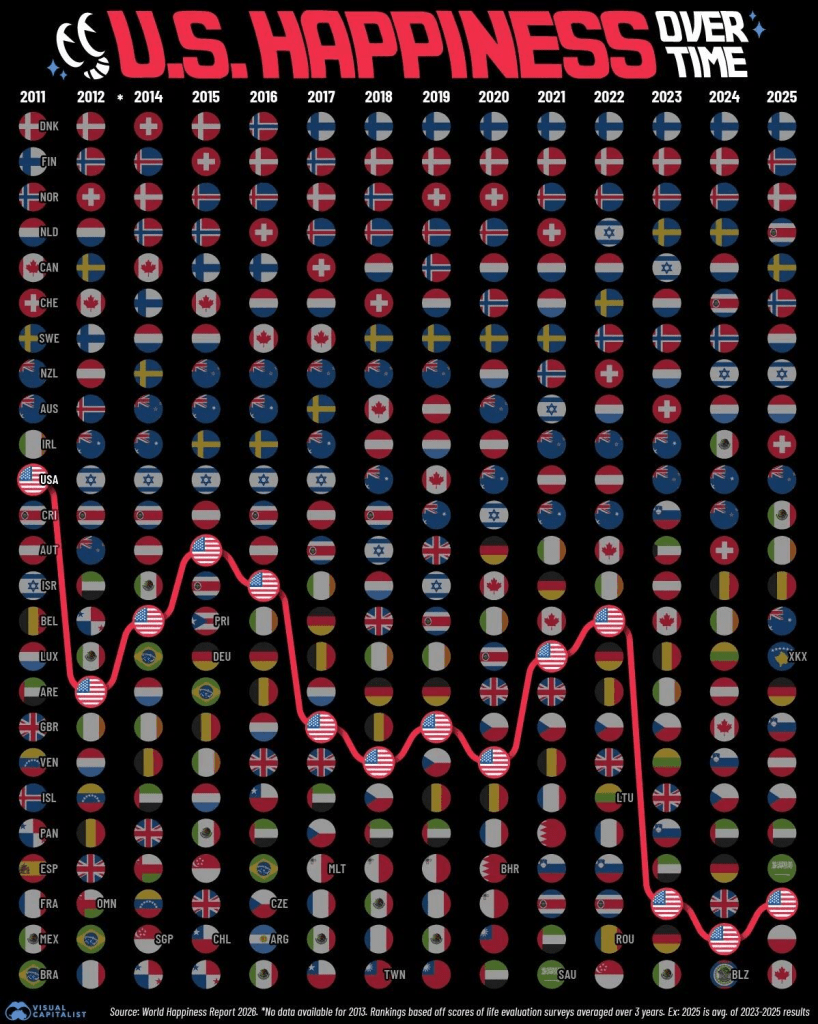
From the World Happiness Report (2026 was just released). The country rankings below are based on three-year averages, so the 2023 result captures responses from 2021, 2022 and 2023.
 Tuna Thoughts