A lot of people in tech believe that if we build a smart enough AI, it will simply figure out cures for cancer and every other disease. This assumes we already understand human biology well enough that a clever reasoner could find the answers hiding in our data. We don’t. We’ve barely measured most of what goes on in the human body.
Making a drug has three steps:
- Figure out which biological mechanism to target
- Design a molecule that hits it
- Test it in patients
Nearly all the AI excitement is around step 2 (designing molecules, thanks to breakthroughs like AlphaFold). But that’s not where drugs fail. Over 90% of drugs that reach clinical trials flop, and usually it’s because the target was wrong, not because the molecule was badly made.
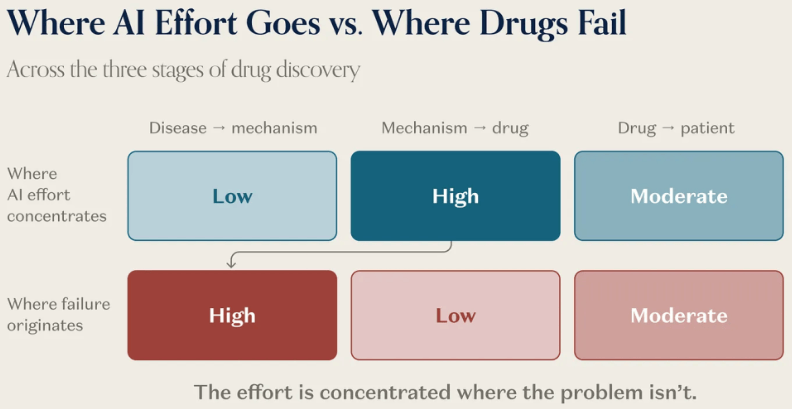
We’re getting great at cutting keys, but we keep cutting them for the wrong locks. Meanwhile, the industry keeps piling onto the same few “safe” targets (dozens of GLP-1 copycats) while the number of genuinely new targets pursued each year has collapsed.
Biology is enormous, messy, and idiosyncratic. Even the biggest cell datasets are orders of magnitude too small, and they mostly lack the kind of “what happens if we poke this?” data that matters for drugs. Worse, the diseases we understand least (Alzheimer’s, ALS) are the most human-specific, so animal studies don’t help and human data is scarce, expensive, and ethically constrained.
Self-driving AI systems work great when there’s a fast, cheap way to check if they’re right (like a compiler for code). In drug development, the only real test is a human clinical trial, which takes years and costs millions. Automating the lab just means you produce wrong answers faster.
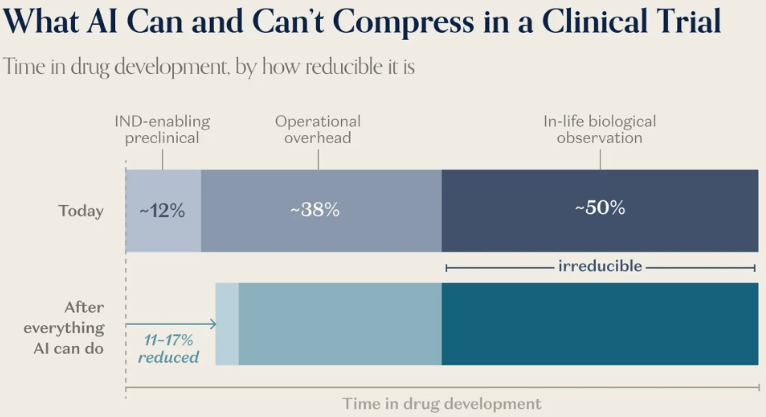
AI can trim paperwork and logistics, but most trial time is spent waiting to see how a disease progresses in real people. That clock can’t be compressed by compute. The only way to shorten it is deeper understanding of the disease itself, which lets you pick the right patients and detect early whether a drug is working.
All these AI tools are useful, but they’re side improvements. The hard, unglamorous, essential problem is understanding disease mechanisms, which requires measuring human biology the right way and using AI to draw insights from those measurements.
__________________________
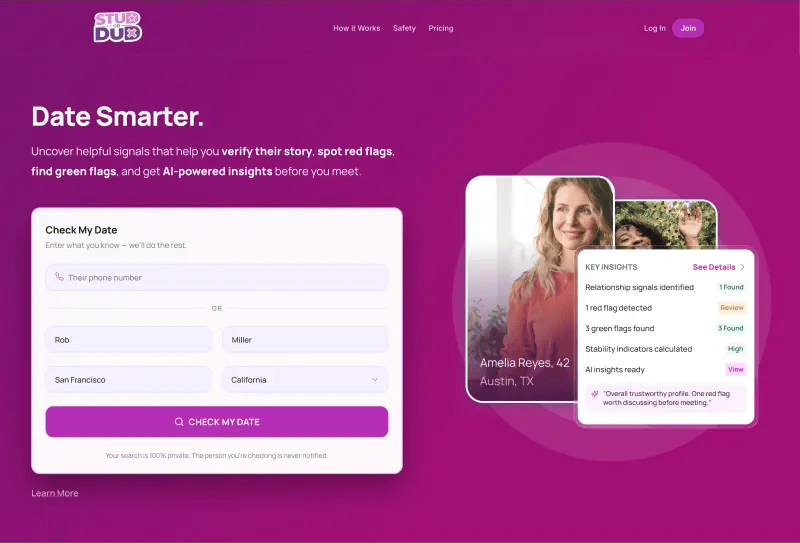
A new online platform called Stud or Dud, which launched by public-records company PeopleFinders, lets interested parties do a simple, free background check on their wannabe dates; including address history, bankruptcies and other publicly available records.
The site aims to simplify the pre-date sleuthing ritual familiar to most singles by putting all public records in one place, by also adding context to the material like compatibility read outs and color coding information with red and green flags. It’s your own little black book.
Before a first date, the standard vetting process for a potential romantic partner typically went as follows: send his dating profile to the group chat, where your best friend deploys the finsta for career-level private investigator work.
Comb through tagged photos. Check LinkedIn for employment. Search Facebook forums like “Are We Dating the Same Guy?” — all in an attempt to verify that your 7:00 pm drinks aren’t the beginning of an elaborate dating scam.
A recent survey found that 1 in 4 Americans reported interacting with a fake profile or AI bot, while 15% reported losing money to an online dating or romance scam. And 21% of men and 10% of women surveyed reported losing money to an online romance scam.
__________________________
The Nonfiction Book Market is Collapsing:
- In 2015, 18 of the top 25 bestselling hardcover books were nonfiction.
- In 2025, only 7 of the top 25 hardcover books were fiction. Fiction now dominates.
Reading habits are extremely gendered, with 80% of women making up the fiction market, and nonfiction being a more 50-50 proposition.
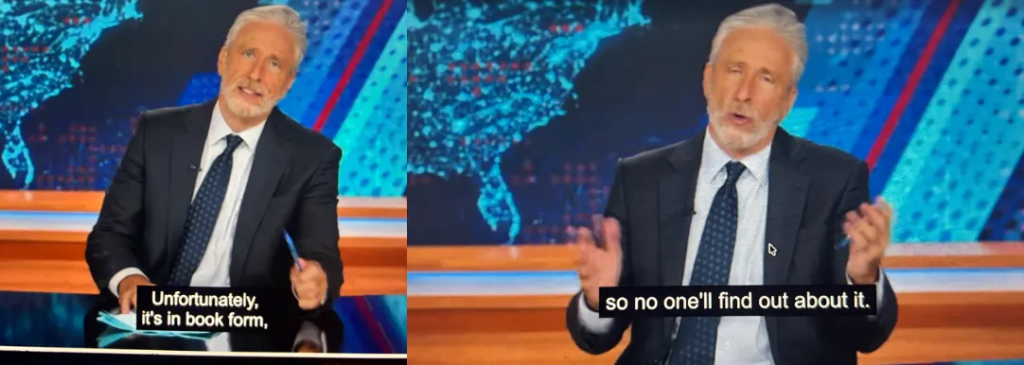
The collapse of nonfiction is less a “male reading crisis” than a massive breakdown in the social fabric of trusting education, expertise, or any authority other than follower count and force of personality.
The tide going out on nonfiction sales and reading is entirely reshaping the power balance in the industry. Not overnight, but slowly, the money is flowing to fiction and away from nonfiction. It is causing quite a scramble.
__________________________
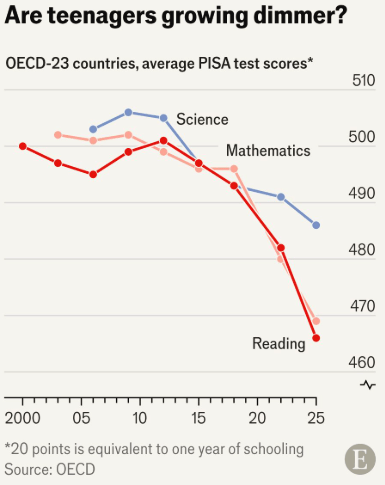
Every three years the OECD, a club of mostly rich countries, releases the results of international school tests sat by 15-year-olds all across the world. There were reasons to hope that the latest data, published on September 8th, would bring good news. It did not.
________________________
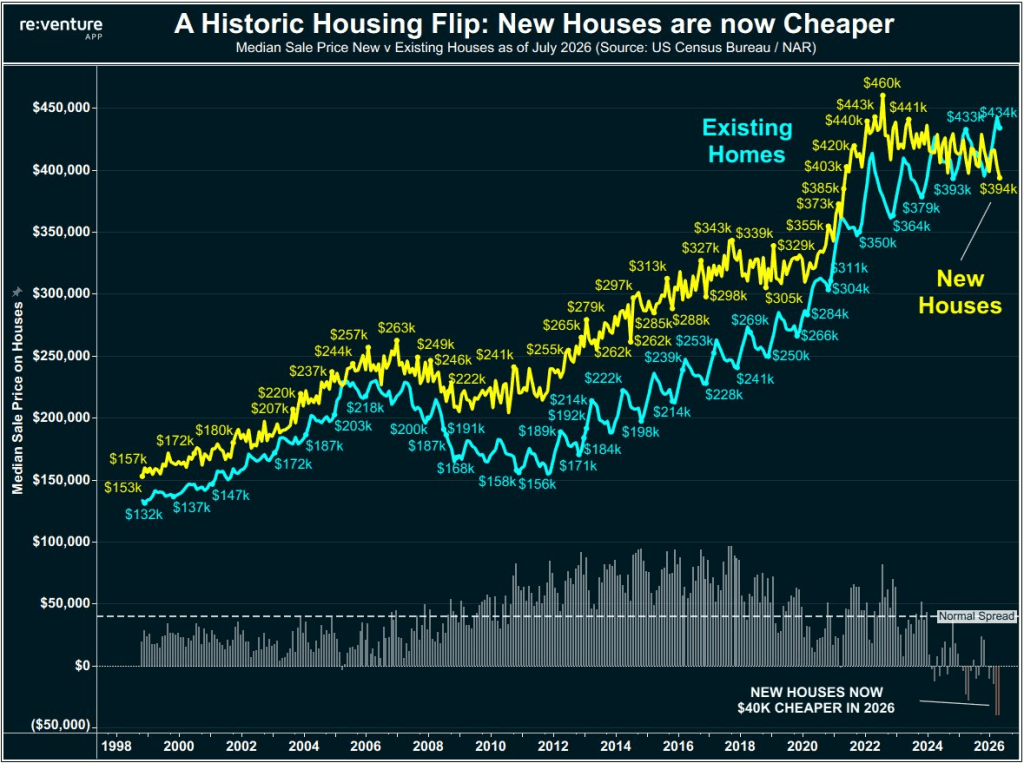
Historically, a new home has sold for about $40,000 more than an existing home. The obvious reasons: lower maintenance costs, warranties, and the appeal of living in a home that no one has ever lived in before. New homes are also bigger (2,200 square feet for the average new home vs. 1,800 square feet for existing).
New home prices are down 15% in the last four years, and for the first time, new builds are cheaper than existing homes. The average new home is selling at $40,000 less than an existing one, a 9.3% discount.
___________________________
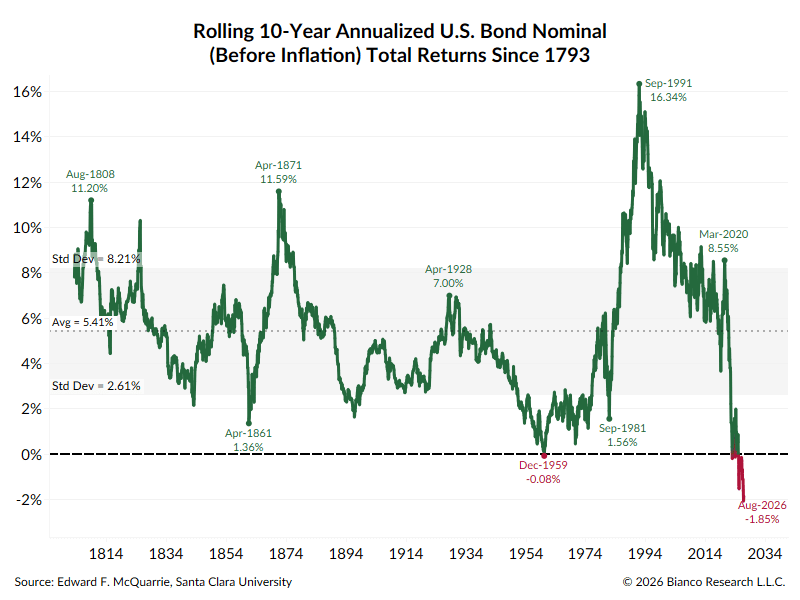
The past 10 years through this summer has been the worst decade for 15-year+ treasuries since 1803.
In 223 years, a negative 10-year return has happened in only 25 months. 24 of them just happened. The only other month was Dec 1959, at -0.08%.
_______________________
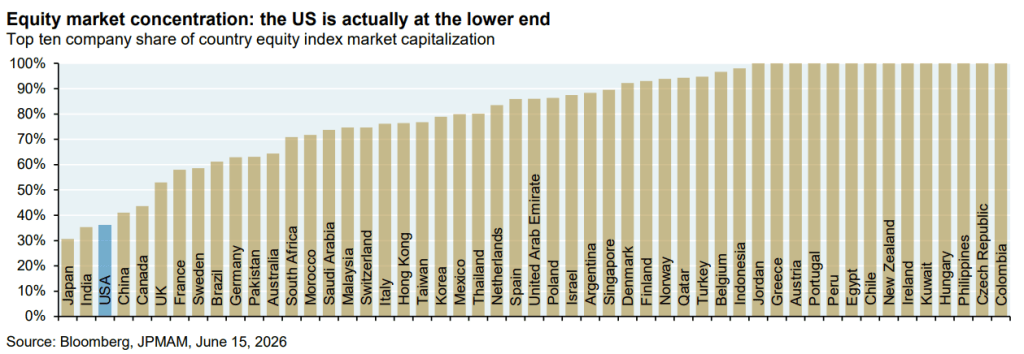
Stock market concentration of the top 10 largest stocks by country. There are only two stock markets with less concentration than the United States; Japan and India. Everywhere else the concentration in the top 10 names is way higher.
__________________________
The College Wage Premium in the Generative AI Era
After expanding for four decades, the U.S. college wage premium is experiencing a sustained contraction, dropping sharply from 0.626 in 2022 to 0.575 in 2026.
Using Current Population Survey Outgoing Rotation Group data through 2026, standard market-clearing supply-and demand accounting implies an unprecedented drop in relative demand for college labor-the first sustained negative relative demand growth in a series spanning back to 1914.
__________________________
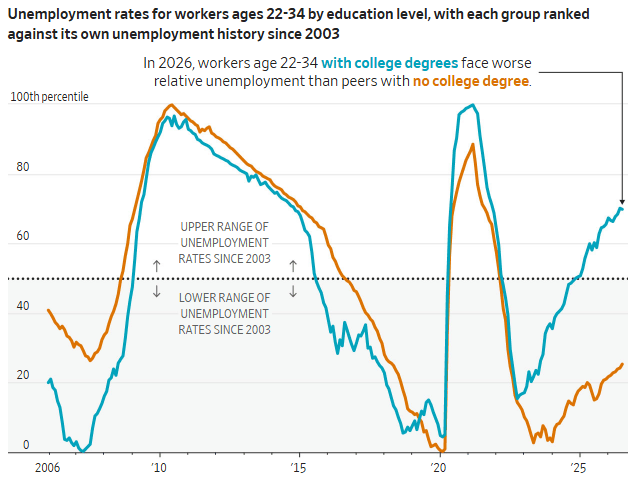
For U.S. workers without college degrees, this is one of the best job markets in decades. The unemployment rate for workers ages 22 to 34 who never graduated from college has rarely been lower in the past two decades.
Just as job hunters without degrees are having one of their best runs, those with college educations are having one of their worst. And those with advanced degrees or in fields such as science and technology are having an even harder time than usual.
That divergence of fortunes is a departure from what the U.S. economy has seen for years, and much of it boils down to supply and demand: There aren’t enough skilled tradespeople to go around as older generations retire and immigration drops.
______________________
 Tuna Thoughts