Income Traps, Unhappiness & Magic Internet Money

I wanted to see what would happen if I ignored the official stats and simply calculated the cost of existing. I built a Basic Needs budget for a family of four (two earners, two kids). No vacations, no Netflix, no luxury. Just the “Participation Tickets” required to hold a job and raise kids in 2024. Using conservative, national-average data:

  • Childcare: $32,773
  • Housing: $23,267
  • Food: $14,717
  • Transportation: $14,828
  • Healthcare: $10,567
  • Other essentials: $21,857

Required net income to live: $118,009. Add federal, state, and FICA taxes of roughly $18,500, and you arrive at a required gross income of $136,500.

I then ran the numbers on what happens to a family climbing the ladder toward that break-even number. What I found explains the “vibes” of the economy better than any CPI print.

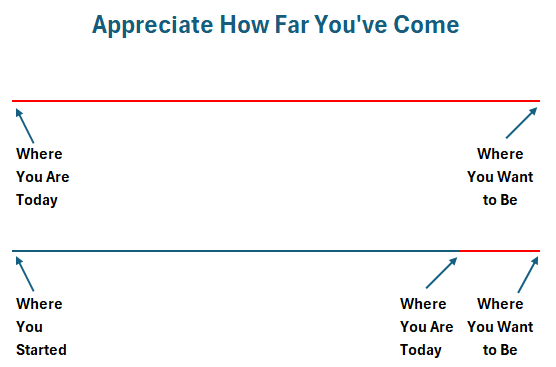
Our entire safety net is designed to catch people at the very bottom, but it sets a trap for anyone trying to climb out. As income rises from $40,000 to $100,000, benefits disappear faster than wages increase. I call this The Valley of Death. Let’s look at the transition for a family in New Jersey:

1. The View from $35,000 (The “Official” Poor)

At this income, the family is struggling, but the state provides a floor. They qualify for Medicaid (free healthcare). They receive SNAP (food stamps). They receive heavy childcare subsidies. Their deficits are real, but capped.

2. The Cliff at $45,000 (The Healthcare Trap)

The family earns a $10,000 raise. Good news? No. At this level, the parents lose Medicaid eligibility. Suddenly, they must pay premiums and deductibles.

  • Income Gain: +$10,000
  • Expense Increase: +$10,567
  • Net Result: They are poorer than before. The effective tax on this mobility is over 100%.

3. The Cliff at $65,000 (The Childcare Trap)

This is the breaker. The family works harder. They get promoted to $65,000. They are now solidly “Working Class.” But at roughly this level, childcare subsidies vanish. They must now pay the full market rate for daycare.

  • Income Gain: +$20,000 (from $45k)
  • Expense Increase: +$28,000 (jumping from co-pays to full tuition)
  • Net Result: Total collapse.

When you run the net-income numbers, a family earning $100,000 is effectively in a worse monthly financial position than a family earning $40,000. At $40,000, you are drowning, but the state gives you a life vest. At $100,000, you are drowning, but the state says you are a “high earner” and ties an anchor to your ankle called “Market Price.”

In option terms, the government has sold a call option to the poor, but they’ve rigged the gamma. As you move “closer to the money” (self-sufficiency), the delta collapses. For every dollar of effort you put in, the system confiscates 70 to 100 cents.

___________________________

Bitcoin was never the future of money. It was a battering ram in a regulatory war. Now that war is wrapping up, and the capital that built it is quietly leaving. For 17 years we convinced ourselves that Magic Internet Money was the final state of finance. It was not. Bitcoin was a regulatory battering ram, a one purpose siege engine built to smash a specific wall: the state’s refusal to tolerate digital bearer assets.

That job is basically done. Tokenized US stocks are already being issued.  Tokenized gold is legal and growing.  Tokenized USD has a market cap of several hundred billion dollars. In wartime, a battering ram is priceless. In peacetime, it is a heavy, expensive antique.

Now that the financial rails are being upgraded and legalized, the Gold 2.0 narrative is collapsing back into what we actually wanted in the 1990s: tokenized claims on real assets.

_________________________

There is genuine and widespread despair in the U.S., but the primary reason isn’t economic, rather it is because human fulfillment requires more than material wealth, which in our quest for more stuff, we have forgotten. People need physical communities, and while the US excels at material wealth, it’s achieved it, especially in the last forty years, at the expense of the aesthetic, communal, stable, and personal, and so the bad vibes are justified.

Societies come with strong forces that shape expectations and even shape people’s understanding of a ‘good life.’ That is, society provides citizens playbooks that they are urged to follow which are supposed to end in happily ever after, and ours is that you can become a millionaire on your own terms as long as you hustle hustle hustle — and when that doesn’t happen, it’s very lonely and humiliating, because we as a culture have put all our eggs in that one particular basket. At the expense of community, friendships, and even family.

When you give your citizens a cultural script, built on the material, that promises hard work will lead to success, and then your policy design ensures it doesn’t, people will end up both economically frustrated, as well as spiritually empty, sitting in their living room streaming the latest movie wondering what exactly is the point of life. Or, they will feel they have failed at the material, while also having little else to give them meaning.

_____________________________

In his investment classic Winning the Loser’s Game, Charley Ellis tells a great story about healthcare and simplicity:

“Two of my best friends, who are at the peak of their distinguished careers in medicine and medical research, agree that the two most important discoveries in medical history are penicillin and washing hands (which stopped the spread of infection from one mother to another by the midwives who delivered most babies before 1900). What’s more, my friends counsel, there’s no better advice on how to live longer than to quit smoking and buckle up when driving. “

The Lesson: Advice doesn’t always have to be complicated to be good.

Identity Switching, Work-Life Balance & College Graduates

One of the great causes of suffering is this maddening worry about what others think of us. I can go into its causes by pointing to evolutionary psychology and our hunter-gatherer roots, but that’s neither novel nor interesting. Rather, I want to delve into the asymmetry between what we know about ourselves, and the uncertainty surrounding what others know of us. Because at its core, the worry about what others think is ultimately a function of uncertainty.

Whenever we interact with someone – whether in-person or online – a gap emerges between who you are, and who you are presenting. This is why the person you are with your boss isn’t the same as the person on the couch watching Netflix. Or why the person you are with your best friend isn’t the same as the person you are with an acquaintance. Each relationship contains a culture of behavior that you oscillate between, which means that you’re constantly presenting a different version of yourself across a wide range of interactions.

What this means is that it becomes increasingly difficult to know who you really are. If a certain version of you emerges with this individual, but in the very next moment you toggle another set of behaviors with another, then that means your very identity is switching upon context. And the more you have to maneuver between various projections of yourself, the more difficult it becomes to get a handle on what “yourself” means in the first place.

This is why you’re likely exhausted after large social gatherings, and yearn to turn on the TV and watch something brainless until you drift off to sleep. The fatigue is not caused by the rigor in which your mouth is moving to talk, but rather by the constant switching of identity that occurs in these situations. When you’re worried about what someone thinks of you, it’s rarely about that person’s opinions of you. It’s about your own opinions of yourself. 

_________________________

Is A.I. taking jobs from young college graduates? It depends on the job.

Stanford economists studied payroll data from the private company ADP, which covers millions of workers, through mid-2025. They found that young workers aged 22–25 in “highly AI-exposed” jobs, such as software developers and customer service agents, experienced a significant decline in employment since the advent of ChatGPT:

On the other end of the spectrum, they found for entry level workers in fields like home health aides, there is faster employment growth. That suggests this isn’t an economy-wide trend. The decline in employment really seems to be more concentrated in jobs that are more AI-exposed.

_______________________

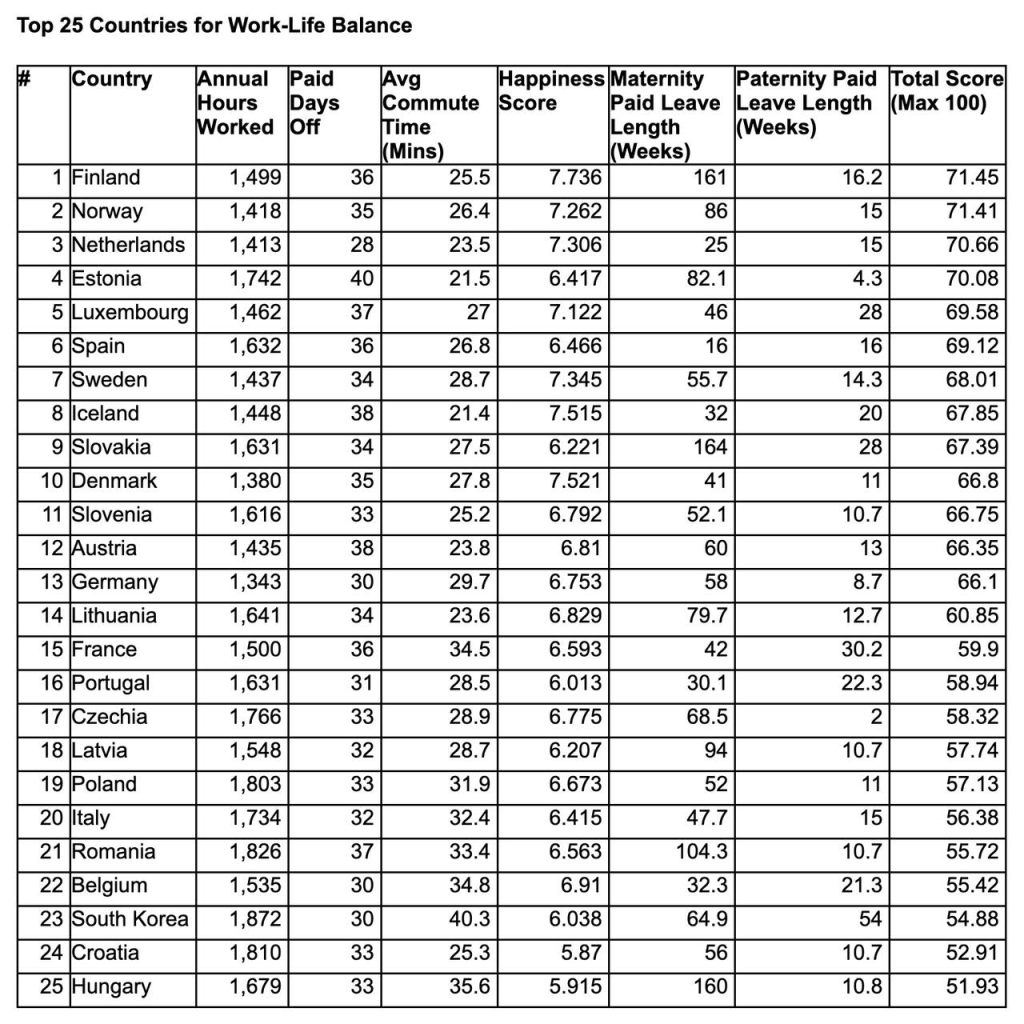
A new analysis of 39 nations reveals where employees enjoy the healthiest mix of work and personal life and on the other end of the spectrum – where long hours, limited leave, and lack of support take the greatest toll. The study assessed 10 factors including working hours, paid leave, commute length, parental support, remote work availability, and happiness scores.

Unsurprisingly, the United States finished dead last, ranked 39th out of 39. The US suffers from some of the longest working hours in the study, averaging 1,799 annually. It is the only country in the ranking without federally mandated paid annual leave or paid parental leave, and Americans devote only 14.6 hours per day to personal care and leisure.

___________________________

Interesting point on why college students are putting less effort into class: courses don’t prepare them for real jobs (like they should), so they have to spend more and more time making up the difference after class:

“A student said that coursework doesn’t prepare students to answer interview questions for finance and consulting jobs. The only way to get ready is through extracurriculars or on one’s own time. By sophomore year, his friends were fully absorbed in the internship-recruiting process. They took the easiest classes they could find and did the bare-minimum coursework to reserve time to prepare for technical interviews.

___________________________

From Kevin Kelly on how the relationship between book publishers and authors has changed:

“Traditional book publishers have lost their audience, which was bookstores, not readers. It’s very strange but New York book publishers do not have a database with the names and contacts of the people who buy their books. Instead, they sell to bookstores, which are disappearing. They have no direct contact with their readers; they don’t “own” their customers.

So when an author today pitches a book to an established publisher, the second question from the publishers after “what is the book about” is “do you have an audience?” Because they don’t have an audience. They need the author and creators to bring their own audiences. So, the number of followers an author has, and how engaged they are, becomes central to whether the publisher will be interested in your project.

Many of the key decisions in publishing today come down to whether you own your audience or not.”

_______________________________

Canada’s Great Condo Crash: For years, low interest rates fueled a big-city condo-flipping frenzy. Profits got bigger and condos got smaller. Now the bubble has popped, leaving behind thousands of unsellable, unlivable units.

In the first quarter of 2019, the average Toronto condo cost $560,000. By the first quarter of 2022, they had soared to $808,000. Since that peak, the market has been in a painful reset.

By the first quarter of 2024, average condo values in the city had dropped by over $100,000 to $696,000, and they have continued to fall. As of this spring, the inventory of unsold units in Toronto totaled more than 23,000, which would take nearly five years to sell at the current rate. Of those, nearly 2,000 are built and sitting empty, more than 11,000 are under construction and roughly 11,000 more are in pre-construction projects.

_____________________________

As of July, there has been no reduction in import prices since Liberation Day, which are measured pre-tariff. Thus, foreign exporters in aggregate are not absorbing the tariff costs by reducing prices. This means most or all of the tariffs are being paid by American consumers and American businesses. For context, it takes about a 13% reduction in prices to offset a 15% tariff, or a 16% reduction in prices to offset a 20% tariff.

This shows up in a combination of higher consumer goods prices and/or compressed business margins of goods-heavy businesses, depending on how quickly businesses are able to pass those prices on to consumers (which will vary by industry and company; those with in-demand products can eventually pass on price increases, and those with thin margins have to eventually pass on price increases).

Consumers on the higher end of the income spectrum are less likely to change their consumption behavior and thus will basically just pay the tariffs, giving the government more revenue. Consumers on the lower end of the income spectrum are more likely to have to curtail consumption because their disposable income is scarce.

Another excellent newsletter from Lyn Alden on tariffs, fiscal income/spending, monetary policy and the implication on global economies and asset prices.

_____________________________

_______________________________

This chart shows the change in active housing inventory by state for 2025 compared to the average of 2018/2019. Orange colors mean higher inventory levels and prices are susceptible to fall, while green colors mean very low inventory and likely still price increases.

Hedonic Adaption, Gold & The Dungeon Of Insularity

“I love the challenge … it’s one of the greatest joys of my life, but does it fill the deepest wants and desires of my heart? Absolutely not.”

That was the killer quote from a recent interview with the world’s number one golfer, Scottie Scheffler, that went viral this week. And I think this one went viral for a reason: It taps into a universal truth or two about humanity that we know at a subconscious level, but that rarely shines through the manic malaise of our achievement-oriented culture.

“It feels like you work your whole life to celebrate winning a tournament for a few minutes – it only lasts a few minutes, that euphoric feeling,” Sheffler further explained. “You win it, you celebrate, get to hug my family, my sister’s there, it’s such an amazing moment. Then it’s like, ‘OK, what are we going to eat for dinner?’ You know, life goes on.”

While his language is a touch more approachable, Sheffler is practically quoting ancient wisdom literature attributed to the world’s then (in the 10th century, BC) number one, King Solomon, in Ecclesiastes: “Then I considered all that my hands had done… and behold, all was vanity and a striving after wind, and there was nothing to be gained under the sun.”

That fading feeling is explained in the field of behavioral economics through the term “hedonic adaptation.” This theory notes that we, as humans, can marshal an enormous amount of energy to achieve certain goals, only to experience a pretty rapid dilution of the intensity felt in peak moments.

The other upside of hedonic adaptation is that it doesn’t just apply to the good and great things we experience, but also to the bad and even horrible. Yes, humans are designed to bounce back pretty quickly, and that, too, is explained by hedonic adaptation.

So, if being the very best in the world at something doesn’t provide lasting satisfaction, what does?

“Every day when I wake up early to go put in the work, my wife thanks me for going out and working so hard. When I get home, I try and thank her every day for taking care of our son.… I’d much rather be a great father than I would be a great golfer. At the end of the day, that’s what’s more important to me.”

Arthur Brooks may summarize it best: “Money, power, pleasure, and fame won’t make you happy. Faith, family, friends, and meaningful work will.”

_________________________________

Between 2003 and 2024, the amount of time that Americans spent attending or hosting a social event declined by 50 percent. Almost every age group cut their party time in half in the last two decades. For young people, the decline was even worse. Last year, Americans aged 15-to-24 spent 70 percent less time attending or hosting parties than they did in 2003.

As late as the 1970s, the average US household entertained friends at home about 15 times a year and went out to a friend’s place about every other week. After the 1970s, Americans pulled back from just about every form of socializing. By the late 1990s, the share of Americans who said they visited the homes of friends in the previous week had declined by more than 40 percent.

Women have long been the keepers of the family social calendar. Wives, not husbands, historically planned the quilting parties, the bridge games, and the neighborhood potlucks. But in the second half of the 20th century, many women swapped unpaid family jobs for salaried positions. In 1970, right around the inflection point of America’s social decline, the share of women between 25 and 54 who participated in the labor force surged past 50 percent for the first time; it’s currently near 80 percent. As more women poured their weekdays into 9-to-5 work, men failed to take over the logistical labor required to fill out the social calendar, and adult gatherings gradually eroded in the age of the dual-earner household.

Meanwhile, parenting norms have changed. Americans used to have more kids whom they watched less; now they have fewer children whom they watch more. Between 1975 and 1998, they found, mothers increased the amount of time they spent with their kids by about 200 minutes a week. For married fathers, the increase was even more dramatic—about 240 minutes per week. Parents are more anxious than they used to be, not only about neighborhood crime and playground accidents, but also about their children’s achievements.

It’s impossible to host a cocktail party when your second job is to be your son and daughter’s part-time limo driver who escorts them to 13 weekend extracurricular activities (that you kind of forced them to do, in the first place).

Then, there are the screens. The television landed in the US living room in the middle of the 20th century like an asteroid from deep space, displacing settled habits and sending ripples through the social fabric. Between 1965 and 1995, the typical American’s leisure time grew by about 300 hours a year, but we seem to have spent almost all those hours watching more TV. By the 1980s, people who said that television was their “primary form of entertainment” were less likely to engage in practically every other form of social interaction.

I don’t like the simplistic idea that smartphones are purely anti-social. Digital technology has not obliterated our social connections but rather warped them.  Many of us spend hours every week with our favorite TikTok stars, YouTube gurus, Instagram influencers, Twitter gadflies, podcast buddies, Reddit friends, and other people we kind of know and sort of care about, even though they might not even know we exist, at all. Keeping up with these people—watching them, listening to them, giving ourselves over to them—necessarily requires pulling our focus out of the world of flesh and blood. To be a citizen of the Internet is to spend hundreds of hours inside the minds of virtual people we couldn’t party with, even if we desperately wanted to.

Finally, while one needn’t be drunk to have a good time with others, I cannot ignore the fact that the great American party deficit has coincided with an extraordinary decline in teen drinking. Last year was the first on record, going back to 1975, that fewer than 50 percent of high school seniors said they’d ever had a drink of alcohol.

Like the rise of the dual-earner household, the turn against alcohol among the same young people whose socialization has plunged is a complicated phenomenon that defies easy good-bad categorization. I cannot deny that abstinence is good for young people’s livers; but I worry that it’s part of a larger set of behaviors that’s bad for their hearts.

We’ve built ourselves a world of greater professional ambition, more intensive parenting, and lavish entertainment abundance. But in making this world, we’ve lost a bit of each other. If summoning these magnificent technologies incurs the death of our social lives, a permanent surge of anxiety, and the long-term demise of deep friendships, then we’ll have built ourselves a glittering dungeon of insularity and called it progress.

_______________________________

What if gold goes the way of diamonds? The supply of gold is limited – limited by miners’ ability to dig it out of the ground and process it, what happens if a new supply of gold comes online? Not a new mine, but actual alchemy. A company researching fusion energy, Marathon Fusion, believes that it could produce gold alongside energy:

Marathon’s proposal is to also introduce a mercury isotope, mercury-198, into the breeding blanket and use the high-energy neutrons to turn it into mercury-197. Mercury-197 is an unstable isotope that then decays over about 64 hours into gold-197, the only stable isotope of the metal.

While the science needs to be confirmed, it seems not out of the realm of possibility. If so, it has big implications for fusion energy AND the gold market itself.

Another industry is already facing pressure from an ‘artificial’ competitor: Diamonds can now be made in labs that mimic the earth’s extreme pressure and temperatures, but for a fraction of the price. A decade ago, such man-made gems were novel. Today they are mainstream, and increasingly challenging the perception of diamonds as a luxury accessory.

This is bad news for the ‘natural’ diamond industry, which is facing incredible pricing pressure. The industry’s response seems to be to double down on the natural aspects of traditional diamonds and hope that they can at least hold the high end of the market.

Nobody knows if large scale production of gold will eventually come online. Even if it does, it is years, if not decades, into the future. The point here is to think through the hypothetical impact of an abundant gold supply. For example, would gold still a be a store of value if it’s supply were dramatically increased? Would we find new and novel uses for a now abundant shiny metal?

If you were involved in the diamond business in 2016, and knew how the market for manufactured diamonds would mature over the next decade, you may have done things very differently.

______________________________________

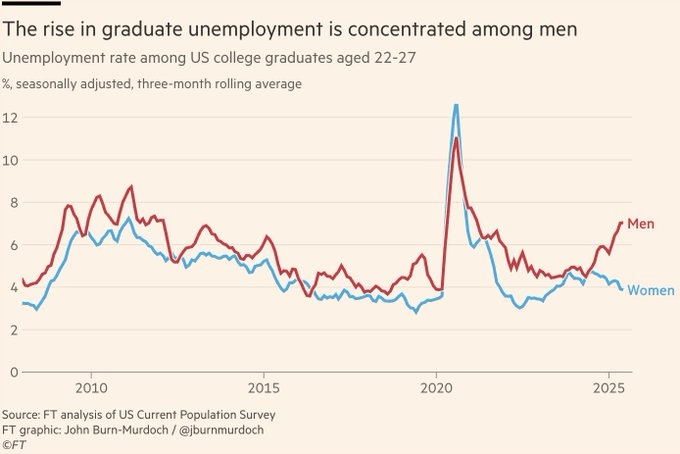
There’s been a lot of discussion lately about rising graduate unemployment. If you dig a little closer a striking story emerges: Unemployment is climbing among young graduate “men,” but college-educated young women are generally doing okay.