Private equity (PE) firms have been buying up about 10% of US life insurance companies since 2020. They’re then using the insurance companies’ money (called the “float” – money from premiums that hasn’t been paid out yet) to make risky loans to struggling businesses.
They’re using a private ratings agency to label these risky loans as safer than they actually are. This fake safety rating lets them:
Hold less cash in reserve (normally you need more reserves for risky investments)
Legally invest in things they otherwise couldn’t
Many of these loans are going bad – about 10% are already defaulting. The companies that borrowed the money are often unprofitable startups (especially software companies) that can’t actually pay back their debts. Some are even “zombie companies” kept alive artificially.
How the Fed raising rates in 2023 amplified this problem:
Fed Raises Rates → Government Borrowing Costs Go Up
When the Fed raised interest rates, it became more expensive for the US government to borrow money
The government pays interest on its debt, so higher rates mean higher interest payments
This caused the government’s budget deficit to balloon by 3% of GDP in 2023
Bigger Deficit → More Treasury Bonds Issued
To cover this bigger deficit, the government had to issue more Treasury bonds
These bonds became “fresh collateral” – basically, new assets that could be used as backing for loans
The RRP Money Gets Unlocked
There was $2.5 trillion sitting in something called the Fed’s “Reverse Repo Program” (RRP) – think of it as a parking lot for cash
Normally this money just sits there safely
But with all these new Treasury bonds available, financial institutions could use them to borrow against in “repo markets” (short-term lending markets)
PE Firms Borrow This Money
The private equity firms and their various entities (the “layers of the leverage cake”) were able to tap into this massive pool of money
They used it to fund more and more risky loans through the insurance companies
Instead of letting the economy cool down (which is what rate hikes are supposed to do), the Fed accidentally created a situation where trillions of dollars flowed into this problematic private equity scheme.
Who Gets Hurt: Foreign banks and insurance companies:
Foreign Institutions Bought the Debt
These PE firms and BDCs (Business Development Companies – investment funds that make these risky loans) didn’t just use insurance company money
They also borrowed money from banks and sold bonds/securities to investors
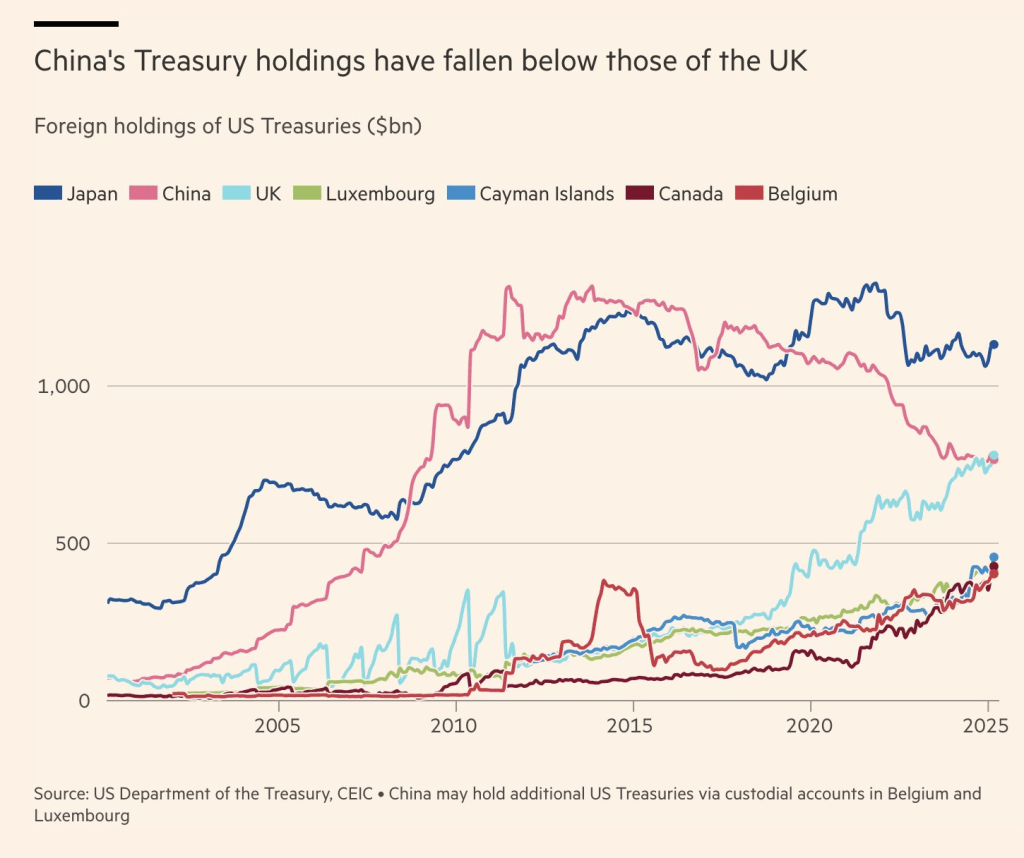
Foreign banks and insurance companies in countries like Japan and Germany were major buyers of these securities
Why Foreign Buyers?
Japanese and German institutions are from “surplus creditor nations” – countries that save a lot and invest globally
They’re always looking for places to invest their money
US securities seemed attractive, especially ones with good (fake) credit ratings
They’re Holding the Bad Loans
When these loans start defaulting (which the author says is already happening at 10%+), the value of those securities plummets
The foreign banks and insurers who bought them will take massive losses
They Don’t Know Yet
Stocks of these foreign financial institutions are “at all time highs”
Meanwhile, US-listed PE firms and BDCs have already collapsed in value
This suggests the foreign institutions haven’t realized their investments are worthless yet – the losses are hidden in complex financial structures
Foreign banks and insurers thought they were buying safe, well-rated US investments. Instead, they’re holding bags of loans to failing startups and zombie companies. When they finally discover this (mark their books to reality), their stock prices will crash too. It’s like they bought what they thought were AAA-rated bonds, but they’re actually subprime loans in disguise.
In Summary: This is as a massive, ticking time bomb of bad debt hidden inside insurance companies, enabled by sketchy ratings and Fed policy.
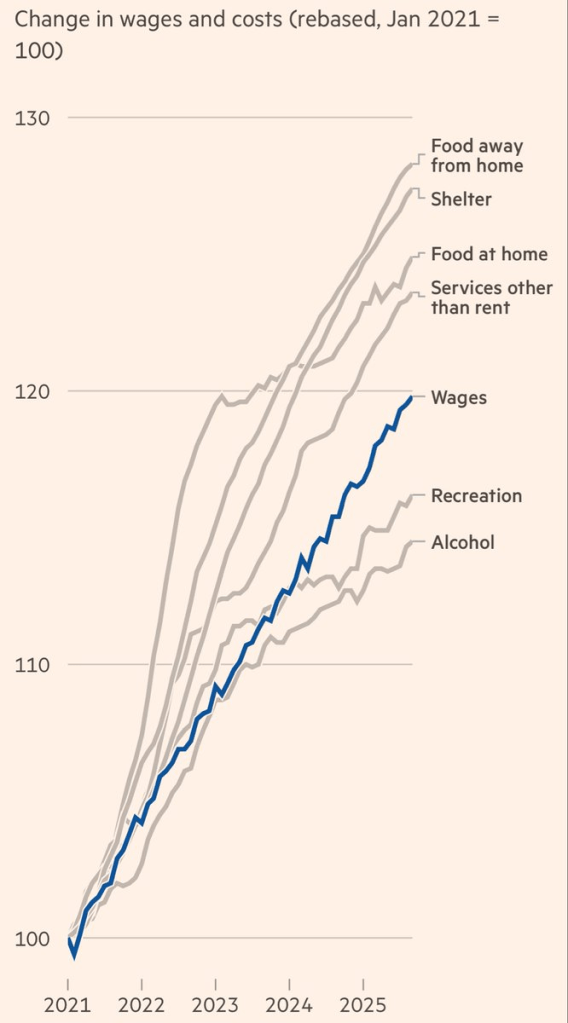
I wanted to see what would happen if I ignored the official stats and simply calculated the cost of existing. I built a Basic Needs budget for a family of four (two earners, two kids). No vacations, no Netflix, no luxury. Just the “Participation Tickets” required to hold a job and raise kids in 2024. Using conservative, national-average data:
Childcare: $32,773
Housing: $23,267
Food: $14,717
Transportation: $14,828
Healthcare: $10,567
Other essentials: $21,857
Required net income to live: $118,009. Add federal, state, and FICA taxes of roughly $18,500, and you arrive at a required gross income of $136,500.
I then ran the numbers on what happens to a family climbing the ladder toward that break-even number. What I found explains the “vibes” of the economy better than any CPI print.
Our entire safety net is designed to catch people at the very bottom, but it sets a trap for anyone trying to climb out. As income rises from $40,000 to $100,000, benefits disappear faster than wages increase. I call this The Valley of Death. Let’s look at the transition for a family in New Jersey:
1. The View from $35,000 (The “Official” Poor)
At this income, the family is struggling, but the state provides a floor. They qualify for Medicaid (free healthcare). They receive SNAP (food stamps). They receive heavy childcare subsidies. Their deficits are real, but capped.
2. The Cliff at $45,000 (The Healthcare Trap)
The family earns a $10,000 raise. Good news? No. At this level, the parents lose Medicaid eligibility. Suddenly, they must pay premiums and deductibles.
Income Gain: +$10,000
Expense Increase: +$10,567
Net Result: They are poorer than before. The effective tax on this mobility is over 100%.
3. The Cliff at $65,000 (The Childcare Trap)
This is the breaker. The family works harder. They get promoted to $65,000. They are now solidly “Working Class.” But at roughly this level, childcare subsidies vanish. They must now pay the full market rate for daycare.
Income Gain: +$20,000 (from $45k)
Expense Increase: +$28,000 (jumping from co-pays to full tuition)
Net Result: Total collapse.
When you run the net-income numbers, a family earning $100,000 is effectively in a worse monthly financial position than a family earning $40,000. At $40,000, you are drowning, but the state gives you a life vest. At $100,000, you are drowning, but the state says you are a “high earner” and ties an anchor to your ankle called “Market Price.”
Bitcoin was never the future of money. It was a battering ram in a regulatory war. Now that war is wrapping up, and the capital that built it is quietly leaving. For 17 years we convinced ourselves that Magic Internet Money was the final state of finance. It was not. Bitcoin was a regulatory battering ram, a one purpose siege engine built to smash a specific wall: the state’s refusal to tolerate digital bearer assets.
That job is basically done. Tokenized US stocks are already being issued. Tokenized gold is legal and growing. Tokenized USD has a market cap of several hundred billion dollars. In wartime, a battering ram is priceless. In peacetime, it is a heavy, expensive antique.
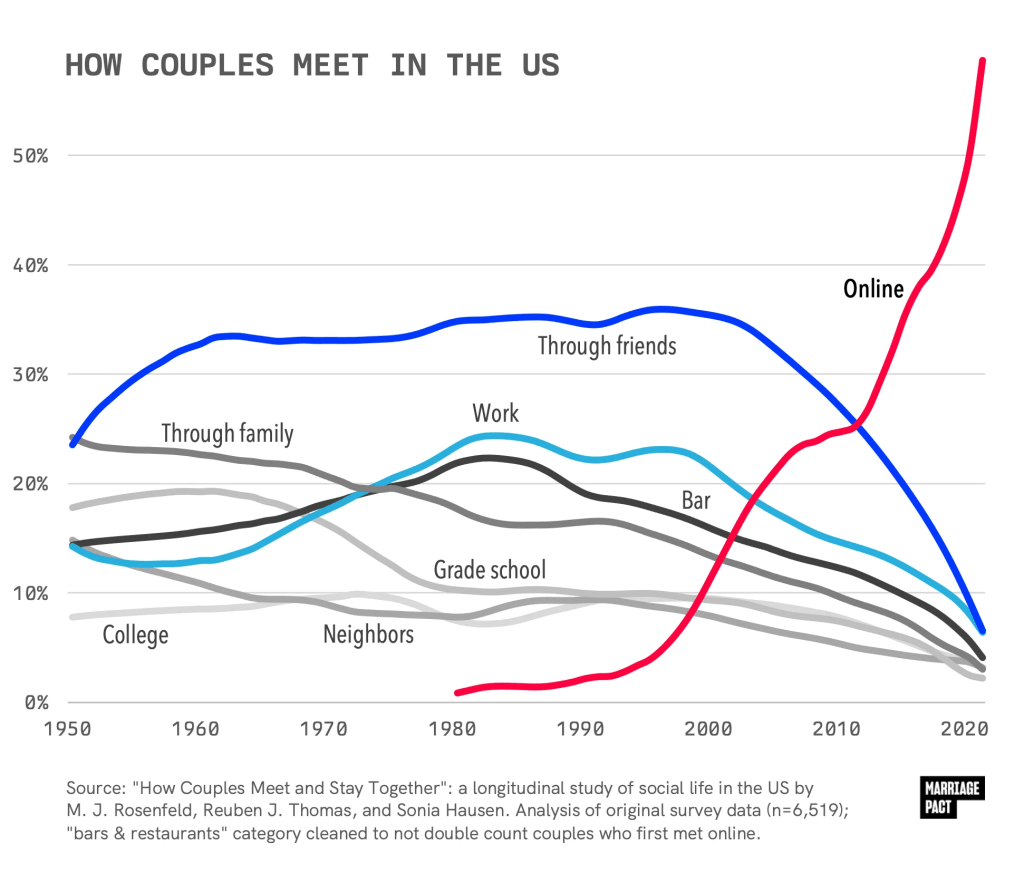
There is genuine and widespread despair in the U.S., but the primary reason isn’t economic, rather it is because human fulfillment requires more than material wealth, which in our quest for more stuff, we have forgotten. People need physical communities, and while the US excels at material wealth, it’s achieved it, especially in the last forty years, at the expense of the aesthetic, communal, stable, and personal, and so the bad vibes are justified.
Societies come with strong forces that shape expectations and even shape people’s understanding of a ‘good life.’ That is, society provides citizens playbooks that they are urged to follow which are supposed to end in happily ever after, and ours is that you can become a millionaire on your own terms as long as you hustle hustle hustle — and when that doesn’t happen, it’s very lonely and humiliating, because we as a culture have put all our eggs in that one particular basket. At the expense of community, friendships, and even family.
When you give your citizens a cultural script, built on the material, that promises hard work will lead to success, and then your policy design ensures it doesn’t, people will end up both economically frustrated, as well as spiritually empty, sitting in their living room streaming the latest movie wondering what exactly is the point of life. Or, they will feel they have failed at the material, while also having little else to give them meaning.
_____________________________
In his investment classic Winning the Loser’s Game, Charley Ellis tells a great story about healthcare and simplicity:
“Two of my best friends, who are at the peak of their distinguished careers in medicine and medical research, agree that the two most important discoveries in medical history are penicillin and washing hands (which stopped the spread of infection from one mother to another by the midwives who delivered most babies before 1900). What’s more, my friends counsel, there’s no better advice on how to live longer than to quit smoking and buckle up when driving. “
Imagine you are a new college grad from a middle-class family. If you are lucky, you have no education debt, but many do. If you are lucky, you land a 100k+ job, but many don’t. Even if you are lucky, you still look up at astronomical asset prices (houses) and try to work out how you can maybe afford one in 20 years, with the understanding that they will only continue to go up in the meantime.
You are surrounded by online examples of success (usually fake or survivorship bias). Your attention span has been fried by TikTok and YouTube shorts. You simply don’t have the patience or discipline for the slow path.
So instead, you start taking outsized risks with your monthly paychecks – crypto, options, meme stocks, meme coins, sports betting. Your rationale is that this current amount could never buy a house, but if you win it might. And if you lose, you simply have to wait a week or two before you can reload and try again. This is “hyper-gambling.”
The obvious downside of taking repeated high-risk investments is that most will fail in this lottery strategy, and if you find yourself at the end of the tunnel with no diamonds to show for it, you will be even farther behind.
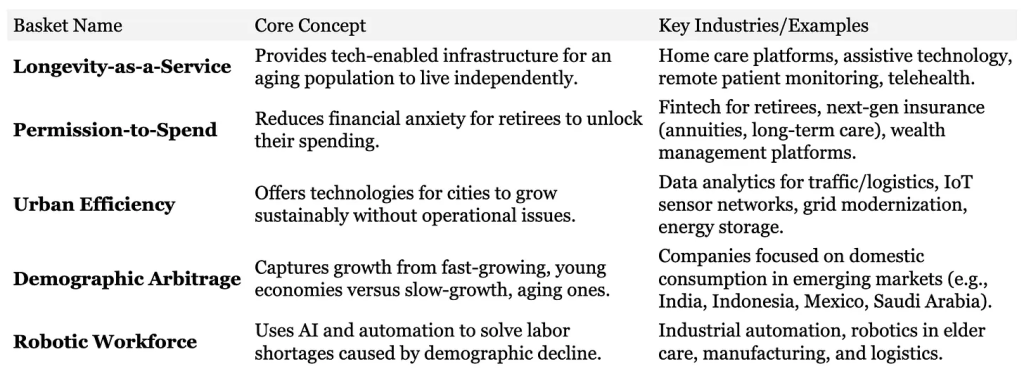
Between 2015 and 2050, the proportion of the global population over 60 is set to nearly double, climbing from 12% to 22%. The most extreme changes though, are happening at the upper end of the age spectrum. The number of individuals aged 80 or older is projected to triple between 2020 and 2050, reaching 426 million. This is exponential acceleration, and two-thirds of the world’s elderly will live in developing nations, up from just over half today.
Running parallel to the aging of the globe is a second, equally powerful human migration: the mass movement into cities. Today, 58% of the world’s 8 billion people live in urban areas. By 2050 this figure is projected to climb to 70%. Nearly 90% of this 2.5 billion-person increase in cities will occur in Asia and Africa. India, China, and Nigeria. are projected to account for over a third of all new urban dwellers globally.
President Clinton noted in his January 2000 State of the Union speech:
“We begin the new century with over 20 million new jobs; the fastest economic growth in more than 30 years; the lowest unemployment rates in 30 years; the lowest poverty rates in 20 years; the lowest African-American and Hispanic unemployment rates on record; the first back-to-back surpluses in 42 years; and next month, America will achieve the longest period of economic growth in our entire history.”
That wasn’t an exaggeration. But it marked the beginning of the worst decade for the U.S. stock market in modern times.
In January 2010, President Obama noted in his State of the Union speech:
“One in 10 Americans still cannot find work. Many businesses have shuttered. Home values have declined. Small towns and rural communities have been hit especially hard. And for those who’d already known poverty, life has become that much harder.”
That wasn’t an exaggeration. But it marked the beginning of one of the best 15 years (and counting) for the U.S. stock market in history.
In the last two decades, the share of American adults who say they exercise or play sports on any given day has increased by about 20 percent.
The share of Americans who say they don’t regularly work out or play sports, which SFIA calls the “inactivity rate,” has fallen by more than one-fifth since 2019.
Rich and young Americans exercise the most. Poor and older Americans work out the least. Among adults, income predicts activity better than age.
The increase in exercise minutes is significantly led by young people and women over 65, who increased their weekly workouts by about twice as much as men over 65.
No fitness activity saw a larger increase in participation between 2019 and 2024 than Pilates. Yoga and barre were close behind among the fastest-growing activities. Meanwhile, group cycling, cardio kickboxing, boot camps, and cross-training workouts like CrossFit got walloped by the pandemic, and they haven’t bounced back. In general, Americans seem to have traded sweaty group classes for gentler core work.
After persevering through a valley of tears since 2010, value investors are finally beginning to reap a fruitful harvest in developed international markets. Over the past five years, the value premium has returned to positive territory in international markets as value stocks have returned to outpacing growth stocks. Since July 2020, value has outperformed growth by 11.6% annualized in developed international markets:
“When (Charlie Munger and I) were born the odds were over 30-to-1 against being born in the United States. Just winning that portion of the lottery, enormous plus. We wouldn’t be worth a damn in Afghanistan. We won it partially in the era in which we were born by being born male. We won it in another way by being wired in a certain way, which we had nothing to do with, that happens to enable us to be good at valuing businesses. And you know, is that the greatest talent in the world? No. It just happens to be something that pays off like crazy in this system.”
If you had invested from 1960 to 1980 and beaten the market (the S&P 500) by 5% each year, you would have made less money than if you had invested from 1980-2000 and under-performed the market by 5% every year. When you start investing can be more important than anything else.
_______________________________________
For years, 529 accounts were synonymous with college savings plans. But recent updates have given the accounts a makeover. They’ve become education savings accounts, not just college savings accounts. The latest change allows the accounts to be used to help pay for a broader range of post-high school credentials, like certification in specialties like auto mechanics or food safety,and related expenses.
Population ageing and decline is one of the most powerful forces in the world, shaping everything from economics to politics and the environment. It it implies the goal is the same today as it was in the past: finding ways to encourage couples to have more children. A closer look at the data suggests a whole new challenge.
Take the US as an example. Between 1960 and 1980, the average number of children born to a woman halved from almost four to two, even as the share of women in married couples edged only modestly lower. There were still plenty of couples in happy, stable relationships. They were just electing to have smaller families.
When you ask people, “What builds wealth?” you get a wide variety of answers. Some will tell you it’s mindset. Some will say work ethic. Some will say it’s spending. And a host of other explanations. If you could have just one piece of information on somebody to predict their future wealth, what would it be? Would you ask for their IQ? Whether they went to college? How about their parents’ education level?
The answer is the most obvious and straightforward: For someone of working age, their income is the best leading indicator of wealth. What leads to higher income? Hard work, connections, and luck are important, but high earners tend to follow one of four distinct paths. These paths won’t guarantee success, but they are where high incomes tend to cluster:
Sales and Persuasion
Technical/Analytical Skills
Advanced Degrees/Credentials
Entrepreneurship and Business Building
______________________________
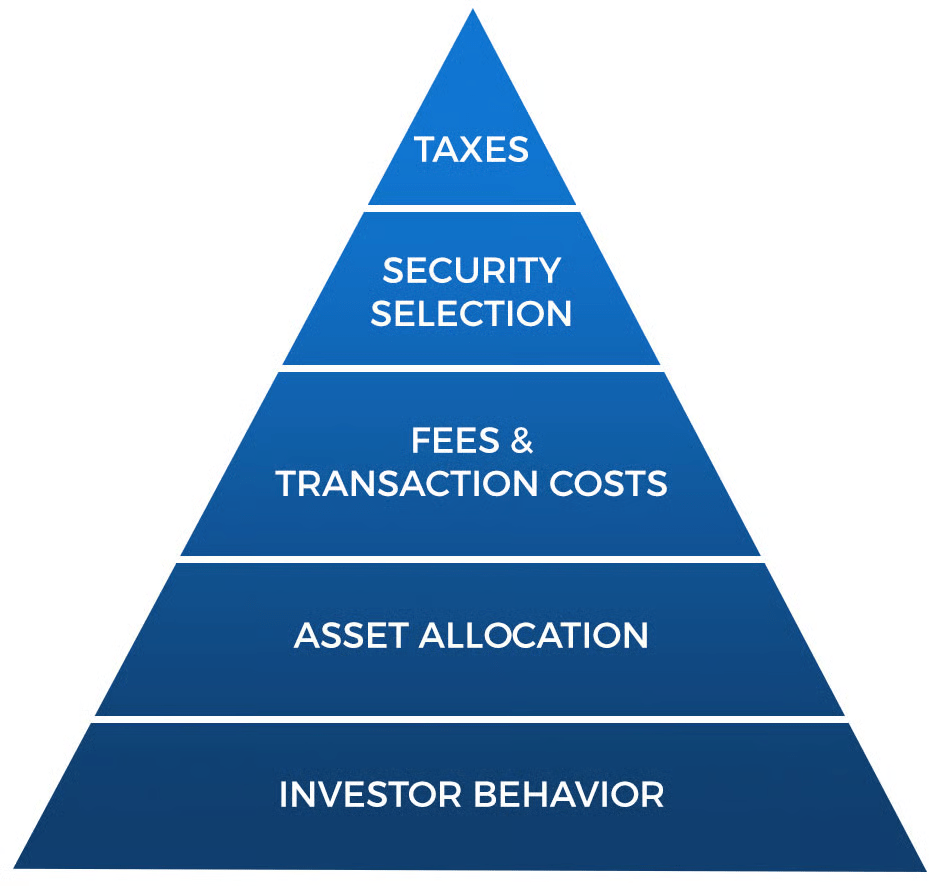
Some investing skills have to be mastered before any other skills matter at all. There is a hierarchy of needs.
At the foundation of this hierarchy are the boring but essential behaviors: living below your means, having an emergency fund, staying invested during downturns, and picking a reasonable asset allocation. These things aren’t exciting. They won’t get you likes. But they will carry you through decades of compounding.
Higher up the hierarchy are things like choosing the right stocks or funds and minimizing fees. These are useful, but only after the foundation is strong. Otherwise, you’re just rearranging furniture in a house with shaky walls.
Barry: You’ve covered human behavior and human nature, what led you to say, I wanna write a new book about the art of spending money?
Morgan: I didn’t call this book The Science of Spending Money because I don’t think that exists. Science implies that there is like a, a one size fits all rule for, for you and I, and that’s not the case. I call it the artist spending money because art is subjective. It is often contradictory. It is different from person to person, and that’s really what spending is. So much good ink has been spilled on how to invest, how to grow your career, how to earn more money, but very little on spending money.
Barry: There’s been a lot of academic research: Does money make you happier?
Morgan: What a lot of the research shows is that if you are already a happy person, money can make you happier. But if you are a depressed person – or a miserable person, whatever it might be – that it will not, and it’s easy to just kind of contextualize this into a real person’s life of if you are in a bad marriage and you hate your career and you have a two hour commute and just go on down the list, you’re an alcoholic, you’re obese. If you take that person and you give them more money, will they be happier? The answer is no, of course not, because all of those other aspects of their life are gonna override whatever money can do for them.
But if you also take somebody who’s in a great marriage loves their career, they’re happy, they’re healthy, they sleep eight hours, they have a good set of friends – and you give that person more money, there’s a good chance that they’re gonna use that money to just leverage what they’re already doing. To spend more time with the friends who they already love, to spend more time getting healthier and eating good food.
Barry: One of the interesting things in the academic literature that I recall seeing a few years ago was when they draw these charts of money potentially making people happier, Divorce is a giant red flag. People in the middle of a divorce or people who have recently been divorced, that’s a really challenging road to haul, isn’t it?
Morgan: I think what it comes down to is that having more money is so quantifiable that we use it as a crutch for all of our problems. For example, if I said I would have a better life if I was a 10% better dad. What does that even mean? What does a 10% better Dad mean? There’s no way to quantify it, but if I said I would have a better life if my salary went up by 10%, you can easily quantify that, wrap your head around it. So we chase that and we assume that that’s gonna be the solution to all of our ills. Becoming a better dad might make me a happier, better person, but since it’s impossible to quantify, I just ignore it and pretended that it doesn’t exist.
Barry: You alluded to impressing others. How should people avoid spending money for status and symbolism as opposed to bringing themselves satisfaction and happiness?
Morgan: It is so easy to overestimate how much other people are looking at your stuff, your house, your cars……they’re not paying any attention. They’re busy worrying about themselves and thinking about themselves. And so when you frame it like that – it’s not to say don’t use your money to gain attention – it’s use it to gain attention from the very small core group of people who you want to love you. There’s a great quote from Warren Buffett where he says, “The definition of success in life is when the people who you want to love you do love you.”
Barry: The person driving down the street in the loud Lamborghini or the person around the corner from you with a giant house? You are only seeing one half of the balance sheet. You’re only seeing their assets. Did they pay cash for that or did they go deep into debt in order to buy a house or a car to show off for the neighbors? Talk about that a little bit.
Morgan: Wealth is what you don’t see. Wealth is the cars that you didn’t purchase and the giant house that you didn’t buy. That’s what wealth is. It is money that you didn’t spend that you can now save for either for future consumption or for independence today. I can see your car, I can see your house, I can see your watch and your clothes. I cannot see your bank account or your brokerage statement. So the most important part of wealth – literally in my view, the definition of wealth is invisible to everybody.
Think about physical fitness. You can see somebody’s physique, it’s right there. And so you know who to admire and who to chase. “Oh, that, that person’s in great shape. I should ask them what they do. I should ask them their diet and try to mimic what they do.” But if you see somebody with a mansion or a Ferrari or whatever it is, you don’t know they got that by success. That may be the picture of a leverage. It’s possible they haven’t slept in two weeks because they’re wondering how they’re gonna make their next Ferrari lease payment. And so we have a fake view of who we’re chasing and what we should do, because wealth that we’re chasing is invisible.
During the month following Lehman Brothers’ September 2008 implosion, then Federal Reserve Chairman Ben Bernanke testified to the House Committee on the Budget on Monday, October 20, 2008. He reminded members that the Federal Reserve’s charter was to maintain high employment and low inflation. The Fed, he also reminded, was not authorized to manage the stability of the financial system or keep credit markets flowing; it was not the FOMC’s charge to address any of the myriad issues that had endangered the financial system’s functioning.
A fiery speech from someone (maybe Rand Paul?) led to a vote against Bernanke’s funding and authority request. He would not be getting the tools necessary to unfreeze credit and keep the banking system operating.
Sayeth Mr. Market: “Hold My Beer.”
The sell-off began immediately after the vote; over the next five trading days, from recent highs, the S&P 500 fell 13.9%, the Nasdaq was right behind it at 13.5%, and the Russell 2000 crashed 18%. MOSTLY IN ONE WEEK. Congress reconvened and passed both the necessary authority and the dollars that the Fed chairman had requested. By November 4th, all of the losses had been made up and then some.
Don’t fix the credit markets, and put corporate revenue and payrolls at risk? FAFO.
______________________________
Behind a paycheck, the largest source of income for the 1% highest earners in the U.S. isn’t being a partner at an investment bank or launching a one-in-a-million tech startup. It is owning a medium-size regional business. Many of them are distinctly boring and extremely lucrative, like auto dealerships, beverage distributors, grocery stores, dental practices and law firms.
The analysis of anonymized tax data from 2000 through 2022 suggests the importance of such business ownership to the U.S. economy has grown. The share of income that ownership generates has increased to 34.9% in 2022 from 30.3% in 2014 for the top 1% earners. It has increased even more at the topmost levels. The top 0.1% highest-earners saw 43.1% of their income come from such business ownership in 2022, compared with 37.3% in 2014. (The minimum income threshold in 2022 to qualify for the top 0.1% of earners was $2.3 million).
The growth of this growth can be attributed in large part to tax cuts in recent decades for such business owners and low interest rates that have boosted company valuations. The number of such business owners worth $10 million or more, adjusted for inflation, has more than doubled since 2001, to 1.6 million as of 2022. The growth has been in S-corporations and partnerships, where the profits and losses of the business flow through to the owners or partners; the business itself doesn’t pay taxes. The typical medium-size business they studied has annual sales of $20 million and 100 employees.
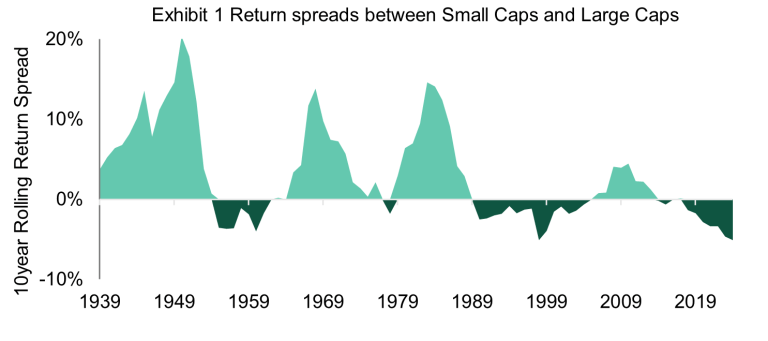
Small-cap underperformance has historical precedent — but cycles turn. We’re in the 12th year of a small-cap lagging cycle, longer than average. Historical data suggests a reversal is near.
Higher interest rates are reigniting migration. With rates expected to stay elevated, small-cap stocks are more likely to graduate to large caps — boosting overall performance potential.
Valuation and quality favor small caps. Compared to the weakest segment of large caps, small-cap stocks offer stronger return on assets and more attractive price-to-book ratios, contradicting the view that only low-quality names remain in the space.
_____________________________
The MSCI ACWI index includes large and mid-sized companies from 23 developed countries (like the U.S., UK, Japan) and 24 emerging markets (like China, India, Brazil). It covers about 85% of the available stocks around the world. The number of stocks in the MSCI ACWI that do business globally has risen to 80% (which is why the global stock market did not respond well to the recent tariff announcements).
Minimum Levels Of Stress, a phenomenal new article by one of my favorite authors; Morgan Housel.
A day after the September 11th terrorist attacks, every member of Congress stood on the steps of the U.S. Capitol and sang God Bless America. Could you imagine that happening today? It’s easy to say no, given how nasty politics has become. But if America faced an existential crisis like 9/11 again, I think you’d see the same kind of unity return. There’s a long history of enemies putting their differences aside when facing a big, devastating threat. People get serious when shit gets real. If that sounds like wishful thinking to you, let me propose a reason why: Part of the reason today’s world is so petty and angry is because life is currently pretty good for a lot of people.
There are no domestic wars. Unemployment is low. Household wealth is at an all-time high. Innovation is astounding.
As the world improves, our threshold for complaining drops. In the absence of big problems, people shift their worries to smaller ones. In the absence of small problems, they focus on petty or even imaginary ones. Most people – and definitely society as a whole – seem to have a minimum level of stress. They will never be fully at ease because after solving every problem the gaze of their anxiety shifts to the next problem, no matter how trivial it is relative to previous ones. Free from stressing about where their next meal will come from, worry shifts to, say, a politician being rude. Relieved of the trauma of war, stress shifts to whether someone’s language is offensive, or whether the stock market is overvalued.
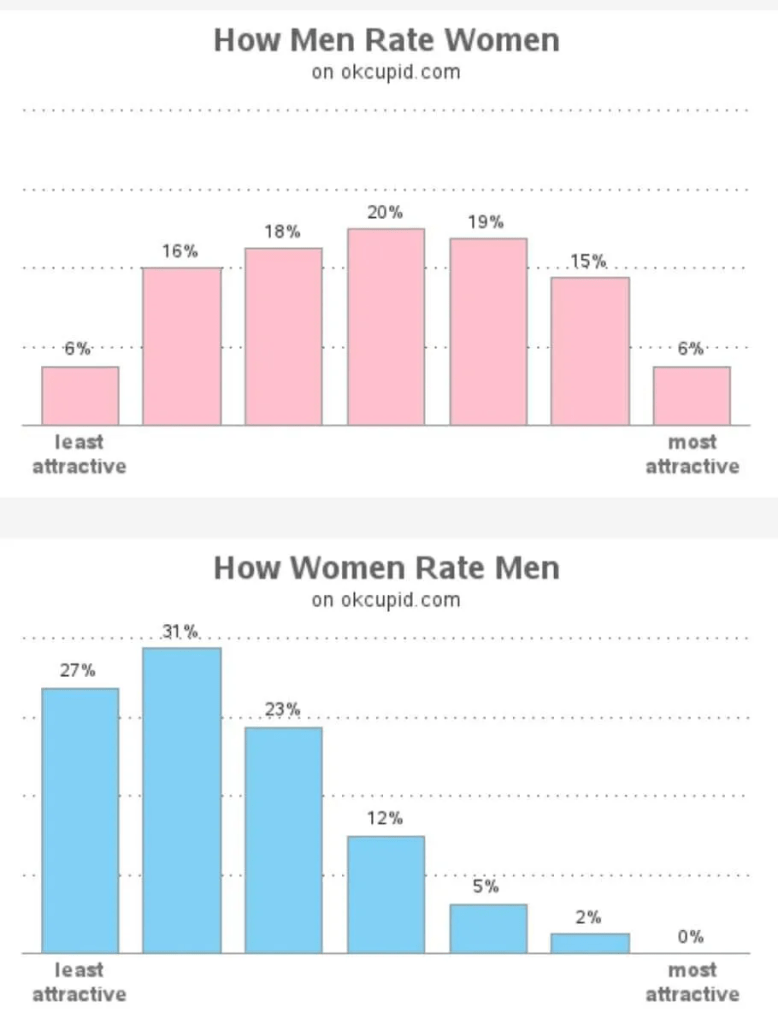
A summary and thoughts on the data from the author:
The typical woman is disgusted by the typical man
The typical woman is moderately disgusted by the median man
The typical woman is strongly disgusted by the bottom quarter of men
Men should stop taking rejection so personally. When the typical women rejects you, the problem isn’t so much that she finds you unappealing. The problem is that the typical woman finds almost all men unappealing.
Men should try harder to be less disgusting.
Women should try harder to be less disgusted. Most women eventually accept a guy who isn’t visibly attractive. Much of the reason is that superficially unappealing guys win them over with charm, humor, and devotion.
It’s not hard to use evolutionary psychology to explain why the typical man disgusts the typical woman: Since women’s maximum reproductive capacity is strictly limited, they’re evolved to be hypergamous, with a strong preference for mating with the best of the best.
__________________________________
Numerous studies show a strong relationship between stock market valuation and long-term subsequent returns. Since 1979, global stock market indices have been valued on average at a Shiller-CAPE of 20 and a price-to-book ratio (PB) of 1.9. Investors who invested at attractive valuations in recent decades were able to achieve above-average returns over the following 10-15 years. Those who bought at high valuations, on the other hand, were generally disappointed in the long term.
Here’s a look at where countries stand today. The lower left are the least expensive countries/stock markets and the upper right are the most expensive. You can see that India is off the charts expensive while the United States is in another solar system based on how overvalued it is.
What long-term stock market returns can investors expect in the 20 most important stock markets based on valuation?
Based on CAPE and PB, Latin America and Asia currently show the lowest valuations, particularly in Brazil, Korea and China. These equity markets are currently trading at a CAPE of 9-12 and a PB of 0.9-1.4.
Historically, comparably attractive valuations have been followed by above-average returns of 9-11% (in real terms) over the next 10-15 years.
In general, the emerging markets (with the exception of India) are currently valued much more attractively than the developed markets. Historically, comparable valuations in the emerging markets have been followed by annual returns of 7.7%, while the developed markets are expected to achieve rather low returns of 2.5%.
The low return expectations of the developed equity markets are caused by the extremely high US valuation: with a CAPE of 35.4 and a P/B ratio of 5.1, the US market is trading at around twice the level of recent decades. In the last 140 years, such high valuations have been followed by long-term returns of only 0.1% p.a.
Among the developed markets, Germany, Italy, Japan, Singapore, Spain, Norway and the UK still appear attractive. Investors here can expect annual returns of 7-8% in the long term here.















 Tuna Thoughts