It’s difficult to escape “temporal chauvinism,” which is the feeling that the time we’re living in now is the most significant or terrifying one ever, simply because it’s the one we happen to be around to experience.
Everything about our situation as humans pushes us to overrate the importance of our own era. Apart from anything else, present-day unknowns feel the scariest, because all previous unknowns eventually resolved themselves into knowns (every prior prediction of the end of the world turned out to be wrong) while future ones haven’t occurred to us yet.
It is very, very, very, very unlikely that the literal apocalypse is coming anytime soon. We’re almost certainly not living at the end of human civilization. Frankly, it’s pretty unlikely we’re even on the cusp of unprecedented levels of disruptive change. The truth is that we’re probably living through times that future historians will think of as broadly normal.
The point is not that life is safer and more secure than the heralds of the apocalypse would have us believe. It’s the opposite: that human existence is intrinsically unsafe and insecure, all the time. Anything could happen at any moment, the future is unknowable, one day you’ll die, and some people end up having vastly more traumatic encounters with these realities than others.
Yet there’s a stunning bit of good news hiding in all this, because if radical insecurity about the future is just how life is, then by definition, we’re already coping with it. Look back at your life to date, and you might even conclude that, so far, you’re handling it all rather brilliantly.

________________________
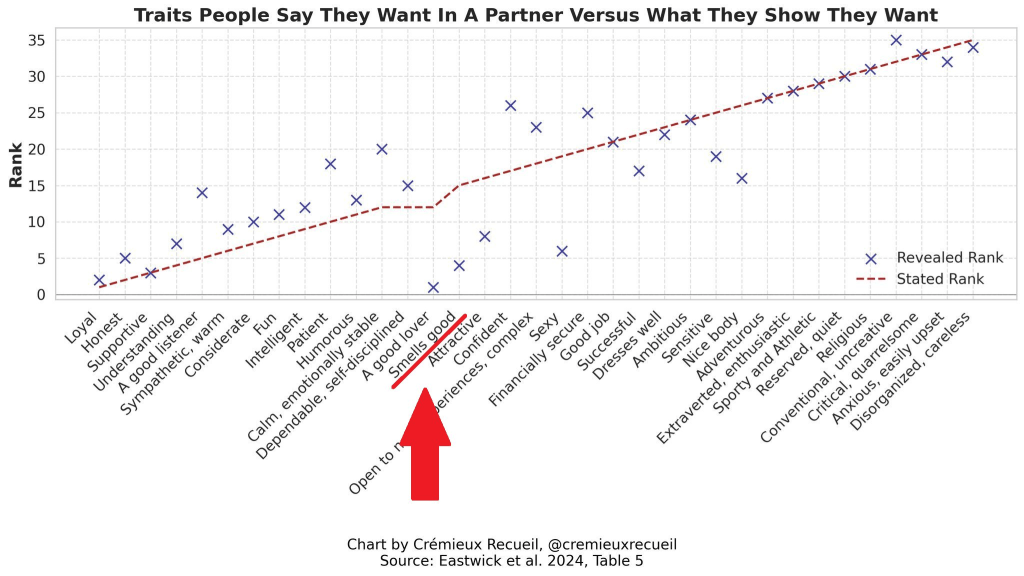
The graph below shows what people say they want or what is important to them in a partner (red line). The “X” marks show how much each trait correlated with people’s actual romantic evaluations or how important it was in real life.
The biggest discrepancies were in (1) being attractive, (2) being a good lover, (3) being sexy, (4) having a nice body, and (5) smelling good. Perhaps people are simpler than we realized once we look beyond surveys.
The discrepancies run the other way too. Being (1) a good listener, (2) patient, and (3) calm and emotionally stable were all overrated in stated preferences.
It’s a little confusing that the red line rises from left to right, suggesting increasing importance, but since these are rankings, a higher number actually means less important (1 = most important).
_________________________
Research has consistently shown that younger siblings fare worse than firstborns on lifetime earnings, educational achievement, mental health and, for women, teen pregnancy. The later the birth order, the worse the stats get. Why?
(1) Less Quality Time with Parents
First-born children average 20 to 30 more quality minutes each day with parents compared with a second-born child of the same age. The deficit amounts to about 3,000 fewer hours spent on reading, playing, talking or other activities with at least one parent for younger siblings. That’s roughly comparable to more than a year of schooling between the ages of 4 and 13.
The gap only widens as more kids enter the picture. That means the youngest siblings get far less quality time overall because whatever is available gets split among more children.
(2) Germs
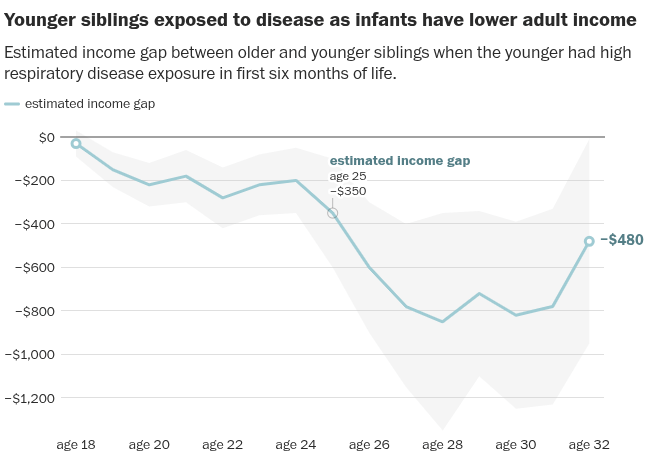
Studies find that the tiniest organisms have a profound impact on a child’s future. Exposure to respiratory viruses before a baby’s first birthday, when immune systems are immature and before most childhood vaccinations, consistently predict reduced earnings, education and health decades later.
Researchers estimate that half or more of the gap in life outcomes between older and younger siblings can be attributed to pathogens inadvertently brought home by older siblings.
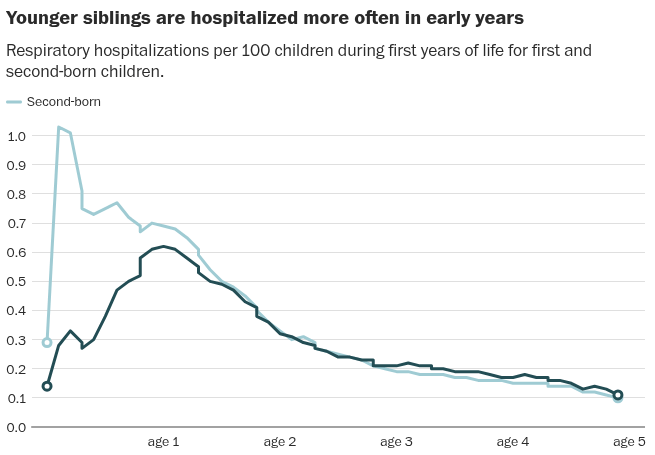
The disparity is stark: Younger siblings are two to three times more likely to be hospitalized for acute respiratory conditions than their older siblings during their first year of life. After that, when younger children generally begin attending group child care, the hospitalization gap disappears. Older siblings, the data suggested, bring home viruses to vulnerable infants with no other significant sources of exposure.
To show that higher disease exposure causes harm later in life required more work for researchers. They had to control for parental income, education and employment across municipalities with higher and lower infection rates. Yet the pattern was clear: earnings, education and mental health outcomes all declined as community disease exposure rose.
In the first months of life, roughly 85 percent of an infant’s calorie intake goes toward neural development. A serious infection can reduce how much a baby eats and divert calories away building a brain. If a child is very ill during that time, it might impact brain development by diverting biological resources to fighting an illness.
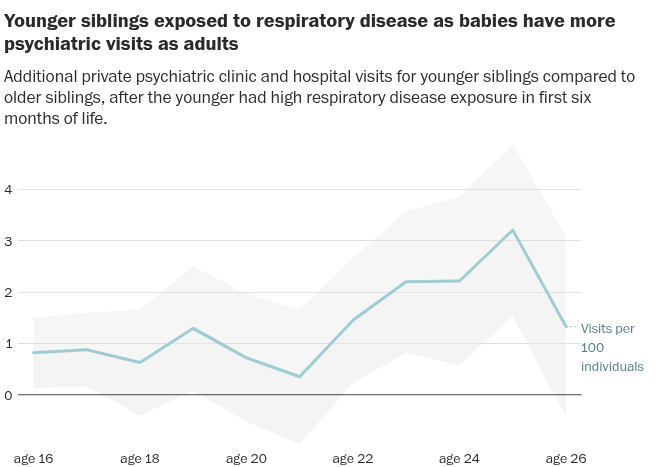
RSV was singled out as a key pathogen. It caused roughly one-third of all respiratory hospitalizations among second-born children with no protective immunity from first-year exposure against RSV hospitalization during later childhood.
____________________________

