The Zone Of Scarcity & Global Developments

Vikram Mansharamani published his global developments to watch from 2026 to 2031. These were a few that I found interesting:

  • Bio-fabrication technologies advance rapidly enabling human organs to be printed on demand. A new industry of “body mechanics” emerges and utilizes AI-driven prediction models to pre-emptively replace joints, bones, and organs before they fail. The expected lifespan of a child born in 2030 rises to 151 years.
  •  Advancements in quantum computing lead to a geopolitical crisis as all formerly- secure communications become instantaneously vulnerable. Each breakthrough leads to a bump in gold prices as investors fear the possibility of quantum-enabled theft of cryptocurrency. Cybersecurity re-emerges as an area of top concern for corporate boardrooms, nation states, and individuals.
  • Deepfake technologies become indistinguishable from real life, leading to mass human confusion and cognitive dissonance. Reality Defender emerges as the world’s hottest company as it secures elections by providing voters assurance of authentic messaging from candidates, thereby saving democracy from being hijacked by technologically-savvy foreign actors.
  •  A boom in next generation nuclear technologies combines with improved hydrocarbon extraction efficiency to keep energy prices contained in the face of exploding demand from technology applications and data centers. As copper emerges as the world’s most strategic resource, the Great Powers shift their focus from the Middle East to the Andean region.
  • The insatiable consumer appetite for protein continues indefinitely. Restaurants start disclosing the protein content of menu items, and Coke introduces a high-protein soda. Public health deteriorates as Americans’ religious focus on protein leads to elevated consumption of sugars and artificial sweeteners.
  • The global use of GLP-1 drugs skyrockets as an oral pill becomes readily available and is covered by most health insurance plans or government health offices. 
  • Artificial intelligence generates deflation, leading to structurally rising unemployment and elevated debt levels.

___________________________________

We are drowning in information and data. So much so that we’re obese in the mind. The same way the human body was not prepared for a world of abundant food, and we thus transformed our cities into feeding zones full of fat people, the human mind is not prepared for a world with infinite content and information. Less than two decades into social media and the world is already full of morbidly obese minds that cannot think or focus, let alone produce anything novel anymore.

Even the best of us are mentally overweight! There are few, if any, original ideas anywhere. Everyone, everywhere is in a constant, social-media induced mimetic trance, mistaking repetition for thought while parroting the same words as those in our little echo chamber.

The only solution is to shut it all out. I’ve come to the realization that selective ignorance on the other hand; I’m talking actual willful, intentional ignorance, is not only blissful, but is a holy virtue.

It’s the kind of ignorance that is deliberately oblivious to what is going on in the world because none of it matters an iota in the grand scheme of one’s life. It’s the kind of noble, savage and ruthless ignorance that doesn’t even waste energy saying: “I don’t care.” It’s just blissfully above to the noise, present only with what matters, here and now.

As the pace of things accelerates and the never ending cycle of hysteria continues, it’s dawned on me that none of it really matters. Sure, individual events may matter to some people, but because of how we’re wired and how the internet and social media have connected us all, the number of events that can (a) happen and also (b) be brought to our attention is infinite.

Which in short means that everything matters all the time. But when everything matters all of the time, then the only reaction for the mind and body is to become numb. In other words, nothing means anything or matters any more. This is not a way to live.

Attention, at the end of the day, is all we really have. It’s finite. It’s super super super finite. We have so little time. We have only so much energy. It’s hard to focus at the best of times, and here we are, on a daily basis, being either:

  1. Distracted by things inside of a phone-size shopfront that most of us will either never have (picture-perfect women, hotels, cars, etc), or
  2. Inflamed by things on that same stupid screen which we have no relationship to or influence over, happening in other parts of the world, thousands of miles away.

The end result of all this stupidity (for 99.9999% of people) is just a LOSS of attention. I’m sure some of you have found inspiration or motivation from these screens (this can happen), but if we’re all being TRULY honest with ourselves here, we can admit the truth: we can be just as inspired by a walk on the beach or a conversation with a loved one too.

When I’m on my deathbed, I won’t remember wtf I saw on Twitter or Instagram from all those endless hours of looking at the screen. But I will remember the time I spent with the people who I truly loved. To find a solution, one must first understand the problem, and the problem is twofold:

  1. Nobody is entirely immune to the siren call of dopamine. These platforms hack your biology in such a way that they hook you. Thus you are not fighting the platform, but your own biology – and this consumes energy. Energy that could be much better spent elsewhere.
  2. Our cups are already full. Those of use who are strong learners have already had our fill, especially if you’ve been online for the last 5 – 10 years. We’re well past the point of diminishing returns. We have all the information we could possibly need to live and lead meaningful lives. Stuffing our minds with more stuff won’t improve anything, and at this point is just a distraction from living in the real world and implementing the things we’ve already learned or know.

The beautiful thing about value is that it always migrates to the zone of greatest scarcity. As a zone attracts more attention (and thus value), it begins to lose scarcity, until it gets saturated, and then one day, the value migrates away to a zone where scarcity prevails. People are starting to realize that being online is quickly becoming uncouth and that they need to run away. But where?

The answer: offline. 

Inversion, Eudaimonia & Workplace Skills

Happiness, it turns out, is more Rorschach than road map. Is it found in the ultraluxe wellness center or the austere monastery? Does it come from getting what you want or wanting less?

By the early 20th century, utility maximization — happiness writ small — emerged as a linchpin of economic analysis. Public happiness, in turn, became a matter of optimizing the sum of individual welfare. The mathematics could be complex, but the premise was simple: Getting what you want in life — that’s happiness, bro.

The notion of happiness as choice-making swiftly migrated from economic models into the marrow of the broader culture. What was once a lifelong project shrank into a sequence of transactions. As the midcentury economy boomed, it didn’t just build wealth; it reconstructed desire. The good life, formerly the province of philosophers, was now a mainstay of the marketers: happiness packaged as the perfect lawn, the gleaming automobile, the immaculate kitchen with its humming refrigerator. We became, almost without noticing, what we bought.

And if you still felt empty? That’s where the therapy culture of the 1970s and 1980s came in — not as a remedy for consumerism but as an extension of it. The older vocabulary of life-defining commitments and meaning-making projects continued to wither while a new lexicon took hold: self-acceptance, self-esteem, self-love.

By the 1990s, happiness had acquired a personal brand. Oprah Winfrey presided over a daytime academy of self-care, empowerment and curated aspiration. Then came the next wave: the life-hacking, self-quantifying, habit-stacking era of optimization gurus like Tim Ferriss, whose first book, published in 2007, was “The 4-Hour Workweek” — “a toolkit,” in his words, “for maximizing per-hour output.”

Excitement is the more practical synonym for happiness, and it is precisely what you should strive to chase,” Ferriss wrote. “It is the cure-all.” Amid the excitement, the happiness concept kept getting miniaturized. With the rise of the algorithms, decision-making became a series of bite-size transactions. If you liked this, you’ll like that. Every swipe, click and purchase was an act of preference revelation, the digital cookie crumbs of personal identity.

In today’s social media ecosystem, happiness even threatens to become a ring-lighted aesthetic: matcha lattes, artisanal candles, sage-smudging, captioned reminders to just breathe. Once again, happiness is work — but now the work of packaging moods and moments for validation, with a tiny dopamine hit for each “like.”

“So long as you’re happy,” parents tell their kids. In reality, they want to see their children engaged in something worthwhile, contributing to something beyond their own fleeting satisfactions. 

If you’ll indulge the philosophers’ habit of conjuring characters to illustrate their abstractions, imagine a young person — let’s call her Julia — who left community college after a semester and has bounced between gigs ever since: dog-walking, cafe shifts, warehouse nights. Her life is messy, but she has learned how to show up for people. When her neighbor’s mother gets sick, Julia brings groceries. When her cousin gets out of rehab, she’s the one who texts every day. She doesn’t have a wellness routine or a five-year plan. But people trust her. She holds lives together in small, invisible ways.

Or imagine a middle-aged man named Daniel, a product manager with a smart fridge and an Optimal Morning Routine. For years, he has chased happiness through upgrades — to his apps, his appliances, himself. But lately, the returns feel thin. When his niece’s soccer team needs a coach, he volunteers, awkwardly at first, then with growing investment. Daniel has started showing up at town meetings, fighting to save the field from developers. Now his calendar includes something he cares deeply about that doesn’t come with a progress bar.

Daniel still wears a Whoop band. Julia hasn’t found her “calling.” But they’re living into a broader idea of happiness — less about what they have, more about what they give, who they’re with, what they’re part of.

Is it possible that happiness stayed big, and it’s only our way of talking about it that got small? Surely the old understanding, in which the pursuit of happiness is inseparable from shared commitments, hasn’t gone anywhere. On some level, we still know the difference between feeling good and flourishing, between the hedonic and the eudaemonic, between the algorithm’s next suggestion and the difficult and uncertain path toward a meaningful existence. Yes, we often speak as if feelings are all that count, but maybe that’s because the language of the “good life” has been hollowed out.

____________________________

Inversion is a mental model that flips the script on traditional problem-solving. Rather than look at a problem in a linear, forward, logical manner, you think about it in reverse. Well, there is one complex, foundational problem that is truly universal: How do you live a good life? Using inversion to address it: Here are some ways to live a miserable life…

  • Allow idleness to dominate your life – Stress and anxiety feed on idleness. They take hold while you sit and scroll on your phone, while you overthink your situation, while you compare yourself to others, while you try to create the perfect plan. When you take action, you starve them of the oxygen they need to survive. 
  • Allow optimal to get in the way of beneficial – Ambitious people have a bad tendency to think like this: “I don’t have an hour to work out, so I just won’t go. I don’t have two hours for deep work, so I’ll do email instead. I don’t have 30 minutes to call my mom, so I won’t call at all.” When you allow optimal to get in the way of beneficial, you ignore the most powerful principle in life: Anything above zero compounds. A little bit is always better than nothing. Tiny wins stack over long periods of time. Small things become big things.
  • Obsess over speed – Life is about direction, not speed. It’s much better to climb slowly up the right mountain than to climb fast up the wrong one.

____________________________

More police officers kill themselves every year than are killed by suspects. At least 184 public-safety officers die by suicide each year, while an average of about 57 officers are killed by suspects. Law-enforcement officers are 54 percent more likely to die by suicide than the average American worker.

Most officers are required to pass psychological and physical screenings before they are hired. But many struggle after chronic exposure to trauma. Police officers have higher rates of depression than other American workers. Shift work, which disrupts sleep, and alcohol use, long the profession’s culturally accepted method of blowing off steam and managing stress, further compound health issues

______________________________

A survey of 1,000 managers across America revealed the reasons that 8 in 10 managers said newly hired college graduates did not work out during their first year on the job:

  • 78%: Excessive use of cell phones – the top pet peeve of managers
  • 61%: Entitled or easily offended
  • 57%: Unprepared for the workplace
  • 54%: Lack of a work ethic
  • 47%: Poor communication skills
  • 27%: Lack of technical skills

Other concerns managers had about the graduates included lateness, failure to turn in assignments on time, unprofessional behavior, and inappropriate dress and language.

Colleges don’t teach students how to behave in the workplace, and there is a lack of transitional support from both universities and employers. Most students graduate with little exposure to professional environments, so when they arrive at their first job, they’re often learning basic workplace norms for the first time.

______________________________

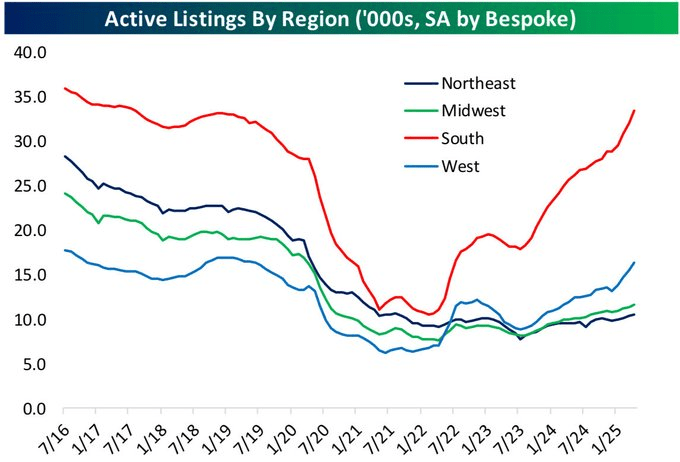
Where the number of homes for sale is growing. Fast.

___________________________

The Russell 1000 is a stock market index that represents the 1,000 largest companies in the U.S. by market value (also called market capitalization). The graph below shows the number of stocks within that 1,000 that fall by a certain percentage over a 1, 3 and 5-year time frame. While over time most major indices like The Russell 1000 go up, the odds are very high that any individual stock is going to fall by a lot.

___________________________

Lead characters were far more likely to die in the 1960s and 1970s than they are today. Across the 1970s, almost one in three protagonists died by the end of the film. That rate has steadily declined since. The drop has been particularly sharp since 2010. In the last five years, the share of lead characters who die has averaged just 17%. This is one of the lowest rates in almost a century of film history.

_________________________________

____________________________

Only 21% of American college revenues come from tuition:

__________________________

The average age of the global population is up from 26.5 years in 1980 to 33.6 years in 2025. Meanwhile, the average growth rate of the global population has also halved, from 1.8% in 1980 to 0.9% in 2025. The growth rate is expected to hit zero by 2084, and the world’s population is expected to begin declining by 2085, with the average age rising to 42. At the end of the 21st century, the average age is projected to be 43 years.

Lasting Fulfillment & Cognitive Dissonance

The U.S. has hit a new low in the world happiness rankings:

________________________________

But the Good News: Happiness Isn’t Everything

In happiness research, the British-American tradition is to think of happiness as the ultimate goal in life. Being healthy, having harmonious relationships, finding meaning in life and work, etc. are considered to be steps on the way to achieving maximum happiness (see left hand sketch in the chart below).

In other cultures, in particular in Asian and African cultures, happiness is considered to be one part of well-being but not the ultimate goal in life. Rather, happiness interacts with other factors such as meaning or spiritually to create a much more diverse assessment of well-being (or what people like to call ‘the good life’) as shown on the right-hand side of the chart below.

If you look at happiness in this broader context, then achieving maximum happiness will not be your goal in life. This in turn increases life satisfaction and well-being because other factors such as spirituality or living in harmony with nature and other people are much easier to control than happiness itself. Happiness is simply too fragile and vulnerable to external shocks.

Analysing the responses of tens of thousands of people worldwide, here is an overview chart of the optimal level of happiness that people in different countries aim for. Note how in general people in Western Europe try to achieve very high to extreme levels of happiness while people in Asia and Africa are content with more moderate levels of happiness.

What do we learn from this? Maybe trying to cheer my readers up by bringing them a week of good news isn’t really increasing their happiness. Rather, we all should look for a content life where happiness is in harmony with spirituality, nature, our friends, and family. Get off the hedonic treadmill and stop thinking about how to maximise returns for a moment. Take a step back and ask yourself what true well-being looks like for you. Because if you increase well-being, you will be able to better deal with the inevitable bad news that bombards us all the time and will continue to do so forever.

________________________________

Cognitive dissonance arises when a person holds two different beliefs that are inconsistent with one another. The theory is that when this happens it causes our minds discomfort which we then seek to reduce. Whenever this inconsistency in our attitudes, ideas or opinions kicks in our default is to eliminate that dissonance. Humans have evolved over time to avoid discomfort, so when we encounter issues that we disagree with it’s much easier to give ourselves a mental break to avoid an internal conflict.

________________________________

Those who achieve lasting fulfillment often do it in this order:

  1. Financial Freedom – Build stability first. This doesn’t mean getting rich—just having enough to live without constant financial stress, and having saved enough to be able to look forward to next steps.
  2. Time Freedom – Use financial stability to create time autonomy. Maybe that means working remotely, taking sabbaticals, or designing a more flexible life.
  3. Freedom of Purpose – With financial and time security in place, focus on what gives life meaning.

________________________________

U.S. home price gains or losses over the last 75 years below. What stands out to me is that we all remember the run from 1997 through 2005, but the 1974 to 1981 run was just as spectacular. Those gains came at a time when the 10-year treasury yield rose from 7% to 16% (mortgage rates are historically 2 to 3% above the 10-year treasury rate). The other standout to me was how insane 2021 was for price gains relative to any other year in history coming off an already blistering second half of 2020.

______________________

Academy Award-winning filmmaker Errol Morris (The Fog of War, The Thin Blue Line) turns his lens to an unlikely cast of upstarts who transformed the investment landscape in the documentary Tune Out the Noise. The film chronicles a group of academics at the University of Chicago in the 1960s whose groundbreaking research challenged Wall Street’s status quo and was used by firms to disrupt traditional methods of investing, ultimately reshaping the way the world views markets. 

Savoring, Scammers & A.G.I.

For the last couple of months, I have had this strange experience: Person after person — from artificial intelligence labs, from government — has been coming to me saying: It’s really about to happen. We’re about to get to artificial general intelligence. What they mean is that they have believed, for a long time, that we are on a path to creating transformational artificial intelligence capable of doing basically anything a human being could do behind a computer — but better. They thought it would take somewhere from five to 15 years to develop. But now they believe it’s coming in two to three years.

_______________________________

Seth Godin: “Once you have enough for beans and rice and taking care of your family and a few other things, money is a story. You can tell yourself any story you want about money. And it’s better to tell yourself a story about money that you can happily live with. So if you want more money, you need to understand you’re always going to have to trade something for it, and you need to be very clear with yourself what you’re willing to trade.”

_______________________________

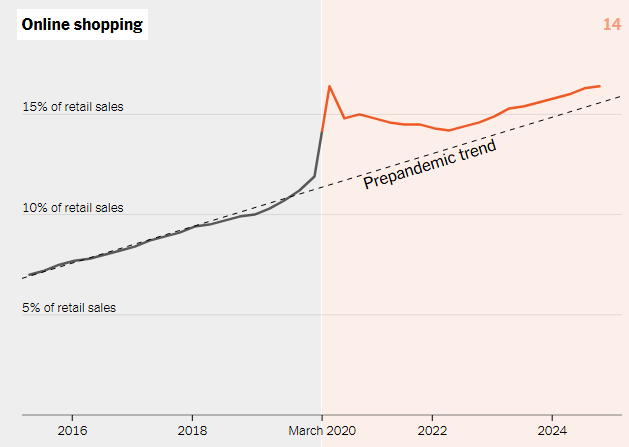
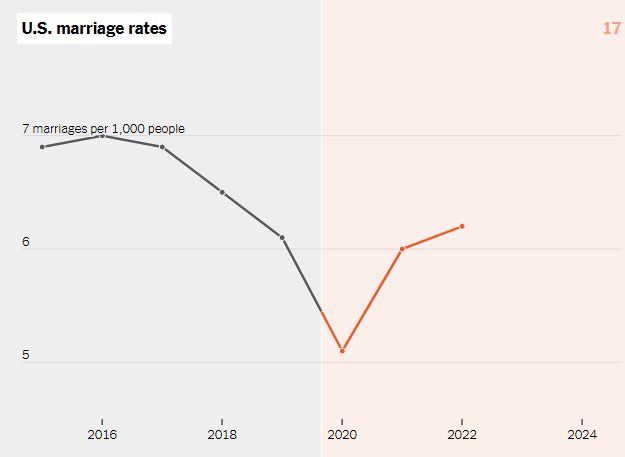
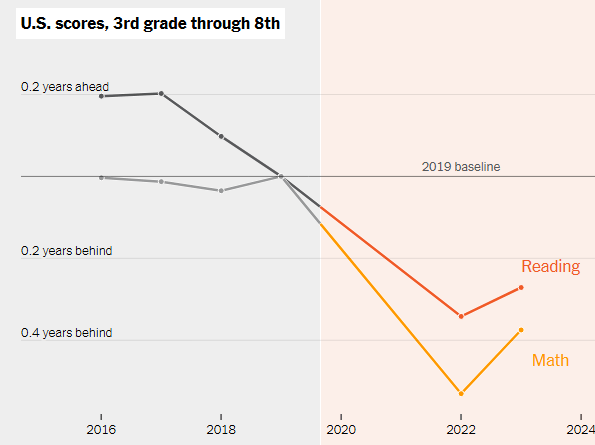
30 Charts That Show How Covid Changed Everything

_______________________________

The Atlantic magazine in 1920: “The older generation had certainly pretty well ruined this world before passing it on to us. They give us this thing, knocked to pieces, leaky, red-hot, threatening to blow up; and then they are surprised that we don’t accept it with the same attitude of pretty, decorous enthusiasm with which they received it, way back in the 1880s.” Some things never change.

_______________________________

Savoring has been defined as “the capacity to attend to, appreciate, and enhance the positive experiences in one’s life.” This can mean focusing on a current, future, or past experience with particular attention to the positive parts. Savoring has been shown in research to stimulate the brain’s striatum, a region involved in processing reward, and is effective in lowering symptoms of depression. The result, correspondingly, is a higher level of reported happiness. 

Savoring positive experiences in the moment also leads to happier memories later on. Researchers found when they instructed people to savor these experiences more fully as they recorded them, their subsequent memories were more vivid, and in effect they enjoyed the experiences more. Easier said than done, unfortunately: We are evolved less to savor the good things in life than to take note of what we dislike and harbor resentments. Humans typically exhibit a “negativity bias,” meaning that adverse events arrest our attention more than positive ones.

This makes sense in an evolutionary sense: Your suspicious, nervous troglodyte ancestors survived to pass on their genes while their blissfully unaware friends became a saber-toothed tiger’s lunch. But in our modern world, largely free of prowling super-predators, our negativity bias tends to be maladaptive. Many scientists have pointed out that a negative disposition makes us error-prone in our predictions, and this anachronistic bias simply lowers our quality of life.

________________________________

You want your parents to have health insurance so that medical needs don’t bankrupt them, right? You want them to have car insurance so that if they get in an accident, they don’t need to pay out of pocket to replace an entire car or in case someone sues them for $100,000, right? These are examples of potential economic devastation wrought by a couple different risks. Getting scammed is a risk that can be just as disruptive and economically devastating. 

What advice can I give me parents to protect them from scam calls that is extremely easy and simple to execute that won’t require any judgement in the moment?” I settled on advising them to say this every time a financial institution calls: “Where are you calling from? Thank you. I’m going to hang up and call back.”

Then go find the institution’s phone number (from a statement, the back of the credit card, or by typing in the URL of the website itself and finding it on the website; you can’t just search for the website because scammers can manipulate search results) and call the institution yourself. I also told my loved ones, “And you can always call me if you have any questions about what’s going on or what you should do.

__________________________________

Winners of the 2025 World Nature Photography Awards

__________________________________________

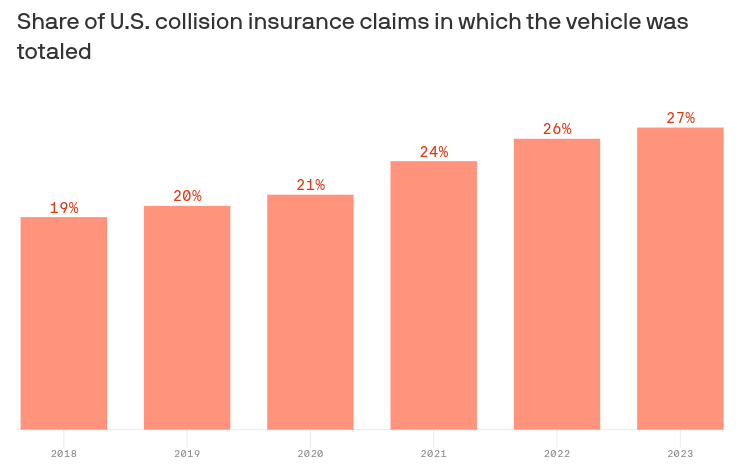
Why crashed cars are increasingly totaled; pandemic-era trends accelerated the percentage of vehicles that are declared a total loss, for multiple reasons.

  • The cost of replacement parts spiked.
  • The amount of time needed to get repairs increased, which also increased the amount of time that insurers had to provide loaners to car owners.
  • The cost of loaners soared as car prices skyrocketed, when the chips shortage created production delays.

Stories, Failing & Fartcoins

63 life lessons/principles from Nabeel Qureshi, including:

  • Think about what makes you ‘imbalanced’ as a personality, & do things where this gives you an edge.
  • Once you are ok with people telling you ‘no’, you can ask for whatever you want.
  • Doing as much as you can every day is a form of life extension.
  • Always be high integrity, even when it costs you. The shortcuts aren’t worth it.
  • Figure out what your primary focus is and make progress on that every day, first thing in the morning, no exceptions. Days with 0 output are the killers.
  • If you find yourself dreading Mondays, quit.
  • No matter how bad things seem, everything passes.
  • Form opinions on things and then find the strongest critique of those opinions. Repeat.

_______________________________________

The function of the mind is to process information and to interpret it according to its unique perceptions. It’s not a fact-gathering machine, but an opinion-generating one. It attempts to find the personal narrative that weaves through everything it knows, and will then communicate that opinion in the hopes that it will resonate with others. In other words, AI can give you all the information you want, but that’s not what creativity is. Creativity is about finding the unique connections within those facts and communicating the result to others, and that can only be done through the skill of storytelling.

_________________________________________

The reason we hate being bad at things and failing is because when goal-directed activity is inhibited or blocked (either by an outside force or our own lack of aptitude), that stimulates our dorsal anterior cingulate cortex, which is part of the brain’s pain circuitry. This is the same region affected when we experience social rejection. This kind of mental pain does, however, have an evolved benefit—creating the motivation to succeed, if not at the activity at hand then at some other one.

This motivation effect is detectable in business activities. When employees are frustrated by their relative incompetence at one task, they tend to be motivated to show more competence for something they’re already better at.

Ruminating on failure is widely recognized to be a destructive waste of time, because this type of reflection focuses on self-worth and what failure says about one as a person. Action rumination is different: It is task-focused and involves replaying the exact missteps that one made and how they could be rectified in the future, which can lead to learning and improvement as opposed to frustration and chagrin.

_________________________________________

Are we overprescribing antidepressants in the U.S. or are things worse here?

_______________________________________

The probability of divorce for married people has been declining steadily for a long time, and in 2023, a record-low 1.4% of married adults got divorced.

________________________________________

A global perspective on what the DeepSeek A.I. technology out of China means for the economy and financial markets, from a the CEO of a research company that is from France, has a child going to school in the U.S., and works in Hong Kong.

_____________________________

The lunatic fringe of the U.S. financial system seems to be experiencing a speculative mania involving cryptocurrencies and crypto-related stocks. It could be called the Fartcoin stage of the market. The current meme coin mania makes the bubble of 2021 seem like a relatively sober exercise in rational valuation. At least back then, Roaring Kitty talked about earnings, and crypto enthusiasts rhapsodized about use cases. They might have been delusional, but at least they were delusional about the right things. Karl Marx said that history repeats, first as tragedy, second as farce. He was too optimistic. The truth is that history repeats, first as tragedy, second as farts.