Loneliness, Doctors & Notes From Books

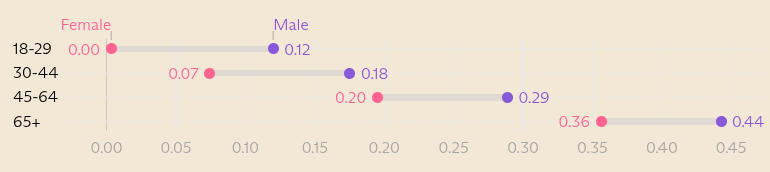
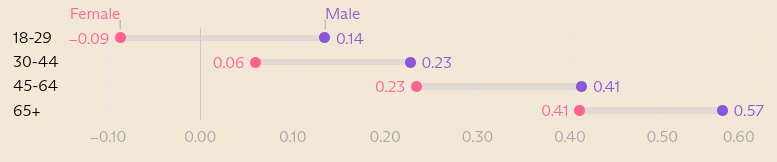
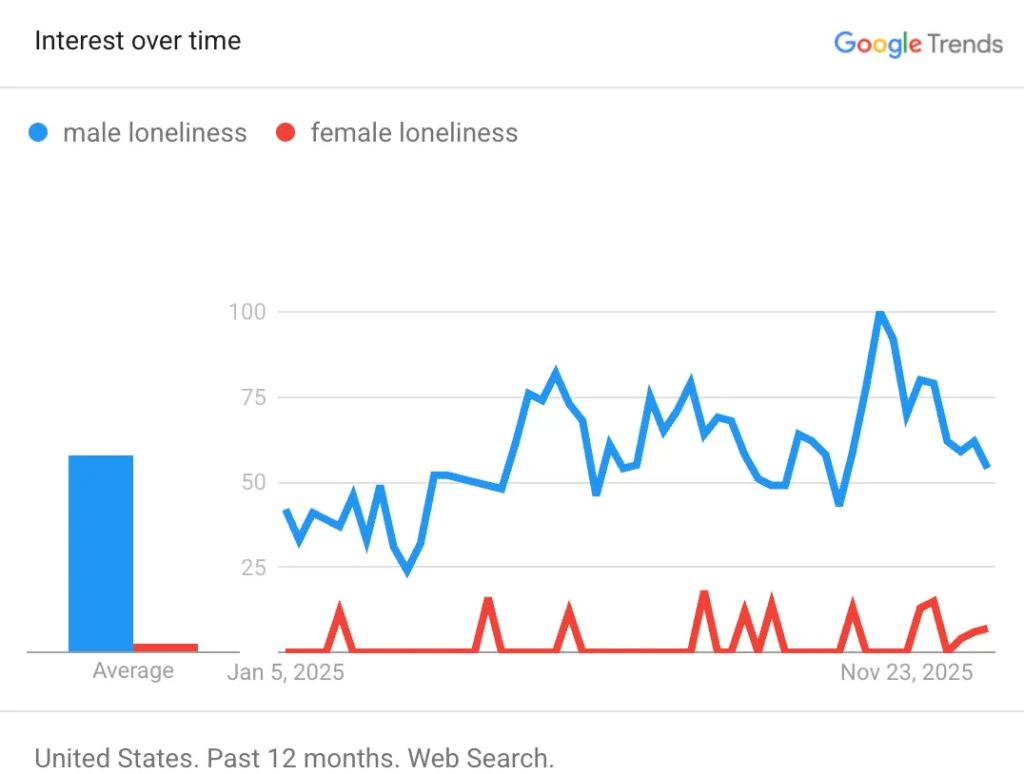
What afflicts America’s young today can’t be properly called a loneliness crisis. It seems more to me like an absence-of-loneliness crisis. It is a being-constantly-alone-and-not-even-thinking-that’s-a-problem crisis. Americans—and young men, especially—are choosing to spend historic gobs of time by themselves without feeling the internal cue to go be with other people, because it has simply gotten too pleasurable to exist without them. The problem is not loneliness. The problem is that we’ve forgotten how to feel lonely in the first place.

Since the 1970s, America has over-regulated the physical world and under-regulated the digital space. To open a daycare, build an apartment, or start a factory requires lawyers, permits, and years of compliance. To open a casino app or launch a speculative token requires a credit card and a few clicks. We made it hard to build physical-world communities and easy to build online casinos. The state that once poured concrete for public parks now licenses gambling platforms. The country that regulates a lemonade stand will let an 18-year-old day-trade options on his phone.

In short: The first half of the twentieth century was about mastering the physical world, the first half of the twenty-first has been about escaping it.

_____________________________

As part of a larger project, an author read 102 books over the past twelve-and-a-half months. Here were some of the insights he took away:

  • Exercising regularly is probably the single best thing you can do for your health. (Outside of quitting smoking.)
  • Happiness, not stress, leads to productivity.
  • Despite our preconceptions, we may be happier at work than at home. People experience more flow at work than in leisure.
  • Energy, not time, is the limited resource in our ability to be productive.
  • You can’t beat the market. Nearly everyone is better off simply buying a diversified low-cost index fund. Neither can any fund you invest in. The percentage of funds that beat the market after fees is so low that you can round it to zero.
  • You can’t time the market. Frequent trades expose you to taxes and whittle away your capital on fees. Buy and hold is better.
  • If you need an advisor, find someone who charges hourly. Paying a percentage of your assets seems cheaper, but the cost is enormous in the long-run.
  • We’re overweight because we eat too much. The increase in calories consumed is enough to entirely explain the change in body mass. Successful weight loss requires you to stick to a dietary pattern forever. The weight will always come back the moment you stop.
  • Loneliness is as bad for your health as smoking cigarettes. The stress of loneliness weakens our immune system.
  • There are numerous explanations for the increase in time alone, but a simple one is just better entertainment options available. 
  • Sleep serves many important functions. It flushes the brain of metabolic byproducts, consolidates memories, reinforces the immune system and recalibrates synaptic connections.
  • If you have insomnia, don’t worry, you probably are sleeping enough. If you’re sleep deprived you will fall asleep, so despite feeling cranky and low energy, most insomniacs are not actually sleep deprived.
  • Asking yourself “what went well?” at the end of the day can give you a big boost to your happiness.
  • ADHD is about as heritable as height, is not caused by parenting style, doesn’t go away as you age and, despite popular disbelief, medication works pretty well.

102 Lessons From Reading 102 Books

___________________________

Why do doctors now seem so rushed and dismissive? You wait 45 minutes in the exam room when the doctor finally walks in. They seem rushed. A few questions, a quick exam, a glance at the clock and then a rapid-fire plan with little time for discussion – and you leave feeling unheard, hurried and frustrated.

Increasingly, health care organizations and physician groups face intense financial pressures. Many doctors can no longer sustain their private practice due to declining reimbursements, rising costs and increasing administrative burdens; instead, they’ve become employees of larger health care systems. In some cases, their practices have been acquired by private equity groups.

With this shift, doctors have less control over their workloads and the time they get with their patients. More and more, payment models fail to cover the true cost of care. The default solution is often for doctors to see more patients with less time for each, and to squeeze in additional work after hours.

That negative, impolite tone you may have experienced might be because the doctor has many patients waiting and a full evening ahead just to catch up on writing visit notes, reviewing medical records and completing other required documentation. During the work day, they’re often fielding over 100 messages and alerts daily, including referrals and coordinating care, all while trying to focus on the patient in front of them.

________________________________

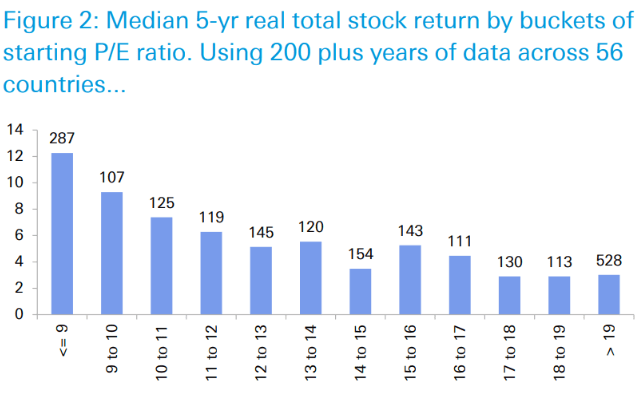
200 years of data across 56 countries, showing 25-year and 5-year returns from different starting P/E ratios (the price of a stock dividend by its earnings). The takeaway? Even over relatively short periods like five years, valuations matter a lot. If you buy when stocks are expensive they tend to do worse than when you buy them cheap.

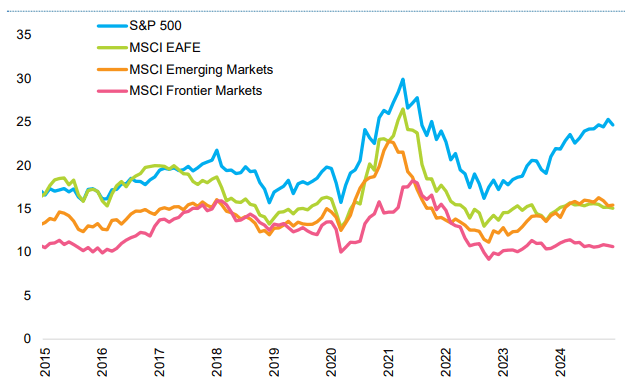
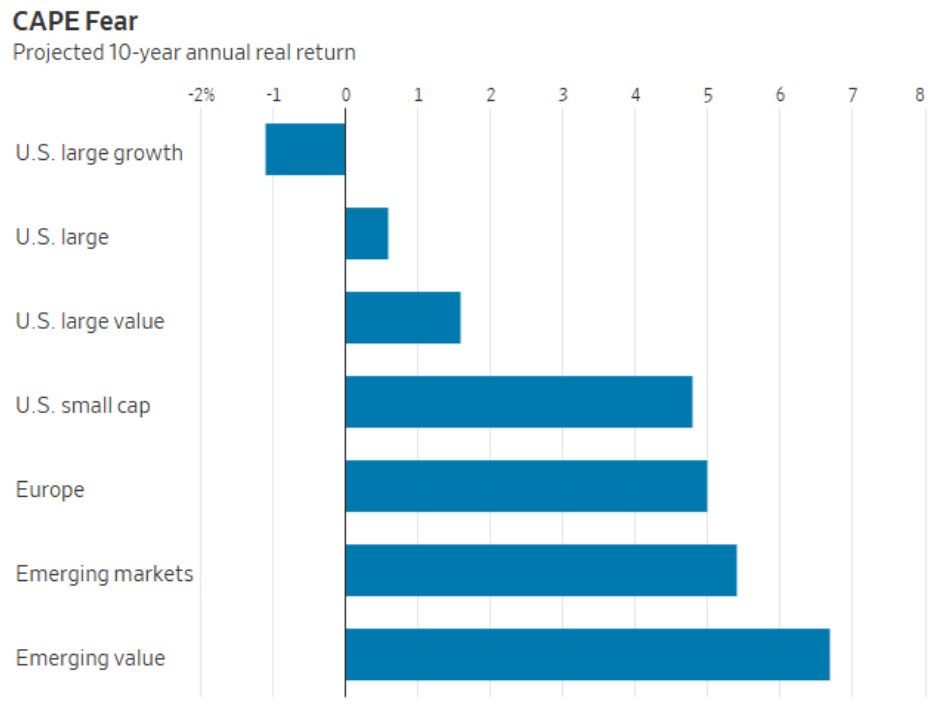
Here are the forecasts for different categories of stocks over the coming decade based on their current valuations:

Chatfishing & Poorly Defined Problems

Why Aren’t Smart People Happier?

A good name for problems on tests that determine someone’s level of intelligence is “well-defined.” Well-defined problems can be very difficult, but they aren’t mystical. You can write down instructions for solving them. And you can put them on a test. In fact, standardized tests items must be well-defined problems, because they require indisputable answers. Matching a word to its synonym, finding the area of a trapezoid, putting pictures in the correct order—all common tasks on IQ tests—are well-defined problems.

People differ in their ability to solve well-defined problems, they’re not the only kind of problems. “Why can’t I find someone to spend my life with?” “Should I be a dentist or a dancer?” and “How do I get my child to stop crying?” are all important but “poorly defined” problems. Getting better at rotating shapes or remembering state capitals is not going to help you solve them.

One way to spot people who are good at solving poorly defined problems is to look for people who feel good about their lives; “how do I live a life I like” is a humdinger of a poorly defined problem. The rules aren’t stable: what makes you happy may make me miserable. The boundaries aren’t clear: literally anything I do could make me more happy or less happy. The problems are not repeatable: what made me happy when I was 21 may not make me happy when I’m 31.

This is why the people who score well on intelligence tests and win lots of chess games are no happier than the people who flunk the tests and lose at chess: well-defined and poorly defined problems require completely different problem-solving skills. Nobody agrees on the rules, the pieces do whatever they want, and the board covers the whole globe, as well as the inside of your head and possibly several metaphysical planes as well.

Over the last generation, we have solved tons of well-defined problems. We eradicated smallpox and polio. We landed on the moon. We built better cars, refrigerators, and televisions. We even got ~15 IQ points smarter. How much did our happiness improve? None.

We haven’t yet defined the problem of “living a happy life”. We know that if you’re starving, lonely, or in pain, you’ll probably get happier if you get food, friends, and relief. After that, the returns diminish very quickly. You could read all the positive psychology you want, take the online version of The Science of Wellbeing, read posts on hacking the hedonic treadmill, meditate, exercise, and keep a gratitude journal—and after all that, maybe you’ll be a smidge happier. Whatever else you think will put a big, permanent smile on your face, you’re probably wrong.

We fawn over people who are good at solving well-defined problems. They get to be called “professor” and “doctor.” We pay them lots of money to teach us stuff. They get to join exclusive clubs like Mensa and the Prometheus Society. 

People who are good at solving poorly defined problems don’t get the same kind of kudos. They don’t get any special titles or clubs. There is no test they can take that will spit out a big, honking number that will make everybody respect them.

And that’s a shame. My grandma does not know how to use the “input” button on her TV’s remote control, but she does know how to raise a family full of good people who love each other, how to carry on through a tragedy, and how to make the perfect pumpkin pie.

If you don’t value the ability to solve poorly defined problems, you’ll never get more of it. You won’t seek out people who have that ability and try to learn from them, nor will you listen to them when they have something important to say. You’ll spend your whole life trying to solve problems with cleverness when what you really need is wisdom. And you’ll wonder why it never really seems to work. All of your optimizing, your straining to achieve and advance, your ruthless crusade to eliminate all of the well-defined problems from your life—it doesn’t actually seem make your life any better.

_________________________

‘I realized I’d been ChatGPT-ed into bed’: how ‘Chatfishing’ made finding love on dating apps even weirder.

Standing outside the pub, 36-year-old business owner Rachel took a final tug on her vape and steeled herself to meet the man she’d spent the last three weeks opening up to. They’d matched on the dating app Hinge and built a rapport that quickly became something deeper. “From the beginning he was asking very open-ended questions, and that felt refreshing,” says Rachel.

One early message from her match read: “I’ve been reading a bit about attachment styles lately, it’s helped me to understand myself better – and the type of partner I should be looking for. Have you ever looked at yours? Do you know your attachment style?” “It was like he was genuinely trying to get to know me on a deeper level. The questions felt a lot more thoughtful than the usual, ‘How’s your day going?’” she says.

Soon, Rachel and her match were speaking daily, their conversations running the gamut from the ridiculous (favourite memes, ketchup v mayonnaise) to the sublime (expectations in love, childhood traumas). Often they’d have late-night exchanges that left her staring at her phone long after she should have been asleep. “They were like things that you read in self-help books – really personal conversations about who we are and what we want for our lives,” she says.

Which is why the man who greeted her inside the pub – polite, pleasant but oddly flat – felt like a stranger. Gone was the quickfire wit and playful rhythm she’d come to expect from their exchanges. Over pints he stumbled through small talk, checked his phone a little too often, and seemed to wilt under the pressure of her questions. “I felt like I was sitting opposite someone I’d never even spoken to,” she says. “I tried to have the same sort of conversation as we’d been having online, but it was like, ‘Knock, knock, is anyone home?’ – like he knew basically nothing about me. That’s when I suspected he’d been using AI.”

Rachel gave her date the benefit of the doubt. “I thought maybe he was nervous,” she says. But she’d been “Chatfished” before, so when the gap between his real and digital selves failed to close on their second date, she called it off. “I’d already been ChatGPT-ed into bed at least once. I didn’t want it to happen again.”

In a landscape where text-based communication plays an outsized role in the search for love, it’s perhaps understandable that some of us reach for AI’s helping hand – not everyone gives good text. Some Chatfishers, though, go to greater extremes, outsourcing entire conversations to ChatGPT, leaving their match in a dystopian hall of mirrors: believing they’re building a genuine connection with another human being when in reality they’re opening up to an algorithm trained to reflect their desires back to them.

_______________________________

Youtube is eating everything:

Consciousness, Being Present & The Fragile Gift Of Life

The night before my brain surgery, my wife and I sat across from each other in wordless stillness. Hours before surgery, with death still in the room, I didn’t feel fear. I felt something quieter. Stranger. I felt connected. To my wife’s eyes. To my breath. To the weight of my feet against the floor. To the wind brushing the window. Even to our cat, oblivious, licking her paws in perfect peace.

Upstairs, in a crib painted white, our 18-month-old daughter lay sleeping. I imagined her face at 5, at 15, at 40. I hoped she would know how deeply I loved her. And in that moment — that unbearable, radiant moment — I was, for perhaps the first time ever, conscious.

Not in the neurological sense. Not in the academic or philosophical sense. But in the raw, elemental sense of being awake to the miracle and the absurdity of existence. Alive to the texture of being. 

Leading up to surgery the world had never looked so alive. Every detail sharpened, sacred. Time no longer moved. It hovered. Held. The future dissolved. The past let go. All that remained was one long, luminous moment. And in that moment, I was tethered — to my wife’s hand, to the stars, to everything. I was, finally, conscious.

I considered the paradox of being most awake at the edge of unconsciousness. The strange intimacy of being stripped down to nothing: no ego, no schedule, no ambition.  Just breath. Presence. And the knowledge that everything is about to change—or end. 

At that moment, I was not thinking about business plans or unread emails. I was not anxious about the past. I was not hungry for the future. I was only there, suspended, waiting. And in that waiting, I was more myself than I’d ever been.

I laughed to myself in the hours before the anesthesia took hold: This is what it means to be fully human. This is what it means to be conscious.

I lived, and in the weeks following surgery, I experienced what doctors call “survivor’s euphoria.” A clinical term, woefully inadequate. It wasn’t just euphoria. It was revelation. It was a reawakening. It was a second birth.

The world opened itself to me like a wound and a gift. I smelled color. I tasted air. I watched dust motes floating in the light and felt tears rise. My daughter’s laugh shattered something inside me, and I let it. I held my wife in the dark, listening to her breath, feeling the hum of her life, and I cried because I could.

I no longer chase productivity the way I once did. I no longer confuse urgency with meaning. I try, imperfectly, to pay attention. To listen more than I speak. To feel what I feel, even when it hurts.

There is a kind of consciousness that lives not in thought but in presence. It asks nothing of us but awareness. It demands no degree, no ideology, no spiritual badge. Only that we pay attention. Only that we look — at our children, our lovers, our trees, our coffee, our clocks — and see them as if for the first time.

Schopenhauer, Colleges & Pickleball

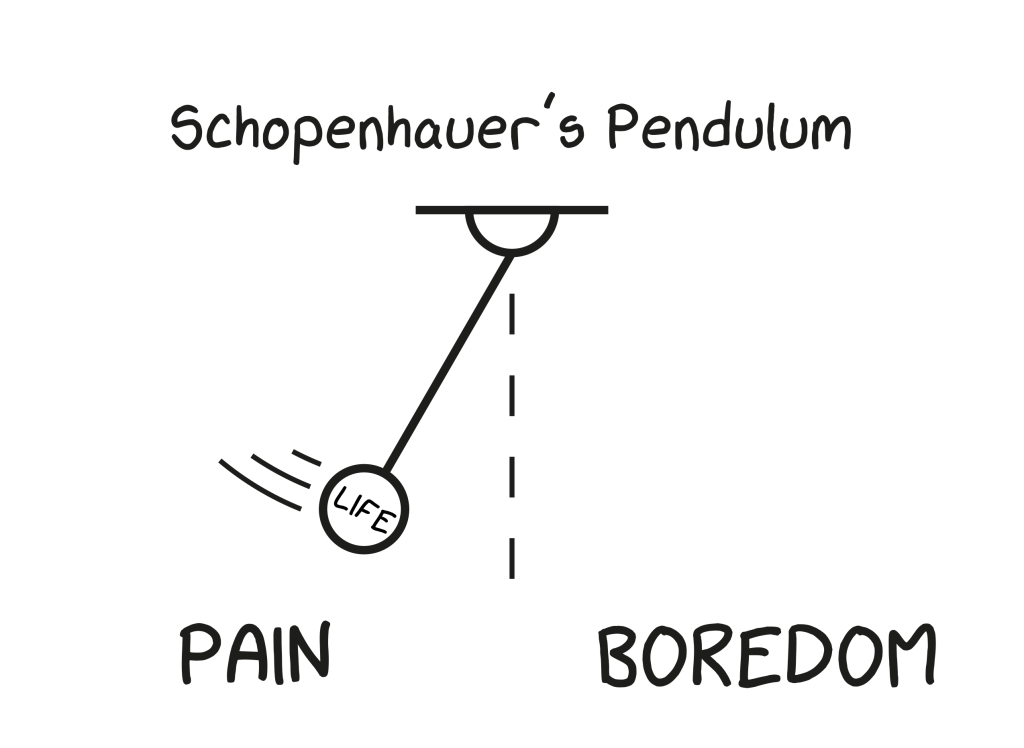
Schopenhauer believed that all of human experience runs along a pendulum that swings from two poles: one of desire, and the other of satisfaction. We strive when we have desire, so the only way to alleviate this is to experience the pleasure that comes with satisfaction. But once you’re satisfied, boredom ensues, and desire inevitably arises yet again. Hence the pendulum.

The pace in which the pendulum swings between desire and satisfaction is what matters most. If it swings rapidly between the two, you get happiness. If it swings slowly between them, you get suffering.

To Schopenhauer, one could only be happy if desire is quickly offset by satisfaction, and this satisfaction could then be quickly offset by another desire. If it’s in our nature to restlessly strive for something, the only way to be happy is to feed that nature what it wants. Suppressing the existence of a desire only prolongs the suffering, which is why he didn’t believe that an ascetic life was the answer.

I think this does a good job explaining the phenomenon of busyness, and its existential utility for people. Ultimately, being busy is you continually swinging between desire and satisfaction. Anytime you create an item on a To Do list and proceed to check it off, that’s you making one round on this continuum. Multiply this by however many times you do it over the course of a week, and you get the feeling of busyness.

 If your mind always has something to check off, then there’s no room to ask yourself if you’re deriving meaning or purpose in what you’re doing. You just move from one cycle of desire / satisfaction to the next, and that in itself is where you dedicate your attention to.

This is where Schopenhauer’s take breaks down. Simply going from one pole to the next in a rapid manner is not happiness. Oftentimes, it’s just distraction. And when the pace of the pendulum slows in a manner where your desire takes a long time to satisfy, then you’ll see through the illusion that your busyness has created. Anytime there’s a lull or silence in your day-to-day life, this void may be filled with the angst that what you’re doing isn’t the answer, and that’s when an existential crisis takes hold.

This is why true happiness cannot be contingent upon any notion of satisfaction. Because to be satisfied is to imply an endpoint. A goal. And as the hedonic treadmill illustrates, once there is a goal, the logical conclusion is to create another chase to distract you. This distraction may keep you amused and busy, but once you’re faced with silence, you will be afraid of what you may feel.

The answer here is that happiness cannot be pursued, nor can it ever be achieved. Because the moment you’re aware that you’re happy, then paradoxically, you no longer are because you’ve called it out. Once you name a positive feeling, you become attached to it, and you long to feel it again.

The moment you pursue happiness, it is nullified. Paradoxically, understanding this is the only way one can truly be happy.

_______________________________

America is about to tumble off the edge of a massive demographic cliff. The timing is no coincidence. The US birth rate peaked in 2007, with just over 4.3 million babies born that year. That number has dropped almost every year since, reaching a 30-year low of 3.8 million births in 2017. Last year, the rate was down to 3.6 million.

Now, those 2007 babies are turning 18 (ugh, I know). As they prepare to start college and enter the workforce, their transition to adulthood signals a new reality for universities, employers, and the whole of America’s economy. Every year from here on out — at least for the foreseeable future — colleges will face a smaller and smaller pool of prospective students.

___________________________

To give you some context for pickleball’s pre-pandemic popularity, think about badminton. And now think about something half as popular as badminton. That was pickleball in 2019. Total pickleball players in the U.S. were outnumbered by participants in archery, bow hunting, fly fishing, indoor climbing, snorkeling, and sledding. Now it’s more popular than all of those pastimes … and America’s pastime. Yes, more Americans played pickleball last year than baseball.

___________________________

I’ve taught the same course to a class of undergraduate, M.B.A., medical and nursing students every year for over a decade. While I didn’t change my lectures or teaching style, somehow the students’ evaluations of last year’s class were better than ever before.

What changed? I banned all cellphones and computer-based note taking in the classroom.

To help sell this policy, I presented in the first lecture of the course a study showing that students who were required to take class notes by hand retained significantly more information than students who used computers. The reason is that with computers, students can type as fast as I speak and strive for verbatim transcripts, but there is almost no mental processing of the class’s content.

Handwritten notes require simultaneous mental processing to determine the important points that need recording. This processing encodes the material in the brain differently and facilitates longer-term retention.

Repeated studies show students perform worst on tests when phones are on desks, next worse when they’re placed in bags or pockets, and best when they’re stored in another room. The presence of smartphones also undermines the quality of in-person social interactions.

___________________________

A recently published paper looked at twin studies to see if heavy social media users have innate tendencies toward lower social well-being. After looking at info on the amount of use, the number of posts, the number of social media accounts, etc., they found only a modest correlation between social media use and well-being (including anxious-depressive symptoms).

What they did find, which many studies have found in the past, is that those symptoms correlated heavily to genetic influences.

___________________________

Today, I’m going after a sacred modern virtue. Tell me if you’ve heard this one before: “Freedom is the highest form of wealth.” After 2 years of freedom, I’d like to disagree. I don’t have issue with freedom as a form of wealth. Or that it’s a better form of wealth than money (it is). I only take issue with the “highest” or “greatest” part of this argument.

I now believe that meaning is the highest form of wealth. The ability to continually have and make meaning, every day. To feel a deep sense of fulfillment and purpose in our actions; emphasizing what we do more than who we are. The good news is you don’t need money for meaning (though it can help). There’s plenty who never find freedom, but still find purpose. So wait, does that make them free? And having freedom without meaning is its own kind of prison.

___________________________

Howard Marks’ newsletter this month provides an in depth analysis that lays out where investment value comes from and how they should be assessed. The TDLR jumping to his conclusion at the end on where we are with U.S. stocks today:

“Fundamentals appear to me to be less good overall than they were seven months ago, but at the same time, asset prices are high relative to earnings, higher than they were at the end of 2024, and at high valuations relative to history.”

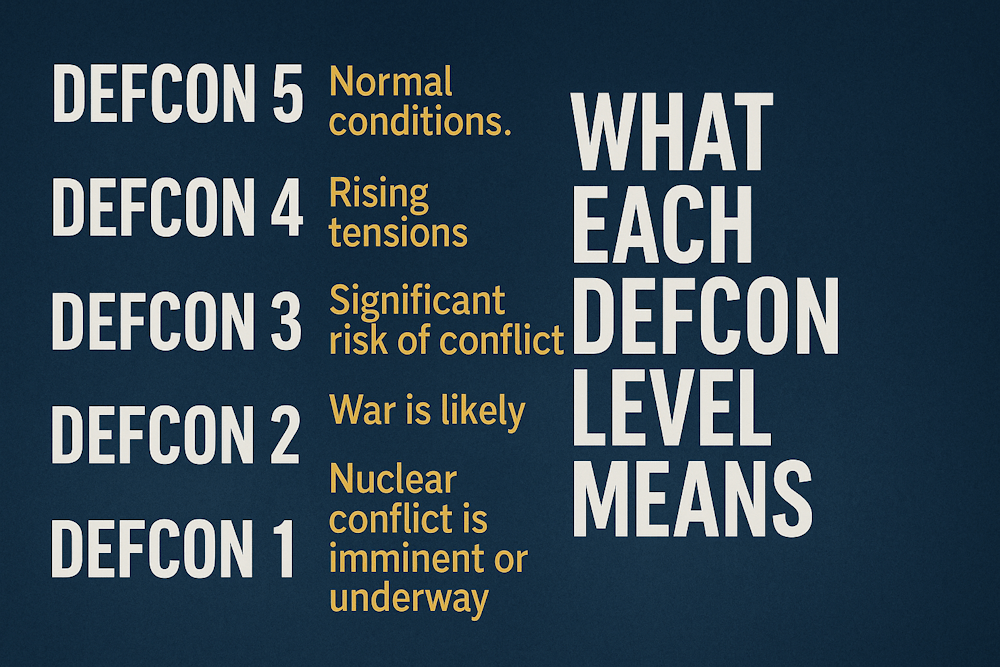
Instead of DEFCONs like the Pentagon uses for war scenarios, he laid out levels of INVESTCONs investors can move through to protect investments in the face of above average market valuations and optimistic investor behavior:

6. Stop buying
5. Reduce aggressive holdings and increase defensive holdings
4. Sell off the remaining aggressive holdings
3. Trim defensive holdings as well
2. Eliminate all holdings
1. Go short

From Marks: “In my view, it’s essentially impossible to reasonably reach the degree of certainty needed to implement INVESTCON 3, 2, or 1. Because “overvaluation” is never synonymous with “sure to go down soon,” it’s rarely wise to go to those extremes. I know I never have. But I have no problem thinking right now it’s time for INVESTCON 5. 

Hedonic Adaption, Gold & The Dungeon Of Insularity

“I love the challenge … it’s one of the greatest joys of my life, but does it fill the deepest wants and desires of my heart? Absolutely not.”

That was the killer quote from a recent interview with the world’s number one golfer, Scottie Scheffler, that went viral this week. And I think this one went viral for a reason: It taps into a universal truth or two about humanity that we know at a subconscious level, but that rarely shines through the manic malaise of our achievement-oriented culture.

“It feels like you work your whole life to celebrate winning a tournament for a few minutes – it only lasts a few minutes, that euphoric feeling,” Sheffler further explained. “You win it, you celebrate, get to hug my family, my sister’s there, it’s such an amazing moment. Then it’s like, ‘OK, what are we going to eat for dinner?’ You know, life goes on.”

While his language is a touch more approachable, Sheffler is practically quoting ancient wisdom literature attributed to the world’s then (in the 10th century, BC) number one, King Solomon, in Ecclesiastes: “Then I considered all that my hands had done… and behold, all was vanity and a striving after wind, and there was nothing to be gained under the sun.”

That fading feeling is explained in the field of behavioral economics through the term “hedonic adaptation.” This theory notes that we, as humans, can marshal an enormous amount of energy to achieve certain goals, only to experience a pretty rapid dilution of the intensity felt in peak moments.

The other upside of hedonic adaptation is that it doesn’t just apply to the good and great things we experience, but also to the bad and even horrible. Yes, humans are designed to bounce back pretty quickly, and that, too, is explained by hedonic adaptation.

So, if being the very best in the world at something doesn’t provide lasting satisfaction, what does?

“Every day when I wake up early to go put in the work, my wife thanks me for going out and working so hard. When I get home, I try and thank her every day for taking care of our son.… I’d much rather be a great father than I would be a great golfer. At the end of the day, that’s what’s more important to me.”

Arthur Brooks may summarize it best: “Money, power, pleasure, and fame won’t make you happy. Faith, family, friends, and meaningful work will.”

_________________________________

Between 2003 and 2024, the amount of time that Americans spent attending or hosting a social event declined by 50 percent. Almost every age group cut their party time in half in the last two decades. For young people, the decline was even worse. Last year, Americans aged 15-to-24 spent 70 percent less time attending or hosting parties than they did in 2003.

As late as the 1970s, the average US household entertained friends at home about 15 times a year and went out to a friend’s place about every other week. After the 1970s, Americans pulled back from just about every form of socializing. By the late 1990s, the share of Americans who said they visited the homes of friends in the previous week had declined by more than 40 percent.

Women have long been the keepers of the family social calendar. Wives, not husbands, historically planned the quilting parties, the bridge games, and the neighborhood potlucks. But in the second half of the 20th century, many women swapped unpaid family jobs for salaried positions. In 1970, right around the inflection point of America’s social decline, the share of women between 25 and 54 who participated in the labor force surged past 50 percent for the first time; it’s currently near 80 percent. As more women poured their weekdays into 9-to-5 work, men failed to take over the logistical labor required to fill out the social calendar, and adult gatherings gradually eroded in the age of the dual-earner household.

Meanwhile, parenting norms have changed. Americans used to have more kids whom they watched less; now they have fewer children whom they watch more. Between 1975 and 1998, they found, mothers increased the amount of time they spent with their kids by about 200 minutes a week. For married fathers, the increase was even more dramatic—about 240 minutes per week. Parents are more anxious than they used to be, not only about neighborhood crime and playground accidents, but also about their children’s achievements.

It’s impossible to host a cocktail party when your second job is to be your son and daughter’s part-time limo driver who escorts them to 13 weekend extracurricular activities (that you kind of forced them to do, in the first place).

Then, there are the screens. The television landed in the US living room in the middle of the 20th century like an asteroid from deep space, displacing settled habits and sending ripples through the social fabric. Between 1965 and 1995, the typical American’s leisure time grew by about 300 hours a year, but we seem to have spent almost all those hours watching more TV. By the 1980s, people who said that television was their “primary form of entertainment” were less likely to engage in practically every other form of social interaction.

I don’t like the simplistic idea that smartphones are purely anti-social. Digital technology has not obliterated our social connections but rather warped them.  Many of us spend hours every week with our favorite TikTok stars, YouTube gurus, Instagram influencers, Twitter gadflies, podcast buddies, Reddit friends, and other people we kind of know and sort of care about, even though they might not even know we exist, at all. Keeping up with these people—watching them, listening to them, giving ourselves over to them—necessarily requires pulling our focus out of the world of flesh and blood. To be a citizen of the Internet is to spend hundreds of hours inside the minds of virtual people we couldn’t party with, even if we desperately wanted to.

Finally, while one needn’t be drunk to have a good time with others, I cannot ignore the fact that the great American party deficit has coincided with an extraordinary decline in teen drinking. Last year was the first on record, going back to 1975, that fewer than 50 percent of high school seniors said they’d ever had a drink of alcohol.

Like the rise of the dual-earner household, the turn against alcohol among the same young people whose socialization has plunged is a complicated phenomenon that defies easy good-bad categorization. I cannot deny that abstinence is good for young people’s livers; but I worry that it’s part of a larger set of behaviors that’s bad for their hearts.

We’ve built ourselves a world of greater professional ambition, more intensive parenting, and lavish entertainment abundance. But in making this world, we’ve lost a bit of each other. If summoning these magnificent technologies incurs the death of our social lives, a permanent surge of anxiety, and the long-term demise of deep friendships, then we’ll have built ourselves a glittering dungeon of insularity and called it progress.

_______________________________

What if gold goes the way of diamonds? The supply of gold is limited – limited by miners’ ability to dig it out of the ground and process it, what happens if a new supply of gold comes online? Not a new mine, but actual alchemy. A company researching fusion energy, Marathon Fusion, believes that it could produce gold alongside energy:

Marathon’s proposal is to also introduce a mercury isotope, mercury-198, into the breeding blanket and use the high-energy neutrons to turn it into mercury-197. Mercury-197 is an unstable isotope that then decays over about 64 hours into gold-197, the only stable isotope of the metal.

While the science needs to be confirmed, it seems not out of the realm of possibility. If so, it has big implications for fusion energy AND the gold market itself.

Another industry is already facing pressure from an ‘artificial’ competitor: Diamonds can now be made in labs that mimic the earth’s extreme pressure and temperatures, but for a fraction of the price. A decade ago, such man-made gems were novel. Today they are mainstream, and increasingly challenging the perception of diamonds as a luxury accessory.

This is bad news for the ‘natural’ diamond industry, which is facing incredible pricing pressure. The industry’s response seems to be to double down on the natural aspects of traditional diamonds and hope that they can at least hold the high end of the market.

Nobody knows if large scale production of gold will eventually come online. Even if it does, it is years, if not decades, into the future. The point here is to think through the hypothetical impact of an abundant gold supply. For example, would gold still a be a store of value if it’s supply were dramatically increased? Would we find new and novel uses for a now abundant shiny metal?

If you were involved in the diamond business in 2016, and knew how the market for manufactured diamonds would mature over the next decade, you may have done things very differently.

______________________________________

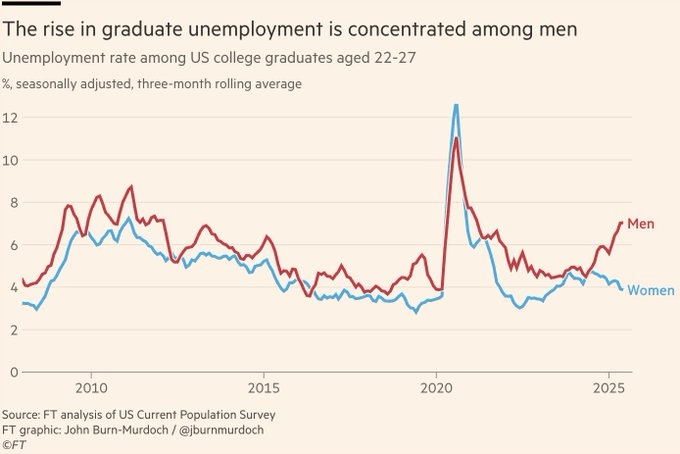
There’s been a lot of discussion lately about rising graduate unemployment. If you dig a little closer a striking story emerges: Unemployment is climbing among young graduate “men,” but college-educated young women are generally doing okay.

Dropped Calls, Polymarket & Passwords

That Dropped Call With Customer Service? It Was on Purpose. Endless wait times and excessive procedural fuss—it’s all part of a tactic called “sludge.”

In the 2008 best seller Nudge, the legal scholar Cass R. Sunstein and the economist Richard H. Thaler marshaled behavioral-science research to show how small tweaks could help us make better choices. An updated version of the book includes a section on what they called “sludge”—tortuous administrative demands, endless wait times, and excessive procedural fuss that impede us in our lives.

Sludge is often intentional,” said a professional that works in the customer service call center industry. “Of course. The goal is to put as much friction between you and whatever the expensive thing is. So the frontline person is given as limited information and authority as possible. And it’s punitive if they connect you to someone who could actually help.”

Helpfulness aside, I mentioned that I frequently felt like I was talking with someone alarmingly indifferent to my plight.

“That’s called good training,” Tenumah said. “What you’re hearing is a human successfully smoothed into a corporate algorithm, conditioned to prioritize policy over people. If you leave humans in their natural state, they start to care about people and listen to nuance, and are less likely to follow the policy.”

For some people, that humanity gets trained out of them. For others, the threat of punishment suppresses it. To keep bosses happy, Tenumah explained, agents develop tricks. If your average handle time is creeping up, hanging up on someone can bring it back down. If you’ve escalated too many times that day, you might “accidentally” transfer a caller back into the queue. Choices higher up the chain also add helpful friction, Tenumah said: Not hiring enough agents leads to longer wait times, which in turn weeds out a percentage of callers. Choosing cheaper telecom carriers leads to poor connection with offshore contact centers; many of the calls disconnect on their own.

“No one says, ‘Let’s do bad service,’” Tenumah told me. “Instead they talk about things like credit percentages”—the number of refunds, rebates, or payouts extended to customers. “My boss would say, ‘We spent a million dollars in credits last month. That needs to come down to 750.’ That number becomes an edict, makes its way down to the agents answering the phones. You just start thinking about what levers you have.”

“Does anyone tell them to pull those levers?” I asked.

“The brilliance of the system is that they don’t have to say it out loud,” Tenumah said. “It’s built into the incentive structure.”

That structure, he said, can be traced to a shift in how companies operate. There was a time when the happiness of existing customers was a sacred metric. CEOs saw the long arc of loyalty as essential to a company’s success. That arc has snapped. Everyone still claims to value customer service, but as the average CEO tenure has shortened, executives have become more focused on delivering quick returns to shareholders and investors. This means prioritizing growth over the satisfaction of customers already on board.

Customers are part of the problem too, Tenumah added. “We’ve gotten collectively worse at punishing companies we do business with,” he said. He pointed to a deeply unpopular airline whose most dissatisfied customers return only slightly less often than their most satisfied customers. “We as customers have gotten lazy. I joke that all the people who hate shopping at Walmart are usually complaining from inside Walmart.”

In other words, he said, companies feel emboldened to treat us however they want. “It’s like an abusive relationship. All it takes is a 20 percent–off coupon and you’ll come back.” Supervisors don’t tell customer service workers to deceive or thwart customers. But having them get frustrated and give up is the best way to meet numbers.

Sometimes they intentionally drop a call or feign technical trouble: “‘I’m sorry, the call … I can’t … I’m having a hard time hearing y—.’ It’s sad. Sometimes they drag out the call enough that customers get agitated, or say things that get them agitated, and they hang up.”

Even if an agent wanted to treat callers more humanely, much of the friction was structural, a longtime contact-center worker named Amayea Maat told me. For one, the different corners of a business were seldom connected, which forced callers to re-explain their problem over and over: more incentive to give up.

“And often they make the IVR”—interactive voice response, the automated phone systems we curse at—“really difficult to get through, so you get frustrated and go online.” Employees described working with one government agency that programmed its IVR to simply hang up on people who’d been on hold for a certain amount of time.

________________________

On June 12th, an anonymous trader opened a new account on Polymarket, an anonymous internet betting site that uses cryptocurrency to obscure the source of money. The new trader was interested in betting on one topic: whether the Israeli military would strike Iran within the next 24 hours, by Friday, June 13th.

As the 13th approached, most people thought it was unlikely, but this new account seemed convinced that airstrikes were imminent. The trades started during a one-hour period around 12pm; $1,728 of bets in the first one, then another $311, $280, $560. Then, between 10pm and midnight, with time running out, they accelerated their betting, showing their confidence by ramping up the bets, putting about $20,000 in total at risk.

Three and a half hours later, Israel struck Iran in a surprise attack—and the Polymarket trader cashed out. They had made a total of $134,000 in profits. After taking their winnings, they closed the account, never trading again. This was probably a case of geopolitical insider trading. Someone who knew that the strike was imminent decided to use that knowledge to make a lot of money anonymously through online betting markets.

This is pretty dystopian: individuals, state actors, even terrorist groups can decide to bet on their own behavior, even their own uses of violence. There’s nothing stopping someone who’s a high-profile political actor—or the people around them—from betting on an outcome, then making comments or posting something on, say, Truth Social or X, that inevitably affects public perceptions about a likely course of action. They can drive the price up or down at will, knowing full well that they can ultimately decide whether the value of a “share” goes to $0.00 or to $1.00. And then, they can anonymously cash out, with nobody the wiser. It’s the Wild West of insider trading.

____________________________

Nearly half of U.S. grandchildren (47%) live within 10 miles of a grandparent. Of those, significant numbers live even closer: 21% live between 1 and 5 miles, and 13% live within a walkable distance of 1 mile.

______________________________

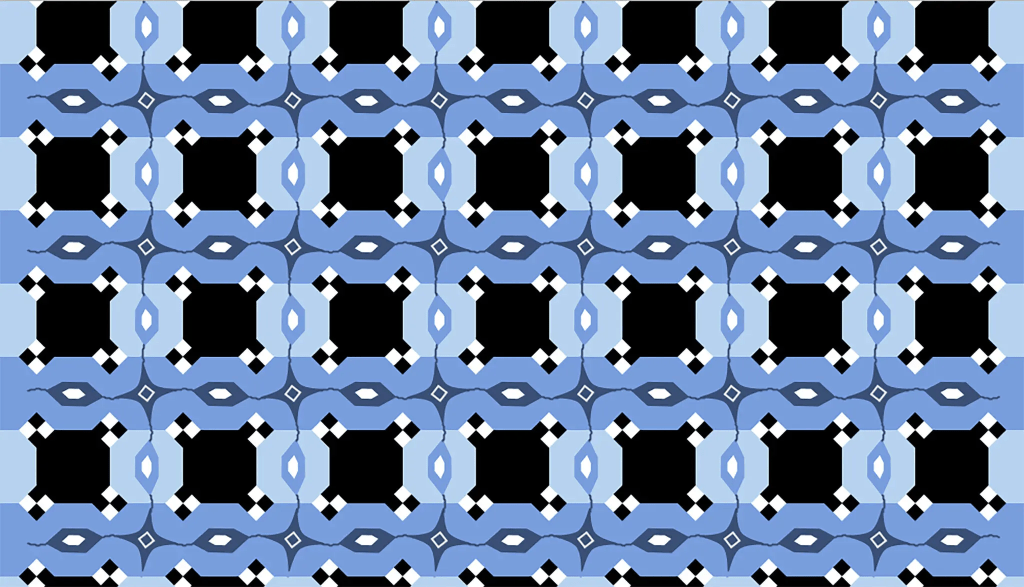
The blue horizontal bars in the picture below are parallel to each other:

_______________________________

Ranked: The World’s Most Common Passwords. The data comes from NordPass, which analyzed the most frequently used passwords based on a 2.5 terabyte database of credentials exposed by data breaches. All of the passwords below would take a hacker less than 1 second to crack.

According to NordPass, your password should be at least 20 characters long and include uppercase and lowercase letters, numbers, and special symbols. They suggest that you never reuse passwords. If one account were to be compromised, other accounts that share the same password could also be at risk.

_______________________________

American household leverage is the lowest in 50 years. The leverage ratio is liabilities (mortgage, auto, credit, student loans) divided by the price of assets they own (stocks, bonds, real estate,).

Stock price gains help the top 10% wealthiest families disproportionately, but the biggest improvement in the leverage ratio above for most American families comes from home prices:

Productivity, Jobs, Rates & Zyn Pouches

Here’s a surprising truth it took me ages to grasp: by far the best way to spend more of your life doing meaningful, rewarding and difference-making things is to really feel the deep sense in which you don’t need to do any of that stuff at all.

At public events, people sometimes ask what advice I’d give my fourteen, sixteen or eighteen-year-old self – which is a ticklish question, partly since I’m sure my teenage self would have scoffed at being lectured at by the late-forties version. And he might have been right to do so; I think you probably have to just go through a certain amount of experience, in order to learn about life, instead of having wisdom dispensed by your elders.

Still, the honest answer is that I’d say something like this: “You do realise you don’t absolutely have to do any of this, right – the good grades, the praiseworthy accomplishments, ‘fulfilling your potential’ and all the rest? It’s all great, and it matters, but do you understand that it doesn’t matter matter? That the sky won’t fall in if you chill out a bit, and that people who don’t always ‘do their best’ or ‘fulfill their potential’ are allowed to enjoy life, too?”

The spiritual teacher Michael Singer says somewhere that the basic stance most of us take toward the world is that we try to use life to make ourselves feel OK. And this is certainly true of the type psychologists label ‘insecure overachievers’, who often accomplish plenty of impressive things, but who do so, deep down, because we don’t believe we’d have earned the right to feel good about ourselves, or to relax into life, if we didn’t.

It’s a soul-crushing way to live, not least because it turns each success into a new source of oppression, since now that’s the minimum standard you feel obliged to meet next time. A hugely successful author once told me he knew something was amiss when the experience of reaching the upper echelons of the bestseller list, previously a cause of excited disbelief, instead brought only relief that he hadn’t failed to replicate his prior achievement.

Most productivity advice, I think, caters to people mired in this mindset. It promises ways to help you take so much action, so efficiently, that you might one day get to feel good about yourself at last. Which isn’t going to work – because the real problem isn’t that you haven’t yet done enough things, or got good enough at doing them. The real problem is the fact that for whatever combination of reasons in your childhood, culture or genes, your sense of self-worth and psychological safety got tethered to your productivity or accomplishments in the first place.

But there exists another, very different sort of productive action: the kind you take not because you feel you have to, in order to feel OK, but precisely because you understand that you don’t have to – because you already feel basically OK about yourself, so now of course you want to take action, because action is how you express your enjoyment in being alive, being good at a few things, and being able to use your talents to make some kind of difference in the world, alongside other people.

One of the most important consequences of all this, for me, has been the realisation that when you begin to outgrow action-from-insecurity, you don’t have to give up on being ambitious. On the contrary: you get to be much more effectively and enjoyably ambitious, if that’s the way you’re inclined.

I’ve long been allergic to the notion, prevalent in self-help circles, that if you truly managed to liberate yourself from your issues, you’d ideally spend your days just sort of passively floating around, smiling at everyone, maybe attending the occasional yoga retreat, but not much more. “The more I heal, the less ambitious I become” is a phrase I’ve encountered multiple times online in recent months. And yes, sure, if your ambition was only ever a function of anxiety, becoming less ambitious would be an excellent development. Then again, the desire to create remarkable outcomes in your creative work, relationships or community – or even just in your bank balance – might just be an authentic part of who you are, once the clouds of insecurity begin to clear.

So you don’t need to choose between peace of mind and the thrill of pursuing ambitious goals. You just need to understand those goals less as vehicles to get you to a future place of sanity and good feeling, and more as things that unfold from an existing place of sanity and good feeling. (Besides, I’ve got to believe that ambition pursued in this spirit is far likelier to make a positive difference in the world.)

Obviously, if you’re deeply stuck on insecure-overachiever mode, merely reading about the alternative in a newsletter isn’t going to solve everything. Nor do I mean to suggest that every task becomes an undiluted joy when you re-frame action in this way – or that there aren’t plenty of things you “need to do” for reasons other than feeling OK about yourself, such as keeping food on the table.

But it can be strikingly liberating just to begin, however gingerly, to experiment with the idea that, actually, you could just do the minimum. You really could. You could not try to impress, or be extraordinary, or do your best, or fulfill your potential (whatever that even means). And you would still be fully entitled to a relaxed and enjoyable life.

And then you might begin to feel, in that newly peaceful state of mind, the stirrings of a different kind of action: one that’s no less energetic or productive or effective; far more alive; and much, much easier to enjoy.

___________________________

I went into my conversations with college career executives expecting to hear about AI replacing work. What I heard instead is that AI is transforming everything around work. The transition from college to the workforce is fully drenched in artificial intelligence. AI is automating homework, obliterating the meaning of much testing, disrupting the labor-market signal of college achievement and grades, distorting the job hunt by normalizing 500+ annual applications per person, turning first-round interviews into creepy surveillance experiences or straight-up conversations with robots, and, oh, after all that, maybe kinda beginning to saw off the bottom of the corporate ladder by automating some entry-level jobs during a period of economic uncertainty. This really is a hard time to be a young person.

___________________________

Even if Trump’s tactics improbably succeed in changing Jerome Powell’s mind, they would change only one vote out of 12 on the Federal Open Market Committee. The FOMC’s decision at its June 18 meeting to leave the Fed funds rate unchanged was unanimous. Furthermore, seven of the 19 officials who are eligible for the 12 voting positions predicted there will be no rate cuts for the remainder of 2025, up from four in March.

Surely, you might say, the FOMC would never go against its chair if he altered his position on rates? If that were to happen it would not be unprecedented. In June 1978, Miller was in the minority as the full FOMC voted to raise rates.

________________________

U.S. shipments of Zyn pouches rose 177% from the first quarter of 2023 to the first quarter of 2025.

Success Addicts, Individual Stocks & Best Places To Work

Imagine reading a story titled “The Relentless Pursuit of Booze.” You would likely expect a depressing story about a person in a downward alcoholic spiral. Now imagine instead reading a story titled “The Relentless Pursuit of Success.” That would be an inspiring story, wouldn’t it? Maybe—but maybe not. It might well be the story of someone whose never-ending quest for more and more success leaves them perpetually unsatisfied and incapable of happiness.

Though it isn’t a conventional medical addiction, for many people success has addictive properties. To a certain extent, I mean that literally—praise stimulates the neurotransmitter dopamine, which is implicated in all addictive behaviors. success also resembles addiction in its effect on human relationships. People sacrifice their links with others for their true love, success. They travel for business on anniversaries; they miss Little League games and recitals while working long hours. Some forgo marriage for their careers.

People willingly sacrifice their own well-being through overwork to keep getting hits of success. I know a thing or two about this: As I once found myself confessing to a close friend, “I would prefer to be special than happy.” He asked why. “Anyone can do the things it takes to be happy; going on vacation with family, relaxing with friends … but not everyone can accomplish great things.” My friend scoffed at this, but I started asking other people in my circles and found that I wasn’t unusual. Many of them had made the success addict’s choice of specialness over happiness. They (and sometimes I) would put off ordinary delights of relaxation and time with loved ones until after this project, or that promotion, when finally, it would be time to rest. But, of course, that day never seemed to arrive.

We are not only gregarious animals, liking to be in sight of our fellows, but we have an innate propensity to get ourselves noticed, and noticed favorably, by our kind. And success makes us attractive to others (that is, until we ruin our marriages).

Unfortunately, success is Sisyphean (to mix my Greek myths). The goal can’t be satisfied; most people never feel “successful enough.” The high only lasts a day or two, and then it’s on to the next goal. Psychologists call this the hedonic treadmill, in which satisfaction wears off almost immediately and we must run on to the next reward to avoid the feeling of falling behind. This is why so many studies show that successful people are almost invariably jealous of people who are more successful.

They should get off the treadmill. But quitting isn’t easy for addicts. For people hooked on substances, withdrawal can be an agonizing experience, both physically and psychologically. Anxiety and depression are very common after one quits alcoholic drinking. Success addicts giving up their habit experience a kind of withdrawal as well. Research finds that depression and anxiety are common among elite athletes after their careers end.

American culture valorizes overwork, which makes it easy to slip into a mindset that can breed success addiction. What can you do to retrain yourself to chase happiness instead of success, no matter where you are in your life’s journey?

  1. Admit that as successful as you are, were, or hope to be in your life and work, you are not going to find true happiness on the hedonic treadmill of your professional life. You’ll find it in things that are deeply ordinary: enjoying a walk or a conversation with a loved one, instead of working that extra hour. This is extremely difficult for many people. It feels almost like an admission of defeat for those who have spent their lives worshipping hard work and striving to outperform others. Social comparison is a big part of how people measure worldly success, but the research is clear that it strips us of life satisfaction.
  2. Start showing up and being present for relationships you’ve compromised in the pursuit of success.
  3. Find the right metrics of success. If you only measure yourself by the worldly rewards of money, power, and prestige, you’ll spend your life running on the hedonic treadmill and comparing yourself to others. Better metrics include faith, family, and friendship. I also include work—but not work for the sake of outward achievement. Rather, it should be work that serves others and gives you a sense of personal meaning.

Success in and of itself is not a bad thing, any more than wine is a bad thing. Both can bring fun and sweetness to life. But both become tyrannical when they are a substitute for—instead of a complement to—the relationships and love that should be at the center of our lives.

___________________________

I stopped buying active investments (individual stocks, etc.) a few years ago. I’ve gone through different justifications for why too. Originally, I stopped buying active investments because of the performance argument. If 85% of active stock managers can’t beat the market over 10 years, what makes you think you can? It’s also too hard to know if you’re actually good. Because there is so much luck involved (especially over shorter time periods), you are better off not wasting your time trying to figure it out.

But there’s an even better argument:  I don’t make active investments now because you can’t put a price on mental freedom. What I’ve realized about myself (and many others I’ve spoken to) is that when you buy an active investment like an individual stock, that investment consumes a lot of your attention.

I don’t identify with the S&P 500. I don’t identify with index funds. When they drop by 10% or 20%, it’s no big deal because it’s out of my control. But that not true with individual stocks. It’s a personal decision that you’ll likely start watching much closer. If you log in to check your pick (or picks) multiple times per day, that is time you could be doing more valuable things like focusing on work, friends and family.

____________________

The antisocial century, in three parts:

1. 1960-2000: Robert Putnam sees associations and club membership plummeting, writes “Bowling Alone”

2. 2000 – 2020s: Face to face socializing falls another 25%, as coupling rates plunge

3. Now this…

_____________________________

Forbes surveyed more than 217,000 employees working at companies within the U.S. that employ more than 1,000 people. The organizations were stratified so that companies with 1,000 to 5,000 employees were deemed midsize, while companies with more than 5,000 employees were considered large employers.

Survey respondents (who remained anonymous so they could answer freely) were asked if they would recommend their employer to others and to rate it based on a range of criteria, including salary, work environment, training programs and opportunities to advance. Participants were also asked if they would recommend their previous employers (within the past two years) and the employers they knew through their industry experience or through friends or family who worked there.

Ultimately, each employer was given a score, and the 1,199 organizations with the highest scores landed on one of the two final lists—498 companies on America’s Best Midsize Employers 2025, and 701 organizations on America’s Best Large Employers 2025. The top 50 large employers are below:

________________________________

Inversion, Eudaimonia & Workplace Skills

Happiness, it turns out, is more Rorschach than road map. Is it found in the ultraluxe wellness center or the austere monastery? Does it come from getting what you want or wanting less?

By the early 20th century, utility maximization — happiness writ small — emerged as a linchpin of economic analysis. Public happiness, in turn, became a matter of optimizing the sum of individual welfare. The mathematics could be complex, but the premise was simple: Getting what you want in life — that’s happiness, bro.

The notion of happiness as choice-making swiftly migrated from economic models into the marrow of the broader culture. What was once a lifelong project shrank into a sequence of transactions. As the midcentury economy boomed, it didn’t just build wealth; it reconstructed desire. The good life, formerly the province of philosophers, was now a mainstay of the marketers: happiness packaged as the perfect lawn, the gleaming automobile, the immaculate kitchen with its humming refrigerator. We became, almost without noticing, what we bought.

And if you still felt empty? That’s where the therapy culture of the 1970s and 1980s came in — not as a remedy for consumerism but as an extension of it. The older vocabulary of life-defining commitments and meaning-making projects continued to wither while a new lexicon took hold: self-acceptance, self-esteem, self-love.

By the 1990s, happiness had acquired a personal brand. Oprah Winfrey presided over a daytime academy of self-care, empowerment and curated aspiration. Then came the next wave: the life-hacking, self-quantifying, habit-stacking era of optimization gurus like Tim Ferriss, whose first book, published in 2007, was “The 4-Hour Workweek” — “a toolkit,” in his words, “for maximizing per-hour output.”

Excitement is the more practical synonym for happiness, and it is precisely what you should strive to chase,” Ferriss wrote. “It is the cure-all.” Amid the excitement, the happiness concept kept getting miniaturized. With the rise of the algorithms, decision-making became a series of bite-size transactions. If you liked this, you’ll like that. Every swipe, click and purchase was an act of preference revelation, the digital cookie crumbs of personal identity.

In today’s social media ecosystem, happiness even threatens to become a ring-lighted aesthetic: matcha lattes, artisanal candles, sage-smudging, captioned reminders to just breathe. Once again, happiness is work — but now the work of packaging moods and moments for validation, with a tiny dopamine hit for each “like.”

“So long as you’re happy,” parents tell their kids. In reality, they want to see their children engaged in something worthwhile, contributing to something beyond their own fleeting satisfactions. 

If you’ll indulge the philosophers’ habit of conjuring characters to illustrate their abstractions, imagine a young person — let’s call her Julia — who left community college after a semester and has bounced between gigs ever since: dog-walking, cafe shifts, warehouse nights. Her life is messy, but she has learned how to show up for people. When her neighbor’s mother gets sick, Julia brings groceries. When her cousin gets out of rehab, she’s the one who texts every day. She doesn’t have a wellness routine or a five-year plan. But people trust her. She holds lives together in small, invisible ways.

Or imagine a middle-aged man named Daniel, a product manager with a smart fridge and an Optimal Morning Routine. For years, he has chased happiness through upgrades — to his apps, his appliances, himself. But lately, the returns feel thin. When his niece’s soccer team needs a coach, he volunteers, awkwardly at first, then with growing investment. Daniel has started showing up at town meetings, fighting to save the field from developers. Now his calendar includes something he cares deeply about that doesn’t come with a progress bar.

Daniel still wears a Whoop band. Julia hasn’t found her “calling.” But they’re living into a broader idea of happiness — less about what they have, more about what they give, who they’re with, what they’re part of.

Is it possible that happiness stayed big, and it’s only our way of talking about it that got small? Surely the old understanding, in which the pursuit of happiness is inseparable from shared commitments, hasn’t gone anywhere. On some level, we still know the difference between feeling good and flourishing, between the hedonic and the eudaemonic, between the algorithm’s next suggestion and the difficult and uncertain path toward a meaningful existence. Yes, we often speak as if feelings are all that count, but maybe that’s because the language of the “good life” has been hollowed out.

____________________________

Inversion is a mental model that flips the script on traditional problem-solving. Rather than look at a problem in a linear, forward, logical manner, you think about it in reverse. Well, there is one complex, foundational problem that is truly universal: How do you live a good life? Using inversion to address it: Here are some ways to live a miserable life…

  • Allow idleness to dominate your life – Stress and anxiety feed on idleness. They take hold while you sit and scroll on your phone, while you overthink your situation, while you compare yourself to others, while you try to create the perfect plan. When you take action, you starve them of the oxygen they need to survive. 
  • Allow optimal to get in the way of beneficial – Ambitious people have a bad tendency to think like this: “I don’t have an hour to work out, so I just won’t go. I don’t have two hours for deep work, so I’ll do email instead. I don’t have 30 minutes to call my mom, so I won’t call at all.” When you allow optimal to get in the way of beneficial, you ignore the most powerful principle in life: Anything above zero compounds. A little bit is always better than nothing. Tiny wins stack over long periods of time. Small things become big things.
  • Obsess over speed – Life is about direction, not speed. It’s much better to climb slowly up the right mountain than to climb fast up the wrong one.

____________________________

More police officers kill themselves every year than are killed by suspects. At least 184 public-safety officers die by suicide each year, while an average of about 57 officers are killed by suspects. Law-enforcement officers are 54 percent more likely to die by suicide than the average American worker.

Most officers are required to pass psychological and physical screenings before they are hired. But many struggle after chronic exposure to trauma. Police officers have higher rates of depression than other American workers. Shift work, which disrupts sleep, and alcohol use, long the profession’s culturally accepted method of blowing off steam and managing stress, further compound health issues

______________________________

A survey of 1,000 managers across America revealed the reasons that 8 in 10 managers said newly hired college graduates did not work out during their first year on the job:

  • 78%: Excessive use of cell phones – the top pet peeve of managers
  • 61%: Entitled or easily offended
  • 57%: Unprepared for the workplace
  • 54%: Lack of a work ethic
  • 47%: Poor communication skills
  • 27%: Lack of technical skills

Other concerns managers had about the graduates included lateness, failure to turn in assignments on time, unprofessional behavior, and inappropriate dress and language.

Colleges don’t teach students how to behave in the workplace, and there is a lack of transitional support from both universities and employers. Most students graduate with little exposure to professional environments, so when they arrive at their first job, they’re often learning basic workplace norms for the first time.

______________________________

Where the number of homes for sale is growing. Fast.

___________________________

The Russell 1000 is a stock market index that represents the 1,000 largest companies in the U.S. by market value (also called market capitalization). The graph below shows the number of stocks within that 1,000 that fall by a certain percentage over a 1, 3 and 5-year time frame. While over time most major indices like The Russell 1000 go up, the odds are very high that any individual stock is going to fall by a lot.

___________________________

Lead characters were far more likely to die in the 1960s and 1970s than they are today. Across the 1970s, almost one in three protagonists died by the end of the film. That rate has steadily declined since. The drop has been particularly sharp since 2010. In the last five years, the share of lead characters who die has averaged just 17%. This is one of the lowest rates in almost a century of film history.

_________________________________

____________________________

Only 21% of American college revenues come from tuition:

__________________________

The average age of the global population is up from 26.5 years in 1980 to 33.6 years in 2025. Meanwhile, the average growth rate of the global population has also halved, from 1.8% in 1980 to 0.9% in 2025. The growth rate is expected to hit zero by 2084, and the world’s population is expected to begin declining by 2085, with the average age rising to 42. At the end of the 21st century, the average age is projected to be 43 years.

The Disease Of More & Short-Term Thinking

The “disease of more” was a phrase coined by National Basketball Association (NBA) coach Pat Riley to describe how, following a successful season, players can become entitled and want more of everything, including money, playing time, and media attention, which starts the onset of the team’s demise.

Needless to say, it’s not just NBA players that are affected by wanting more. Everyone wants more of everything, more so than ever before. Never in human history has there been such an overwhelming abundance of food, clothing, and material goods. Beyond necessities, consumer goods of all kinds—electronics, furniture, and household items are more accessible and affordable than ever, filling stores and warehouses to the brim.

In addition to the explosion of physical goods, the world now overflows with the non-physical. The digital age has brought an endless supply of information, entertainment and convenience.

Suppose you invented an incredible new passenger plane that reduced aviation fuel consumption by 50%, and every airliner worldwide adopted your aircraft. In that scenario, it’s a natural assumption to think that aviation fuel across the globe would reduce dramatically and be good for the environment. However, the opposite is true, and fuel consumption would increase because flying has become more efficient, which means more flights, lower prices and more demand for flying. This is known as the Jevons paradox.

Instead of digital communication making our lives easier with how we communicate with friends and family in a similar way to the workplace, the reduction of friction has made us do more of it than ever before to the point where it has become all-consuming. As things become easier — we just do more of it, and in spades. It’s been an evolution of deliberate and reflective communication to text speak, forwarding cat videos and memes.

News has become like a drug. We hear what is going on instantly all of the time. It becomes impossible to avoid. Every hour on the hour, the radio stations give us our fix. Social media was originally meant for discovering what your friends and family were doing, and now it’s just another news outlet keeping us transfixed.

In a roundabout way, we all fall into the chronic busyness category. Even if we’re not running around with packed diaries and overflowing work schedules, we’re all swamped with communication, news, things to buy, pings, breaking news alerts, and vibrations. We’re overloading our nervous system, which means we don’t have time to think, reflect, and consider. Being bored is invaluable thinking time to ponder what to do or change about your life.

One of our deepest evolutionary instincts—believing that more is always better—no longer serves us. Our ancestors struggled with scarcity; we struggle with excess. The way forward isn’t more, it’s less. Less news, less noise, less busyness, less mindless communication, fewer endless choices. More slowness, more presence, more clarity.

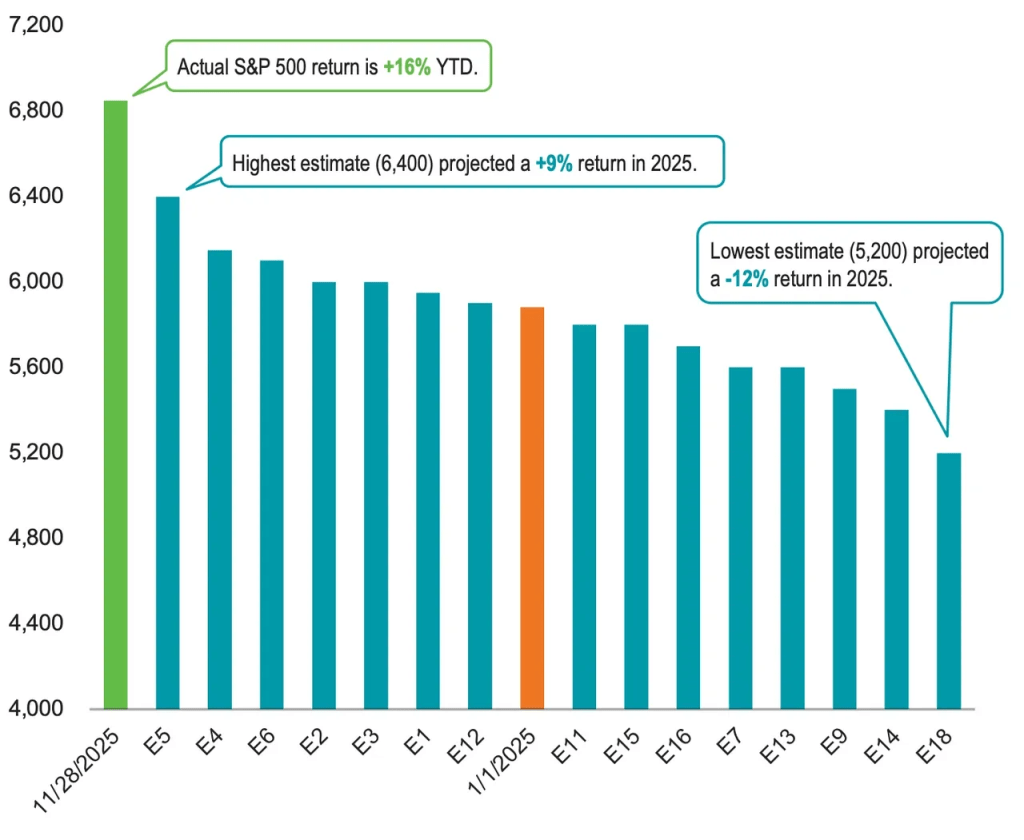
I love the title of a book by a financial market analyst named Walter Deemer: “When the Time Comes to Buy, You Won’t Want To.” The negative developments that make for the greatest price declines are terrifying, and they discourage buying. But, when unfavorable developments are raining down, that’s often the best time to step up.

To paraphrase Mark Twain, there are themes that rhyme throughout history. For that reason, just as I recycled the title of my post-Lehman (Sept 2008) bankruptcy memo for this one, I’ll also borrow its closing paragraph: Everyone was happy to buy 18-24-36 months ago, when the horizon was cloudless and asset prices were sky-high. Now, with heretofore unimaginable risks on the table and priced in, it’s appropriate to sniff around for bargains: the babies that are being thrown out with the bath water. 

_______________________

Measures of retirement preparedness often suggest a substantial share of U.S. households are not on track to maintain their standard of living in retirement (financially). And many retirees report regret for not saving enough. Yet, when asked about their life satisfaction, the overwhelming majority (92%) of retired households say that they are “very satisfied” or “moderately satisfied.” In fact, gerontologists and psychologists have found a weak correlation between older Americans’ financial circumstances and retirement satisfaction.

_________________________

I think the thing that doesn’t get talked about is that no one wants to admit they’re a short-term thinker. We fool ourselves into believing we’re committed to something for the long haul, but we’ve been trained since childhood to be tactical, to chase the short-term win, to have a short attention span.

We emphasize who just scored a goal in soccer instead of asking, Does this kid have perseverance? Do they have good sportsmanship? Those qualities are much more useful for who they will become. But instead, we reward the kid who cheated or played dirty to score a goal. And that sticks with us.

I don’t judge people based on job interviews. That’s a false proxy — unless I’m hiring a talk show host, being good at a job interview doesn’t matter. Shielding ourselves from false proxies is really hard. Some people just can’t do it. They need immediate feedback, they need to know what’s happening right now.

__________________________

Despite the existence of an arsenal of medications that target the neurotransmitters in the brain thought to be responsible for mood disorders, about 30% of individuals with major depressive disorder remain treatment-resistant. This points to other possible factors that may contribute to the condition.

Research to date has implicated impaired energy metabolism as a potential culprit, as the brain requires enormous amounts of energy to function normally. This, in turn, would suggest that interventions known to boost cellular energy production might offer some relief for those suffering from depression, and attention has turned to one such supplement in particular: creatine. Well known for its role in muscular energetics, might creatine have additional benefits in the treatment of depression?

__________________________

Where people are happiest in the Americas, from the 2025 World Happiness Report.

Where people are happiest in Europe, from the 2025 World Happiness Report.

_____________________________

The odds of getting audited by the IRS are low:

_________________________

America Has Never Been Wealthier. Why Doesn’t Feel That Way? A 10 percent boost to the middle and especially higher incomes is money that feels real, like you can do something with it. For someone making $100,000, that means a $10,000 raise. But a 10 percent increase at the bottom, perhaps to an hourly wage of $16.50 from $15, means you’re still living hand-to-mouth. If we define someone as living paycheck to paycheck if they either say they do not have three months of emergency savings or say they cannot afford a $2,000 emergency expense, then 59 percent of American adults are “living paycheck to paycheck.

___________________________

1Hawaii13.9%
2New York13.6%
3Vermont11.5%
4California11.0%
5Maine10.6%
6New Jersey10.3%
7Illinois10.2%
8Rhode Island10.1%
9Maryland10.0%
10Connecticut9.9%
11Minnesota9.7%
12New Mexico9.6%
13Massachusetts9.6%
14Utah9.5%
15Ohio9.4%
16Kansas9.3%
17Iowa9.2%
18Indiana9.1%
19Mississippi9.1%
20Oregon9.1%
21Louisiana8.9%
22Kentucky8.9%
23Virginia8.9%
24West Virginia8.9%
25Nebraska8.8%
26Colorado8.7%
27Nevada8.6%
28Washington8.6%
29Arkansas8.6%
30Pennsylvania8.6%
31Georgia8.5%
32Wisconsin8.3%
33Michigan8.3%
34Arizona8.2%
35North Carolina8.2%
36South Carolina8.2%
37Alabama8.0%
38Montana7.9%
39Missouri7.8%
40Texas7.8%
41Idaho7.5%
42Oklahoma7.0%
43North Dakota6.6%
44Delaware6.5%
45Florida6.5%
46South Dakota6.5%
47Tennessee6.4%
48New Hampshire5.9%
49Wyoming5.8%
50Alaska4.9%