“I love the challenge … it’s one of the greatest joys of my life, but does it fill the deepest wants and desires of my heart? Absolutely not.”
That was the killer quote from a recent interview with the world’s number one golfer, Scottie Scheffler, that went viral this week. And I think this one went viral for a reason: It taps into a universal truth or two about humanity that we know at a subconscious level, but that rarely shines through the manic malaise of our achievement-oriented culture.
“It feels like you work your whole life to celebrate winning a tournament for a few minutes – it only lasts a few minutes, that euphoric feeling,” Sheffler further explained. “You win it, you celebrate, get to hug my family, my sister’s there, it’s such an amazing moment. Then it’s like, ‘OK, what are we going to eat for dinner?’ You know, life goes on.”
While his language is a touch more approachable, Sheffler is practically quoting ancient wisdom literature attributed to the world’s then (in the 10th century, BC) number one, King Solomon, in Ecclesiastes: “Then I considered all that my hands had done… and behold, all was vanity and a striving after wind, and there was nothing to be gained under the sun.”
That fading feeling is explained in the field of behavioral economics through the term “hedonic adaptation.” This theory notes that we, as humans, can marshal an enormous amount of energy to achieve certain goals, only to experience a pretty rapid dilution of the intensity felt in peak moments.
The other upside of hedonic adaptation is that it doesn’t just apply to the good and great things we experience, but also to the bad and even horrible. Yes, humans are designed to bounce back pretty quickly, and that, too, is explained by hedonic adaptation.
So, if being the very best in the world at something doesn’t provide lasting satisfaction, what does?
“Every day when I wake up early to go put in the work, my wife thanks me for going out and working so hard. When I get home, I try and thank her every day for taking care of our son.… I’d much rather be a great father than I would be a great golfer. At the end of the day, that’s what’s more important to me.”

_________________________________
Between 2003 and 2024, the amount of time that Americans spent attending or hosting a social event declined by 50 percent. Almost every age group cut their party time in half in the last two decades. For young people, the decline was even worse. Last year, Americans aged 15-to-24 spent 70 percent less time attending or hosting parties than they did in 2003.
As late as the 1970s, the average US household entertained friends at home about 15 times a year and went out to a friend’s place about every other week. After the 1970s, Americans pulled back from just about every form of socializing. By the late 1990s, the share of Americans who said they visited the homes of friends in the previous week had declined by more than 40 percent.
Women have long been the keepers of the family social calendar. Wives, not husbands, historically planned the quilting parties, the bridge games, and the neighborhood potlucks. But in the second half of the 20th century, many women swapped unpaid family jobs for salaried positions. In 1970, right around the inflection point of America’s social decline, the share of women between 25 and 54 who participated in the labor force surged past 50 percent for the first time; it’s currently near 80 percent. As more women poured their weekdays into 9-to-5 work, men failed to take over the logistical labor required to fill out the social calendar, and adult gatherings gradually eroded in the age of the dual-earner household.

Meanwhile, parenting norms have changed. Americans used to have more kids whom they watched less; now they have fewer children whom they watch more. Between 1975 and 1998, they found, mothers increased the amount of time they spent with their kids by about 200 minutes a week. For married fathers, the increase was even more dramatic—about 240 minutes per week. Parents are more anxious than they used to be, not only about neighborhood crime and playground accidents, but also about their children’s achievements.
It’s impossible to host a cocktail party when your second job is to be your son and daughter’s part-time limo driver who escorts them to 13 weekend extracurricular activities (that you kind of forced them to do, in the first place).
Then, there are the screens. The television landed in the US living room in the middle of the 20th century like an asteroid from deep space, displacing settled habits and sending ripples through the social fabric. Between 1965 and 1995, the typical American’s leisure time grew by about 300 hours a year, but we seem to have spent almost all those hours watching more TV. By the 1980s, people who said that television was their “primary form of entertainment” were less likely to engage in practically every other form of social interaction.
I don’t like the simplistic idea that smartphones are purely anti-social. Digital technology has not obliterated our social connections but rather warped them. Many of us spend hours every week with our favorite TikTok stars, YouTube gurus, Instagram influencers, Twitter gadflies, podcast buddies, Reddit friends, and other people we kind of know and sort of care about, even though they might not even know we exist, at all. Keeping up with these people—watching them, listening to them, giving ourselves over to them—necessarily requires pulling our focus out of the world of flesh and blood. To be a citizen of the Internet is to spend hundreds of hours inside the minds of virtual people we couldn’t party with, even if we desperately wanted to.
Finally, while one needn’t be drunk to have a good time with others, I cannot ignore the fact that the great American party deficit has coincided with an extraordinary decline in teen drinking. Last year was the first on record, going back to 1975, that fewer than 50 percent of high school seniors said they’d ever had a drink of alcohol.
Like the rise of the dual-earner household, the turn against alcohol among the same young people whose socialization has plunged is a complicated phenomenon that defies easy good-bad categorization. I cannot deny that abstinence is good for young people’s livers; but I worry that it’s part of a larger set of behaviors that’s bad for their hearts.
We’ve built ourselves a world of greater professional ambition, more intensive parenting, and lavish entertainment abundance. But in making this world, we’ve lost a bit of each other. If summoning these magnificent technologies incurs the death of our social lives, a permanent surge of anxiety, and the long-term demise of deep friendships, then we’ll have built ourselves a glittering dungeon of insularity and called it progress.

_______________________________
What if gold goes the way of diamonds? The supply of gold is limited – limited by miners’ ability to dig it out of the ground and process it, what happens if a new supply of gold comes online? Not a new mine, but actual alchemy. A company researching fusion energy, Marathon Fusion, believes that it could produce gold alongside energy:
Marathon’s proposal is to also introduce a mercury isotope, mercury-198, into the breeding blanket and use the high-energy neutrons to turn it into mercury-197. Mercury-197 is an unstable isotope that then decays over about 64 hours into gold-197, the only stable isotope of the metal.
While the science needs to be confirmed, it seems not out of the realm of possibility. If so, it has big implications for fusion energy AND the gold market itself.
Another industry is already facing pressure from an ‘artificial’ competitor: Diamonds can now be made in labs that mimic the earth’s extreme pressure and temperatures, but for a fraction of the price. A decade ago, such man-made gems were novel. Today they are mainstream, and increasingly challenging the perception of diamonds as a luxury accessory.
This is bad news for the ‘natural’ diamond industry, which is facing incredible pricing pressure. The industry’s response seems to be to double down on the natural aspects of traditional diamonds and hope that they can at least hold the high end of the market.
Nobody knows if large scale production of gold will eventually come online. Even if it does, it is years, if not decades, into the future. The point here is to think through the hypothetical impact of an abundant gold supply. For example, would gold still a be a store of value if it’s supply were dramatically increased? Would we find new and novel uses for a now abundant shiny metal?

______________________________________
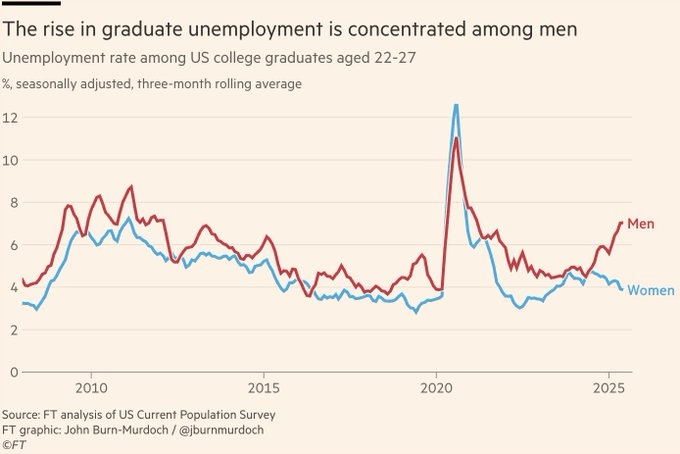
There’s been a lot of discussion lately about rising graduate unemployment. If you dig a little closer a striking story emerges: Unemployment is climbing among young graduate “men,” but college-educated young women are generally doing okay.
 Tuna Thoughts