Schopenhauer, Colleges & Pickleball

Schopenhauer believed that all of human experience runs along a pendulum that swings from two poles: one of desire, and the other of satisfaction. We strive when we have desire, so the only way to alleviate this is to experience the pleasure that comes with satisfaction. But once you’re satisfied, boredom ensues, and desire inevitably arises yet again. Hence the pendulum.

The pace in which the pendulum swings between desire and satisfaction is what matters most. If it swings rapidly between the two, you get happiness. If it swings slowly between them, you get suffering.

To Schopenhauer, one could only be happy if desire is quickly offset by satisfaction, and this satisfaction could then be quickly offset by another desire. If it’s in our nature to restlessly strive for something, the only way to be happy is to feed that nature what it wants. Suppressing the existence of a desire only prolongs the suffering, which is why he didn’t believe that an ascetic life was the answer.
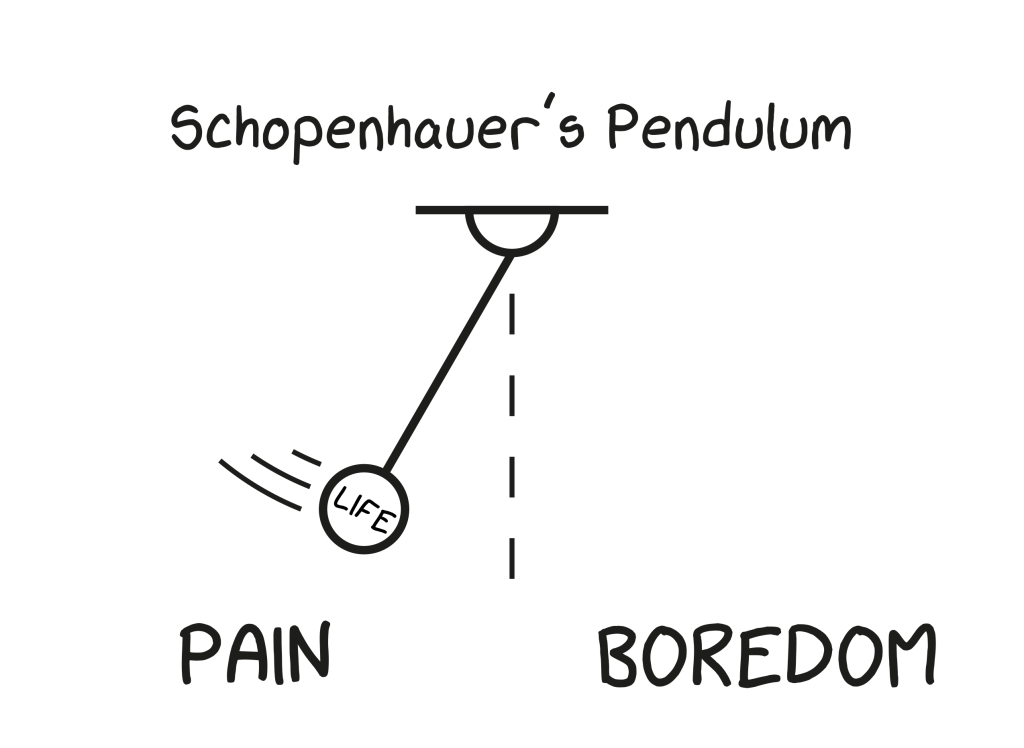
I think this does a good job explaining the phenomenon of busyness, and its existential utility for people. Ultimately, being busy is you continually swinging between desire and satisfaction. Anytime you create an item on a To Do list and proceed to check it off, that’s you making one round on this continuum. Multiply this by however many times you do it over the course of a week, and you get the feeling of busyness.

 If your mind always has something to check off, then there’s no room to ask yourself if you’re deriving meaning or purpose in what you’re doing. You just move from one cycle of desire / satisfaction to the next, and that in itself is where you dedicate your attention to.

This is where Schopenhauer’s take breaks down. Simply going from one pole to the next in a rapid manner is not happiness. Oftentimes, it’s just distraction. And when the pace of the pendulum slows in a manner where your desire takes a long time to satisfy, then you’ll see through the illusion that your busyness has created. Anytime there’s a lull or silence in your day-to-day life, this void may be filled with the angst that what you’re doing isn’t the answer, and that’s when an existential crisis takes hold.

This is why true happiness cannot be contingent upon any notion of satisfaction. Because to be satisfied is to imply an endpoint. A goal. And as the hedonic treadmill illustrates, once there is a goal, the logical conclusion is to create another chase to distract you. This distraction may keep you amused and busy, but once you’re faced with silence, you will be afraid of what you may feel.

The answer here is that happiness cannot be pursued, nor can it ever be achieved. Because the moment you’re aware that you’re happy, then paradoxically, you no longer are because you’ve called it out. Once you name a positive feeling, you become attached to it, and you long to feel it again.

The moment you pursue happiness, it is nullified. Paradoxically, understanding this is the only way one can truly be happy.

_______________________________

America is about to tumble off the edge of a massive demographic cliff. The timing is no coincidence. The US birth rate peaked in 2007, with just over 4.3 million babies born that year. That number has dropped almost every year since, reaching a 30-year low of 3.8 million births in 2017. Last year, the rate was down to 3.6 million.

Now, those 2007 babies are turning 18 (ugh, I know). As they prepare to start college and enter the workforce, their transition to adulthood signals a new reality for universities, employers, and the whole of America’s economy. Every year from here on out — at least for the foreseeable future — colleges will face a smaller and smaller pool of prospective students.

___________________________

To give you some context for pickleball’s pre-pandemic popularity, think about badminton. And now think about something half as popular as badminton. That was pickleball in 2019. Total pickleball players in the U.S. were outnumbered by participants in archery, bow hunting, fly fishing, indoor climbing, snorkeling, and sledding. Now it’s more popular than all of those pastimes … and America’s pastime. Yes, more Americans played pickleball last year than baseball.

___________________________

I’ve taught the same course to a class of undergraduate, M.B.A., medical and nursing students every year for over a decade. While I didn’t change my lectures or teaching style, somehow the students’ evaluations of last year’s class were better than ever before.

What changed? I banned all cellphones and computer-based note taking in the classroom.

To help sell this policy, I presented in the first lecture of the course a study showing that students who were required to take class notes by hand retained significantly more information than students who used computers. The reason is that with computers, students can type as fast as I speak and strive for verbatim transcripts, but there is almost no mental processing of the class’s content.

Handwritten notes require simultaneous mental processing to determine the important points that need recording. This processing encodes the material in the brain differently and facilitates longer-term retention.

Repeated studies show students perform worst on tests when phones are on desks, next worse when they’re placed in bags or pockets, and best when they’re stored in another room. The presence of smartphones also undermines the quality of in-person social interactions.

___________________________

A recently published paper looked at twin studies to see if heavy social media users have innate tendencies toward lower social well-being. After looking at info on the amount of use, the number of posts, the number of social media accounts, etc., they found only a modest correlation between social media use and well-being (including anxious-depressive symptoms).

What they did find, which many studies have found in the past, is that those symptoms correlated heavily to genetic influences.

___________________________

Today, I’m going after a sacred modern virtue. Tell me if you’ve heard this one before: “Freedom is the highest form of wealth.” After 2 years of freedom, I’d like to disagree. I don’t have issue with freedom as a form of wealth. Or that it’s a better form of wealth than money (it is). I only take issue with the “highest” or “greatest” part of this argument.

I now believe that meaning is the highest form of wealth. The ability to continually have and make meaning, every day. To feel a deep sense of fulfillment and purpose in our actions; emphasizing what we do more than who we are. The good news is you don’t need money for meaning (though it can help). There’s plenty who never find freedom, but still find purpose. So wait, does that make them free? And having freedom without meaning is its own kind of prison.

___________________________

Howard Marks’ newsletter this month provides an in depth analysis that lays out where investment value comes from and how they should be assessed. The TDLR jumping to his conclusion at the end on where we are with U.S. stocks today:

“Fundamentals appear to me to be less good overall than they were seven months ago, but at the same time, asset prices are high relative to earnings, higher than they were at the end of 2024, and at high valuations relative to history.”

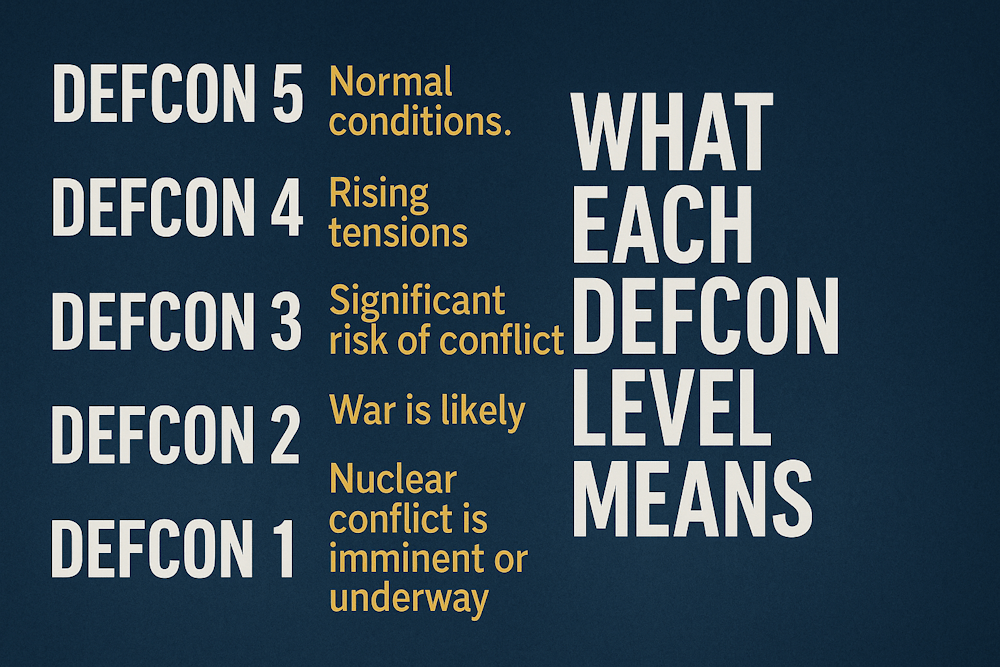
Instead of DEFCONs like the Pentagon uses for war scenarios, he laid out levels of INVESTCONs investors can move through to protect investments in the face of above average market valuations and optimistic investor behavior:

6. Stop buying
5. Reduce aggressive holdings and increase defensive holdings
4. Sell off the remaining aggressive holdings
3. Trim defensive holdings as well
2. Eliminate all holdings
1. Go short

From Marks: “In my view, it’s essentially impossible to reasonably reach the degree of certainty needed to implement INVESTCON 3, 2, or 1. Because “overvaluation” is never synonymous with “sure to go down soon,” it’s rarely wise to go to those extremes. I know I never have. But I have no problem thinking right now it’s time for INVESTCON 5. 
Success Addicts, Individual Stocks & Best Places To Work

Imagine reading a story titled “The Relentless Pursuit of Booze.” You would likely expect a depressing story about a person in a downward alcoholic spiral. Now imagine instead reading a story titled “The Relentless Pursuit of Success.” That would be an inspiring story, wouldn’t it? Maybe—but maybe not. It might well be the story of someone whose never-ending quest for more and more success leaves them perpetually unsatisfied and incapable of happiness.

Though it isn’t a conventional medical addiction, for many people success has addictive properties. To a certain extent, I mean that literally—praise stimulates the neurotransmitter dopamine, which is implicated in all addictive behaviors. success also resembles addiction in its effect on human relationships. People sacrifice their links with others for their true love, success. They travel for business on anniversaries; they miss Little League games and recitals while working long hours. Some forgo marriage for their careers.

People willingly sacrifice their own well-being through overwork to keep getting hits of success. I know a thing or two about this: As I once found myself confessing to a close friend, “I would prefer to be special than happy.” He asked why. “Anyone can do the things it takes to be happy; going on vacation with family, relaxing with friends … but not everyone can accomplish great things.” My friend scoffed at this, but I started asking other people in my circles and found that I wasn’t unusual. Many of them had made the success addict’s choice of specialness over happiness. They (and sometimes I) would put off ordinary delights of relaxation and time with loved ones until after this project, or that promotion, when finally, it would be time to rest. But, of course, that day never seemed to arrive.

We are not only gregarious animals, liking to be in sight of our fellows, but we have an innate propensity to get ourselves noticed, and noticed favorably, by our kind. And success makes us attractive to others (that is, until we ruin our marriages).

Unfortunately, success is Sisyphean (to mix my Greek myths). The goal can’t be satisfied; most people never feel “successful enough.” The high only lasts a day or two, and then it’s on to the next goal. Psychologists call this the hedonic treadmill, in which satisfaction wears off almost immediately and we must run on to the next reward to avoid the feeling of falling behind. This is why so many studies show that successful people are almost invariably jealous of people who are more successful.

They should get off the treadmill. But quitting isn’t easy for addicts. For people hooked on substances, withdrawal can be an agonizing experience, both physically and psychologically. Anxiety and depression are very common after one quits alcoholic drinking. Success addicts giving up their habit experience a kind of withdrawal as well. Research finds that depression and anxiety are common among elite athletes after their careers end.

American culture valorizes overwork, which makes it easy to slip into a mindset that can breed success addiction. What can you do to retrain yourself to chase happiness instead of success, no matter where you are in your life’s journey?

  1. Admit that as successful as you are, were, or hope to be in your life and work, you are not going to find true happiness on the hedonic treadmill of your professional life. You’ll find it in things that are deeply ordinary: enjoying a walk or a conversation with a loved one, instead of working that extra hour. This is extremely difficult for many people. It feels almost like an admission of defeat for those who have spent their lives worshipping hard work and striving to outperform others. Social comparison is a big part of how people measure worldly success, but the research is clear that it strips us of life satisfaction.
  2. Start showing up and being present for relationships you’ve compromised in the pursuit of success.
  3. Find the right metrics of success. If you only measure yourself by the worldly rewards of money, power, and prestige, you’ll spend your life running on the hedonic treadmill and comparing yourself to others. Better metrics include faith, family, and friendship. I also include work—but not work for the sake of outward achievement. Rather, it should be work that serves others and gives you a sense of personal meaning.

Success in and of itself is not a bad thing, any more than wine is a bad thing. Both can bring fun and sweetness to life. But both become tyrannical when they are a substitute for—instead of a complement to—the relationships and love that should be at the center of our lives.

___________________________

I stopped buying active investments (individual stocks, etc.) a few years ago. I’ve gone through different justifications for why too. Originally, I stopped buying active investments because of the performance argument. If 85% of active stock managers can’t beat the market over 10 years, what makes you think you can? It’s also too hard to know if you’re actually good. Because there is so much luck involved (especially over shorter time periods), you are better off not wasting your time trying to figure it out.

But there’s an even better argument:  I don’t make active investments now because you can’t put a price on mental freedom. What I’ve realized about myself (and many others I’ve spoken to) is that when you buy an active investment like an individual stock, that investment consumes a lot of your attention.

I don’t identify with the S&P 500. I don’t identify with index funds. When they drop by 10% or 20%, it’s no big deal because it’s out of my control. But that not true with individual stocks. It’s a personal decision that you’ll likely start watching much closer. If you log in to check your pick (or picks) multiple times per day, that is time you could be doing more valuable things like focusing on work, friends and family.

____________________

The antisocial century, in three parts:

1. 1960-2000: Robert Putnam sees associations and club membership plummeting, writes “Bowling Alone”

2. 2000 – 2020s: Face to face socializing falls another 25%, as coupling rates plunge

3. Now this…

_____________________________

Forbes surveyed more than 217,000 employees working at companies within the U.S. that employ more than 1,000 people. The organizations were stratified so that companies with 1,000 to 5,000 employees were deemed midsize, while companies with more than 5,000 employees were considered large employers.

Survey respondents (who remained anonymous so they could answer freely) were asked if they would recommend their employer to others and to rate it based on a range of criteria, including salary, work environment, training programs and opportunities to advance. Participants were also asked if they would recommend their previous employers (within the past two years) and the employers they knew through their industry experience or through friends or family who worked there.

Ultimately, each employer was given a score, and the 1,199 organizations with the highest scores landed on one of the two final lists—498 companies on America’s Best Midsize Employers 2025, and 701 organizations on America’s Best Large Employers 2025. The top 50 large employers are below:

________________________________

Inversion, Eudaimonia & Workplace Skills

Happiness, it turns out, is more Rorschach than road map. Is it found in the ultraluxe wellness center or the austere monastery? Does it come from getting what you want or wanting less?

By the early 20th century, utility maximization — happiness writ small — emerged as a linchpin of economic analysis. Public happiness, in turn, became a matter of optimizing the sum of individual welfare. The mathematics could be complex, but the premise was simple: Getting what you want in life — that’s happiness, bro.

The notion of happiness as choice-making swiftly migrated from economic models into the marrow of the broader culture. What was once a lifelong project shrank into a sequence of transactions. As the midcentury economy boomed, it didn’t just build wealth; it reconstructed desire. The good life, formerly the province of philosophers, was now a mainstay of the marketers: happiness packaged as the perfect lawn, the gleaming automobile, the immaculate kitchen with its humming refrigerator. We became, almost without noticing, what we bought.

And if you still felt empty? That’s where the therapy culture of the 1970s and 1980s came in — not as a remedy for consumerism but as an extension of it. The older vocabulary of life-defining commitments and meaning-making projects continued to wither while a new lexicon took hold: self-acceptance, self-esteem, self-love.

By the 1990s, happiness had acquired a personal brand. Oprah Winfrey presided over a daytime academy of self-care, empowerment and curated aspiration. Then came the next wave: the life-hacking, self-quantifying, habit-stacking era of optimization gurus like Tim Ferriss, whose first book, published in 2007, was “The 4-Hour Workweek” — “a toolkit,” in his words, “for maximizing per-hour output.”

Excitement is the more practical synonym for happiness, and it is precisely what you should strive to chase,” Ferriss wrote. “It is the cure-all.” Amid the excitement, the happiness concept kept getting miniaturized. With the rise of the algorithms, decision-making became a series of bite-size transactions. If you liked this, you’ll like that. Every swipe, click and purchase was an act of preference revelation, the digital cookie crumbs of personal identity.

In today’s social media ecosystem, happiness even threatens to become a ring-lighted aesthetic: matcha lattes, artisanal candles, sage-smudging, captioned reminders to just breathe. Once again, happiness is work — but now the work of packaging moods and moments for validation, with a tiny dopamine hit for each “like.”

“So long as you’re happy,” parents tell their kids. In reality, they want to see their children engaged in something worthwhile, contributing to something beyond their own fleeting satisfactions. 

If you’ll indulge the philosophers’ habit of conjuring characters to illustrate their abstractions, imagine a young person — let’s call her Julia — who left community college after a semester and has bounced between gigs ever since: dog-walking, cafe shifts, warehouse nights. Her life is messy, but she has learned how to show up for people. When her neighbor’s mother gets sick, Julia brings groceries. When her cousin gets out of rehab, she’s the one who texts every day. She doesn’t have a wellness routine or a five-year plan. But people trust her. She holds lives together in small, invisible ways.

Or imagine a middle-aged man named Daniel, a product manager with a smart fridge and an Optimal Morning Routine. For years, he has chased happiness through upgrades — to his apps, his appliances, himself. But lately, the returns feel thin. When his niece’s soccer team needs a coach, he volunteers, awkwardly at first, then with growing investment. Daniel has started showing up at town meetings, fighting to save the field from developers. Now his calendar includes something he cares deeply about that doesn’t come with a progress bar.

Daniel still wears a Whoop band. Julia hasn’t found her “calling.” But they’re living into a broader idea of happiness — less about what they have, more about what they give, who they’re with, what they’re part of.

Is it possible that happiness stayed big, and it’s only our way of talking about it that got small? Surely the old understanding, in which the pursuit of happiness is inseparable from shared commitments, hasn’t gone anywhere. On some level, we still know the difference between feeling good and flourishing, between the hedonic and the eudaemonic, between the algorithm’s next suggestion and the difficult and uncertain path toward a meaningful existence. Yes, we often speak as if feelings are all that count, but maybe that’s because the language of the “good life” has been hollowed out.

____________________________

Inversion is a mental model that flips the script on traditional problem-solving. Rather than look at a problem in a linear, forward, logical manner, you think about it in reverse. Well, there is one complex, foundational problem that is truly universal: How do you live a good life? Using inversion to address it: Here are some ways to live a miserable life…

  • Allow idleness to dominate your life – Stress and anxiety feed on idleness. They take hold while you sit and scroll on your phone, while you overthink your situation, while you compare yourself to others, while you try to create the perfect plan. When you take action, you starve them of the oxygen they need to survive. 
  • Allow optimal to get in the way of beneficial – Ambitious people have a bad tendency to think like this: “I don’t have an hour to work out, so I just won’t go. I don’t have two hours for deep work, so I’ll do email instead. I don’t have 30 minutes to call my mom, so I won’t call at all.” When you allow optimal to get in the way of beneficial, you ignore the most powerful principle in life: Anything above zero compounds. A little bit is always better than nothing. Tiny wins stack over long periods of time. Small things become big things.
  • Obsess over speed – Life is about direction, not speed. It’s much better to climb slowly up the right mountain than to climb fast up the wrong one.

____________________________

More police officers kill themselves every year than are killed by suspects. At least 184 public-safety officers die by suicide each year, while an average of about 57 officers are killed by suspects. Law-enforcement officers are 54 percent more likely to die by suicide than the average American worker.

Most officers are required to pass psychological and physical screenings before they are hired. But many struggle after chronic exposure to trauma. Police officers have higher rates of depression than other American workers. Shift work, which disrupts sleep, and alcohol use, long the profession’s culturally accepted method of blowing off steam and managing stress, further compound health issues

______________________________

A survey of 1,000 managers across America revealed the reasons that 8 in 10 managers said newly hired college graduates did not work out during their first year on the job:

  • 78%: Excessive use of cell phones – the top pet peeve of managers
  • 61%: Entitled or easily offended
  • 57%: Unprepared for the workplace
  • 54%: Lack of a work ethic
  • 47%: Poor communication skills
  • 27%: Lack of technical skills

Other concerns managers had about the graduates included lateness, failure to turn in assignments on time, unprofessional behavior, and inappropriate dress and language.

Colleges don’t teach students how to behave in the workplace, and there is a lack of transitional support from both universities and employers. Most students graduate with little exposure to professional environments, so when they arrive at their first job, they’re often learning basic workplace norms for the first time.

______________________________

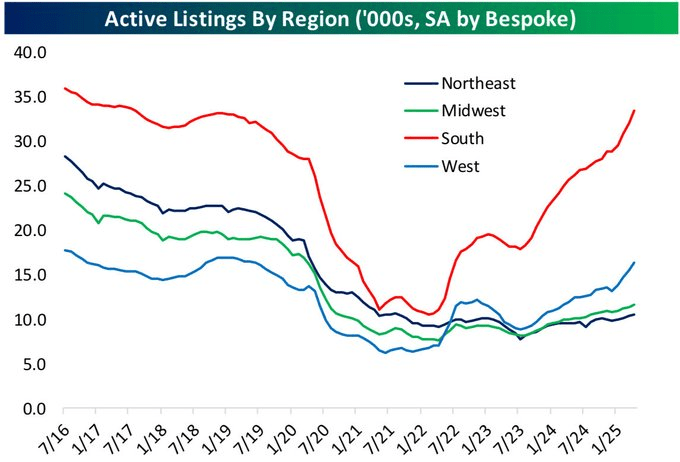
Where the number of homes for sale is growing. Fast.

___________________________

The Russell 1000 is a stock market index that represents the 1,000 largest companies in the U.S. by market value (also called market capitalization). The graph below shows the number of stocks within that 1,000 that fall by a certain percentage over a 1, 3 and 5-year time frame. While over time most major indices like The Russell 1000 go up, the odds are very high that any individual stock is going to fall by a lot.

___________________________

Lead characters were far more likely to die in the 1960s and 1970s than they are today. Across the 1970s, almost one in three protagonists died by the end of the film. That rate has steadily declined since. The drop has been particularly sharp since 2010. In the last five years, the share of lead characters who die has averaged just 17%. This is one of the lowest rates in almost a century of film history.

_________________________________

____________________________

Only 21% of American college revenues come from tuition:

__________________________

The average age of the global population is up from 26.5 years in 1980 to 33.6 years in 2025. Meanwhile, the average growth rate of the global population has also halved, from 1.8% in 1980 to 0.9% in 2025. The growth rate is expected to hit zero by 2084, and the world’s population is expected to begin declining by 2085, with the average age rising to 42. At the end of the 21st century, the average age is projected to be 43 years.

Lasting Fulfillment & Cognitive Dissonance

The U.S. has hit a new low in the world happiness rankings:

________________________________

But the Good News: Happiness Isn’t Everything

In happiness research, the British-American tradition is to think of happiness as the ultimate goal in life. Being healthy, having harmonious relationships, finding meaning in life and work, etc. are considered to be steps on the way to achieving maximum happiness (see left hand sketch in the chart below).

In other cultures, in particular in Asian and African cultures, happiness is considered to be one part of well-being but not the ultimate goal in life. Rather, happiness interacts with other factors such as meaning or spiritually to create a much more diverse assessment of well-being (or what people like to call ‘the good life’) as shown on the right-hand side of the chart below.

If you look at happiness in this broader context, then achieving maximum happiness will not be your goal in life. This in turn increases life satisfaction and well-being because other factors such as spirituality or living in harmony with nature and other people are much easier to control than happiness itself. Happiness is simply too fragile and vulnerable to external shocks.

Analysing the responses of tens of thousands of people worldwide, here is an overview chart of the optimal level of happiness that people in different countries aim for. Note how in general people in Western Europe try to achieve very high to extreme levels of happiness while people in Asia and Africa are content with more moderate levels of happiness.

What do we learn from this? Maybe trying to cheer my readers up by bringing them a week of good news isn’t really increasing their happiness. Rather, we all should look for a content life where happiness is in harmony with spirituality, nature, our friends, and family. Get off the hedonic treadmill and stop thinking about how to maximise returns for a moment. Take a step back and ask yourself what true well-being looks like for you. Because if you increase well-being, you will be able to better deal with the inevitable bad news that bombards us all the time and will continue to do so forever.

________________________________

Cognitive dissonance arises when a person holds two different beliefs that are inconsistent with one another. The theory is that when this happens it causes our minds discomfort which we then seek to reduce. Whenever this inconsistency in our attitudes, ideas or opinions kicks in our default is to eliminate that dissonance. Humans have evolved over time to avoid discomfort, so when we encounter issues that we disagree with it’s much easier to give ourselves a mental break to avoid an internal conflict.

________________________________

Those who achieve lasting fulfillment often do it in this order:

  1. Financial Freedom – Build stability first. This doesn’t mean getting rich—just having enough to live without constant financial stress, and having saved enough to be able to look forward to next steps.
  2. Time Freedom – Use financial stability to create time autonomy. Maybe that means working remotely, taking sabbaticals, or designing a more flexible life.
  3. Freedom of Purpose – With financial and time security in place, focus on what gives life meaning.

________________________________

U.S. home price gains or losses over the last 75 years below. What stands out to me is that we all remember the run from 1997 through 2005, but the 1974 to 1981 run was just as spectacular. Those gains came at a time when the 10-year treasury yield rose from 7% to 16% (mortgage rates are historically 2 to 3% above the 10-year treasury rate). The other standout to me was how insane 2021 was for price gains relative to any other year in history coming off an already blistering second half of 2020.

______________________

Academy Award-winning filmmaker Errol Morris (The Fog of War, The Thin Blue Line) turns his lens to an unlikely cast of upstarts who transformed the investment landscape in the documentary Tune Out the Noise. The film chronicles a group of academics at the University of Chicago in the 1960s whose groundbreaking research challenged Wall Street’s status quo and was used by firms to disrupt traditional methods of investing, ultimately reshaping the way the world views markets. 

Savoring, Scammers & A.G.I.

For the last couple of months, I have had this strange experience: Person after person — from artificial intelligence labs, from government — has been coming to me saying: It’s really about to happen. We’re about to get to artificial general intelligence. What they mean is that they have believed, for a long time, that we are on a path to creating transformational artificial intelligence capable of doing basically anything a human being could do behind a computer — but better. They thought it would take somewhere from five to 15 years to develop. But now they believe it’s coming in two to three years.

_______________________________

Seth Godin: “Once you have enough for beans and rice and taking care of your family and a few other things, money is a story. You can tell yourself any story you want about money. And it’s better to tell yourself a story about money that you can happily live with. So if you want more money, you need to understand you’re always going to have to trade something for it, and you need to be very clear with yourself what you’re willing to trade.”

_______________________________

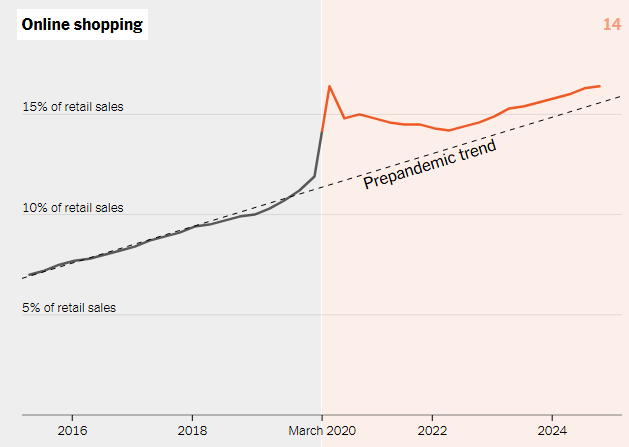
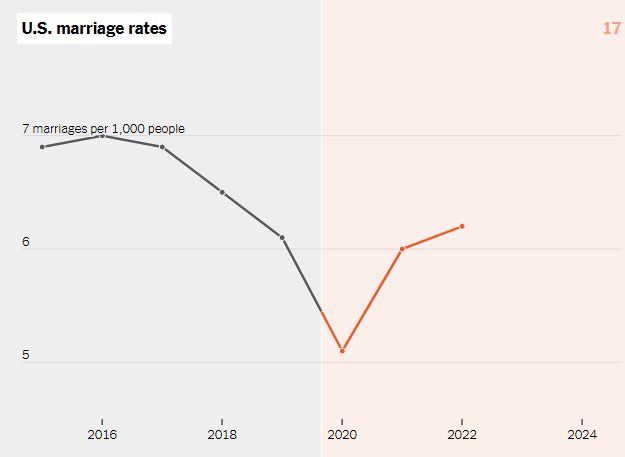
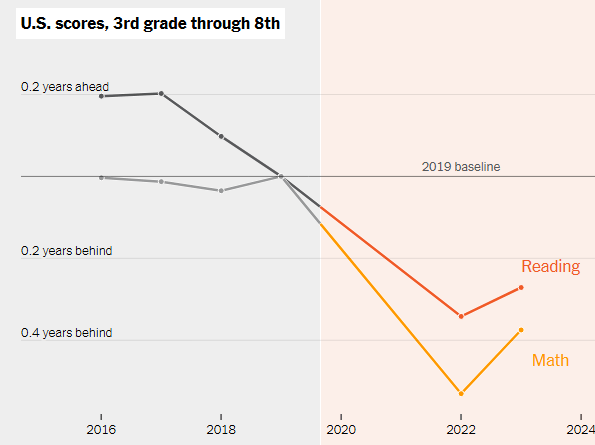
30 Charts That Show How Covid Changed Everything

_______________________________

The Atlantic magazine in 1920: “The older generation had certainly pretty well ruined this world before passing it on to us. They give us this thing, knocked to pieces, leaky, red-hot, threatening to blow up; and then they are surprised that we don’t accept it with the same attitude of pretty, decorous enthusiasm with which they received it, way back in the 1880s.” Some things never change.

_______________________________

Savoring has been defined as “the capacity to attend to, appreciate, and enhance the positive experiences in one’s life.” This can mean focusing on a current, future, or past experience with particular attention to the positive parts. Savoring has been shown in research to stimulate the brain’s striatum, a region involved in processing reward, and is effective in lowering symptoms of depression. The result, correspondingly, is a higher level of reported happiness. 

Savoring positive experiences in the moment also leads to happier memories later on. Researchers found when they instructed people to savor these experiences more fully as they recorded them, their subsequent memories were more vivid, and in effect they enjoyed the experiences more. Easier said than done, unfortunately: We are evolved less to savor the good things in life than to take note of what we dislike and harbor resentments. Humans typically exhibit a “negativity bias,” meaning that adverse events arrest our attention more than positive ones.

This makes sense in an evolutionary sense: Your suspicious, nervous troglodyte ancestors survived to pass on their genes while their blissfully unaware friends became a saber-toothed tiger’s lunch. But in our modern world, largely free of prowling super-predators, our negativity bias tends to be maladaptive. Many scientists have pointed out that a negative disposition makes us error-prone in our predictions, and this anachronistic bias simply lowers our quality of life.

________________________________

You want your parents to have health insurance so that medical needs don’t bankrupt them, right? You want them to have car insurance so that if they get in an accident, they don’t need to pay out of pocket to replace an entire car or in case someone sues them for $100,000, right? These are examples of potential economic devastation wrought by a couple different risks. Getting scammed is a risk that can be just as disruptive and economically devastating. 

What advice can I give me parents to protect them from scam calls that is extremely easy and simple to execute that won’t require any judgement in the moment?” I settled on advising them to say this every time a financial institution calls: “Where are you calling from? Thank you. I’m going to hang up and call back.”

Then go find the institution’s phone number (from a statement, the back of the credit card, or by typing in the URL of the website itself and finding it on the website; you can’t just search for the website because scammers can manipulate search results) and call the institution yourself. I also told my loved ones, “And you can always call me if you have any questions about what’s going on or what you should do.

__________________________________

Winners of the 2025 World Nature Photography Awards

__________________________________________

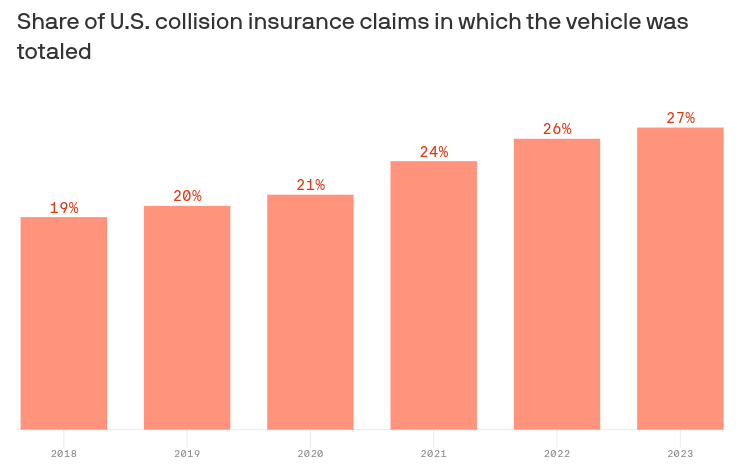
Why crashed cars are increasingly totaled; pandemic-era trends accelerated the percentage of vehicles that are declared a total loss, for multiple reasons.

  • The cost of replacement parts spiked.
  • The amount of time needed to get repairs increased, which also increased the amount of time that insurers had to provide loaners to car owners.
  • The cost of loaners soared as car prices skyrocketed, when the chips shortage created production delays.