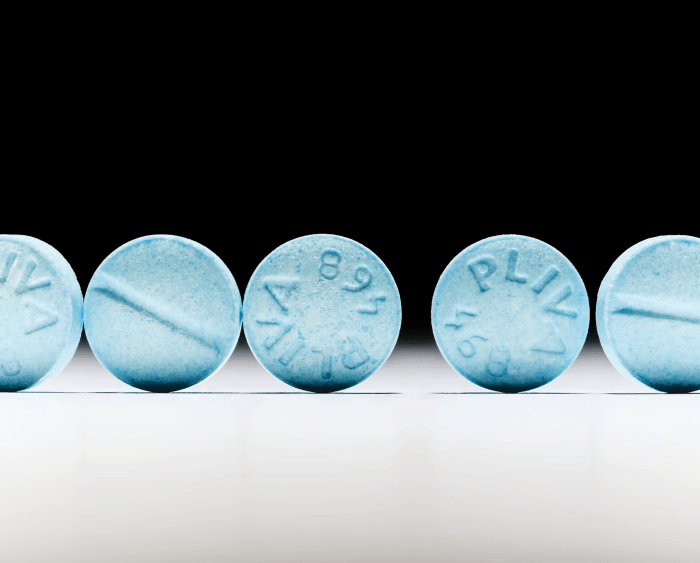
The Pill That Women Are Taking for Everything From Speeches to First Dates: Propranolol has become the go-to pill for dealing with all sorts of stressful situations. Prescriptions are on the rise, up 28 percent from 2020. By slowing down heart rate and lowering blood pressure, the drug can reduce the physical symptoms of anxiety.
Where other beta blockers focus on specific parts of the body, propranolol affects beta receptors in the heart and everywhere else in the body, including the brain. The effects on the brain are the effects that cause the decrease of anxiety.
Compared to Xanax or Valium, propranolol is considered nonaddictive and is among the mildest variety of anti-anxiety medication, but it is not without risk. Because propranolol works to reduce blood pressure and heart rate, if you reduce it too much, the person could faint.
Szeder, founder of the AI gambling startup MonsterBet, says his tools give customers an edge. “We have some people who are probably hitting around 56 to 60 percent of the time, myself included,” he claims. He created an assistant called MonsterGPT to select bets on professional sports in the US. It uses projection models he designed combined with information scraped from across the internet.
MonsterGPT accesses web scrapers through retrieval-augmented generation (RAG), a process that allows AI tools to incorporate new data from external sources on top of their training materials. He charges $77 a month for access to MonsterGPT and other tools.
More than 16 million people aged 65 and older in the U.S. live alone. That represents 28% of that age group, almost triple the share in 1950. Among the reasons: increased longevity, higher divorce rates among older adults and children more scattered than previous generations. Many are women who outlived their spouses, and at least one-fourth of older adults with dementia live alone.
_________________________
A stock or a bond is a tangible claim on some future revenue stream; real estate and commodities are physical things that you can use even if their price drops. Crypto coins, or tokens, or however it pleases you to visualize these bits of ephemeral code, are pure speculative baubles, endowed with value only to the extent that you can convince another person to pay you more for them than you paid. They are a claim on nothing. They are the grandest embodiment of Greater Fool Theory ever invented by mankind.
Major banks have now decided to allow crypto to be used as collateral for loans. This sets the stage for a rapid collapse in crypto prices to spread its harm much more broadly throughout the financial system.
There is an ongoing phenomenon of companies that are not doing well simply buying a bunch of Bitcoin and rebranding themselves as crypto holding companies and then seeing their stock price shoot up. Because we are still in the frothy phase of the bubble, it turns out that investors will actually pay more for crypto held by a company like this than they could just buy the crypto for themselves on the open market. So a, you know, declining ball bearings manufacturer can go out and buy $1 billion of Bitcoin and announce that in a press release and then see their stock value increase by $2 billion.
Self-Defeating Prophecy: A prediction causes behavior that prevents it from coming true.
The Taco (Trump Always Chickens Out) trade logically follows: whenever President Trump announces something that causes markets to swoon, buy during the fainting spell and wait for the clucking sound to emerge from the White House.
It all makes sense until you start to pull on the loose end of the logical thread. Why did Trump chicken out? Because the markets panicked when he announced a dramatic act of self-harm. But the fact that the markets were so alarmed in early April suggests that they weren’t really swallowing the Taco hypothesis.
Then came May; US equity markets had a great month despite the prospect of Trump’s 90-day “pause” expiring soon, the random imposition of further tariffs and the unsettling new prospect that Congress planned to give the administration powers to levy taxes on selected foreign investors at will. Perhaps the markets had finally digested the truth about Taco?
Which raises the possibility that the Taco trade will eat itself. The markets could become overconfident, taking Trump neither literally nor seriously. The market ignores him.
Then the next step: the horrifying realization that since the market has not blinked, Trump is not actually planning to chicken out. The step after that? The market will belatedly plunge, Trump will belatedly chicken out and the markets will be saved — until the next time.
If that isn’t enough to send you into a spin, consider this: perhaps Trump’s pride will be so wounded by all the Taco talk that he will stop chickening out altogether.
This spiraling chain reaction may all seem like an Escher fever-dream, but the underlying point is simple and could come from a Greek tragedy: when you try to predict the future, you risk changing it.
This effect is at work in any financial market. Everyone who successfully spots a bargain contributes to that bargain vanishing. The same dynamic is at play any time you try to decide which line to join at a supermarket or at passport control: once everyone has rushed to join the shortest line, it is no longer the shortest.
One notorious example from the history of computing is the “Osborne Effect”, named, perhaps unfairly, after the shortlived Osborne Computer Corporation. In the early 1980s, Osborne made an early and enormously covetable portable computer, but went bankrupt after prematurely announcing that new and better models were on the horizon. Demand for Osborne’s inventory is said to have collapsed because customers were waiting for the improved product to arrive.
This interacts with the preparedness paradox: the better you prepare for a problem, the more it seems that you were being silly because there was never a serious problem in the first place. From pandemic surveillance to nuclear deterrence, it can be hard to distinguish a far-sighted policy from a foolish waste.
Consider vaccination. Successful vaccination campaigns make common illnesses seem rare — giving credence to those who suggest vaccination is a needless risk. Global agreements to restrict CFC gases have helped the ozone hole to heal — and now, of course, there are people on social media asking why everyone lost their minds about an environmental problem that was so fleeting. While we’re on the subject, why do they waste all that money having guards at Fort Knox anyway? Everyone knows that place has never been robbed.
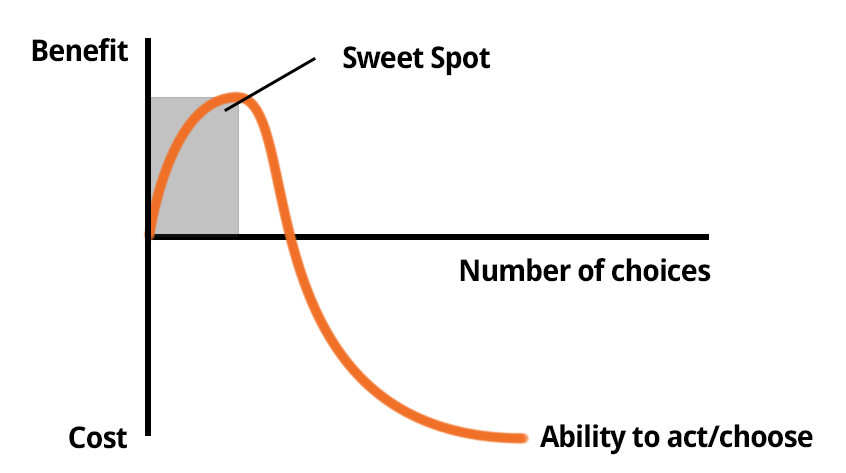
The “paradox of choice” refers to the phenomenon where having many options to choose from can lead to decreased satisfaction and make it harder to make a decision.
A study of online daters in Canada tested the idea that using the apps would make dating more efficient. Instead, researchers discovered people spent far more time on the apps looking for potential mates. With hundreds of different options to filter through — age, height, interests, etc. — there was a paralysis by analysis that overwhelmed users and caused them to second guess the choices they did make.
And the people who did find lots of matches were less likely to make a lot of selections because they were less satisfied from outsized expectations. With so many profiles to choose from, people tend to focus on the most superficial traits, meaning they were less committed to the people they were matched up with. That’s why so many of the relationships formed on the dating apps are short-term in nature.
_____________________________
Walking won’t solve everything. But it won’t make anything worse. That’s more than you can say for most things we do when we’re stressed, tired, or lost. You walk to get out of your head. To breathe. To let your mind drift without crashing. You don’t walk to fix the problem—you walk because you need space from it. The world doesn’t look so cruel when you’re moving through it one step at a time. You notice things. You remember you’re alive. So when in doubt—go for a walk.
______________________________
In recent years, some researchers completed a 70-year long study on happiness. They took a graduating class from Harvard, and measured every aspect of their lives. What types of jobs they got, what their politics were, how many kids they had, where they lived—even the length of their scrotums!
They were trying to find what behaviors or characteristics had the highest correlation with self-reported happiness. You know what they found out? Nothing! After 70 years, they never got to the bottom of it.
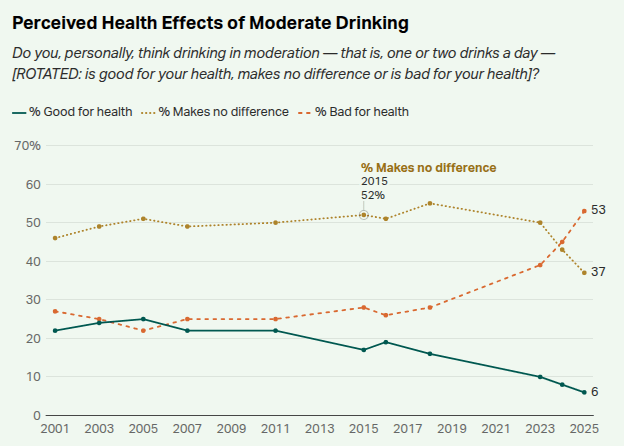
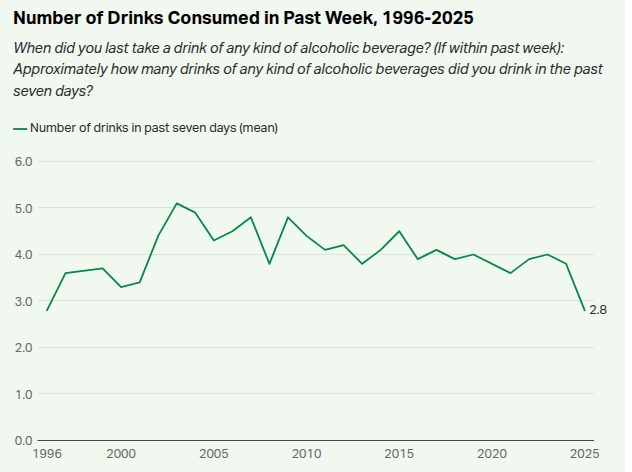
But they did find out one interesting thing—the people in the study who reported the lowest levels of happiness reported the highest levels of alcohol consumption. We don’t know what makes people happy, but we know what makes them unhappy—alcohol! I’m not talking about the occasional drink at a party—I’m talking about alcohol abuse. Did you know that 10% of people consume 60% of all alcohol? Found that out recently.
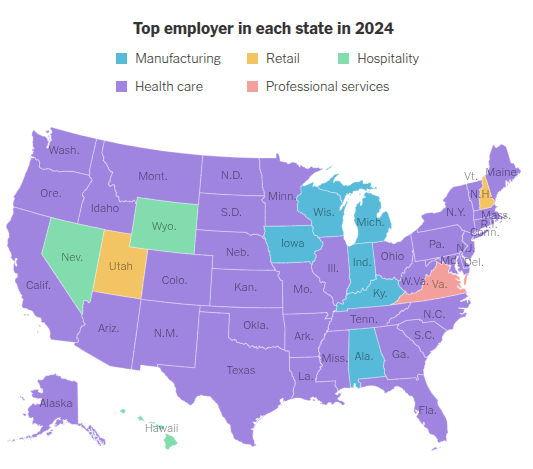
How Health Care Remade the U.S. Economy. For years, the United States labor market has been undergoing a structural transformation. As jobs in manufacturing have receded, slowly but steadily, the health care industry has more than replaced them.
___________________________
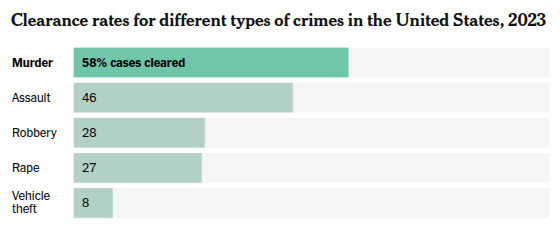
In the United States, people often get away with murder. The clearance rate — the share of cases that result in an arrest or are otherwise solved — was 58 percent in 2023, the latest year for which F.B.I. data is available. And that figure is inflated because it includes murders from previous years that police solved in 2023.
In a recent interview, Dwarkesh asked legendary bio-researcher George Church for the most under-hyped bio-technologies. His answer was both surprising and compelling:
What I would say is genetic counseling is underhyped.
What Church means is that gene editing is sexy but for rare diseases carrier screening is cheaper and more effective. In other words, collect data on the genes of two people and let them know if their progeny would have a high chance of having a genetic disease. Depending on when the information is made known, the prospective parents can either date someone else or take extra precautions. Genetic testing now costs on the order of a hundred dollars or less so the technology is cheap. Moreover, it’s proven.
The winner? Hot water immersion. Among young, healthy adults, soaking in hot water triggered the strongest responses across the board, helping the body regulate temperature, boost circulation, and even enhance the immune system more effectively than either sauna style.
____________________________
Recent good news on the cancer front is everywhere, if you know where to look. In June 2025, a French study compared data from all patients diagnosed with lung cancer in public hospitals in France in 2020 with data from similar studies performed in 2000 and 2010. Researchers found that the three-year survival rate for lung adenocarcinoma rose from about 16 percent in 2000 to about 39 percent in 2020, thanks to both earlier diagnosis and better targeted treatment. That means lung cancer survival rates have more than doubled in this century alone.
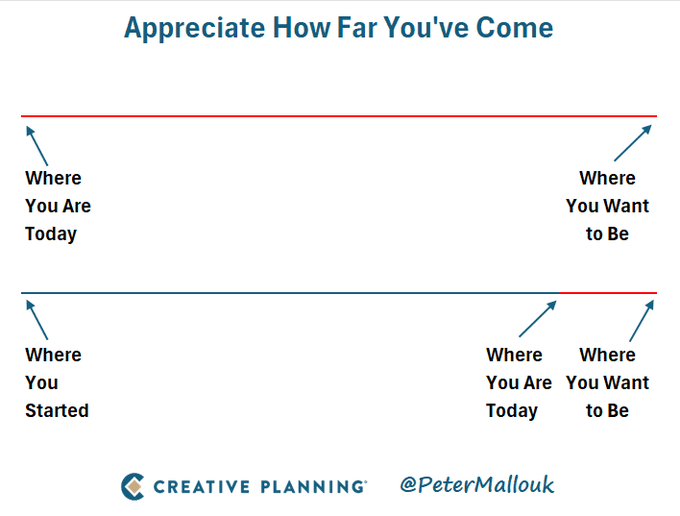
_____________________________ All of us are really good at measuring the gap between where we are and where we want to be, but make sure to pause occasionally and appreciate how far you’ve come.
These days I’m pretty good at avoiding the trap that’s been called “onedayism” – the tendency to live as if the really important part of life won’t truly begin until you’ve reached some far-off milestone, like finding a long-term partner, or achieving financial security, or until you’ve fixed your problem with procrastination, or once world events don’t seem so apocalyptic. (You have to find meaning, accomplishment and joy in the midst of all that, not solely once it’s all been “sorted out”.)
Yet as I’ve relaxed my grip on that sort of unconscious postponement, I’ve found it’s still easy to make the same error, just on a much shorter timescale: to proceed through the day as if my generally sane and interesting and enjoyable life can resume just as soon as I’ve got this task out of the way, cleared this batch of email, or made it through to this evening. But of course you can miss your whole life in this manner, ceaselessly focused on a point a few hours in the future, no less surely than with the longer-timescale version.
The answer definitely isn’t to beat yourself up for not yet having perfectly mastered the art of being present. (That, you might notice, is just another version of the same mistake.) But you can remind yourself to unclench a bit, to soften, to fall back into what’s really going on, here and now, and to see there’s no reason why you can’t find this very experience juicy and alive. I like how the entrepreneur Shane Melaugh puts it: “Your life plays out over your entire lifetime.” Which always includes now.
Humility: Given how little of the world we’ve experienced, in most situations we are likely wrong, especially in knowing how other people think and make decisions.
Self-Discipline: Everyone knows the famous marshmallow test, where kids who could delay eating one marshmallow in exchange for two later on ended up better off in life. But the most important part of the test is often overlooked. The kids exercising patience often didn’t do it through sheer will. Most kids will take the first marshmallow if they sit there and stare at it. The patient ones delayed gratification by distracting themselves. They hid under a desk. Or sang a song. Or played with their shoes. Delayed gratification isn’t about surrounding yourself with temptations and hoping to say no to them. No one is good at that. The smart way to handle long-term thinking is enjoying what you’re doing day to day enough that the terminal rewards don’t constantly cross your mind.
Influence: A good storyteller with a decent idea will always have more influence than someone with a great idea who hopes the facts will speak for themselves. People often wonder why so many unthoughtful people end up in government. The answer is easy: Politicians do not win elections to make policies; they make policies to win elections. What’s most persuasive to voters isn’t whether an idea is right, but whether it narrates a story that confirms what they see and believe in the world. It’s hard to overstate this: The main use of facts is their ability to give stories credibility. But the stories are always what persuade.
Balance: Someone with B+ intelligence in several fields likely has a better grasp of how the world works than someone with A+ intelligence in one field. The best thing to do is to quickly learn and accept that your field is no more important or influential to other people’s decisions than dozens of other fields, which pushes you to spend your time connecting the dots between your expertise and other disciplines. Being an expert in economics would help you understand the world if the world were governed purely by economics. But it’s not. It’s governed by economics, psychology, sociology, biology, physics, politics, physiology, ecology, and on and on.
____________________________
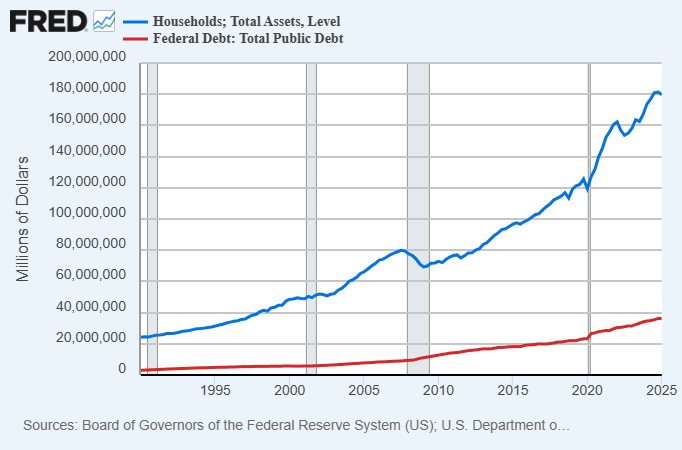
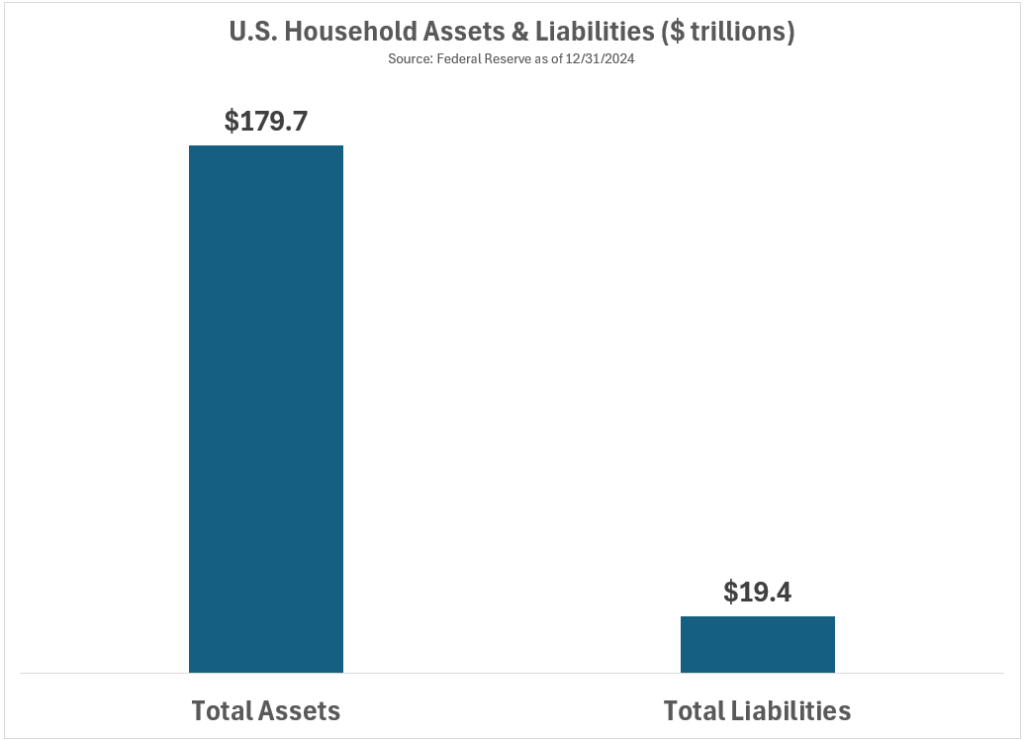
The federal government has a bit over $36 trillion in debt. To put that in context, US households collectively have $180 trillion in assets, or $160 trillion in net worth after liabilities (mostly mortgages) are subtracted.
The US monetary base is about $6 trillion. There is over $120 trillion worth of dollar-denominated loans and bonds outstanding in total (public and private, domestic and international, excluding derivatives). In the foreign sector alone, there is about $18 trillion worth of dollar-denominated debt. What this means is that there is an incredibly large amount of inflexible demand for dollars domestically and throughout the world. Everyone who owes dollars, needs dollars.
When a country like Turkey or Argentina hyper-inflates or nearly-so, it’s in a context where practically nobody outside of their country needs their lira or pesos. There’s no entrenched demand for their currency. And so, if their currency becomes undesirable for any reason (usually due to rapid money supply growth), it’s very easy to just repudiate it and send its value to Hades.
Countless specific entities around the world contractually owe countless other specific entities around the world a certain number of dollars by a certain date in time, and thus need to constantly try to get their hands on dollars. The fact that they collectively owe more dollars than there are base dollars in existence is important. That’s why the monetary base can double, triple, or more, and not be outright hyper-inflationary. It’s still a small increase relative to how much contractual demand there is for dollars. When outstanding debt greatly exceeds the number of base units, it takes a ton of printing of base units to render that base unit worthless.
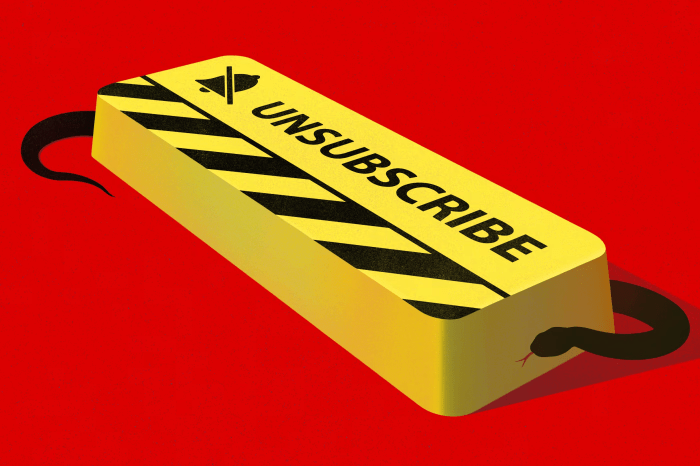
Clicking “unsubscribe” in emails can lead to malicious websites testing if your email is active.
Criminals can build a files on users who click unsubscribe links, hoping to eventually extort money through scams.
Use list-unsubscribe headers, mark emails as spam or use disposable email addresses for online sign-ups.
____________________________
Cannabis use among seniors surged 46% in the last two years; 7% of adults 65 and older now report recent use.This rise isn’t just in numbers but also in diversity older users today are more likely to be women, college-educated, and higher-income. Researchers suggest legalization and growing social acceptance are contributing factors, especially in states with medical marijuana laws. The trend is especially notable among those with chronic illnesses, raising both opportunities and concerns for medical professionals trying to balance symptom relief with the complexities of aging.
_____________________________
College Baseball Has a Power Problem: Players Keep Hitting the Ball Too Hard: In the big leagues, only superstars like Aaron Judge can routinely crush the ball at speeds in excess of 115 mph. In college baseball these days, everybody’s doing it.
College baseball is seeing unprecedented exit velocities, rivaling and sometimes exceeding those in Major League Baseball.
College players are 42% more likely to hit balls at 115 mph or harder than MLB players.
The reasons for the surge in exit velocity aren’t entirely clear, but it’s creating safety concerns for pitchers, infielders or with fans sitting in the stands
___________________________
Nerds is on track to hit more than $900 million in sales this year, a more than 1,700% increase from the $50 million in sales in 2018. The unprecedented surge is directly attributed to the widely popular Nerds Gummy Clusters, which represented the first meaningful innovation for the once-sleepy brand in years. Nerds Gummy Clusters are now the top sugar confection on the market, overtaking skittles.
_____________________________
Older people will remember the time when there was – for a while – a discussion about how the US stock market had significantly higher returns overnight when the market was closed vs. the actual trading day. Those were the innocent days of an era long gone, aka 2018, when we were all naïve and enthralled by a bull market that couldn’t be derailed by anything. The graph below shows the “overnight effect” through January 2018:
This effect was so promising that it even led to the launch of an ETF in June 2022 that focused on this trade. A product that was so successful that it was liquidated in August 2023.
A new study shows that the effect disappeared after the pandemic. What makes the study interesting, though, is that they seem to find why the effect existed in the US (and not other countries) in the first place: Hype.
The number of paying Tinder users has dwindled to just 9.1 million in its most recent quarter — down 18% from a peak of 11.1 million in late 2022. While Tinder remains Match Group’s biggest brand, Hinge, another dating app under the Match umbrella, saw paying users grow 19% year over year in Q1 2025.














 Tuna Thoughts