The Baumol Effect, Memory Banks & Short Form Videos

Weird things happen to economies when you have huge bursts of productivity that are concentrated in one industry. Obviously, it’s great for that industry, because when the cost of something falls while its quality rises, we usually find a way to consume way more of that thing – creating a huge number of new jobs and new opportunities in this newly productive area.

But there’s an interesting spillover effect. The more jobs and opportunities created by the productivity boom, the more wages increase in other industries, who at the end of the day all have to compete in the same labor market.

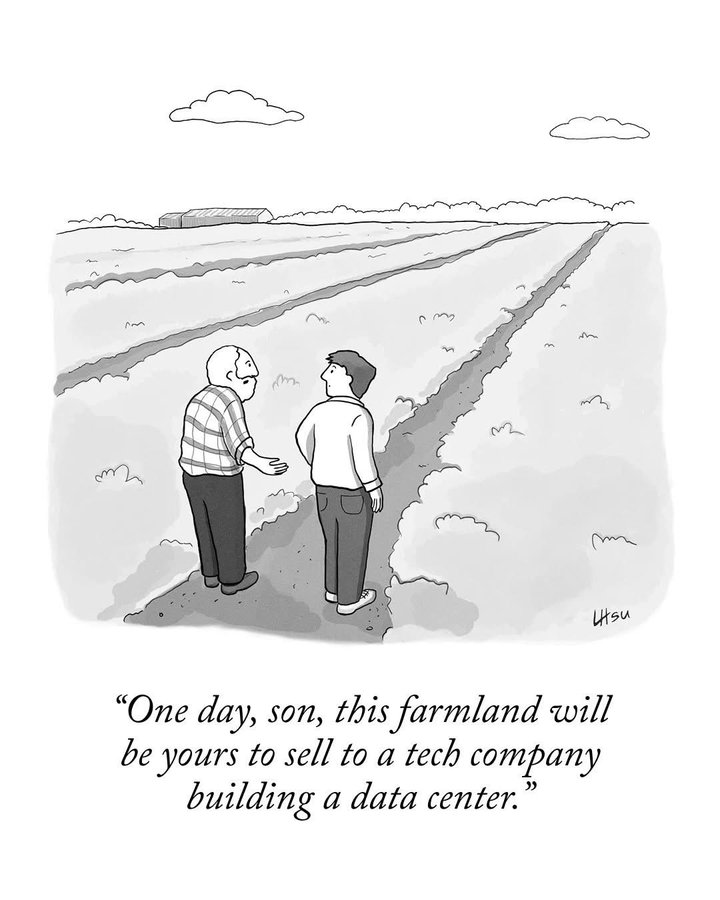
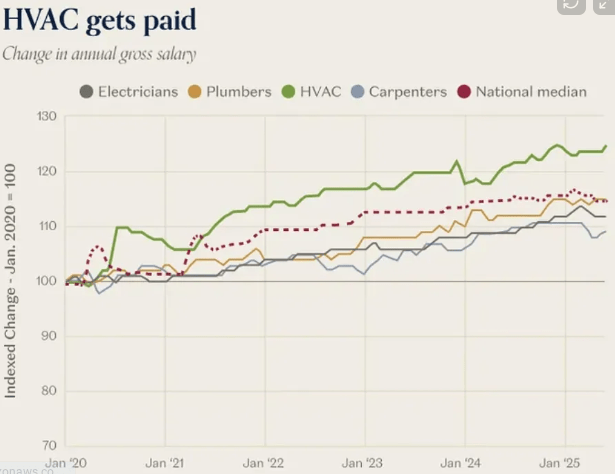
Our explosion of demand for data centers means there’s infinite work for HVAC technicians. So they get paid more (even though they themselves didn’t change), which means they charge more on all jobs (even the ones that have nothing to do with AI). Furthermore, the next generation of plumber apprentices might decide to do HVAC instead; so now plumbing is more expensive too. And so on.
The Baumol Effect; “We’ll spend more on what doesn’t get more productive,” is top of mind right now, as we watch in awe at what is happening with AI Capex spend.

_______________________________

Academics have published new research on the impact that Short Form Videos (SFV) like TikTok, Instagram Reels and Youtube shorts have on cognitive and mental health. The report systematically reviews and analyzes 71 studies involving over 98,000 participants.

If you just read just the findings below it would be indistinguishable from an addiction to a hard drug:

  • SFV use is linked to poorer cognitive performance, with the strongest deficits in attention and inhibitory control, suggesting users struggle to focus and suppress impulses.
  • Frequent exposure to fast-paced, highly rewarding SFV content may rewire attention systems, fostering “rapid disengagement” from tasks that are slower or require sustained effort, reducing cognitive endurance over time.
  • SFV use is associated with poorer overall mental health, with the strongest links to stress and anxiety, indicating consistent emotional strain among heavier users.
  • Heavy SFV use reinforces impulsive engagement loops driven by dopamine rewards, contributing to compulsive scrolling and difficulty disengaging, patterns resembling behavioral addiction.
  • Short-form video consumption is associated with poorer sleep quality, especially when used at night, due to overstimulation and blue light disrupting melatonin, which can worsen mood and cognitive functioning.
  • Higher SFV use correlates with increased loneliness and reduced life satisfaction, as digital interactions replace real-world social connection for some users.
  • Negative effects occur across both youth and adults, meaning the cognitive and emotional risks of SFV use are not limited to developing brains; adults experience similar declines and mental health associations.

_______________________________

These days, it’s all stocks all the time, with reputable authorities calling on small investors to put everything they have saved into equities. Older investors are reminded of the mantra so common in 1999: “Every penny you don’t have invested in stocks will hurt you.”

More than a generation ago, financial historian Peter Bernstein wrote about investors’ “memory banks,” the market experience that accumulates in their hippocampi over their investing lives and molds their investment strategy. As he put it, looking back on the 1990s: “Most of the new participants in the market had no memory of what a bear market was like.”

And here we are today, almost seventeen years into a great bull market. Rather like 1999, also seventeen years into a long-term bull market, or 1966, once more seventeen years. Or 1873, sixteen years in, or 1837, eighteen years in, or 1893, twenty years in — to name a few of the notable tops over the past two centuries. Just long enough to produce empty memory banks in just enough investors.

A new generation of investors have never personally experienced a long-term bear market. Their memory banks are devoid of the damage wrought by the Grim Reaper of equity risk. Let’s be generous and assume some have read market history and know that stocks can lose money — sometimes, a lot — and take months, if not years, to recover. There’s a difference, though, between being told that markets can fall by more than 50% and having it burned into your memory banks by seeing your net worth halved in real time as the economy careens towards the precipice.

_____________________________________

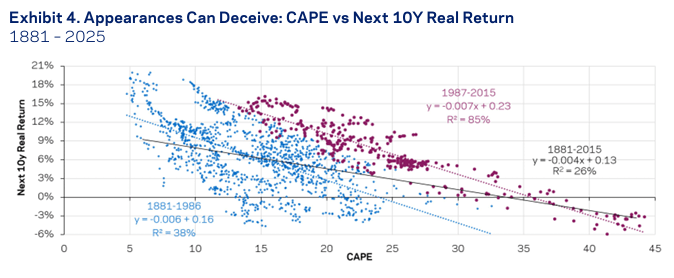
Historically, valuations have been a useful (though not perfect) indicator of real returns over the following decade. Below, you’ll see historical CAPE readings (in black) for the U.S. market alongside their corresponding forward ten-year real returns (in green). The conclusion is straightforward: when valuations are low, future returns tend to be above average; when valuations are high, forward returns tend to be much more muted.

Right now, the U.S. market sits at a CAPE ratio of around 40. It’s nearly double the long-term average of roughly 20, and the second most expensive in history.

historically, when valuations have climbed to this level, the following decade hasn’t been kind to investors. Not once has a country that ended a year with a CAPE above 40 produced positive real returns over the next ten years. That’s not a personal opinion but what the data shows.

To get a sense of what current valuations might mean going forward, I ran a linear regression using historical CAPE data and forward ten-year real returns. The relationship is remarkably consistent: as valuations rise, future returns fall. At today’s valuation levels, the regression suggests an expected real return of -2.46% for the next decade. From a historical perspective, the last time we were at the CAPE reading we find ourselves in today, the market went on to lose -2.11% per year for the next ten years.

Valuation isn’t the only red flag flashing. Today, about 40% of the market is concentrated in its 10 largest companies. This is the most concentrated the market has ever been.

Concentration itself isn’t a bearish sign. What really matters is how concentration changes going forward. Rising concentration tends to coincide with strong market performance as leading firms continue to gain share and deliver growth. On the other hand, when concentration starts to fall, this means your largest players are underperfoming the rest of your portfolio, and that’s when returns have historically suffered. If the biggest names continue to pull away from the pack, the market could remain strong for a while. But if that leadership falters, history suggests the unwind can be painful.

Identity Switching, Work-Life Balance & College Graduates

One of the great causes of suffering is this maddening worry about what others think of us. I can go into its causes by pointing to evolutionary psychology and our hunter-gatherer roots, but that’s neither novel nor interesting. Rather, I want to delve into the asymmetry between what we know about ourselves, and the uncertainty surrounding what others know of us. Because at its core, the worry about what others think is ultimately a function of uncertainty.

Whenever we interact with someone – whether in-person or online – a gap emerges between who you are, and who you are presenting. This is why the person you are with your boss isn’t the same as the person on the couch watching Netflix. Or why the person you are with your best friend isn’t the same as the person you are with an acquaintance. Each relationship contains a culture of behavior that you oscillate between, which means that you’re constantly presenting a different version of yourself across a wide range of interactions.

What this means is that it becomes increasingly difficult to know who you really are. If a certain version of you emerges with this individual, but in the very next moment you toggle another set of behaviors with another, then that means your very identity is switching upon context. And the more you have to maneuver between various projections of yourself, the more difficult it becomes to get a handle on what “yourself” means in the first place.

This is why you’re likely exhausted after large social gatherings, and yearn to turn on the TV and watch something brainless until you drift off to sleep. The fatigue is not caused by the rigor in which your mouth is moving to talk, but rather by the constant switching of identity that occurs in these situations. When you’re worried about what someone thinks of you, it’s rarely about that person’s opinions of you. It’s about your own opinions of yourself. 

_________________________

Is A.I. taking jobs from young college graduates? It depends on the job.

Stanford economists studied payroll data from the private company ADP, which covers millions of workers, through mid-2025. They found that young workers aged 22–25 in “highly AI-exposed” jobs, such as software developers and customer service agents, experienced a significant decline in employment since the advent of ChatGPT:

On the other end of the spectrum, they found for entry level workers in fields like home health aides, there is faster employment growth. That suggests this isn’t an economy-wide trend. The decline in employment really seems to be more concentrated in jobs that are more AI-exposed.

_______________________

A new analysis of 39 nations reveals where employees enjoy the healthiest mix of work and personal life and on the other end of the spectrum – where long hours, limited leave, and lack of support take the greatest toll. The study assessed 10 factors including working hours, paid leave, commute length, parental support, remote work availability, and happiness scores.

Unsurprisingly, the United States finished dead last, ranked 39th out of 39. The US suffers from some of the longest working hours in the study, averaging 1,799 annually. It is the only country in the ranking without federally mandated paid annual leave or paid parental leave, and Americans devote only 14.6 hours per day to personal care and leisure.

___________________________

Interesting point on why college students are putting less effort into class: courses don’t prepare them for real jobs (like they should), so they have to spend more and more time making up the difference after class:

“A student said that coursework doesn’t prepare students to answer interview questions for finance and consulting jobs. The only way to get ready is through extracurriculars or on one’s own time. By sophomore year, his friends were fully absorbed in the internship-recruiting process. They took the easiest classes they could find and did the bare-minimum coursework to reserve time to prepare for technical interviews.

___________________________

From Kevin Kelly on how the relationship between book publishers and authors has changed:

“Traditional book publishers have lost their audience, which was bookstores, not readers. It’s very strange but New York book publishers do not have a database with the names and contacts of the people who buy their books. Instead, they sell to bookstores, which are disappearing. They have no direct contact with their readers; they don’t “own” their customers.

So when an author today pitches a book to an established publisher, the second question from the publishers after “what is the book about” is “do you have an audience?” Because they don’t have an audience. They need the author and creators to bring their own audiences. So, the number of followers an author has, and how engaged they are, becomes central to whether the publisher will be interested in your project.

Many of the key decisions in publishing today come down to whether you own your audience or not.”

_______________________________

Canada’s Great Condo Crash: For years, low interest rates fueled a big-city condo-flipping frenzy. Profits got bigger and condos got smaller. Now the bubble has popped, leaving behind thousands of unsellable, unlivable units.

In the first quarter of 2019, the average Toronto condo cost $560,000. By the first quarter of 2022, they had soared to $808,000. Since that peak, the market has been in a painful reset.

By the first quarter of 2024, average condo values in the city had dropped by over $100,000 to $696,000, and they have continued to fall. As of this spring, the inventory of unsold units in Toronto totaled more than 23,000, which would take nearly five years to sell at the current rate. Of those, nearly 2,000 are built and sitting empty, more than 11,000 are under construction and roughly 11,000 more are in pre-construction projects.

_____________________________

As of July, there has been no reduction in import prices since Liberation Day, which are measured pre-tariff. Thus, foreign exporters in aggregate are not absorbing the tariff costs by reducing prices. This means most or all of the tariffs are being paid by American consumers and American businesses. For context, it takes about a 13% reduction in prices to offset a 15% tariff, or a 16% reduction in prices to offset a 20% tariff.

This shows up in a combination of higher consumer goods prices and/or compressed business margins of goods-heavy businesses, depending on how quickly businesses are able to pass those prices on to consumers (which will vary by industry and company; those with in-demand products can eventually pass on price increases, and those with thin margins have to eventually pass on price increases).

Consumers on the higher end of the income spectrum are less likely to change their consumption behavior and thus will basically just pay the tariffs, giving the government more revenue. Consumers on the lower end of the income spectrum are more likely to have to curtail consumption because their disposable income is scarce.

Another excellent newsletter from Lyn Alden on tariffs, fiscal income/spending, monetary policy and the implication on global economies and asset prices.

_____________________________

_______________________________

This chart shows the change in active housing inventory by state for 2025 compared to the average of 2018/2019. Orange colors mean higher inventory levels and prices are susceptible to fall, while green colors mean very low inventory and likely still price increases.

Adult Friends, A.I. Psychologists & Short Songs

Psychologist and writer Adam Mastroianni has been trying to figure out why adults have so much trouble making friends and Derek Thompson spoke with him to discuss:

Mastroianni: It seems like the takeaway from this research that has been done over the past 10 years or so is that people are way too negative about their own social abilities and the things that are likely to happen when they talk, especially to someone new. So, for instance, they underestimate how pleasant it’s going to be to talk to someone new. But even afterward, when we ask them, hey, how much did you like that person? They say oh, I like them a lot. And when we ask, how much did they like you? Oh, less than that. I ran one study with some friends of mine where we had people talking groups of three and we’re like, okay, how much did you like them? People would say 5 or 6 out of 7. And how much did they like you? People would say 4 or 5 out of 7. On average, people thought they were the least liked person in the conversation, which obviously can’t be true for each person.

Thompson: We are, on the one hand, the social animal. Yet we delude ourselves about the degree to which we’re a fun hang. We’re the social species and we’re the socially anxious species as well.

Mastroianni: Yeah, well, we’re the ones who care about it the most. And so we have the most to lose. And so we worry about it the most in part in the hopes that maybe it makes us better at doing it. The way I think about it is in our evolutionary history, we lived in groups. But how often did we meet someone who we literally had no connection to before? I can’t imagine it was all that often. But today it can happen literally every day. You get on the bus and it’s full of people that aren’t related to you. You don’t know them. They don’t know you. That’s a really weird thing to do.

____________________________________

Morgan Stanley surveyed all stocks trading on U.S. exchanges over a 40-year period, between 1985 and 2024. They found the median stock experienced a decline of 85% at one point or another. Worse yet, more than half of these stocks never fully recouped their losses. The median stock recovered to just 90% of its prior high-water mark. Among those stocks that were able to reclaim their prior highs, it was a long process—about five years, on average. 

Those numbers only apply to the median stock, but suppose you had above-average stock-picking skills. How would things have turned out? If you had the foresight to pick the 20 best performing stocks over that 40-year period, at some point they still would have delivered an average agonizing draw-down of 72%.

It’s hard to remember, but Apple dropped 83% at one point. Nike once lost 66%. Even Nvidia, which was the best performing stock over the past 20 years through 2024, lost more than 90% at one point. And most notably, Amazon was once down 95% from its prior high.

Over the long term, share prices tend to move in tandem with corporate profits. When a company’s earnings increase, often its share price does too. The problem is that prices are only sometimes rational. Very often, stock prices disconnect from corporate earnings, and the gap can be significant.

This was first proven empirically Daniel Kahneman and Amos Tversky. In 1974, they published a paper that found investors exhibit an “availability heuristic.” That is, they tend to rely on the information that is most available. That’s a problem because the information that happens to be most available isn’t necessarily the information that’s the most accurate or even relevant. Often, the information that happens to come to mind is the information that’s most vivid. In other words, extreme information or news becomes most memorable, and thus drives decision-making.

___________________________

ChatGPT users may want to think twice before turning to their AI app for therapy or other kinds of emotional support. Sam Altman, OpenAI’s CEO:

“People talk about the most personal sh** in their lives to ChatGPT. People use it — young people, especially, use it — as a therapist, a life coach; having these relationship problems and [asking] ‘what should I do?’ And right now, if you talk to a therapist or a lawyer or a doctor about those problems, there’s legal privilege for it. There’s doctor-patient confidentiality, there’s legal confidentiality, whatever. And we haven’t figured that out yet for when you talk to ChatGPT. This could create a privacy concern for users in the case of a lawsuit, because OpenAI would be legally required to produce those conversations today.

_________________________________

The average young person is on course to spend 25 years of their life on their phone. Plus more on other screens. Most of them don’t want to live this way, but feel trapped.

____________________________

A fascinating walk-through explaining why the length of new songs became much shorter around 2019, and has slowly started increasing again over the last year.

_____________________________

How Country Music Took Over the Charts: A Statistical Analysis.

The 1990s were a turning point for country’s mainstream acceptance, driven by two mutually reinforcing phenomena:

  1. Improved Telecommunication Infrastructure: The Telecommunications Act of 1996 enabled American media companies to consolidate regional stations into national networks, facilitating country radio play outside of rural strongholds. Simultaneously, enhanced geographic radio coverage brought consistent access to under-served rural listeners. Together, these infrastructure improvements fostered a virtuous cycle: greater airplay propelled more country songs onto the charts, which in turn drove even more airplay.
  2. Country Crossover Successes: Country crossovers like Garth Brooks, Shania Twain, and Tim McGraw blended conventional genre staples with accessible pop and rock influences, broadening the format’s appeal beyond its traditional fanbase.

______________________________________

Something unusual—and incredibly fast—is happening with teenagers running the 100-meter around the world. From Japan to the U.K., young speedsters are posting eye-popping times in track’s most prestigious event. What’s driving these turbocharged athletes who aren’t old enough to vote?

One major cause is the relatively recent arrival of super spike shoes, which has helped lower times across the board. But just as significantly, the line between amateur and pro track athletes is fuzzier than ever. Prodigies are accessing better coaching, and they’re able to sign endorsement deals, which adds a financial incentive to improve.

______________________________________

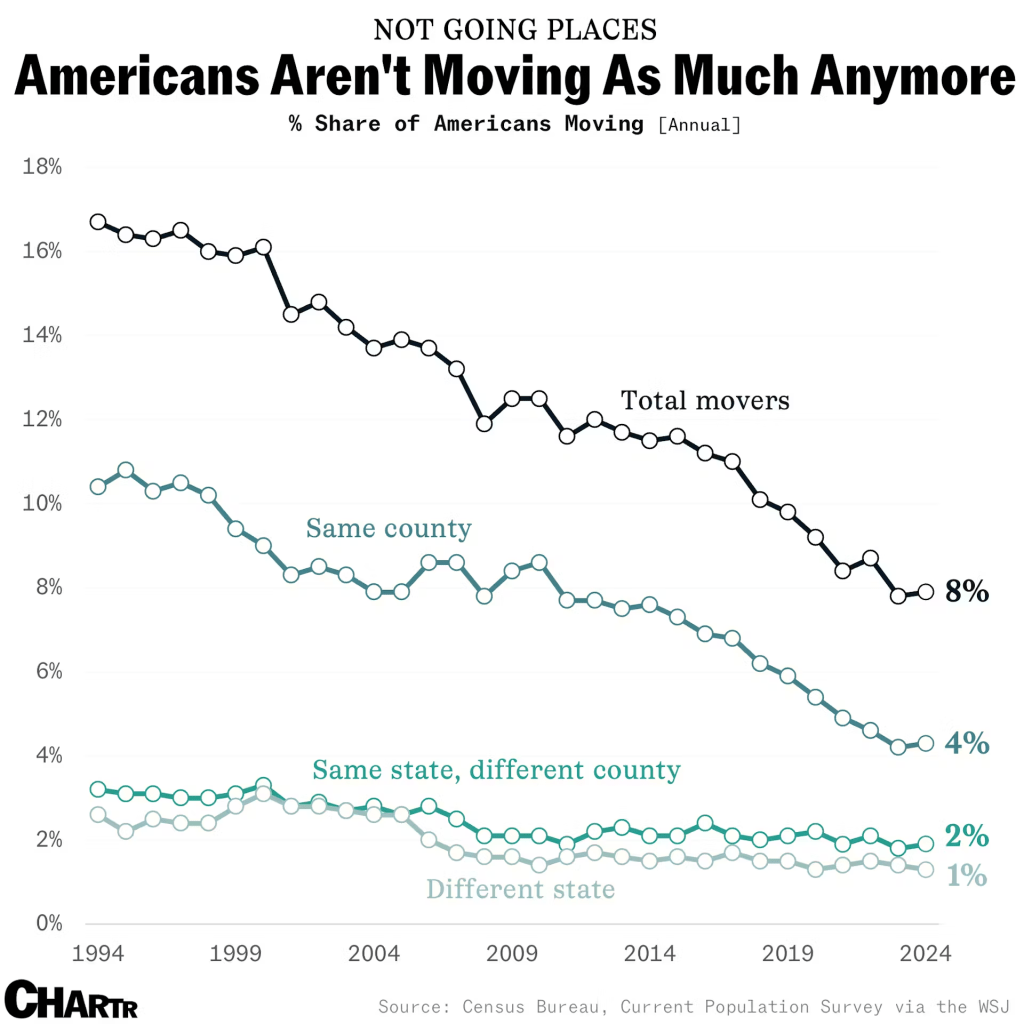
Pretty incredible graph for Americans:

_____________________________

The number of companies listed on U.S. stock exchanges has decreased substantially since its peak in 1996, as it nearly halved to less than 4,700 in 2022. At the same time, the number of U.S. PE-backed
companies grew to over 11,000.

_______________________________

Peter Bernstein liked to say that investors have memory banks: the market returns collectively earned by people of similar age. Experience shapes expectations. The problem is that your memory bank can deceive you in dangerous ways. Your experience of the past is a reasonable guide to the future only if the future turns out to resemble the portion of the past that you’ve lived through. And it often doesn’t. It’s worth looking at a few investing beliefs that your memory bank might hold—and asking whether they’re still valid.

_______________________________

How much longer will emerging markets be undervalued and hated?

________________________________

Nasdaq Price to Earnings valuations are at the very high end of their historical range. That means they are extremely expensive.

______________________________

AQR’s most recent report analyzes how the CAPE ratio and other P/E metrics, while far from perfect, still remain the best available predictor of long-run future market stock returns.

______________________________

While countries like the United States and India are extremely expensive relative to the rest of the world, the global stock market as a whole has seen its P/E ratio rise dramatically from the early 2010s.

_______________________________

Looking at Enterprise Value (EV) divided by sales, we’re not above the 2000 and 2021 bubble peak for global stocks:

__________________________________

Comparison, Survivorship, Reciprocity & War

The Federal Reserve did a study that looked into the financial habits of Canadians whose neighbors won the lottery. The neighbors of people who struck it rich were more likely to increase their spending, take on more debt, put more money into speculative investments, and eventually file for bankruptcy. And the larger the winnings, the more likely that others in that neighborhood would go bankrupt.

It’s in our flawed nature to compare ourselves to others, particularly people we see and interact with every day. Money insecurity leads us to compete and not appreciate what we have. Also true, though, is that the research shows one thing for certain: The Joneses aren’t very happy.

An examination of 259 different independent samples found that materialism was “associated with significantly lower well-being” and was a poor way of meeting psychological needs. The researchers’ findings suggest that this association holds across different demographics, participants, and cultural factors. Another meta-analysis of 92 studies found that those pursuing goals of growth, community, giving, and health experienced significantly higher levels of well-being than those pursuing the Jones-y goals of wealth, fame, or beauty.

You’ll never be content trying to keep up with the Joneses because there is an endless supply of them to keep up with. There are always people spending more money, taking nicer trips, buying bigger houses and making more money than you are.

There was another classic psychological study that compared lottery winners with people who were paralyzed in an accident. Surprisingly, the lottery winners weren’t significantly happier than the average person and actually reported less enjoyment from everyday experiences. The big win seemed to raise their expectations, which made small daily pleasures feel less satisfying.

In contrast, many accident victims rated themselves as moderately happy, despite their life-altering injuries. While thinking about their past lives sometimes made them feel worse, they still found deep meaning and enjoyment in ordinary things because they appreciated them more. After major life changes, people adjust their expectations. Lottery winners adjusted upward and felt less satisfied. Accident victims adjusted downward and found more value in the little things.

It’s expectations all the way down. Finding contentment is probably a better goal than finding happiness.

________________________

Many of the behaviors that have made humans such a successful species, also make it difficult to be good, long-term investors. Our overreaction to short-term, visible, in-the-moment risks, is just one of them. It was important for our ancestors to run first if they heard something in the bushes that could be hungry tiger. The investment issue that we are currently worrying about is very unlikely to be as vital as we believe it to be, but it is very human to act as if it is.

_________________________

Nothing was the same after June 28, 1914. The assassination of Archduke Franz Ferdinand triggered a chain of events that led to WWI and closed the NYSE for months. One month to the day of the assassination, Austria-Hungary declared war. Three days later, Henry Noble, president of the NYSE, closed the exchange. Other regional U.S. exchanges in Chicago, Baltimore, San Francisco, Philadelphia, and other cities followed suit. Most major exchanges around the world closed too.

Noble knew that wars demanded funds. Foreign investors could make a run on the exchange, selling securities to raise cash. The cash could then be converted into gold and shipped back to Europe. That put the U.S., being on the gold standard, in a tricky spot. Depleting the U.S. gold reserves would put faith in the dollar and adherence to the gold standard at risk.

  • June 28, 1914 – Archduke Ferdinand assassinated. Dow closes the next day at 57.9.
  • July 28, 1914 – Austria-Hungary declares war on Serbia – World War 1 begins: Dow closed 55.3.
  • July 30, 1914 – Dow closes 51.7.
  • July 31, 1914 – NYSE & regional U.S. exchanges close the markets
  • December 12, 1914 – NYSE reopens stock market with trading limitations.
  • December 14, 1914 – Dow closes 56.8.
  • December 14, 1915 – Dow closes 98.3.

When the stock market reopened December 12, 1914, investors had four and a half months to reassess the business environment in war time. And business was good. Over the next 12 months, the Dow soared 73% (Dec. 14, 1914, to Dec. 14, 1915, not including dividends). The U.S. became the main food and war supplier for the Allies war effort. Companies like U.S. Steel and DuPont saw profits explode 5x and 10x respectively, in a year. Dividend payments did the same. WWI is the perfect example of why geopolitical events are hard to predict. The market reacts in unexpected ways during scary confusing times. 

______________________________

Reciprocity is a deeply human thing, and it applies directly to the nature of interest. If you show someone that you’re interested in them, they will reciprocate that curiosity by revealing what makes them so interesting. Believing that someone is boring is a failure of recognizing jthat fact. Boredom is almost always the result of a lack of curiosity, or the inability to see anything or anyone through the lens of a question. In a way, boredom is arrogance. It’s the acceptance of the belief that nothing is worth your interest because you already know what you need to about yourself, others, and the world. A curious mind is a humble one, as a prerequisite for curiosity is the acceptance that there is more to life than what you think you already know.

____________________________

We are a story-driven species. From cave walls to balance sheets, we look for narratives that explain the world and our place in it. And nowhere is this tendency more dangerous than when we only learn from the winners. When we allow survival alone to imply superiority. When the fact that someone or something made it through becomes enough proof that they knew what they were doing.

This is the essence of survivorship bias, and in the world of investing, it distorts almost everything. Consider the stock market, which is full of visible winners. We often hear stories of stocks that went 20x, fund managers who outperformed for a decade, companies that pivoted into success, and investors who became celebrities.

What about the others? The ones who didn’t make it? They’re barely mentioned, rarely studied, and almost never remembered. And so, the narrative we inherit is hopelessly incomplete.

Then there’s the most seductive arena of all: success stories. Business books, biographies, and podcast interviews are all proudly built on the same question: “How did you do it?”But that question, when asked only of survivors, creates a dangerous narrative. It turns randomness into wisdom and luck into method.

A founder who succeeded against all odds is praised for her vision, her grit, and her intuition. But what about the 100 others who had the same qualities and failed? What about the timing, the macro conditions, the investor interest, the random tailwinds that no one could have planned? None of that gets included in the final story. And so we start to think: this is how success works. This is the roadmap. Just do what she did.

Survivorship bias also affects how we view risk. When risky behaviour pays off, it’s reframed as boldness or foresight. But when it doesn’t, there’s no reframing…just silence. The lesson that reaches the public, though, is clear: take bold bets. It worked for him, it could work for you. But that’s the equivalent of watching five Russian roulette winners and deciding the game must be safe.

_________________________

Foreigners have steadily increased their holdings of US equities and currently own 18% of the US stock market, see chart below. This is the mirror image of a trade deficit. Foreigners selling goods to the US receive dollars in return, which are then used to purchase US assets, including US equities. If the trade deficit is eliminated, there will be fewer dollars for foreigners to recycle into the S&P 500.

Being Present, Unsubscribing & Gummy Clusters

These days I’m pretty good at avoiding the trap that’s been called “onedayism” – the tendency to live as if the really important part of life won’t truly begin until you’ve reached some far-off milestone, like finding a long-term partner, or achieving financial security, or until you’ve fixed your problem with procrastination, or once world events don’t seem so apocalyptic. (You have to find meaning, accomplishment and joy in the midst of all that, not solely once it’s all been “sorted out”.)

Yet as I’ve relaxed my grip on that sort of unconscious postponement, I’ve found it’s still easy to make the same error, just on a much shorter timescale: to proceed through the day as if my generally sane and interesting and enjoyable life can resume just as soon as I’ve got this task out of the way, cleared this batch of email, or made it through to this evening. But of course you can miss your whole life in this manner, ceaselessly focused on a point a few hours in the future, no less surely than with the longer-timescale version.

The answer definitely isn’t to beat yourself up for not yet having perfectly mastered the art of being present. (That, you might notice, is just another version of the same mistake.) But you can remind yourself to unclench a bit, to soften, to fall back into what’s really going on, here and now, and to see there’s no reason why you can’t find this very experience juicy and alive. I like how the entrepreneur Shane Melaugh puts it: “Your life plays out over your entire lifetime.” Which always includes now.

None of this is about attaining some kind of pristine, static, passive state of Presence In The Moment, as it sometimes gets presented in spiritual circles. You still get to pursue goals and ambitions and exciting future states; you can still look forward to the end of the day. It’s just that you get to experience all that as something that’s unfolding now, in a present moment that gets to count just as much as any moment that might coming in future.

__________________________

Different Kinds Of Smart:

Humility: Given how little of the world we’ve experienced, in most situations we are likely wrong, especially in knowing how other people think and make decisions.

Self-Discipline: Everyone knows the famous marshmallow test, where kids who could delay eating one marshmallow in exchange for two later on ended up better off in life. But the most important part of the test is often overlooked. The kids exercising patience often didn’t do it through sheer will. Most kids will take the first marshmallow if they sit there and stare at it. The patient ones delayed gratification by distracting themselves. They hid under a desk. Or sang a song. Or played with their shoes. Delayed gratification isn’t about surrounding yourself with temptations and hoping to say no to them. No one is good at that. The smart way to handle long-term thinking is enjoying what you’re doing day to day enough that the terminal rewards don’t constantly cross your mind.

Influence: A good storyteller with a decent idea will always have more influence than someone with a great idea who hopes the facts will speak for themselves. People often wonder why so many unthoughtful people end up in government. The answer is easy: Politicians do not win elections to make policies; they make policies to win elections. What’s most persuasive to voters isn’t whether an idea is right, but whether it narrates a story that confirms what they see and believe in the world. It’s hard to overstate this: The main use of facts is their ability to give stories credibility. But the stories are always what persuade.

Balance: Someone with B+ intelligence in several fields likely has a better grasp of how the world works than someone with A+ intelligence in one field. The best thing to do is to quickly learn and accept that your field is no more important or influential to other people’s decisions than dozens of other fields, which pushes you to spend your time connecting the dots between your expertise and other disciplines. Being an expert in economics would help you understand the world if the world were governed purely by economics. But it’s not. It’s governed by economics, psychology, sociology, biology, physics, politics, physiology, ecology, and on and on.

____________________________

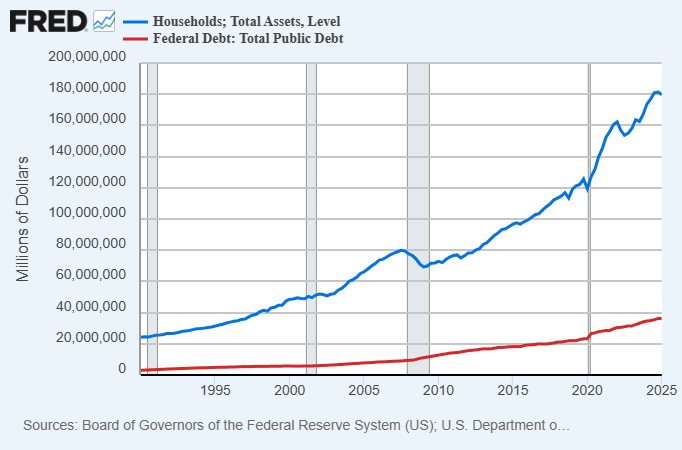
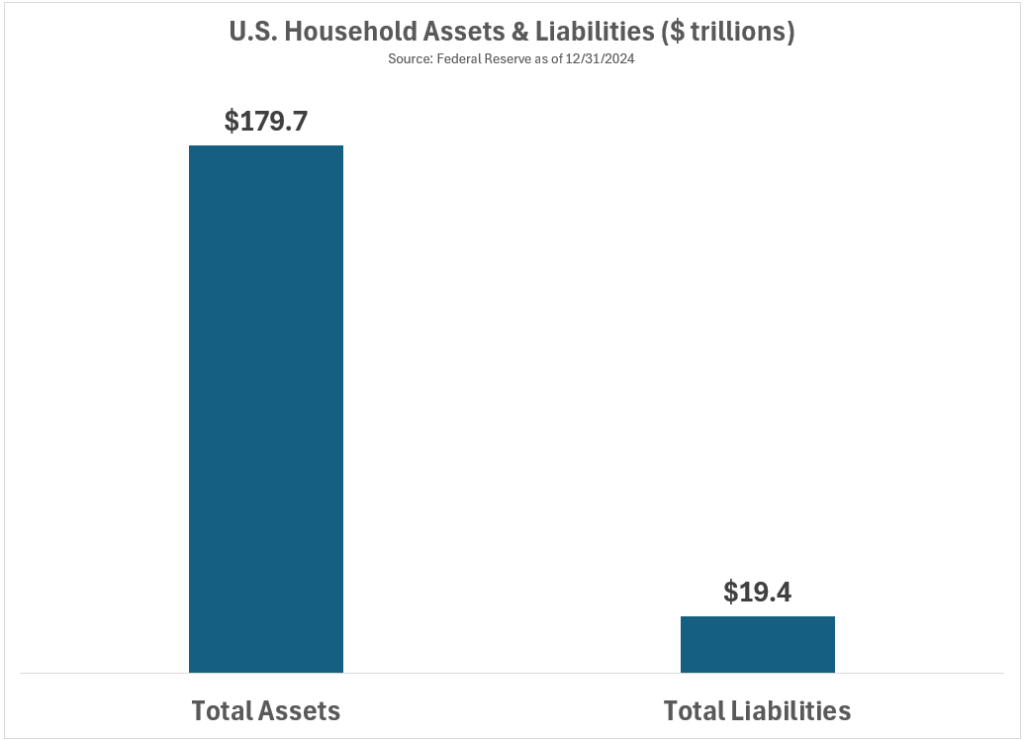
The federal government has a bit over $36 trillion in debt. To put that in context, US households collectively have $180 trillion in assets, or $160 trillion in net worth after liabilities (mostly mortgages) are subtracted.

The US monetary base is about $6 trillion. There is over $120 trillion worth of dollar-denominated loans and bonds outstanding in total (public and private, domestic and international, excluding derivatives). In the foreign sector alone, there is about $18 trillion worth of dollar-denominated debt. What this means is that there is an incredibly large amount of inflexible demand for dollars domestically and throughout the world. Everyone who owes dollars, needs dollars.

When a country like Turkey or Argentina hyper-inflates or nearly-so, it’s in a context where practically nobody outside of their country needs their lira or pesos. There’s no entrenched demand for their currency. And so, if their currency becomes undesirable for any reason (usually due to rapid money supply growth), it’s very easy to just repudiate it and send its value to Hades.

Countless specific entities around the world contractually owe countless other specific entities around the world a certain number of dollars by a certain date in time, and thus need to constantly try to get their hands on dollars. The fact that they collectively owe more dollars than there are base dollars in existence is important. That’s why the monetary base can double, triple, or more, and not be outright hyper-inflationary. It’s still a small increase relative to how much contractual demand there is for dollars. When outstanding debt greatly exceeds the number of base units, it takes a ton of printing of base units to render that base unit worthless.

Suppose that bond yields break out to the point of rendering banks insolvent or the Treasury market acutely illiquid. The Fed can step in with QE or yield suppression. Yes, that comes with the cost of potential price inflation and has implications for asset prices, but no, it’s not hyper-inflationary in this context.

____________________________

Think Twice Before You Click Unsubscribe On An Email:

  • Clicking “unsubscribe” in emails can lead to malicious websites testing if your email is active.
  • Criminals can build a files on users who click unsubscribe links, hoping to eventually extort money through scams.
  • Use list-unsubscribe headers, mark emails as spam or use disposable email addresses for online sign-ups.

____________________________

Cannabis use among seniors surged 46% in the last two years; 7% of adults 65 and older now report recent use. This rise isn’t just in numbers but also in diversity older users today are more likely to be women, college-educated, and higher-income. Researchers suggest legalization and growing social acceptance are contributing factors, especially in states with medical marijuana laws. The trend is especially notable among those with chronic illnesses, raising both opportunities and concerns for medical professionals trying to balance symptom relief with the complexities of aging.

_____________________________

College Baseball Has a Power Problem: Players Keep Hitting the Ball Too Hard: In the big leagues, only superstars like Aaron Judge can routinely crush the ball at speeds in excess of 115 mph. In college baseball these days, everybody’s doing it.

  • College baseball is seeing unprecedented exit velocities, rivaling and sometimes exceeding those in Major League Baseball.
  • College players are 42% more likely to hit balls at 115 mph or harder than MLB players.
  • The reasons for the surge in exit velocity aren’t entirely clear, but it’s creating safety concerns for pitchers, infielders or with fans sitting in the stands

___________________________

Nerds is on track to hit more than $900 million in sales this year, a more than 1,700% increase from the $50 million in sales in 2018. The unprecedented surge is directly attributed to the widely popular Nerds Gummy Clusters, which represented the first meaningful innovation for the once-sleepy brand in years. Nerds Gummy Clusters are now the top sugar confection on the market, overtaking skittles.

_____________________________

Older people will remember the time when there was – for a while – a discussion about how the US stock market had significantly higher returns overnight when the market was closed vs. the actual trading day. Those were the innocent days of an era long gone, aka 2018, when we were all naïve and enthralled by a bull market that couldn’t be derailed by anything. The graph below shows the “overnight effect” through January 2018:

This effect was so promising that it even led to the launch of an ETF in June 2022 that focused on this trade. A product that was so successful that it was liquidated in August 2023. 

A new study shows that the effect disappeared after the pandemic. What makes the study interesting, though, is that they seem to find why the effect existed in the US (and not other countries) in the first place: Hype.

They noticed that stocks with large trading volume just after markets opened were the main driver of the overnight effect. For the uninitiated, trading volumes are heavily concentrated during the last hour of the day. Institutional investors typically want to trade when liquidity is highest which means they tend to wait until the end of a trading day to execute their orders. This becomes a self-fulfilling prophecy. Because big institutions focus their trading on the last hour of the day, this is where volume is highest and this is when other institutions want to trade in the future as well.

________________________

The number of paying Tinder users has dwindled to just 9.1 million in its most recent quarter — down 18% from a peak of 11.1 million in late 2022. While Tinder remains Match Group’s biggest brand, Hinge, another dating app under the Match umbrella, saw paying users grow 19% year over year in Q1 2025.

Double Date, a feature that allows pairs of users to match with other pairs, is now available on Tinder in the US, with a global rollout planned for July. So far, the results seem hopeful: after first trialing the feature in a handful of European countries, Tinder reported that women were 3x more likely to “like” a pair than an individual profile, and that nearly 90% of Double Date profiles came from users under 29.

Trade, Jobs, Saunas & Music

Lyn Alden delivered an absolutely masterful letter this month, offering deep insights on U.S. trade, deficits, and their impact on asset prices.

Many people assume that the trade deficit works like this: Americans send slips of paper to the rest of the world, and the rest of the world sends us real good and services. That sounds like a pretty sweet deal for Americans, right? The problem is that this common description misses the next step. What does the rest of the world do with that paper (or more realistically, electronic digits) that they receive?

The answer is that they buy American assets, including stocks, bonds, private equity, and real estate. Stocks and bonds represent the bulk of what they buy. As a result, over time foreigners own a larger and larger share of US stocks in particular. So, in practice we are not selling worthless papers for real goods and services. We are selling stakes in our valuable appreciating capital assets to buy depreciating goods and services.

That asset accumulation by the wealthier parts of the foreign sector is what gives them a lot of ammo to hurt US markets when they run into dollar shortages. They’ve got a big stockpile of assets that they can sell to get dollars, and they own increasing shares of our companies’ dividend payments and voting rights.

_____________________________________

Labor conditions for recent college graduates have “deteriorated noticeably” in the past few months, and the unemployment rate now stands at an unusually high 5.8 percent. Even newly minted M.B.A.s from elite programs are struggling to find work. Law-school applications are surging—an ominous echo of when young people used graduate school to bunker down during the great financial crisis. What’s going on? I see three plausible explanations, and each might be a little bit true:

  1. The labor market for young people never fully recovered from the coronavirus pandemic—or even, arguably, from the Great Recession.
  2. College doesn’t confer the same labor advantages that it did 15 years ago.
  3. There are early signs that artificial intelligence is starting to transform the economy.

When you think from first principles about what generative AI can do, and what jobs it can replace, it’s the kind of things that young college grads have done” in white-collar firms. They read and synthesize information and data. They produce reports and presentations.

Today’s college graduates are entering an economy that is relatively worse for young college grads than any month on record, going back at least four decades.

____________________________________

More on the World Happiness Report for 2025 from a reporter who went to see what was happening in Finland, the country that has ranked highest in happiness for 8 consecutive years.

The first World Happiness Report, summarizing the state of its research, drew a distinction between two concepts: “affective happiness” and “evaluative happiness.” Affective happiness captures emotions, immediate responses to events, whether we are experiencing joy or sadness at one moment or another. Evaluative happiness is a more contemplative or systemic matter, mapping a person’s overall appraisal of life and whether they are satisfied with theirs. Affective happiness is the realm of laughter, fun, picnics, parties, sex. Evaluative happiness is tied to good health, sufficient income, social cohesion, safety.

A crude synonym for evaluative happiness — and so much of this research flounders on the crudeness of synonyms! — would be “contentment.” That is what the Cantril Ladder measures, and it should surprise no one that the Nordic countries, with their long life expectancies, highly redistributive tax regimens, functional governance, low corruption and shared norms land at the top of the charts. The type of happiness that tourists go to Finland to find isn’t even the sort of happiness the country is accused of possessing.

A second area of confusion is that the two concepts of happiness, affective and evaluative, can operate independent of each other. A woman in the midst of extruding a baby might suffer from labor pains (low affective happiness) but feel profoundly satisfied or purposeful (high evaluative happiness). The “happiest country in the world” label seems to imprint on the American mind as a never-ending carousel of delights, but in Finland’s February chill, the reality is more modest.

At home in Brooklyn, the library is papered with reminders to “Please keep your voice down.” In contradistinction, the signs at Oodi said, “Please let others work in peace!” The two commands are almost — but meaningfully not — synonymous. The Brooklyn version is a plea for self-control. The Finnish version is a request to acknowledge the existence of other people. You see the difference.

A friend called and I rambled about my sorrow at watching the Finnish children rove and play, and told her about how mothers of all ages gathered spontaneously in the library to chat or rest or idly massage their feet. I explained that one of these mothers had placed her baby, a child of no more than 9 months, in a highchair at a library cafe table and handed him a vegetable purée to consider, then left for 20 minutes to fetch books. When the mother returned she told me, “every few years there’s a crisis where a baby is stolen but then it is returned or found 15 minutes later. Nothing severe.”

All government buildings in Finland have a sauna on-site. Nationwide, there is more than one sauna for every two Finns. In Finland, sauna is not a means to an end. It will not make a person richer or more attractive or more focused. The point is not to sweat out “toxins,” though that may occur — I’m not a scientist. The point seems to be the act itself: sitting in nude serenity among family, friends and strangers, safe in the bone-deep sense of trust that such an idyll both requires and reinforces.

____________________________________

The internet has caused a Cambrian explosion of creative expression by allowing artists to execute and distribute their visions with unprecedented ease. More than 500 scripted TV shows get made every year; streaming services reportedly add about 100,000 songs every day. We have podcasts that cater to every niche passion and video games of novelistic sophistication. Technology companies like to say that they’ve democratized the arts, enabling exciting collisions of ideas from unlikely talents. Yet no one seems very happy about the results.

The problem is particularly acute in music. In 2024, new releases accounted for a little more than a quarter of the albums consumed in the U.S.; every year, a greater and greater percentage of the albums streamed online is “catalog music,” meaning it is at least 18 months old. Hoping to remonetize the classics, record labels and private-equity firms have spent billions of dollars to acquire artists’ publishing rights. 

Music is turning into a rights-management business. There are vested interests now that don’t want new music to flourish. The private-equity funds just want you to listen to the same songs over and over again, because they own them. The ultimate effect, he thinks, is to discourage true, daring artistry. If Bach were alive today, he’d spend a few weeks trying to break into the L.A. music scene and say, ‘Ah, I’ll be a hedge-fund manager instead.’

__________________________________

Morgan Housel put together a list of questions we should probably be asking ourselves, like:

  • Who do I envy that is actually less happy than I am?
  • How much have things outside of my control contributed to things I take credit for?
  • Which of my strongest beliefs are formed on second-hand information vs. first-hand experience?
  • If I could not compare myself to anyone else, how would I define a good life?
  • Which future memory am I creating right now, and will I be proud to own it?
  • What kind of lifestyle would I live if no one other than my immediate family could see it?
  • How much of what I do is internal benchmark (makes me happy) vs. external benchmark (I think it changes what other people think of me)?

____________________________________

The Global Flourishing Study, based on a survey undertaken by a consortium of institutions including my Harvard colleagues at the Human Flourishing Program. This survey also uses self-reporting, but it collects much more comprehensive data on well-being, in about half a dozen distinct dimensions and in 22 countries, from more than 200,000 individuals whom it follows over five years.

What does it show? A decline in the happiness of young people, and although young people’s emotional and psychological distress is more pronounced in wealthy, industrialized nations such as the United States, it is occurring across the world.

Scholars have long noted that happiness tends to follow a U-shape across the lifespan: Self-reported happiness declines gradually in young and middle adulthood, then turns upward later in life, starting around age 50.

But that has changed. The flourishing scores don’t fall from early adulthood, because they now start low; they stay low until they start to rise at the expected age later in life.

That’s the bad news, which is plenty bad. But there is some good news. The flourishing survey discovers one notable exception to this global pattern: a more traditional U-shaped curve among those young people who have more friends and intimate social relationships.

___________________________

This week, U.S. GDP data for the first quarter of 2025 (January through March) was released. The data showed that the U.S. economy shrank at an annualized rate of 0.3%, but almost every economics journalist and columnist reported that this decline was due to a surge of imports, as American companies rushed to stock up on foreign-made goods ahead of Trump’s tariffs. This is incorrect.

GDP is a measurement of everything produced within a country’s borders. Imports are produced outside a country’s borders. So imports don’t add to or subtract from GDP. Imports simply aren’t counted in GDP at all.

Suppose an American buys a TV made in China for $1000. Remember that GDP can be calculated as the sum of consumption, investment, government purchases, and net exports:

GDP = Consumption + Investment + Government Purchases + Net Exports

When the American buys the $1000 TV from China, U.S. consumption goes up by $1000. And U.S. net exports go down by $1000, since “net exports” means exports minus imports. The increase in consumption exactly cancels out the fall in net exports. So the total contribution of the imported TV to U.S. GDP is zero.

Let’s take another example, which is more like what actually happened in Q1. Suppose an American company, Best Buy, decides to buy a Chinese TV and put it in a warehouse, because it knows that tariffs are coming soon. That purchase counts as inventory investment. So investment goes up by $1000. And just like in the previous example, net exports go down by $1000. The two cancel out, and the total contribution of the imported TV to U.S. GDP is zero.

Here’s a simple analogy: Does putting on shoes make you lose weight? No, it doesn’t. And yet when you weigh yourself with your shoes on at the doctor’s office, and you want to know your actual body weight, you subtract the weight of your shoes afterwards. Imports are to GDP what shoes are to your weight on the scale at the doctor’s office — just something superfluous that gets added in for the sake of measurement convenience, and which has to be netted out again later to get the true number.

_____________________________________

____________________________________

Horror movies are having a good year:

Fiscal Dominance, Premortems & Waking Up Early

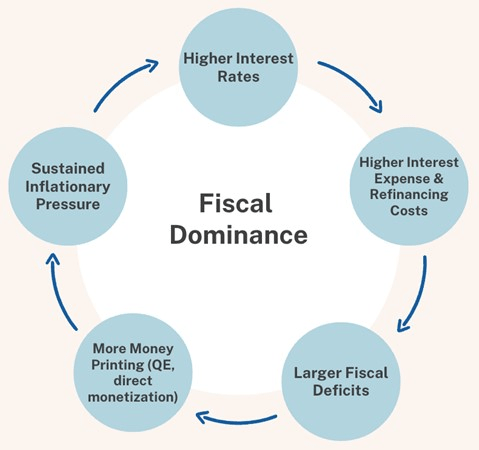
Lyn Alden just released an absolute masterpiece of a newsletter on Fiscal Dominance and the impact it will continue to have on the economy and financial markets moving forward. She walks through:

  • What fiscal dominance is and how we got here
  • Why government spending is now more important than bank/private sector lending
  • Why central bank tools become ineffective at combating inflation in this new environment
  • Why DOGE will fail to reach its goals on cutting government spending
  • Why the stock market, not labor markets, have become the dominant driver of tax revenues
  • What to own/invest in to navigate the through the years ahead

___________________________

A phenomenal Q&A with Russell Napier, market strategist and historian, discussing how the global economy and financial markets will look in the months and years ahead.

___________________________

Forget about making a New Year’s resolution. Have you tried imagining your deathbed? It’s called a Premortem. It’s a habit that began for Ron as a response to the death of his parents in the 1990s. His mother was at peace with herself when she died, he says. But his father was “racked with regret and remorse” about decisions he made and the opportunities he missed. What he took away from their experiences was the last lesson that his parents would teach him—and the most profound of them all. Don’t wait until the end to decide if you are proud of your life. Do it before it’s too late. Do it while you can still do something about it. To him, there is nothing macabre or even remotely depressing about ruminating on death. In fact, he finds it to be oddly inspiring. 

______________________________

There’s one particular, very achievable commitment in mind that will help you become happier and improve your health and effectiveness: This year, start getting up early.

  • Our brain exhibits greater functional connectivity in the mornings. This, we might assume, facilitates better performance of complex tasks.
  • It tends to enable the achievement of other popular goals. The goal-directed brain regions—such as the hippocampus and orbitofrontal cortex—work better at this time than later in the day.
  • One habit that is easier to adopt first thing in the morning is exercise. Clear data exist to show that when people intend to exercise early in the day, they are significantly less likely to experience “intention failure” than if they plan to exercise later.
  • People who get up early enjoy a more positive mood throughout the day compared with those who rise late.

______________________________

All the major Wall Street brokerage and bank strategists failed to anticipate how well the market would do in 2024. Only part of the problem is that they are bad at predictions; the bigger issue is that they do it all. It’s kinda like Phrenology, the pseudoscience feeling bumps on people’s skull to predict their personality traits. It’s not that there are better or worse phrenologists, but rather, why was anyone doing phrenology? Think about how variable the future is. Random events can and will completely derail the best laid plans we may make. Even the most well-ordered, thoughtful forecasts turn to mush when randomness strikes. And randomness is served up daily.

____________________________________

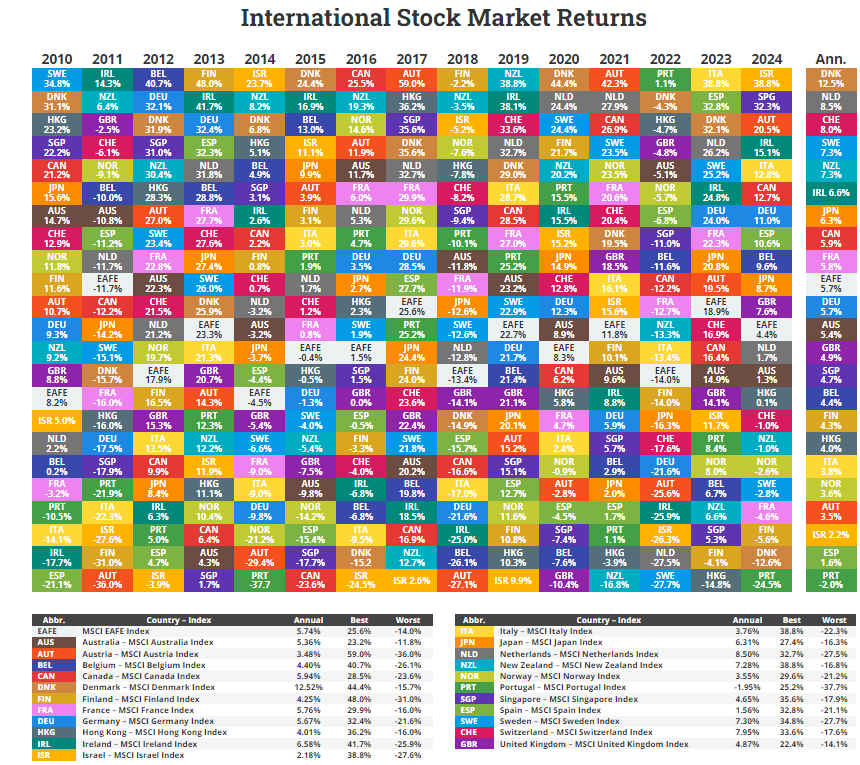
It’s a big world out there. The U.S. makes up a little less than half of the global market cap. By avoiding international stock markets, you cut out half of the investment opportunities. Why limit yourself?

The chart below breaks down the annual performance of developed international stock markets. Each country’s performance seems to bounce around at random year after year, but over the long term those returns smooth out. While it’s difficult to pick the best performing country every year, a diversified global portfolio offers the benefits of international stock market performance which in turn lowers risk.

________________________________

Zooming out to all asset classes, U.S. stocks crushed everything in 2024, as they have for the last 15 years: