Loneliness, Doctors & Notes From Books

What afflicts America’s young today can’t be properly called a loneliness crisis. It seems more to me like an absence-of-loneliness crisis. It is a being-constantly-alone-and-not-even-thinking-that’s-a-problem crisis. Americans—and young men, especially—are choosing to spend historic gobs of time by themselves without feeling the internal cue to go be with other people, because it has simply gotten too pleasurable to exist without them. The problem is not loneliness. The problem is that we’ve forgotten how to feel lonely in the first place.

Since the 1970s, America has over-regulated the physical world and under-regulated the digital space. To open a daycare, build an apartment, or start a factory requires lawyers, permits, and years of compliance. To open a casino app or launch a speculative token requires a credit card and a few clicks. We made it hard to build physical-world communities and easy to build online casinos. The state that once poured concrete for public parks now licenses gambling platforms. The country that regulates a lemonade stand will let an 18-year-old day-trade options on his phone.

In short: The first half of the twentieth century was about mastering the physical world, the first half of the twenty-first has been about escaping it.

_____________________________

As part of a larger project, an author read 102 books over the past twelve-and-a-half months. Here were some of the insights he took away:

  • Exercising regularly is probably the single best thing you can do for your health. (Outside of quitting smoking.)
  • Happiness, not stress, leads to productivity.
  • Despite our preconceptions, we may be happier at work than at home. People experience more flow at work than in leisure.
  • Energy, not time, is the limited resource in our ability to be productive.
  • You can’t beat the market. Nearly everyone is better off simply buying a diversified low-cost index fund. Neither can any fund you invest in. The percentage of funds that beat the market after fees is so low that you can round it to zero.
  • You can’t time the market. Frequent trades expose you to taxes and whittle away your capital on fees. Buy and hold is better.
  • If you need an advisor, find someone who charges hourly. Paying a percentage of your assets seems cheaper, but the cost is enormous in the long-run.
  • We’re overweight because we eat too much. The increase in calories consumed is enough to entirely explain the change in body mass. Successful weight loss requires you to stick to a dietary pattern forever. The weight will always come back the moment you stop.
  • Loneliness is as bad for your health as smoking cigarettes. The stress of loneliness weakens our immune system.
  • There are numerous explanations for the increase in time alone, but a simple one is just better entertainment options available. 
  • Sleep serves many important functions. It flushes the brain of metabolic byproducts, consolidates memories, reinforces the immune system and recalibrates synaptic connections.
  • If you have insomnia, don’t worry, you probably are sleeping enough. If you’re sleep deprived you will fall asleep, so despite feeling cranky and low energy, most insomniacs are not actually sleep deprived.
  • Asking yourself “what went well?” at the end of the day can give you a big boost to your happiness.
  • ADHD is about as heritable as height, is not caused by parenting style, doesn’t go away as you age and, despite popular disbelief, medication works pretty well.

102 Lessons From Reading 102 Books

___________________________

Why do doctors now seem so rushed and dismissive? You wait 45 minutes in the exam room when the doctor finally walks in. They seem rushed. A few questions, a quick exam, a glance at the clock and then a rapid-fire plan with little time for discussion – and you leave feeling unheard, hurried and frustrated.

Increasingly, health care organizations and physician groups face intense financial pressures. Many doctors can no longer sustain their private practice due to declining reimbursements, rising costs and increasing administrative burdens; instead, they’ve become employees of larger health care systems. In some cases, their practices have been acquired by private equity groups.

With this shift, doctors have less control over their workloads and the time they get with their patients. More and more, payment models fail to cover the true cost of care. The default solution is often for doctors to see more patients with less time for each, and to squeeze in additional work after hours.

That negative, impolite tone you may have experienced might be because the doctor has many patients waiting and a full evening ahead just to catch up on writing visit notes, reviewing medical records and completing other required documentation. During the work day, they’re often fielding over 100 messages and alerts daily, including referrals and coordinating care, all while trying to focus on the patient in front of them.

________________________________

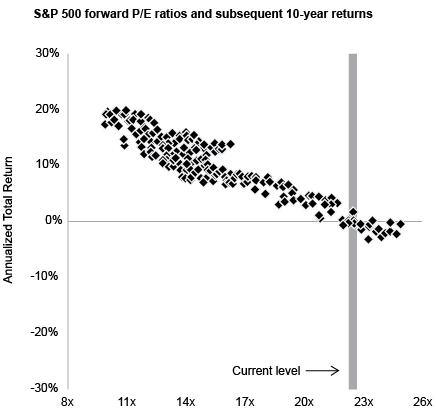
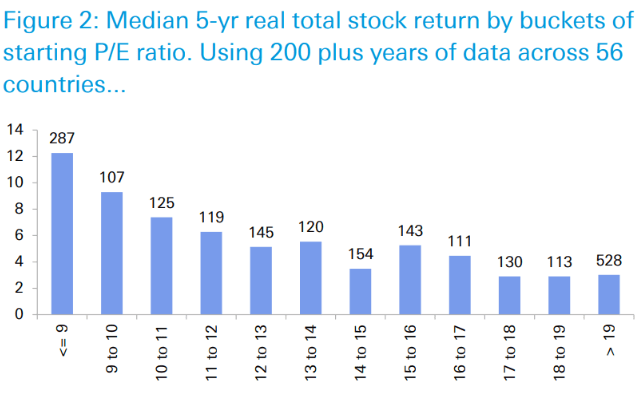
200 years of data across 56 countries, showing 25-year and 5-year returns from different starting P/E ratios (the price of a stock dividend by its earnings). The takeaway? Even over relatively short periods like five years, valuations matter a lot. If you buy when stocks are expensive they tend to do worse than when you buy them cheap.

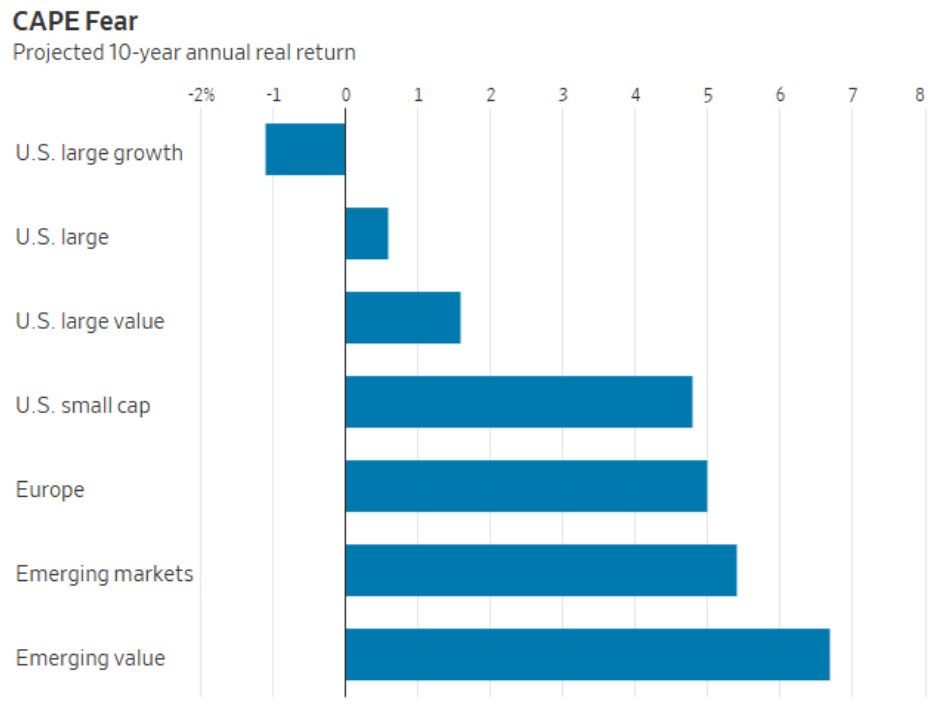
Here are the forecasts for different categories of stocks over the coming decade based on their current valuations:
Anti-Social, Bubbles & Walking

Derek Thompson wrote a great article this week called The Anti-Social Century: Americans are now spending more time alone than ever. It’s changing our personalities, our politics, and even our relationship to reality. He also released a podcast episode discussing the article.

  • Men who watch television now spend 7 hours in front of the TV for every 1 hour they spend hanging out with somebody outside their home.
  • The typical female pet owner spends more time actively engaged with her pet than she spends in face-to-face contact with friends of her own species.
  • From the late 1970s to the late 1990s, the frequency of hosting friends for parties, games, dinners, and so on declined by 45%, then it got worse. Between the early 2000s and the latest data, the average amount of time that Americans spent hosting or attending social events declined another 32%.
  • A 5-percentage-point increase in alone time is associated with about the same decline in life satisfaction as was a 10% lower household income.
  • From 1965 to 1995, the typical adult gained 6 weekly hours in leisure time. They funneled almost all of it into one activity: watching TV.
  • In 1970, just 6 percent of sixth graders had a TV set in their bedroom; in 1999, that proportion had grown to 77 percent.
  • The share of boys and girls who say they meet up with friends almost daily outside school hours has declined by nearly 50 percent since the early 1990s.
  • Today’s adults spend an additional 99 minutes inside their homes on any given day, compared with 2003.
  • The share of U.S. adults having dinner or drinks with friends outside the home on any given night has declined by more than 30% in the past 20 years.
  • Restaurants used to be the ultimate “social” business. But today, just one-quarter of restaurant traffic is “on-premises”—that is, sitting, ordering, talking with people at a table. With the rise and rise of delivery 74% of all restaurant traffic now comes from “off premises” customers—takeout and delivery. And solo dining has increased by 29% in just the past two years. The top reason given? The need for more “me time.”

_____________________________

Gen Z spends an average of 109 days per year looking at a screen. Eighty percent of our waking hours are spent consuming information, up from 40% in 1980.

_____________________________

Do You Even Maxx Bro? Chewing-gum workouts for sharper jawlines. Specialty products for feathered bangs. So. Much. Cologne. Exploring the extreme self-care trends shaping a generation of young men.

In the past, I might have tuned out a very online trend like looksmaxxing, but I regret to inform you that we can’t skip this one. Because looksmaxxing might be the key to understanding Gen Z and Gen Alpha behavior, knowing where they’re headed, and, frankly, answering a larger question you’ve definitely thought about: Are young men okay?

Someone unexpected has emerged as an unlikely Gen Alpha role model: American Psycho’s Patrick Bateman, the yoked killer from the 1991 Bret Easton Ellis novel, memorably played by Christian Bale (and his cheekbones) in the film. In forums on Reddit , looksmaxxers have coalesced around Bateman, whose well-moisturized face has become an extremely popular profile pic for self-described “sigmas,” a Gen Alpha term for independent men who prioritize power, class, and self-control, known to attract beautiful women aroused by their bank accounts.

As Bateman says in the film: “You can always be thinner…look better.” For many, that starts with “mewing,” a non-medical technique that involves pressing your tongue to the roof of your mouth to reshape your jawline. Men now receive ads for Jawliner gum, part of a new category of fitness chewing gums, which is 10 times harder to chew than a standard piece and is designed to tone the masseter muscles in their face. Terms like brotox have made their way into professional conversations, and more men have been seeking jawline-enhancing procedures.

____________________________

Great newsletter from Howard Markets this month discussing bubbles and valuations in the market using historical examples from his decades of experience in the financial industry (started in 1969). Some highlights:

  • In bubbles, investors treat the leading companies—and pay for their stocks—as though the firms are sure to remain leaders for decades. Some do and some don’t, but change seems to be more the rule than persistence.

My early brush with a genuine bubble caused me to formulate some guiding principles that carried me through the next 50-odd years:

  • It’s not what you buy, it’s what you pay that counts.
  • Good investing doesn’t come from buying good things, but from buying things well.
  • There’s no asset so good that it can’t become overpriced and thus dangerous, and there are few assets so bad that they can’t get cheap enough to be a bargain.

________________________________

Studies continue to show that any type of movement (even just taking a simple walk) can be extremely beneficial for mental health.

  • Researchers analyzed 33 studies examining the movements of nearly 100,000 adults using smartphones, pedometers and other fitness trackers. Those who clocked more daily steps were less likely to report depressive symptoms or be diagnosed with the condition than those who walked less.
  • Participants ranged in age from 18 to 91 years old and lived in 13 different countries. Those who logged at least 5,000 or more daily steps were less likely to experience depressive symptoms, with the greatest effect coming for those who logged more than 7,500 steps a day — they were 42% less likely to suffer depressive symptoms.
  • A subset of studies included in the meta-analysis found that for every 1,000 daily step increase, adults reduced their risk of developing depression by 9%.
  • The message is very consistent: more is better, and some is better than none.

______________________________

An in-depth report from Reuters on the origins of OnlyFans and how it turned into one of the most profitable businesses in the world.

  • Created in 2016, OnlyFans has paid out over $20 billion to its creators, who now number 4.1 million. The company takes a 20% cut of creators’ revenue.
  • In 2023 alone, content creators generated $6.6 billion on the platform that has over 300 million users
  • Its dividend payout of $472 million to the owner was more than Ralph Lauren earned from the fashion company he founded, and Nike co-founder Phil Knight earned from the sportswear giant – combined.

_______________________________

While no one is ever going to feel bad for someone that co-founded a company and sold it for $975 million, Vinay Hiremath wrote a blog post this week titled: “I Am Rich & Have No Idea What To Do With Myself.” After selling the company he found himself lost, depressed and breaking up with what sounds like an amazing girlfriend that loved him. He just booked a ticket to Hawaii to do some soul searching (again, no one is going to feel bad for him), and is asking himself:

  • Why couldn’t I just leave Loom and say “I don’t know what I want to do next”?
  • Why do I feel the need to only be on a journey if it’s grand?
  • What is wrong with being insignificant?

It’s an introspective look into someone’s open, honest mind providing another example that money solves a lot of problems, but it can’t solve all of them. Most of the time people seem to end up less happy at the destination than they were along the journey to get there.

_________________________________