Ovarian cancer is a misnomer. Nearly all ovarian cancers, and nearly all fatal ovarian cancers, are actually cancers of the fallopian tubes. The 20 percent or so that start in the ovaries are different, and usually can be cured.
Women who have their tubes (the gummy worm-shaped ducts that carry eggs from the ovaries to the uterus) removed reduce their chances of getting ovarian cancer by nearly 80 percent. It’s a five-minute operation that can be done as part of nearly any abdominal surgery, including a hysterectomy, tubal ligation, gallbladder surgery and hernia repair.
Most doctors (and the public) do not know about this new approach, even though professional groups like the American Cancer Society, the American College of Surgeons and the European Society of Gynaecological Oncology have recently issued statements encouraging doctors to offer tube removal at the time of other abdominal surgeries.
The American Cancer Society is now working on a national campaign to make more women and doctors aware that tube removal can help prevent most ovarian cancers.
Women have, on average, a 1.1 percent risk of being diagnosed with ovarian cancer, among the most deadly of all cancers. Screening to find it early does not work (death rates do not budge). Ultrasound, blood tests and advanced imaging have all failed. And most of the 20,000 women a year who receive a diagnosis of ovarian cancer have no known risk factors. By the time they find out why they have vague symptoms like bloating and abdominal pain, the cancer has spread throughout their bodies. Surgery and chemotherapy, the standard treatments, are unlikely to cure them.
The tumors start as microscopic specks of cancer cells that spill out of the wide end of the fallopian tube that is nestled against an ovary. They seed the ovary and abdomen, where they grow and become lethal. You can liken these tiny cancer cells to dust coming up from a rug and floating through a room. They’re like dandruff drifting down to a person’s shoulders.

_______________________
There are now 1,000+ publicly accessible padel courts in the U.S., up from about 227 three years ago. Last year, padel drew one million players domestically and, padel club and individual memberships grew by about 50 percent year-over-year.
Padel is mostly played as doubles, and courts are smaller than tennis courts, making it more social and easier to get to know other players.

Across the country, entrepreneurs are capitalizing on the interest by retrofitting unconventional spaces, from parking lots to distribution warehouses, with padel courts. On the sidelines of some are saunas and bars where players can mingle between matches.

Last year, over 24 million Americans played pickleball, up from about 4 million in 2020. Investors believe padel has the potential to grow like pickleball, but the cost to install one padel court can be around $50,000 because of the glass and other materials for the walls. Pickleball courts are much cheaper to build.
Instead of strings, padel rackets have holes in their dense heads. Padel balls share a color with tennis balls, but are less bouncy. The sport’s rectangular courts are 66-feet long by 33-feet wide, divided by a net and surrounded by four walls made of glass panels and mesh.
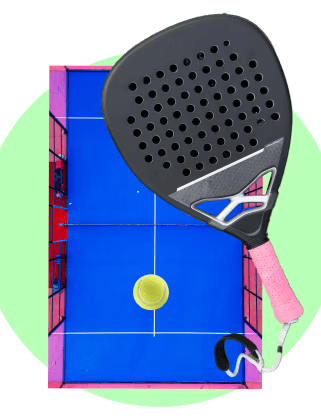
Playing singles tennis is still the best exercise, but padel doubles provides more exercise than tennis doubles.

_______________________
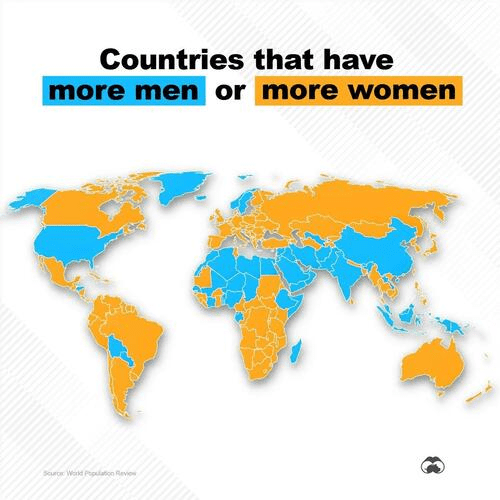
Of the 233 countries and territories in the dataset, men outnumber women in just 33%. Despite the smaller number of male-majority countries, there are roughly 42 million more men than women worldwide.
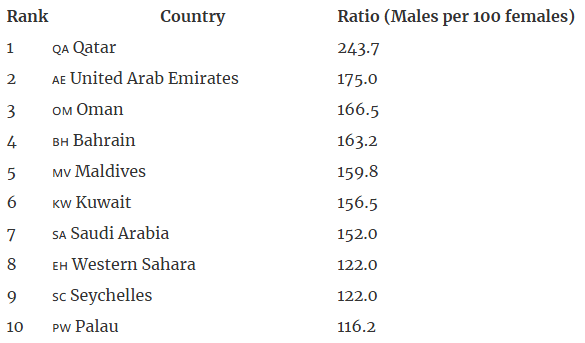
There are two main reasons for this.
- The Gulf states are the clearest outliers. Countries such as Qatar, the UAE, Oman, and Kuwait rely heavily on temporary migrant workers employed in construction, energy, and infrastructure, industries dominated by men. Because many of these workers arrive without their families, national gender balances become unusually skewed.
- Three of the world’s most populous countries, China, India, and the United States, all have more men than women. Although their ratios are less extreme, their large populations magnify the difference. In India alone, a ratio of 106.3 men per 100 women translates into a male surplus of more than 40 million.
Countries with more women:

Russia offers one of the region’s most prominent examples. Higher male mortality, shorter male life expectancy, historical wartime losses, and alcohol-related deaths all contribute to its ratio of 86.4 men per 100 women.
Sex ratios at birth naturally favor boys by a small margin, but populations rarely maintain that balance. Migration, life expectancy, war, public health, and economic opportunity can all reshape a country’s demographic profile over decades.
As these forces evolve, the map represents a snapshot rather than a permanent reality. Countries experiencing rapid immigration, population aging, conflict, or major improvements in healthcare may see their gender balance shift substantially from one generation to the next.
__________________________
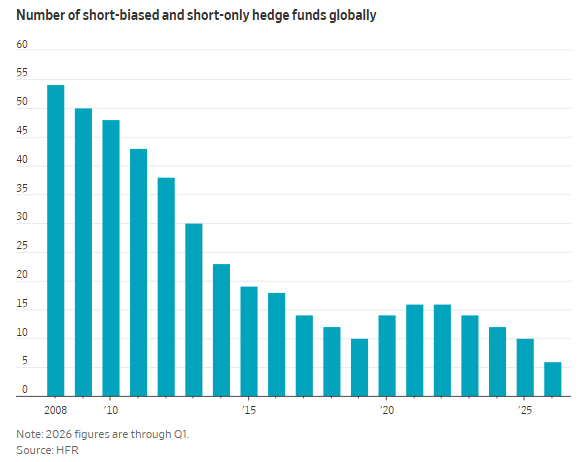
Hedge funds that are short-biased or short-only surged after the 2008 downturn, and they are slowly disappearing as the U.S. bull market in stocks extends toward its 18th year.
_______________________
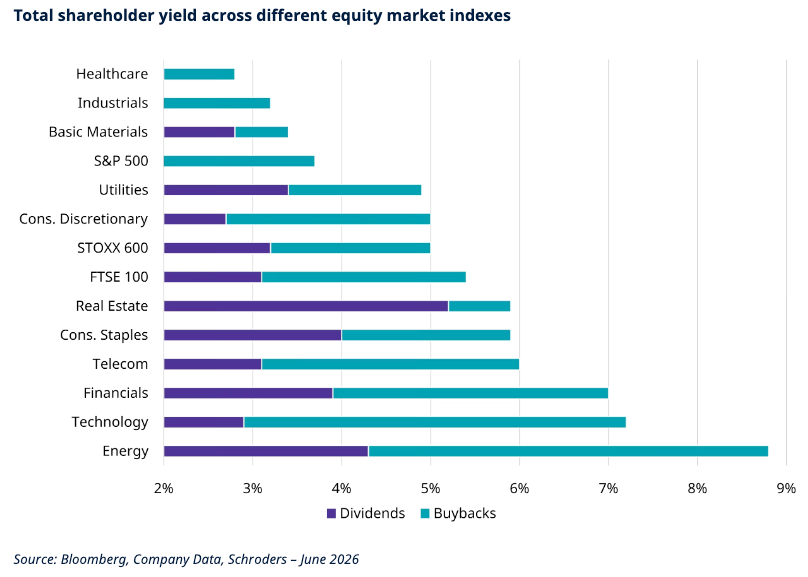
Shareholder Yield = the total cash a company returns to its investors (stockholders).
This occurs through three main factors: (1) dividends (2) net stock buybacks; repurchases minus newly issues shares (3) net debt reduction.