A boy once asked Charlie Munger, “What advice do you have for someone like me to succeed in life?” Munger replied: “Don’t do cocaine. Don’t race trains to the track. And avoid all AIDS situations.” It’s often hard to know what will bring joy but easy to spot what will bring misery. When trying to get ahead it can be helpful to flip things around, focusing on how to not fall back. Here are a few pieces of very bad advice:
- Allow your expectations to grow faster than your income
- Envy others’ success without having a full picture of their lives.
- Mimic the strategy of people who want something different than you do.
- Automatically associate wealth with wisdom.
- Assume a new dopamine hit is a good indication of long-term joy.
- Assume people care where you went to school after age 25.
- Assume that what people can communicate is 100% of what they know or believe.
__________________________
- More effort = more reward
- More time = more progress

But real learning doesn’t usually follow that path. Instead, we often hit long plateaus, followed by sudden breakthroughs.

If we’re expecting constant progress, those plateaus can feel like failure. But they’re not failure. They’re part of the process.

This is where a lot of people give up. When you’ve been practicing, trying, doing the work, and it feels like nothing’s happening, it’s tempting to walk away.

But you may be much closer to a breakthrough than you think. Sometimes, just around the corner, something clicks—and you’re suddenly at the next level.

It’s not always a flat line before a breakthrough. Sometimes you make slow, steady gains. Sometimes it feels like you’re backsliding. Sometimes it gets messier before it gets clearer. But underneath the surface, your brain is making connections. Your understanding is deepening. The dots are starting to line up. Eventually, that invisible progress becomes visible.

__________________________
There is a reason why people find the financial markets endlessly fascinating. They haven’t been solved. The complexity of markets is dizzying, and in complex situations even the iron laws of physics can produce surprising, unstable results (think of airplane turbulence). More important still, finance is ultimately driven by people, not particles, and they do not always respond to similar stimuli in similar ways. They look at what happened last time, try to do better, anticipate what other traders will do and seek to outfox them. The absence of fundamental laws in markets is frustrating, disorientating—and what makes them so interesting.
There is certainly plenty to learn about the markets. But there is a case for learning as much as you can about finance and the markets and then easing back. There’s this weird dynamic in personal finance where you have to go deep at first. You need to learn enough to protect yourself. To build a plan. To avoid getting fleeced. But once that plan is in place, ideally you should be able to step back.
Check in once a year. Rebalance when necessary. And focus on everything else in life that matters more than your asset allocation. But here’s the problem: after doing all that work, learning all those concepts, following all those market narratives… can you actually let go?
__________________________
One of the main reasons people make behavioral mistakes when investing: the power of stories. Humans interpret the world through stories, and financial markets are narrative generating machines. When we make poor investment decisions, they are inevitably deeply intwined with a story we are using to interpret a complex and chaotic environment. It is easy to look at historic financial market events with equanimity because we know how these stories unfolded; it is an entirely different proposition when we are in the midst of an event – because we don’t know how the story will end. So, we make up our own ending and invest accordingly.
__________________________
Modern neuroscience distinguishes between two mental states: one of striving, where a surge of dopamine keeps us laser-focused on external goals like winning, perfection or achievement – and another of serene presence, where we hover in the moment, simply being. In this latter state, our neural chemistry shifts; endogenous opioids and endocannabinoids fill the brain, bringing feelings of deep satisfaction, fulfillment and joy in the now.
Motivation psychologists distinguish these two states as extrinsic and intrinsic motivation for what we’re doing. The former takes hard work and discipline to keep us going. The latter propels us forward, as by magic: flow.
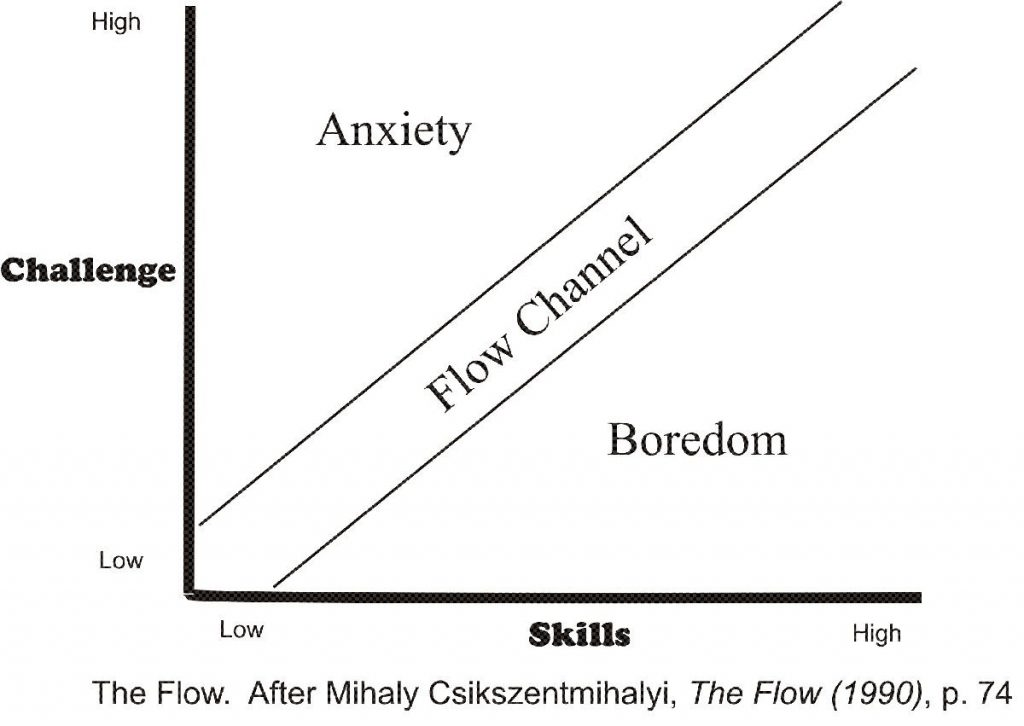
Repetition: the repeated movements of our craft – the physical routines we practice over and over – follow us everywhere. Whether we call it practice or technique, these repeated actions shape our brains in powerful ways, often without us even realizing it.
They form unique connections in the brain – linking movement, memory and emotion. These connections stretch across the parts of the brain that control movement, wrap around the areas responsible for memory, and reach deep into the emotional core of the brain – the limbic system. That includes the insula, a region that helps manage both our physical health and our inner sense of self.
‘Muscle memory’ doesn’t live in our hands or legs. The real control centre is in the brain. This is where movement begins, guided by systems that plan and initiate what we do. From there, messages travel through long chains of nerve cells – from the brain down the spine and out to the rest of the body. Millions of tiny electrical signals, known as action potentials, move back and forth, telling our muscles, organs and even the tips of our fingers what to do next.
The idea is to ‘program’ the right moves in our brain so they become so automatic we can use them to, yes, feel, and to find flow. The prefrontal cortex part of our brain matures last in our individual development, with restructuring continuing well into our 20s. These parts of the brain are very ‘plastic’, meaning that they are easily shaped by experience and learning. So they are also key to the development of technique in our craft – be that in science, the arts or other fields – because they are suited to rule-based learning.
Neuroplasticity is our brain’s capacity to learn; to forge new connections between neural systems, as we practice something with our body. Professional singers and actors do daily vocal exercises, dancers do daily barre exercises – the same moves over and again – and musicians are known for their never-ending scales practice that drives neighbors up the wall. What may seem a strange, repetitive, even boring activity that artists, scientists and other creatives engage in daily is in fact doing magic to their brains.

Repeating something consciously – in this context meaning exercising those prefrontal systems of the brain – is quite effortful, and it needs a lot of energy and attentional resources. Therefore, our brain starts to forge connections that let the movements we’re practicing pass from explicit, effortful memory systems into implicit, almost automatic memory systems.
This works a bit like learning a new language. First, we learn the words, the basic grammar, and we make many mistakes. It is effortful and we have to think before uttering any sentence at all. But as we repeat the words, practice verbal tenses and vocabulary over and over, our brain realizes the repetition and transports the skill of that new language from explicit to implicit memory systems.
That’s why the advice to ‘just let go’, ‘be in the present’ and ‘feel it’ are unhelpful to find flow. When flow happens to you, it may well feel magical, it might feel like you’re ‘letting go’. You feel a strange fusion of your movements and your awareness, and you’re somehow entirely entrapped in the present. It’s still early days to say exactly how this works, but it has to do with those low-level, implicit memory systems that encode movements that we internalize with technique practice. Then, the prefrontal systems deactivate while we let the implicit motor memory systems do their job. That’s when you use that skill to express and find flow.
But this is a neural process that happens outside of your conscious awareness, you can’t do this at will. Repetitive movement practices have a wonderful side-effect if used well: they remove uncertainty from our brain. Uncertainty is part of all our lives to a larger or lesser extent; and it is among the chief killers of our calm. Being in flow makes us escape from the unpredictability of life.
Life is unpredictable, and our senses can’t always find something recognizable to cling to. When our ability to predict is weakened and our brain is put on alert, this mind-absorbing state can make us feel miserable. We can regain our footing by controlling our surroundings or other people, but if flow is what we seek, we’ll fail. What we need instead are routines in our day to create habits of well-being in our mind, because our brain will, during those periods of routine, know exactly what’s going to happen next.
Place the pathway prompts strategically in your surroundings – and off you go, flow.
________________________
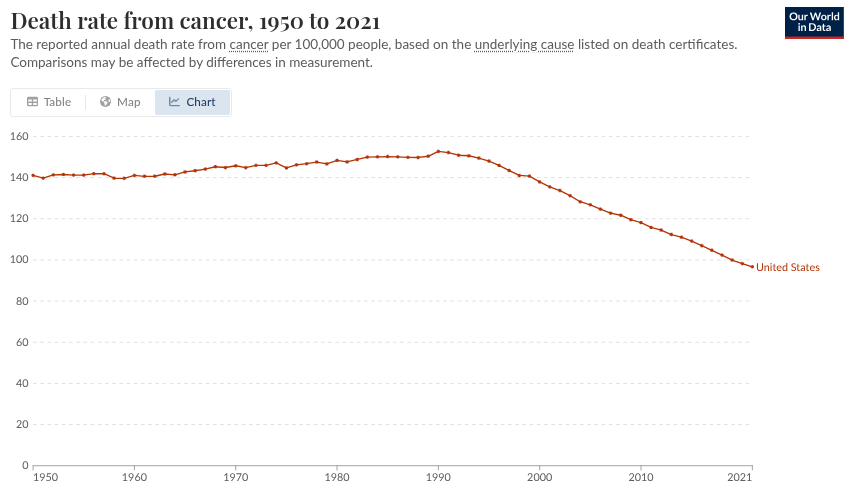
The age-adjusted death rate in the US for cancer has declined by about a third since 1991, meaning people of a given age have about a third lower risk of dying from cancer than people of the same age more than three decades ago. That adds up to over 4 million fewer cancer deaths over that time period. Thanks to breakthroughs in treatments like autologous stem-cell harvesting and CAR-T therapy, cancer isn’t the death sentence it once was. The dramatic bend in the curve of cancer deaths didn’t happen by accident — it’s the compound interest of three revolutions:
- While anti-smoking policy has been the single biggest lifesaver, other interventions have helped reduce people’s cancer risk. One of the biggest successes is the HPV vaccine. Cervical cancer deaths in US women under 25 fell about 62 percent, a decline researchers attribute largely to the HPV vaccine.
- The next revolution is better and earlier screening. It’s generally true that the earlier cancer is caught, the better the chances of survival.
- Most exciting of all are frontier developments in treating cancer. From drugs like lenalidomide and bortezomib in the 2000s, which helped double median myeloma survival, to the spread of monoclonal antibodies, real breakthroughs in treatments have meaningfully extended people’s lives — not just by months, but years. Perhaps the most promising development is CAR-T therapy, a form of immunotherapy. Rather than attempting to kill the cancer directly, immunotherapies turn a patient’s own T-cells into guided missiles.
__________________________
There is so much we don’t know about the deep ocean, but what we do know is astonishing. The ocean’s deepest point extends approximately 36,000 feet below the surface. Beyond 600 feet, light no longer penetrates, making photosynthesis impossible, yet 98% of marine life resides on or near the sea floor. Life at these depths depends almost entirely on “marine snow”—organic matter drifting down from the ocean’s upper layers.
When a whale dies, its massive body sinks to the seabed and sets off an extraordinary chain of events. A single whale fall can blanket an area of 50 square meters, roughly 538 square feet, on the ocean floor. In that single moment, it delivers a bounty of food equivalent to what small particles would provide over 200 to 2,000 years. It’s an enormous input of organic matter that sticks around for centuries.

________________________
The math and odds are against you to be able to make enough money to survive as a professional tennis player. Employing a bottom-up analysis of the top 100 junior players from 2008, research examines their career trajectories, rankings, and financial outcomes. The findings reveal that you need to be ranked in the top 150 in the world in order to break-even financially. It’s even tougher for females because male players tend to sustain longer careers, potentially due to higher earnings in the ATP circuit outside Grand Slam events.
______________________

The U.S. as a whole remains much more expensive than all foreign markets:
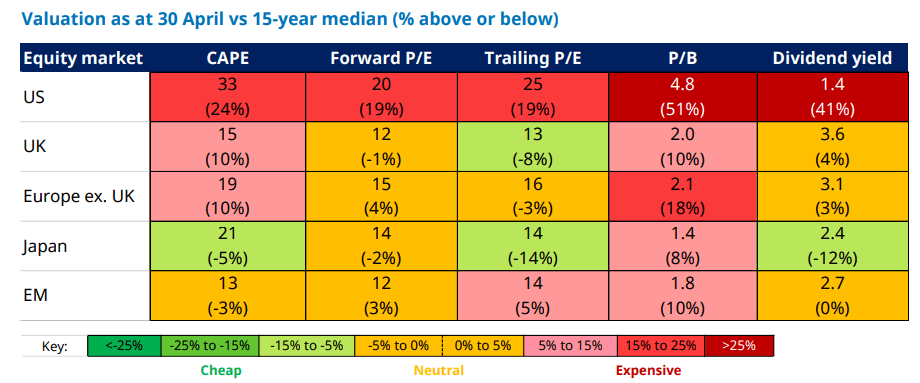
The gap in price to earnings from the U.S. vs. the rest of the world has narrowed slightly in 2025 but remains enormous:

_______________________________
Only a third of five-to-10-year-old kids frequently read for fun, compared to over half in 2012. This could be in part because their parents are less likely to read to them before they turn five: 41% of parents of all ages reported doing so, a steep drop from the 64% in 2012.
_______________________
Barry Ritholtz and Paul Krugman interview: On Art as an investment: If you go back to the old masters in the 15, 1600s and buy one of their paintings for $100 and it sells centuries later for tens of millions, it’s about a 3% return rate. It’s just the magic of compounding over centuries that are just outside our comprehension.
_____________________

__________________________
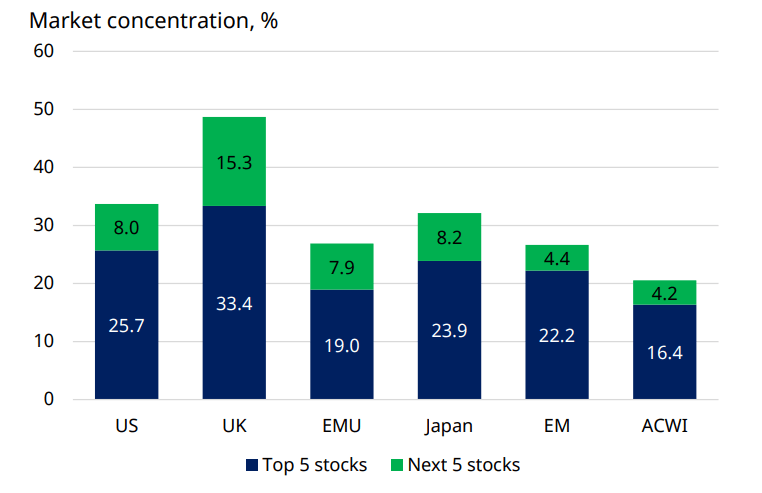
The largest stocks dominate market caps in most countries, not just the U.S. (with the Mag 7):
 Tuna Thoughts