Part 1: The People Making Enormous Money (For The Moment)
Polymarket is sort of like the Nasdaq or the New York Stock Exchange, except instead of buying and selling shares of publicly traded companies like Apple or Microsoft, the platform allows you to trade on what will happen in the future.
Polymarket and its main rival, Kalshi, are the two largest prediction markets in the world. The two platforms processed $25 billion in trading volume in April, up tenfold from a year ago.
On Kalshi, sports wagers are the largest betting category, accounting for roughly 70 percent of all revenue on the platform. But users on both platforms can wager on just about anything: the price of Bitcoin; the duration of Donald Trump and Xi Jinping’s handshake; whether the headlines on the front page of this newspaper will use the word “stupid” in a given week. Unlike a sports-betting app or a casino, there’s no house, just other bettors on the other side of each trade: Every dollar you lose is a dollar won by someone else.
Traditional financial markets (stocks, bonds) have thousands of sophisticated players battling over trillions of dollars. This means that market prices usually reflect reality, and it’s incredibly difficult for even the most seasoned Wall Street traders to find an edge. Prediction markets, on the other hand, are so immature and so illiquid — there’s just not enough money moving around in them — that the price may not reflect reality.
An army of “sharps” (a loosely coordinated group of traders who are each making six- and seven-figure annual returns) have built a system to exploit it by figuring out what other people don’t yet know. Like Wall Street analysts, they get their edge from research: Hours scouring public voter data, building financial models and even contacting professors, journalists and actual Wall Street analysts to get a leg up. Right now, they are getting very, very rich.
A 25-year-old sharp who goes by the username @Frosen; “I really am just taking money from people.” Frosen is a graduate student, and he turned $200 into nearly half a million dollars last year. “Every dollar that I gain is someone losing, and there’s just a lot of people joining, betting, losing and leaving,” he said, laughing nervously. “And then there’s a group of a couple hundred people consistently winning, and that’s the story.”
A better named Fean noticed Kalshi had 98 percent odds of Lady Gaga and Bruno Mars’s “Die With a Smile” topping the Billboard Hot 100 chart. No, he thought, it’s going to be Travis Scott. He then discovered that Scott had sold more than 100,000 singles by inspecting his website’s source code. He was right. Within an hour, Fean had made a 1,000 percent return on his $80 wager.
Most of the sharps ask to be identified by one of their usernames out of fear of being hacked or even “crypto kidnapped.” @JesterTheGoose, a college student studying computer science, deployed an open-source machine-learning tool to predict the outcome of the Chess World Championships. He has turned $2 into more than $150,000.
@PrinceHal, a struggling screenwriter turned full-time Kalshi trader, has been trading for about a decade. He builds inflation-forecasting models that consistently outperform major financial institutions to the tune of $3.7 million in lifetime profits.
The best traders often work alone and try to hide their edge. @Domer, who is widely regarded as one of the most successful prediction market traders on Polymarket, having put money on Robert Francis Prevost’s election as pope and JD Vance’s selection to be vice president, will sometimes email Bloomberg reporters or university professors to try to get a leg up. “It’s every man for himself,” he said; he’s made nearly $5 million.
Some say that @RememberAmalek, who is up more than $750,000, scraped the Nobel Prize Committee website hours before the Peace Prize announcement in order to bet on María Corina Machado.
In the private chat rooms sharps coordinate the best way to buy up ignorance. Recently, after President Trump announced he would nominate the financier Kevin Warsh as the next chair of the Federal Reserve, a conspiracy theory spread online that he would instead choose Judy Shelton, who was an economic policy adviser during his first campaign. The market saw $127,684,065 in Shelton trades on Polymarket. Warsh was nominated; the “dumb money” lost millions; and per usual, the sharps won big. “You can’t stop the “noobs,” the newbies, “from buying literally worthless shares, over and over and over again, every single day. You can’t stop them.”
Part Two: The High Speed Algorithmic Bots Are Coming For Everything
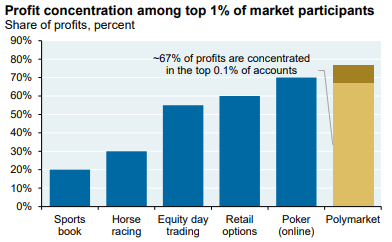
There’s a lot of predation in prediction markets: 1% of participants on Polymarket earn 76.5% of the profits due to high speed algorithmic bots that reprice prediction contracts based on breaking information faster than the average person. Prediction market profit concentration is much higher than in online poker, day trading, horse racing and other gambling platforms shown below.
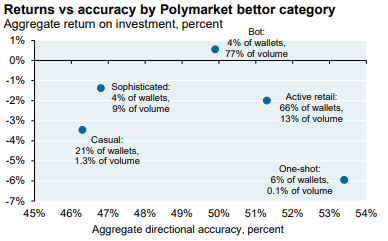
These gains accrue overwhelmingly to automated traders (bots). Joshua Della Vedova at the University of San Diego performed a fascinating analysis of over 200 million Polymarket trades from November 2022 to February 2026. Vedova found that profits are more closely linked to execution timing than to directional accuracy.
Automated traders (bots) achieved 49.9% aggregate directional accuracy (no better than a coin flip), yet earned the only positive aggregate return in the sample at $133 million. Active retail traders achieved 51.3% accuracy but lost $79 million, and other non-bot bettor categories had negative returns as well.
The reason is execution, not forecasting: bots win by providing liquidity and entering markets early (about 10 bots account for 70% of bot profits), while bettors that arrive after prices absorb relevant information pay entry prices that leave no room for profit, regardless of accuracy.
Della Vedova also identifies a subset of accounts whose accuracy and execution are consistent with trading on private (inside) information stripping those profits out would make the non-bot returns shown on the right look even worse.
If a Polymarket bet does not have a clear outcome, it moves to a third-party token-based voting system called Universal Market Access. Any individual, not necessarily Polymarket users, can purchase tokens from crypto exchanges and cast votes in resolutions, influencing the outcome of resolutions they’re actively betting on. For example: a Polymarket bet on whether Ukraine would agree to a critical mineral deal with the US before April 2025 was resolved via UMA. A single voter cast 5 million tokens (25% of votes) and swayed the decision to “Yes” even though the deal was not signed until April 30, 2025.