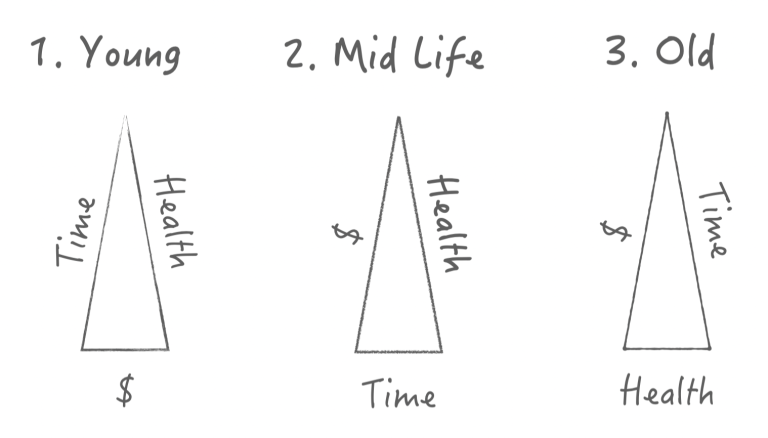
In happiness research, the British-American tradition is to think of happiness as the ultimate goal in life. Being healthy, having harmonious relationships, finding meaning in life and work, etc. are considered to be steps on the way to achieving maximum happiness (see left hand sketch in the chart below).
In other cultures, in particular in Asian and African cultures, happiness is considered to be one part of well-being but not the ultimate goal in life. Rather, happiness interacts with other factors such as meaning or spiritually to create a much more diverse assessment of well-being (or what people like to call ‘the good life’) as shown on the right-hand side of the chart below.
If you look at happiness in this broader context, then achieving maximum happiness will not be your goal in life. This in turn increases life satisfaction and well-being because other factors such as spirituality or living in harmony with nature and other people are much easier to control than happiness itself. Happiness is simply too fragile and vulnerable to external shocks.
Analysing the responses of tens of thousands of people worldwide, here is an overview chart of the optimal level of happiness that people in different countries aim for. Note how in general people in Western Europe try to achieve very high to extreme levels of happiness while people in Asia and Africa are content with more moderate levels of happiness.
What do we learn from this? Maybe trying to cheer my readers up by bringing them a week of good news isn’t really increasing their happiness. Rather, we all should look for a content life where happiness is in harmony with spirituality, nature, our friends, and family. Get off the hedonic treadmill and stop thinking about how to maximise returns for a moment. Take a step back and ask yourself what true well-being looks like for you. Because if you increase well-being, you will be able to better deal with the inevitable bad news that bombards us all the time and will continue to do so forever.
Financial Freedom – Build stability first. This doesn’t mean getting rich—just having enough to live without constant financial stress, and having saved enough to be able to look forward to next steps.
Time Freedom – Use financial stability to create time autonomy. Maybe that means working remotely, taking sabbaticals, or designing a more flexible life.
Freedom of Purpose – With financial and time security in place, focus on what gives life meaning.
________________________________
U.S. home price gains or losses over the last 75 years below. What stands out to me is that we all remember the run from 1997 through 2005, but the 1974 to 1981 run was just as spectacular. Those gains came at a time when the 10-year treasury yield rose from 7% to 16% (mortgage rates are historically 2 to 3% above the 10-year treasury rate). The other standout to me was how insane 2021 was for price gains relative to any other year in history coming off an already blistering second half of 2020.
______________________
Academy Award-winning filmmaker Errol Morris (The Fog of War, The Thin Blue Line) turns his lens to an unlikely cast of upstarts who transformed the investment landscape in the documentary Tune Out the Noise. The film chronicles a group of academics at the University of Chicago in the 1960s whose groundbreaking research challenged Wall Street’s status quo and was used by firms to disrupt traditional methods of investing, ultimately reshaping the way the world views markets.
Denmark’s social rule of janteloven – the idea that “you’re no better than anyone else” – keeps everyone grounded. Its education system is rooted in equality, with children calling teachers by their first names and collaboration prioritised over competition. There’s a flat hierarchical structure and high taxes help redistribute wealth – not a terrible plan since more equal societies are happier and healthier.
Danes trust their neighbours, institutions and even strangers, with 74% believing “most people can be trusted”. So, babies are left to nap outside in their prams, children roam freely and people sell secondhand clothes from “trust stands” outside their homes.
The Danes are masters of the work-life balance, with a 37-hour work week as standard and OECD figures showing that the average Dane puts in only 33 hours a week. The result? Lower stress and higher productivity.
Friluftsliv, or “open-air life”, is deeply ingrained in Nordic culture and spending time in nature has been shown to reduce stress.
One of the greatest gifts from our Danish years is the habit of eating together. This is non-negotiable – TV off, phones away and everyone at the table for a home-cooked meal, proven to improve mental and physical health as well as our relationships. Thanks to a short working week, a daily family dinner is entirely possible in Denmark and tends to be eaten early, something our metabolism and gut health apparently thank us for.
Nearly half of Danes volunteer, contributing to their communities through clubs, events and schools. If Denmark taught me anything, it’s that small acts of service build stronger communities.
The Danish art of cosines meant slowing down, switching off and sharing quality time in relaxed surroundings (accepting that the best evenings don’t involve wifi). Danes priorities daily moments of joy.
Vikings are allowed to take risks, learn from mistakes and develop independence early on. From two-year-olds dressing themselves to eight-year-olds cycling to school alone, there’s a collective confidence in giving children freedom in Denmark, which helps them flourish. A phrase beloved by my children’s teachers was that adults should “sit on their hands” – ie do nothing and let children work things out for themselves.
Danish minimalism goes beyond design; it’s a way of life. From clothes to home decor, the approach taught me the beauty of having fewer things, of higher quality.
The country ranking itself stems from the the “life evaluation” metric: “Please imagine a ladder with steps numbered from 0 at the bottom to 10 at the top. The top of the ladder represents the best possible life for you and the bottom of the ladder represents the worst possible life for you. On which step of the ladder would you say you personally feel you stand at this time?”
Considering this, the most prominent factor that determines whether citizens are “happy” might have more to do with how satisfied they are with their immediate surroundings, rather than how they’re feeling.
While the World Happiness Report takes into account life satisfaction, it lacks one crucial joy-determining factor: emotions. The 2024 Gallup Global Emotions Report focused on respondents’ positive and negative emotion; including how often people laugh, smile, or learn something new, as well as how often they feel pain, stress, or anger (the “Positive Emotions Ranking” column below):
Finland ranked in 25th place overall for feeling positive emotions specifically, and until recently, had one of the highest suicide rates in the world. What the happiness ranking could speak to, then, is the Finnish custom of “sisu,” or inner strength, which means people rarely complain about their problems… or, for that matter, place themselves low on the life ladder.
Another factor contributing to life satisfaction that the report highlighted was meal sharing. The growing number of people eating alone in the United States — in 2023, about 1 in 4 Americans reported eating all their meals alone the day before, up 53% from two decades prior — was said to have contributed to a decline in national well-being, as the US ranked 24th overall in the report, the lowest position it’s ever held.
_____________________________
American women have never been this resigned to staying single and they’re giving up on marriage. They are responding to major demographic shifts, including huge and growing gender gaps in economic and educational attainment, political affiliation and beliefs about what a family should look like. More women than men are attending college, buying houses and focusing on their friendships and careers over dating and marriage.
Women throughout history rarely questioned whether finding and securing a romantic partner should be a primary goal of adulthood. This seems to be changing. Over half of single women say they believe they are happier than their married counterparts. A rise in earning power and a decline in the social stigma for being single has allowed more women to be choosy. They would rather be alone than with a man who holds them back. The focus has shifted toward self-improvement, friendship and the ability to find happiness on their own.
48% of women say that being married is not too or not at all important for a fulfilling life, up from 31% in 2019. Marriage rates for both men and women are in decline, in part owing to less pressure to pair off and higher expectations for a would-be match. Dating apps make people feel like there might always be a better option. They view looking for a marriage partner the same way that you view looking for a job candidate.
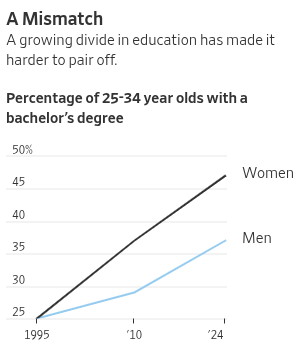
The challenges of finding a romantic partner have been made more complicated by a growing divide in education and career prospects between men and women. 47% of American women ages 25-34 have a bachelor’s degree, compared with 37% of men. A bachelor’s degree increases net lifetime earnings by an estimated $1 million. Women are doing comparatively well when it comes to education and their early years in the labor force, and men are doing comparatively badly. That creates a mismatch, because people prefer to date in terms of comparable education or income.
Men’s economic struggles seem to be having the biggest effect on women without a college degree, whose marriage rates by age 45 have plummeted from 79% to 52% for those born between 1930 and 1980. Young men without a degree are struggling so much as a group that there simply aren’t enough with steady jobs and earnings for non-college women to date.
What were some of your most popular articles at the Journal? “Anything with a list, anything that mentioned my kids, and anything on the topic of money and happiness. “
What’s changed since those days? “Go back to the late 1980s and through the 1990s, all the focus was on investing, how to build a portfolio, what’s the expected return, yada yada yada. Since then, people have realized that there’s a limit to how much we can optimize a portfolio. Instead, there’s a lot of focus on other issues, like helping people buy the right-size home, making sure they have all their estate-planning documents, making sure they have the right insurance policies, making sure they claim Social Security at the right age, and so on. There has been more focus on the psychological aspects of managing money. And finally, there’s now a focus on helping people figure out what money means to them.”
Do you remember your final article at the Journal? “When I left in 2008, I wrote a piece about three ways that money can help happiness. One, money can give you a sense of financial security. Two, it can allow you to spend your days doing what you love. And three, it can allow you to have special times with friends and family. I believe that those are the three ingredients for not only a happy financial life, but also a happy life—period. It’s certainly the three things that I’m focused on.”
Has your thinking changed about anything since your diagnosis? “In the last couple of years, I’ve become better about giving money to my kids and funding my grandchildren’s 529 plans. In retrospect, I think I should have started earlier and could have been more generous, because it’s clear to me that I’d never have been able to spend all this money I’ve accumulated, even if I did live to a ripe old age. If you’re pretty sure that your kids have good financial habits, and you’re not going to undermine their ambitions or send them on some wayward path, by all means give them money now. Why have them live with unnecessary financial anxiety? Why not make them feel a little more financially secure? I really believe that’s one of the greatest gifts that we can give to family members, this sense of financial security.”
In your writing, you’ve shared that you aren’t feeling negative emotions about your diagnosis. In fact, you wrote that your first reaction was, “I’m okay with this.” Can you say more about that? “I feel like I’ve been very fortunate. It’s not that bad things haven’t happened in my life. They have. But I’ve been able to spend my life doing what I love. I have a close-knit family, and I’ve largely been free of financial worry. All in all, I feel like I’ve managed to get a whole lot out of my life.”
________________________________
Michael Easter (author of The Comfort Crisis and Scarcity Brain) interviewed Brett McKay who has an extremely popular podcast called the “Art Of Manliness” that I’ve been listening to for many years. Brett is one of the best at interviewing authors about their new books, helping me decide if I want to read them. It was strange to hear someone asking Brett the questions.Some random thoughts from their conversation.
What’s the dumbest health trend you’ve noticed recently? Blue-light-blocking glasses. They’re useless—the research doesn’t support significant circadian disruption from blue light.
You’ve experimented extensively with health trends. What’s something you’ve changed your mind about? Low-carb diets. I got into low-carb in early days. And then I learned, wait, there’s nothing magic about low carb. You just eat fewer calories typically when you’re on low carb. But you can do that with any diet.
You’ve talked to a ton of parenting experts on podcasts. What’s your best parenting advice? Parent like a video game. In video games, if you mess up you just start from the beginning—it’s not a big deal. So if your kid makes a mistake, treat it like restarting a game—tell them not to do that again and move on. No big deal. Also, something I appreciate more and more is that kids are their own people. You can guide them, create a supportive environment, but you can’t control their personalities or outcomes. You see families where all the kids are parented the same way, but they all end up different. Why’s that? Because people are different. So do your best, love them, and let them be themselves.
The U.S. is making progress against one of its most devastating public-health threats: drug overdoses.The decline is at least in part due to a drop in opioid use. A 2022 report found that opioid-use disorder increased from 2010 to 2014, then stabilized and slightly declined each year thereafter. Another reason is because the most vulnerable people have died and others have adapted. Many fentanyl users are now smoking the drug instead of injecting it, and some research shows that smoking fentanyl could come with lower risk of overdose, infections and other complications.
_________________________________
Market timing is hard because, even if you get out at an opportune time, you have to nail the landing and get back in. Few people can do both. In fact, getting the first leg of the parlay right often makes it even harder to get back in because you become so attached to the loving arms of cash. The psychology of market timing becomes even more challenging when you add politics to the mix.
______________________________
A popular investment strategy being sold to investors today is the idea of getting limited upside annually on your stocks in exchange for limiting the downside. AQR discussed these in their recent article: Rebuffed: A Closer Look At Options-Based Strategies.
At the heart of the strategies examined are put options. The way puts work is straightforward: the investor pays some amount (the option premium) to protect themselves from a specific decline in a specific asset’s price over a specific period. There’s one wrinkle though: when it comes to buying puts, the price of admission is generally higher than the benefit.
let’s say an investor is less concerned with long-term returns, and more concerned with shorter-term drawdowns. Surely options-based strategies should at least help there, since a put option is literally tailor-made for this task.
Nope.
Puts are designed for very specific outcomes – they protect against a specific price level for a specific length of time. If the duration of the draw-down doesn’t align with the maturity of the option, the hoped-for protection won’t be there. This is why a strategy that buys 5% out-of-the-money puts every month can have a drawdown that’s worse than 5% – markets might fall by 4% in one month, and by another 4% the next so the options you paid for never pay you. And this is a reason 81% of the funds in Exhibit 3 weren’t able to deliver on the seemingly easy goal of downside protection (again, compared to an applicable mix of equities plus T-bills).
Daniel Kahneman spent his life studying behavioral economics, cognitive biases and learning why people make irrational decisions. He won the Nobel prize for his research and wrote the most influential book ever on the topic titled “Thinking, Fast & Slow.” At age 90, his closest friends and family were shocked and upset when they received an email from him saying that he would be ending his life through assisted suicide, even though he was still in relatively good health. From his email:
“I am still active, enjoying many things in life (except the daily news) and will die a happy man. But my kidneys are on their last legs, the frequency of mental lapses is increasing, and I am ninety years old. It is time to go.
Not surprisingly, some of those who love me would have preferred for me to wait until it is obvious that my life is not worth extending. But I made my decision precisely because I wanted to avoid that state, so it had to appear premature. I am grateful to the few with whom I shared early, who all reluctantly came round to support me.
I discovered after making the decision that I am not afraid of not existing, and that I think of death as going to sleep and not waking up. The last period has truly not been hard, except for witnessing the pain I caused others. So if you were inclined to be sorry for me, don’t be.“
One reason why the younger generation doesn’t like to drink is because every moment of their lives is either being filmed or only seconds away from the next picture that will be shared online. “I think that a lot of times we’re so consumed with how other people are looking at us that we don’t even want to risk being considered messy,” said Sofie Ruiz, a sophomore at Texas Christian University. This fear of being perceived as “messy” is fueled by the popularity of the “clean girl” aesthetic. A “clean girl” is often associated with healthy habits like yoga, pilates, green smoothies, and journaling—definitely not heavy drinking. The epitome of the popular girl is now one who projects an image of a balanced, healthy, and often sober lifestyle. This ideal is heavily promoted on social media, influencing what is seen as desirable and aspirational. College campuses also have school-specific social media apps, such as Yik Yak, wherea drunken night out can get posted by peers with lasting and embarrassing consequences, said Ruiz. With social media comes permanent and wide-reaching evidence, and students are choosing not to be seen in a certain way in perpetuity.
The reputation repercussions can run deep. Ruiz has a friend who attends a university with its own dedicated Instagram account. Students can send in anything, and it will likely be posted. A female student was kicked out of her sorority for being drunkenly featured on the page. “We grew up a lot hearing the concerns of a digital footprint. People don’t want to risk their future on stuff like that,” said Ruiz. “Guys don’t have as much to be scared about, I think. Because even if they do something embarrassing and it gets posted, they, by history, most likely will not get the same repercussions as a girl might. As a girl, you don’t want to be hungover, you don’t want to feel sick, which also goes into the clean girl aesthetic thing.” “I think that if social media wasn’t a component, it would definitely be a lot different,” she said. The opposite is true with marijuana. Ruiz said that cannabis’s popularity may stem from its perceived social acceptability: “You’re kind of at less of a risk to embarrass yourself because if you’re high, you’re normally just going to chill out. Whereas when you’re drunk, you don’t really have control over your actions.”
_________________________________
Are there financial determinants of great-power decline and fall? “Ferguson’s Law,” which states that any great power that spends more on debt servicing than on defense risks ceasing to be a great power. The paper identifies the “Ferguson limit,” or the point at which interest payments exceed defense spending, as the tipping point after which the centripetal forces of the aggregate debt burden tend to pull apart the geopolitical grip of a great power.
This is because the debt burden draws scarce resources towards itself, reducing the amount available for national security, and leaving the power increasingly vulnerable to military challenge. Looking at historical case studies that are analogous to the situation of the modern United States as the dominant global power, it is very rare but not unprecedented for a great power to return to the right side of the Ferguson limit. The United States began violating Ferguson’s Law for the first time in nearly a century in 2024.
________________________________
Don’t let your kids get on motorcycles, if possible.
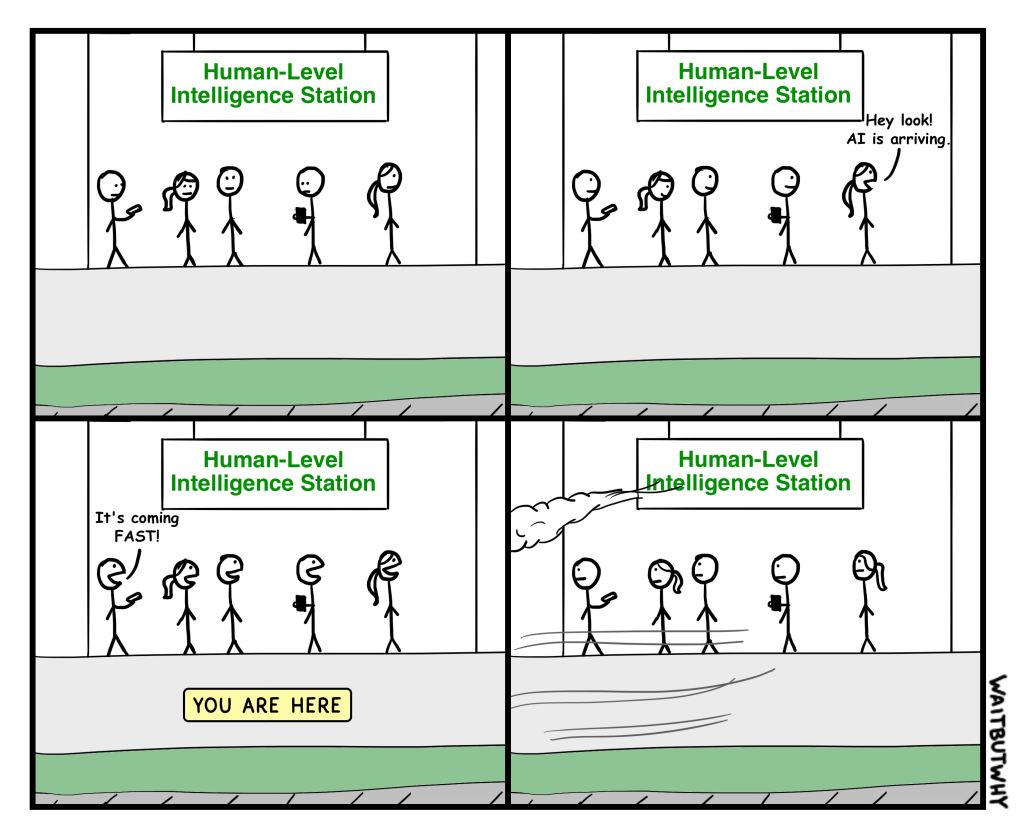
For the last couple of months, I have had this strange experience: Person after person — from artificial intelligence labs, from government — has been coming to me saying: It’s really about to happen. We’re about to get to artificial general intelligence. What they mean is that they have believed, for a long time, that we are on a path to creating transformational artificial intelligence capable of doing basically anything a human being could do behind a computer — but better. They thought it would take somewhere from five to 15 years to develop. But now they believe it’s coming in two to three years.
_______________________________
Seth Godin: “Once you have enough for beans and rice and taking care of your family and a few other things, money is a story. You can tell yourself any story you want about money. And it’s better to tell yourself a story about money that you can happily live with. So if you want more money, you need to understand you’re always going to have to trade something for it, and you need to be very clear with yourself what you’re willing to trade.”
The Atlantic magazine in 1920: “The older generation had certainly pretty well ruined this world before passing it on to us. They give us this thing, knocked to pieces, leaky, red-hot, threatening to blow up; and then they are surprised that we don’t accept it with the same attitude of pretty, decorous enthusiasm with which they received it, way back in the 1880s.” Some things never change.
_______________________________
Savoring has been defined as “the capacity to attend to, appreciate, and enhance the positive experiences in one’s life.” This can mean focusing on a current, future, or past experience with particular attention to the positive parts. Savoring has been shown in research to stimulate the brain’s striatum, a region involved in processing reward, and is effective in lowering symptoms of depression. The result, correspondingly, is a higher level of reported happiness.
Savoring positive experiences in the moment also leads to happier memories later on. Researchers found when they instructed people to savor these experiences more fully as they recorded them, their subsequent memories were more vivid, and in effect they enjoyed the experiences more. Easier said than done, unfortunately: We are evolved less to savor the good things in life than to take note of what we dislike and harbor resentments. Humans typically exhibit a “negativity bias,” meaning that adverse events arrest our attention more than positive ones.
You want your parents to have health insurance so that medical needs don’t bankrupt them, right? You want them to have car insurance so that if they get in an accident, they don’t need to pay out of pocket to replace an entire car or in case someone sues them for $100,000, right? These are examples of potential economic devastation wrought by a couple different risks. Getting scammed is a risk that can be just as disruptive and economically devastating.
What advice can I give me parents to protect them from scam calls that is extremely easy and simple to execute that won’t require any judgement in the moment?” I settled on advising them to say this everytime a financial institution calls: “Where are you calling from? Thank you. I’m going to hang up and call back.”
When you’re independent you feel less desire to impress strangers, which can be an enormous financial and psychological cost. Speaking of hidden forms of debts: How much of what takes place in our modern economy is done purely for signaling reasons? It’s impossible to quantify, but you know it when you see it. And taking an action to impress other people is a direct form of dependence.
___________________________
After shuffling the cards in a standard 52-card deck, Alex Mullen, a three-time world memory champion, can memorize their order in under 20 seconds. As he flips though the cards, he takes a mental walk through a house. At each point in his journey — the mailbox, front door, staircase and so on — he attaches a card. To recall the cards, he relives the trip. This technique, called “method of loci” or “memory palace,” is effective because it mirrors the way the brain naturally constructs narrative memories: Mullen’s memory for the card order is built on the scaffold of a familiar journey.
Analyses have generated a new understanding of how the human brain constructs narrative memories. Nearly the entire brain is involved, contradicting earlier ideas that placed memory in specific brain regions. And memories are built in temporal pieces, each of which ranges from a second to a minute in length. The brain places those pieces onto the scaffolds of event scripts. It’s all a construction. It’s not like you have this video camera of exactly what happened, exactly as it happened. You have to reconstruct, based on pieces of the experience, what you think happened.
The brain doesn’t simply record what it perceives. Instead, much if not most of the brain’s reaction to an event or story originates in memories of how that type of event usually plays out. In other words, we process the present through the past.
There are two critical steps to constructing memories. As we go about our day, we record the new experiences in pieces of varying size and complexity, from simple perceptions to stunning plot twists. Meanwhile, our brains access templates for these new events based on knowledge of similar ones, and place the pieces of the evolving memory in that context. Memories, it turns out, are more like paint-by-number than rendered from scratch on a blank canvas. The way we experience and remember events arises largely from our mental state, as opposed to properties of the events themselves.
_____________________________
We report eleven studies that show declines in life satisfaction and happiness among young adults in the last decade or so, with less uniform trends among older adults. In the U. S. life satisfaction rises with age. This is broadly confirmed in several other datasets including four from the European Commission across five other English-speaking countries: Australia, Canada, Ireland New Zealand and the UK. There is broad evidence across all of these English-speaking countries that happiness and life satisfaction since 2020 rise with age. In several of these surveys we also find that ill-being declines in age. The U-shape in well-being by age that used to exist in these countries is now gone, replaced by a crisis in well-being among the young.
_____________________________
Which Sports Provide the Best Return on Your Time Investment? Football has the greatest amount of “false advertising” in terms of how much time the game actually takes versus how long it lasts on the clock. Hockey, by contrast, is the most honest American sport — with a ratio of 2.5 “real” minutes per minute on the scoreboard — with NBA games checking in right behind at 2.8 “real” minutes per clock minute.
_________________________________
The U.S. has become much less Christian, driven in large part by Gen Z and younger Millennials, according to a new Pew study. “We’ve had rising shares of people who don’t identify with any religion — so-called ‘nones’ — and declining shares who identify as Christian, in all parts of the country, in all parts of the population, by ethnicity and race, among both men and women, and among people at all levels of the educational spectrum,” he says about the survey findings. A significant portion of U.S. adults (35%) have switched from the religion of their childhood.
________________________________
Lessons From This Year’s Berkshire Hathaway Letter. Sixty years ago, Warren Buffett bought control of Berkshire Hathaway. He’s highlighted that mistake on and off ever since. He did so once again in this year’s annual letter, which came out over the weekend.
_______________________________
India is best thought of as a country of 1.4 billion people of whom about 300 million are leading a relatively comfortable life in major cities like Bombay and New Delhi while 1.1 billion are in rural or urban poverty. India is poor but 300 million middle-class citizens is a population almost the size of the United States. Again, that’s the point. A U.S.-sized middle-class population already exists in India with 1.1 billion more people waiting to join the ranks. The growth potential is almost beyond comprehension.
___________________________
My quest for cheap stocks has led me to South America. Specifically, Brazil. The largest Brazil ETF, EWZ, currently trades at around 8x earnings with an 8% dividend yield. An entire country ETF offering an 8% yield. Meanwhile, the dividend yield on the S&P 500 is 1.27%. EWZ trades at 1.5x book value, while the S&P 500 currently sits at 5.01x (a higher multiple means stocks are more expensive). The chart combines seven metrics to show just how expensive the U.S. stock market has become.
___________________________
The U.S. stock market as a whole is the most expensive in the world, but when you pull out just the technology stocks, they are on another planet in terms of how they’re priced relative to their earnings.
How about the capital being employed? There better be something new. I mean, we’re talking now for the just a top handful of companies doing $300 to $500 billion in capex [capital expenditures] annually. I mean, AI isn’t like the internet, which made things more capital efficient and raised returns on capital. So far, AI is doing the opposite. It is a massively capital-intensive business. Someone joked that the top tech companies are now looking like the oil frackers did in 2014, 2015, where more and more capital is chasing arguably a variable return.
Fracking technology has revived the U.S. oil and gas industries, and along with renewables, has made America energy-independent for the first time in generations. But the fracking companies themselves turned out to be far less profitable than they led investors to believe.
John Gardner worked as a director of Shell Oil, American Airlines, New York Telephone and Time Inc, in the nonprofit world as a foundation president, in federal government as a cabinet officer, in the military as a Marine Corps officer and member of the Scientific Advisory Board of the Air Force. The paragraphs below are clips from a speech he gave at age 79 :
“When you reach middle age, when your energies aren’t what they used to be, then you’ll begin to wonder what it all added up to; you’ll begin to look for the figure in the carpet of your life. I have some simple advice for you when you begin that process. Don’t be too hard on yourself. Look ahead. Someone said that “Life is the art of drawing without an eraser.” And above all don’t imagine that the story is over. Life has a lot of chapters.
It isn’t a bad idea to pause occasionally for an inward look. By midlife, most of us are accomplished fugitives from ourselves. The things you learn in maturity aren’t simple things such as acquiring information and skills. You learn not to engage in self-destructive behavior. You leant not to burn up energy in anxiety. You discover how to manage your tensions, if you have any, which you do. You learn that self-pity and resentment are among the most toxic of drugs. You find that the world loves talent, but pays off on character.
You come to understand that most people are neither for you nor against you, they are thinking about themselves. You learn that no matter how hard you try to please, some people in this world are not going to love you, a lesson that is at first troubling and then really quite relaxing. Those are things that are hard to learn early in life, As a rule you have to have picked up some mileage and some dents in your fenders before you understand. As Norman Douglas said “There are some things you can’t learn from others. You have to pass through the fire.’
So you scramble and sweat and climb to reach what you thought was the goal. When you get to the top you stand up and look around and chances are you feel a little empty. Maybe more than a little empty. You wonder whether you climbed the wrong mountain. But life isn’t a mountain that has a summit, Nor is it — as some suppose — a riddle that has an answer. Nor a game that has a final score.
Young people run around searching for identity, but it isn’t handed out free any more — not in this transient, rootless, pluralistic society. Your identity is what you’ve committed yourself to. It may just mean doing a better job at whatever you’re doing. There are men and women who make the world better just by being the kind of people they are –and that too is a kind of commitment. They have the gift of kindness or courage or loyalty or integrity. It matters very little whether they’re behind the wheel of a truck or running a country store or bringing up a family.”
Our egos are hardwired to fall into the trap of confounding luck and skill. Suppose you decide to drive drunk and you make it home safely. That was a bad decision with a good outcome. One week later, after a good night of drinking Zinfandel, you ask a designated driver to drive you home. The driver gets into an accident. That was a good decision with a bad outcome. (Setting aside that you drank Zinfandel, which clearly is a horrible decision.)
Because of randomness, outcomes are often silent on the quality of decisions. Worse, they can mislead. In a world in which we can’t predict much of the future, good decisions can lead to bad outcomes, and bad decisions can lead to good outcomes. In the business of investment management, we say there’s “randomness.”
This problem is acute in the investment world. You can make money, at least for a while, by making bad decisions like holding a concentrated portfolio or investing in fads. If you don’t examine your process and the quality of your decisions, in other words, if you only focus on outcomes, you may think you’re an absolute genius. But you’re unlikely to be a successful investor in the long run.
Annie Duke’s excellent book, Thinking in Bets, has become required reading in the investment world. Duke is a business consultant and ex-professional poker player. She explains that we instinctively associate good results with good decisions and bad results with bad decisions. She calls this instinct “resulting.” But in poker and many aspects of life, “winning and losing are only loose signals of decision quality.”
____________________________________
Nostalgia for terrible things may sound absurd, but many people experience it, for reasons that speak to the way people make meaning of their lives. The central reason for this phenomenon, according to researchers who study nostalgia, is that humans look to our past selves to make sense of our present. Reflecting on the challenging times we’ve endured provides significance and edification to a life that can otherwise seem pointlessly difficult. The past was tough, we think, but we survived it, so we must be tough too.
It used to be assumed that the financial memory should last, at a maximum, no more than 20 years. This is normally the time it takes for the recollection of one disaster to be erased and for some variant on previous dementia to come forward to capture the financial mind. It is also the time generally required for a new generation to enter the scene, impressed, as had been its predecessors, with its own innovative genius.
William Vanderbilt was the son of the great Cornelius Vanderbilt. When his father died, Cornelius was the richest person on the planet. Billy took his father’s wealth and almost immediately doubled it with some shrewd business maneuvers (in today’s terms, imagine Elon Musk’s son inheriting $500 billion when he dies and then investing it and quickly doubling it to $1 trillion). Being the richest rich person didn’t make William Vanderbilt any happier:
“The sheer magnitude of his fortune, he told Chauncey Depew, gave him no advantages over men of moderate wealth. “I have my house, my pictures and my horses, and so do they. I can have a steam yacht if I want to, but it would give me no pleasure, and I don’t care for it.” On another occasion he spoke of a neighbor saying, “He isn’t worth a hundredth part as much as I am, but he has more of the real pleasures of life than I have. His house is as comfortable as mine, even if it didn’t cost so much; his team is about as good as mine; his opera box is next to mine; his health is better than mine, and he will probably outlive me. And he can trust his friends.”
Being the richest person in the world brought him, he said, nothing but anxiety.
The Drug Industry Is Having Its Own DeepSeek Moment. It isn’t just artificial intelligence—Chinese biotechs are now developing drugs faster and cheaper than their U.S. counterparts. Many top scientists trained in the U.S. have returned to China over the past decade, fueling the emergence of biotech hubs around Shanghai. And just as DeepSeek built a formidable chatbot—allegedly on a lean budget with limited access to semiconductors—Chinese biotech companies are also scrappier, capitalizing on a highly skilled, lower-cost workforce that can move faster. Additionally, companies can conduct clinical trials at a fraction of what they would cost in the U.S., while recent changes in the Chinese regulatory system have streamlined and accelerated the approval process to get a study started.
The silver market is heading into a perfect storm. Even in our most conservative case, holding everything but solar demand constant, we’re looking at potential deficits of 100-200 million ounces annually for the next decade. Solar panels now consume one in four ounces of silver mined globally. Even at current solar installation rates – before factoring in any AI-driven surge in energy demand – we’re looking at a supply-demand gap as large as the entire elastic (price-sensitive) portion of silver supply. Solar demand is structurally inelastic – panel manufacturers will buy silver at almost any price because it represents a tiny fraction of total costs but is essential to functionality. The sheer scale of the energy transition dwarfs anything in silver’s industrial history – we’re talking about rebuilding the entire global energy infrastructure.
Losing It on Live TV. Lorne Michaels reportedly dislikes when “Saturday Night Live” cast members break character. But over 50 seasons, it’s become one of the show’s signature moves — one that usually delights the audience.
__________________________________
A common narrative is that less people are getting married, and the number of births is declining because more college educated women are choosing their jobs over starting a family. In reality, the graph below shows it’s the opposite. The married rates for college educated women have held steady, while the number of non-college educated married women has plummeted.
Seen below, scammers will queue up “the model” to speak to the victims on video calls.
_________________________________
The Endowment Effect is sneaky. It whispers, “Hold on. This is yours. It’s special.” But the truth is, nothing is special just because you own it. A bad stock doesn’t become good because it’s in your portfolio. A house isn’t worth more because you have memories in it. How do we fight the Endowment Effect?
Ask: If I didn’t own this, would I buy it today? If the answer is no, it might be time to let go.
Detach from the purchase price. The stock doesn’t know what price you bought it at.
Think like an outsider. What advice would you give a friend in your position?
Set clear exit rules. Have a plan for when to exit an investment before you even enter.
Seek a devil’s advocate. Have someone play devil’s advocate to convince you out of your decision to hold.
How many decades since 1900 has the United States stock market outperformed the rest of the world? Only 3:
1900’s
1910’s
2010’s
___________________________
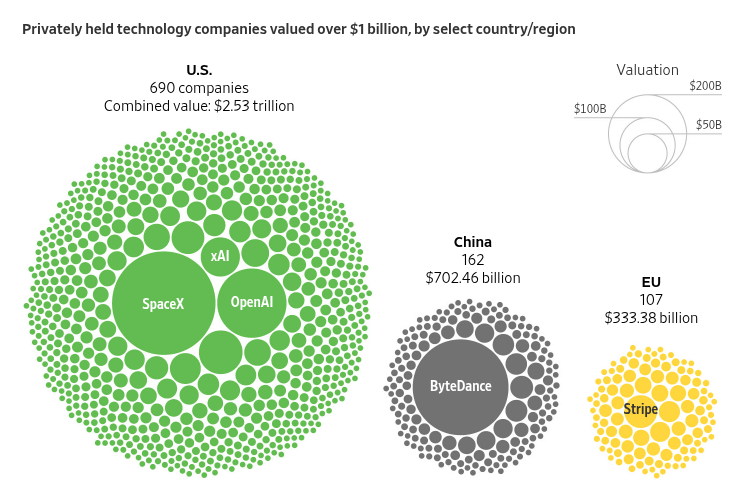
America dominates the rest of the world in venture capital (VC) investments:
_____________________________
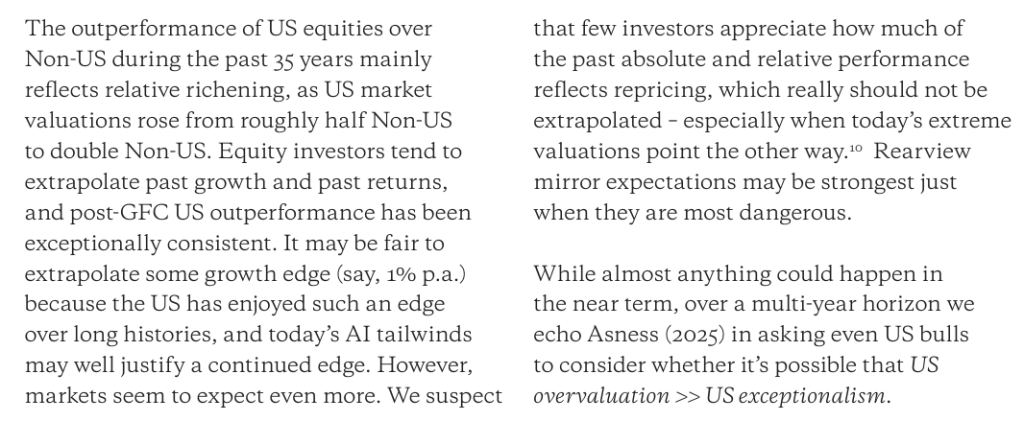
Perhaps the single greatest divergence in equity markets has been the continued outperformance of US versus international equities—and thus the widening of the valuation gap between the US and the rest of the world. To try and determine why, we regressed value against the other common risk factors for the top 1,000 stocks globally. By far the most significant difference, explaining about half the valuation gap, is the domicile of listing. US-listed stocks are substantially more expensive than internationally listed stocks for no reason other than the place of listing.
Think about what makes you ‘imbalanced’ as a personality, & do things where this gives you an edge.
Once you are ok with people telling you ‘no’, you can ask for whatever you want.
Doing as much as you can every day is a form of life extension.
Always be high integrity, even when it costs you. The shortcuts aren’t worth it.
Figure out what your primary focus is and make progress on that every day, first thing in the morning, no exceptions. Days with 0 output are the killers.
If you find yourself dreading Mondays, quit.
No matter how bad things seem, everything passes.
Form opinions on things and then find the strongest critique of those opinions. Repeat.
The reason we hate being bad at things and failing is because when goal-directed activity is inhibited or blocked (either by an outside force or our own lack of aptitude), that stimulates our dorsal anterior cingulate cortex, which is part of the brain’s pain circuitry. This is the same region affected when we experience social rejection. This kind of mental pain does, however, have an evolved benefit—creating the motivation to succeed, if not at the activity at hand then at some other one.
This motivation effect is detectable in business activities. When employees are frustrated by their relative incompetence at one task, they tend to be motivated to show more competence for something they’re already better at.
Ruminating on failure is widely recognized to be a destructive waste of time, because this type of reflection focuses on self-worth and what failure says about one as a person. Action rumination is different: It is task-focused and involves replaying the exact missteps that one made and how they could be rectified in the future, which can lead to learning and improvement as opposed to frustration and chagrin.
The lunatic fringe of the U.S. financial system seems to be experiencing a speculative mania involving cryptocurrencies and crypto-related stocks. It could be called the Fartcoin stage of the market. The current meme coin mania makes the bubble of 2021 seem like a relatively sober exercise in rational valuation. At least back then, Roaring Kitty talked about earnings, and crypto enthusiasts rhapsodized about use cases. They might have been delusional, but at least they were delusional about the right things. Karl Marx said that history repeats, first as tragedy, second as farce. He was too optimistic. The truth is that history repeats, first as tragedy, second as farts.
The face of cancer in the U.S. is getting younger—and more feminine. Cancer rates for women in the U.S. have risen over the past half-century, particularly among women under age 65 diagnosed with breast cancer. For decades, the cancer burden in the U.S. was higher for men, who started smoking en masse in the 20th century. Their rates of lung-cancer cases and deaths soared. Lung cancer remains the biggest cancer killer for men in the U.S., but case and death rates have dropped, after smoking rates declined.
Women started smoking heavily later than men and have been slower to quit, so their lung-cancer decline started later and hasn’t been as steep. That has had a significant impact: Lung cancer incidence among women under 65 was greater than among men for the first time in 2021. Women are also more likely to get diagnosed with lung cancer as nonsmokers.
Parlays accounted for about 27% of the money wagered on all sports bets last year through October in Illinois, New Jersey and Colorado, states in which gambling regulators report data by bet type. That’s up from 22% of all sports bets in 2021. The multi-leg bets delivered about 56% of sports-betting revenue after payouts for companies in the three states during that period, up from 50% in the same stretch of 2021.
Multi-leg bets are so lucrative that FanDuel parent company Flutter Entertainment recently increased its expectation for total online gambling revenues in the U.S. to $63 billion by 2030, up from its estimate of $40 billion two years ago, driven in part by parlays, the company said.