“When (Charlie Munger and I) were born the odds were over 30-to-1 against being born in the United States. Just winning that portion of the lottery, enormous plus. We wouldn’t be worth a damn in Afghanistan. We won it partially in the era in which we were born by being born male. We won it in another way by being wired in a certain way, which we had nothing to do with, that happens to enable us to be good at valuing businesses. And you know, is that the greatest talent in the world? No. It just happens to be something that pays off like crazy in this system.”
If you had invested from 1960 to 1980 and beaten the market (the S&P 500) by 5% each year, you would have made less money than if you had invested from 1980-2000 and under-performed the market by 5% every year. When you start investing can be more important than anything else.
_______________________________________
For years, 529 accounts were synonymous with college savings plans. But recent updates have given the accounts a makeover. They’ve become education savings accounts, not just college savings accounts. The latest change allows the accounts to be used to help pay for a broader range of post-high school credentials, like certification in specialties like auto mechanics or food safety,and related expenses.
Population ageing and decline is one of the most powerful forces in the world, shaping everything from economics to politics and the environment. It it implies the goal is the same today as it was in the past: finding ways to encourage couples to have more children. A closer look at the data suggests a whole new challenge.
Take the US as an example. Between 1960 and 1980, the average number of children born to a woman halved from almost four to two, even as the share of women in married couples edged only modestly lower. There were still plenty of couples in happy, stable relationships. They were just electing to have smaller families.
When you ask people, “What builds wealth?” you get a wide variety of answers. Some will tell you it’s mindset. Some will say work ethic. Some will say it’s spending. And a host of other explanations. If you could have just one piece of information on somebody to predict their future wealth, what would it be? Would you ask for their IQ? Whether they went to college? How about their parents’ education level?
The answer is the most obvious and straightforward: For someone of working age, their income is the best leading indicator of wealth. What leads to higher income? Hard work, connections, and luck are important, but high earners tend to follow one of four distinct paths. These paths won’t guarantee success, but they are where high incomes tend to cluster:
Sales and Persuasion
Technical/Analytical Skills
Advanced Degrees/Credentials
Entrepreneurship and Business Building
______________________________
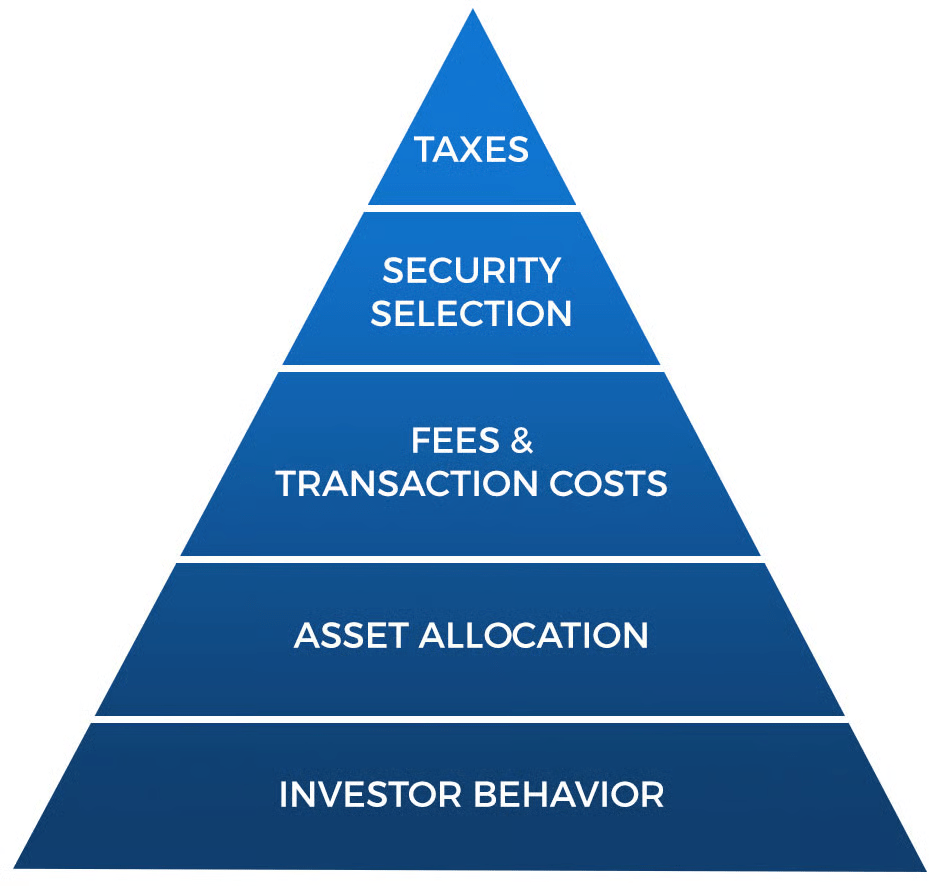
Some investing skills have to be mastered before any other skills matter at all. There is a hierarchy of needs.
At the foundation of this hierarchy are the boring but essential behaviors: living below your means, having an emergency fund, staying invested during downturns, and picking a reasonable asset allocation. These things aren’t exciting. They won’t get you likes. But they will carry you through decades of compounding.
Higher up the hierarchy are things like choosing the right stocks or funds and minimizing fees. These are useful, but only after the foundation is strong. Otherwise, you’re just rearranging furniture in a house with shaky walls.
“I love the challenge … it’s one of the greatest joys of my life, but does it fill the deepest wants and desires of my heart? Absolutely not.”
That was the killer quote from a recent interview with the world’s number one golfer, Scottie Scheffler, that went viral this week. And I think this one went viral for a reason: It taps into a universal truth or two about humanity that we know at a subconscious level, but that rarely shines through the manic malaise of our achievement-oriented culture.
“It feels like you work your whole life to celebrate winning a tournament for a few minutes – it only lasts a few minutes, that euphoric feeling,” Sheffler further explained. “You win it, you celebrate, get to hug my family, my sister’s there, it’s such an amazing moment. Then it’s like, ‘OK, what are we going to eat for dinner?’ You know, life goes on.”
While his language is a touch more approachable, Sheffler is practically quoting ancient wisdom literature attributed to the world’s then (in the 10th century, BC) number one, King Solomon, in Ecclesiastes: “Then I considered all that my hands had done… and behold, all was vanity and a striving after wind, and there was nothing to be gained under the sun.”
That fading feeling is explained in the field of behavioral economics through the term “hedonic adaptation.” This theory notes that we, as humans, can marshal an enormous amount of energy to achieve certain goals, only to experience a pretty rapid dilution of the intensity felt in peak moments.
The other upside of hedonic adaptation is that it doesn’t just apply to the good and great things we experience, but also to the bad and even horrible. Yes, humans are designed to bounce back pretty quickly, and that, too, is explained by hedonic adaptation.
So, if being the very best in the world at something doesn’t provide lasting satisfaction, what does?
“Every day when I wake up early to go put in the work, my wife thanks me for going out and working so hard. When I get home, I try and thank her every day for taking care of our son.… I’d much rather be a great father than I would be a great golfer. At the end of the day, that’s what’s more important to me.”
Between 2003 and 2024, the amount of time that Americans spent attending or hosting a social event declined by 50 percent. Almost every age group cut their party time in half in the last two decades. For young people, the decline was even worse. Last year, Americans aged 15-to-24 spent 70 percent less time attending or hosting parties than they did in 2003.
As late as the 1970s, the average US household entertained friends at home about 15 times a year and went out to a friend’s place about every other week. After the 1970s, Americans pulled back from just about every form of socializing. By the late 1990s, the share of Americans who said they visited the homes of friends in the previous week had declined by more than 40 percent.
Women have long been the keepers of the family social calendar. Wives, not husbands, historically planned the quilting parties, the bridge games, and the neighborhood potlucks. But in the second half of the 20th century, many women swapped unpaid family jobs for salaried positions. In 1970, right around the inflection point of America’s social decline, the share of women between 25 and 54 who participated in the labor force surged past 50 percent for the first time; it’s currently near 80 percent. As more women poured their weekdays into 9-to-5 work, men failed to take over the logistical labor required to fill out the social calendar, and adult gatherings gradually eroded in the age of the dual-earner household.
Meanwhile, parenting norms have changed. Americans used to have more kids whom they watched less; now they have fewer children whom they watch more. Between 1975 and 1998, they found, mothers increased the amount of time they spent with their kids by about 200 minutes a week. For married fathers, the increase was even more dramatic—about 240 minutes per week. Parents are more anxious than they used to be, not only about neighborhood crime and playground accidents, but also about their children’s achievements.
It’s impossible to host a cocktail party when your second job is to be your son and daughter’s part-time limo driver who escorts them to 13 weekend extracurricular activities (that you kind of forced them to do, in the first place).
Then, there are the screens. The television landed in the US living room in the middle of the 20th century like an asteroid from deep space, displacing settled habits and sending ripples through the social fabric. Between 1965 and 1995, the typical American’s leisure time grew by about 300 hours a year, but we seem to have spent almost all those hours watching more TV. By the 1980s, people who said that television was their “primary form of entertainment” were less likely to engage in practically every other form of social interaction.
I don’t like the simplistic idea that smartphones are purely anti-social. Digital technology has not obliterated our social connections but rather warped them. Many of us spend hours every week with our favorite TikTok stars, YouTube gurus, Instagram influencers, Twitter gadflies, podcast buddies, Reddit friends, and other people we kind of know and sort of care about, even though they might not even know we exist, at all. Keeping up with these people—watching them, listening to them, giving ourselves over to them—necessarily requires pulling our focus out of the world of flesh and blood. To be a citizen of the Internet is to spend hundreds of hours inside the minds of virtual people we couldn’t party with, even if we desperately wanted to.
Finally, while one needn’t be drunk to have a good time with others, I cannot ignore the fact that the great American party deficit has coincided with an extraordinary decline in teen drinking. Last year was the first on record, going back to 1975, that fewer than 50 percent of high school seniors said they’d ever had a drink of alcohol.
Like the rise of the dual-earner household, the turn against alcohol among the same young people whose socialization has plunged is a complicated phenomenon that defies easy good-bad categorization. I cannot deny that abstinence is good for young people’s livers; but I worry that it’s part of a larger set of behaviors that’s bad for their hearts.
What if gold goes the way of diamonds? The supply of gold is limited – limited by miners’ ability to dig it out of the ground and process it, what happens if a new supply of gold comes online? Not a new mine, but actual alchemy. A company researching fusion energy, Marathon Fusion, believes that it could produce gold alongside energy:
Marathon’s proposal is to also introduce a mercury isotope, mercury-198, into the breeding blanket and use the high-energy neutrons to turn it into mercury-197. Mercury-197 is an unstable isotope that then decays over about 64 hours into gold-197, the only stable isotope of the metal.
While the science needs to be confirmed, it seems not out of the realm of possibility. If so, it has big implications for fusion energy AND the gold market itself.
Another industry is already facing pressure from an ‘artificial’ competitor: Diamonds can now be made in labs that mimic the earth’s extreme pressure and temperatures, but for a fraction of the price. A decade ago, such man-made gems were novel. Today they are mainstream, and increasingly challenging the perception of diamonds as a luxury accessory.
This is bad news for the ‘natural’ diamond industry, which is facing incredible pricing pressure. The industry’s response seems to be to double down on the natural aspects of traditional diamonds and hope that they can at least hold the high end of the market.
Nobody knows if large scale production of gold will eventually come online. Even if it does, it is years, if not decades, into the future. The point here is to think through the hypothetical impact of an abundant gold supply. For example, would gold still a be a store of value if it’s supply were dramatically increased? Would we find new and novel uses for a now abundant shiny metal?
Self-Defeating Prophecy: A prediction causes behavior that prevents it from coming true.
The Taco (Trump Always Chickens Out) trade logically follows: whenever President Trump announces something that causes markets to swoon, buy during the fainting spell and wait for the clucking sound to emerge from the White House.
It all makes sense until you start to pull on the loose end of the logical thread. Why did Trump chicken out? Because the markets panicked when he announced a dramatic act of self-harm. But the fact that the markets were so alarmed in early April suggests that they weren’t really swallowing the Taco hypothesis.
Then came May; US equity markets had a great month despite the prospect of Trump’s 90-day “pause” expiring soon, the random imposition of further tariffs and the unsettling new prospect that Congress planned to give the administration powers to levy taxes on selected foreign investors at will. Perhaps the markets had finally digested the truth about Taco?
Which raises the possibility that the Taco trade will eat itself. The markets could become overconfident, taking Trump neither literally nor seriously. The market ignores him.
Then the next step: the horrifying realization that since the market has not blinked, Trump is not actually planning to chicken out. The step after that? The market will belatedly plunge, Trump will belatedly chicken out and the markets will be saved — until the next time.
If that isn’t enough to send you into a spin, consider this: perhaps Trump’s pride will be so wounded by all the Taco talk that he will stop chickening out altogether.
This spiraling chain reaction may all seem like an Escher fever-dream, but the underlying point is simple and could come from a Greek tragedy: when you try to predict the future, you risk changing it.
This effect is at work in any financial market. Everyone who successfully spots a bargain contributes to that bargain vanishing. The same dynamic is at play any time you try to decide which line to join at a supermarket or at passport control: once everyone has rushed to join the shortest line, it is no longer the shortest.
One notorious example from the history of computing is the “Osborne Effect”, named, perhaps unfairly, after the shortlived Osborne Computer Corporation. In the early 1980s, Osborne made an early and enormously covetable portable computer, but went bankrupt after prematurely announcing that new and better models were on the horizon. Demand for Osborne’s inventory is said to have collapsed because customers were waiting for the improved product to arrive.
This interacts with the preparedness paradox: the better you prepare for a problem, the more it seems that you were being silly because there was never a serious problem in the first place. From pandemic surveillance to nuclear deterrence, it can be hard to distinguish a far-sighted policy from a foolish waste.
Consider vaccination. Successful vaccination campaigns make common illnesses seem rare — giving credence to those who suggest vaccination is a needless risk. Global agreements to restrict CFC gases have helped the ozone hole to heal — and now, of course, there are people on social media asking why everyone lost their minds about an environmental problem that was so fleeting. While we’re on the subject, why do they waste all that money having guards at Fort Knox anyway? Everyone knows that place has never been robbed.
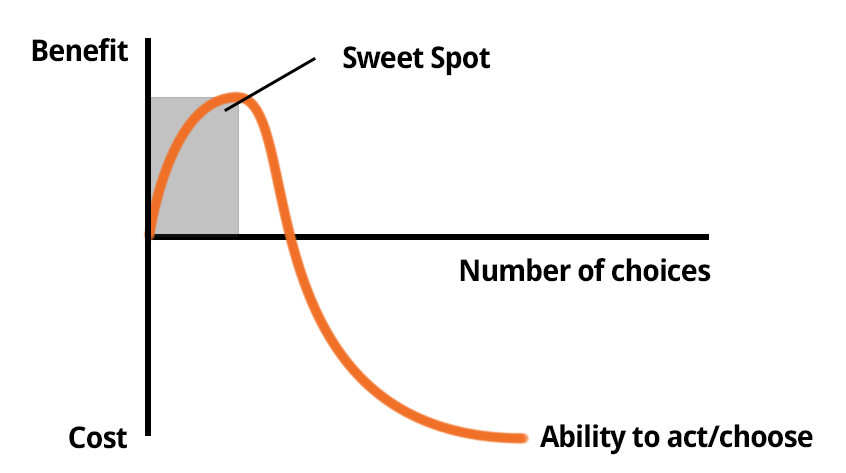
The “paradox of choice” refers to the phenomenon where having many options to choose from can lead to decreased satisfaction and make it harder to make a decision.
A study of online daters in Canada tested the idea that using the apps would make dating more efficient. Instead, researchers discovered people spent far more time on the apps looking for potential mates. With hundreds of different options to filter through — age, height, interests, etc. — there was a paralysis by analysis that overwhelmed users and caused them to second guess the choices they did make.
And the people who did find lots of matches were less likely to make a lot of selections because they were less satisfied from outsized expectations. With so many profiles to choose from, people tend to focus on the most superficial traits, meaning they were less committed to the people they were matched up with. That’s why so many of the relationships formed on the dating apps are short-term in nature.
_____________________________
Walking won’t solve everything. But it won’t make anything worse. That’s more than you can say for most things we do when we’re stressed, tired, or lost. You walk to get out of your head. To breathe. To let your mind drift without crashing. You don’t walk to fix the problem—you walk because you need space from it. The world doesn’t look so cruel when you’re moving through it one step at a time. You notice things. You remember you’re alive. So when in doubt—go for a walk.
______________________________
In recent years, some researchers completed a 70-year long study on happiness. They took a graduating class from Harvard, and measured every aspect of their lives. What types of jobs they got, what their politics were, how many kids they had, where they lived—even the length of their scrotums!
They were trying to find what behaviors or characteristics had the highest correlation with self-reported happiness. You know what they found out? Nothing! After 70 years, they never got to the bottom of it.
But they did find out one interesting thing—the people in the study who reported the lowest levels of happiness reported the highest levels of alcohol consumption. We don’t know what makes people happy, but we know what makes them unhappy—alcohol! I’m not talking about the occasional drink at a party—I’m talking about alcohol abuse. Did you know that 10% of people consume 60% of all alcohol? Found that out recently.
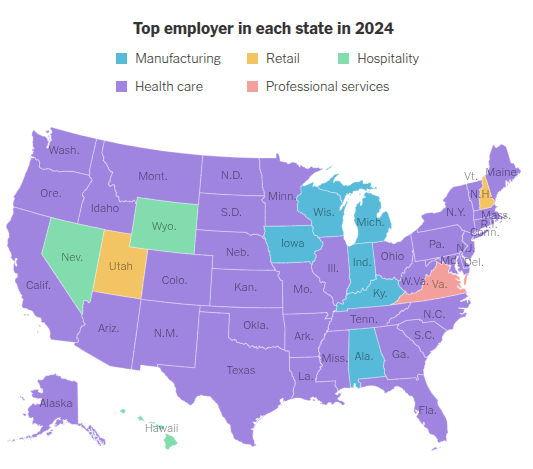
How Health Care Remade the U.S. Economy. For years, the United States labor market has been undergoing a structural transformation. As jobs in manufacturing have receded, slowly but steadily, the health care industry has more than replaced them.
___________________________
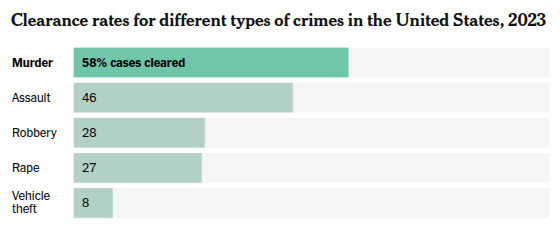
In the United States, people often get away with murder. The clearance rate — the share of cases that result in an arrest or are otherwise solved — was 58 percent in 2023, the latest year for which F.B.I. data is available. And that figure is inflated because it includes murders from previous years that police solved in 2023.
In a recent interview, Dwarkesh asked legendary bio-researcher George Church for the most under-hyped bio-technologies. His answer was both surprising and compelling:
What I would say is genetic counseling is underhyped.
What Church means is that gene editing is sexy but for rare diseases carrier screening is cheaper and more effective. In other words, collect data on the genes of two people and let them know if their progeny would have a high chance of having a genetic disease. Depending on when the information is made known, the prospective parents can either date someone else or take extra precautions. Genetic testing now costs on the order of a hundred dollars or less so the technology is cheap. Moreover, it’s proven.
The winner? Hot water immersion. Among young, healthy adults, soaking in hot water triggered the strongest responses across the board, helping the body regulate temperature, boost circulation, and even enhance the immune system more effectively than either sauna style.
____________________________
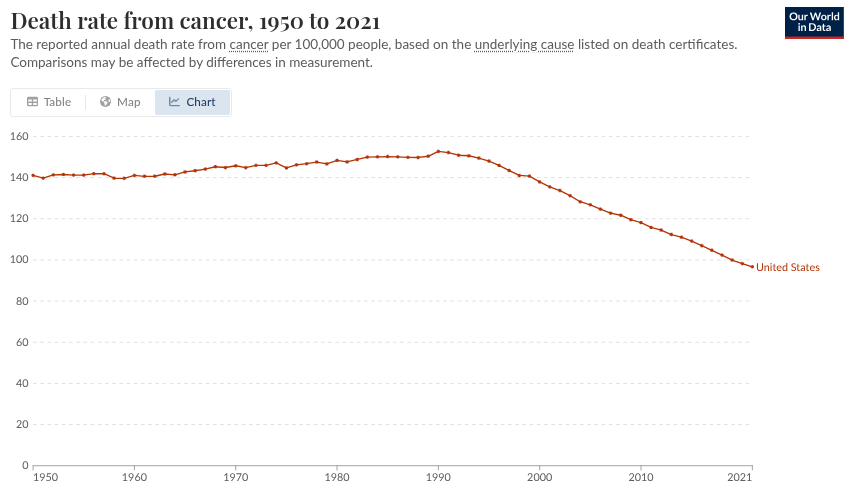
Recent good news on the cancer front is everywhere, if you know where to look. In June 2025, a French study compared data from all patients diagnosed with lung cancer in public hospitals in France in 2020 with data from similar studies performed in 2000 and 2010. Researchers found that the three-year survival rate for lung adenocarcinoma rose from about 16 percent in 2000 to about 39 percent in 2020, thanks to both earlier diagnosis and better targeted treatment. That means lung cancer survival rates have more than doubled in this century alone.
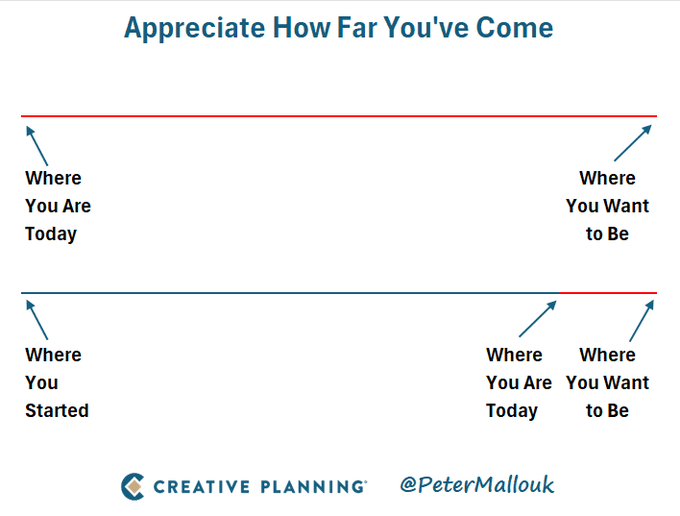
_____________________________ All of us are really good at measuring the gap between where we are and where we want to be, but make sure to pause occasionally and appreciate how far you’ve come.
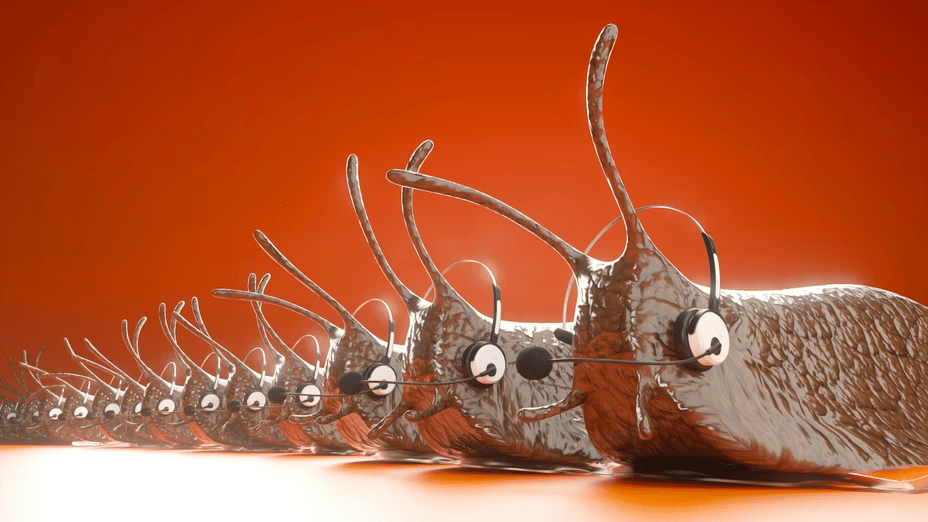
In the 2008 best seller Nudge, the legal scholar Cass R. Sunstein and the economist Richard H. Thaler marshaled behavioral-science research to show how small tweaks could help us make better choices. An updated version of the book includes a section on what they called “sludge”—tortuous administrative demands, endless wait times, and excessive procedural fuss that impede us in our lives.
Sludge is often intentional,” said a professional that works in the customer service call center industry. “Of course. The goal is to put as much friction between you and whatever the expensive thing is. So the frontline person is given as limited information and authority as possible. And it’s punitive if they connect you to someone who could actually help.”
Helpfulness aside, I mentioned that I frequently felt like I was talking with someone alarmingly indifferent to my plight.
“That’s called good training,” Tenumah said. “What you’re hearing is a human successfully smoothed into a corporate algorithm, conditioned to prioritize policy over people. If you leave humans in their natural state, they start to care about people and listen to nuance, and are less likely to follow the policy.”
For some people, that humanity gets trained out of them. For others, the threat of punishment suppresses it. To keep bosses happy, Tenumah explained, agents develop tricks. If your average handle time is creeping up, hanging up on someone can bring it back down. If you’ve escalated too many times that day, you might “accidentally” transfer a caller back into the queue. Choices higher up the chain also add helpful friction, Tenumah said: Not hiring enough agents leads to longer wait times, which in turn weeds out a percentage of callers. Choosing cheaper telecom carriers leads to poor connection with offshore contact centers; many of the calls disconnect on their own.
“No one says, ‘Let’s do bad service,’” Tenumah told me. “Instead they talk about things like credit percentages”—the number of refunds, rebates, or payouts extended to customers. “My boss would say, ‘We spent a million dollars in credits last month. That needs to come down to 750.’ That number becomes an edict, makes its way down to the agents answering the phones. You just start thinking about what levers you have.”
“Does anyone tell them to pull those levers?” I asked.
“The brilliance of the system is that they don’t have to say it out loud,” Tenumah said. “It’s built into the incentive structure.”
That structure, he said, can be traced to a shift in how companies operate. There was a time when the happiness of existing customers was a sacred metric. CEOs saw the long arc of loyalty as essential to a company’s success. That arc has snapped. Everyone still claims to value customer service, but as the average CEO tenure has shortened, executives have become more focused on delivering quick returns to shareholders and investors. This means prioritizing growth over the satisfaction of customers already on board.
Customers are part of the problem too, Tenumah added. “We’ve gotten collectively worse at punishing companies we do business with,” he said. He pointed to a deeply unpopular airline whose most dissatisfied customers return only slightly less often than their most satisfied customers. “We as customers have gotten lazy. I joke that all the people who hate shopping at Walmart are usually complaining from inside Walmart.”
In other words, he said, companies feel emboldened to treat us however they want. “It’s like an abusive relationship. All it takes is a 20 percent–off coupon and you’ll come back.” Supervisors don’t tell customer service workers to deceive or thwart customers. But having them get frustrated and give up is the best way to meet numbers.
Sometimes they intentionally drop a call or feign technical trouble: “‘I’m sorry, the call … I can’t … I’m having a hard time hearing y—.’ It’s sad. Sometimes they drag out the call enough that customers get agitated, or say things that get them agitated, and they hang up.”
Even if an agent wanted to treat callers more humanely, much of the friction was structural, a longtime contact-center worker named Amayea Maat told me. For one, the different corners of a business were seldom connected, which forced callers to re-explain their problem over and over: more incentive to give up.
“And often they make the IVR”—interactive voice response, the automated phone systems we curse at—“really difficult to get through, so you get frustrated and go online.” Employees described working with one government agency that programmed its IVR to simply hang up on people who’d been on hold for a certain amount of time.
________________________
On June 12th, an anonymous trader opened a new account on Polymarket, an anonymous internet betting site that uses cryptocurrency to obscure the source of money. The new trader was interested in betting on one topic: whether the Israeli military would strike Iran within the next 24 hours, by Friday, June 13th.
As the 13th approached, most people thought it was unlikely, but this new account seemed convinced that airstrikes were imminent. The trades started during a one-hour period around 12pm; $1,728 of bets in the first one, then another $311, $280, $560. Then, between 10pm and midnight, with time running out, they accelerated their betting, showing their confidence by ramping up the bets, putting about $20,000 in total at risk.
Three and a half hours later, Israel struck Iran in a surprise attack—and the Polymarket trader cashed out. They had made a total of $134,000 in profits. After taking their winnings, they closed the account, never trading again. This was probably a case of geopolitical insider trading. Someone who knew that the strike was imminent decided to use that knowledge to make a lot of money anonymously through online betting markets.
This is pretty dystopian: individuals, state actors, even terrorist groups can decide to bet on their own behavior, even their own uses of violence. There’s nothing stopping someone who’s a high-profile political actor—or the people around them—from betting on an outcome, then making comments or posting something on, say, Truth Social or X, that inevitably affects public perceptions about a likely course of action. They can drive the price up or down at will, knowing full well that they can ultimately decide whether the value of a “share” goes to $0.00 or to $1.00. And then, they can anonymously cash out, with nobody the wiser. It’s the Wild West of insider trading.
Ranked: The World’s Most Common Passwords. The data comes from NordPass, which analyzed the most frequently used passwords based on a 2.5 terabyte database of credentials exposed by data breaches. All of the passwords below would take a hacker less than 1 second to crack.
According to NordPass, your password should be at least 20 characters long and include uppercase and lowercase letters, numbers, and special symbols. They suggest that you never reuse passwords. If one account were to be compromised, other accounts that share the same password could also be at risk.
_______________________________
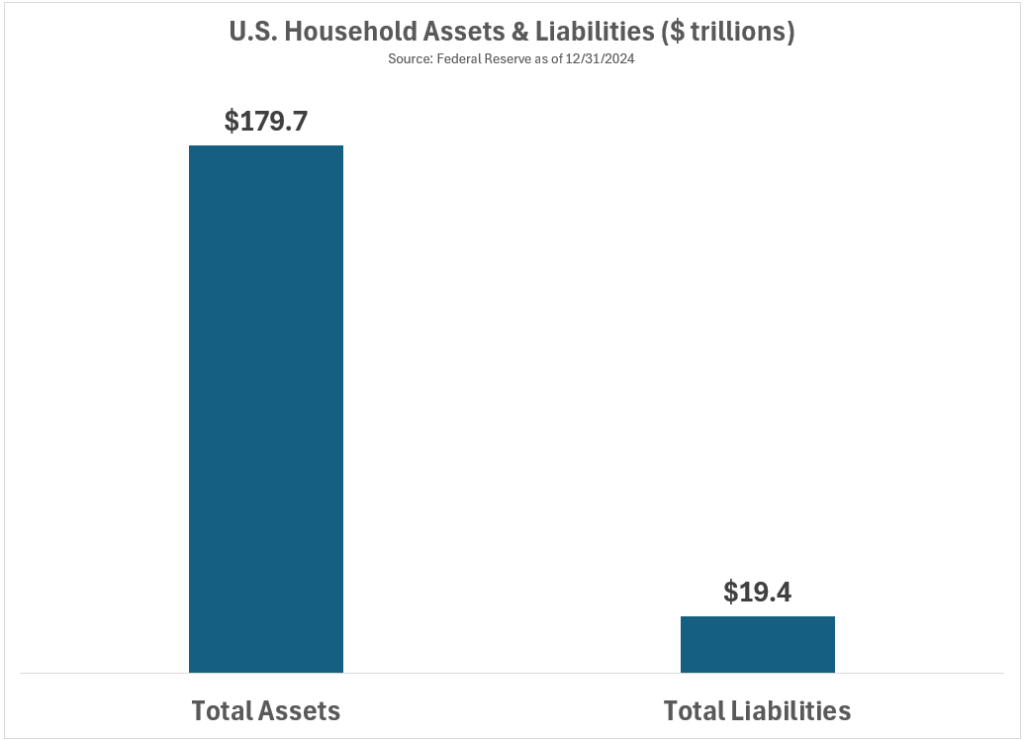
American household leverage is the lowest in 50 years. The leverage ratio is liabilities (mortgage, auto, credit, student loans) divided by the price of assets they own (stocks, bonds, real estate,).
Stock price gains help the top 10% wealthiest families disproportionately, but the biggest improvement in the leverage ratio above for most American families comes from home prices:
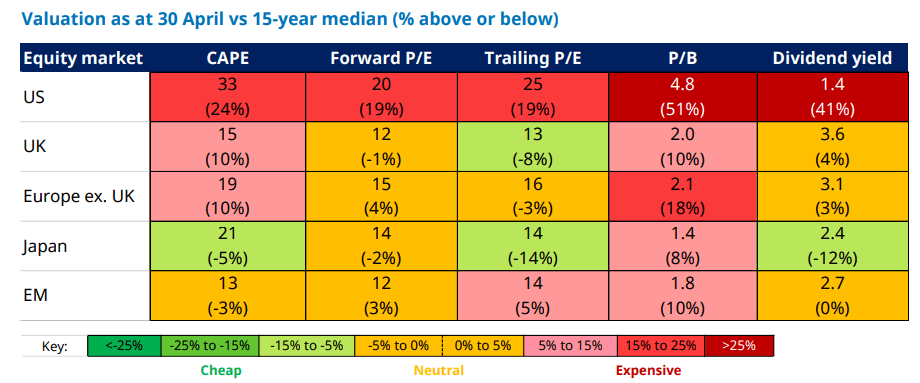
A higher price to earnings ratio means a country’s stock market is more expensive. A lower number is less expensive. It’s the price you are paying for the earnings of the companies.
United States Stock Market: 36
Average of Foreign Developed Stock Markets: 20
Average of Foreign Emerging Stock Markets: 17
*Abbreviations:
CAPE: Cyclically Adjusted Price Earnings – a valuation measure that uses real earnings per share (EPS) over a 10-year period to smooth out fluctuations in corporate profits that occur over different periods of a business cycle.
CAPD: Cyclically Adjusted Price Dividends – a valuation measure that uses dividends over a 10-year period to smooth out fluctuations in corporate profits that occur over different periods of a business cycle.
CAPCF: Cyclically Adjusted Price Cash Flow – a valuation measure that uses cash flow over a 10-year period to smooth out fluctuations in corporate profits that occur over different periods of a business cycle.
CAPB: Cyclically Adjusted Price Book – a valuation measure that uses book value over a 10-year period to smooth out fluctuations in corporate profits that occur over different periods of a business cycle.
Here’s a surprising truth it took me ages to grasp: by far the best way to spend more of your life doing meaningful, rewarding and difference-making things is to really feel the deep sense in which youdon’t need to do any of that stuff at all.
At public events, people sometimes ask what advice I’d give my fourteen, sixteen or eighteen-year-old self – which is a ticklish question, partly since I’m sure my teenage self would have scoffed at being lectured at by the late-forties version. And he might have been right to do so; I think you probably have to just go through a certain amount of experience, in order to learn about life, instead of having wisdom dispensed by your elders.
Still, the honest answer is that I’d say something like this: “You do realise you don’t absolutely have to do any of this, right – the good grades, the praiseworthy accomplishments, ‘fulfilling your potential’ and all the rest? It’s all great, and it matters, but do you understand that it doesn’t matter matter? That the sky won’t fall in if you chill out a bit, and that people who don’t always ‘do their best’ or ‘fulfill their potential’ are allowed to enjoy life, too?”
The spiritual teacher Michael Singer says somewhere that the basic stance most of us take toward the world is that we try to use life to make ourselves feel OK. And this is certainly true of the type psychologists label ‘insecure overachievers’, who often accomplish plenty of impressive things, but who do so, deep down, because we don’t believe we’d have earned the right to feel good about ourselves, or to relax into life, if we didn’t.
It’s a soul-crushing way to live, not least because it turns each success into a new source of oppression, since now that’s the minimum standard you feel obliged to meet next time. A hugely successful author once told me he knew something was amiss when the experience of reaching the upper echelons of the bestseller list, previously a cause of excited disbelief, instead brought only relief that he hadn’t failed to replicate his prior achievement.
Most productivity advice, I think, caters to people mired in this mindset. It promises ways to help you take so much action, so efficiently, that you might one day get to feel good about yourself at last. Which isn’t going to work – because the real problem isn’t that you haven’t yet done enough things, or got good enough at doing them. The real problem is the fact that for whatever combination of reasons in your childhood, culture or genes, your sense of self-worth and psychological safety got tethered to your productivity or accomplishments in the first place.
But there exists another, very different sort of productive action: the kind you take not because you feel you have to, in order to feel OK, but precisely because you understand that you don’t have to – because you already feel basically OK about yourself, so now of course you want to take action, because action is how you express your enjoyment in being alive, being good at a few things, and being able to use your talents to make some kind of difference in the world, alongside other people.
One of the most important consequences of all this, for me, has been the realisation that when you begin to outgrow action-from-insecurity, you don’t have to give up on being ambitious. On the contrary: you get to be much more effectively and enjoyably ambitious, if that’s the way you’re inclined.
I’ve long been allergic to the notion, prevalent in self-help circles, that if you truly managed to liberate yourself from your issues, you’d ideally spend your days just sort of passively floating around, smiling at everyone, maybe attending the occasional yoga retreat, but not much more. “The more I heal, the less ambitious I become” is a phrase I’ve encountered multiple times online in recent months. And yes, sure, if your ambition was only ever a function of anxiety, becoming less ambitious would be an excellent development. Then again, the desire to create remarkable outcomes in your creative work, relationships or community – or even just in your bank balance – might just be an authentic part of who you are, once the clouds of insecurity begin to clear.
So you don’t need to choose between peace of mind and the thrill of pursuing ambitious goals. You just need to understand those goals less as vehicles to get you to a future place of sanity and good feeling, and more as things that unfold from an existing place of sanity and good feeling. (Besides, I’ve got to believe that ambition pursued in this spirit is far likelier to make a positive difference in the world.)
Obviously, if you’re deeply stuck on insecure-overachiever mode, merely reading about the alternative in a newsletter isn’t going to solve everything. Nor do I mean to suggest that every task becomes an undiluted joy when you re-frame action in this way – or that there aren’t plenty of things you “need to do” for reasons other than feeling OK about yourself, such as keeping food on the table.
But it can be strikingly liberating just to begin, however gingerly, to experiment with the idea that, actually, you could just do the minimum. You really could. You could not try to impress, or be extraordinary, or do your best, or fulfill your potential (whatever that even means). And you would still be fully entitled to a relaxed and enjoyable life.
I went into my conversations with college career executives expecting to hear about AI replacing work. What I heard instead is that AI is transforming everything around work. The transition from college to the workforce is fully drenched in artificial intelligence. AI is automating homework, obliterating the meaning of much testing, disrupting the labor-market signal of college achievement and grades, distorting the job hunt by normalizing 500+ annual applications per person, turning first-round interviews into creepy surveillance experiences or straight-up conversations with robots, and, oh, after all that, maybe kinda beginning to saw off the bottom of the corporate ladder by automating some entry-level jobs during a period of economic uncertainty. This really is a hard time to be a young person.
___________________________
Even if Trump’s tactics improbably succeed in changing Jerome Powell’s mind, they would change only one vote out of 12 on the Federal Open Market Committee. The FOMC’s decision at its June 18 meeting to leave the Fed funds rate unchanged was unanimous. Furthermore, seven of the 19 officials who are eligible for the 12 voting positions predicted there will be no rate cuts for the remainder of 2025, up from four in March.
The Federal Reserve did a study that looked into the financial habits of Canadians whose neighbors won the lottery. The neighbors of people who struck it rich were more likely to increase their spending, take on more debt, put more money into speculative investments, and eventually file for bankruptcy. And the larger the winnings, the more likely that others in that neighborhood would go bankrupt.
It’s in our flawed nature to compare ourselves to others, particularly people we see and interact with every day. Money insecurity leads us to compete and not appreciate what we have. Also true, though, is that the research shows one thing for certain: The Joneses aren’t very happy.
An examination of 259 different independent samples found that materialism was “associated with significantly lower well-being” and was a poor way of meeting psychological needs. The researchers’ findings suggest that this association holds across different demographics, participants, and cultural factors. Another meta-analysis of 92 studies found that those pursuing goals of growth, community, giving, and health experienced significantly higher levels of well-being than those pursuing the Jones-y goals of wealth, fame, or beauty.
You’ll never be content trying to keep up with the Joneses because there is an endless supply of them to keep up with. There are always people spending more money, taking nicer trips, buying bigger houses and making more money than you are.
There was another classic psychological study that compared lottery winners with people who were paralyzed in an accident. Surprisingly, the lottery winners weren’t significantly happier than the average person and actually reported less enjoyment from everyday experiences. The big win seemed to raise their expectations, which made small daily pleasures feel less satisfying.
In contrast, many accident victims rated themselves as moderately happy, despite their life-altering injuries. While thinking about their past lives sometimes made them feel worse, they still found deep meaning and enjoyment in ordinary things because they appreciated them more. After major life changes, people adjust their expectations. Lottery winners adjusted upward and felt less satisfied. Accident victims adjusted downward and found more value in the little things.
Nothing was the same after June 28, 1914. The assassination of Archduke Franz Ferdinand triggered a chain of events that led to WWI and closed the NYSE for months. One month to the day of the assassination, Austria-Hungary declared war. Three days later, Henry Noble, president of the NYSE, closed the exchange. Other regional U.S. exchanges in Chicago, Baltimore, San Francisco, Philadelphia, and other cities followed suit. Most major exchanges around the world closed too.
Noble knew that wars demanded funds. Foreign investors could make a run on the exchange, selling securities to raise cash. The cash could then be converted into gold and shipped back to Europe. That put the U.S., being on the gold standard, in a tricky spot. Depleting the U.S. gold reserves would put faith in the dollar and adherence to the gold standard at risk.
June 28, 1914 – Archduke Ferdinand assassinated. Dow closes the next day at 57.9.
July 28, 1914 – Austria-Hungary declares war on Serbia – World War 1 begins: Dow closed 55.3.
July 30, 1914 – Dow closes 51.7.
July 31, 1914 – NYSE & regional U.S. exchanges close the markets
December 12, 1914 – NYSE reopens stock market with trading limitations.
December 14, 1914 – Dow closes 56.8.
December 14, 1915 – Dow closes 98.3.
When the stock market reopened December 12, 1914, investors had four and a half months to reassess the business environment in war time. And business was good. Over the next 12 months, the Dow soared 73% (Dec. 14, 1914, to Dec. 14, 1915, not including dividends). The U.S. became the main food and war supplier for the Allies war effort. Companies like U.S. Steel and DuPont saw profits explode 5x and 10x respectively, in a year. Dividend payments did the same. WWI is the perfect example of why geopolitical events are hard to predict. The market reacts in unexpected ways during scary confusing times.
______________________________
Reciprocity is a deeply human thing, and it applies directly to the nature of interest. If you show someone that you’re interested in them, they will reciprocate that curiosity by revealing what makes them so interesting. Believing that someone is boring is a failure of recognizing jthat fact. Boredom is almost always the result of a lack of curiosity, or the inability to see anything or anyone through the lens of a question. In a way, boredom is arrogance. It’s the acceptance of the belief that nothing is worth your interest because you already know what you need to about yourself, others, and the world. A curious mind is a humble one, as a prerequisite for curiosity is the acceptance that there is more to life than what you think you already know.
____________________________
We are a story-driven species. From cave walls to balance sheets, we look for narratives that explain the world and our place in it. And nowhere is this tendency more dangerous than when we only learn from the winners. When we allow survival alone to imply superiority. When the fact that someone or something made it through becomes enough proof that they knew what they were doing.
This is the essence of survivorship bias, and in the world of investing, it distorts almost everything. Consider the stock market, which is full of visible winners. We often hear stories of stocks that went 20x, fund managers who outperformed for a decade, companies that pivoted into success, and investors who became celebrities.
What about the others? The ones who didn’t make it? They’re barely mentioned, rarely studied, and almost never remembered. And so, the narrative we inherit is hopelessly incomplete.
Then there’s the most seductive arena of all: success stories. Business books, biographies, and podcast interviews are all proudly built on the same question: “How did you do it?”But that question, when asked only of survivors, creates a dangerous narrative. It turns randomness into wisdom and luck into method.
A founder who succeeded against all odds is praised for her vision, her grit, and her intuition. But what about the 100 others who had the same qualities and failed? What about the timing, the macro conditions, the investor interest, the random tailwinds that no one could have planned? None of that gets included in the final story. And so we start to think: this is how success works. This is the roadmap. Just do what she did.
These days I’m pretty good at avoiding the trap that’s been called “onedayism” – the tendency to live as if the really important part of life won’t truly begin until you’ve reached some far-off milestone, like finding a long-term partner, or achieving financial security, or until you’ve fixed your problem with procrastination, or once world events don’t seem so apocalyptic. (You have to find meaning, accomplishment and joy in the midst of all that, not solely once it’s all been “sorted out”.)
Yet as I’ve relaxed my grip on that sort of unconscious postponement, I’ve found it’s still easy to make the same error, just on a much shorter timescale: to proceed through the day as if my generally sane and interesting and enjoyable life can resume just as soon as I’ve got this task out of the way, cleared this batch of email, or made it through to this evening. But of course you can miss your whole life in this manner, ceaselessly focused on a point a few hours in the future, no less surely than with the longer-timescale version.
The answer definitely isn’t to beat yourself up for not yet having perfectly mastered the art of being present. (That, you might notice, is just another version of the same mistake.) But you can remind yourself to unclench a bit, to soften, to fall back into what’s really going on, here and now, and to see there’s no reason why you can’t find this very experience juicy and alive. I like how the entrepreneur Shane Melaugh puts it: “Your life plays out over your entire lifetime.” Which always includes now.
Humility: Given how little of the world we’ve experienced, in most situations we are likely wrong, especially in knowing how other people think and make decisions.
Self-Discipline: Everyone knows the famous marshmallow test, where kids who could delay eating one marshmallow in exchange for two later on ended up better off in life. But the most important part of the test is often overlooked. The kids exercising patience often didn’t do it through sheer will. Most kids will take the first marshmallow if they sit there and stare at it. The patient ones delayed gratification by distracting themselves. They hid under a desk. Or sang a song. Or played with their shoes. Delayed gratification isn’t about surrounding yourself with temptations and hoping to say no to them. No one is good at that. The smart way to handle long-term thinking is enjoying what you’re doing day to day enough that the terminal rewards don’t constantly cross your mind.
Influence: A good storyteller with a decent idea will always have more influence than someone with a great idea who hopes the facts will speak for themselves. People often wonder why so many unthoughtful people end up in government. The answer is easy: Politicians do not win elections to make policies; they make policies to win elections. What’s most persuasive to voters isn’t whether an idea is right, but whether it narrates a story that confirms what they see and believe in the world. It’s hard to overstate this: The main use of facts is their ability to give stories credibility. But the stories are always what persuade.
Balance: Someone with B+ intelligence in several fields likely has a better grasp of how the world works than someone with A+ intelligence in one field. The best thing to do is to quickly learn and accept that your field is no more important or influential to other people’s decisions than dozens of other fields, which pushes you to spend your time connecting the dots between your expertise and other disciplines. Being an expert in economics would help you understand the world if the world were governed purely by economics. But it’s not. It’s governed by economics, psychology, sociology, biology, physics, politics, physiology, ecology, and on and on.
____________________________
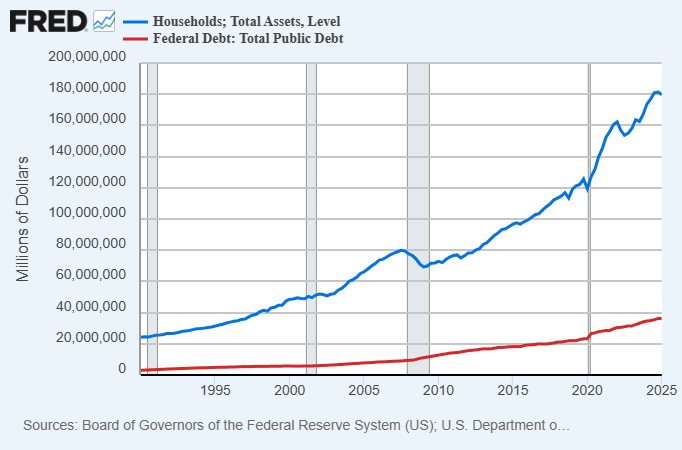
The federal government has a bit over $36 trillion in debt. To put that in context, US households collectively have $180 trillion in assets, or $160 trillion in net worth after liabilities (mostly mortgages) are subtracted.
The US monetary base is about $6 trillion. There is over $120 trillion worth of dollar-denominated loans and bonds outstanding in total (public and private, domestic and international, excluding derivatives). In the foreign sector alone, there is about $18 trillion worth of dollar-denominated debt. What this means is that there is an incredibly large amount of inflexible demand for dollars domestically and throughout the world. Everyone who owes dollars, needs dollars.
When a country like Turkey or Argentina hyper-inflates or nearly-so, it’s in a context where practically nobody outside of their country needs their lira or pesos. There’s no entrenched demand for their currency. And so, if their currency becomes undesirable for any reason (usually due to rapid money supply growth), it’s very easy to just repudiate it and send its value to Hades.
Countless specific entities around the world contractually owe countless other specific entities around the world a certain number of dollars by a certain date in time, and thus need to constantly try to get their hands on dollars. The fact that they collectively owe more dollars than there are base dollars in existence is important. That’s why the monetary base can double, triple, or more, and not be outright hyper-inflationary. It’s still a small increase relative to how much contractual demand there is for dollars. When outstanding debt greatly exceeds the number of base units, it takes a ton of printing of base units to render that base unit worthless.
Clicking “unsubscribe” in emails can lead to malicious websites testing if your email is active.
Criminals can build a files on users who click unsubscribe links, hoping to eventually extort money through scams.
Use list-unsubscribe headers, mark emails as spam or use disposable email addresses for online sign-ups.
____________________________
Cannabis use among seniors surged 46% in the last two years; 7% of adults 65 and older now report recent use.This rise isn’t just in numbers but also in diversity older users today are more likely to be women, college-educated, and higher-income. Researchers suggest legalization and growing social acceptance are contributing factors, especially in states with medical marijuana laws. The trend is especially notable among those with chronic illnesses, raising both opportunities and concerns for medical professionals trying to balance symptom relief with the complexities of aging.
_____________________________
College Baseball Has a Power Problem: Players Keep Hitting the Ball Too Hard: In the big leagues, only superstars like Aaron Judge can routinely crush the ball at speeds in excess of 115 mph. In college baseball these days, everybody’s doing it.
College baseball is seeing unprecedented exit velocities, rivaling and sometimes exceeding those in Major League Baseball.
College players are 42% more likely to hit balls at 115 mph or harder than MLB players.
The reasons for the surge in exit velocity aren’t entirely clear, but it’s creating safety concerns for pitchers, infielders or with fans sitting in the stands
___________________________
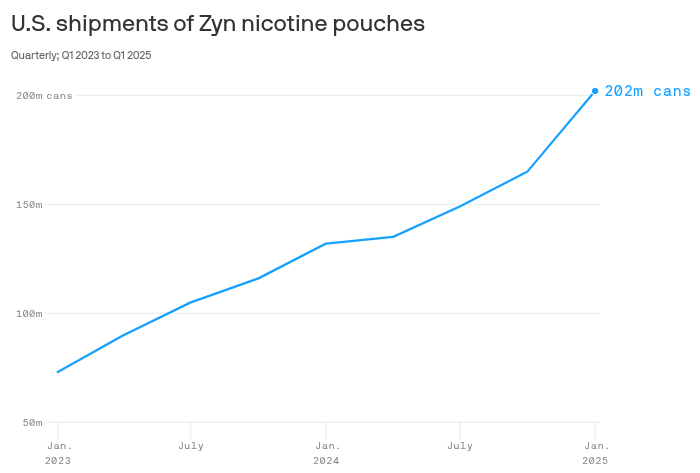
Nerds is on track to hit more than $900 million in sales this year, a more than 1,700% increase from the $50 million in sales in 2018. The unprecedented surge is directly attributed to the widely popular Nerds Gummy Clusters, which represented the first meaningful innovation for the once-sleepy brand in years. Nerds Gummy Clusters are now the top sugar confection on the market, overtaking skittles.
_____________________________
Older people will remember the time when there was – for a while – a discussion about how the US stock market had significantly higher returns overnight when the market was closed vs. the actual trading day. Those were the innocent days of an era long gone, aka 2018, when we were all naïve and enthralled by a bull market that couldn’t be derailed by anything. The graph below shows the “overnight effect” through January 2018:
This effect was so promising that it even led to the launch of an ETF in June 2022 that focused on this trade. A product that was so successful that it was liquidated in August 2023.
A new study shows that the effect disappeared after the pandemic. What makes the study interesting, though, is that they seem to find why the effect existed in the US (and not other countries) in the first place: Hype.
The number of paying Tinder users has dwindled to just 9.1 million in its most recent quarter — down 18% from a peak of 11.1 million in late 2022. While Tinder remains Match Group’s biggest brand, Hinge, another dating app under the Match umbrella, saw paying users grow 19% year over year in Q1 2025.
A boy once asked Charlie Munger, “What advice do you have for someone like me to succeed in life?” Munger replied: “Don’t do cocaine. Don’t race trains to the track. And avoid all AIDS situations.” It’s often hard to know what will bring joy but easy to spot what will bring misery. When trying to get ahead it can be helpful to flip things around, focusing on how to not fall back. Here are a few pieces of very bad advice:
Allow your expectations to grow faster than your income
Envy others’ success without having a full picture of their lives.
Mimic the strategy of people who want something different than you do.
Automatically associate wealth with wisdom.
Assume a new dopamine hit is a good indication of long-term joy.
Assume people care where you went to school after age 25.
Assume that what people can communicate is 100% of what they know or believe.
But real learning doesn’t usually follow that path. Instead, we often hit long plateaus, followed by sudden breakthroughs.
If we’re expecting constant progress, those plateaus can feel like failure. But they’re not failure. They’re part of the process.
This is where a lot of people give up. When you’ve been practicing, trying, doing the work, and it feels like nothing’s happening, it’s tempting to walk away.
But you may be much closer to a breakthrough than you think. Sometimes, just around the corner, something clicks—and you’re suddenly at the next level.
It’s not always a flat line before a breakthrough. Sometimes you make slow, steady gains. Sometimes it feels like you’re backsliding. Sometimes it gets messier before it gets clearer. But underneath the surface, your brain is making connections. Your understanding is deepening. The dots are starting to line up. Eventually, that invisible progress becomes visible.
__________________________
There is a reason why people find the financial markets endlessly fascinating. They haven’t been solved. The complexity of markets is dizzying, and in complex situations even the iron laws of physics can produce surprising, unstable results (think of airplane turbulence). More important still, finance is ultimately driven by people, not particles, and they do not always respond to similar stimuli in similar ways. They look at what happened last time, try to do better, anticipate what other traders will do and seek to outfox them. The absence of fundamental laws in markets is frustrating, disorientating—and what makes them so interesting.
There is certainly plenty to learn about the markets. But there is a case for learning as much as you can about finance and the markets and then easing back. There’s this weird dynamic in personal finance where you have to go deep at first. You need to learn enough to protect yourself. To build a plan. To avoid getting fleeced. But once that plan is in place, ideally you should be able to step back.
One of the main reasons people make behavioral mistakes when investing: the power of stories.Humans interpret the world through stories, and financial markets are narrative generating machines. When we make poor investment decisions, they are inevitably deeply intwined with a story we are using to interpret a complex and chaotic environment. It is easy to look at historic financial market events with equanimity because we know how these stories unfolded; it is an entirely different proposition when we are in the midst of an event – because we don’t know how the story will end. So, we make up our own ending and invest accordingly.
__________________________
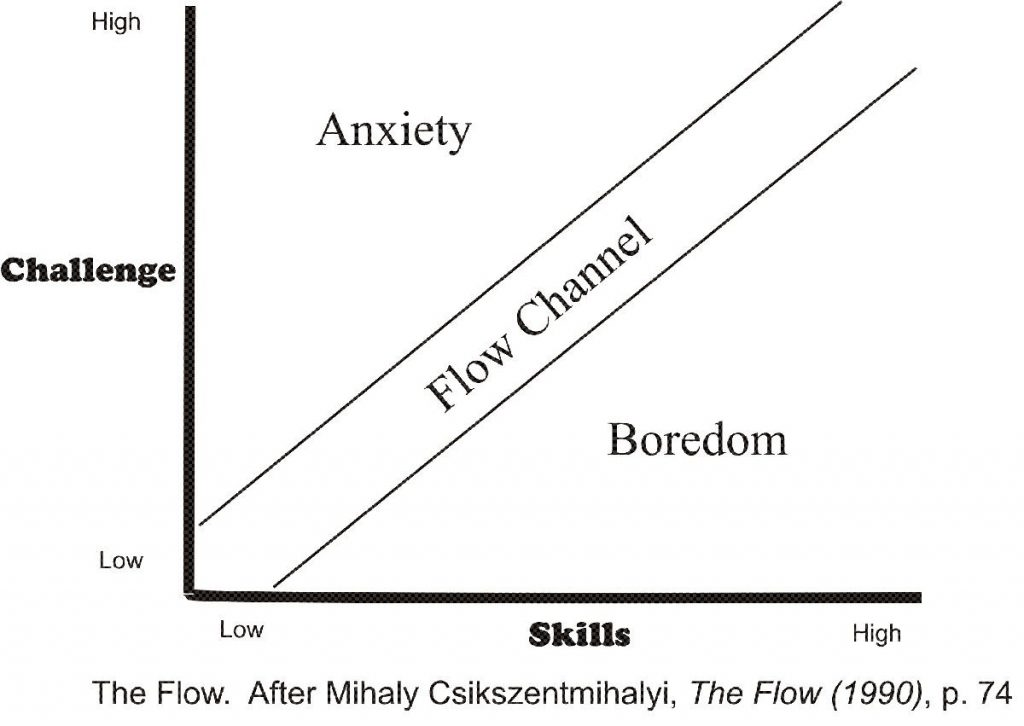
Modern neuroscience distinguishes between two mental states: one of striving, where a surge of dopamine keeps us laser-focused on external goals like winning, perfection or achievement – and another of serene presence, where we hover in the moment, simply being. In this latter state, our neural chemistry shifts; endogenous opioids and endocannabinoids fill the brain, bringing feelings of deep satisfaction, fulfillment and joy in the now.
Motivation psychologists distinguish these two states as extrinsic and intrinsic motivation for what we’re doing. The former takes hard work and discipline to keep us going. The latter propels us forward, as by magic: flow.
Repetition: the repeated movements of our craft – the physical routines we practice over and over – follow us everywhere. Whether we call it practice or technique, these repeated actions shape our brains in powerful ways, often without us even realizing it.
They form unique connections in the brain – linking movement, memory and emotion. These connections stretch across the parts of the brain that control movement, wrap around the areas responsible for memory, and reach deep into the emotional core of the brain – the limbic system. That includes the insula, a region that helps manage both our physical health and our inner sense of self.
‘Muscle memory’ doesn’t live in our hands or legs.The real control centre is in the brain. This is where movement begins, guided by systems that plan and initiate what we do. From there, messages travel through long chains of nerve cells – from the brain down the spine and out to the rest of the body. Millions of tiny electrical signals, known as action potentials, move back and forth, telling our muscles, organs and even the tips of our fingers what to do next.
The idea is to ‘program’ the right moves in our brain so they become so automatic we can use them to, yes, feel, and to find flow. The prefrontal cortex part of our brain matures last in our individual development, with restructuring continuing well into our 20s. These parts of the brain are very ‘plastic’, meaning that they are easily shaped by experience and learning. So they are also key to the development of technique in our craft – be that in science, the arts or other fields – because they are suited to rule-based learning.
Neuroplasticity is our brain’s capacity to learn; to forge new connections between neural systems, as we practice something with our body. Professional singers and actors do daily vocal exercises, dancers do daily barre exercises – the same moves over and again – and musicians are known for their never-ending scales practice that drives neighbors up the wall. What may seem a strange, repetitive, even boring activity that artists, scientists and other creatives engage in daily is in fact doing magic to their brains.
Repeating something consciously – in this context meaning exercising those prefrontal systems of the brain – is quite effortful, and it needs a lot of energy and attentional resources. Therefore, our brain starts to forge connections that let the movements we’re practicing pass from explicit, effortful memory systems into implicit, almost automatic memory systems.
This works a bit like learning a new language. First, we learn the words, the basic grammar, and we make many mistakes. It is effortful and we have to think before uttering any sentence at all. But as we repeat the words, practice verbal tenses and vocabulary over and over, our brain realizes the repetition and transports the skill of that new language from explicit to implicit memory systems.
That’s why the advice to ‘just let go’, ‘be in the present’ and ‘feel it’ are unhelpful to find flow. When flow happens to you, it may well feel magical, it might feel like you’re ‘letting go’. You feel a strange fusion of your movements and your awareness, and you’re somehow entirely entrapped in the present. It’s still early days to say exactly how this works, but it has to do with those low-level, implicit memory systems that encode movements that we internalize with technique practice. Then, the prefrontal systems deactivate while we let the implicit motor memory systems do their job. That’s when you use that skill to express and find flow.
But this is a neural process that happens outside of your conscious awareness, you can’t do this at will. Repetitive movement practices have a wonderful side-effect if used well: they remove uncertainty from our brain. Uncertainty is part of all our lives to a larger or lesser extent; and it is among the chief killers of our calm. Being in flow makes us escape from the unpredictability of life.
Life is unpredictable, and our senses can’t always find something recognizable to cling to. When our ability to predict is weakened and our brain is put on alert, this mind-absorbing state can make us feel miserable. We can regain our footing by controlling our surroundings or other people, but if flow is what we seek, we’ll fail. What we need instead are routines in our day to create habits of well-being in our mind, because our brain will, during those periods of routine, know exactly what’s going to happen next.
While anti-smoking policy has been the single biggest lifesaver, other interventions have helped reduce people’s cancer risk. One of the biggest successes is the HPV vaccine. Cervical cancer deaths in US women under 25 fell about 62 percent, a decline researchers attribute largely to the HPV vaccine.
The next revolution is better and earlier screening. It’s generally true that the earlier cancer is caught, the better the chances of survival.
Most exciting of all are frontier developments in treating cancer. From drugs like lenalidomide and bortezomib in the 2000s, which helped double median myeloma survival, to the spread of monoclonal antibodies, real breakthroughs in treatments have meaningfully extended people’s lives — not just by months, but years. Perhaps the most promising development is CAR-T therapy, a form of immunotherapy. Rather than attempting to kill the cancer directly, immunotherapies turn a patient’s own T-cells into guided missiles.
__________________________
There is so much we don’t know about the deep ocean, but what we do know is astonishing. The ocean’s deepest point extends approximately 36,000 feet below the surface. Beyond 600 feet, light no longer penetrates, making photosynthesis impossible, yet 98% of marine life resides on or near the sea floor. Life at these depths depends almost entirely on “marine snow”—organic matter drifting down from the ocean’s upper layers.
When a whale dies, its massive body sinks to the seabed and sets off an extraordinary chain of events. A single whale fall can blanket an area of 50 square meters, roughly 538 square feet, on the ocean floor. In that single moment, it delivers a bounty of food equivalent to what small particles would provide over 200 to 2,000 years. It’s an enormous input of organic matter that sticks around for centuries.
________________________
The math and odds are against you to be able to make enough money to survive as a professional tennis player. Employing a bottom-up analysis of the top 100 junior players from 2008, research examines their career trajectories, rankings, and financial outcomes. The findings reveal that you need to be ranked in the top 150 in the world in order to break-even financially. It’s even tougher for females because male players tend to sustain longer careers, potentially due to higher earnings in the ATP circuit outside Grand Slam events.
The U.S. as a whole remains much more expensive than all foreign markets:
The gap in price to earnings from the U.S. vs. the rest of the world has narrowed slightly in 2025 but remains enormous:
_______________________________
Only a third of five-to-10-year-old kids frequently read for fun, compared to over half in 2012. This could be in part because their parents are less likely to read to them before they turn five: 41% of parents of all ages reported doing so, a steep drop from the 64% in 2012.
_______________________
Barry Ritholtz and Paul Krugman interview: On Art as an investment: If you go back to the old masters in the 15, 1600s and buy one of their paintings for $100 and it sells centuries later for tens of millions, it’s about a 3% return rate. It’s just the magic of compounding over centuries that are just outside our comprehension.
_____________________
__________________________
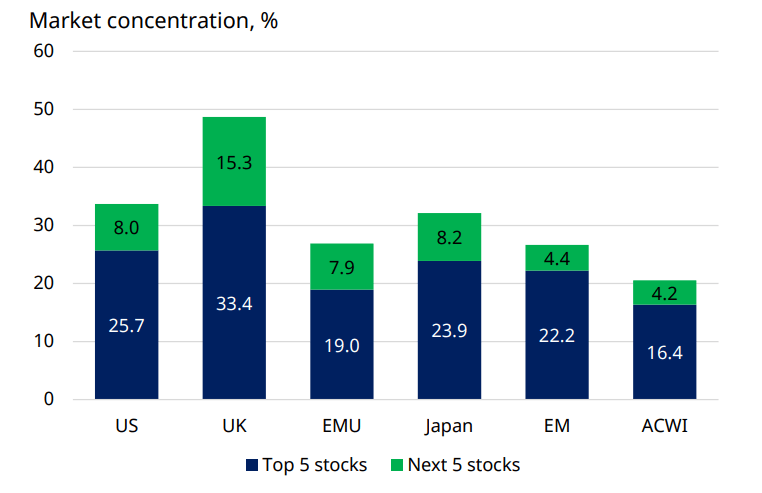
The largest stocks dominate market caps in most countries, not just the U.S. (with the Mag 7):
Imagine reading a story titled “The Relentless Pursuit of Booze.” You would likely expect a depressing story about a person in a downward alcoholic spiral. Now imagine instead reading a story titled “The Relentless Pursuit of Success.” That would be an inspiring story, wouldn’t it? Maybe—but maybe not. It might well be the story of someone whose never-ending quest for more and more success leaves them perpetually unsatisfied and incapable of happiness.
Though it isn’t a conventional medical addiction, for many people success has addictive properties. To a certain extent, I mean that literally—praise stimulates the neurotransmitter dopamine, which is implicated in all addictive behaviors. success also resembles addiction in its effect on human relationships. People sacrifice their links with others for their true love, success. They travel for business on anniversaries; they miss Little League games and recitals while working long hours. Some forgo marriage for their careers.
People willingly sacrifice their own well-being through overwork to keep getting hits of success. I know a thing or two about this: As I once found myself confessing to a close friend, “I would prefer to be special than happy.” He asked why. “Anyone can do the things it takes to be happy; going on vacation with family, relaxing with friends … but not everyone can accomplish great things.” My friend scoffed at this, but I started asking other people in my circles and found that I wasn’t unusual. Many of them had made the success addict’s choice of specialness over happiness. They (and sometimes I) would put off ordinary delights of relaxation and time with loved ones until after this project, or that promotion, when finally, it would be time to rest. But, of course, that day never seemed to arrive.
We are not only gregarious animals, liking to be in sight of our fellows, but we have an innate propensity to get ourselves noticed, and noticed favorably, by our kind. And success makes us attractive to others (that is, until we ruin our marriages).
Unfortunately, success is Sisyphean (to mix my Greek myths). The goal can’t be satisfied; most people never feel “successful enough.” The high only lasts a day or two, and then it’s on to the next goal. Psychologists call this the hedonic treadmill, in which satisfaction wears off almost immediately and we must run on to the next reward to avoid the feeling of falling behind. This is why so many studies show that successful people are almost invariably jealous of people who are more successful.
They should get off the treadmill. But quitting isn’t easy for addicts. For people hooked on substances, withdrawal can be an agonizing experience, both physically and psychologically. Anxiety and depression are very common after one quits alcoholic drinking. Success addicts giving up their habit experience a kind of withdrawal as well. Research finds that depression and anxiety are common among elite athletes after their careers end.
American culture valorizes overwork, which makes it easy to slip into a mindset that can breed success addiction. What can you do to retrain yourself to chase happiness instead of success, no matter where you are in your life’s journey?
Admit that as successful as you are, were, or hope to be in your life and work, you are not going to find true happiness on the hedonic treadmill of your professional life. You’ll find it in things that are deeply ordinary: enjoying a walk or a conversation with a loved one, instead of working that extra hour. This is extremely difficult for many people. It feels almost like an admission of defeat for those who have spent their lives worshipping hard work and striving to outperform others. Social comparison is a big part of how people measure worldly success, but the research is clear that it strips us of life satisfaction.
Start showing up and being present for relationships you’ve compromised in the pursuit of success.
Find the right metrics of success. If you only measure yourself by the worldly rewards of money, power, and prestige, you’ll spend your life running on the hedonic treadmill and comparing yourself to others. Better metrics include faith, family, and friendship. I also include work—but not work for the sake of outward achievement. Rather, it should be work that serves others and gives you a sense of personal meaning.
I stopped buying active investments (individual stocks, etc.) a few years ago. I’ve gone through different justifications for why too. Originally, I stopped buying active investments because of the performance argument. If 85% of active stock managers can’t beat the market over 10 years, what makes you think you can? It’s also too hard to know if you’re actually good. Because there is so much luck involved (especially over shorter time periods), you are better off not wasting your time trying to figure it out.
But there’s an even better argument: I don’t make active investments now because you can’t put a price on mental freedom. What I’ve realized about myself (and many others I’ve spoken to) is that when you buy an active investment like an individual stock, that investment consumes a lot of your attention.
1. 1960-2000: Robert Putnam sees associations and club membership plummeting, writes “Bowling Alone”
2. 2000 – 2020s: Face to face socializing falls another 25%, as coupling rates plunge
3. Now this…
_____________________________
Forbes surveyed more than 217,000 employees working at companies within the U.S. that employ more than 1,000 people. The organizations were stratified so that companies with 1,000 to 5,000 employees were deemed midsize, while companies with more than 5,000 employees were considered large employers.
Survey respondents (who remained anonymous so they could answer freely) were asked if they would recommend their employer to others and to rate it based on a range of criteria, including salary, work environment, training programs and opportunities to advance. Participants were also asked if they would recommend their previous employers (within the past two years) and the employers they knew through their industry experience or through friends or family who worked there.



































 Tuna Thoughts