Chatfishing & Poorly Defined Problems

Why Aren’t Smart People Happier?

A good name for problems on tests that determine someone’s level of intelligence is “well-defined.” Well-defined problems can be very difficult, but they aren’t mystical. You can write down instructions for solving them. And you can put them on a test. In fact, standardized tests items must be well-defined problems, because they require indisputable answers. Matching a word to its synonym, finding the area of a trapezoid, putting pictures in the correct order—all common tasks on IQ tests—are well-defined problems.

People differ in their ability to solve well-defined problems, they’re not the only kind of problems. “Why can’t I find someone to spend my life with?” “Should I be a dentist or a dancer?” and “How do I get my child to stop crying?” are all important but “poorly defined” problems. Getting better at rotating shapes or remembering state capitals is not going to help you solve them.

One way to spot people who are good at solving poorly defined problems is to look for people who feel good about their lives; “how do I live a life I like” is a humdinger of a poorly defined problem. The rules aren’t stable: what makes you happy may make me miserable. The boundaries aren’t clear: literally anything I do could make me more happy or less happy. The problems are not repeatable: what made me happy when I was 21 may not make me happy when I’m 31.

This is why the people who score well on intelligence tests and win lots of chess games are no happier than the people who flunk the tests and lose at chess: well-defined and poorly defined problems require completely different problem-solving skills. Nobody agrees on the rules, the pieces do whatever they want, and the board covers the whole globe, as well as the inside of your head and possibly several metaphysical planes as well.

Over the last generation, we have solved tons of well-defined problems. We eradicated smallpox and polio. We landed on the moon. We built better cars, refrigerators, and televisions. We even got ~15 IQ points smarter. How much did our happiness improve? None.

We haven’t yet defined the problem of “living a happy life”. We know that if you’re starving, lonely, or in pain, you’ll probably get happier if you get food, friends, and relief. After that, the returns diminish very quickly. You could read all the positive psychology you want, take the online version of The Science of Wellbeing, read posts on hacking the hedonic treadmill, meditate, exercise, and keep a gratitude journal—and after all that, maybe you’ll be a smidge happier. Whatever else you think will put a big, permanent smile on your face, you’re probably wrong.

We fawn over people who are good at solving well-defined problems. They get to be called “professor” and “doctor.” We pay them lots of money to teach us stuff. They get to join exclusive clubs like Mensa and the Prometheus Society. 

People who are good at solving poorly defined problems don’t get the same kind of kudos. They don’t get any special titles or clubs. There is no test they can take that will spit out a big, honking number that will make everybody respect them.

And that’s a shame. My grandma does not know how to use the “input” button on her TV’s remote control, but she does know how to raise a family full of good people who love each other, how to carry on through a tragedy, and how to make the perfect pumpkin pie.

If you don’t value the ability to solve poorly defined problems, you’ll never get more of it. You won’t seek out people who have that ability and try to learn from them, nor will you listen to them when they have something important to say. You’ll spend your whole life trying to solve problems with cleverness when what you really need is wisdom. And you’ll wonder why it never really seems to work. All of your optimizing, your straining to achieve and advance, your ruthless crusade to eliminate all of the well-defined problems from your life—it doesn’t actually seem make your life any better.

_________________________

‘I realized I’d been ChatGPT-ed into bed’: how ‘Chatfishing’ made finding love on dating apps even weirder.

Standing outside the pub, 36-year-old business owner Rachel took a final tug on her vape and steeled herself to meet the man she’d spent the last three weeks opening up to. They’d matched on the dating app Hinge and built a rapport that quickly became something deeper. “From the beginning he was asking very open-ended questions, and that felt refreshing,” says Rachel.

One early message from her match read: “I’ve been reading a bit about attachment styles lately, it’s helped me to understand myself better – and the type of partner I should be looking for. Have you ever looked at yours? Do you know your attachment style?” “It was like he was genuinely trying to get to know me on a deeper level. The questions felt a lot more thoughtful than the usual, ‘How’s your day going?’” she says.

Soon, Rachel and her match were speaking daily, their conversations running the gamut from the ridiculous (favourite memes, ketchup v mayonnaise) to the sublime (expectations in love, childhood traumas). Often they’d have late-night exchanges that left her staring at her phone long after she should have been asleep. “They were like things that you read in self-help books – really personal conversations about who we are and what we want for our lives,” she says.

Which is why the man who greeted her inside the pub – polite, pleasant but oddly flat – felt like a stranger. Gone was the quickfire wit and playful rhythm she’d come to expect from their exchanges. Over pints he stumbled through small talk, checked his phone a little too often, and seemed to wilt under the pressure of her questions. “I felt like I was sitting opposite someone I’d never even spoken to,” she says. “I tried to have the same sort of conversation as we’d been having online, but it was like, ‘Knock, knock, is anyone home?’ – like he knew basically nothing about me. That’s when I suspected he’d been using AI.”

Rachel gave her date the benefit of the doubt. “I thought maybe he was nervous,” she says. But she’d been “Chatfished” before, so when the gap between his real and digital selves failed to close on their second date, she called it off. “I’d already been ChatGPT-ed into bed at least once. I didn’t want it to happen again.”

In a landscape where text-based communication plays an outsized role in the search for love, it’s perhaps understandable that some of us reach for AI’s helping hand – not everyone gives good text. Some Chatfishers, though, go to greater extremes, outsourcing entire conversations to ChatGPT, leaving their match in a dystopian hall of mirrors: believing they’re building a genuine connection with another human being when in reality they’re opening up to an algorithm trained to reflect their desires back to them.

_______________________________

Youtube is eating everything:

Offshoring Automation & Meaningful Ordinary Things

Inside a multistory office building in Manila’s financial district, around 60 young men and women monitored and controlled artificial intelligence robots restocking convenience store shelves in distant Japan. Occasionally, when a bot dropped a can, someone would don a virtual-reality headset and use joysticks to help recover it. 

The AI robots are designed by Tokyo-based startup Telexistence, and run on Nvidia and Microsoft platforms. Since 2022, the company has deployed the machines in the back rooms of over 300 FamilyMart and Lawson stores in Tokyo. It is also planning to use them soon in 7-Elevens.

The bots are remotely monitored 24/7 in Manila by the employees of Astro Robotics, a robot-workforce startup. Japan faces a worker shortage as its population ages, and the country has been cautious about expanding immigration. Telexistence’s bots offer a workaround, allowing physical labor to be offshored. This lowers costs for companies and increases their scale of operations, he said. 

It’s hard to find workers to do stacking in Japan. If you get one who’s willing to do it, it’s going to be very expensive. The minimum wage is quite expensive. It’s easy to get young, tech-savvy Filipinos to operate the robots. Each tele-operator, called a “pilot,” monitors around 50 robots at a time.

The bots are usually autonomous, but occasionally — about 4% of the time — they mess up. Perhaps they drop a bottle, which rolls away. Getting the AI bot to recover it by mimicking the human grip perfectly — the friction, the feel of metal in the hand — is one of the more challenging problems in robotics. That’s when a pilot steps in. 

Astro Robotics’ tele-operators are benefiting from an AI- and automation-related boom in IT-service work and tech jobs in the Philippines, even as layoffs hit similar workers in richer countries. Filipino tech workers maneuver industrial robots, drive autonomous vehicles, collaborate with AI on various tasks, or help build “AI agents,” which are computer programs that enable autonomous action. 

________________________

Diane has been a death doula for two decades now, meaning she is a companion for people at the end of life. She has sat beside people with no time left to waste and nothing left to prove, continually learning from the profound insights they leave behind. An insight she has gleaned:

What does it really mean to live like you are dying? Go skydiving? Ride a bull? Those may sound fun, but insights from people who are actually dying are often simpler and much deeper.

One client told me, “I just want to sit in my own kitchen one more time, with the people I love and a bowl of warm, fresh pasta with parmesan cheese melting on top.” That was his dream. Not a trip to Bali. Not bungee jumping. Just warm pasta, family, and home.

I used to expect that people would reminisce about big events like weddings, awards, or epic vacations. But over and over, what they actually longed for were the simplest pleasures.

My client Bernice had lived an extravagant life. Her walls were covered with perfectly posed photographs of big events from her life. But in her final months, she said, “I wish I had different pictures on the wall—messy ones. Pajama parties with friends, Sunday night movies with my kids, and neighborhood barbeques.” Those were the memories that stirred her soul.

We spend so much of life chasing big moments, but the dying often remind me that it’s not the grand gestures that matter most in the end. It’s the small, ordinary things. A meaningful life is built in everyday moments. Not in the highlight reel, but in the quiet, ordinary spaces in-between.

The dying know something we seem to have forgotten: Life is happening right now. In the warm pasta. During the neighborhood barbecue. In the sound of your favorite voice calling your name. Big events are wonderful, but in the end, the ordinary is everything.

____________________________________

The decline of local news has all kinds of implications. One that doesn’t get much attention is that the wider the news becomes, the more likely it is to be pessimistic. Two things make that so:

  • Bad news gets more attention than good news because pessimism is seductive and feels more urgent than optimism.
  • The odds of a bad news story—a fraud, a corruption, a disaster—occurring in your local town at any given moment is low. When you expand your attention nationally, the odds increase. When they expand globally, the odds of something terrible happening in any given moment are 100 percent.

______________________________________

The top 10 stocks in the S&P 500 account for 40% of the index’s market cap. Since ChatGPT launched in November 2022, AI-related stocks have registered 75% of S&P 500 returns, 80% of earnings growth, and 90% of capital spending growth. Meanwhile, AI investments accounted for nearly 92% of the U.S. GDP growth this year. Without those AI investments growth would be flat. America is now one big bet on AI, and this concentration creates fragility.

Valuations for the Mag 10 — the original group of seven leading tech stocks, plus AMD, Broadcom, and Palantir — are high, but not yet at historic peaks. The 24-month forward P/E ratio of the Mag 10 is 35x. In 2000, at the height of the dot-com bubble, the top 10 stocks traded at 52x forward earnings. Implicit in these valuations, however, is an assumption that AI will help these companies cut costs, or grow revenues by $1 trillion in the next two years. I believe we’re either going to see a massive destruction in valuations, infecting all U.S. stocks and global markets. Or we’re going to see a massive destruction in employment across industries with the highest concentrations of white-collar workers. Both scenarios are ugly.

_____________________________

Cellphone bans in schools have become a popular policy in recent years in the United States, yet very little is known about their effects on student outcomes. In this study, we try to fill this gap by examining the causal effects of bans using detailed student-level data from Florida and a quasi-experimental research strategy relying upon differences in pre-ban cellphone use by students. Several important findings emerge.

  • The enforcement of cellphone bans in schools led to a significant increase in student suspensions in the short-term, but disciplinary actions began to dissipate after the first year, potentially suggesting a new steady state after an initial adjustment period.
  • We find significant improvements in student test scores in the second year of the ban after that initial adjustment period.
  • The findings suggest that cellphone bans in schools significantly reduce student unexcused absences, an effect that may explain a large fraction of the test score gains.

Contentment, Luck, Knowledge & Experience

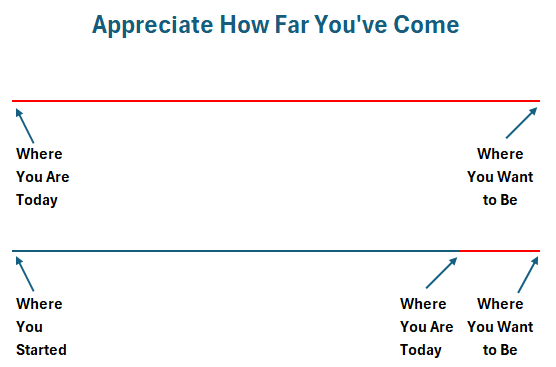
When we dream about being happier in the future, we’re imagining being content with what we have. Maybe we picture a new house or a luxurious lifestyle. But what we’re really imagining is being satisfied with those things. We’re not just picturing wealth, you’re picturing contentment. But often, when reality doesn’t live up to expectations, it’s because the moment we get something new, we immediately start wanting whatever comes next.

The more you desire something you don’t have, the more you’re just focusing on the fact that you’re not happy right now. The person who has everything but wants even more feels poorer than the person who has little but wants nothing else.
______________________

In economics, there is something called the law of diminishing marginal utility. Simply put, it states that for any commodity, you will derive lower levels of utility (or pleasure) with each additional unit you consume. For example, if you’re hungry and you buy a burger, that first one will be amazing. But if you buy another burger, then that one will be less pleasurable than the first. And by the 5th burger, you’ll hate yourself and won’t buy that burger again for the next month (at least).

When it comes to overcoming obstacles, however, I feel that there’s an inverse of this: a law of increasing marginal utility. With each obstacle you overcome, the utility comes in the form of a lesson you can import into the next obstacle you face. And once you overcome that one, the utility gained has a compounding effect that takes all the prior lessons into account as well.

This has the interesting effect of allowing calmness to be more of a baseline state as you’re introduced to various obstacles over time, one of the benefits of getting older.

___________________________

A group of researchers piggybacked on the Global Flourishing Survey, which asked more than 200,000 people in 22 countries over five years to rate how they feel about several aspects of life. One item was the question: “In general. How often do you feel you are at peace with your thoughts and feelings?”

The older people get, the more they feel inner peace. The pattern that emerges is the one that people who no longer compete with other people (whether it is for a job, a salary increase, a spouse, etc.) simply are happier.

_____________________________

Knowledge of the world (through screens and images) vs. experiencing the world in-person:

“It feels as if the whole world has been transformed into images of the world, and has thus been drawn into the human realm, which now encompasses everything. There is no place, no thing, no person or phenomenon that I cannot obtain as image or information. One might think this adds substance to the world, since one knows more about it, not less, but the opposite is true: it empties the world, it becomes thinner. That’s because knowledge of the world and experience of the world are two fundamentally different things. While knowledge has no particular time or place and can be transmitted, experience is tied to a specific time and place and can never be repeated. For the same reason, it also can’t be predicted. Exactly those two dimensions – the unrepeatable and the unpredictable – are what technology abolishes. The feeling is one of loss of the world.”

Apart from anything else, another good reason to get outside, and soon.

________________________

________________________________

We are told to view winning, in sport and in life as: “success must be earned by an effort of willpower, preferably in a triumph over adversity.”

Natural talent conflicts with the consoling fantasy that we live in a meritocracy where hard work always pays off in the end. But it doesn’t. We simply never hear about the thousands of would-be athletes (or business people, or musicians, or inventors) who put in their 10,000 hours but lack the talent to make significant progress.

If people believe, as more and more of them are encouraged to, that their advancement comes 100% from their own merits . . . they can be insufferably smug. Recognizing luck as a factor in success is inherently civilizing.

It can be difficult to accept that we are all, to some degree, victims and beneficiaries of circumstance, but we are. We are misled by histories of great men and women in which it’s implied that each planned his or her ascent meticulously, homing in on success like a soldier finding a flag in an army training exercise.

The origins of success are usually much more subtle and complex. Successful people, by being open to opportunity and exposing themselves to chance, take new directions that prove more fruitful than anyone could have predicted. We change in many ways as we grow. A missed opportunity represents the failure to evolve into a different, better person.

Believing in luck does not imply fatalism, as many people mistakenly believe. But it does demand openness—and humility. What about effort, skill and planning? All necessary, of course—but never sufficient.

________________________

AI may produce faster and more extensive searches and may find correlations that human efforts could not identify in a lifetime, but that’s all still existing information. In short, AI has no creative capacity. It cannot “think” of anything new, unlike humans who create new formulas and works of art routinely. AI is not “intelligent” or creative. It’s just fast.

In a recent experiment, a supercomputer and a group of first grade children were given a ruler, a teapot and a stove and asked to draw a circle. The computer “knew” that the ruler was a draftsman’s tool not unlike a compass and promptly tried to draw a circle with a ruler. It failed. The children glanced at the teapot, saw that the bottom was round and used it to trace perfect circles.

AI will never be superintelligent, expenditures have hit the wall of diminishing returns, AI offers no creativity at all (just fast searches), and children can outperform the fastest machines when the task calls for intuition. Is the frenzy about to hit the wall?

There are some encouraging solutions that may allow AI to add value beyond robotics and fast processing. One of these is the use of small language models (SLMs) instead of LLMs.

Unlike LLMs, which troll the entire internet or large subsets, SLMs contain far less data and are curated by subject matter experts to be tailored to specific tasks. One difference between SLMs and LLMs is the number of parameters that the model is trained on. SLMs can run faster on far less energy. They can also be scaled more easily for smart phones and other applications like self-driving cars and household appliances.

SLMs also have fewer “hallucinations” than LLMs and run on less expensive chips, which may have negative implications for monster chip makers like NVIDIA. SLMs running on smaller cloud systems may make the massive server farms now being constructed, either redundant or obsolete.

Q4 2025 Global Stock Market Valuations By Country

A higher price to earnings ratio (CAPE) means a country’s stock market is more expensive. A lower number is less expensive.

  • United States Stock Market: 38
  • Average of Foreign Developed Stock Markets: 20
  • Average of Foreign Emerging Stock Markets: 17

The rankings below show the price you are paying for the earnings, dividends, cash flow and book value for the companies within these countries.

*Abbreviations:
CAPE: Cyclically Adjusted Price Earnings – a valuation measure that uses real earnings per share (EPS) over a 10-year period to smooth out fluctuations in corporate profits that occur over different periods of a business cycle.
CAPD: Cyclically Adjusted Price Dividends – a valuation measure that uses dividends over a 10-year period to smooth out fluctuations in corporate profits that occur over different periods of a business cycle.
CAPCF: Cyclically Adjusted Price Cash Flow – a valuation measure that uses cash flow over a 10-year period to smooth out fluctuations in corporate profits that occur over different periods of a business cycle.
CAPB: Cyclically Adjusted Price Book – a valuation measure that uses book value over a 10-year period to smooth out fluctuations in corporate profits that occur over different periods of a business cycle.

Source: Meb Faber & Cambria Funds

Time, Work, Beer & A.I.

Does Time Seem To Be Flying By? There Are Ways To Slow It Down. Exposure to variety in your life creates memories, which in turn makes time seem to pass slower because there is more to look back on. For children, fresh experiences and “firsts” are a natural part of everyday life — losing that first tooth, first day of school, first bicycle. This constant stream of new occurrences stretches the passage of time in a young mind.

Older adults, on the other hand, often slip into predictable patterns where days differ only by the calendar date. With scant new memories being formed between existing time markers like birthdays and holidays, Christmas seems to roll around quicker each year. 

So as simple as it sounds, if you want time to slow down, the key is to intentionally introduce more novel experiences into your daily routine. Researchers divide these into two categories:

Distinct novelty. Taking a trip to somewhere you have never been fires a whole different system in your mind that preserves all the details like a high-resolution photo, creating vivid memories you recall for years to come. Your brain’s reaction is, “This looks important. I’d better save all of this!”

Common novelty. You decide to try a different restaurant in your neighborhood instead of the ones you normally frequent. It’s new but related to something you already know, so the impression is not particularly powerful.

__________________________

Typically, what you find in highly successful people is that an addiction to work is, in fact, based on an inchoate belief that love from others—including spouses, parents, and friends—can be earned only through constant toil and exceptional merit.

Why might someone fall prey to such an erroneous belief? It could be the way you were raised. Workaholic parents tend to have workaholic kids. If you grow up seeing adulthood modeled by people who work all hours and are rarely home, you can be forgiven for regarding this as appropriate behavior for a responsible spouse and parent. This is at least partly the same mechanism behind the fact that you are much likelier to become an alcoholic if you were raised by one.

Researchers have also shown that when parents express love for a child in a conditional way based on the child’s behavior, that person is likely to grow up feeling that they deserve love only through good conduct and hard work. This might sound as though I’m describing terrible parents, but I don’t mean to do so at all; well-intentioned parental encouragement can be heard by a child as a message about their worthiness.

In the workaholic’s case, it might look like this: Your parents wanted you to succeed in school and in life, so they gave you the most love and attention when you got good report cards, won at sports, or earned the top spot in the orchestra. You were a bright kid, and put two and two together: I am extra lovable when I earn accolades. In my experience, this describes the childhood of a lot of people who strove to be special to gain their parents’ attention, and who carry this behavior into adulthood by trying to earn the love of others through compulsive work.

__________________________

Michelob Ultra has become king of the hill among beer brands. By topping the sales by volume charts for 2025, it has ousted Modelo Especial as America’s best-selling beer.

While its lower caloric content certainly appealed to many people, some of Michelob Ultra’s success can also be credited to aggressive marketing campaigns, which helped the brand gain notoriety at major sporting events like the FIFA Club World Cup, NBA games, and the PGA tour. That falls in line with Michelob Ultra’s focus on folks with active lifestyles. 

More people are seeing Michelob Ultra on tap. The new top dog surpassed its sister brand, Bud Light, in bar and restaurant presence in December 2024. Michelob Ultra’s upsurge in popularity happened at a relatively quick pace; the brand has flourished by 15% since 2020. That equates to a 2% hold over the entire beer market in that time frame.

___________________________

A.I. investors shouldn’t swim upstream, but fish downstream: companies whose products rely on achieving high-quality results from somewhat ambiguous information will see increased productivity and higher profits. These sectors include professional services, healthcare, education, financial services, and creative services, which together account for between a third and a half of global GDP and have not seen much increased productivity from automation. AI can help lower costs, but how individual businesses incorporate lower costs into their strategies—and what they decide to do with the savings—will determine success. To put it bluntly, using cost savings to increase profits rather than grow revenue is a loser’s game. The companies that will benefit most rapidly are those whose strategies are already conditional on lowering costs.

With A.I., knowledge-intensive services will get cheaper, allowing consumers to buy more of them, while services that require person-to-person interaction will get more expensive, taking up a greater percentage of household spending. This points to obvious opportunities in both. But the big news is that most of the new value created by AI will be captured by consumers, who should see a wider variety of knowledge-intensive goods at reasonable prices, and wider and more affordable access to services like medical care, education, and advice.

There is nothing better than the beginning of a new wave, when the opportunities to envision, invent, and build world-changing companies leads to money, fame, and glory. But there is nothing more dangerous for investors and entrepreneurs than wishful thinking. The lessons learned from investing in tech over the last 50 years are not the right ones to apply now. The way to invest in AI is to think through the implications of knowledge workers becoming more efficient, to imagine what markets this efficiency unlocks, and to invest in those. For decades, the way to make money was to bet on what the new thing was. Now, you have to bet on the opportunities it opens up.

_________________________

There is a consistent doom-and-gloom forecast that within 18 months A.I. software will make human capabilities worthless. The far more significant crisis is precisely the opposite. Young people are already degrading their cognitive capabilities by outsourcing their minds to machines long before software is ready to steal their jobs.

Many recent articles have loudly proclaimed what most people were already thinking: Everybody is using AI to cheat their way through school. By allowing high school and college students to summon into existence any essay on any topic, large language models have created an existential crisis for teachers trying to evaluate their students’ ability to actually write, as opposed to their ability to prompt an LLM to do all their homework. Massive numbers of students are going to emerge from university with degrees, and into the workforce, who are essentially illiterate.

The demise of writing matters, because writing is not a second thing that happens after thinking. The act of writing is an act of thinking. Students, scientists, and anyone else who lets AI do the writing for them will find their screens full of words and their minds emptied of thought.

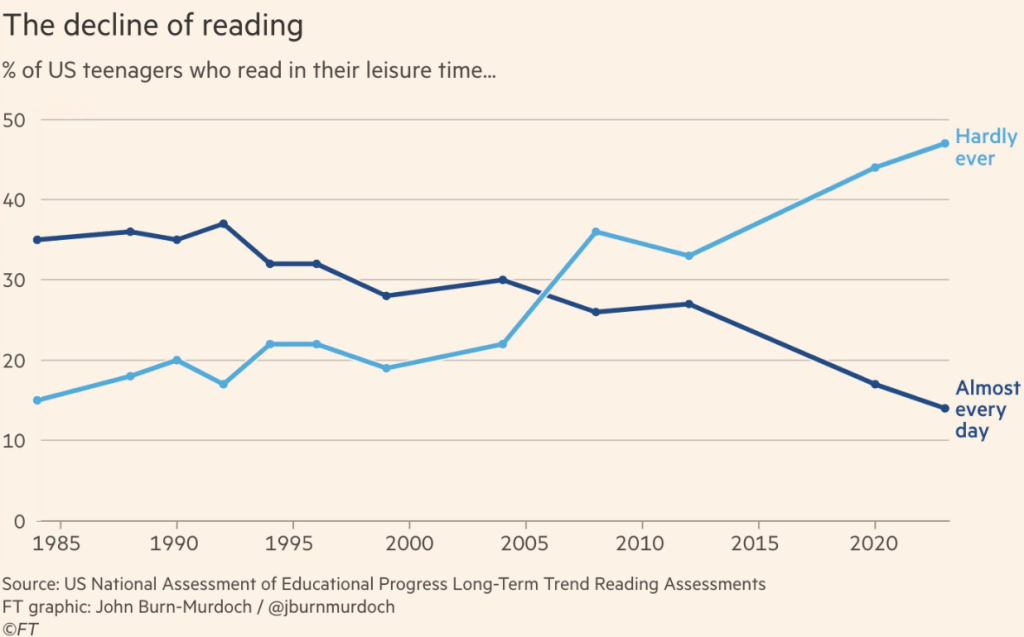
As writing skills have declined, reading has declined even more. Most of our students are functionally illiterate. Achievement scores in literacy and numeracy are declining across the West for the first time in decades.

Americans are reading words all the time: email, texts, social media newsfeeds, subtitles on Netflix shows. But these words live in fragments that hardly require any kind of sustained focus; and, indeed, Americans in the digital age don’t seem interested in, or capable of, sitting with anything linguistically weightier than a tweet. The share of Americans overall who say they read books for leisure has declined by nearly 50 percent since the 2000s.

Even America’s smartest teenagers have essentially stopped reading anything longer than a paragraph. Students are matriculating into America’s most elite colleges without having ever read a full book. High schools have chunkified books to prepare students for the reading-comprehension sections of standardized exams.

Thinking benefits from a principle of “time under tension.” It is the ability to sit patiently with a group of barely connected or disconnected ideas that allows a thinker to braid them together into something that is combinatorially new. 

__________________________

A.I. related stocks have accounted for 75% of S&P 500 returns, 80% of earnings growth and 90% of capital spending growth since ChatGPT launched in November 2022. Data centers are eclipsing office construction spending and are coming under increased scrutiny for their impact on power grids and rising electricity prices.

The biggest medium-term risk I can think of for top heavy US equity markets: China’s Huawei and SMIC pierce the $6.3 trillion NVIDIA-TSMC-ASML moat by creating their own supernode computing clusters and deep-ultraviolet lithography machines of comparable quality.

Oracle’s stock jumped by 25% after being promised $60 billion a year from OpenAI, an amount of money OpenAI doesn’t earn yet, to provide cloud computing facilities that Oracle hasn’t built yet, and which will require 4.5 GW of power (the equivalent of 2.25 Hoover Dams or four nuclear plants), as well as increased borrowing by Oracle whose debt to equity ratio is already 500%. In other words, the tech capital cycle may be about to change.

__________________________

This is a fascinating look at how foreign households invest. I had no idea U.K. residents had such a low percentage of their personal investments in stocks, and the amount Japanese citizens hold in cash (which has provided no interest/return for decades) is incredible.

_____________________________

____________________________________

Africa is enormous. These countries would all fit within Africa’s border:

52 Cards, Gray Divorce & Gun Suicides

The mathematics of card shuffling is quite easy to explain. To calculate how many arrangements 52 playing cards can have, you must go through all the possible shuffles. If you do the multiplication and round the answer, you will get a number with 67 zeros. That’s more than a quadrillion times as many ways to arrange these cards as there are atoms on Earth.

It is extremely unlikely that two people in the entire history of humanity have ever shuffled a deck of cards the same way. This illustrates how many possibilities there are for arranging 52 cards.

The vastness of 52! is not only inspiring to contemplate—it has also posed some significant practical problems for online game developers. Online poker can involve large sums of money, so it’s critical that these games are as secure and fair as possible. Any flaws or loopholes could be exploited by cheaters or used by the house against players.

Digital cards should be well shuffled and dealt randomly, just like real ones. In an ideal world, an algorithm would randomly select an arrangement from the 52! possible decks. But no computer has enough memory to evaluate all of these possibilities, and a perfect random number generator doesn’t yet exist. Therefore, developers generally rely on algorithms that simulate card shuffling, and the limited number of shuffles created problems for early developers and ones that online poker players could exploit.

Today many online poker sites use the Fisher–Yates algorithm, also called the Knuth shuffle (which sounds delightfully like a dance). Even with continuous improvements over time, random generators simply aren’t good enough to do what people can do with an actual deck.

________________________

The US has one of the highest divorce rates in the world, even though over the past four decades, it has fallen among younger couples. Instead, middle-aged and older adults have taken over. In fact, adults aged 65 and older are now the only age group in the US with a growing divorce rate. Today, roughly 36% of people getting divorced are 50 and older, compared to only 8.7% in 1990. This is known as a “gray divorce”.

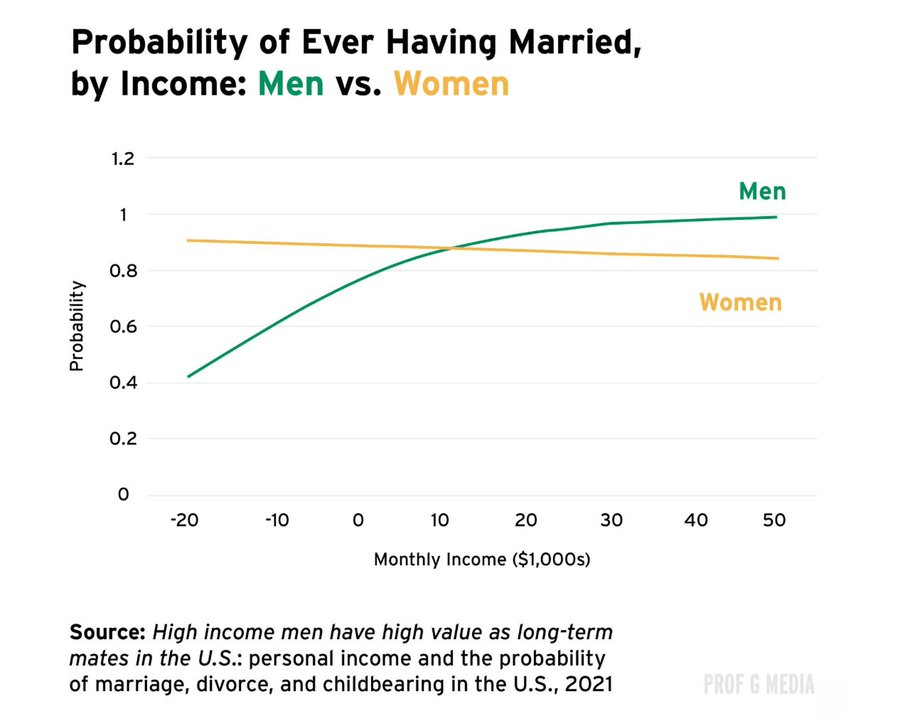
This tilt towards later-in-life divorce is happening for a mix of reasons. Lives are longer than they used to be, and older couples may be less willing to put up with unfulfilling marriages than before. Meanwhile, young people are getting married later and have become more selective when choosing a partner. As one researcher puts it, “the United States is progressing toward a system in which marriage is rarer and more stable than it was in the past”.

Amid this trend, one aspect of gray divorce is beginning to receive more attention: the surprisingly deep and wide-ranging impact the split can have on adult children – and on their relationships with their parents, especially, their fathers.

After a divorce, husbands often lose their social networks and have less contact with their children, who often side with their mother. This pattern of children turning towards the mother after a divorce is known as the matrifocal tilt and increases further when a father re-partners. By contrast, when a mother re-partners, it does not seem to change the mother-child contact. Interestingly, women are more likely to file for divorce, and are less likely to remarry after a gray divorce.

________________________

Americans 70 and over have the highest suicide rates of any age group, and their rates of suicide have increased in recent years. During this period, 63,836 older Americans died by gun suicide. Gun suicide is a greater killer of men over 70 than car crashes.

And if older men are in trouble, older white men are especially in trouble. They die by gun suicide at the highest rate—a rate more than triple that of Black and Latino men of the same age, and 19 times the rate of women 70 and over.

Suicide in later life often stays hidden. Many isolated older Americans have no obituary, memorial, or funeral. For those who do, the cause of death often goes unmentioned. But doctors and researchers are sounding the alarm. No single factor drives the high rates, researchers say. But severe illness, pain, financial pressures, isolation, a lack of mental health care, cognitive impairment, and the availability of firearms all play a role. Gun laws also factor in. The US has a substantially higher suicide rate for older adults than neighboring Mexico or Canada, countries with stricter gun laws.

________________________

We know that making money is not the purpose of life. Of course, money won’t fill our inner void. But what will? If you are very good at making money, if it feels satisfying, it is easier to keep doing that than to stop and step into the unknown.

The better you are at making money, the more you leave on the table when you exit the game. The greater your future earning potential, the higher the price of your freedom. Without clarity on what we value, any amount of money can be a prison.

_________________________

Mexico’s New Drug King Cashes In – The Trump administration’s war on fentanyl created an opening for ‘El Señor Mencho’ to smuggle cocaine into the U.S. by the ton.

From a heavily guarded mountain hideout in the heart of the Sierra Madre, 59-year-old Nemesio “Mencho” Oseguera reigns as the new drug king of Mexico, aided in his ascendance by America’s resurging love of cocaine and the Trump administration’s escalating war on fentanyl. Oseguera spent decades building his Jalisco New Generation Cartel into a transnational criminal organization fierce enough to forge a new underworld order in Mexico, displacing the Sinaloa cartel, torn by warring factions, as the world’s biggest drug pusher.

The Sinaloans, Mexico’s top fentanyl traffickers, got caught in the crosshairs of the Trump administration, which promised to eradicate the synthetic opioid. The crackdown has left an open field for Jalisco and its lucrative cocaine trade, elevating Oseguera to No. 1. “‘Mencho’ is the most powerful drug trafficker operating in the world,” said Derek Maltz, who served this year as interim chief of the Drug Enforcement Administration. 

_________________________

Since 2024, foreign investors have been net sellers of Indian equities in the secondary market (existing stocks), but they have been rushing into India’s primary market, which consists of initial public offerings and follow-on public offers. Overseas investors made net investments to the tune of $14.5 billion in the primary market last year, while redeeming $14.4 billion from the secondary markets.

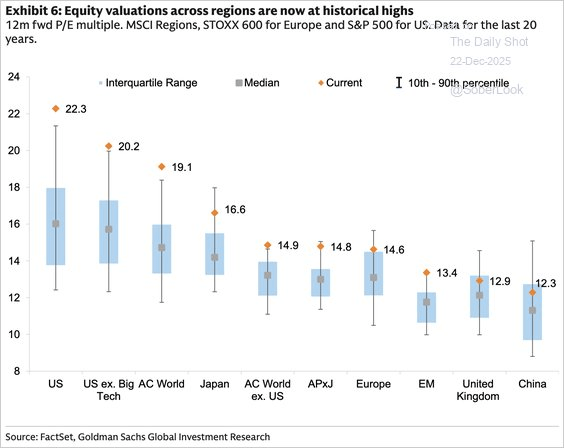
For global investors, the math is simple. India’s secondary market looks overpriced as compared to other emerging markets. MSCI India index trades at a price-to-earnings ratio of 25.4x as compared to MSCI Emerging Market Index — which includes India — with P/E ratio of 15.41x. The MSCI China index trades at 14.6x while MSCI Korea index is at 12.4x.

Even the U.S. imposing 50% tariffs on Indian exports has not led to any significant correction in the market, preventing investors from entering cheap. In such a scenario, IPOs offer a better play for the Indian markets as managements and bankers price the issue attractively, drawing significant investor interest. Returns from Indian IPOs in 2024 were starkly higher at 37.1%, compared with its stock market returns of just over 7%.

Foreign investors selling in the secondary market while writing checks for IPOs is not a contradiction, it is a strategy — one that has paid off well so far. 

Beta Blockers, A.I. Sports Betting Software & Loneliness

The Pill That Women Are Taking for Everything From Speeches to First Dates: Propranolol has become the go-to pill for dealing with all sorts of stressful situations. Prescriptions are on the rise, up 28 percent from 2020. By slowing down heart rate and lowering blood pressure, the drug can reduce the physical symptoms of anxiety.

Where other beta blockers focus on specific parts of the body, propranolol affects beta receptors in the heart and everywhere else in the body, including the brain. The effects on the brain are the effects that cause the decrease of anxiety.

Compared to Xanax or Valium, propranolol is considered nonaddictive and is among the mildest variety of anti-anxiety medication, but it is not without risk. Because propranolol works to reduce blood pressure and heart rate, if you reduce it too much, the person could faint.

_______________________

Meet the Guys Betting Big on AI Gambling Agents. Online gambling is a massive industry. The AI boom keeps booming. It was only a matter of time before people tried to put them together.

Szeder, founder of the AI gambling startup MonsterBet, says his tools give customers an edge. “We have some people who are probably hitting around 56 to 60 percent of the time, myself included,” he claims. He created an assistant called MonsterGPT to select bets on professional sports in the US. It uses projection models he designed combined with information scraped from across the internet. 

MonsterGPT accesses web scrapers through retrieval-augmented generation (RAG), a process that allows AI tools to incorporate new data from external sources on top of their training materials. He charges $77 a month for access to MonsterGPT and other tools.

_______________________

The percentage of U.S. adults who say they consume alcohol has fallen to 54%, the lowest by one percentage point in Gallup’s nearly 90-year trend. This coincides with a growing belief among Americans that moderate alcohol consumption is bad for one’s health, now the majority view for the first time.

________________________

The Share of Americans Having Regular Sex Keeps Dropping.:

________________________

More than 16 million people aged 65 and older in the U.S. live alone. That represents 28% of that age group, almost triple the share in 1950. Among the reasons: increased longevity, higher divorce rates among older adults and children more scattered than previous generations. Many are women who outlived their spouses, and at least one-fourth of older adults with dementia live alone.

_________________________

A stock or a bond is a tangible claim on some future revenue stream; real estate and commodities are physical things that you can use even if their price drops. Crypto coins, or tokens, or however it pleases you to visualize these bits of ephemeral code, are pure speculative baubles, endowed with value only to the extent that you can convince another person to pay you more for them than you paid. They are a claim on nothing. They are the grandest embodiment of Greater Fool Theory ever invented by mankind.

Major banks have now decided to allow crypto to be used as collateral for loans. This sets the stage for a rapid collapse in crypto prices to spread its harm much more broadly throughout the financial system.

There is an ongoing phenomenon of companies that are not doing well simply buying a bunch of Bitcoin and rebranding themselves as crypto holding companies and then seeing their stock price shoot up. Because we are still in the frothy phase of the bubble, it turns out that investors will actually pay more for crypto held by a company like this than they could just buy the crypto for themselves on the open market. So a, you know, declining ball bearings manufacturer can go out and buy $1 billion of Bitcoin and announce that in a press release and then see their stock value increase by $2 billion. 

This obviously irrational thing is a symptom of financial mania. History tells us this ends poorly. A rational government response would be to hedge against the fallout that will come when this bubble pops. Instead, our government is doing the opposite: leaning in to trying to skim money on the bubble’s upside.

_______________________

Summers (warm days) last longer than they used to:

_________________________

Foreign countries love U.S. stocks:

And they love U.S. treasury bonds:

___________________________

Consciousness, Being Present & The Fragile Gift Of Life

The night before my brain surgery, my wife and I sat across from each other in wordless stillness. Hours before surgery, with death still in the room, I didn’t feel fear. I felt something quieter. Stranger. I felt connected. To my wife’s eyes. To my breath. To the weight of my feet against the floor. To the wind brushing the window. Even to our cat, oblivious, licking her paws in perfect peace.

Upstairs, in a crib painted white, our 18-month-old daughter lay sleeping. I imagined her face at 5, at 15, at 40. I hoped she would know how deeply I loved her. And in that moment — that unbearable, radiant moment — I was, for perhaps the first time ever, conscious.

Not in the neurological sense. Not in the academic or philosophical sense. But in the raw, elemental sense of being awake to the miracle and the absurdity of existence. Alive to the texture of being. 

Leading up to surgery the world had never looked so alive. Every detail sharpened, sacred. Time no longer moved. It hovered. Held. The future dissolved. The past let go. All that remained was one long, luminous moment. And in that moment, I was tethered — to my wife’s hand, to the stars, to everything. I was, finally, conscious.

I considered the paradox of being most awake at the edge of unconsciousness. The strange intimacy of being stripped down to nothing: no ego, no schedule, no ambition.  Just breath. Presence. And the knowledge that everything is about to change—or end. 

At that moment, I was not thinking about business plans or unread emails. I was not anxious about the past. I was not hungry for the future. I was only there, suspended, waiting. And in that waiting, I was more myself than I’d ever been.

I laughed to myself in the hours before the anesthesia took hold: This is what it means to be fully human. This is what it means to be conscious.

I lived, and in the weeks following surgery, I experienced what doctors call “survivor’s euphoria.” A clinical term, woefully inadequate. It wasn’t just euphoria. It was revelation. It was a reawakening. It was a second birth.

The world opened itself to me like a wound and a gift. I smelled color. I tasted air. I watched dust motes floating in the light and felt tears rise. My daughter’s laugh shattered something inside me, and I let it. I held my wife in the dark, listening to her breath, feeling the hum of her life, and I cried because I could.

I no longer chase productivity the way I once did. I no longer confuse urgency with meaning. I try, imperfectly, to pay attention. To listen more than I speak. To feel what I feel, even when it hurts.

There is a kind of consciousness that lives not in thought but in presence. It asks nothing of us but awareness. It demands no degree, no ideology, no spiritual badge. Only that we pay attention. Only that we look — at our children, our lovers, our trees, our coffee, our clocks — and see them as if for the first time.

Identity Switching, Work-Life Balance & College Graduates

One of the great causes of suffering is this maddening worry about what others think of us. I can go into its causes by pointing to evolutionary psychology and our hunter-gatherer roots, but that’s neither novel nor interesting. Rather, I want to delve into the asymmetry between what we know about ourselves, and the uncertainty surrounding what others know of us. Because at its core, the worry about what others think is ultimately a function of uncertainty.

Whenever we interact with someone – whether in-person or online – a gap emerges between who you are, and who you are presenting. This is why the person you are with your boss isn’t the same as the person on the couch watching Netflix. Or why the person you are with your best friend isn’t the same as the person you are with an acquaintance. Each relationship contains a culture of behavior that you oscillate between, which means that you’re constantly presenting a different version of yourself across a wide range of interactions.

What this means is that it becomes increasingly difficult to know who you really are. If a certain version of you emerges with this individual, but in the very next moment you toggle another set of behaviors with another, then that means your very identity is switching upon context. And the more you have to maneuver between various projections of yourself, the more difficult it becomes to get a handle on what “yourself” means in the first place.

This is why you’re likely exhausted after large social gatherings, and yearn to turn on the TV and watch something brainless until you drift off to sleep. The fatigue is not caused by the rigor in which your mouth is moving to talk, but rather by the constant switching of identity that occurs in these situations. When you’re worried about what someone thinks of you, it’s rarely about that person’s opinions of you. It’s about your own opinions of yourself. 

_________________________

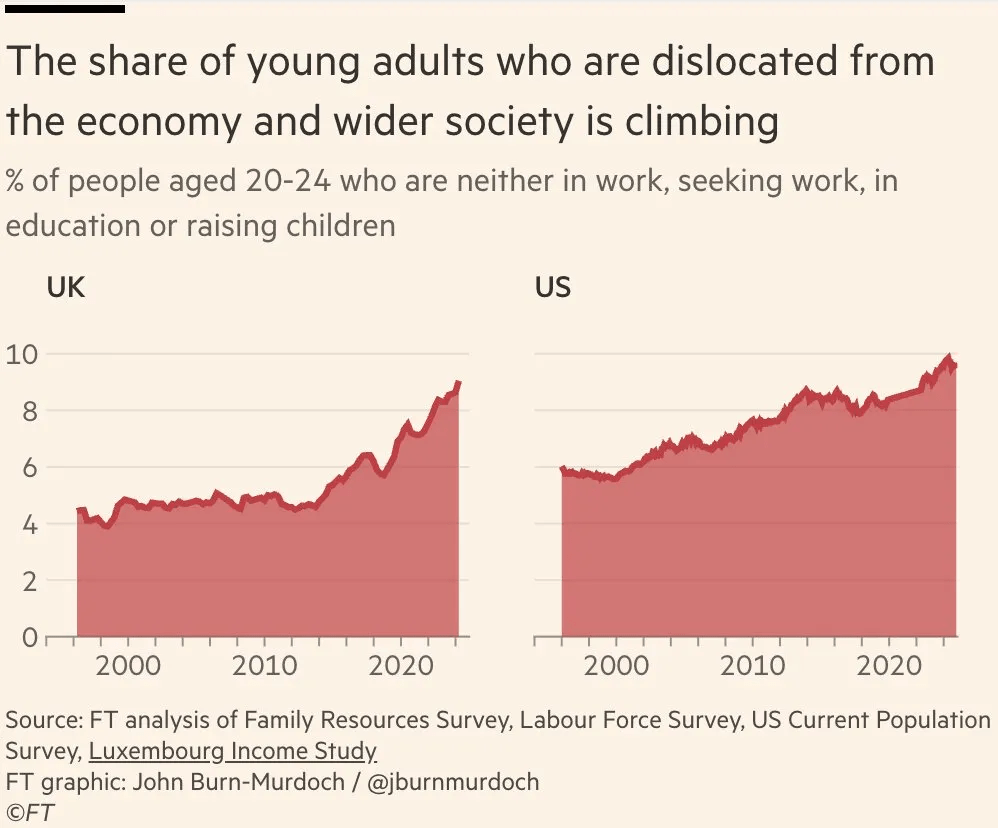
Is A.I. taking jobs from young college graduates? It depends on the job.

Stanford economists studied payroll data from the private company ADP, which covers millions of workers, through mid-2025. They found that young workers aged 22–25 in “highly AI-exposed” jobs, such as software developers and customer service agents, experienced a significant decline in employment since the advent of ChatGPT:

On the other end of the spectrum, they found for entry level workers in fields like home health aides, there is faster employment growth. That suggests this isn’t an economy-wide trend. The decline in employment really seems to be more concentrated in jobs that are more AI-exposed.

_______________________

A new analysis of 39 nations reveals where employees enjoy the healthiest mix of work and personal life and on the other end of the spectrum – where long hours, limited leave, and lack of support take the greatest toll. The study assessed 10 factors including working hours, paid leave, commute length, parental support, remote work availability, and happiness scores.

Unsurprisingly, the United States finished dead last, ranked 39th out of 39. The US suffers from some of the longest working hours in the study, averaging 1,799 annually. It is the only country in the ranking without federally mandated paid annual leave or paid parental leave, and Americans devote only 14.6 hours per day to personal care and leisure.

___________________________

Interesting point on why college students are putting less effort into class: courses don’t prepare them for real jobs (like they should), so they have to spend more and more time making up the difference after class:

“A student said that coursework doesn’t prepare students to answer interview questions for finance and consulting jobs. The only way to get ready is through extracurriculars or on one’s own time. By sophomore year, his friends were fully absorbed in the internship-recruiting process. They took the easiest classes they could find and did the bare-minimum coursework to reserve time to prepare for technical interviews.

___________________________

From Kevin Kelly on how the relationship between book publishers and authors has changed:

“Traditional book publishers have lost their audience, which was bookstores, not readers. It’s very strange but New York book publishers do not have a database with the names and contacts of the people who buy their books. Instead, they sell to bookstores, which are disappearing. They have no direct contact with their readers; they don’t “own” their customers.

So when an author today pitches a book to an established publisher, the second question from the publishers after “what is the book about” is “do you have an audience?” Because they don’t have an audience. They need the author and creators to bring their own audiences. So, the number of followers an author has, and how engaged they are, becomes central to whether the publisher will be interested in your project.

Many of the key decisions in publishing today come down to whether you own your audience or not.”

_______________________________

Canada’s Great Condo Crash: For years, low interest rates fueled a big-city condo-flipping frenzy. Profits got bigger and condos got smaller. Now the bubble has popped, leaving behind thousands of unsellable, unlivable units.

In the first quarter of 2019, the average Toronto condo cost $560,000. By the first quarter of 2022, they had soared to $808,000. Since that peak, the market has been in a painful reset.

By the first quarter of 2024, average condo values in the city had dropped by over $100,000 to $696,000, and they have continued to fall. As of this spring, the inventory of unsold units in Toronto totaled more than 23,000, which would take nearly five years to sell at the current rate. Of those, nearly 2,000 are built and sitting empty, more than 11,000 are under construction and roughly 11,000 more are in pre-construction projects.

_____________________________

As of July, there has been no reduction in import prices since Liberation Day, which are measured pre-tariff. Thus, foreign exporters in aggregate are not absorbing the tariff costs by reducing prices. This means most or all of the tariffs are being paid by American consumers and American businesses. For context, it takes about a 13% reduction in prices to offset a 15% tariff, or a 16% reduction in prices to offset a 20% tariff.

This shows up in a combination of higher consumer goods prices and/or compressed business margins of goods-heavy businesses, depending on how quickly businesses are able to pass those prices on to consumers (which will vary by industry and company; those with in-demand products can eventually pass on price increases, and those with thin margins have to eventually pass on price increases).

Consumers on the higher end of the income spectrum are less likely to change their consumption behavior and thus will basically just pay the tariffs, giving the government more revenue. Consumers on the lower end of the income spectrum are more likely to have to curtail consumption because their disposable income is scarce.

Another excellent newsletter from Lyn Alden on tariffs, fiscal income/spending, monetary policy and the implication on global economies and asset prices.

_____________________________

_______________________________

This chart shows the change in active housing inventory by state for 2025 compared to the average of 2018/2019. Orange colors mean higher inventory levels and prices are susceptible to fall, while green colors mean very low inventory and likely still price increases.

Schopenhauer, Colleges & Pickleball

Schopenhauer believed that all of human experience runs along a pendulum that swings from two poles: one of desire, and the other of satisfaction. We strive when we have desire, so the only way to alleviate this is to experience the pleasure that comes with satisfaction. But once you’re satisfied, boredom ensues, and desire inevitably arises yet again. Hence the pendulum.

The pace in which the pendulum swings between desire and satisfaction is what matters most. If it swings rapidly between the two, you get happiness. If it swings slowly between them, you get suffering.

To Schopenhauer, one could only be happy if desire is quickly offset by satisfaction, and this satisfaction could then be quickly offset by another desire. If it’s in our nature to restlessly strive for something, the only way to be happy is to feed that nature what it wants. Suppressing the existence of a desire only prolongs the suffering, which is why he didn’t believe that an ascetic life was the answer.

I think this does a good job explaining the phenomenon of busyness, and its existential utility for people. Ultimately, being busy is you continually swinging between desire and satisfaction. Anytime you create an item on a To Do list and proceed to check it off, that’s you making one round on this continuum. Multiply this by however many times you do it over the course of a week, and you get the feeling of busyness.

 If your mind always has something to check off, then there’s no room to ask yourself if you’re deriving meaning or purpose in what you’re doing. You just move from one cycle of desire / satisfaction to the next, and that in itself is where you dedicate your attention to.

This is where Schopenhauer’s take breaks down. Simply going from one pole to the next in a rapid manner is not happiness. Oftentimes, it’s just distraction. And when the pace of the pendulum slows in a manner where your desire takes a long time to satisfy, then you’ll see through the illusion that your busyness has created. Anytime there’s a lull or silence in your day-to-day life, this void may be filled with the angst that what you’re doing isn’t the answer, and that’s when an existential crisis takes hold.

This is why true happiness cannot be contingent upon any notion of satisfaction. Because to be satisfied is to imply an endpoint. A goal. And as the hedonic treadmill illustrates, once there is a goal, the logical conclusion is to create another chase to distract you. This distraction may keep you amused and busy, but once you’re faced with silence, you will be afraid of what you may feel.

The answer here is that happiness cannot be pursued, nor can it ever be achieved. Because the moment you’re aware that you’re happy, then paradoxically, you no longer are because you’ve called it out. Once you name a positive feeling, you become attached to it, and you long to feel it again.

The moment you pursue happiness, it is nullified. Paradoxically, understanding this is the only way one can truly be happy.

_______________________________

America is about to tumble off the edge of a massive demographic cliff. The timing is no coincidence. The US birth rate peaked in 2007, with just over 4.3 million babies born that year. That number has dropped almost every year since, reaching a 30-year low of 3.8 million births in 2017. Last year, the rate was down to 3.6 million.

Now, those 2007 babies are turning 18 (ugh, I know). As they prepare to start college and enter the workforce, their transition to adulthood signals a new reality for universities, employers, and the whole of America’s economy. Every year from here on out — at least for the foreseeable future — colleges will face a smaller and smaller pool of prospective students.

___________________________

To give you some context for pickleball’s pre-pandemic popularity, think about badminton. And now think about something half as popular as badminton. That was pickleball in 2019. Total pickleball players in the U.S. were outnumbered by participants in archery, bow hunting, fly fishing, indoor climbing, snorkeling, and sledding. Now it’s more popular than all of those pastimes … and America’s pastime. Yes, more Americans played pickleball last year than baseball.

___________________________

I’ve taught the same course to a class of undergraduate, M.B.A., medical and nursing students every year for over a decade. While I didn’t change my lectures or teaching style, somehow the students’ evaluations of last year’s class were better than ever before.

What changed? I banned all cellphones and computer-based note taking in the classroom.

To help sell this policy, I presented in the first lecture of the course a study showing that students who were required to take class notes by hand retained significantly more information than students who used computers. The reason is that with computers, students can type as fast as I speak and strive for verbatim transcripts, but there is almost no mental processing of the class’s content.

Handwritten notes require simultaneous mental processing to determine the important points that need recording. This processing encodes the material in the brain differently and facilitates longer-term retention.

Repeated studies show students perform worst on tests when phones are on desks, next worse when they’re placed in bags or pockets, and best when they’re stored in another room. The presence of smartphones also undermines the quality of in-person social interactions.

___________________________

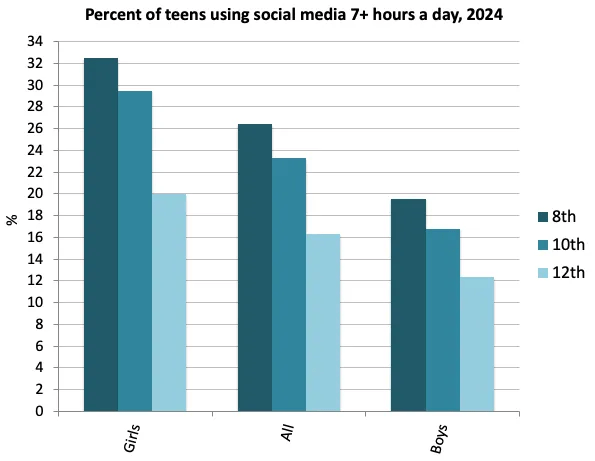
A recently published paper looked at twin studies to see if heavy social media users have innate tendencies toward lower social well-being. After looking at info on the amount of use, the number of posts, the number of social media accounts, etc., they found only a modest correlation between social media use and well-being (including anxious-depressive symptoms).

What they did find, which many studies have found in the past, is that those symptoms correlated heavily to genetic influences.

___________________________

Today, I’m going after a sacred modern virtue. Tell me if you’ve heard this one before: “Freedom is the highest form of wealth.” After 2 years of freedom, I’d like to disagree. I don’t have issue with freedom as a form of wealth. Or that it’s a better form of wealth than money (it is). I only take issue with the “highest” or “greatest” part of this argument.

I now believe that meaning is the highest form of wealth. The ability to continually have and make meaning, every day. To feel a deep sense of fulfillment and purpose in our actions; emphasizing what we do more than who we are. The good news is you don’t need money for meaning (though it can help). There’s plenty who never find freedom, but still find purpose. So wait, does that make them free? And having freedom without meaning is its own kind of prison.

___________________________

Howard Marks’ newsletter this month provides an in depth analysis that lays out where investment value comes from and how they should be assessed. The TDLR jumping to his conclusion at the end on where we are with U.S. stocks today:

“Fundamentals appear to me to be less good overall than they were seven months ago, but at the same time, asset prices are high relative to earnings, higher than they were at the end of 2024, and at high valuations relative to history.”

Instead of DEFCONs like the Pentagon uses for war scenarios, he laid out levels of INVESTCONs investors can move through to protect investments in the face of above average market valuations and optimistic investor behavior:

6. Stop buying
5. Reduce aggressive holdings and increase defensive holdings
4. Sell off the remaining aggressive holdings
3. Trim defensive holdings as well
2. Eliminate all holdings
1. Go short

From Marks: “In my view, it’s essentially impossible to reasonably reach the degree of certainty needed to implement INVESTCON 3, 2, or 1. Because “overvaluation” is never synonymous with “sure to go down soon,” it’s rarely wise to go to those extremes. I know I never have. But I have no problem thinking right now it’s time for INVESTCON 5.