Japanese Stocks & Valuation Lessons From History

After 35 years, the Japanese stock market has finally reached new record highs. You can see the moment on the chart below when “Abenomics” was introduced in Japan:

Abenomics was a “three quiver” approach to try and boost the markets and economy. It involved (1) structural reforms (2) deficit spending and (3) massive money printing:

The other thing that helped start the rally in Japanese stocks back in 2012 was a low price to earnings valuation.

The CAPE ratio (Shiller Price to Earnings ratio) reached 80 at the peak of Japan’s stock market bubble in 1989. That means investors were willing to pay 80 times the average earnings over the previous 10 years. The price to earnings ratio bottomed in 2012 at 16.

Investors once willing to pay 80 times earnings now wanted nothing to do with stocks paying 16 times earnings. There was extreme pessimism and investors (after being destroyed in the market for 23 straight years) understandably had given up.

Here are some other high-water marks for the CAPE Price To Earnings ratio in other stock markets over the last 35 years:

In 1998 Switzerland reached 58.

In 2000 Germany hit 58. Canada, France, Germany and Italy all crossed 60, while Sweden hit 80.

In 2007, China hit 60 and India reached 48.

Just like Japan, all of these countries have experienced horrific returns since their price to earnings valuation peaks. Some are still well below their all-time highs, 17 to 26 later.

The United States stock market reached 47 in March 2000 at the peak of the dot com bubble. It reached 39 in late 2021 and sits around 34 today (February 2024). It’s currently one of the most expensive stock markets in the world.

The following is a quick snapshot/summary of where price to earnings valuations stood for countries around the world entering 2024:

Average of Foreign Developed Countries: 19 (38% less expensive than the United States)
Average of Foreign Emerging Countries: 15 (51% less expensive than the United States)

What does this mean for the United States stock market moving forward? Reviewing the history of other stock market bubble peaks above, there is plenty of room for valuations to go much higher from where they are today.

Fortunately for us, we don’t have to invest in an expensive stock market (the United States). We can invest in other markets around the world that are much less expensive, typically pay higher dividends, and offer a higher probability of stronger returns relative to the U.S. moving forward.

Exercise, Depression & Market Concentration

Researchers Find That Exercising Is Twice As Effective As Anti-Depressants

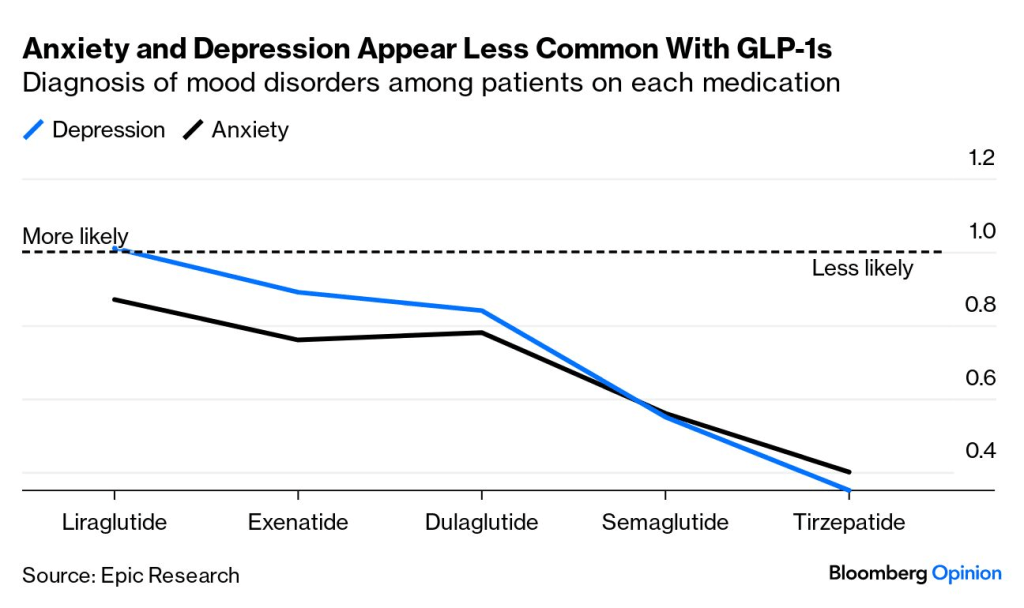
Ozempic and other GLP-1 medications are having a positive effect on depression.

Bill Simmons spoke with Derek Thompson on his podcast this week about many topics, one of which was GLP drugs.

Interview with Jim Bianco who has been in the (recently lonely) camp that the last mile to get inflation down to 2% will be very difficult, and interest rates will be higher and for longer than we expect. This podcast/interview came right before this week’s higher than expected CPI inflation print.

David Einhorn discusses why the financial markets are fundamentally broken and the traditional way to invest in value companies is dead. This is one of the best podcasts I’ve heard in a long time. He walks through how he changed his investing tactics after years of underperformance trying to continue to do the correct thing in a broken market.

The Dark Side of the Internet’s Obsession with Anxiety (Podcast) – Derek Thompson asks if we have “overcorrected” from an era when mental health was shameful to talk about, to an era where people talk about anxiety so much online that it’s now possibly worsening mental health?

Mark Manson brought up the same topic this week on his podcast talking with Lori Gottlieb; the prevalence inflation hypothesis: when awareness can paradoxically contribute the increase mental health problems.

Anger Leaves A Lasting Mark – After unleashing a critical barrage on your child, you seek to justify it, mitigate it, by saying how overworked and stressed out you’ve been. But your child doesn’t register this context at the time, and ten, twenty, thirty years later, it will still very much be forgotten, while the sting of your words indelibly remains.

Americans continue to focus on how large the top 10 companies in the S&P 500 have grown as a percentage of the total market:

However, the concentration is even greater in other stock markets around the world:

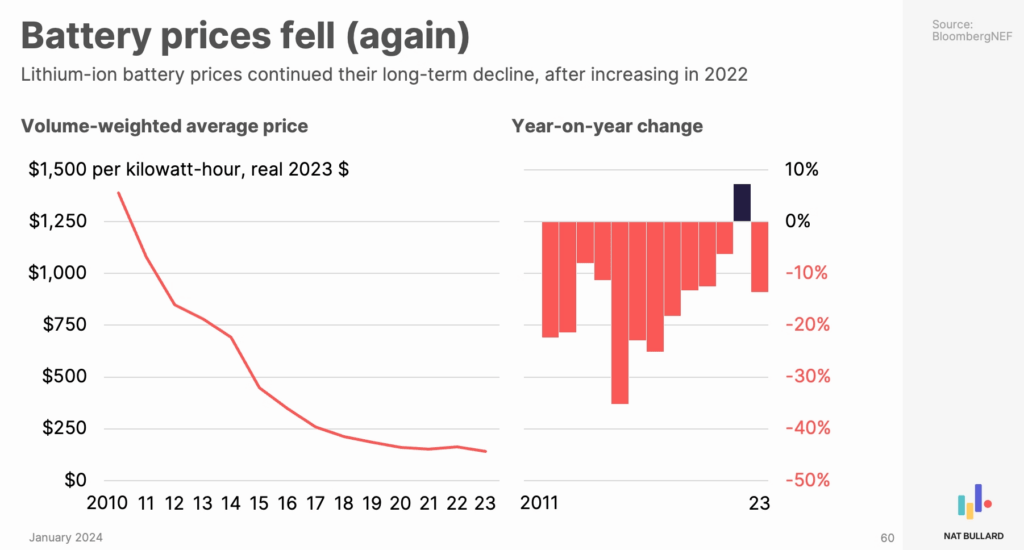
Lithium battery prices continue to get cheaper:

A scathing review of Tony Robbins new book on investing in private investments. The article was written by someone who makes a living keeping his clients in public investments. Not saying there’s anything wrong with that, but if you ask a realtor what someone should invest in, I think you can guess what their answer will be.

Welcome (Back?)!

I started blogging way back in 2006, and 18 years later I guess I’m still going. For those of you that found this site because you were forwarded here from my previous site, thanks for continuing the journey.

I’m 41 years old now, with a wonderful wife, amazing daughter and real estate company that consume most of my mental energy and thoughts.

While I don’t have the time to write that I did 10 to 15 years ago, I still spend many (probably too many) hours every week reading books/articles and listening to books/podcasts about the financial markets, real estate and behavioral psychology.

My hope is to start writing down more of the things I come across that I find interesting, or worth recommending, here on the site. I’ve realized after doing this for a long time that when I take the time to write things down it helps me remember them. As I move into the second half of my life, remembering things will probably become more and more important.

Hopefully people stopping by this site will find some of these thoughts interesting as well, and we can continue learning together. Here’s to 18 more years!