A higher price to earnings ratio means a country’s stock market is more expensive. A lower number is less expensive. It’s the price you are paying for the earnings of the companies.
Average of Foreign Developed Stock Markets: 20 Average of Foreign Emerging Stock Markets: 19
Status leads people to assume something about us that we might otherwise have had to prove. It’s a pattern-matching mechanism that allows us to quickly filter and process information in a world defined by incomplete knowledge. We live in a time-constrained world where don’t have the capacity to evaluate everyone on merit alone, and status is our way of expediting that evaluation process. And let’s not kid ourselves, most of us care a lot about status, to the point that we’ll sacrifice money for it. In a survey of 1,500 office workers, seven out of 10 said they would forego a raise for a higher status job title.
Buy this, not that: Buy term life insurance, not whole life insurance. Buy retirement accounts, not annuities. Buy individual disability insurance, not group disability insurance. Buy experiences, not stuff.
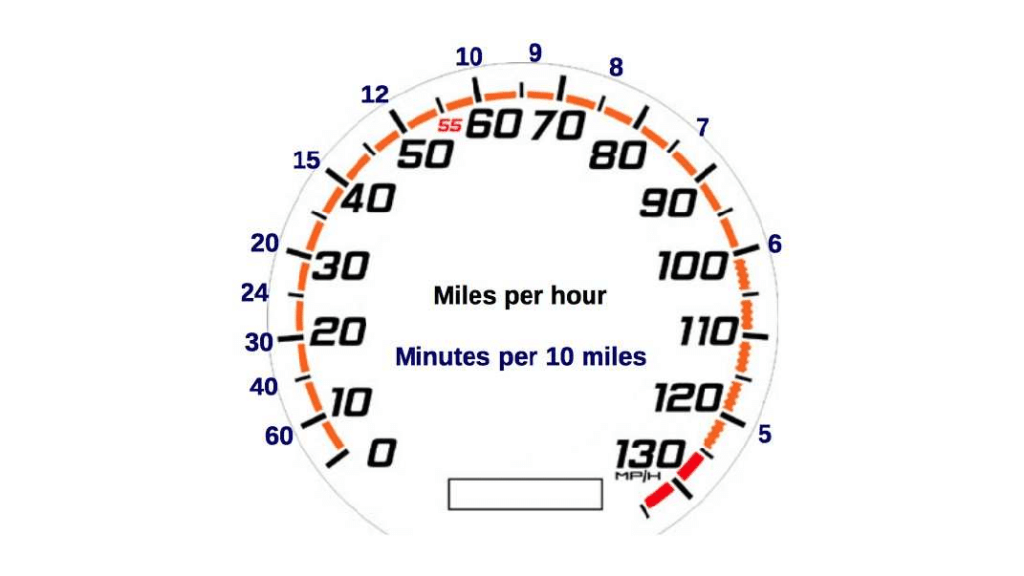
The speedometer below shows how many minutes it takes to arrive somewhere based on your speed. You can see that at the beginning, the value of going faster is enormous. As you hit about 65 miles per hour, the value falls off a cliff while the danger of increasing your speed rises exponentially.
____________________________
In the digital thunderdome of LinkedIn hustlers, Twitter thread bros, and Instagram “success stories,” there’s a piece of advice I continue to see shared, repackaged in various forms but always carrying the same core message: surround yourself with the most ambitious and successful people you can find.
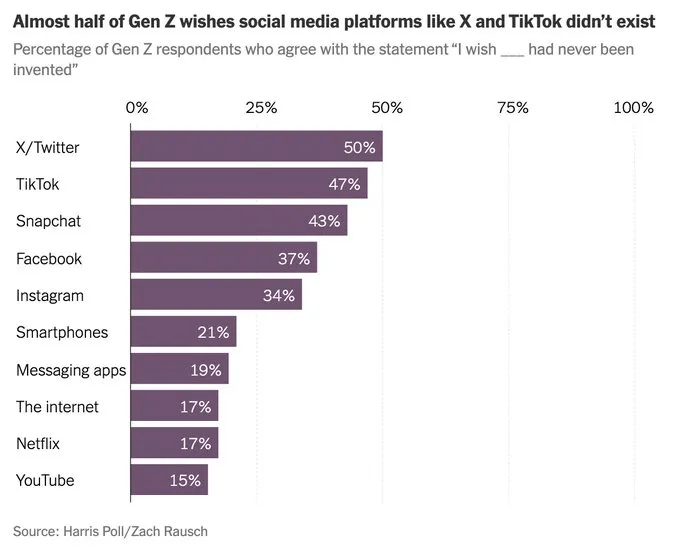
This poll reads like a group of people that have been on drugs for a long time, know they’re awful, but cannot stop using them:
_______________________________
People are biased towards solving problems through addition rather than subtraction.The reason? Because adding something makes you feel like you are advancing, while taking something away makes you feel like you are retreating. We see this dynamic across all parts of the economy, and society at large. the case can be made that we live in an era of too much. Too much information, too much stuff, too many choices, and too many distractions. As a result, there is a good chance that the path to happier lives and investment portfolios performance, might start by taking things away.
_______________________________
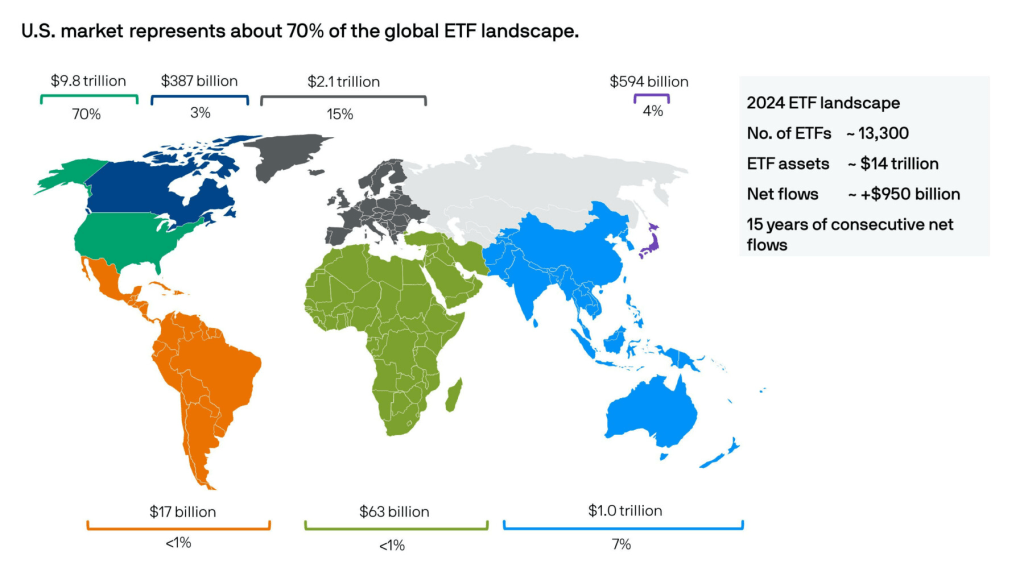
Should Europeans put 72% of their portfolios into 1 foreign country? Obviously, the same question should be asked of Americans, even though they live in that country. As of September 2024, the U.S. represents 72% of the MSCI World Index. Many passive investors simply buy into this widely adopted benchmark, but is that a prudent approach?
The primary reason we’re seeing all this disruption in the job market is because we’ve been part of a mass delusion about the very nature of work.
We told ourselves that millions of corporate workforce jobs—that pay good salaries, have good benefits, and allow you to save for retirement—were somehow a natural feature of the universe.
In fact, that entire paradigm was just a temporary feature of our civilization, caused by builders and creators not being able to do the work required by themselves. And that’s going away.
But it’s ok.
Most of the jobs sucked anyway, and they took up most of the daily waking hours we were supposed to be spending with family and friends.
Plus even if this transition happens really fast, it still won’t be overnight. Big things take a while.
And most importantly—what waits for us on the other side is a better way to live. A more human way to live—where we identify as individuals rather than corporate workers and exchange value and meaning as part of a new human-centered economy.
Great newsletter from Lyn Alden walking through the reasons why we will continue to have enormous structural government deficits moving forward and the implications on the global economy and financial assets.
Nobody knows whether stocks will be up or down tomorrow. Occasionally some newsworthy development is the clear driver of stock market movement, but usually daily market watchers are studying randomness, putting themselves at risk of missing the forest through the trees. Price movement always comes before the narrative. Reality is much more complex.
____________________________
OnlyFans now generates $6.3 billion in annual gross revenues, up from $300 million five years earlier. A reason for OnlyFans success is its high revenue share rate (with its content creators) – 80% – which far exceeds that which a creator might get as a performer working for a production company or other agency. OnlyFans creators collected $5.3 billion in 2023, a 19% increase year-over-year. Many OnlyFans creators now treat sites such as Reddit, Imgur, Instagram, TikTok, and Twitter as “front doors” for OnlyFans customer acquisition. OnlyFans has paid its two owners $1.1 billion in dividends since 2019, with $472 million paid in 2023 alone.
Teen vaping has hit a 10-year low. In an annual survey conducted from January through May in schools across the nation, fewer than 8 percent of high school students reported using e-cigarettes in the past month, the lowest level in a decade. That’s far lower than the apex, in 2019, when more than 27 percent of high school students who took the survey reported that they vaped.
___________________________
The dating apps are under a lot of pressure. Falling revenues, people not wanting to pay, and Gen Z seemingly uninterested have led to collapsing stocks and circling activist investors. Their only path forward is monetization – but what does that mean for the demographic crisis?
American homes have been going up in price since early 2012. That’s part of the reason why it’s been American’s favorite investment for 12 year running. The other reason is leverage. If you put down 20% (or less) and the home price goes up 20%, you’ve made 100% on your investment. Of course, most American’s have done much better than that since 2020.
Based on the way we are wired as humans; our memories are constantly changing over time. Remembering is dominated by the perspective we have in the current moment. We have an ‘experiencing self’ and a ‘remembering self.’ Your experiences of things are continuous in real time and associated with all sorts of feelings and thoughts and sensations. And then in the cold light of reason you have this remembering self in a completely different context, trying to make sense of yourself, a person with a very narrow window of experience.
A look at why young adults are the ones most in crisis with mental health. A recent study found that 36 percent of participants ages 18 to 25 reported experiencing anxiety and 29 percent reported experiencing depression—about double the proportion of 14-to-17-year-olds on each measure. Older adults, often depicted in popular culture and news commentary as isolated and unhappy report the lowest levels of anxiety and depression.
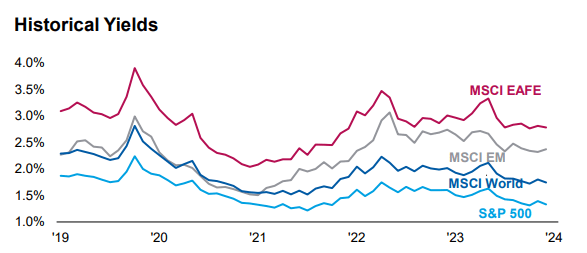
The following graphs show the dividend yields for the S&P 500, MSCI World (all developed stock markets including the U.S.), MSCI EM (emerging markets) and MSCI EAFE (developed markets excluding the U.S.).
Here is the MSCI EAFE forward P/E ratio (stock prices relative to their projected earnings over the next 12 months). The higher the number, the more expensive the market. The S&P 500 is currently at 23. It would be close to being off the chart it is so expensive relative to the rest of the developed world.
They identified 8,577 who were in the study from the early 1990s until 2017 and who met a variety of other criteria for inclusion. This gave them 25 years of follow up, long enough to ask the question: how does participation in sports affect life expectancy? The results? Playing tennis was the clear winner: extending one’s life expectancy by 9.7 years. The other sports all provided benefits too:
Tennis: 9.7 years gain in life expectancy
Badminton: 6.2 years
Soccer: 4.7 years
Cycling: 3.7 years
Swimming: 3.4 years
Jogging: 3.2 years
Calisthenics: 3.1 years
Health club activities: 1.5 years
One possible reason for tennis, badminton, and soccer doing so well is that out of the 8 sports studied, these are the ones that require 2 or more people and involve social interaction. As the authors explain, “Belonging to a group that meets regularly promotes a sense of support, trust, and commonality, which has been shown to contribute to a sense of well-being and improved long-term health.”
Or it might be that the type of exercise you get in tennis – short bursts of activity rather than slow, steady plodding exercise – might be better for you. The authors noted that “short repeated intervals of higher intensity exercise appear to be superior to continuous moderate intensity physical activity for improving health outcomes.”
Constantly being presented with the idea that their friendships should mirror the deep, intimate, dyadic friendships of women alters men’s expectations in a potentially unhelpful way. Guys see memes about how it’s dysfunctional to spend hours with their buddies without discussing personal issues, or read a reddit post about how sad it is that men don’t have friends they can completely open up to, or listen to a podcast about how they need to be vulnerable with other men if they want to be happy and healthy, and start wondering if their social life is subpar and they’re missing out. “Man, maybe I don’t have good friends after all.”
Irving Fisher has one of the most famous quotes in financial history (for being very wrong at the worst possible time), but his full story is even more tragic. Another great lesson on the danger of leverage and overconfidence.
__________________________
Why you don’t need to separate your clothes anymore. There’s no actual threat to your clothes or machines by washing everything together—the life of your clothes may be shortened slightly, but that’s all. Since most of the clothes we wear are now a byproduct of fast fashion, there’s less investment into each piece, and they’re not really built for the long haul the way clothes once were, anyways. Also, the natural fibers and dyes that used to be mainstream have been long replaced by synthetic fibers and better dye processes, which result in much more colorfast garments. These garments also generally stand up to wash processes better. Advancements in detergents also focused on using less of it, stopping colors from fading, keeping whites bright, and washing everything in cold water to save on energy. As a result, laundry in general is a much gentler on clothes.
While the U.S. has never experienced a 20-year period of negative real returns, it has gotten close a few times. From February 1966 through December 1982, U.S. stocks lost 0.16% on an annualized basis, when including dividends and adjusting for inflation. That’s a 16-year period of negative real returns. Additionally, from September 1929 through December 1944, U.S. stocks experienced a 15-year period of negative real returns. This coincided with the beginning of the Great Depression through WWII.
_____________________
This article goes through just about any statistic you can think regarding divorce. What about the famous statistic that half of all marriages end in divorce? That’s a bit of an exaggeration when it comes to first marriages, only 43% of which are dissolved. Second and third marriages actually fail at a far higher rate, though, with 60% of second marriages and 73% of third marriages ending in divorce.
_____________________
People around the world are spending billions of dollars talking to who they think are OnlyFans models online. Many times, they are actually talking to a fake “chatter” which can even be another guy (if they think they’re talking to a girl). The word is out and now lawsuits are starting.
_____________________
This paper discusses how less people are moving south due the rising heat: Snow Belt to Sun Belt Migration: End Of An Era? Internal migration has been cited as a key channel by which societies will adapt to climate change. We show in this paper that this process has already been happening in the United States. Over the course of the past 50 years, the tendency of Americans to move from the coldest places (“Snow Belt”), which have become warmer, to the hottest places (“Sun Belt”), which have become hotter, has steadily declined. Given climate change projections for coming decades of increasing extreme heat in the hottest U.S. counties and decreasing extreme cold in the coldest counties, our findings suggest the “pivoting” in the U.S. climate-migration correlation over the past 50 years is likely to continue, leading to a reversal of the 20th century Snow Belt to Sun Belt migration pattern.
_____________________________
More and more home buyers are discovering cheap financing through a once-obscure workaround — assumable mortgages. The first question to ask is whether the seller has an FHA or VA loan. These actually make up a significant share of the market: About 13 percent of all mortgages are FHA loans, while about 11 percent are VA loans. The property must be the seller’s primary residence and the buyer must meet the qualifications set by the FHA and the lender. For VA loans, a regional VA loan office has to approve the transaction, but the borrower doesn’t have to be a veteran, she added. In addition, the seller has to sign off on the buyer assuming the loan and provide authorization to the lender. Once the loan is approved and the sale goes through closing, the loan servicer replaces the original borrower with the new owner on the loan documents.
_____________________
Research by David Autor from MIT shows that 60% of today’s workers are employed in occupations that didn’t exist in 1940, see chart below. This is important when discussing what impact AI may have on the labor market.
____________________________
Japan’s three-day stock market crash this week was their greatest in history. It topped the Fukushima disaster in 2011, the 1987 global crash (when U.S. stocks fell 22% in a single day), the Covid declines, and the massive 2008 drawdowns:
The graphs below show the price-to-book ratio on the y-axis and the Shiller Price to Earnings CAPE ratio on the x-axis. The higher the numbers (moving the plot point up and to the right), the more expensive/overvalued the country’s stock market.
Today most of the world stock markets are relatively inexpensive or fairly valued, especially compared to the United States and India which have moved off the chart toward outer space overvaluation levels.
The US market is currently trading 31% higher than in the period 1995-2024. In contrast, Emerging America, Developed Asia and Emerging Asia are attractive, trading 29%, 21% and 7% below their historical valuation averages.
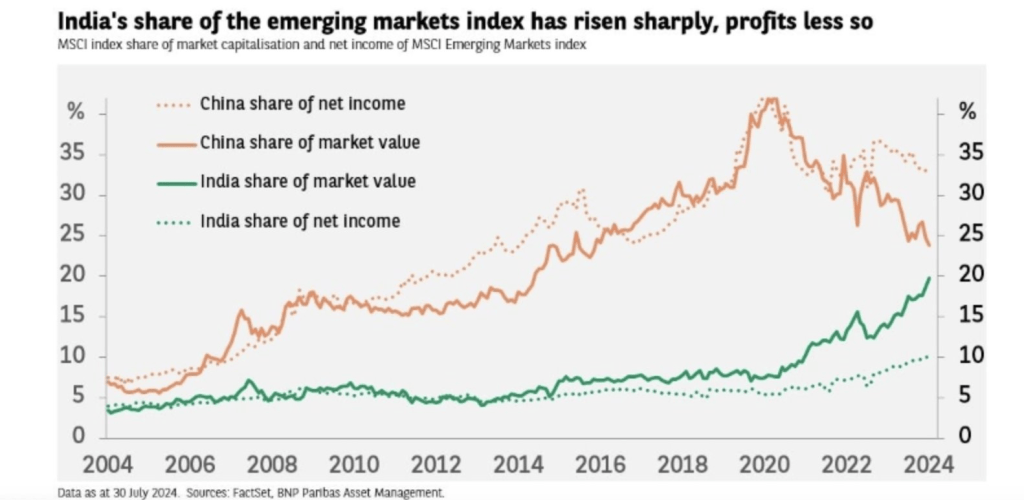
China and India have been oppositive stories since 2020 in terms of their stock prices (dark lines) and their net income (dotted lines):















 Tuna Thoughts