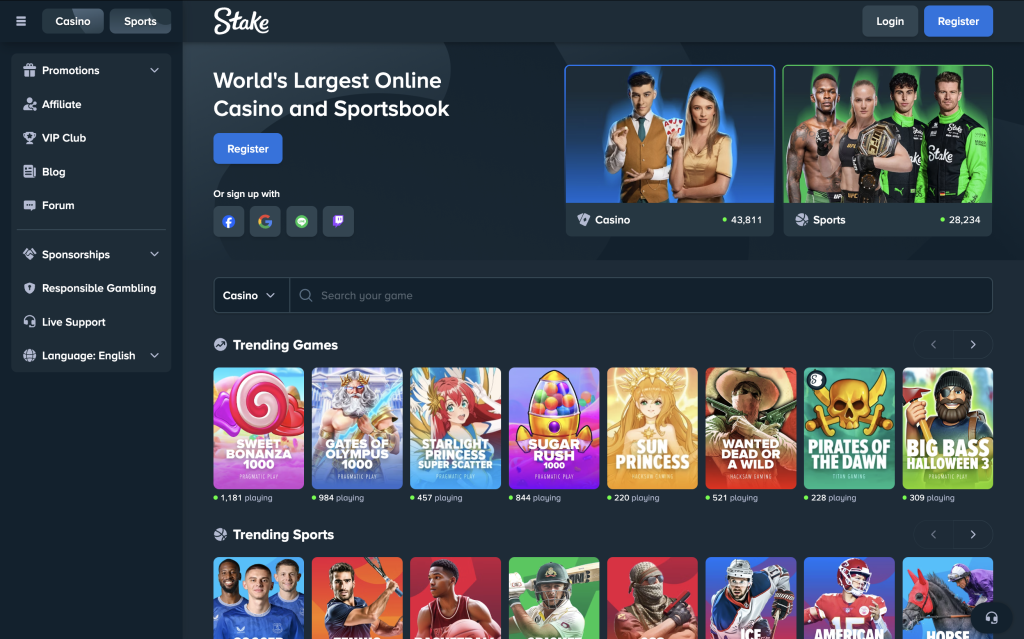
Many young people that are chronically online have been enticed by crypto casinos, an expanding realm of online gambling where longstanding guardrails are often ignored.
The sites have spread across social media, taking advantage of the borderless nature of the internet. They offer hundreds of games, including blackjack, sports betting and flashy online slot machines. They operate with fewer restrictions for gamblers by obtaining licenses in small island nations.
And, although they are not legal in many countries including the United States, the casinos have become gambling havens where teenagers and problem gamblers play and even earn income by promoting the sites.
This flourishing industry has been built by operators willing to deploy an exploitative marketing system. Their strategies encourage reckless wagers, turn social media influencers into casino recruiters and lure in young people, one of the demographics most vulnerable to addiction.
The finances of crypto casinos, private companies licensed outside the United States, are not public. Stake told Forbes it earned $4.7 billion in gaming revenue in 2024, more than MGM reported earning from casino games at all of its Las Vegas properties.
Memecoins exist in a complex world of schemes and double crosses, baffling to outsiders. At the center is an obvious conflict. To lure traders, the coin creators generally promise they’ll sell a fixed number of tokens at a low price. But as soon as the price rises, they have an incentive to dump as many as they can. Common, if not necessarily ethical, tricks for getting people in the door include engineering fake trades to create the appearance of activity, or quietly paying influencers for what looks like organic social media hype. The dumping can also happen surreptitiously, if creators conceal that they’re the people selling. Regardless of how it all plays out, the only consistent winners are insiders who get in early.
No one involved seems particularly squeamish about whether memecoins are legal. A month after Trump’s inauguration, the US Securities and Exchange Commission announced it won’t regulate them. Agency staff noted that other fraud laws may still apply—a scam is a scam, whatever the method—but so far other regulators and prosecutors haven’t waded in.
The shadiness of the memecoin market isn’t a big secret. All but the most gullible traders know the deal. But they still think they can profit by getting out before a coin’s inevitable crash. It’s like consensual scamming. The slimy salesmen depicted in The Wolf of Wall Street had to dial all day to trick retirees into buying their penny stocks. Now the suckers are actually seeking out pump-and-dump schemes.
The plans for Trump’s memecoin were hatched only weeks before its debut. His team was rushing to get it out before Inauguration Day. The assumption was that Trump would face stricter scrutiny after that.
I wanted to see what would happen if I ignored the official stats and simply calculated the cost of existing. I built a Basic Needs budget for a family of four (two earners, two kids). No vacations, no Netflix, no luxury. Just the “Participation Tickets” required to hold a job and raise kids in 2024. Using conservative, national-average data:
Childcare: $32,773
Housing: $23,267
Food: $14,717
Transportation: $14,828
Healthcare: $10,567
Other essentials: $21,857
Required net income to live: $118,009. Add federal, state, and FICA taxes of roughly $18,500, and you arrive at a required gross income of $136,500.
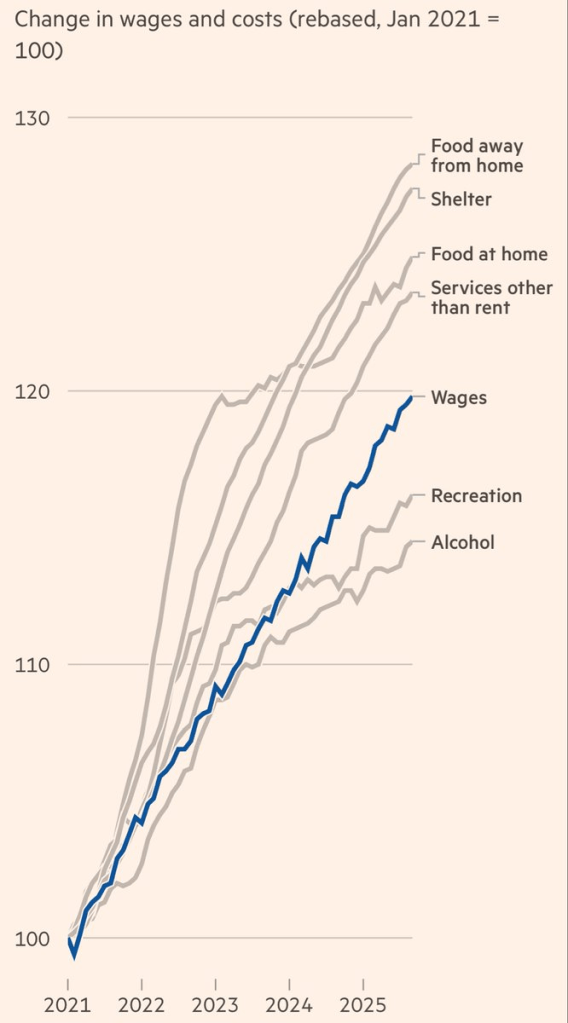
I then ran the numbers on what happens to a family climbing the ladder toward that break-even number. What I found explains the “vibes” of the economy better than any CPI print.
Our entire safety net is designed to catch people at the very bottom, but it sets a trap for anyone trying to climb out. As income rises from $40,000 to $100,000, benefits disappear faster than wages increase. I call this The Valley of Death. Let’s look at the transition for a family in New Jersey:
1. The View from $35,000 (The “Official” Poor)
At this income, the family is struggling, but the state provides a floor. They qualify for Medicaid (free healthcare). They receive SNAP (food stamps). They receive heavy childcare subsidies. Their deficits are real, but capped.
2. The Cliff at $45,000 (The Healthcare Trap)
The family earns a $10,000 raise. Good news? No. At this level, the parents lose Medicaid eligibility. Suddenly, they must pay premiums and deductibles.
Income Gain: +$10,000
Expense Increase: +$10,567
Net Result: They are poorer than before. The effective tax on this mobility is over 100%.
3. The Cliff at $65,000 (The Childcare Trap)
This is the breaker. The family works harder. They get promoted to $65,000. They are now solidly “Working Class.” But at roughly this level, childcare subsidies vanish. They must now pay the full market rate for daycare.
Income Gain: +$20,000 (from $45k)
Expense Increase: +$28,000 (jumping from co-pays to full tuition)
Net Result: Total collapse.
When you run the net-income numbers, a family earning $100,000 is effectively in a worse monthly financial position than a family earning $40,000. At $40,000, you are drowning, but the state gives you a life vest. At $100,000, you are drowning, but the state says you are a “high earner” and ties an anchor to your ankle called “Market Price.”
Bitcoin was never the future of money. It was a battering ram in a regulatory war. Now that war is wrapping up, and the capital that built it is quietly leaving. For 17 years we convinced ourselves that Magic Internet Money was the final state of finance. It was not. Bitcoin was a regulatory battering ram, a one purpose siege engine built to smash a specific wall: the state’s refusal to tolerate digital bearer assets.
That job is basically done. Tokenized US stocks are already being issued. Tokenized gold is legal and growing. Tokenized USD has a market cap of several hundred billion dollars. In wartime, a battering ram is priceless. In peacetime, it is a heavy, expensive antique.
There is genuine and widespread despair in the U.S., but the primary reason isn’t economic, rather it is because human fulfillment requires more than material wealth, which in our quest for more stuff, we have forgotten. People need physical communities, and while the US excels at material wealth, it’s achieved it, especially in the last forty years, at the expense of the aesthetic, communal, stable, and personal, and so the bad vibes are justified.
Societies come with strong forces that shape expectations and even shape people’s understanding of a ‘good life.’ That is, society provides citizens playbooks that they are urged to follow which are supposed to end in happily ever after, and ours is that you can become a millionaire on your own terms as long as you hustle hustle hustle — and when that doesn’t happen, it’s very lonely and humiliating, because we as a culture have put all our eggs in that one particular basket. At the expense of community, friendships, and even family.
When you give your citizens a cultural script, built on the material, that promises hard work will lead to success, and then your policy design ensures it doesn’t, people will end up both economically frustrated, as well as spiritually empty, sitting in their living room streaming the latest movie wondering what exactly is the point of life. Or, they will feel they have failed at the material, while also having little else to give them meaning.
_____________________________
In his investment classic Winning the Loser’s Game, Charley Ellis tells a great story about healthcare and simplicity:
“Two of my best friends, who are at the peak of their distinguished careers in medicine and medical research, agree that the two most important discoveries in medical history are penicillin and washing hands (which stopped the spread of infection from one mother to another by the midwives who delivered most babies before 1900). What’s more, my friends counsel, there’s no better advice on how to live longer than to quit smoking and buckle up when driving. “
Weird things happen to economies when you have huge bursts of productivity that are concentrated in one industry. Obviously, it’s great for that industry, because when the cost of something falls while its quality rises, we usually find a way to consume way more of that thing – creating a huge number of new jobs and new opportunities in this newly productive area.
But there’s an interesting spillover effect. The more jobs and opportunities created by the productivity boom, the more wages increase in other industries, who at the end of the day all have to compete in the same labor market.
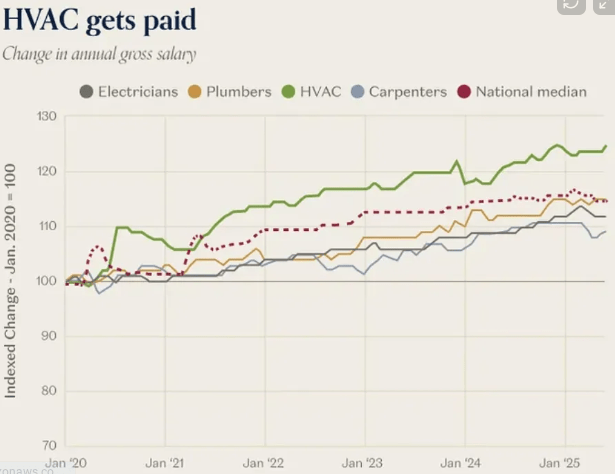
Our explosion of demand for data centers means there’s infinite work for HVAC technicians. So they get paid more (even though they themselves didn’t change), which means they charge more on all jobs (even the ones that have nothing to do with AI). Furthermore, the next generation of plumber apprentices might decide to do HVAC instead; so now plumbing is more expensive too. And so on.
Academics have published new research on the impact that Short Form Videos (SFV) like TikTok, Instagram Reels and Youtube shorts have on cognitive and mental health. The report systematically reviews and analyzes 71 studies involving over 98,000 participants.
SFV use is linked to poorer cognitive performance, with the strongest deficits in attention and inhibitory control, suggesting users struggle to focus and suppress impulses.
Frequent exposure to fast-paced, highly rewarding SFV content may rewire attention systems, fostering “rapid disengagement” from tasks that are slower or require sustained effort, reducing cognitive endurance over time.
SFV use is associated with poorer overall mental health, with the strongest links to stress and anxiety, indicating consistent emotional strain among heavier users.
Heavy SFV use reinforces impulsive engagement loops driven by dopamine rewards, contributing to compulsive scrolling and difficulty disengaging, patterns resembling behavioral addiction.
Short-form video consumption is associated with poorer sleep quality, especially when used at night, due to overstimulation and blue light disrupting melatonin, which can worsen mood and cognitive functioning.
Higher SFV use correlates with increased loneliness and reduced life satisfaction, as digital interactions replace real-world social connection for some users.
Negative effects occur across both youth and adults, meaning the cognitive and emotional risks of SFV use are not limited to developing brains; adults experience similar declines and mental health associations.
_______________________________
These days, it’s all stocks all the time, with reputable authorities calling on small investors to put everything they have saved into equities. Older investors are reminded of the mantra so common in 1999: “Every penny you don’t have invested in stocks will hurt you.”
More than a generation ago, financial historian Peter Bernstein wrote about investors’ “memory banks,” the market experience that accumulates in their hippocampi over their investing lives and molds their investment strategy. As he put it, looking back on the 1990s: “Most of the new participants in the market had no memory of what a bear market was like.”
And here we are today, almost seventeen years into a great bull market. Rather like 1999, also seventeen years into a long-term bull market, or 1966, once more seventeen years. Or 1873, sixteen years in, or 1837, eighteen years in, or 1893, twenty years in — to name a few of the notable tops over the past two centuries. Just long enough to produce empty memory banks in just enough investors.
Historically, valuations have been a useful (though not perfect) indicator of real returns over the following decade. Below, you’ll see historical CAPE readings (in black) for the U.S. market alongside their corresponding forward ten-year real returns (in green). The conclusion is straightforward: when valuations are low, future returns tend to be above average; when valuations are high, forward returns tend to be much more muted.
Right now, the U.S. market sits at a CAPE ratio of around 40. It’s nearly double the long-term average of roughly 20, and the second most expensive in history.
historically, when valuations have climbed to this level, the following decade hasn’t been kind to investors. Not once has a country that ended a year with a CAPE above 40 produced positive real returns over the next ten years. That’s not a personal opinion but what the data shows.
To get a sense of what current valuations might mean going forward, I ran a linear regression using historical CAPE data and forward ten-year real returns. The relationship is remarkably consistent: as valuations rise, future returns fall. At today’s valuation levels, the regression suggests an expected real return of -2.46% for the next decade. From a historical perspective, the last time we were at the CAPE reading we find ourselves in today, the market went on to lose -2.11% per year for the next ten years.
Valuation isn’t the only red flag flashing. Today, about 40% of the market is concentrated in its 10 largest companies. This is the most concentrated the market has ever been.
Concentration itself isn’t a bearish sign. What really matters is how concentration changes going forward. Rising concentration tends to coincide with strong market performance as leading firms continue to gain share and deliver growth. On the other hand, when concentration starts to fall, this means your largest players are underperfoming the rest of your portfolio, and that’s when returns have historically suffered. If the biggest names continue to pull away from the pack, the market could remain strong for a while. But if that leadership falters, history suggests the unwind can be painful.
A few highlights from one of the best articles I’ve read this year discussing the private equity/credit bubble:
The golden age of Private Equity – at least from the standpoint of investor returns (FUM and thus fees to sponsors were significantly lower) – was during 1980-2000, and at a slight stretch, to around the time of the Great Financial Crisis in 2008. During this era, PE delivered legitimately good returns – in some cases outstandingly so. What enabled it was that it was still a niche industry where there was a limited amount of capital chasing deals, while the backdrop was conductive.
In contrast to the 1980-2000s, private equity funds from the 2010s began paying a premium to public market valuations for (typically) small, subscale and illiquid businesses. The problem was that the same thing that always happens when too much money floods into an area happened – bidding competition heated up, target prices rose, and the opportunity that previously existed rapidly disappeared (though the vehicles’ high fee structures of course remained firmly intact). Not surprisingly, since the 2010s, and perhaps as far back as 2006, outcomes have dramatically changed, and PE has delivered generally disappointing returns and underperformed listed equities, and the magnitude of that underperformance has significantly worsened since 2022.
Warren Buffett has scrutinized PEs return calculations and found them to be “well, they’re not calculated in a manner that I would regard as honest.” All kinds of tricks can be and are used to inflate apparent relative returns. PE will often lock up commitments from investors years in advance, and only “call” the funds much later after a deal is done. The IRR calculations only include the period during which the funds are working, but investors need to keep cash in reserve as it can be called at any time, meaningfully diluting effective returns to investors.
The much bigger elephant in the room – the PE industry is currently “marking to model” and is sitting on a vast number of assets it is unable to sell – even in a bull market – because the marks are unrealistic. This will be meaningfully inflating claimed trailing returns, which remain mostly unrealized.
If you look at who private equity companies hire, it is typically ex investment bankers. These guys are deal makers and spreadsheet jockeys, not operational people, and there is no reason to believe they have any unique insights on the intricacies of running small, niche businesses, where specialized skills and decades of domain experience generally count for a lot more than general smarts.
Not to mention that as the industry has mushroomed in size, the average quality of the average hire has meaningfully degraded. Investment bankers also generally lack investment acumen. They are deal makers – a different skill set entirely.
Going even a step further – it’s probable that private equity ownership not only fails to deliver operational improvements, but very likely on net makes the operational performance of companies worse, particularly in the long term. The most obvious means by which this occurs is by saddling investees with significant levels of debt, as well as implementing wholesale asset stripping (such selling and leasing back real estate) and cutting operational costs and capital expenditures to the bone. They frequently don’t just cut the fat, but the muscle as well.
If you are apt to under invest and run the business for maximum cash extraction in the near term, jacking up prices, lowering service quality, squeezing employees, alienating customers and opening the door to competitor inroads – it may improve near term cash generation, but it often comes at the cost of long-term value degradation.
PE has now taken over a large portion of Las Vegas, for instance, and visitors routinely complain of high prices, poor customer service, and the removal of perks such as free drinks that previously endeared visitors to the strip. Visitation has been waning, and people complain Vegas has lost its charm, and has become overpriced and soulless, a victim of “corporate greed.”
This is far from the only example. Employees and customers of PE backed hospitals and dental practices often complain of declining service standards, high prices, and a significant increase in unnecessary treatments unethically prescribed to boost near term utilization/billing.
The fair value of the combined $5 trillion of assets held in the US Private Equity/Credit industry is probably worth only about 60% of that in reality – a $2 trillion hole. When that hole is exposed, it will change economic behavior, and likely to a noticeable degree.
(1) The number of 55+ yard field goals has increased by 3x since just 2022:
(2) Between longer field goals and the dynamic kickoff, the field has basically been shortened by 10-15 yards.
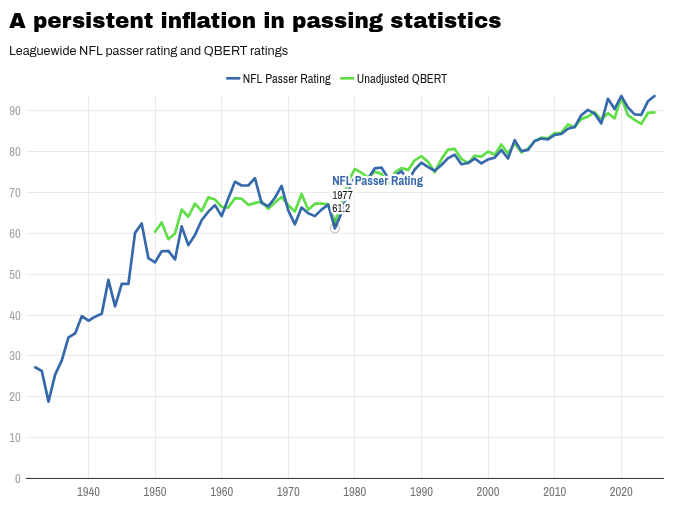
(3) Quarterback passer ratings are tied for their highest-ever at 93.6:
(4) For the first time in NFL history, quarterbacks as a collective are gaining enough rushing yards to outweigh the yards they lose from sacks:
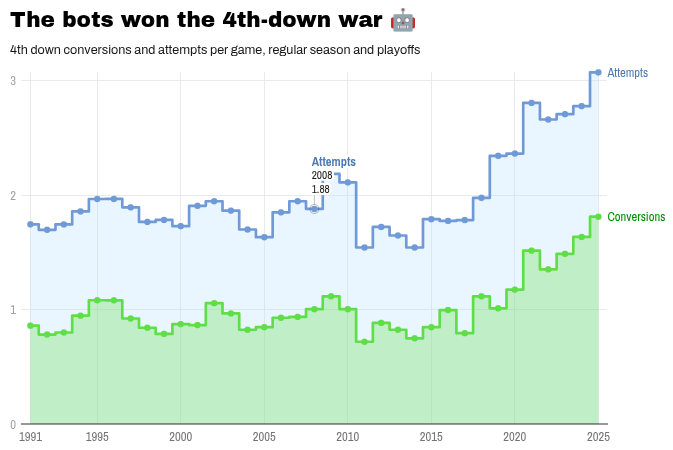
(5) Analytics have teams successfully attempting and completing fourth down conversions:
(6) Rushing plays on 4th-and-short are being attempted (and succeeding) at extremely high rates. The tush push effect:
_______________________
If you’ve ever received a spammy text falsely alerting you to an unpaid toll or failed delivery, it might have come from a so-called Phishing-as-a-Service network that Google is now trying to take down. In just 20 days, Google alleges, Lighthouse was used to spin up 200,000 fraudulent websites to attract over a million potential victims. It estimates that somewhere between 12.7 million and 115 million credit cards in the US were compromised by the scam.
Hyperscalers (Microsoft, Amazon, Google, Oracle, IBM) believe they might build God within the next few years. That’s one of the main reasons they’re spending billions on AI, soon trillions. They think it will take us just a handful of years to get to AGI—Artificial General Intelligence, the moment when an AI can do nearly all virtual human tasks better than nearly any human.
They think it’s a straight shot from there to super-intelligence—an AI that is so much more intelligent than humans that we can’t even fathom how it thinks. A God. The arguments to claim we’re about to make gods are:
AI expertise is growing inexorably. Threshold after threshold, discipline after discipline, it masters it, and then beats humans at it.
We’re now tackling the PhD level.
In the current trajectory, we should reach AI Researcher levels soon.
Once we do, we can automate AI research and turbo-boost it.
If we do that, super-intelligence should be around the corner.
What afflicts America’s young today can’t be properly called a loneliness crisis. It seems more to me like an absence-of-loneliness crisis. It is a being-constantly-alone-and-not-even-thinking-that’s-a-problem crisis. Americans—and young men, especially—are choosing to spend historic gobs of time by themselves without feeling the internal cue to go be with other people, because it has simply gotten too pleasurable to exist without them. The problem is not loneliness. The problem is that we’ve forgotten how to feel lonely in the first place.
Since the 1970s, America has over-regulated the physical world and under-regulated the digital space. To open a daycare, build an apartment, or start a factory requires lawyers, permits, and years of compliance. To open a casino app or launch a speculative token requires a credit card and a few clicks. We made it hard to build physical-world communities and easy to build online casinos. The state that once poured concrete for public parks now licenses gambling platforms. The country that regulates a lemonade stand will let an 18-year-old day-trade options on his phone.
As part of a larger project, an author read 102 books over the past twelve-and-a-half months. Here were some of the insights he took away:
Exercising regularly is probably the single best thing you can do for your health. (Outside of quitting smoking.)
Happiness, not stress, leads to productivity.
Despite our preconceptions, we may be happier at work than at home. People experience more flow at work than in leisure.
Energy, not time, is the limited resource in our ability to be productive.
You can’t beat the market. Nearly everyone is better off simply buying a diversified low-cost index fund. Neither can any fund you invest in. The percentage of funds that beat the market after fees is so low that you can round it to zero.
You can’t time the market. Frequent trades expose you to taxes and whittle away your capital on fees. Buy and hold is better.
If you need an advisor, find someone who charges hourly. Paying a percentage of your assets seems cheaper, but the cost is enormous in the long-run.
We’re overweight because we eat too much. The increase in calories consumed is enough to entirely explain the change in body mass. Successful weight loss requires you to stick to a dietary pattern forever. The weight will always come back the moment you stop.
Loneliness is as bad for your health as smoking cigarettes. The stress of loneliness weakens our immune system.
There are numerous explanations for the increase in time alone, but a simple one is just better entertainment options available.
Sleep serves many important functions. It flushes the brain of metabolic byproducts, consolidates memories, reinforces the immune system and recalibrates synaptic connections.
If you have insomnia, don’t worry, you probably are sleeping enough. If you’re sleep deprived you will fall asleep, so despite feeling cranky and low energy, most insomniacs are not actually sleep deprived.
Asking yourself “what went well?” at the end of the day can give you a big boost to your happiness.
ADHD is about as heritable as height, is not caused by parenting style, doesn’t go away as you age and, despite popular disbelief, medication works pretty well.
Why do doctors now seem so rushed and dismissive? You wait 45 minutes in the exam room when the doctor finally walks in. They seem rushed. A few questions, a quick exam, a glance at the clock and then a rapid-fire plan with little time for discussion – and you leave feeling unheard, hurried and frustrated.
Increasingly, health care organizations and physician groups face intense financial pressures. Many doctors can no longer sustain their private practice due to declining reimbursements, rising costs and increasing administrative burdens; instead, they’ve become employees of larger health care systems. In some cases, their practices have been acquired by private equity groups.
With this shift, doctors have less control over their workloads and the time they get with their patients. More and more, payment models fail to cover the true cost of care. The default solution is often for doctors to see more patients with less time for each, and to squeeze in additional work after hours.
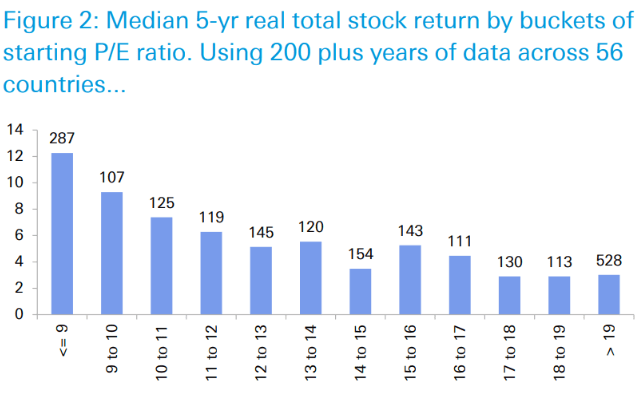
200 years of data across 56 countries, showing 25-year and 5-year returns from different starting P/E ratios (the price of a stock dividend by its earnings). The takeaway? Even over relatively short periods like five years, valuations matter a lot. If you buy when stocks are expensive they tend to do worse than when you buy them cheap.
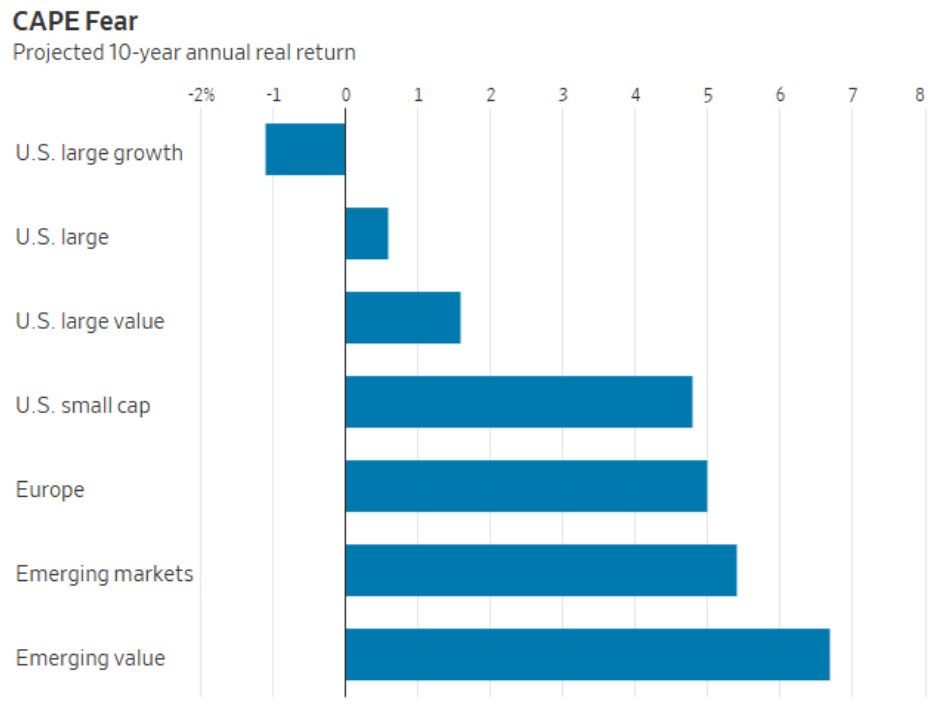
Here are the forecasts for different categories of stocks over the coming decade based on their current valuations:
A good name for problems on tests that determine someone’s level of intelligence is “well-defined.” Well-defined problems can be very difficult, but they aren’t mystical. You can write down instructions for solving them. And you can put them on a test. In fact, standardized tests items must be well-defined problems, because they require indisputable answers. Matching a word to its synonym, finding the area of a trapezoid, putting pictures in the correct order—all common tasks on IQ tests—are well-defined problems.
People differ in their ability to solve well-defined problems, they’re not the only kind of problems. “Why can’t I find someone to spend my life with?” “Should I be a dentist or a dancer?” and “How do I get my child to stop crying?” are all important but “poorly defined” problems. Getting better at rotating shapes or remembering state capitals is not going to help you solve them.
One way to spot people who are good at solving poorly defined problems is to look for people who feel good about their lives; “how do I live a life I like” is a humdinger of a poorly defined problem. The rules aren’t stable: what makes you happy may make me miserable. The boundaries aren’t clear: literally anything I do could make me more happy or less happy. The problems are not repeatable: what made me happy when I was 21 may not make me happy when I’m 31.
This is why the people who score well on intelligence tests and win lots of chess games are no happier than the people who flunk the tests and lose at chess: well-defined and poorly defined problems require completely different problem-solving skills. Nobody agrees on the rules, the pieces do whatever they want, and the board covers the whole globe, as well as the inside of your head and possibly several metaphysical planes as well.
Over the last generation, we have solved tons of well-defined problems. We eradicated smallpox and polio. We landed on the moon. We built better cars, refrigerators, and televisions. We even got ~15 IQ points smarter. How much did our happiness improve? None.
We haven’t yet defined the problem of “living a happy life”. We know that if you’re starving, lonely, or in pain, you’ll probably get happier if you get food, friends, and relief. After that, the returns diminish very quickly. You could read all the positive psychology you want, take the online version of The Science of Wellbeing, read posts on hacking the hedonic treadmill, meditate, exercise, and keep a gratitude journal—and after all that, maybe you’ll be a smidge happier. Whatever else you think will put a big, permanent smile on your face, you’re probably wrong.
We fawn over people who are good at solving well-defined problems. They get to be called “professor” and “doctor.” We pay them lots of money to teach us stuff. They get to join exclusive clubs like Mensa and the Prometheus Society.
People who are good at solving poorly defined problems don’t get the same kind of kudos. They don’t get any special titles or clubs. There is no test they can take that will spit out a big, honking number that will make everybody respect them.
And that’s a shame. My grandma does not know how to use the “input” button on her TV’s remote control, but she does know how to raise a family full of good people who love each other, how to carry on through a tragedy, and how to make the perfect pumpkin pie.
‘I realized I’d been ChatGPT-ed into bed’: how ‘Chatfishing’ made finding love on dating apps even weirder.
Standing outside the pub, 36-year-old business owner Rachel took a final tug on her vape and steeled herself to meet the man she’d spent the last three weeks opening up to. They’d matched on the dating app Hinge and built a rapport that quickly became something deeper. “From the beginning he was asking very open-ended questions, and that felt refreshing,” says Rachel.
One early message from her match read: “I’ve been reading a bit about attachment styles lately, it’s helped me to understand myself better – and the type of partner I should be looking for. Have you ever looked at yours? Do you know your attachment style?” “It was like he was genuinely trying to get to know me on a deeper level. The questions felt a lot more thoughtful than the usual, ‘How’s your day going?’” she says.
Soon, Rachel and her match were speaking daily, their conversations running the gamut from the ridiculous (favourite memes, ketchup v mayonnaise) to the sublime (expectations in love, childhood traumas). Often they’d have late-night exchanges that left her staring at her phone long after she should have been asleep. “They were like things that you read in self-help books – really personal conversations about who we are and what we want for our lives,” she says.
Which is why the man who greeted her inside the pub – polite, pleasant but oddly flat – felt like a stranger. Gone was the quickfire wit and playful rhythm she’d come to expect from their exchanges. Over pints he stumbled through small talk, checked his phone a little too often, and seemed to wilt under the pressure of her questions. “I felt like I was sitting opposite someone I’d never even spoken to,” she says. “I tried to have the same sort of conversation as we’d been having online, but it was like, ‘Knock, knock, is anyone home?’ – like he knew basically nothing about me. That’s when I suspected he’d been using AI.”
Rachel gave her date the benefit of the doubt. “I thought maybe he was nervous,” she says. But she’d been “Chatfished” before, so when the gap between his real and digital selves failed to close on their second date, she called it off. “I’d already been ChatGPT-ed into bed at least once. I didn’t want it to happen again.”
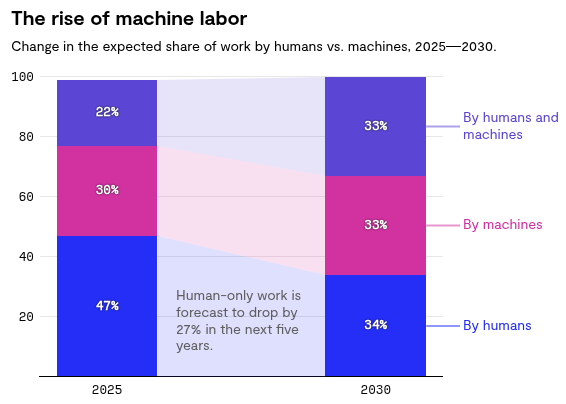
Inside a multistory office building in Manila’s financial district, around 60 young men and women monitored and controlled artificial intelligence robots restocking convenience store shelves in distant Japan. Occasionally, when a bot dropped a can, someone would don a virtual-reality headset and use joysticks to help recover it.
The AI robots are designed by Tokyo-based startup Telexistence, and run on Nvidia and Microsoft platforms. Since 2022, the company has deployed the machines in the back rooms of over 300 FamilyMart and Lawson stores in Tokyo. It is also planning to use them soon in 7-Elevens.
The bots are remotely monitored 24/7 in Manila by the employees of Astro Robotics, a robot-workforce startup. Japan faces a worker shortage as its population ages, and the country has been cautious about expanding immigration. Telexistence’s bots offer a workaround, allowing physical labor to be offshored. This lowers costs for companies and increases their scale of operations, he said.
It’s hard to find workers to do stacking in Japan. If you get one who’s willing to do it, it’s going to be very expensive. The minimum wage is quite expensive. It’s easy to get young, tech-savvy Filipinos to operate the robots. Each tele-operator, called a “pilot,” monitors around 50 robots at a time.
The bots are usually autonomous, but occasionally — about 4% of the time — they mess up. Perhaps they drop a bottle, which rolls away. Getting the AI bot to recover it by mimicking the human grip perfectly — the friction, the feel of metal in the hand — is one of the more challenging problems in robotics. That’s when a pilot steps in.
Diane has been a death doula for two decades now, meaning she is a companion for people at the end of life. She has sat beside people with no time left to waste and nothing left to prove, continually learning from the profound insights they leave behind. An insight she has gleaned:
What does it really mean to live like you are dying? Go skydiving? Ride a bull? Those may sound fun, but insights from people who are actually dying are often simpler and much deeper.
One client told me, “I just want to sit in my own kitchen one more time, with the people I love and a bowl of warm, fresh pasta with parmesan cheese melting on top.” That was his dream. Not a trip to Bali. Not bungee jumping. Just warm pasta, family, and home.
I used to expect that people would reminisce about big events like weddings, awards, or epic vacations. But over and over, what they actually longed for were the simplest pleasures.
My client Bernice had lived an extravagant life. Her walls were covered with perfectly posed photographs of big events from her life. But in her final months, she said, “I wish I had different pictures on the wall—messy ones. Pajama parties with friends, Sunday night movies with my kids, and neighborhood barbeques.” Those were the memories that stirred her soul.
We spend so much of life chasing big moments, but the dying often remind me that it’s not the grand gestures that matter most in the end. It’s the small, ordinary things. A meaningful life is built in everyday moments. Not in the highlight reel, but in the quiet, ordinary spaces in-between.
Bad news gets more attention than good news because pessimism is seductive and feels more urgent than optimism.
The odds of a bad news story—a fraud, a corruption, a disaster—occurring in your local town at any given moment is low. When you expand your attention nationally, the odds increase. When they expand globally, the odds of something terrible happening in any given moment are 100 percent.
______________________________________
The top 10 stocks in the S&P 500 account for 40% of the index’s market cap. Since ChatGPT launched in November 2022, AI-related stocks have registered 75% of S&P 500 returns, 80% of earnings growth, and 90% of capital spending growth. Meanwhile, AI investments accounted for nearly 92% of the U.S. GDP growth this year. Without those AI investments growth would be flat. America is now one big bet on AI, and this concentration creates fragility.
Cellphone bans in schools have become a popular policy in recent years in the United States, yet very little is known about their effects on student outcomes. In this study, we try to fill this gap by examining the causal effects of bans using detailed student-level data from Florida and a quasi-experimental research strategy relying upon differences in pre-ban cellphone use by students. Several important findings emerge.
The enforcement of cellphone bans in schools led to a significant increase in student suspensions in the short-term, but disciplinary actions began to dissipate after the first year, potentially suggesting a new steady state after an initial adjustment period.
We find significant improvements in student test scores in the second year of the ban after that initial adjustment period.
The findings suggest that cellphone bans in schools significantly reduce student unexcused absences, an effect that may explain a large fraction of the test score gains.
When we dream about being happier in the future, we’re imagining being content with what we have. Maybe we picture a new house or a luxurious lifestyle. But what we’re really imagining is being satisfied with those things. We’re not just picturing wealth, you’re picturing contentment. But often, when reality doesn’t live up to expectations, it’s because the moment we get something new, we immediately start wanting whatever comes next.
In economics, there is something called the law of diminishing marginal utility. Simply put, it states that for any commodity, you will derive lower levels of utility (or pleasure) with each additional unit you consume. For example, if you’re hungry and you buy a burger, that first one will be amazing. But if you buy another burger, then that one will be less pleasurable than the first. And by the 5th burger, you’ll hate yourself and won’t buy that burger again for the next month (at least).
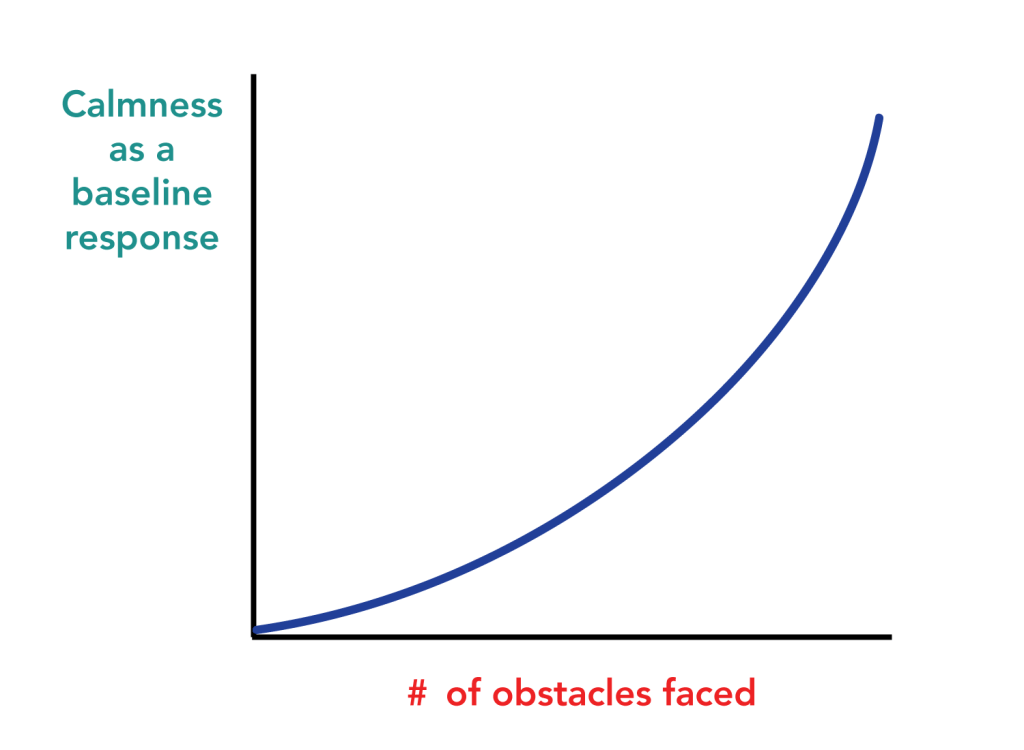
When it comes to overcoming obstacles, however, I feel that there’s an inverse of this: a law of increasing marginal utility. With each obstacle you overcome, the utility comes in the form of a lesson you can import into the next obstacle you face. And once you overcome that one, the utility gained has a compounding effect that takes all the prior lessons into account as well.
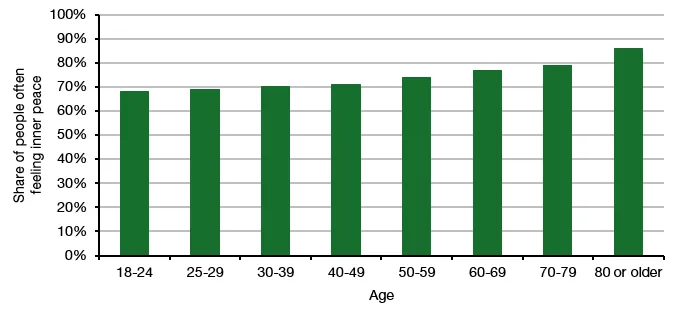
A group of researchers piggybacked on the Global Flourishing Survey, which asked more than 200,000 people in 22 countries over five years to rate how they feel about several aspects of life. One item was the question: “In general. How often do you feel you are at peace with your thoughts and feelings?”
Knowledge of the world (through screens and images) vs. experiencing the world in-person:
“It feels as if the whole world has been transformed into images of the world, and has thus been drawn into the human realm, which now encompasses everything. There is no place, no thing, no person or phenomenon that I cannot obtain as image or information. One might think this adds substance to the world, since one knows more about it, not less, but the opposite is true: it empties the world, it becomes thinner. That’s because knowledge of the world and experience of the world are two fundamentally different things. While knowledge has no particular time or place and can be transmitted, experience is tied to a specific time and place and can never be repeated. For the same reason, it also can’t be predicted. Exactly those two dimensions – the unrepeatable and the unpredictable – are what technology abolishes. The feeling is one of loss of the world.”
We are told to view winning, in sport and in life as: “success must be earned by an effort of willpower, preferably in a triumph over adversity.”
Natural talent conflicts with the consoling fantasy that we live in a meritocracy where hard work always pays off in the end. But it doesn’t. We simply never hear about the thousands of would-be athletes (or business people, or musicians, or inventors) who put in their 10,000 hours but lack the talent to make significant progress.
If people believe, as more and more of them are encouraged to, that their advancement comes 100% from their own merits . . . they can be insufferably smug. Recognizing luck as a factor in success is inherently civilizing.
It can be difficult to accept that we are all, to some degree, victims and beneficiaries of circumstance, but we are. We are misled by histories of great men and women in which it’s implied that each planned his or her ascent meticulously, homing in on success like a soldier finding a flag in an army training exercise.
The origins of success are usually much more subtle and complex. Successful people, by being open to opportunity and exposing themselves to chance, take new directions that prove more fruitful than anyone could have predicted. We change in many ways as we grow. A missed opportunity represents the failure to evolve into a different, better person.
AI may produce faster and more extensive searches and may find correlations that human efforts could not identify in a lifetime, but that’s all still existing information. In short, AI has no creative capacity. It cannot “think” of anything new, unlike humans who create new formulas and works of art routinely. AI is not “intelligent” or creative. It’s just fast.
In a recent experiment, a supercomputer and a group of first grade children were given a ruler, a teapot and a stove and asked to draw a circle. The computer “knew” that the ruler was a draftsman’s tool not unlike a compass and promptly tried to draw a circle with a ruler. It failed. The children glanced at the teapot, saw that the bottom was round and used it to trace perfect circles.
AI will never be superintelligent, expenditures have hit the wall of diminishing returns, AI offers no creativity at all (just fast searches), and children can outperform the fastest machines when the task calls for intuition. Is the frenzy about to hit the wall?
There are some encouraging solutions that may allow AI to add value beyond robotics and fast processing. One of these is the use of small language models (SLMs) instead of LLMs.
Unlike LLMs, which troll the entire internet or large subsets, SLMs contain far less data and are curated by subject matter experts to be tailored to specific tasks. One difference between SLMs and LLMs is the number of parameters that the model is trained on. SLMs can run faster on far less energy. They can also be scaled more easily for smart phones and other applications like self-driving cars and household appliances.
A higher price to earnings ratio (CAPE) means a country’s stock market is more expensive. A lower number is less expensive.
United States Stock Market: 38
Average of Foreign Developed Stock Markets: 20
Average of Foreign Emerging Stock Markets: 17
The rankings below show the price you are paying for the earnings, dividends, cash flow and book value for the companies within these countries.
*Abbreviations:
CAPE: Cyclically Adjusted Price Earnings – a valuation measure that uses real earnings per share (EPS) over a 10-year period to smooth out fluctuations in corporate profits that occur over different periods of a business cycle.
CAPD: Cyclically Adjusted Price Dividends – a valuation measure that uses dividends over a 10-year period to smooth out fluctuations in corporate profits that occur over different periods of a business cycle.
CAPCF: Cyclically Adjusted Price Cash Flow – a valuation measure that uses cash flow over a 10-year period to smooth out fluctuations in corporate profits that occur over different periods of a business cycle.
CAPB: Cyclically Adjusted Price Book – a valuation measure that uses book value over a 10-year period to smooth out fluctuations in corporate profits that occur over different periods of a business cycle.
Does Time Seem To Be Flying By? There Are Ways To Slow It Down. Exposure to variety in your life creates memories, which in turn makes time seem to pass slower because there is more to look back on. For children, fresh experiences and “firsts” are a natural part of everyday life — losing that first tooth, first day of school, first bicycle. This constant stream of new occurrences stretches the passage of time in a young mind.
Older adults, on the other hand, often slip into predictable patterns where days differ only by the calendar date. With scant new memories being formed between existing time markers like birthdays and holidays, Christmas seems to roll around quicker each year.
So as simple as it sounds, if you want time to slow down, the key is to intentionally introduce more novel experiences into your daily routine. Researchers divide these into two categories:
Distinct novelty. Taking a trip to somewhere you have never been fires a whole different system in your mind that preserves all the details like a high-resolution photo, creating vivid memories you recall for years to come. Your brain’s reaction is, “This looks important. I’d better save all of this!”
Common novelty. You decide to try a different restaurant in your neighborhood instead of the ones you normally frequent. It’s new but related to something you already know, so the impression is not particularly powerful.
__________________________
Typically, what you find in highly successful people is that an addiction to work is, in fact, based on an inchoate belief that love from others—including spouses, parents, and friends—can be earned only through constant toil and exceptional merit.
Why might someone fall prey to such an erroneous belief? It could be the way you were raised. Workaholic parents tend to have workaholic kids. If you grow up seeing adulthood modeled by people who work all hours and are rarely home, you can be forgiven for regarding this as appropriate behavior for a responsible spouse and parent. This is at least partly the same mechanism behind the fact that you are much likelier to become an alcoholic if you were raised by one.
Researchers have also shown that when parents express love for a child in a conditional way based on the child’s behavior, that person is likely to grow up feeling that they deserve love only through good conduct and hard work. This might sound as though I’m describing terrible parents, but I don’t mean to do so at all; well-intentioned parental encouragement can be heard by a child as a message about their worthiness.
Michelob Ultra has become king of the hill among beer brands. By topping the sales by volume charts for 2025, it has ousted Modelo Especial as America’s best-selling beer.
While its lower caloric content certainly appealed to many people, some of Michelob Ultra’s success can also be credited to aggressive marketing campaigns, which helped the brand gain notoriety at major sporting events like the FIFA Club World Cup, NBA games, and the PGA tour. That falls in line with Michelob Ultra’s focus on folks with active lifestyles.
More people are seeing Michelob Ultra on tap. The new top dog surpassed its sister brand, Bud Light, in bar and restaurant presence in December 2024. Michelob Ultra’s upsurge in popularity happened at a relatively quick pace; the brand has flourished by 15% since 2020. That equates to a 2% hold over the entire beer market in that time frame.
___________________________
A.I. investors shouldn’t swim upstream, but fish downstream: companies whose products rely on achieving high-quality results from somewhat ambiguous information will see increased productivity and higher profits. These sectors include professional services, healthcare, education, financial services, and creative services, which together account for between a third and a half of global GDP and have not seen much increased productivity from automation. AI can help lower costs, but how individual businesses incorporate lower costs into their strategies—and what they decide to do with the savings—will determine success. To put it bluntly, using cost savings to increase profits rather than grow revenue is a loser’s game. The companies that will benefit most rapidly are those whose strategies are already conditional on lowering costs.
With A.I., knowledge-intensive services will get cheaper, allowing consumers to buy more of them, while services that require person-to-person interaction will get more expensive, taking up a greater percentage of household spending. This points to obvious opportunities in both. But the big news is that most of the new value created by AI will be captured by consumers, who should see a wider variety of knowledge-intensive goods at reasonable prices, and wider and more affordable access to services like medical care, education, and advice.
There is nothing better than the beginning of a new wave, when the opportunities to envision, invent, and build world-changing companies leads to money, fame, and glory. But there is nothing more dangerous for investors and entrepreneurs than wishful thinking. The lessons learned from investing in tech over the last 50 years are not the right ones to apply now. The way to invest in AI is to think through the implications of knowledge workers becoming more efficient, to imagine what markets this efficiency unlocks, and to invest in those. For decades, the way to make money was to bet on what the new thing was. Now, you have to bet on the opportunities it opens up.
_________________________
There is a consistent doom-and-gloom forecast that within 18 months A.I. software will make human capabilities worthless. The far more significant crisis is precisely the opposite. Young people are already degrading their cognitive capabilities by outsourcing their minds to machines long before software is ready to steal their jobs.
Many recent articles have loudly proclaimed what most people were already thinking: Everybody is using AI to cheat their way through school. By allowing high school and college students to summon into existence any essay on any topic, large language models have created an existential crisis for teachers trying to evaluate their students’ ability to actually write, as opposed to their ability to prompt an LLM to do all their homework. Massive numbers of students are going to emerge from university with degrees, and into the workforce, who are essentially illiterate.
The demise of writing matters, because writing is not a second thing that happens after thinking. The act of writing is an act of thinking. Students, scientists, and anyone else who lets AI do the writing for them will find their screens full of words and their minds emptied of thought.
As writing skills have declined, reading has declined even more. Most of our students are functionally illiterate. Achievement scores in literacy and numeracy are declining across the West for the first time in decades.
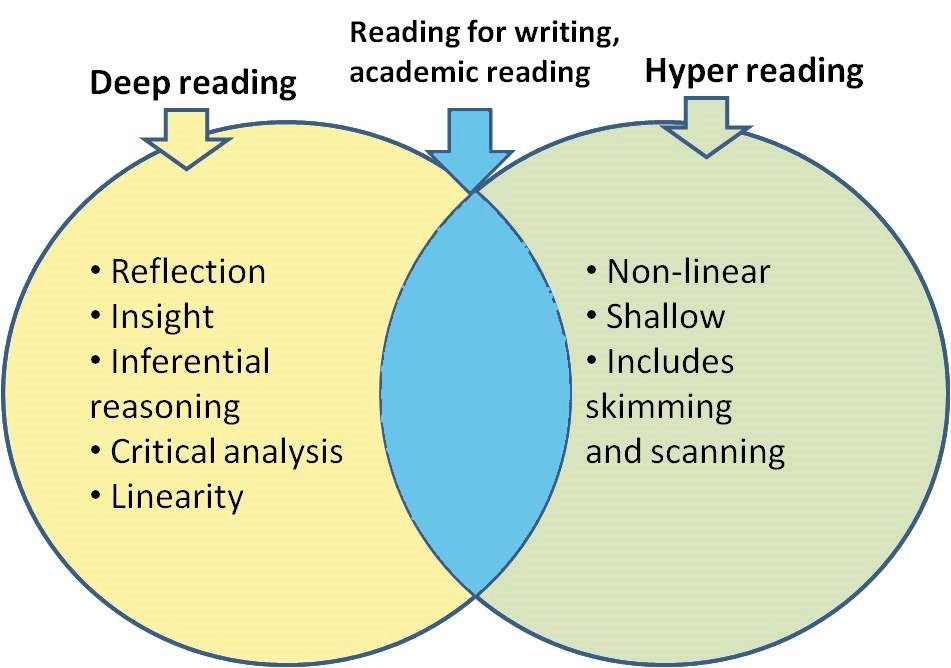
Americans are reading words all the time: email, texts, social media newsfeeds, subtitles on Netflix shows. But these words live in fragments that hardly require any kind of sustained focus; and, indeed, Americans in the digital age don’t seem interested in, or capable of, sitting with anything linguistically weightier than a tweet. The share of Americans overall who say they read books for leisure has declined by nearly 50 percent since the 2000s.
Even America’s smartest teenagers have essentially stopped reading anything longer than a paragraph. Students are matriculating into America’s most elite colleges without having ever read a full book. High schools have chunkified books to prepare students for the reading-comprehension sections of standardized exams.
A.I. related stocks have accounted for 75% of S&P 500 returns, 80% of earnings growth and 90% of capital spending growth since ChatGPT launched in November 2022. Data centers are eclipsing office construction spending and are coming under increased scrutiny for their impact on power grids and rising electricity prices.
The biggest medium-term risk I can think of for top heavy US equity markets: China’s Huawei and SMIC pierce the $6.3 trillion NVIDIA-TSMC-ASML moat by creating their own supernode computing clusters and deep-ultraviolet lithography machines of comparable quality.
Oracle’s stock jumped by 25% after being promised $60 billion a year from OpenAI, an amount of money OpenAI doesn’t earn yet, to provide cloud computing facilities that Oracle hasn’t built yet, and which will require 4.5 GW of power (the equivalent of 2.25 Hoover Dams or four nuclear plants), as well as increased borrowing by Oracle whose debt to equity ratio is already 500%. In other words, the tech capital cycle may be about to change.
__________________________
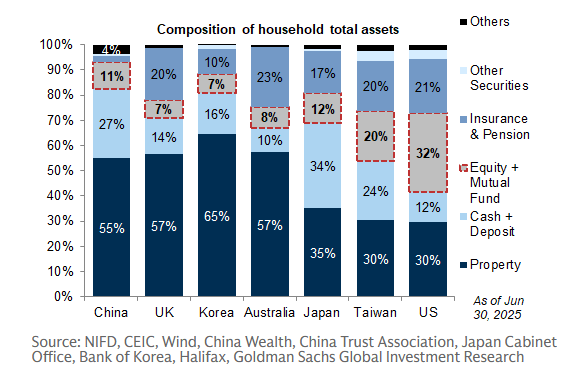
This is a fascinating look at how foreign households invest. I had no idea U.K. residents had such a low percentage of their personal investments in stocks, and the amount Japanese citizens hold in cash (which has provided no interest/return for decades) is incredible.