The graphs below show the price-to-book ratio on the y-axis and the Shiller Price to Earnings CAPE ratio on the x-axis. The higher the numbers (moving the plot point up and to the right), the more expensive/overvalued the country’s stock market.
Today most of the world stock markets are relatively inexpensive or fairly valued, especially compared to the United States and India which have moved off the chart toward outer space overvaluation levels.
The US market is currently trading 31% higher than in the period 1995-2024. In contrast, Emerging America, Developed Asia and Emerging Asia are attractive, trading 29%, 21% and 7% below their historical valuation averages.
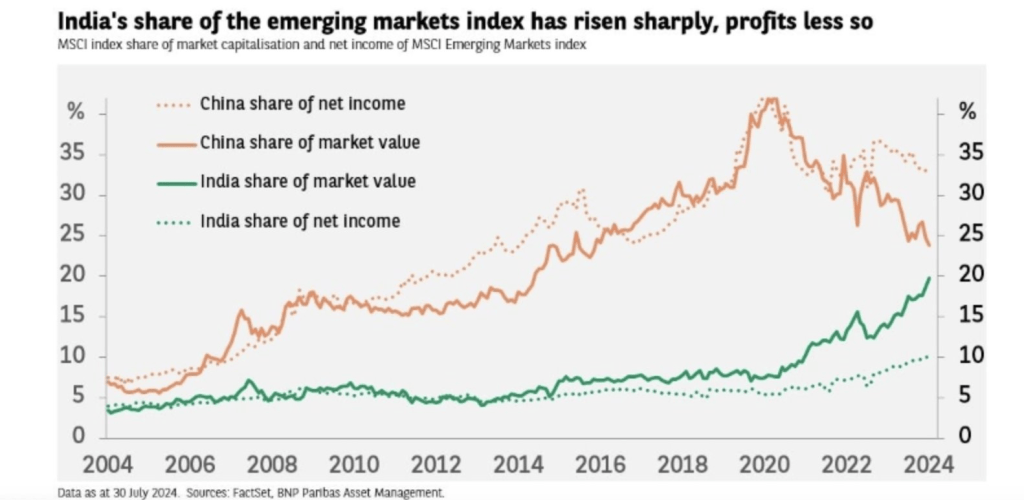
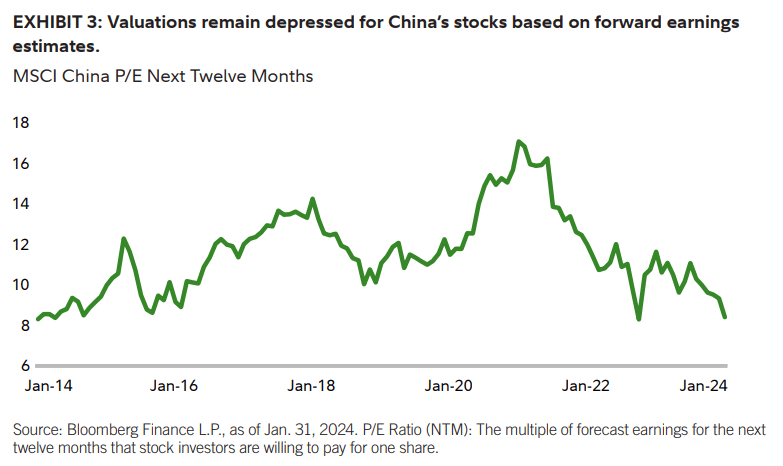
China and India have been oppositive stories since 2020 in terms of their stock prices (dark lines) and their net income (dotted lines):
New studies are showing that more money provides higher levels of happiness, even for the ultra-wealthy. A famous 2010 paper by Kahneman and economist Angus Deaton that said happiness tends to go up with incomes until about $60,000 to $90,000 a year, at which point it flattens. Kahneman and Killingworth reanalyzed that work and found the correlation between money and happiness extended to people with salaries up to at least $500,000 a year. The new research, which is being self-published by Killingsworth, found people with a net worth in the millions or billions reported an average life satisfaction rating between 5.5 and 6 out of 7, compared to a rating of about 4.6 for those earning around $100,000 a year and just above 4 for those earning about $15,000 to $30,000 a year. That makes the difference in happiness between the richest and middle-income groups almost three times larger than the difference between middle- and low-income groups.
The life secret Jerry Seinfeld learned decades ago: “The only thing in life that’s really worth having is good skill. Pursue mastery that will fulfill your life.” This thought stemmed from an edition of Esquire magazine in the late 1980’s that was so popular it inspired books to be written about it. These are the key takeaways from that article.
___________________________
Habits determine a future more than goals. If a child comes to class every day properly prepared, asks questions or attends extra help, does their homework, and refrains from most distractions regarding discovering the opposite sex, the grades will take care of themselves.
___________________________
Lyn Alden discusses how Fed interest rate cuts may impact the economy and financial markets moving forward: The fact that the U.S. was 1) running larger fiscal deficits than its peer countries and 2) had a private sector with more locked-in fixed rates than its peer countries, made it more de-sensitized to this global cycle of rising interest rates than its peer countries. In the downcycle, we could see exactly the reverse. As multiple countries cut interest rates, the countries that have private sectors with more variable-rate debt can get a consumer and corporate stimulus more readily from those lower rates, while the U.S. economy already has most of its private debt fixed at lower rates and wouldn’t get much of a stimulus from a moderate cut in interest rates. Emerging markets could benefit the most, from the starting position of significant weakness.
A higher price to earnings ratio means a country’s stock market is more expensive. A lower number is less expensive. It’s the price you are paying for the earnings of the companies.
Average of Foreign Developed Stock Markets: 20 Average of Foreign Emerging Stock Markets: 15
We are being A/B tested into a world of commoditized content. Things look the same and sound the same because they basically are the same. It’s digital déjà vu on a massive scale and it’s only going to get worse. I promise you that all those stories about young millionaires and overnight crypto fortunes are not meant to make you feel good. They are meant to create anxiety. It’s no wonder why we’ve seen a rise in financial nihilism among young people. When the mainstream media convinces you that you are doing badly financially, you may come to believe it. Of course, there are some people that are truly struggling, but there are far more who are influenced to think they are.
Greed, in all of its forms — greed for life, for money, for love, for knowledge — has marked the upward surge of mankind.There is never enough life, enough love, enough knowledge, enough money, and don’t let anyone tell you otherwise. That’s the leper’s bell of a second-rate intellect approaching. Don’t ever let anyone tell you should be satisfied with what you have, at any age or stage of your life. If you’re not going forward, if you’re not constantly challenging yourself, you’re going backwards. Never get comfortable. Never get complacent. And the most important decision you will ever make in your life is what to do with the next 24 hours.
U.S. stocks have destroyed foreign market over the last 16 years and that trend has continued in 2024. If you look at 1900 through 2010, the U.S. and the rest of the world were essentially equal in percentage returns (with rotating cycles where one would outperform the other). Is it time for the rest of the world to catch up?
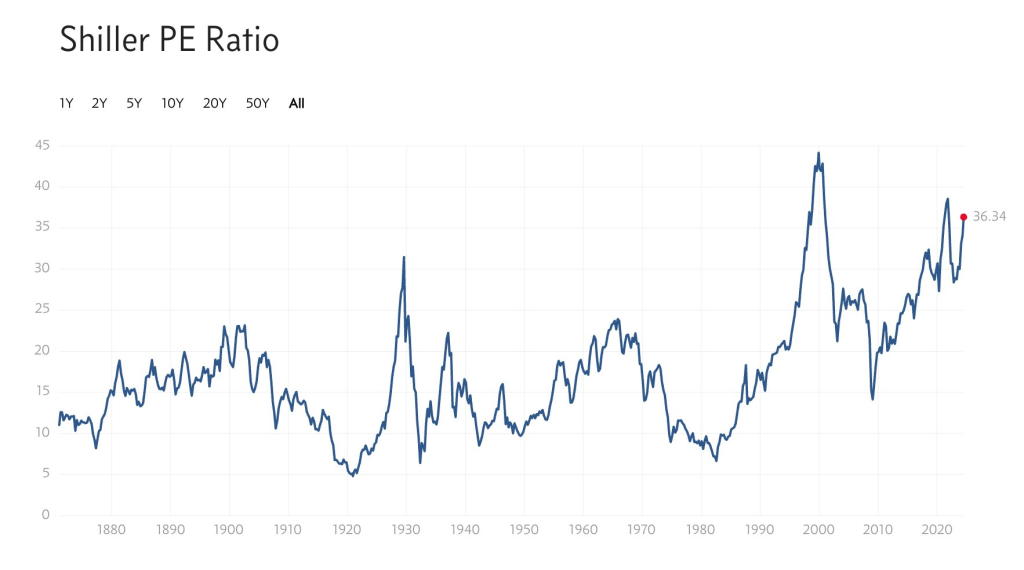
The Shiller price to earnings ratio has crossed back above 36 for U.S. stocks. Stocks are considered more expensive when this number moves higher (you are paying a higher price for company’s earnings). The market is closing in on the 2021 bubble peak of 38 and the all-time bubble peak of 44 back in March of 2000.
Social media the “ultra-processed food” equivalent of media content. This analogy between food and media is useful because it helps us better understand responses to the latter. In the context of nutrition, we’re comfortable deciding to largely avoid ultra-processed food for health reasons. This is how we should think about the ultra-processed content delivered so relentlessly through our screens. To bypass these media for less processed alternatives should be seen as a move toward a self-evidently healthier relationship with information.
_____________________________
How to behave online: 84 new rules. We spend more time online today than ever before. Our digital lives are inextricably intertwined with our offline ones, to the point that the mere idea of “spending time online” actually seems dated, a phrase that would get you slapped with an “OK Boomer” if that hadn’t already entered the meme dumpster. We don’t spend time online anymore. We simply are online, all the time. The problem is, we still don’t always know how to act.
While our stocks may be worth more in America,European citizens are much healthier than Americans; physically and mentally. Anyone who doesn’t see that Europe is so much culturally richer, and healthier, than the US is missing that culture is fundamentally about communities, and the social. It’s about the work/life balance. About third spaces that encourage being around people, in a way that’s deeper than a brutal transactionalism. U.S. is about the individual, to a hyper degree. Everyone is so focused on being emancipated from everything, freed from any “outdated” obligations, that they end up in an empty loneliness.
_______________________________
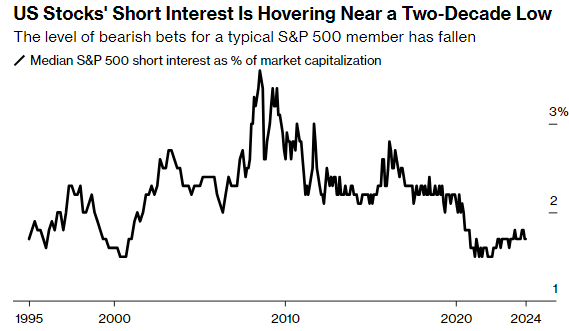
Wall Street seems calm. A closer look shows something more dangerous is lurking under the surface. The risk to investors is that stocks will again begin to move in the same direction, all at once — most likely because of a spark that ignites widespread selling. When that happens, some fear, the role of complex volatility trades could reverse and, rather than dampen the appearance of turbulence, exacerbate it.
If you zoom out and look at the rest of the world, the concentration is significantly higher in many other markets. This is of interest to me because the majority of my stock market portfolio is in stocks outside the United States. I own value funds that have little exposure to these larger (more expensive) companies that dominate their country’s market, but the concentration is worrisome because selloffs tend to drag everything down together. If the big boys fall, they can bring the smaller stocks down with them.
Throughout history happiness for most people followed a U-shaped curve. They were happy in their youth, became less happy during middle age, then became happy again in the later years of life.
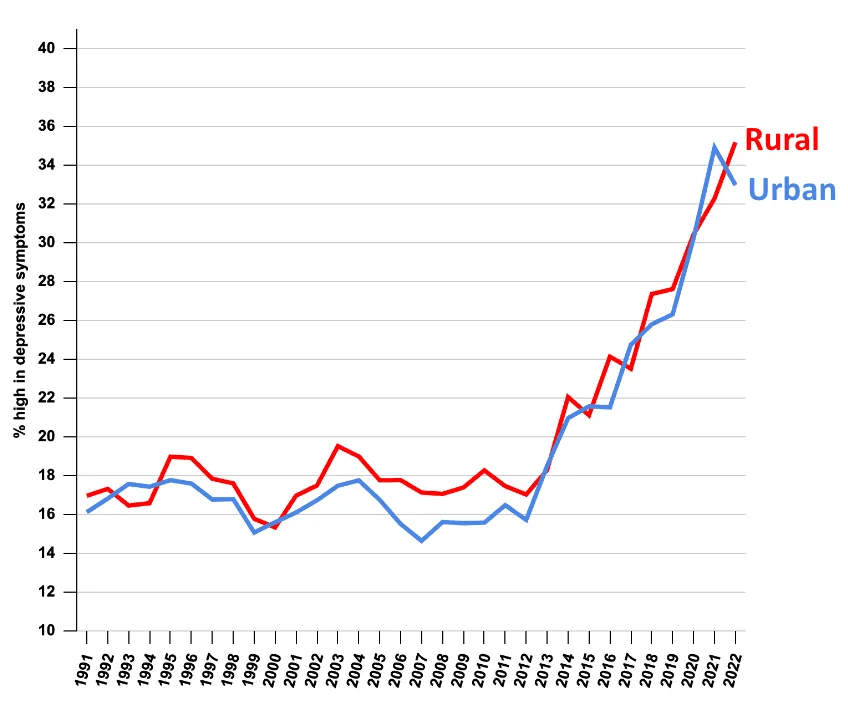
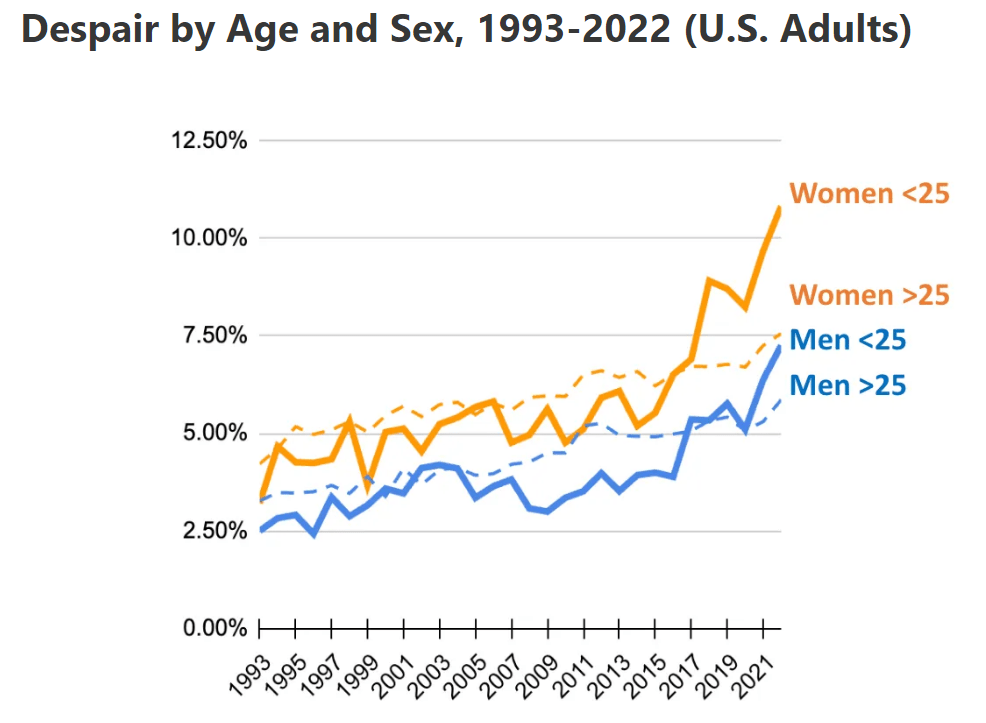
Between 1993 and 2016, despair was hump-shaped in age. The rapid rise in despair before the age of 45, and especially before the mid-20s, has fundamentally changed the lifecycle profile of despair such that the hump shape is no longer apparent.
U.S. stocks have crushed the rest of the world over the last 15 years. However, betting on the U.S. from where we are today is effectively a bet on a repeat performance from the Magnificent Seven because, when they’re excluded, there’s nothing extraordinary about US stocks these past 15 years. And an encore is unlikely.
U.S. stock buybacks are back. Analysts at Goldman Sachs project that total S&P 500 repurchases will reach $925 billion this year and $1.075 trillion in 2025, which would mark annual growth rates of 13% and 16%, respectively.
The top 20 PINs (out of 10k) constitute 27% of all PIN numbers.
Birth years are common… you can see the 2000s start to take off