Self-Defeating Prophecy: A prediction causes behavior that prevents it from coming true.
The Taco (Trump Always Chickens Out) trade logically follows: whenever President Trump announces something that causes markets to swoon, buy during the fainting spell and wait for the clucking sound to emerge from the White House.
It all makes sense until you start to pull on the loose end of the logical thread. Why did Trump chicken out? Because the markets panicked when he announced a dramatic act of self-harm. But the fact that the markets were so alarmed in early April suggests that they weren’t really swallowing the Taco hypothesis.
Then came May; US equity markets had a great month despite the prospect of Trump’s 90-day “pause” expiring soon, the random imposition of further tariffs and the unsettling new prospect that Congress planned to give the administration powers to levy taxes on selected foreign investors at will. Perhaps the markets had finally digested the truth about Taco?

Which raises the possibility that the Taco trade will eat itself. The markets could become overconfident, taking Trump neither literally nor seriously. The market ignores him.
Then the next step: the horrifying realization that since the market has not blinked, Trump is not actually planning to chicken out. The step after that? The market will belatedly plunge, Trump will belatedly chicken out and the markets will be saved — until the next time.
If that isn’t enough to send you into a spin, consider this: perhaps Trump’s pride will be so wounded by all the Taco talk that he will stop chickening out altogether.
This spiraling chain reaction may all seem like an Escher fever-dream, but the underlying point is simple and could come from a Greek tragedy: when you try to predict the future, you risk changing it.
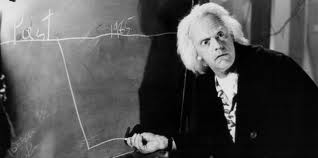
This effect is at work in any financial market. Everyone who successfully spots a bargain contributes to that bargain vanishing. The same dynamic is at play any time you try to decide which line to join at a supermarket or at passport control: once everyone has rushed to join the shortest line, it is no longer the shortest.
One notorious example from the history of computing is the “Osborne Effect”, named, perhaps unfairly, after the shortlived Osborne Computer Corporation. In the early 1980s, Osborne made an early and enormously covetable portable computer, but went bankrupt after prematurely announcing that new and better models were on the horizon. Demand for Osborne’s inventory is said to have collapsed because customers were waiting for the improved product to arrive.
This interacts with the preparedness paradox: the better you prepare for a problem, the more it seems that you were being silly because there was never a serious problem in the first place. From pandemic surveillance to nuclear deterrence, it can be hard to distinguish a far-sighted policy from a foolish waste.
Consider vaccination. Successful vaccination campaigns make common illnesses seem rare — giving credence to those who suggest vaccination is a needless risk. Global agreements to restrict CFC gases have helped the ozone hole to heal — and now, of course, there are people on social media asking why everyone lost their minds about an environmental problem that was so fleeting. While we’re on the subject, why do they waste all that money having guards at Fort Knox anyway? Everyone knows that place has never been robbed.
Even setting aside bad logic and bad faith, it is not easy to think clearly about the future. Serious forecasts, the ones that aim to be more than snack food for the mind, aim to change our understanding and therefore our actions. If they change our actions, they are changing the very future they hope to describe.
__________________________
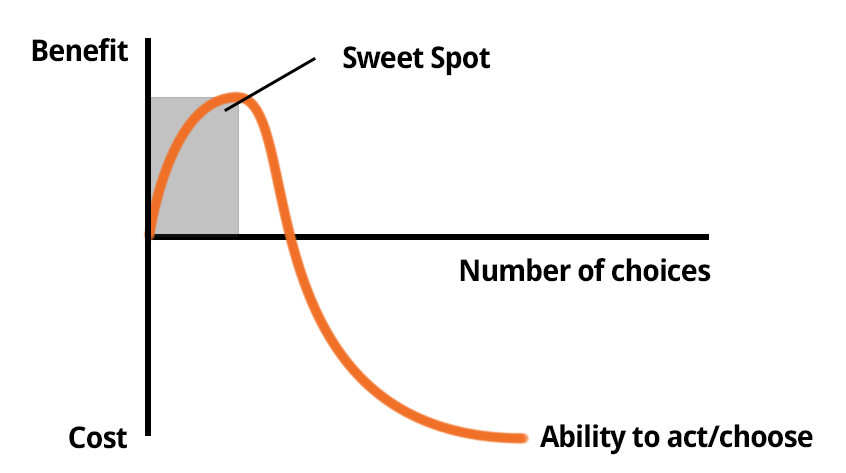
The “paradox of choice” refers to the phenomenon where having many options to choose from can lead to decreased satisfaction and make it harder to make a decision.
A study of online daters in Canada tested the idea that using the apps would make dating more efficient. Instead, researchers discovered people spent far more time on the apps looking for potential mates. With hundreds of different options to filter through — age, height, interests, etc. — there was a paralysis by analysis that overwhelmed users and caused them to second guess the choices they did make.
And the people who did find lots of matches were less likely to make a lot of selections because they were less satisfied from outsized expectations. With so many profiles to choose from, people tend to focus on the most superficial traits, meaning they were less committed to the people they were matched up with. That’s why so many of the relationships formed on the dating apps are short-term in nature.
_____________________________
Walking won’t solve everything. But it won’t make anything worse. That’s more than you can say for most things we do when we’re stressed, tired, or lost. You walk to get out of your head. To breathe. To let your mind drift without crashing. You don’t walk to fix the problem—you walk because you need space from it. The world doesn’t look so cruel when you’re moving through it one step at a time. You notice things. You remember you’re alive. So when in doubt—go for a walk.

______________________________
In recent years, some researchers completed a 70-year long study on happiness. They took a graduating class from Harvard, and measured every aspect of their lives. What types of jobs they got, what their politics were, how many kids they had, where they lived—even the length of their scrotums!
They were trying to find what behaviors or characteristics had the highest correlation with self-reported happiness. You know what they found out? Nothing! After 70 years, they never got to the bottom of it.
But they did find out one interesting thing—the people in the study who reported the lowest levels of happiness reported the highest levels of alcohol consumption. We don’t know what makes people happy, but we know what makes them unhappy—alcohol! I’m not talking about the occasional drink at a party—I’m talking about alcohol abuse. Did you know that 10% of people consume 60% of all alcohol? Found that out recently.

_______________________________

________________________________
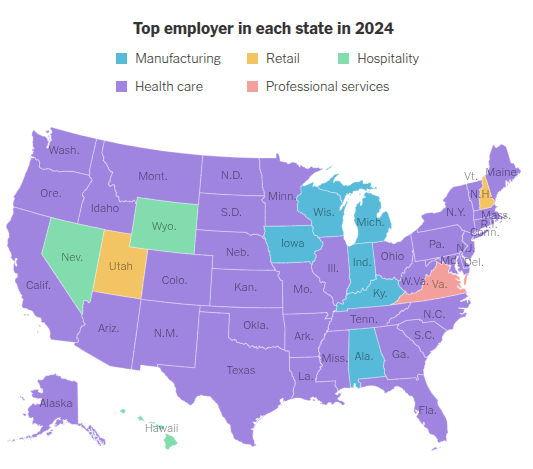
How Health Care Remade the U.S. Economy. For years, the United States labor market has been undergoing a structural transformation. As jobs in manufacturing have receded, slowly but steadily, the health care industry has more than replaced them.


___________________________
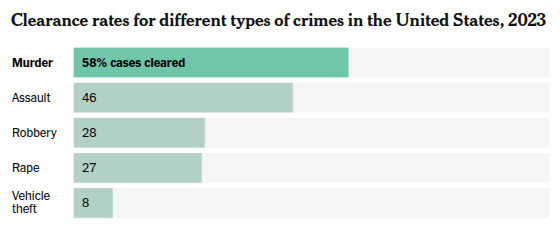
In the United States, people often get away with murder. The clearance rate — the share of cases that result in an arrest or are otherwise solved — was 58 percent in 2023, the latest year for which F.B.I. data is available. And that figure is inflated because it includes murders from previous years that police solved in 2023.
In other words, a murderer’s chance of getting caught within a year essentially comes down to a coin flip. For other crimes, clearance rates are even lower. Only 8 percent of car thefts result in an arrest.
___________________________
In a recent interview, Dwarkesh asked legendary bio-researcher George Church for the most under-hyped bio-technologies. His answer was both surprising and compelling:
What I would say is genetic counseling is underhyped.
What Church means is that gene editing is sexy but for rare diseases carrier screening is cheaper and more effective. In other words, collect data on the genes of two people and let them know if their progeny would have a high chance of having a genetic disease. Depending on when the information is made known, the prospective parents can either date someone else or take extra precautions. Genetic testing now costs on the order of a hundred dollars or less so the technology is cheap. Moreover, it’s proven.

____________________________
Hot tubs vs saunas: Study finds which offers greater health benefits.
The winner? Hot water immersion. Among young, healthy adults, soaking in hot water triggered the strongest responses across the board, helping the body regulate temperature, boost circulation, and even enhance the immune system more effectively than either sauna style.

____________________________
Recent good news on the cancer front is everywhere, if you know where to look. In June 2025, a French study compared data from all patients diagnosed with lung cancer in public hospitals in France in 2020 with data from similar studies performed in 2000 and 2010. Researchers found that the three-year survival rate for lung adenocarcinoma rose from about 16 percent in 2000 to about 39 percent in 2020, thanks to both earlier diagnosis and better targeted treatment. That means lung cancer survival rates have more than doubled in this century alone.

_____________________________
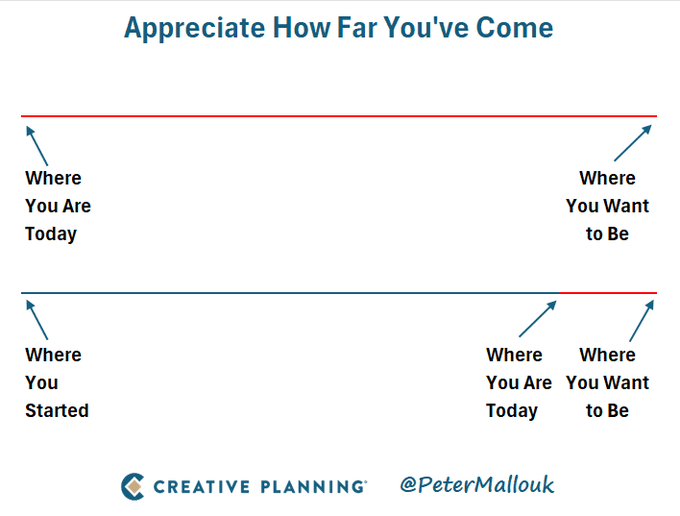
All of us are really good at measuring the gap between where we are and where we want to be, but make sure to pause occasionally and appreciate how far you’ve come.
 Tuna Thoughts