The ultimate success metric is whether you get what you want out of life. But that’s harder than it sounds because it’s easy to try to copy someone who wants something you don’t. It’s possible to be humble and learn from other people while also recognizing that the best strategy for you is the one closest aligned with your unique personality and skills.
________________________
Some thought-provoking examples of our perception of time and why slowing some things down is not only important but may actually make them better. If you give an engineer a train ride and say, “make it better,” they will look for options on how to make the trip shorter, a faster commute. If you give a train ride to Disney, they will say “how can we make this train ride more enjoyable and fun for the passengers?”
The speedometer below shows how many minutes it takes to arrive somewhere based on your speed. You can see that at the beginning, the value of going faster is enormous. As you hit about 65 miles per hour, the value falls off a cliff while the danger of increasing your speed rises exponentially.

____________________________
In the digital thunderdome of LinkedIn hustlers, Twitter thread bros, and Instagram “success stories,” there’s a piece of advice I continue to see shared, repackaged in various forms but always carrying the same core message: surround yourself with the most ambitious and successful people you can find.
But following this advice there’s a risk that goes unspoken, especially for people susceptible to gurus in the first place. It’s the danger of losing yourself. In a desperate bid to absorb ambition and catch the same waves as high achievers, you risk becoming a satellite: a small, rotating body constantly reflecting the light of someone else’s star, but never finding the space to let your own light shine. The cult of personality in our world is real, and many are essentially just part of a kind of self-worth Ponzi scheme.
______________________________
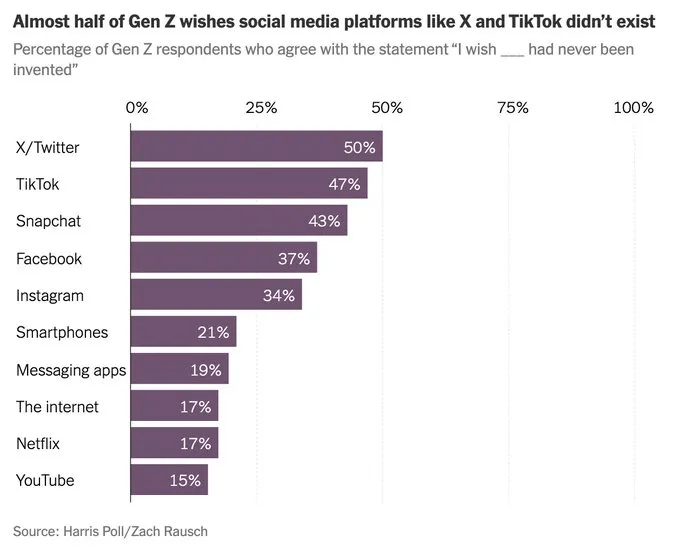
This poll reads like a group of people that have been on drugs for a long time, know they’re awful, but cannot stop using them:
_______________________________
People are biased towards solving problems through addition rather than subtraction. The reason? Because adding something makes you feel like you are advancing, while taking something away makes you feel like you are retreating. We see this dynamic across all parts of the economy, and society at large. the case can be made that we live in an era of too much. Too much information, too much stuff, too many choices, and too many distractions. As a result, there is a good chance that the path to happier lives and investment portfolios performance, might start by taking things away.

_______________________________
Should Europeans put 72% of their portfolios into 1 foreign country? Obviously, the same question should be asked of Americans, even though they live in that country. As of September 2024, the U.S. represents 72% of the MSCI World Index. Many passive investors simply buy into this widely adopted benchmark, but is that a prudent approach?



____________________

 Tuna Thoughts